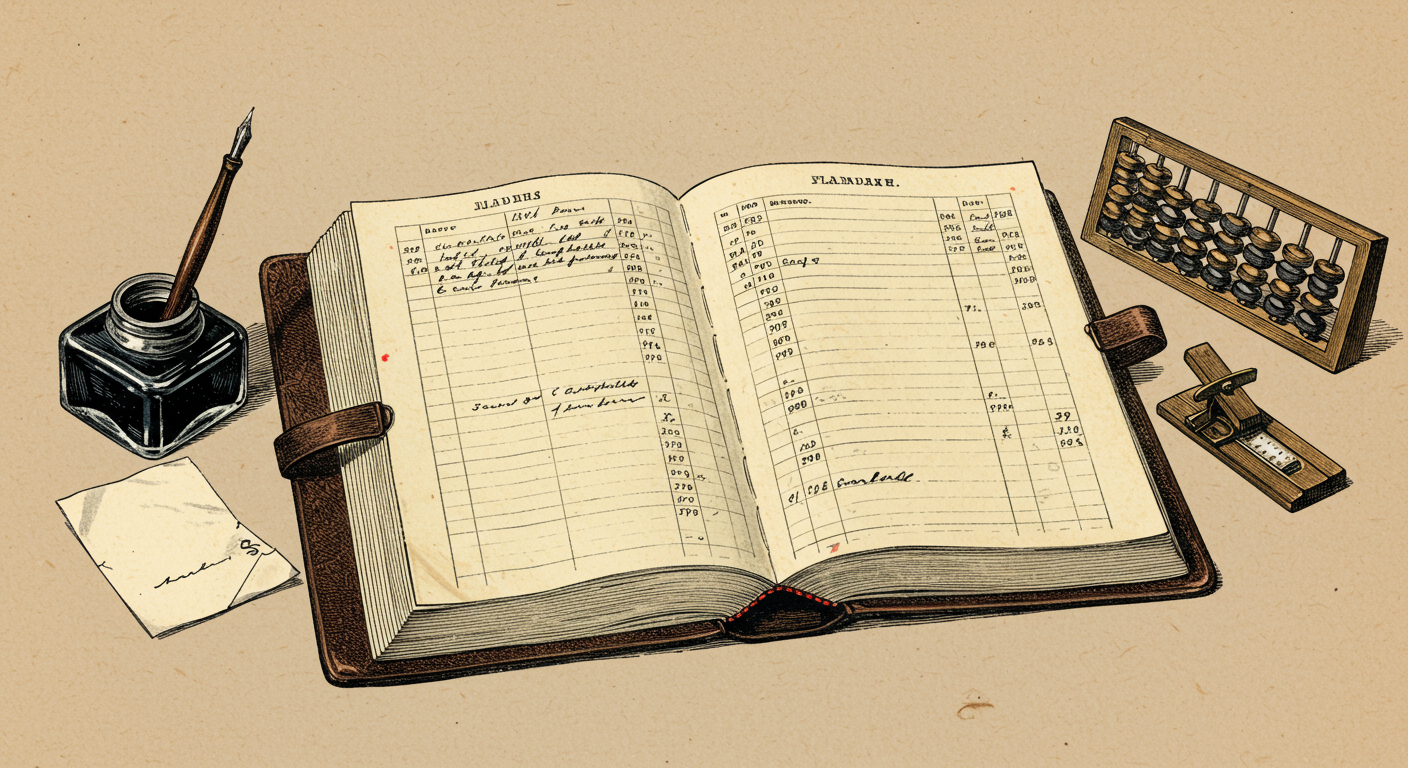
The reigning style of writing about contemporary AI is to treat it as historically unprecedented — a thing without antecedents, requiring fresh categories, demanding that previous diffusions of general-purpose tools be set aside as so much consoling nostalgia. The trouble with treating a thing as unprecedented is that one then has no instruments for reasoning about it except the ones the moment hands over, and the moment, in the way of all moments, hands over instruments of an exceedingly indifferent calibration.
This post takes the opposite line. The 1979-1992 diffusion of the electronic spreadsheet — VisiCalc on the Apple II, Lotus 1-2-3 on the IBM PC, Microsoft Excel arriving on the Macintosh and then, decisively, on Windows — is the closest historical parallel to the 2022-2026 diffusion of AI, and reading the two together illuminates a great deal of what is and is not likely about the AI labour-displacement story going forward. The parallel is not exact; no historical parallel ever is. But the structural shape — a single capable application, an early adopter class who immediately understood what it was for, a fourteen-year arc from invention to ambient-infrastructure ubiquity, a labour transformation that compressed one category of work and expanded another — is the shape that I take to be repeating now, at a faster pace and across a broader population of professions.
What follows is a reading of the spreadsheet’s arc, of the labour transformation it produced, of the structural parallels with the AI diffusion now under way, of the places the parallel breaks, and of what the historical record supports the parallel claiming and does not.
The Spreadsheet’s Arc
The electronic spreadsheet’s history has the unusual property of being short, well-documented, and almost entirely contained within a single fourteen-year window. The arc has three named protagonists.
VisiCalc appeared in 1979. Dan Bricklin, then a Harvard Business School student watching his finance professor make corrections to a paper spreadsheet on a chalkboard and propagate them by hand down the columns, conceived of the application that would do the propagation automatically; Bob Frankston, a friend at MIT, wrote the implementation. The first version shipped for the Apple II in October of that year, retailed at a hundred dollars, and produced a particular and surprising commercial effect: it sold not the spreadsheet but the computer. Accountants and small-business owners who had no other use for a personal computer bought the Apple II in order to run VisiCalc — by some accounts over a quarter of 1979 Apple II sales were VisiCalc-driven — and the Apple II, which had been a hobbyist’s machine, became the machine that a profession had decided it needed. The phrase killer application was coined to name what VisiCalc had done to the Apple II. One application drove the platform.
Lotus 1-2-3 appeared in 1983. Mitch Kapor’s company shipped the second-generation spreadsheet for the IBM PC, integrated it with charting and a primitive database, and sold the combination as a single application capable of carrying the full workflow of a corporate financial analyst. By the mid-1980s the IBM PC and its compatibles, with Lotus 1-2-3 running on them, had become the standard corporate computer in the United States. The Lotus moment was the moment the spreadsheet became corporate infrastructure rather than power-user tool. It was also, retrospectively, the moment the personal-computer market wars were over: the IBM-compatible architecture had won, and one of the principal reasons was that the spreadsheet most accountants wanted to use ran on it.
Microsoft Excel appeared in 1985 on the Macintosh and in 1987 on Windows. Excel was the GUI-native spreadsheet, designed from the start for a windowed interface with mouse-driven cell selection, and it arrived at the moment the broader industry was moving from command-line to graphical computing. Through the late 1980s Lotus 1-2-3 remained the corporate-standard application on DOS, but the platform shift to Windows pulled Excel along with it. By 1993 Excel had overtaken Lotus 1-2-3 in unit sales, and by the mid-1990s had displaced it from the corporate desktop more permanently. From the mid-1990s onward, the question of which electronic spreadsheet to use was, for all practical purposes, settled. Excel was the spreadsheet, in the way that English is the language, by being the one everyone else already had.
The fourteen-year arc from VisiCalc’s October 1979 release to Excel’s mid-1990s dominance covers, in compact form, every phase a general-purpose tool goes through on its way to becoming infrastructure: invention for a power-user audience, corporate-standard form on the dominant platform, GUI-native re-imagining at the platform shift, and ambient-infrastructure ubiquity. The contemporary office worker does not think of themselves as using a spreadsheet in the way the 1981 accountant thought of themselves as using VisiCalc. The application has become invisible at the same rate that it has become universal.
What It Did
The labour-and-economic transformation the spreadsheet produced between roughly 1980 and 2010 is the part of the historical record the AI moment has the most to learn from. It is also the part most often described badly — in either the catastrophist register (“the spreadsheet destroyed the bookkeeper”) or the consoling-platitude register (“technology creates more jobs than it destroys”). The actual transformation was more specific than either.
The category of work the spreadsheet most directly compressed was clerical and bookkeeping employment. US Bureau of Labor Statistics data records that the bookkeeping-and-accounting-clerk occupational category, which by the conventional accounts approached two million workers at its early-1980s peak, declined steadily through the 1990s and 2000s, with the decline accelerating after Excel’s adoption became universal — the BLS series shows roughly 1.7 million in 2021 falling toward 1.6 million by 2024, the contraction still in progress four decades on. The decline was not catastrophic in any single year; it was the steady contraction of an occupational category over thirty years, with new entrants no longer trained into a job that had once required five clerks with paper ledgers and now required one analyst with a spreadsheet.
What grew in the same period — the part catastrophist accounts omit — was the financial analyst category and its adjacent professions. Financial planning and analysis specialists, sales operations analysts, business intelligence analysts, and the broader white-collar function that touches numerical work all expanded substantially over the 1980-2010 window. The expansion was not symmetric with the clerical decline — the analyst category absorbed only a portion of the displaced clerical workforce, and the absorption required upskilling that the displaced workers did not all complete — but the expansion was real, and it was driven by the same tool that had compressed the clerical layer. The spreadsheet made the analyst more productive; the more-productive analyst could carry more interpretive work; the interpretive work expanded into the space the compressed clerical layer had vacated. The net effect was a transformation of the composition of work rather than an evaporation of work.
Three features recur in the AI diffusion now in progress. The first is that the underlying need for financial analysis did not disappear; it expanded. A corporation in 1995 had more spreadsheets, more financial models, and more analytical work in train than the same corporation in 1975 could have produced even in principle. One does not get fewer financial models when modelling becomes cheaper; one gets more of them, and one is expected to have run them.
The second is that the transformation took time. Robert Solow’s 1987 quip — “you can see the computer age everywhere but in the productivity statistics” — was made at exactly the moment when Lotus 1-2-3 had become the corporate standard and the spreadsheet was already in heavy use across American offices. The measured productivity gain from information technology did not begin to appear in the macroeconomic data until the mid-1990s, more than a decade after general adoption. The lag reflected the time required for organisations to reorganise their workflows around the new capability.
The third is that the professions the spreadsheet most transformed were not the ones that immediately recognised themselves as targets. The 1979 accountant looking at VisiCalc saw a tool that would help him do his existing job faster; neither he nor his employer predicted that the tool would compress the clerical layer below them and expand the analytical layer above them. The shape of professions changed in ways the professions themselves only recognised retrospectively, after the change was substantially complete.
The Parallel
The AI diffusion now in progress — ChatGPT’s public release in November of 2022, the rapid succession of GPT-4, Claude, and Gemini through 2023 and 2024 and 2025, the coding-assistant and agent tools that have become standard in the same period — has structural features that map onto the spreadsheet diffusion at a level difficult to dismiss as coincidence.
There is, in the first place, the same single capable application moment at the start. VisiCalc demonstrated, on a platform that had been a hobbyist’s curiosity, that a new general-purpose tool was possible; ChatGPT demonstrated the same thing on a research-laboratory technology that had been an academic curiosity to most of its eventual audience. The 1979 accountant and the 2022 knowledge worker both had the same moment of recognition — this is for me, and I am going to use it.
There is, in the second place, the same power-user-to-everyone curve. VisiCalc was an accountant’s tool in 1980, a small-business owner’s tool by 1981, and a corporate-finance tool by the time Lotus arrived in 1983. ChatGPT was a curiosity for the technically adjacent in late 2022, a tool for engineers and writers and researchers by mid-2023, and an ambient tool for the broader white-collar workforce by 2024 and 2025. The curve has the same shape, on a substantially compressed timescale.
There is, in the third place, the same killer-app question about which specific application carries the diffusion. With the spreadsheet the question had a clear and progressively resolving answer: VisiCalc, then Lotus 1-2-3, then Excel. With AI the question is more contested. Is the killer application the chatbot in its consumer-facing form? Is it the coding assistant, in the Copilot and Cursor and Claude Code form? Is it agentic browsing? The honest answer is that more than one application is plausibly the killer application, and which will turn out to have been the equivalent of Excel has not been settled. The 1985 reader of PC Magazine could have been forgiven for thinking Lotus 1-2-3 permanent; the 1985 reader was wrong, in the specific sense that Lotus would be displaced within a decade by a competitor who was not yet visible on the corporate desktop.
There is, in the fourth place, the same ambient-infrastructure outcome on the long view. The eventual end-state of the spreadsheet diffusion was not that people thought of themselves as using spreadsheets; it was that the spreadsheet became something one used without thinking about it. The 2035 office worker may not describe themselves as using AI any more than the 2026 office worker describes themselves as using a spreadsheet. The tool will have become the floor.
Where It Breaks
The parallel breaks in three specific places, and the places it breaks are at least as important as the places it holds.
The first is time scale. The spreadsheet diffusion took fourteen years from VisiCalc to Excel’s dominance and another decade to reach full ambient-infrastructure status — call it twenty-five years end to end. The AI diffusion is moving substantially faster. ChatGPT to the present moment is three and a half years; the analogous spreadsheet moment would be the early-1983 Lotus emergence, and the AI diffusion at three and a half years is already broader, in terms of audience touched, than the spreadsheet diffusion was at the equivalent point. My own view is that the broad arc will be on the order of ten to fifteen years rather than the spreadsheet’s twenty-five, but that the back half — the ambient-infrastructure-without-comment phase — will take longer than the optimistic short-timelines crowd is currently allowing.
The second is reach. The spreadsheet transformed numerical white-collar work and left almost everything else structurally untouched. The graphic designer in 1995 was not using a spreadsheet to do graphic design; the journalist was not using one to write articles; the lawyer was not using one to draft contracts. The AI diffusion is touching every white-collar role rather than just the numerical ones. The compression effect that the spreadsheet exerted on the bookkeeping clerk, AI will plausibly exert on the first-pass writer, the entry-level legal researcher, the routine coder, the customer-service tier-one responder, and probably half a dozen other roles that the existing professional categories do not yet have names for. The breadth of the affected population is larger by perhaps an order of magnitude.
The third is displacement vector. The spreadsheet compressed the layer below the analyst — the clerical function that did the routine numerical work the analyst then interpreted. AI is positioned to compress the analyst layer itself, the layer the spreadsheet had previously created and expanded. The compression is occurring one stratum up the white-collar hierarchy from where the spreadsheet’s compression occurred. The role the analyst played for the bookkeeper — the more-interpretive layer that absorbed some displaced workers — has, in the AI diffusion, no obvious incumbent. What new layer will expand to absorb compressed analytical work is the harder question, and the candid limit of the spreadsheet parallel is that the historical record does not directly answer it.
What This Suggests
The spreadsheet parallel supports a particular set of predictions and refuses to support another. Both are worth naming plainly.
The parallel does support the prediction that AI will compress some labour categories substantially — particularly those doing the white-collar equivalent of the routinised pre-spreadsheet bookkeeping work, the layer of first-pass writing, first-pass coding, first-pass legal research, and first-pass analytical summary that occupies a great deal of the contemporary white-collar economy. The compression will look, on the BLS data over the next decade or two, much as the bookkeeping clerk’s compression looked between 1985 and 2010 — not catastrophic in any single year, but a steady contraction as new entrants are no longer trained into roles the new tool has subsumed. It does support the prediction that compression will be accompanied by the expansion of a new occupational layer. The spreadsheet’s compression of bookkeeping expanded the financial-analyst category; AI’s compression of the analytical layer will, on the parallel, expand some category of work currently either nascent or unnamed. The 1980 forecasts of the post-spreadsheet labour market did not name financial planning and analysis as a job category, because the category did not yet exist as such — but the structural prediction that some new interpretive, judgement-bearing layer expands is the historically supported one. And it does support the prediction that the diffusion will continue for at least another decade. May of 2026 sits in the analogue position of roughly 1983-1985 in the spreadsheet arc, and the broad diffusion into the long tail of professions still lies substantially ahead.
The parallel does not support the prediction of total labour displacement at the analyst level. Spreadsheets did not eliminate analysts; they made each one more productive and expanded the analytical function across the corporation. The AGI-displaces-all-knowledge-work framing — the framing that has dominated a great deal of contemporary AI commentary — has no analogue in the spreadsheet historical record, which is the most direct precedent available, and the absence is worth taking seriously. The historical pattern is compression-and-expansion, not displacement-and-evaporation. One is at liberty to argue that AI is different, that the analogy does not transfer, that this time the underlying capability is sufficiently broader that the pattern will not repeat — but the burden of the argument falls on the writer claiming the discontinuity, not on the writer claiming the continuity.
It also does not support the prediction of rapid economy-wide GDP gains from AI in the very short term. The spreadsheet’s measured productivity contribution did not appear in the macroeconomic data for a decade after the corporate-standard application became ubiquitous. The expectation that AI will produce sharp short-term GDP acceleration is in tension with the most direct historical precedent available; the gains arrived, and they arrived late. And it does not support the framing of AI as principally a labour-displacement story. The spreadsheet, examined honestly, was principally a capability-expansion story for the corporation — the firm of 1995 could analyse more, model more, and decide on more numerical evidence than the firm of 1975 — and only secondarily a labour-displacement story for the specific role of the bookkeeper. The contemporary AI framing tends to invert the order: it leads with the labour displacement and treats the capability expansion as a corollary. The spreadsheet’s historical record suggests this inversion has the emphasis the wrong way around.
What Comes Next
What the next ten years of AI diffusion will look like, on the parallel, is this. Some current AI product — very probably one of the ones now visible, but possibly one that has not yet been launched in its eventual standard form — will become the corporate-standard application in the way Excel became the corporate-standard spreadsheet. The compression of the routinised analytical layer will produce a steady occupational-category contraction, on the BLS data, over the period from roughly 2027 through the mid-2030s. A new interpretive layer will expand to absorb some portion of the displaced workers, requiring substantial upskilling that some will complete and others will not. The measured economy-wide productivity contribution will lag the diffusion by roughly a decade, beginning to show clearly in the macroeconomic data sometime in the early 2030s. The ambient-infrastructure end-state, in which the user no longer thinks of themselves as using AI any more than they think of themselves as using a spreadsheet, will arrive sometime in the second half of the 2030s or the early 2040s.
These are predictions one is obliged to make with appropriate humility. The historical instrument can be wrong. But the alternative — to make predictions without any historical instrument at all, in deference to the claim that AI is unprecedented and the past has nothing to teach us — is the worse epistemic position, and the contemporary AI commentary that has adopted it is the commentary I take to be most likely to read poorly in retrospect. The spreadsheet diffusion is, for the moment, the closest precedent we have. It is worth taking seriously, and the present moment is exactly the wrong one to set it aside.