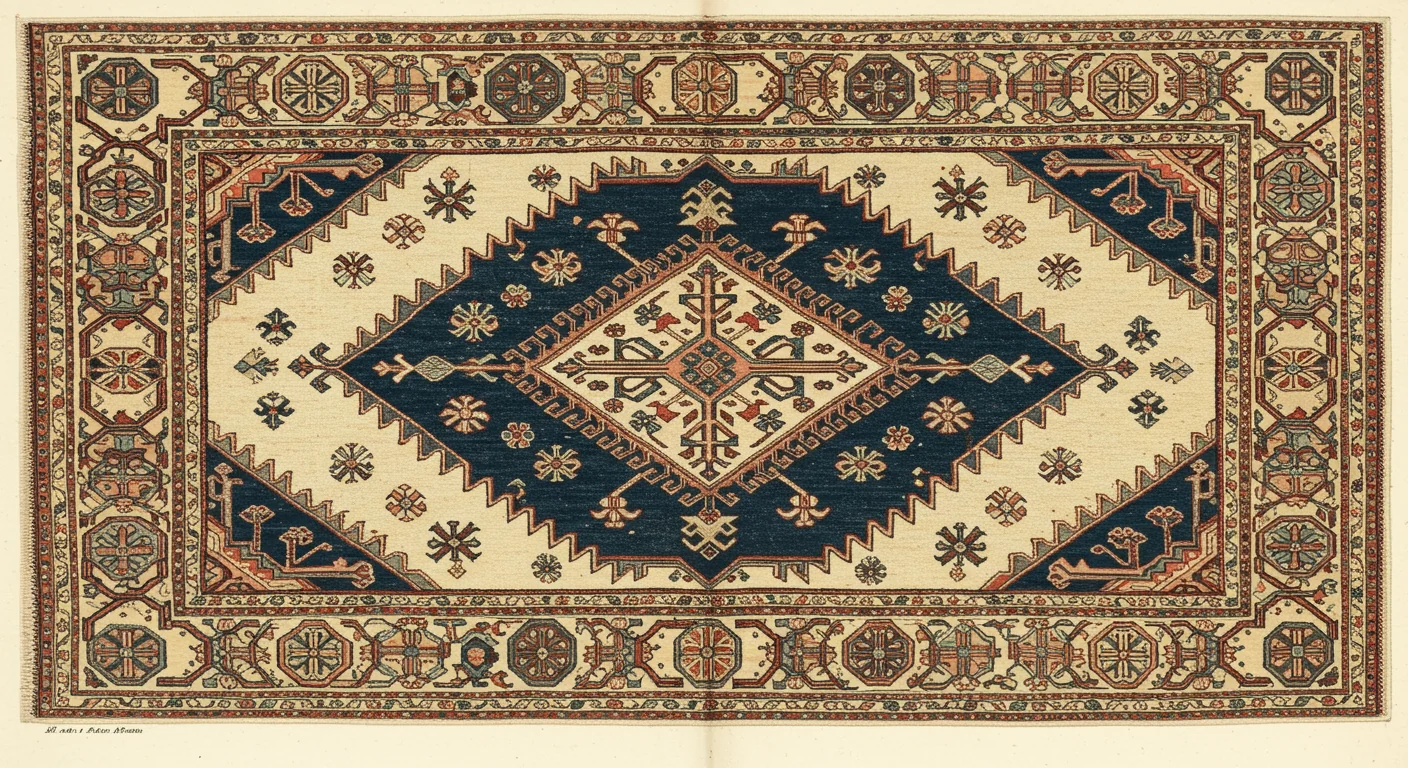
The first three rug posts in this arc — Heriz, Tabriz, and Caucasian Kazak — established the two axes along which the body of antique-rug attribution operates: workshop versus village (Tabriz against Heriz), and Persian-cotton versus Caucasian-wool (Heriz against Kazak). What the Heriz post named in passing but did not treat in detail was the older village tradition out of which the late-nineteenth-century commercial Heriz emerged, and what the Tabriz post acknowledged as the predecessor that the Tabriz workshop quietly tightened. That tradition has its own name in the dealer vocabulary, and Bakshaish is what one calls it. This post is what the Heriz post had to leave for another day.
Bakshaish is the antecedent. A Heriz proper of 1890 sits on a village foundation that goes back at least to the early nineteenth century, and the canonical archaic vocabulary it draws on — the large stepped polygonal medallion, the cream ground oxidised down from saturated madder, the village-loom drawing of an irregularity the commercial workshop later disciplined out — is the Bakshaish vocabulary. The rugs we now class as Heriz are the export-grade descendants of an older village register that the dealer market began separately classifying, and prizing, around the 1890s as the commercial Heriz consolidated. The northwestern Persian triangle of Heriz proper, Tabriz, and Bakshaish is, in this sense, the canonical Persian district laid out on three axes: the city workshop, the commercial-export village, and the older village antecedent. Tabriz and Heriz are done; Bakshaish completes it.
The Specimen
A Bakshaish that one will encounter is, in its commonest form, a substantial rug — eight feet by ten or larger is the village-loom norm, with smaller pieces (five by seven, four by six) considerably less common than in the commercial Heriz successor. The Bakshaish was woven on the same village looms that produced the later Heriz, but in the older period the village preference was for the larger format that the bourgeois Tabriz and provincial-Persian markets received well. Most surviving antique Bakshaish in good condition are in the eight-by-ten to ten-by-fourteen range.
The composition is the archaic large-scale medallion — a single great stepped polygonal medallion that occupies, on most pieces, between a third and half of the rug’s total length, with the field around it rendered in a more open and less densely-ornamented register than its commercial successor. The medallion outline is stepped, the steps drawn at substantially larger scale than in the Heriz successor, and the individual weaver’s hand is visible in the irregularities of the stepping — the angles are not quite mathematical, the proportions of the steps vary slightly from side to side, the corners do not always meet at exactly the same point. The drawing is what one would call archaic in the connoisseur vocabulary — older, looser, more village, more individual — and it is the principal reason the Bakshaish dealer-label retained value after the commercial Heriz took over the export trade. The Heriz proper drew the same general medallion at smaller scale, in tighter proportions, and with the irregularities mostly disciplined out. The Bakshaish drew the same vocabulary at the older scale and admitted the hand.
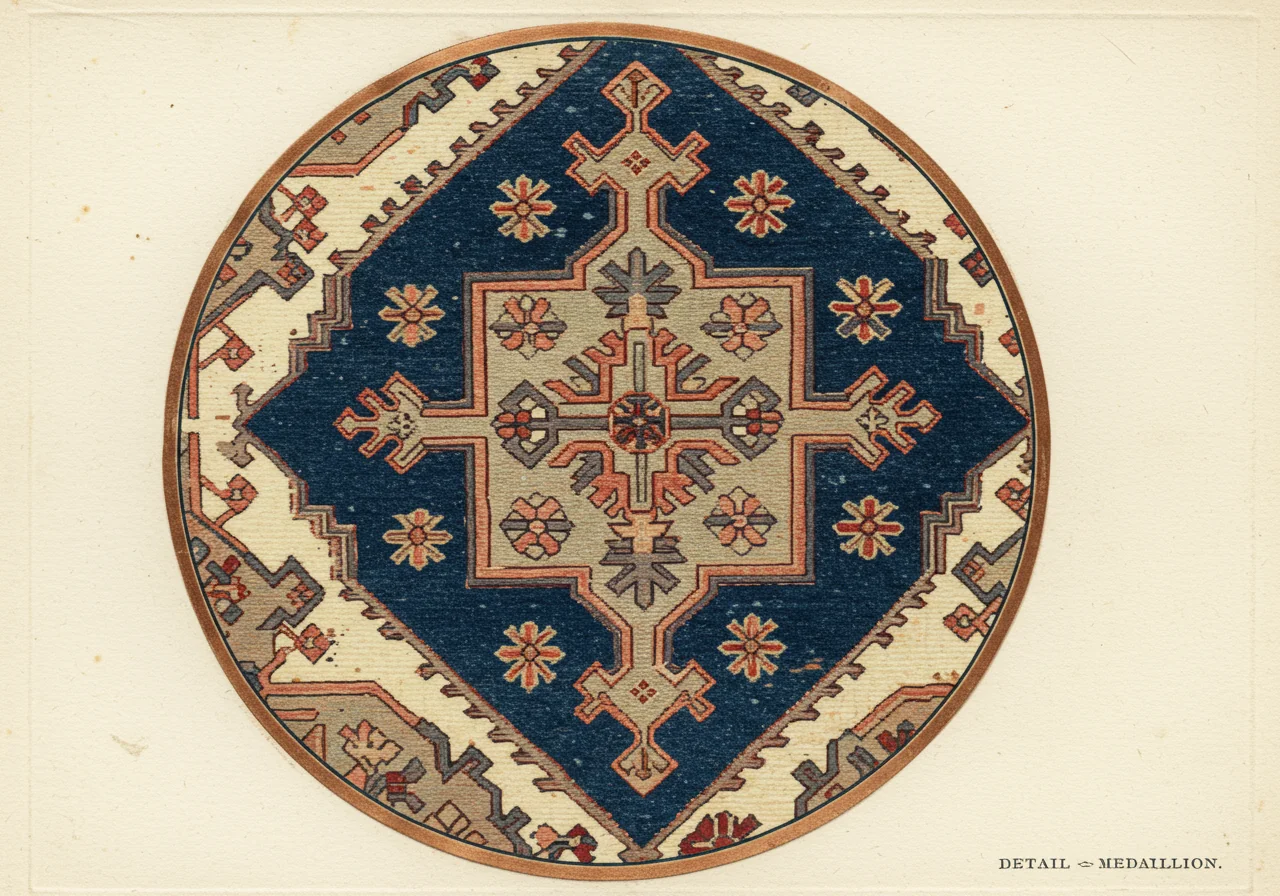
A close detail of a Bakshaish archaic medallion — the stepped polygonal outline at the large scale that occupies a third of the rug’s length on the canonical pieces. The cream / faded-madder ground is the principal palette signature, the result of more than a century of light-fade and oxidation on what began as a saturated madder field. The individual weaver’s hand is visible in the irregularities of the stepping — the angles vary slightly, the proportions of the steps shift from side to side, the corners do not always meet at the same point. This is the village register the commercial Heriz tightened.
The palette is the Bakshaish’s second principal signature, and it is what most separates the type from both its commercial-Heriz successor and the rest of the northwestern Persian district. The field is cream, or pale faded-madder — a soft pinkish or apricot cream that the rug was not woven with but that more than a century of light-fade and natural oxidation has produced from what began as a saturated madder ground. A Bakshaish of 1860 was woven with the same range of vegetable madder dye that the Heriz proper of 1890 used, but the older rug has had thirty additional years of light and use, and the natural ageing has produced the soft cream-and-apricot range that is now the type-signature. The medallion is typically deep indigo or aged indigo-blue, often itself oxidised down from a brighter starting tone. Ivory spandrels at the corners, the same general triadic colour scheme as Heriz, but the whole palette is softer — and the softness, like the medallion drawing, is a feature one is looking for rather than a defect.
The Evidence
The foundation is the structural evidence that places a Bakshaish firmly in the Persian tradition rather than the Caucasian one the Kazak post opened. Cotton warp and wool weft, exactly as in Heriz and Tabriz. The cotton warp at the Bakshaish village register is hand-spun rather than the more uniform machine-spun cotton that later commercial workshops adopted, and the warp shows the slight unevenness of hand-spinning at close inspection of the back. The wool weft is heavy and lanolin-rich, dyed in alternating bands of natural and indigo on most pieces — a darker line of weft is visible between every few rows of knots — which is itself a village identifier (commercial production tightened the weft to a uniform light line).
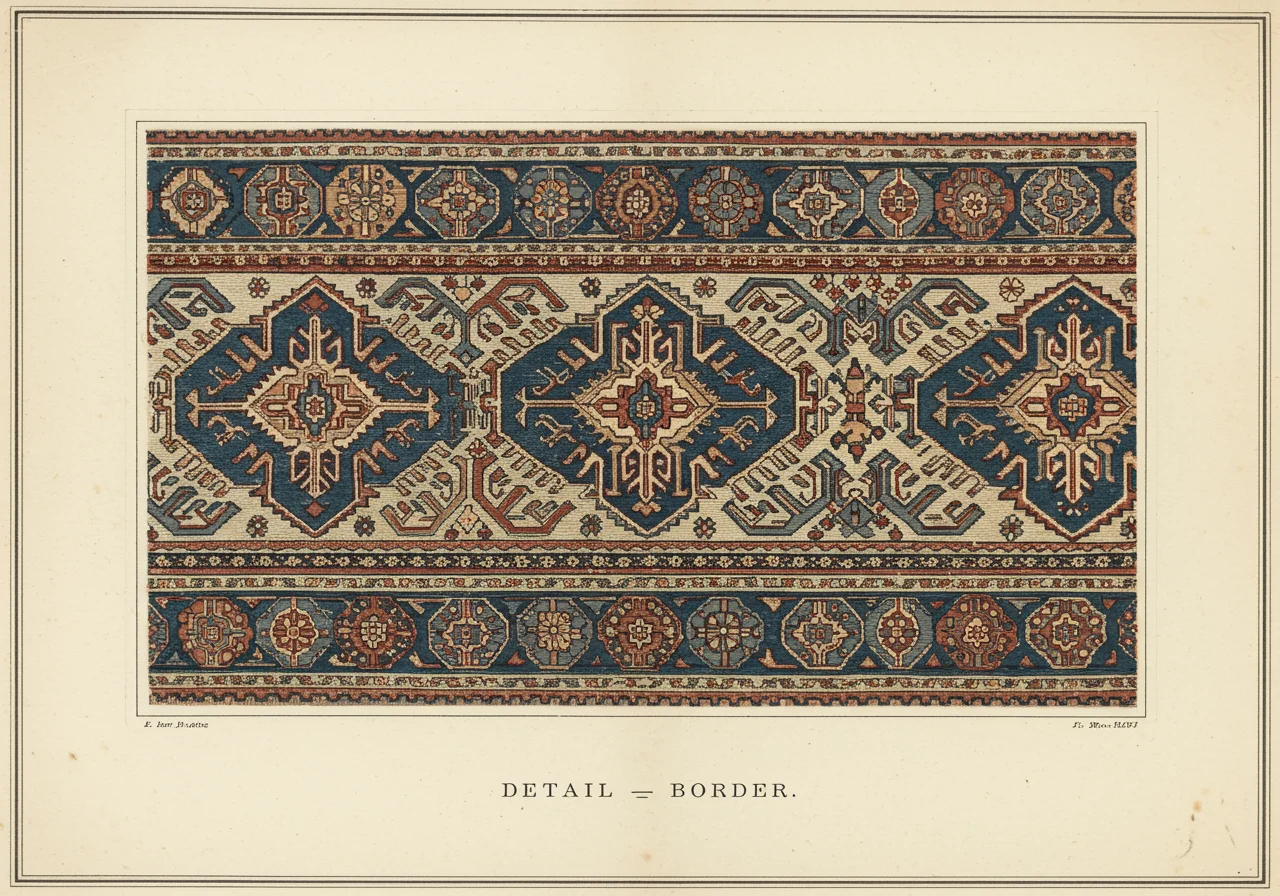
A close detail of a Bakshaish main border — large-scale stepped polygons or botehs drawn at the village-loom irregularity that the commercial Heriz later regularised. The motifs are visibly drawn by hand, with the proportions varying from repeat to repeat, and the border as a whole has the looser cadence of the older village register.
The knot is the symmetric (Turkish) knot, expected for the Azeri-Turkic weaving population of the Sahand slope, and the knot density is moderate to low — eighty to one hundred and ten knots per square inch is the Bakshaish range, with the better village pieces sometimes reaching one hundred and twenty but rarely higher. This is meaningfully looser than the commercial Heriz successor (which ran a hundred to a hundred and fifty), and the lower density is the structural enabling condition for the larger and looser medallion vocabulary. A Bakshaish woven at Heriz density would not give the same drawing; the village range and the village vocabulary are inseparable.
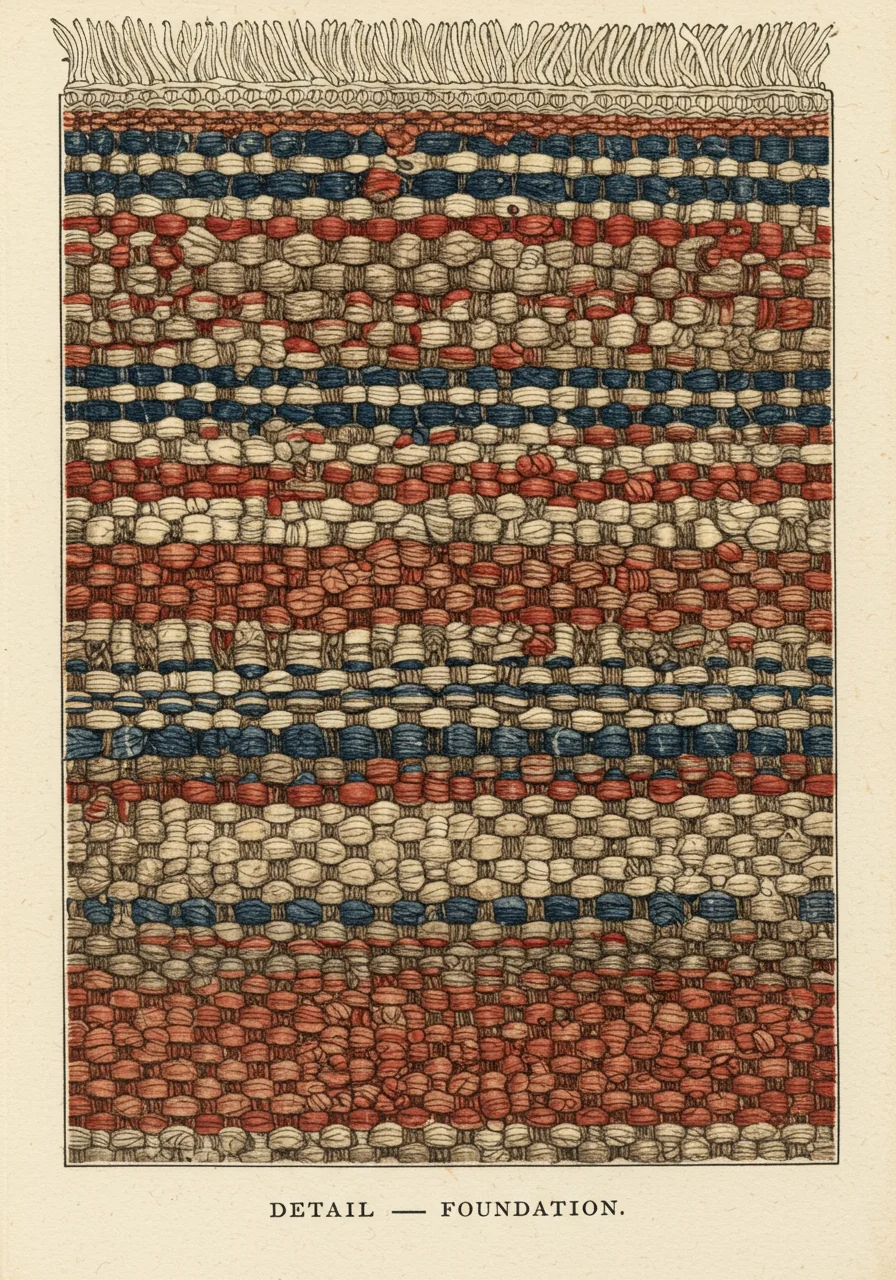
A close detail of the back of a Bakshaish rug — the looser symmetric Turkish knot at village density (eighty to one hundred and ten knots per square inch), the hand-spun cotton warp with its slight unevenness visible at the cut edge, and the heavy lanolin-rich wool weft in alternating bands of natural and indigo. The commercial Heriz proper, woven at higher density on a more uniform machine-spun warp, reads as visibly cleaner and more regular at the same magnification.
The wool of the pile is the principal material signature. Bakshaish wool comes from the highland flocks of the Sahand region — the same flocks that supplied Heriz proper, but at the village register the wool was less heavily sorted and graded, and the surviving antique pieces show the considerable variation in fibre quality and lanolin content that hand-sorted village production produces. The dyes are entirely vegetable on the antique pieces: madder for the reds, indigo for the navy and blues, isparek for the yellows, walnut hull and pomegranate rind for the browns, the synthetic aniline dyes essentially absent before about 1880 and only intermittently present even after. A Bakshaish that has lived through a century and a quarter of light, use, and the slow chemistry of natural oxidation is what one is looking at, and the palette one is reading is not the palette the rug was woven with.
The Period
Bakshaish village sits on the eastern slope of Mount Sahand, the dormant volcanic peak that dominates the country east of Tabriz. The village is one of perhaps a dozen weaving settlements on the Sahand slope — Heriz proper, Mehraban, Ahar, Karaja, Bilverdi, Sharabian and others — that produced the broader district’s rugs from at least the early nineteenth century onward. The Bakshaish-period production we are now collecting runs from about 1820 to about 1900, with the older end represented mostly by museum-grade pieces in major institutional collections and the surviving collectible inventory concentrated in the 1860–1895 range. Pre-1860 Bakshaish in good condition is rare and largely museum-held; 1860–1880 is the most-prized antique register and what serious collectors are typically chasing; 1880–1895 is solid antique-grade work that the dealer trade calls Bakshaish on the looser pieces and Heriz on the tighter ones; after 1895 the commercial Heriz vocabulary had effectively taken over the district’s production for export and the Bakshaish label was applied retrospectively to the older surviving stock.
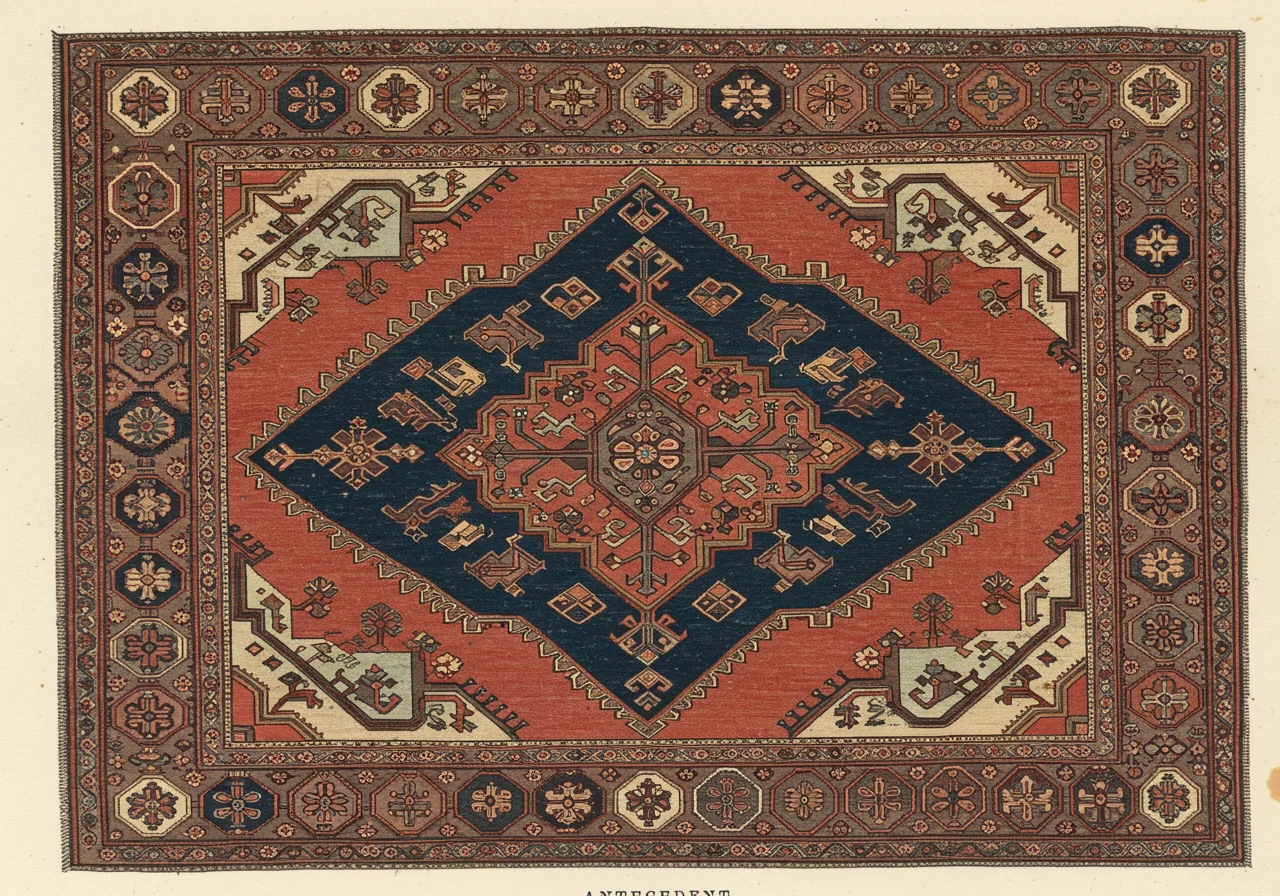
A late-Safavid northwestern Persian village rug of the eighteenth century — the antecedent tradition that the nineteenth-century Bakshaish descended from. The medallion runs at even larger scale than the nineteenth-century Bakshaish version, the ground is closer to the saturated madder of the original dye before centuries of light-fade brought the antique cream, and the village-loom drawing carries the same individual hand at greater scale.
The dealer-attribution complication that has confused Bakshaish collectors for a century is the Serapi label, and a clear account of it is owed to the reader. Serapi was a late-nineteenth-century European-dealer trade name applied to the highest-quality Bakshaish and early-Heriz pieces — the term itself is a corruption of Serab, a town near Tabriz that the dealers conveniently associated with the rugs but that produced essentially none of them. A Serapi is, in practice, a Bakshaish or fine early-Heriz of the better wool grade and better condition, given a separate dealer label to mark its place in the upper end of the price range. The distinction between a Bakshaish and a Serapi is condition, wool grade, and dealer judgement, not provenance or vocabulary — the two trade labels are applied to the same body of rugs, and one will encounter the same canonical piece labelled either way in different dealers’ inventories. The collector vocabulary now generally treats Bakshaish as the broader category and Serapi as the upper sub-grade, but the historical usage was looser, and one is well advised to read the rug rather than the label.
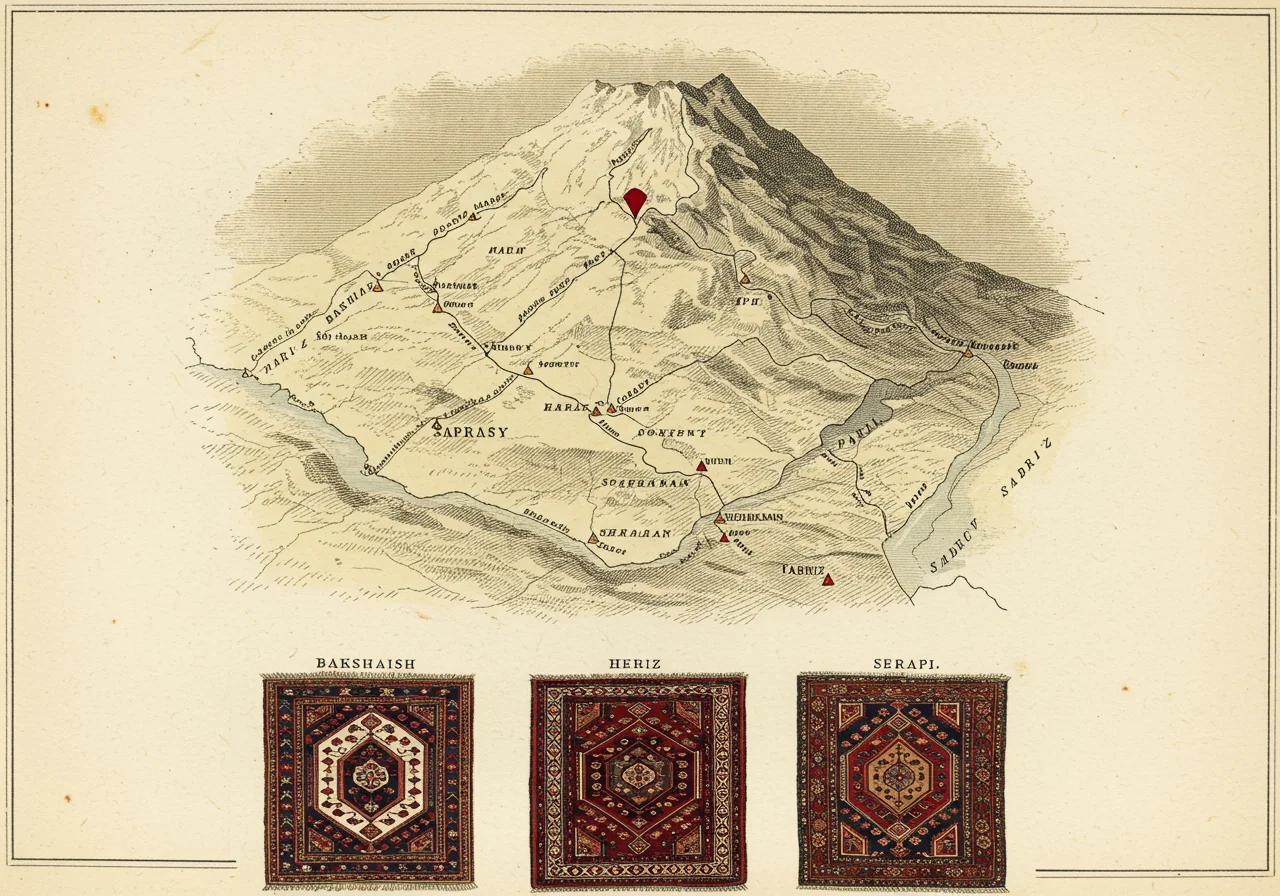
A page from a Victorian connoisseur’s portfolio on the Sahand district east of Tabriz — the district map locating Bakshaish, Heriz proper, Karaja, Ahar, and the smaller villages on the slope of Mount Sahand, with three archetype rug drawings at the bottom showing the principal sub-type designs: the Bakshaish (archaic large-scale medallion), the Heriz proper (tightened commercial medallion at smaller scale), and the Serapi (the upper-grade dealer label applied to the better Bakshaish and early-Heriz pieces).
What It Is Not
Four types stand near enough to Bakshaish that the beginner confuses them with it, and distinguishing them is most of the work of reading the Sahand district.
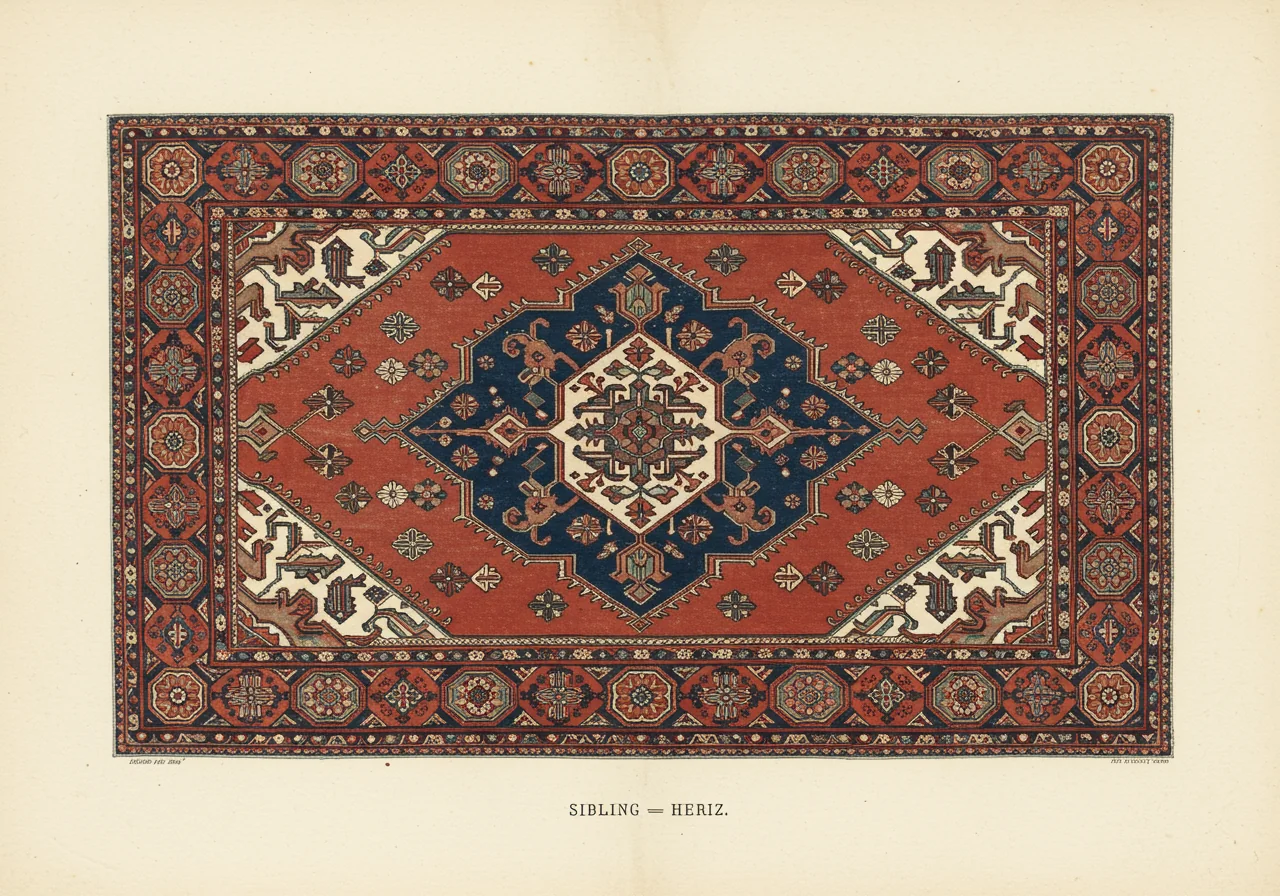
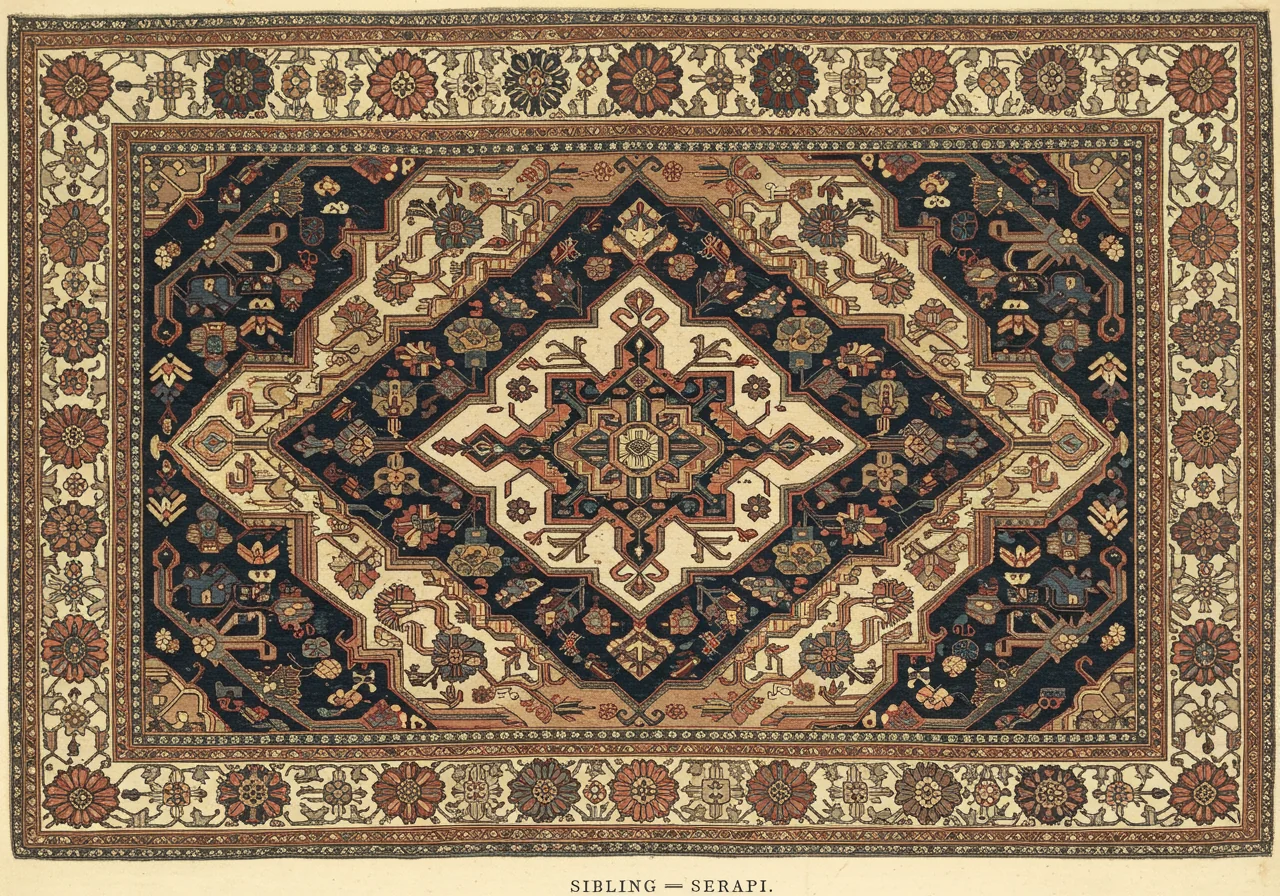
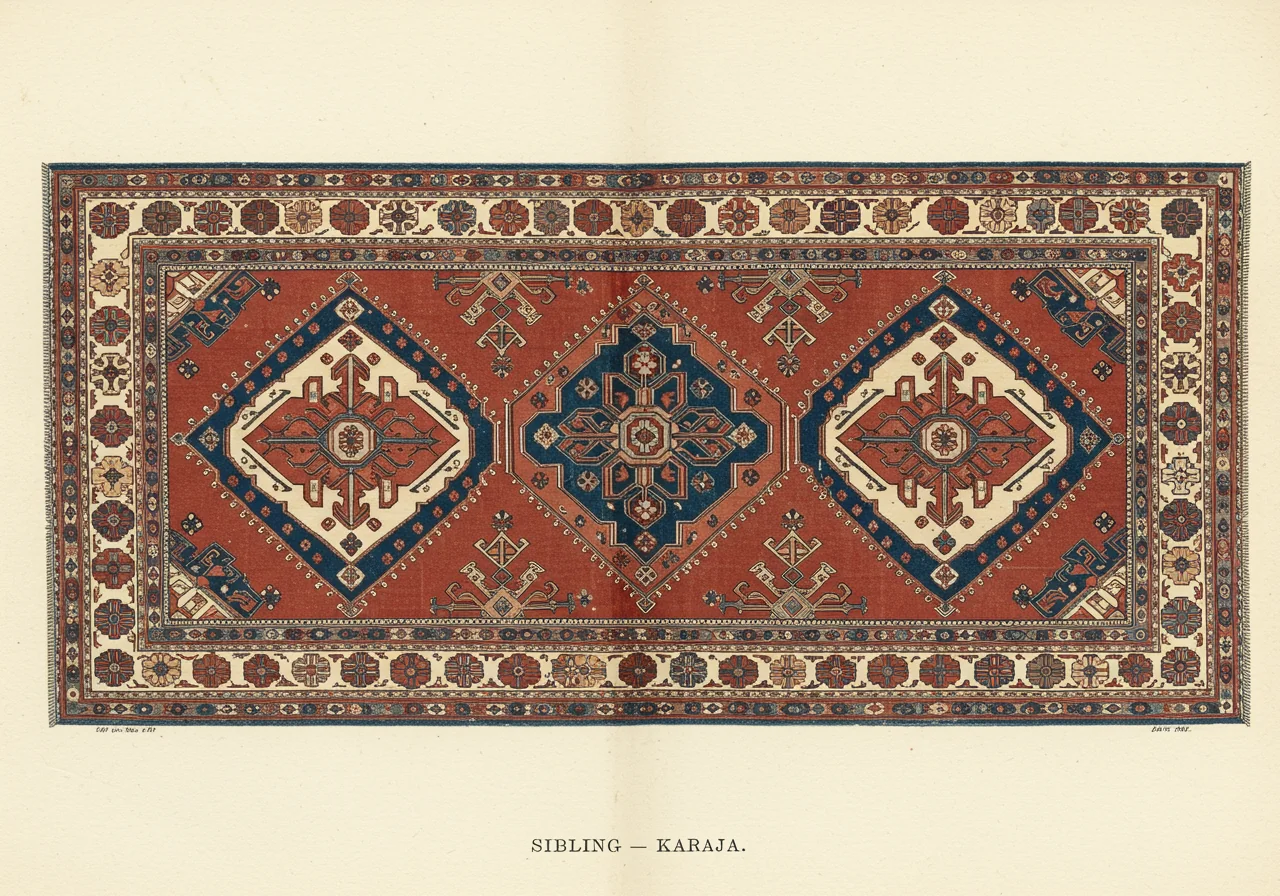
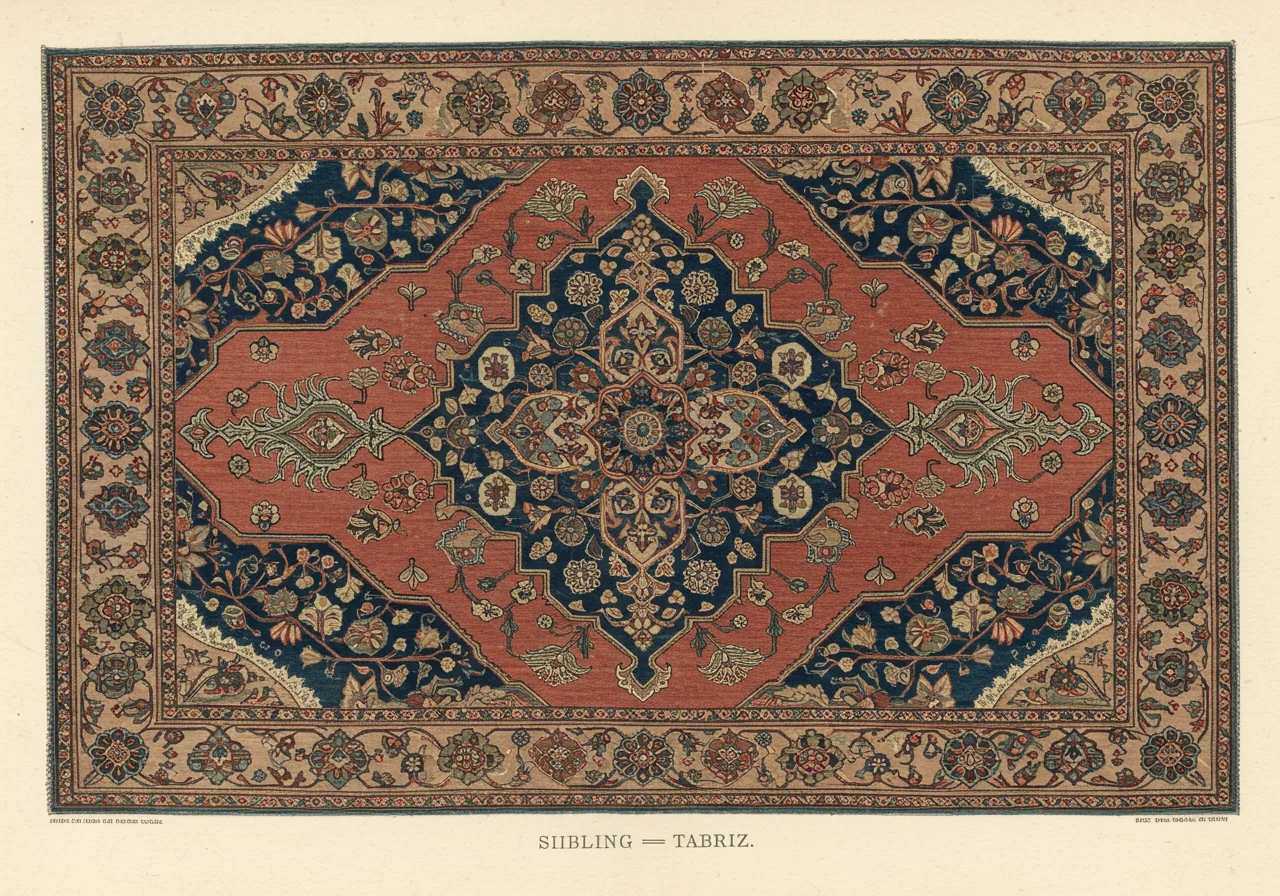
A Heriz proper is the late-nineteenth-century commercial export descendant of Bakshaish — same Sahand district, same village looms, same general medallion vocabulary, but tightened at every register for the European and American export trade. The rule of thumb: archaic large-scale medallion on a cream-or-faded ground is Bakshaish; tightened medium-scale medallion on a saturated brick-red ground is Heriz.
A Serapi is, as discussed above, the upper-grade dealer label applied to the better Bakshaish and finer early-Heriz pieces. The Serapi and the Bakshaish are not separate provenances but separate price-grade attributions of the same body of rugs. The rule of thumb: Bakshaish-vocabulary with high-grade wool and excellent condition is a Serapi; the same vocabulary with ordinary wool and ordinary wear is a Bakshaish proper.
A Karaja is the rug of the neighbouring Karaja village on the Sahand slope. Karaja is distinguished from Bakshaish principally by composition — Karaja’s signature is the three-medallion vertical stack (three smaller medallions arranged along the rug’s long axis, rather than the single great medallion of Bakshaish), and the Karaja palette tends to be deeper red and less faded-cream than the Bakshaish. The rule of thumb: single large medallion on cream ground is Bakshaish; three smaller medallions in vertical stack on deeper-red ground is Karaja.
A Tabriz is the city-workshop rug of the regional capital that the Heriz post treated and that sits at the far end of every Sahand-district comparison. Tabriz is designed by named master-designers rather than woven on the village loom, knotted at substantially finer density, and frequently on a pale-ivory ground (the Hadji Jalili variant the Tabriz post foregrounded). The rule of thumb: village-loom drawing on cream ground is Bakshaish; designed composition at fine workshop density is Tabriz.
What One Looks At
The practical discipline of identifying a Bakshaish, when one is standing in front of a candidate rug in the dealer’s storeroom, comes down to a short ordered checklist that the reader of the prior rug posts will find familiar in structure.
One looks first at the scale and drawing of the medallion. A Bakshaish medallion occupies roughly a third of the rug’s length, drawn at the older village scale, with the stepped outline irregular enough to show the weaver’s hand. A Heriz successor medallion is smaller and more regularised; a Tabriz medallion is finer and more designed; a Karaja composition is the three-medallion vertical stack. The medallion settles the broad attribution at a single glance, and the rest of the checklist is confirmatory.
One looks next at the ground colour and the dye character. Bakshaish ground is cream or pale faded-madder, with the cream being the result of more than a century of natural light-fade and oxidation on what began as saturated madder rather than the original woven palette. A rug that looks like it was woven cream is probably either a commercial modern reproduction or a piece that was bleached for the decorator market — neither is what one is looking for. The reds and indigos within the field should themselves show the soft tones of natural ageing rather than the harder saturation of younger pieces.
One looks at the knot density and the foundation. Bakshaish runs eighty to a hundred and ten knots per square inch, on a hand-spun cotton warp and a heavy lanolin-rich wool weft. The looser knot is the structural enabling condition for the village-scale medallion. A Bakshaish-vocabulary rug at Heriz density (over a hundred and twenty knots per square inch) is more likely a high-quality early-Heriz mis-attributed as Bakshaish than a genuinely fine village piece — in which case it is what the trade would have called a Serapi.
And one looks for the age. A genuine antique Bakshaish is a century and a quarter old at the youngest end of the range, and the wool, the dyes, the foundation, and the wear should all read as having lived through that long span. Late-twentieth-century reproductions in the Bakshaish manner are now a substantial commercial category, made specifically for the decorator market that prizes the soft palette and archaic drawing without commitment to the antique price, and learning to distinguish the antique cream-and-faded-madder palette from the chemically-washed modern equivalent is one of the rug-collector’s particular educations. The wool, the back of the rug, and the small unevennesses of hand-spun warp and hand-mixed dye are the principal evidence; the front of the rug alone is not.
The next post in the rug arc will be either Kashan — to open the central Persian court workshop tradition with its deep wine-red ground and its dense court-workshop vocabulary, the urban counterpoint to the Bakshaish village register — or one of the eastern Caucasian types (most likely Shirvan), which would extend the Caucasian region opened by the Kazak post into the dark-navy small-medallion eastern sub-tradition. The choice will depend on what photographic material is available at the time of writing.