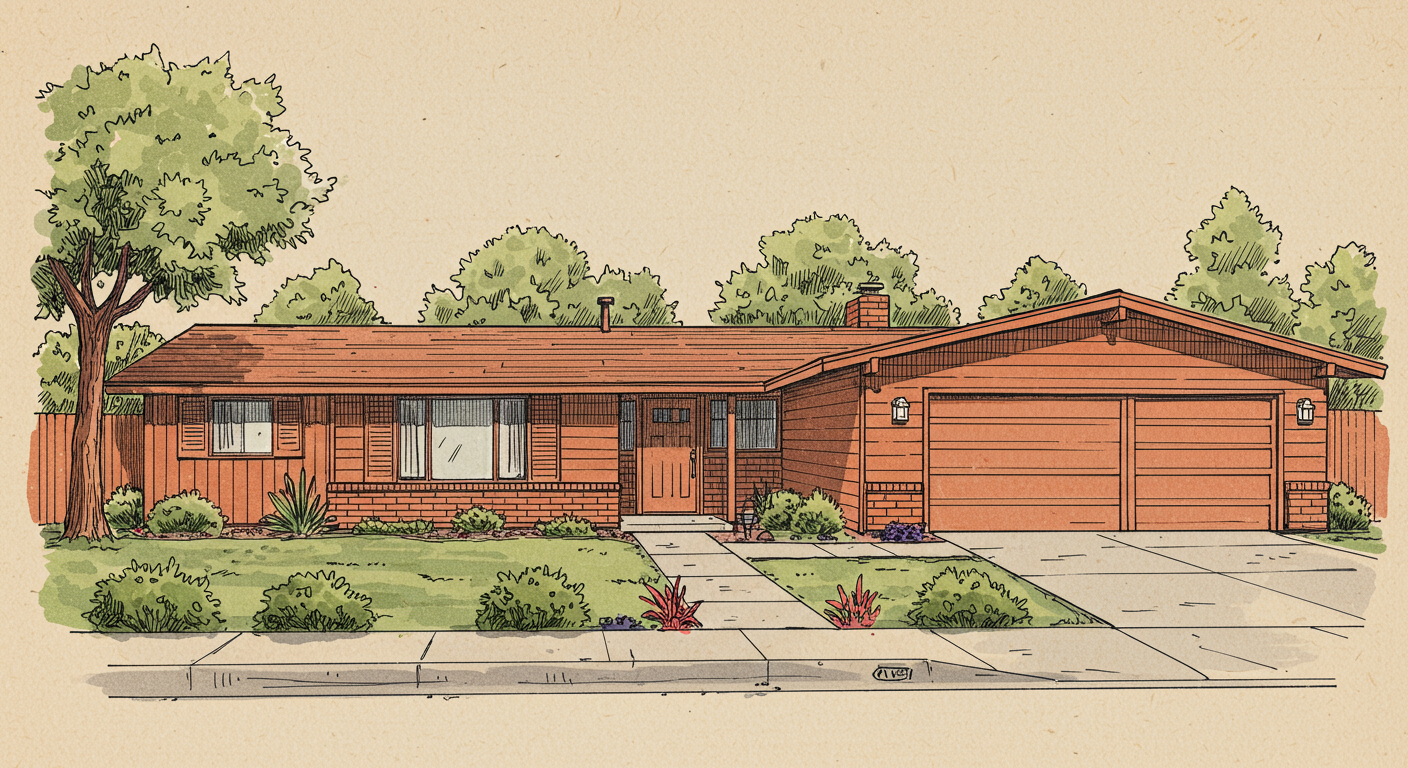
The Spanish Colonial Revival of the previous post described the inter-war Western suburb at its upper-middle commission — the architect-designed houses of Wallace Neff and Addison Mizner, of Beverly Hills and Coral Gables and Santa Barbara, of the upwardly-mobile professional class that wanted its historicist quotation in stucco-and-red-tile. The California Ranch this post takes up is what happened to that architecture after the Depression and the war: the same Mediterranean vocabulary, stripped of the upper-middle commission’s elaborate carved entrances and ornate iron grilles, lowered to a single storey, oriented around an attached two-car garage and a picture window and a rear patio, produced at industrial scale by post-war tract developers, and sold to the millions of middle-class American families who moved out of the cities into the new suburban subdivisions of the late 1940s and 1950s. The result became the dominant residential form of the second half of the twentieth century, and reading the Spanish Colonial Revival and the California Ranch in succession illuminates the post-Depression class shift in American suburban architecture in a way reading either alone cannot.
This is the fifteenth post in Reading the American House. It treats California Ranch in the position the Spanish Colonial Revival post pointed toward — the descendant style, named at the close of that post but not treated in detail. The Ranch is the form in which the historicist suburban architecture of the 1920s was domesticated into the mass-market suburban architecture of the 1950s, and the post’s central argument is the difference between the two: between Cliff May’s custom-designed Spanish-influenced sprawl of 1932–1955 and the post-war tract-built Ranchburger of 1950–1975 that the broader American suburb settled on. These are usually read as the same style. They are not.
The Specimen
If one is to identify a California Ranch — and one will find them in considerable numbers in essentially every American suburb built between roughly 1945 and 1975, often constituting the dominant residential stock of those neighbourhoods — the exercise begins, like the Spanish Colonial Revival’s and the Tudor Revival’s, at the silhouette. But the Ranch silhouette is doing something the prior styles did not.
The principal feature is the horizontal sprawl on a single storey. A California Ranch presents a long low rectangular or L-shaped or U-shaped footprint, typically running thirty to sixty feet across the front facade, with all primary rooms on one floor (no basement in the warmer regions; no second storey except in the occasional split-level variant), the roof pitched low (twelve to twenty-five degrees, considerably shallower than the Tudor Revival’s steep gables or the Foursquare’s pyramidal hip), and the eaves projecting broadly — eighteen to thirty-six inches of overhang on all sides, the deepest eaves of any American residential style. The horizontal proportion is the principal visual move: the Ranch is wider than it is tall by a substantial margin, and the broad eaves emphasise the horizontality further. The roof is typically a low-pitched gable (a single ridge running along the long axis) or a hip roof (sloping on all four sides), in composition shingle or, on the Cliff May customs and the better tract examples, in shake or in clay tile descended from the Spanish Colonial Revival predecessor.
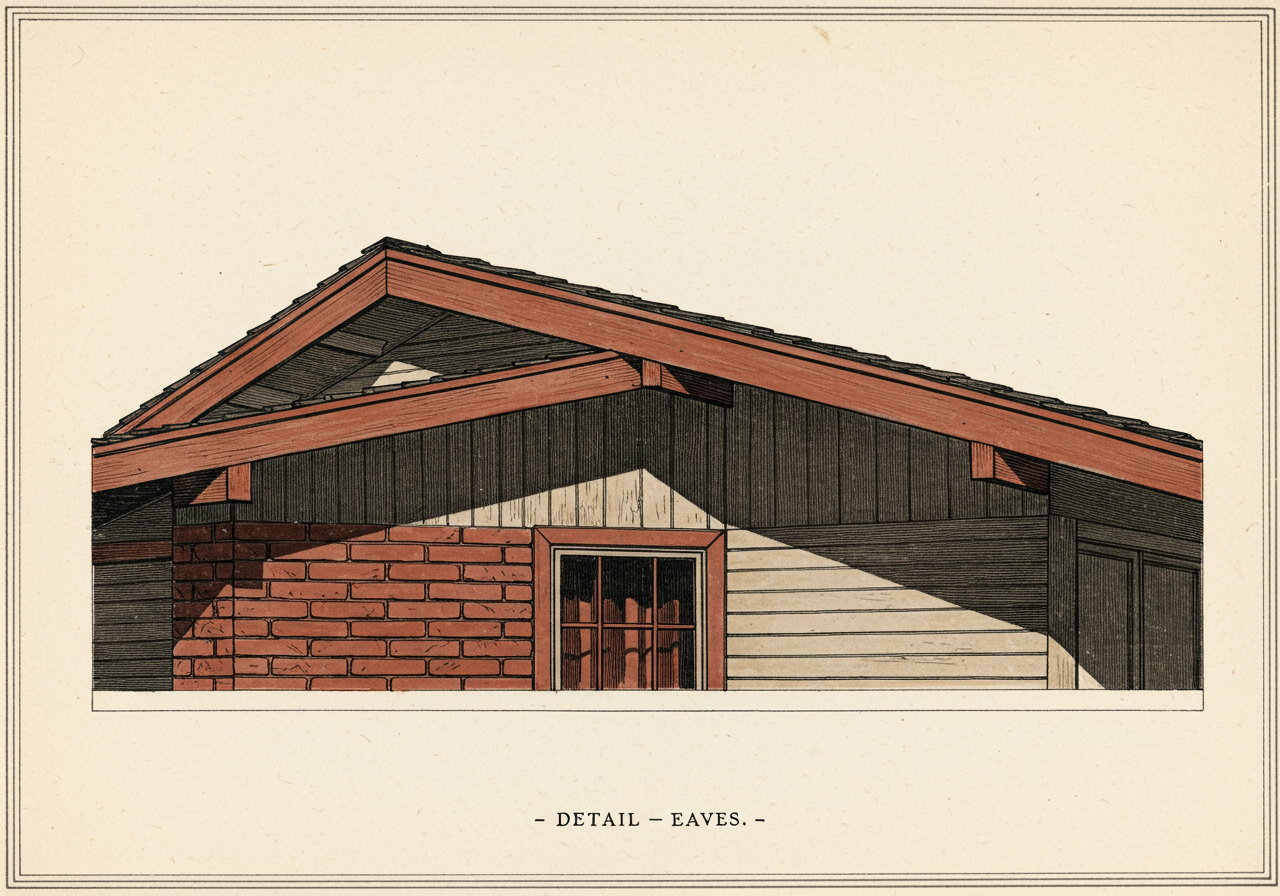
A close detail of the canonical California Ranch broad eaves — eighteen to thirty-six inches of overhang on a low-pitched gable roof, deepest of any American residential style. The deep eaves are the principal Ranch shadow-line, throwing the wall surface into deep shadow at midday and emphasising the horizontality of the silhouette. On the Cliff May customs the rafter tails are exposed in the manner of the Spanish-Mexican antecedents; on the post-1955 tract Ranches the eaves are usually finished with a smooth fascia in painted wood or aluminium, and the underside is enclosed in a flat soffit.
The wall surface is the second decisive feature, and unlike the Spanish Colonial Revival’s unified stucco field the Ranch wall is deliberately mixed. A California Ranch presents two or three different wall materials across the front facade in calculated combinations: a stretch of board-and-batten (vertical wide boards with narrow battens covering the joints, painted or stained in earth tones — sage, ochre, terracotta, rust); a stretch of common-brick veneer (running-bond brick in red or yellow tones, used as a base course or as a feature wall around the entrance); a stretch of smooth stucco in cream, beige, or pale sage; and a stretch of horizontal redwood siding or clapboard in stained or painted finish. The mixing is the point — where the prior historicist styles unified the wall surface into one material register (Tudor Revival half-timber-and-brick, Spanish Colonial Revival stucco, Colonial Revival clapboard), the Ranch deliberately combines two or three materials to break up the long horizontal expanse and to signal a different aesthetic intention: not historicist quotation but casual modernity.
The entrance is unobtrusive. A Ranch front door is typically a plain panelled door (often with one or two small geometric lights, sometimes with a wrought-iron screen door in the Cliff May customs), set into the wall under the broad eaves, with no formal portico, no carved surround, no projecting hood — the entrance is deliberately understated in pointed contrast to the elaborate Churrigueresque cast-stone surround of the Spanish Colonial Revival or the half-timbered Tudor-arched entry of the Tudor Revival. The aesthetic argument is that the Ranch is for the family and the back yard, not for the street; the front door does not need to make an architectural statement because the architecture is happening elsewhere.
Two features complete the front facade. The first is the picture window — a single large fixed pane of plate glass set into the principal room facing the street (usually the living room), framed by smaller operable casement or jalousie windows on either side, the whole composition often running ten to fifteen feet across and serving as the canonical Ranch facade event in the way the round-arched arcade is the canonical Spanish Colonial Revival event. The second is the attached two-car garage, projecting forward of the main house at one end of the facade, with double doors (originally swing-open, after about 1955 overhead-tilting), and roof-line continuous with the main house. The attached garage is the post-war American suburban innovation that the Ranch made universal — every prior historicist style hid the automobile or detached it to a carriage-house out back; the Ranch put the garage on the front facade as a principal architectural element, and the choice tells one most of what one needs to know about the post-war American household’s relationship to the automobile.
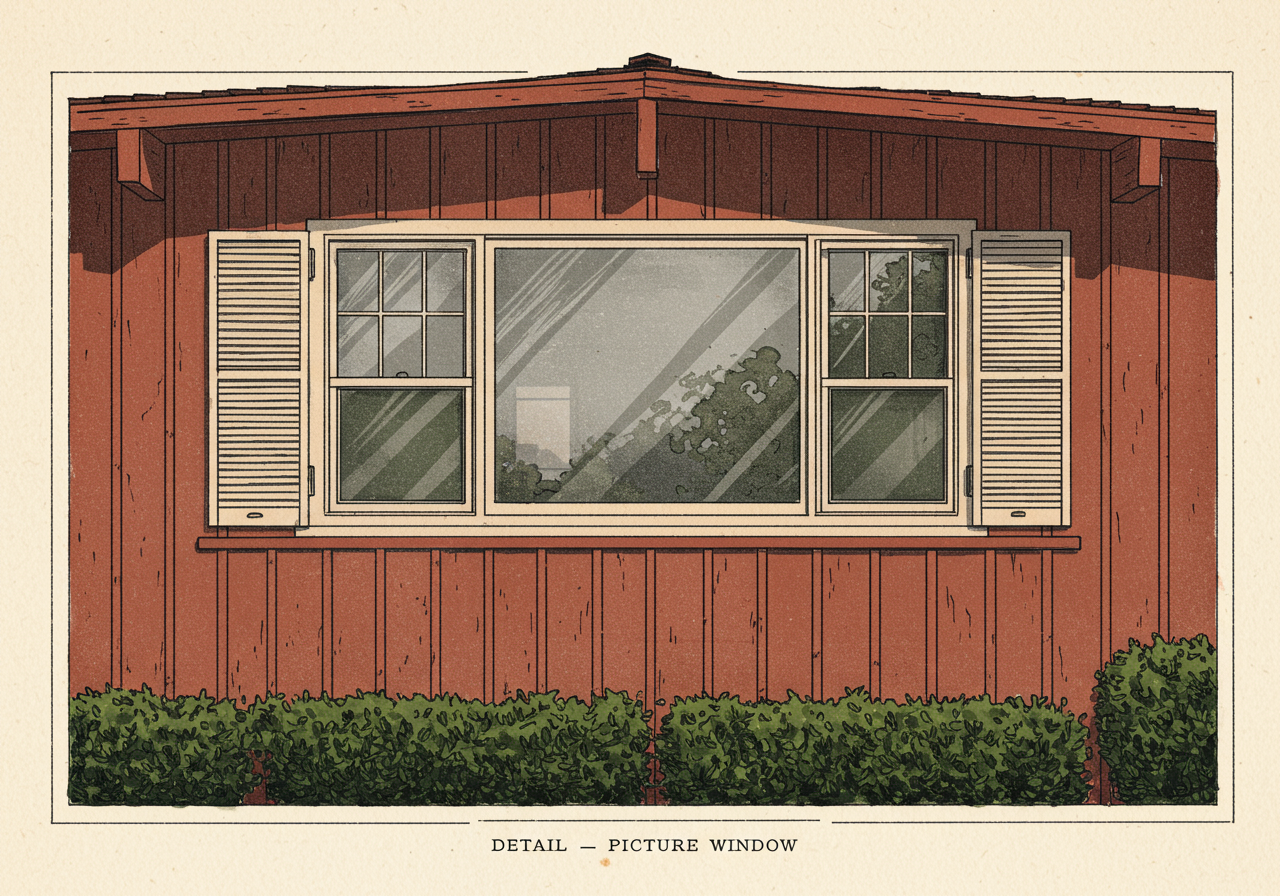
A close detail of the canonical California Ranch picture window — a single large fixed plate-glass pane flanked by smaller operable casement or jalousie windows on either side, the whole composition reading as a horizontal band of glazing across the principal living-room facade. The picture window is the Ranch’s principal facade event and is, in its post-1955 mass-market form, the single most recognisable American suburban architectural feature of the second half of the twentieth century. Its purpose is interior-to-street viewing and indoor-to-outdoor light, in pointed contrast to the small windows of the Spanish Colonial Revival or the leaded casements of the Tudor Revival.
The orientation completes the Specimen description. A California Ranch is oriented around the rear yard. The principal living rooms (the family room, often a den or rec room, sometimes the kitchen breakfast nook) open through sliding glass doors onto a covered or open patio and onto the rear yard beyond. The patio is the Ranch’s principal outdoor room and the equivalent of the Spanish Colonial Revival’s interior courtyard, but pushed to the rear of the lot and opened to the back yard rather than enclosed within the house. The front of the Ranch addresses the street with the garage and the picture window; the back of the Ranch is where the household actually lived.
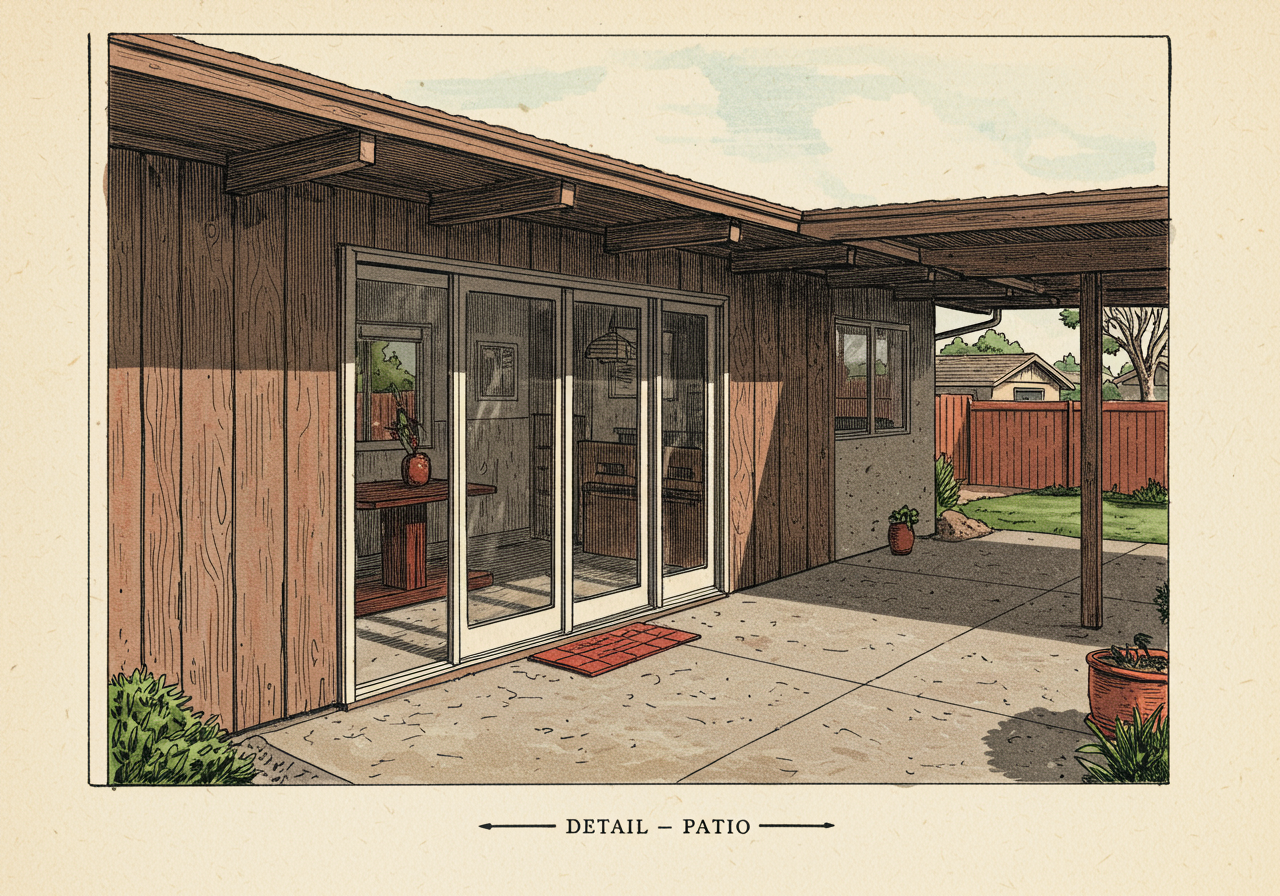
A close detail of the canonical California Ranch rear-patio orientation — sliding glass doors opening from the principal living rooms onto a covered patio and the rear yard beyond, with the broad eaves continuing overhead to shade the patio. The patio is the Ranch’s principal outdoor room, the equivalent of the Spanish Colonial Revival’s enclosed central courtyard but pushed to the rear of the lot and opened to the private back yard. The architectural move — from courtyard-within-house to patio-beyond-house — is the post-war American suburban household’s most consequential spatial decision.
Cliff May’s Sprawl
Cliff May (1908–1989) is the principal documentary figure of the California Ranch, and a clear account of his role is owed to the reader because it is at the centre of the post’s load-bearing distinction.
May was a self-taught San Diego designer (he had no formal architectural training) who built his first Ranch in 1932 in the Talmadge Park neighbourhood of San Diego — a stripped-down one-storey U-shaped house with adobe walls, terracotta tile roof, deep eaves, and an enclosed central courtyard, directly quoting the Spanish-Mexican rancho houses of the early-nineteenth-century California land grants that he had studied through his own family’s connections to the Estudillo family of Old Town San Diego. He built perhaps a thousand custom houses across California, Arizona, Texas, and the broader West between 1932 and the late 1950s, the substantial bulk of them through his own design office (he was not a licensed architect; he employed licensed architects for the technical drawings); he published Western Ranch Houses in 1946 (with the editors of Sunset magazine), which became the principal pattern-book of the post-war Ranch and shaped the broader builder-tract translation of his work; and his customs are the apex of the Ranch tradition, treated by collectors and architectural historians with substantial seriousness.
What the post-war tract developers did with May’s vocabulary, beginning around 1946 at Lakewood (the post-war tract development south of Long Beach) and 1947 at Levittown’s California counterparts and through to the mass-market suburbs of the 1950s and early 1960s, was to take May’s stripped-down Spanish-Mexican plan, remove the U-shape and the enclosed courtyard (too expensive to build at production scale), remove the adobe walls and the tile roof (too expensive in materials), remove the deep recessed Spanish entry (too elaborate to detail), keep the long low one-storey horizontal silhouette, keep the broad eaves, keep the picture window facing the street, attach the garage to one end of the front facade (the post-war innovation that May himself only inconsistently adopted), and produce the resulting house at FHA-mortgage-eligible specifications for sale to the millions of returning veterans and their families who were moving out of the cities into the new suburban subdivisions. The result was the Ranchburger — the post-1950 tract Ranch that dominates the second-half-of-the-twentieth-century American suburban landscape, and that is what most American readers understand when they read “California Ranch.” This is the distinction the post is most concerned to make: the Cliff May customs of 1932–1955 are architecturally serious; the post-1955 mass-market Ranchburger is the builder’s translation of those customs into a production form, and is architecturally a different kind of object even when it carries the same silhouette and roof pitch.
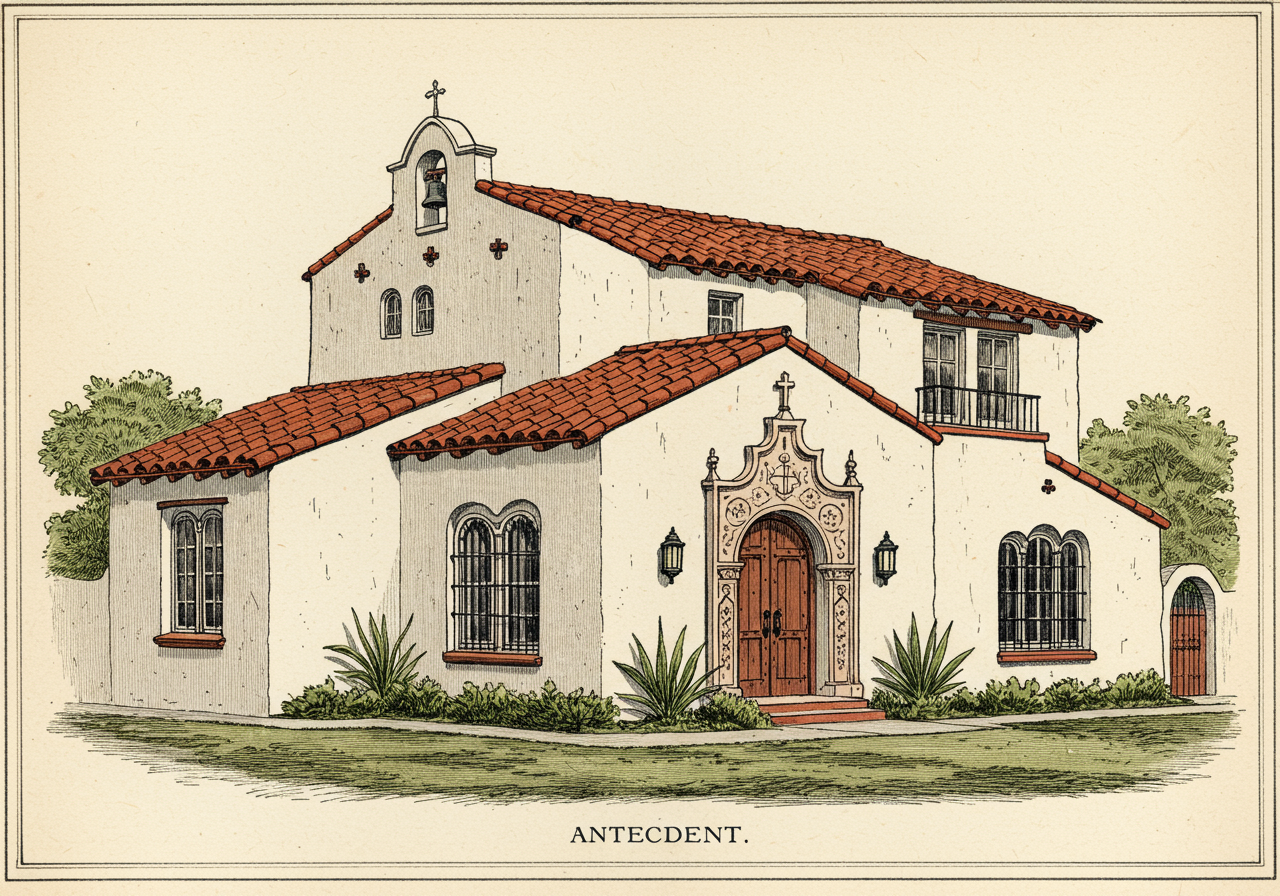
A Spanish Colonial Revival house of the 1920s — the inter-war upper-middle commission with white stucco, terracotta tile roof, ornate cast-stone entrance, and rhythmic arched arcades. The California Ranch descended from this Spanish Colonial Revival through Cliff May’s 1932 stripped-down translation of the Spanish-Mexican vocabulary, and then through the post-1945 tract developers’ further stripping of May’s customs into the mass-market production form. The Spanish Colonial Revival is the architectural parent; the Ranch is the post-Depression descendant.
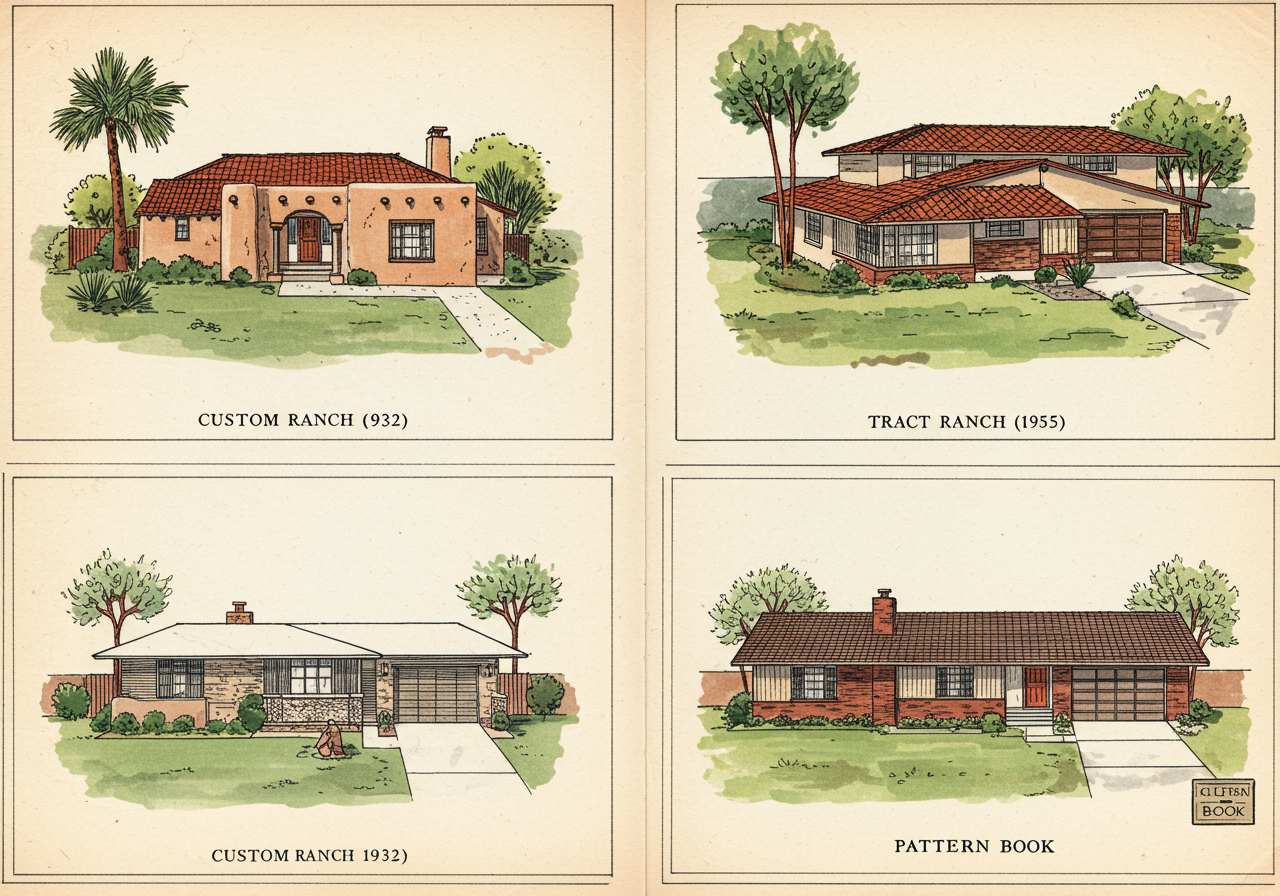
A page from Cliff May’s 1946 Western Ranch Houses — floor plans and elevations of the canonical custom Ranch (U-shaped plan with enclosed central courtyard, adobe walls, terracotta tile roof, deep recessed Spanish entry) alongside a simplified post-war tract Ranch (rectangular plan, attached garage at one end, board-and-batten walls, composition shingle roof, picture window). The from-custom-to-tract translation is the principal Ranch story, and Cliff May’s pattern book is the documentary source most directly responsible for the wider adoption of his vocabulary in the post-war suburb.
What It Is Not
Four styles stand near enough to California Ranch that the beginner confuses them with it, and distinguishing them is most of the work of reading the mid-twentieth-century American suburb.
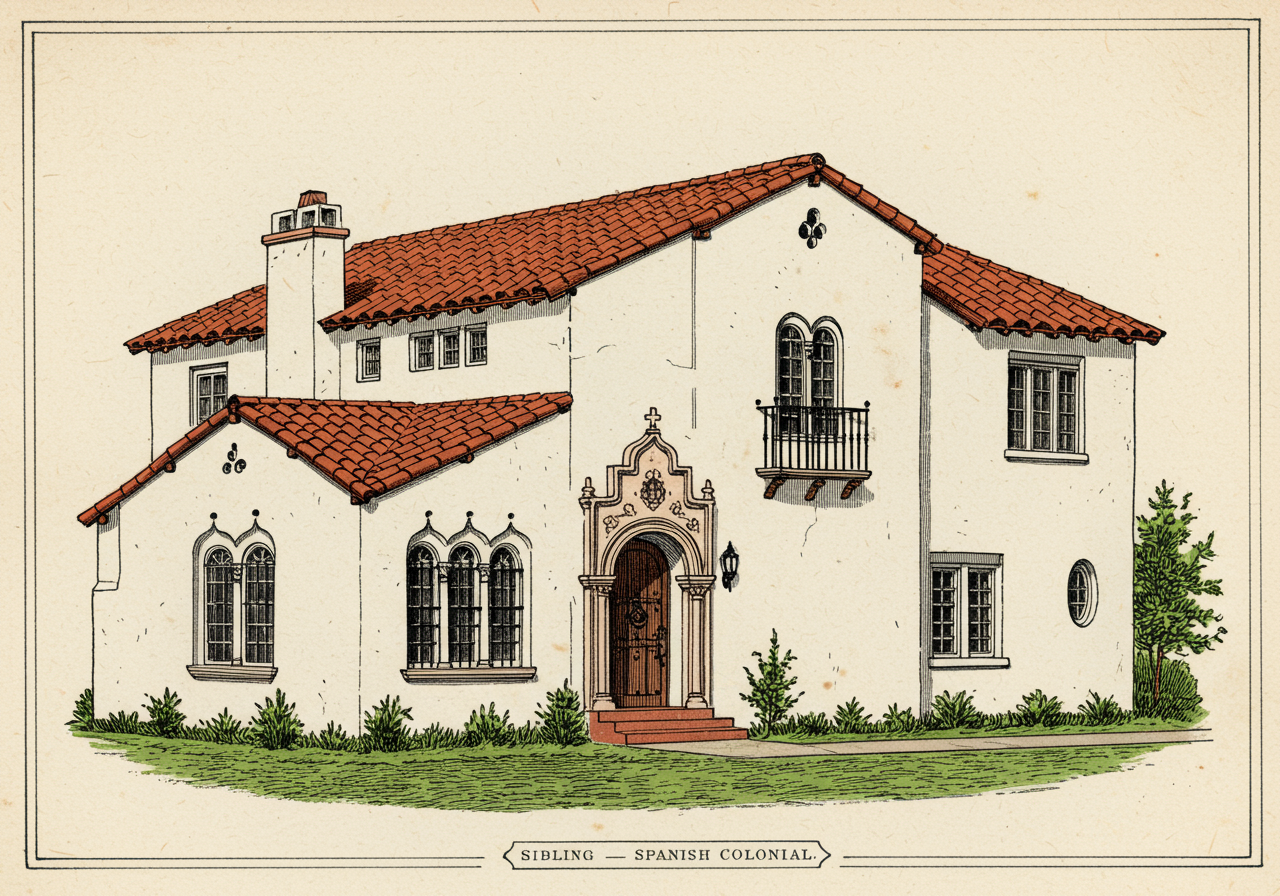
A Spanish Colonial Revival is the architectural parent of the Ranch and was treated in the previous post. The parent style is two storeys (or at minimum a tall single storey with a substantial vertical proportion), uses unified stucco for the wall surface rather than the Ranch’s mixed materials, features an ornate carved entrance (Churrigueresque or Plateresque) rather than the Ranch’s plain understated door, has small grouped round-arched windows rather than the Ranch’s broad picture window, and presents to the street as a historicist quotation of Mexican-Spanish architecture rather than the Ranch’s casual modernity. The rule of thumb: two storeys with ornate carved entrance is Spanish Colonial Revival; one storey with picture window and attached garage is Ranch.
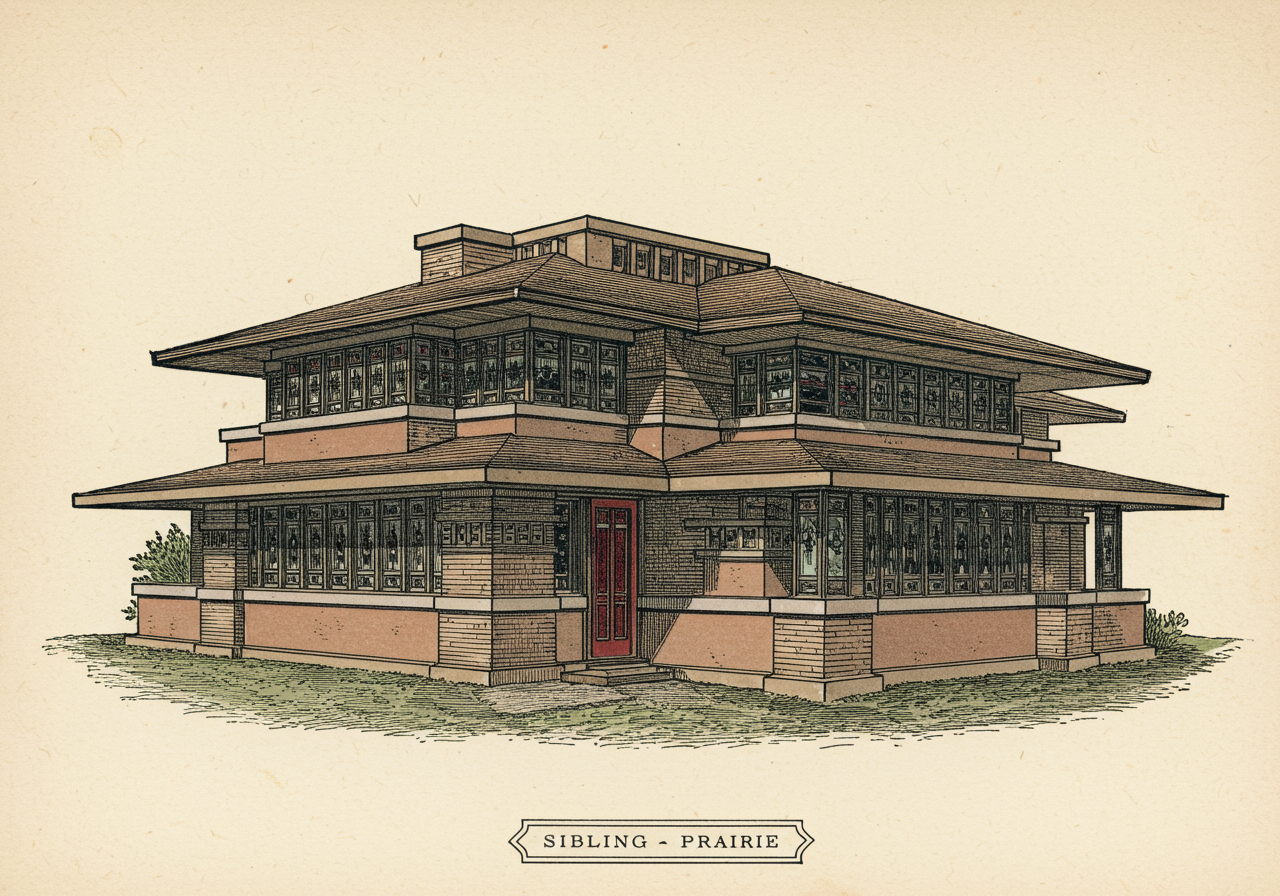
A Prairie house is Frank Lloyd Wright’s Midwestern parallel, examined in an earlier post. The Prairie shares the horizontal massing and the broad eaves with the Ranch but is architect-designed (typically by Wright’s office or his Chicago-school followers, not by a builder or a self-taught designer), is substantially larger and more expensive than even the better Ranch customs, uses art-glass casement windows in long ribbon bands rather than the Ranch’s picture window, and presents reduced ornament in geometric abstraction rather than the Ranch’s casual mixed-material wall. The rule of thumb: architect-designed Chicago-school 1900–1920 is Prairie; builder-tract Western 1945–1975 is Ranch.
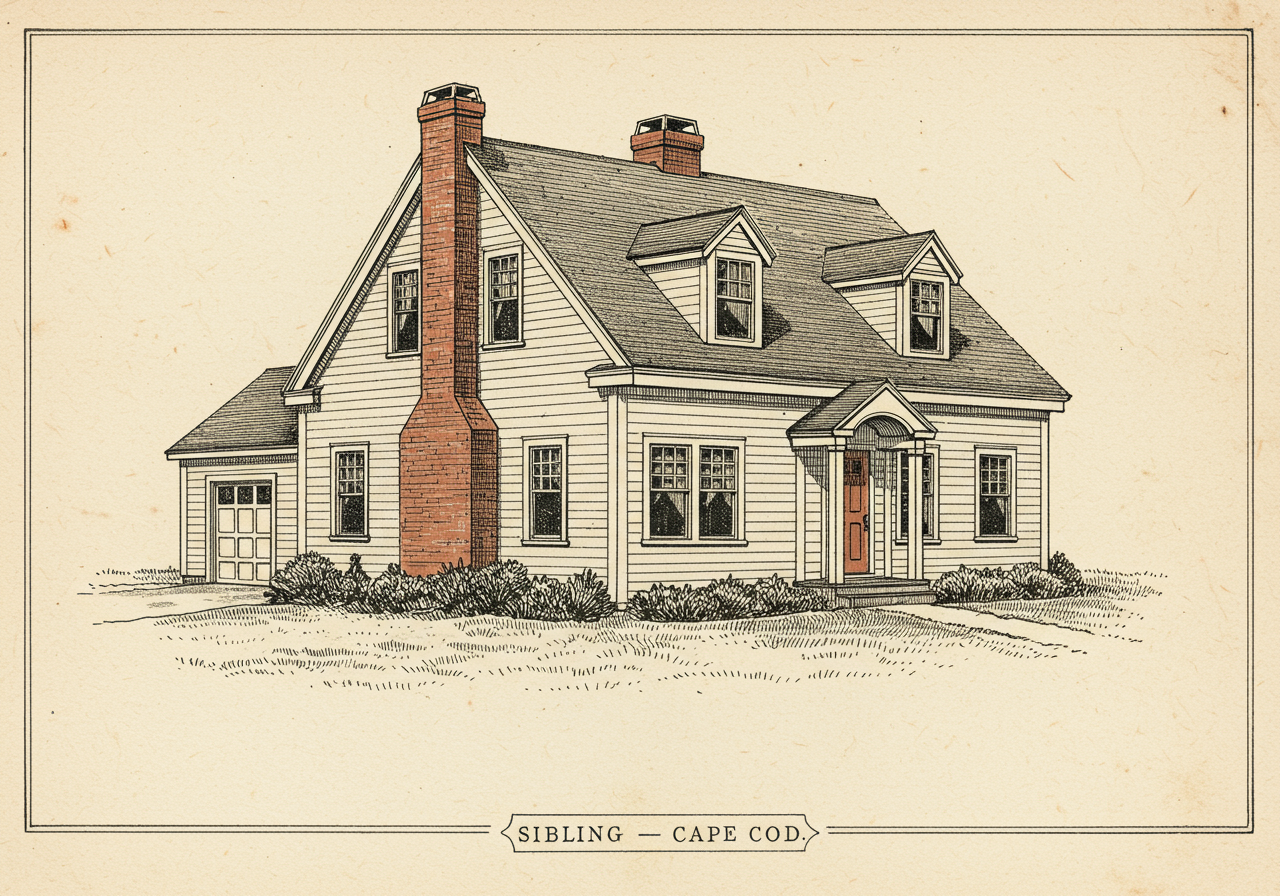
A Cape Cod is the East Coast post-war counterpart — the mass-market suburban shape that dominated the post-1945 suburbs of New England, the Mid-Atlantic, and the Midwest in the way the Ranch dominated the West and the South. A Cape Cod is one-and-a-half storeys (a steep gable roof with finished or finishable second-floor space), symmetrical across a central entrance (in pointed contrast to the Ranch’s asymmetric garage-and-living-room composition), uses uniform clapboard or shingle for the wall surface, presents central-chimney colonial-revival historicist vocabulary rather than the Ranch’s casual modernity, and is essentially the colonial-revival’s mass-market post-war translation in the way the Ranch is the Spanish-Colonial-Revival’s. The rule of thumb: one-and-a-half storeys with central entrance and steep gable is Cape Cod; one storey with attached garage and low gable is Ranch.
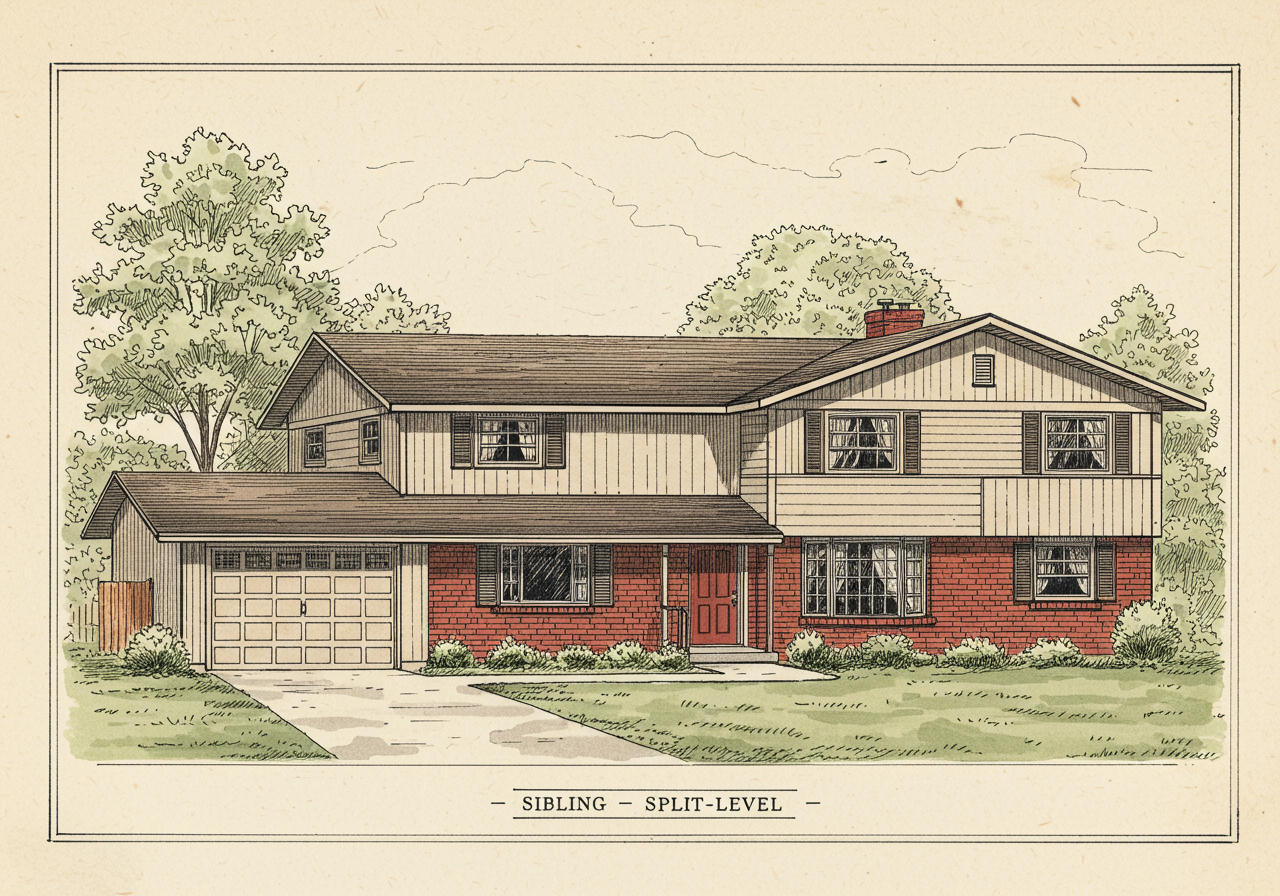
A Split-Level is the Ranch’s late-1950s and 1960s descendant — the same broad horizontal silhouette, the same broad eaves, the same picture window, but with the floor plan divided across three or four staggered levels (public rooms on one level, bedrooms half-flight up, family room half-flight down, garage and utility on the ground level), all under the same continuous low-pitched roof. The split-level was an adaptation of the Ranch to sloping suburban lots and to growing post-war family sizes (more bedrooms required without adding length to the footprint), and dominated the 1960s and 1970s American suburb in regions of varied topography. The rule of thumb: one storey on one level is Ranch; one silhouette across multiple staggered levels is Split-Level.
What It Was Trying to Say
What I find most telling about the California Ranch, taking the Specimen and the historical account together, is the double-life of the style — the way the Ranch is simultaneously the most architecturally serious of the post-war American suburban forms (in its Cliff May custom register) and the most architecturally banal (in its post-1955 tract Ranchburger register), and the way the second has eclipsed the first in the broader American memory.
The first argument is the post-Depression class-shift argument, and it is the principal social fact about the Ranch. The Spanish Colonial Revival of the 1920s was an upper-middle commission — the average Spanish Colonial Revival house in 1928 Beverly Hills or Coral Gables cost somewhere between fifteen and forty thousand dollars (perhaps half a million in current terms), was commissioned by a named architect from a named client, and was sold to a buyer in the upper decile of American household income. The post-war tract Ranchburger of 1955 cost between eight and fifteen thousand dollars (perhaps a hundred to two hundred thousand in current terms), was produced by a tract-developer-builder from a stock plan, and was sold to a buyer in the median of American household income on a thirty-year FHA-or-VA mortgage. The architectural translation between the two — same Mediterranean-influenced silhouette, dropped to one storey, stripped of the carved entrance and the unified stucco and the small grouped arched windows, opened to the rear yard rather than the central courtyard, oriented around the automobile rather than the formal entry — is the architectural expression of the broader post-war American class-shift from upper-middle inter-war custom commissions to middle-class mass-market production. Reading the Spanish Colonial Revival and the Ranch in succession is reading the architecture of that class-shift.
The second argument is the industrial-production argument, and it is the principal economic fact about the Ranch. No prior American residential style was produced at the scale or speed of the post-war tract Ranch. Levitt and Sons at Levittown (the eastern post-war tract developer who built the Cape Cod), William Lewis Pereira at Lakewood (the western counterpart who built the Ranch), Joseph Eichler in Northern California (the architect-designed but tract-produced higher-end Ranch), and the thousands of regional builders who followed their model produced perhaps two million Ranch-and-Cape-Cod houses between 1946 and 1960 — substantially more than the entire prior corpus of named-architectural American residential design from the 1880s through the 1930s combined. The Ranch was built at industrial scale on FHA-mortgage-eligible specifications with standardised materials, standardised plans (perhaps six to twelve plan variations per tract), and a workforce of construction crews moving from house to house through the tract in production-line fashion. The architecture is what the post-war American economy could produce; the post-war American economy could not have produced anything else at that price point.
The third argument is the suburban-form argument, and it is the principal cultural fact about the Ranch. The California Ranch (and its East Coast Cape Cod counterpart) is the architectural form that produced the American suburb as we now understand it — the detached single-family home on a quarter-acre lot, served by an attached two-car garage, oriented around the rear yard rather than the street, located in a subdivision of similar houses connected by curving streets and cul-de-sacs, accessed by a privately-owned automobile from a separated commercial centre. The Ranch is what the American suburb is, in its dominant post-1945 form, and what the architectural critics of the period dismissed as banal was in fact the architectural expression of the broader social settlement the post-war American household had made: the choice for the suburban single-family detached house over the urban apartment or the small-town row house, for the private rear-yard patio over the public urban street, for the automobile-served subdivision over the streetcar-served neighbourhood. The Ranch’s success was not aesthetic. It was social and economic. The critics of the 1950s were right that the Ranchburger was banal; they were wrong that it would therefore not last. It has lasted, and the architectural conversation that has tried to ignore it for sixty years has misread the dominant residential form of the American second half of the twentieth century.
The next specimen I should like to take up is the Cape Cod — the Ranch’s East Coast post-war counterpart, the colonial-revival’s translation into the mass-market post-war suburb, and the principal Eastern parallel to the Ranch’s Western dominance. Reading the two in succession illuminates the two halves of the post-war American suburban settlement in the way reading the Tudor Revival and the Spanish Colonial Revival illuminated the two halves of the inter-war American suburb.