The first two rug posts in this arc — Heriz and Tabriz — described the principal axis of Persian weaving: workshop versus village, curvilinear versus geometric, fine knot versus moderate, named master versus anonymous, court antecedent versus tribal. Both posts treated rugs woven in northwestern Persia, on cotton foundations, in the symmetrical (Turkish) knot, by Azeri-Turkic weavers of the slope east of Tabriz and the city of Tabriz itself. The Caucasian Kazak that this post takes up sits just sixty kilometres north of Tabriz across what is now the Iranian-Azerbaijani frontier — and is, on inspection, an almost entirely different kind of rug, made by a different population for a different market on a different foundation in a different vocabulary, even where the geographic distance between the two traditions is small enough to walk in a day.
This is the third post in Reading the Antique Rug, and the first to cross from the Persian tradition into the Caucasian. It treats Caucasian Kazak first among the Caucasian types because Kazak is the type that most rewards an opening post for the region: the most encountered, the most often confused with Persian work (and particularly with Heriz, its immediate geographical neighbour), and the type whose place in the wider weaving geography of the Caucasus makes it the cleanest first specimen against which the other Caucasian types — Karabagh, Shirvan, Daghestan, Kuba and their sub-divisions — can later be compared.
The reason Kazak deserves the post that opens the Caucasian region, rather than (say) a finer Daghestan or a more refined Kuba, is structural. The Heriz/Tabriz pair established the first axis along which the rug arc operates — workshop versus village, fine versus moderate, named master versus anonymous. Kazak establishes the second axis: Persian versus Caucasian, cotton foundation versus wool, court-derived court vocabulary versus tribal-derived tribal vocabulary, room-size export carpet versus scatter-and-runner format. Once both axes are in place, every subsequent rug post — whatever its region or tradition — can be located along the two of them at once, and the rest of the arc becomes legible in a way that no single post alone can make it. Getting the Kazak post written immediately after the Tabriz post is, in this sense, the structural move the arc most needs in its third post.
The Specimen
The Kazak that one will encounter is, in its commonest form, a small-to-medium rug — anywhere from four feet by six to six feet by eight, with the four-by-six and five-by-seven formats accounting for the bulk of antique production. Runner-format pieces (perhaps three feet wide and seven to twelve long) are common, particularly from the Akstafa and certain Karachov sub-regions. Larger formats up to about eight by ten exist, but the room-size carpets that dominated the late-nineteenth-century Persian export trade are essentially absent from Caucasian production. The Kazak was a tribal-and-village rug woven for household use and for export of the more modest sort, not a workshop product woven to the dimensions of a European drawing room.
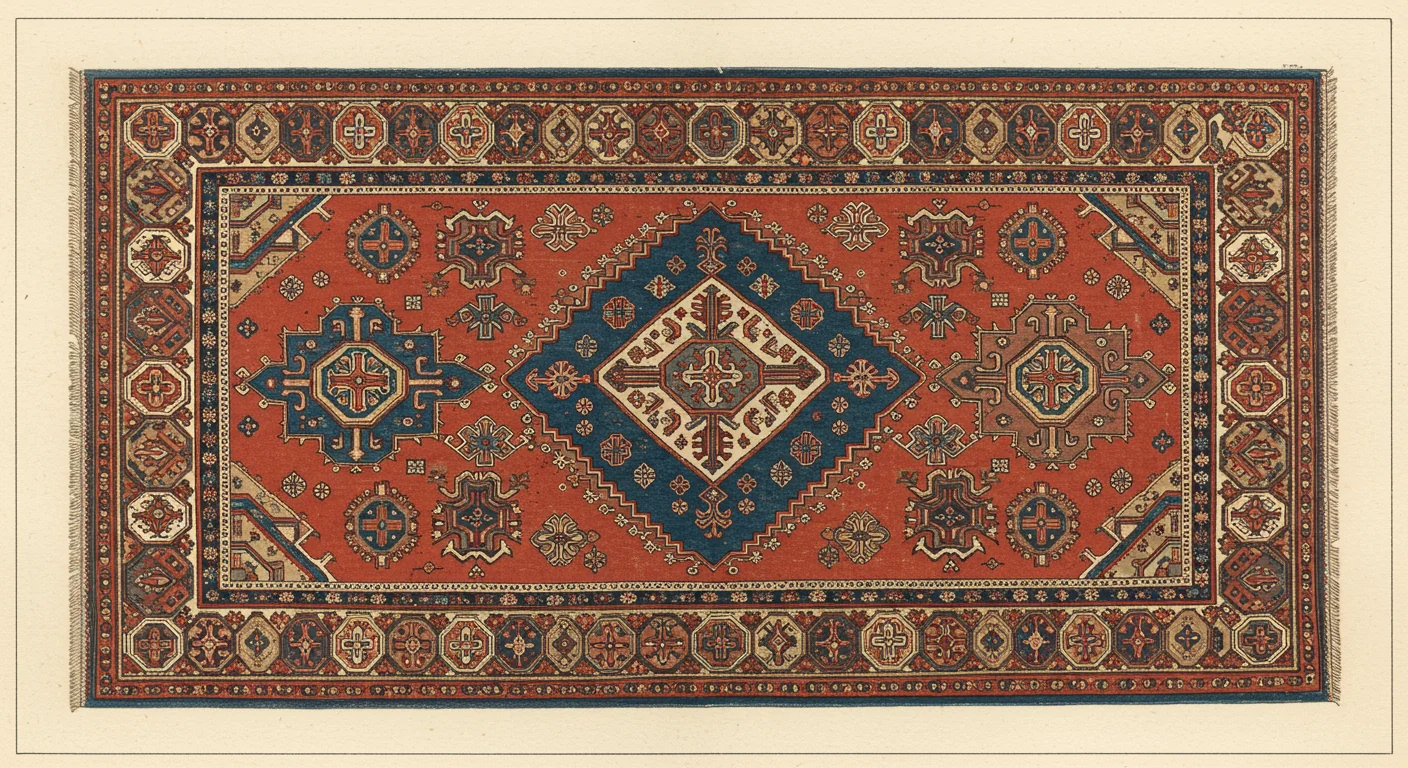
The composition, in the dominant Kazak format, is the bold geometric medallion — a single large medallion (or, in the runner format, two or three vertically-arranged medallions) of stepped angular outline, rendered in saturated indigo or dark navy against a saturated red field, with smaller geometric ornaments scattered across the field and at the corners. The medallion vocabulary is not the curvilinear arabesque of Tabriz, nor the comparatively refined stepped medallion of Heriz; it is more primitive, more emphatically geometric, and considerably bolder in scale relative to the field. A Kazak medallion is the visual event of the rug, and the field exists in some real sense to frame it.
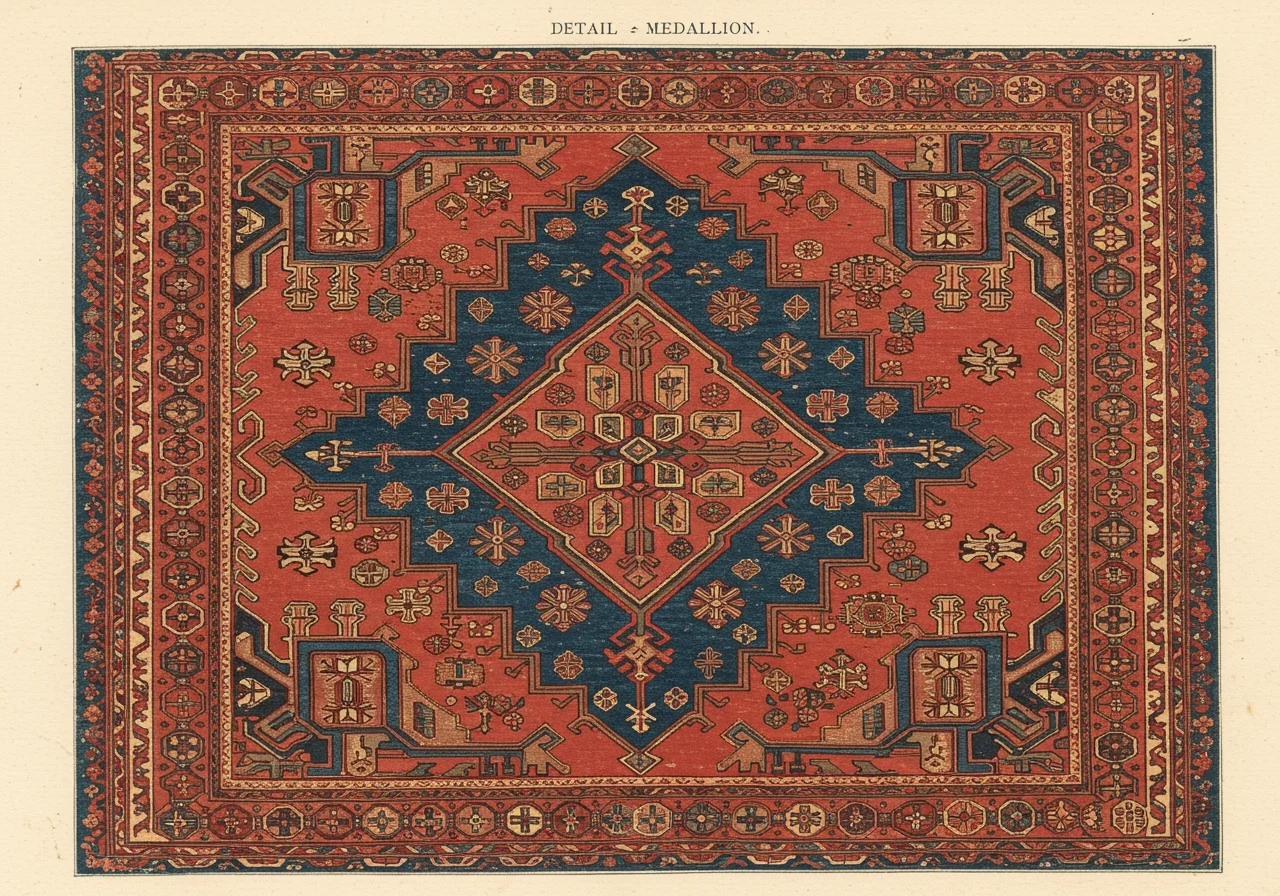
A close detail of a Karachov Kazak central medallion — the large stepped octagonal indigo shape, surrounded by smaller geometric ornaments (cruciform stars, small rosettes, angular palmettes) scattered across the saturated red field. The medallion is the visual event of the rug; the field exists to frame it. Every motif is rendered in straight lines and stepped angles, in the most rectilinear vocabulary the rug arc has shown — more emphatically geometric than the Heriz medallion of the previous post but in the same general direction. The drawing is the tribal-village vocabulary the post is principally about, in pointed contrast to the urban-workshop curvilinear arabesque of the Tabriz.
Several sub-types within Kazak deserve naming, because the Kazak trade name is a broader regional category that covers a number of distinct sub-region vocabularies, each with characteristic medallion shapes.
Karachov Kazak — the type-specimen and the most-collected variant. A large central octagonal indigo medallion with smaller medallions at the top and bottom, all set on a saturated red ground, with ivory corner spandrels and a wide border of latch-hook ornament. The Karachov region is in the south-central Caucasus near the modern Armenian-Azerbaijani border.
Lori Pambak Kazak — a large central diamond medallion with stepped angular outline, often with smaller diamond medallions stacked above and below it on a saturated red ground. The Lori-Pambak region sits in the mountains around Lake Sevan in modern Armenia.
Sewan Kazak (sometimes spelled Sevan) — a large central medallion with characteristic “anchor-and-hook” projections extending from the top and bottom of the medallion, often on an ivory ground rather than the saturated red of the Karachov. From the Lake Sevan region.
Bordjalou Kazak (also Borchalo) — multiple narrow concentric borders of latch-hook ornament surround a central field that may itself carry medallion or allover small-pattern. The deep-bordered composition is the Borchalo signature. From the Borchalo region of southern Georgia.
Akstafa Kazak — known particularly for runner-format pieces with stylised peacock or bird motifs arranged along the long axis. From the Akstafa region in eastern Azerbaijan.
Fachralo Kazak — prayer-rug formats (with the mihrab arch indicating the direction of Mecca) and small medallion pieces. From the Fachralo region in the south.
The colour palette is more saturated than any Persian tradition the arc has shown. The dominant ground is deep tomato-red — verging toward an orange-red rather than the brick-red of Heriz or the rose of Tabriz, often dyed with a combination of madder and lac (the resinous secretion of the lac insect, imported through the Caucasus trade routes). The medallion blue is deep indigo, sometimes with a slight greenish cast. The spandrels are ivory or cream, often quite saturated rather than the muted ivory of Persian work. Vibrant yellow and green accents appear in the smaller field ornaments and in the borders. The whole palette is bolder, more saturated, and more visually arresting than the Persian palettes — and is one of the reasons that Caucasian rugs were prized by the European Arts and Crafts movement of the 1880s and 1890s for their perceived “primitive” vigour, in pointed contrast to the more refined Persian work then dominating the upper end of the market.
The border is, almost universally, a latch-hook border — a wide field of alternating T-shaped or arrow-shaped “hooks” projecting from a central line, in alternating colours (typically ivory and indigo on a red ground, or red and indigo on an ivory ground). Multiple bands of latch-hook ornament are common: a wide main border with one or two narrower guard bands of further latch-hook variants. The latch-hook border is so characteristic of Caucasian weaving generally that its presence on a rug is one of the surest single indicators of Caucasian provenance — a Persian rug with a latch-hook border is uncommon enough that one’s first hypothesis on encountering one should be Caucasian rather than Persian.
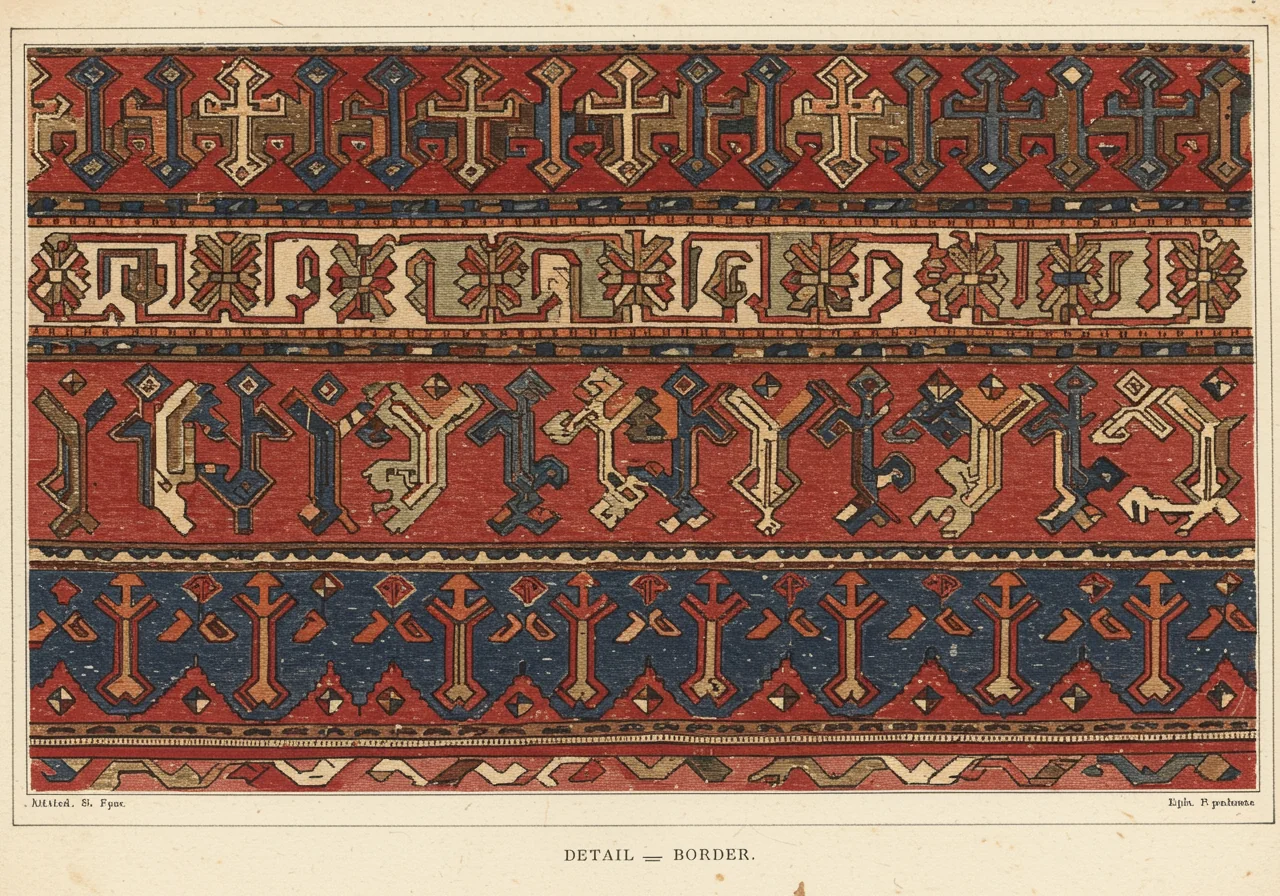
A close detail of a Kazak latch-hook border — the wide main border carrying alternating T-shaped or arrow-shaped ‘hooks’ in ivory and indigo on a red ground, with a narrower guard band of further latch-hook ornament running above and below. The latch-hook is the principal Caucasian border vocabulary, present on essentially every Kazak and most other Caucasian types, and is one of the surest single indicators of Caucasian provenance. A Persian rug with a latch-hook border is uncommon enough that the first hypothesis on encountering one should be Caucasian rather than Persian.
The construction is the second-most-important contrast with the Persian tradition the arc has shown so far. The foundation — warp and weft — is wool rather than cotton. This is the most diagnostically important structural difference between Caucasian rugs and Persian rugs of the period. A wool-foundation rug has a different drape (more flexible, less stiff), a different weight (often lighter for its size), and a different feel in the hand (woollier, more textured) than a cotton-foundation rug of comparable size. The pile is wool, knotted in the symmetrical (Turkish) knot — the same knot as Heriz and Tabriz, geographically expected for the Azeri-Turkic and Armenian populations of the Caucasus. Knot density is moderate to low — fifty to eighty knots per square inch is typical, with some rougher village pieces lower still — which is the structural enabling condition for the bold geometric vocabulary the Kazak tradition has settled on. The pile is long and shaggy — notably longer than Persian workshop pile — which gives the Kazak its distinctive sheepskin-like surface character and contributes to the rug’s substantial physical weight per square foot despite its small format.
The Evidence
Behind the visible composition is the structural evidence by which a Kazak is identified at close range and its provenance dated and attributed.
The foundation, first, and this is the principal evidence one is reading for. A Caucasian Kazak has wool warp and wool weft. The wool foundation is the single most diagnostic feature of the type and the easiest to verify: turn the rug over and look at the fringe (the cotton warp of a Persian rug is white and tightly twisted; the wool warp of a Caucasian rug is off-white or cream and softer, sometimes with visible lanolin sheen) and look at the back of the rug between the rows of knots (the cotton weft of Persian work is a tight white horizontal line; the wool weft of Caucasian work is wider, woollier, and often shows in the same dyed colour as the foundation). The contrast with the cotton-foundation Persian tradition of Heriz and Tabriz is unmistakable to a trained hand, and the rug’s drape and weight will themselves often signal the foundation before close inspection confirms it.
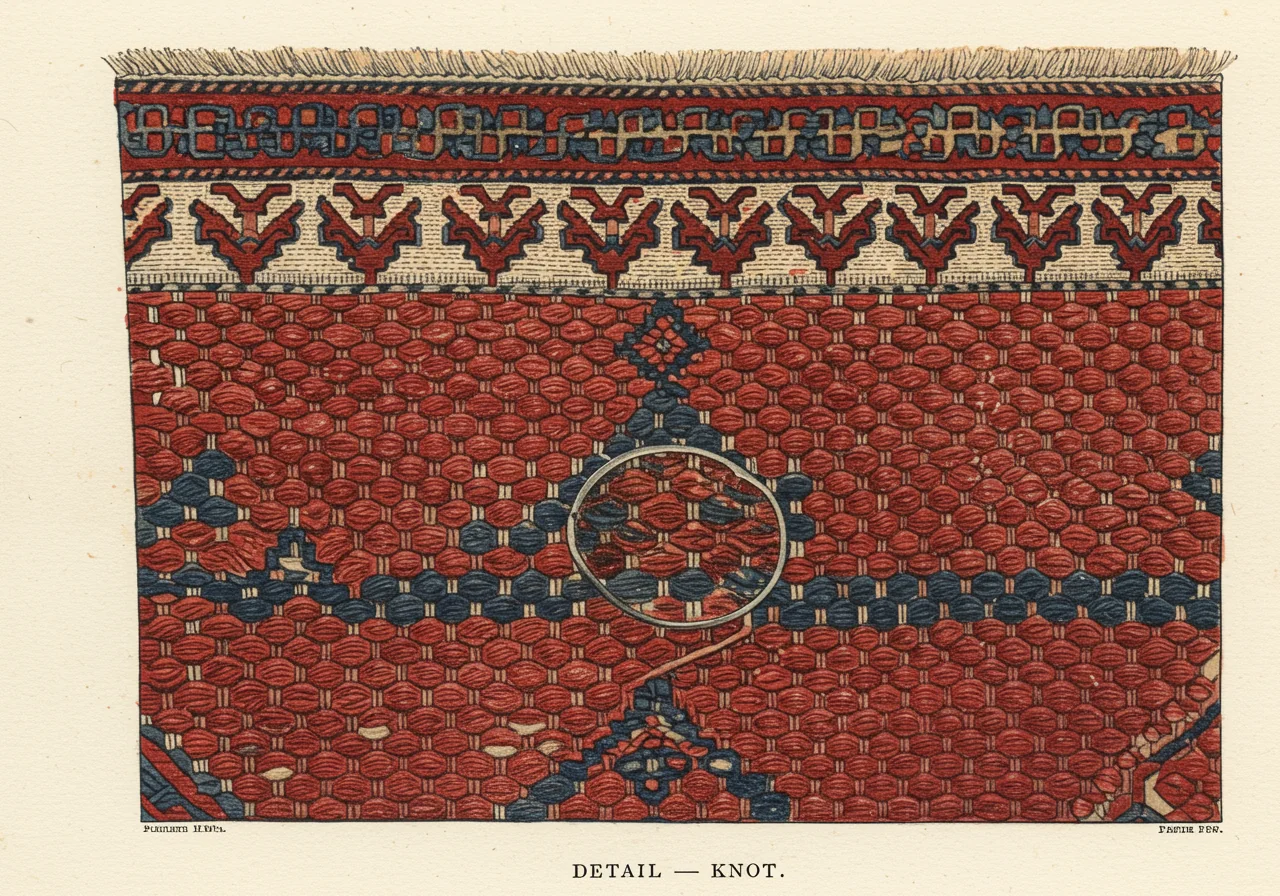
A close detail of the back of a Kazak rug at magnification — symmetrical Turkish knots packed at moderate density (fifty to eighty knots per square inch) in long-pile wool on a wool foundation, with the characteristically wider wool weft visible as a soft horizontal line between rows of knots, and the off-white wool warp visible at the cut edge. The wool foundation is the most diagnostic single feature of the Caucasian tradition and the surest visual separator from the cotton-foundation Persian work shown in the previous two rug posts. Turn the rug over and look: cotton warp is tightly-twisted white, wool warp is off-white and softer, often with visible lanolin sheen.
The knot, second, is the symmetrical (Turkish) knot, with the wool wrapped around two adjacent warps and pulled down between them. A Caucasian rug with the asymmetric (Persian) knot is exceptional and should provoke immediate scepticism about the attribution — the entire Caucasian region uses the Turkish knot consistently, and a Persian-knot rug attributed to the Caucasus is more likely a misattribution than an unusual exception.
The knot density, third, is moderate to low — fifty to eighty knots per square inch is the Kazak commercial range, with the better Karachov pieces sometimes reaching a hundred and the rougher village pieces dropping to forty or below. The low knot count is, as with Heriz, what enables and requires the bold geometric vocabulary. A finer Caucasian piece (Daghestan, Shirvan, the finer Kuba sub-types) will run a hundred and fifty or more knots per square inch; a Kazak running a hundred is at the upper end of the type’s range.
The wool of the pile, fourth, is the distinguishing material signature. Kazak wool comes from the regional flocks of Azerbaijani and Armenian highland sheep, and it is high in lanolin, coarse-fibred, and takes the natural dyes with particular saturation. The long shaggy pile is partly a function of the wool’s character — finer-fibred wool would not give the same effect even cut to the same length — and is one of the reasons that an antique Kazak with its original full pile has a distinctively warm, almost sheepskin-like character at the surface that synthetic-dyed or machine-spun modern reproductions cannot reproduce.
The dyes, fifth, are entirely vegetable in the antique pieces. Madder for the dominant reds (sometimes combined with lac for the deeper tomato variants); indigo for the navy and the deeper blues; isparek (Persian buckthorn) or weld for the yellows; the various plant-derived greens; tinging agents (walnut hull, pomegranate rind) for the browns. The Caucasian palette is somewhat narrower than the Persian — fewer accent colours, more concentrated on the red-indigo-ivory triad — but the dyes are deployed at greater saturation than in any Persian tradition. The synthetic aniline dyes that became available in the region after about 1880 are present in some commercial Kazak production from the 1890s onward; an antique Kazak from this period may show a mix of vegetable and aniline dyes, and learning to distinguish the natural saturation from the chemical saturation is one of the period’s particular pleasures (and pitfalls).
The selvedges of a Kazak are wrapped in wool, usually in alternating bands of two contrasting colours (typically a checkerboard pattern of indigo and ivory, or indigo and red). The ends are typically finished with a substantial kilim section of plain weave in alternating coloured bands, often six to twelve inches deep on the better pieces, before the wool-warp fringe. The Caucasian end-finish is more elaborate than the Persian, and a Kazak with its original kilim ends and wool fringe intact is increasingly rare as household wear shortens both over time.
The Region
The Caucasus is the mountain region between the Black Sea and the Caspian Sea, comprising what is now Azerbaijan, Armenia, Georgia, parts of Dagestan in the Russian North Caucasus, and the easternmost portion of northeastern Turkey. The population is and has historically been a mix of Azerbaijani-Turkic, Armenian, Georgian, Kurdish, Russian-settler, and various smaller mountain peoples. The principal weaving regions for the Kazak trade are concentrated in the southwestern Caucasus — the historical Ganja province (now around the modern Azerbaijani city of Ganja, formerly Elisabethpol or Elisavetpol under the Russian Empire), the Karabagh region of western Azerbaijan, the Lori-Pambak region of northern Armenia, the Borchalo region of southern Georgia, and the Akstafa region of north-western Azerbaijan.
The Kazak name itself, despite its similarity to Kazakh, has no etymological or actual relationship to the modern country of Kazakhstan. The name comes from the Cossack peoples of the Russian-Caucasian frontier — Turkic-and-Slavic warrior populations who settled the southwestern Caucasian highlands from the seventeenth century onward and who, in the European-collector market of the late nineteenth century, became associated with the bold geometric rugs of the region in a way that produced the current trade name. Whether the actual weavers of the canonical Kazak rugs were ethnically Cossack is doubtful — most production was by Azerbaijani Turkic and Armenian village women — but the name attached itself to the type in the European collector vocabulary of the 1880s and 1890s and has remained.
The carpet-weaving tradition of the Caucasus can be documented to the medieval period. The famous Dragon carpets of the seventeenth century — large carpets, sometimes ten or twelve feet long, with stylised dragons rendered in palmette-and-cartouche compositions on dark red grounds, woven for the Safavid and Ottoman court markets in the Karabagh region — are the documentary antecedent of the modern Caucasian tradition. Surviving Dragon carpets are now in major museum collections (the Metropolitan Museum, the Victoria and Albert, the Textile Museum in Washington) and establish the formal vocabulary from which the later Caucasian rugs descend, even when the descent is at considerable simplification. The intermediate Eagle Kazaks (sometimes called Adler Kazaks or Chelaberd Kazaks) of the eighteenth century are the simplifying link between the elaborate Dragon carpets and the bold geometric Kazaks of the nineteenth century — large stylised eagle or double-headed bird motifs that gradually simplified into the medallion vocabulary of the later type.
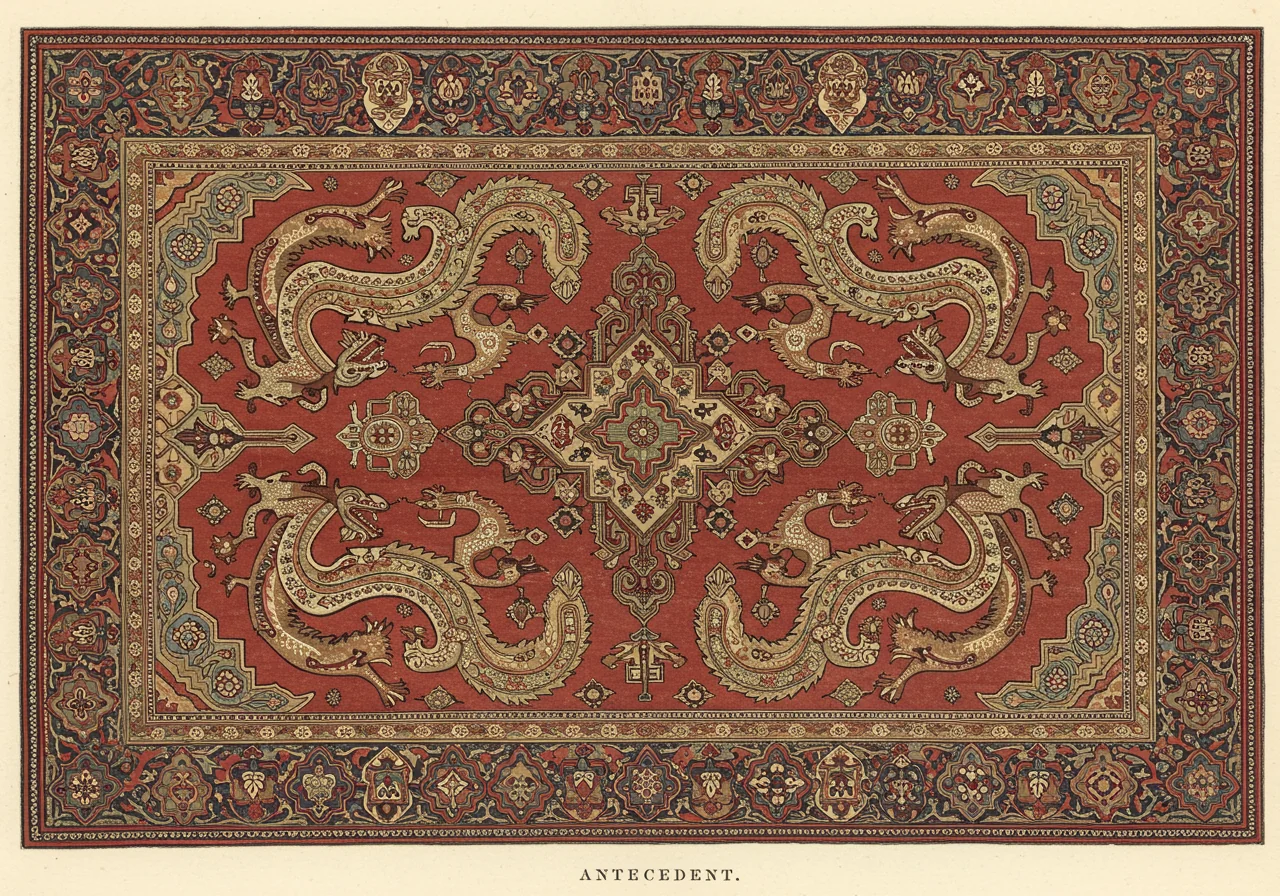
A seventeenth-century Caucasian Dragon carpet from the Karabagh region — stylised dragons (the long curving forms in the lower portion of the field) rendered in a palmette-and-cartouche composition on a dark red ground, woven for the Safavid court market. The Dragon carpets are the documentary antecedent of the modern Caucasian tradition: surviving examples in the Metropolitan Museum, the Victoria and Albert, and the Textile Museum in Washington establish the formal vocabulary from which the later Kazak descended through several centuries of progressive simplification. The intermediate Eagle Kazaks of the eighteenth century are the bridge between this elaborate court vocabulary and the bold geometric Kazaks of the nineteenth-century European export market.
The modern Kazak export market emerged in the 1850s and 1860s as the Russian Empire, which had completed the annexation of the southern Caucasus from Persia in 1828 (the Treaty of Turkmenchay), opened the region to European trade. The principal export route was through Tiflis (modern Tbilisi, the capital of Georgia), then by road to Batumi on the Black Sea coast, then by ship to European ports. The completion of the Caucasian Railway connecting Tiflis to the Russian rail network in the 1880s accelerated the trade considerably, and by 1890 the Caucasian rugs were a substantial category in the European collector market — sold particularly through Vienna, Munich, Hamburg, and London, with a smaller American market through New York and Boston.
The peak period of Kazak production was roughly 1870 to 1914. The First World War, the Russian Revolution, and the subsequent Soviet collectivisation of the 1920s and 1930s effectively ended the commercial export tradition: village production continued at substantially reduced volume and quality through the Soviet period, with most Soviet-era Caucasian production being made for Soviet domestic use rather than for the European market. By 1990 the village weaving tradition of the Caucasus had largely disappeared as a continuing commercial activity, surviving only in revivals and in modern collector-market reproductions that have themselves become a category of their own.
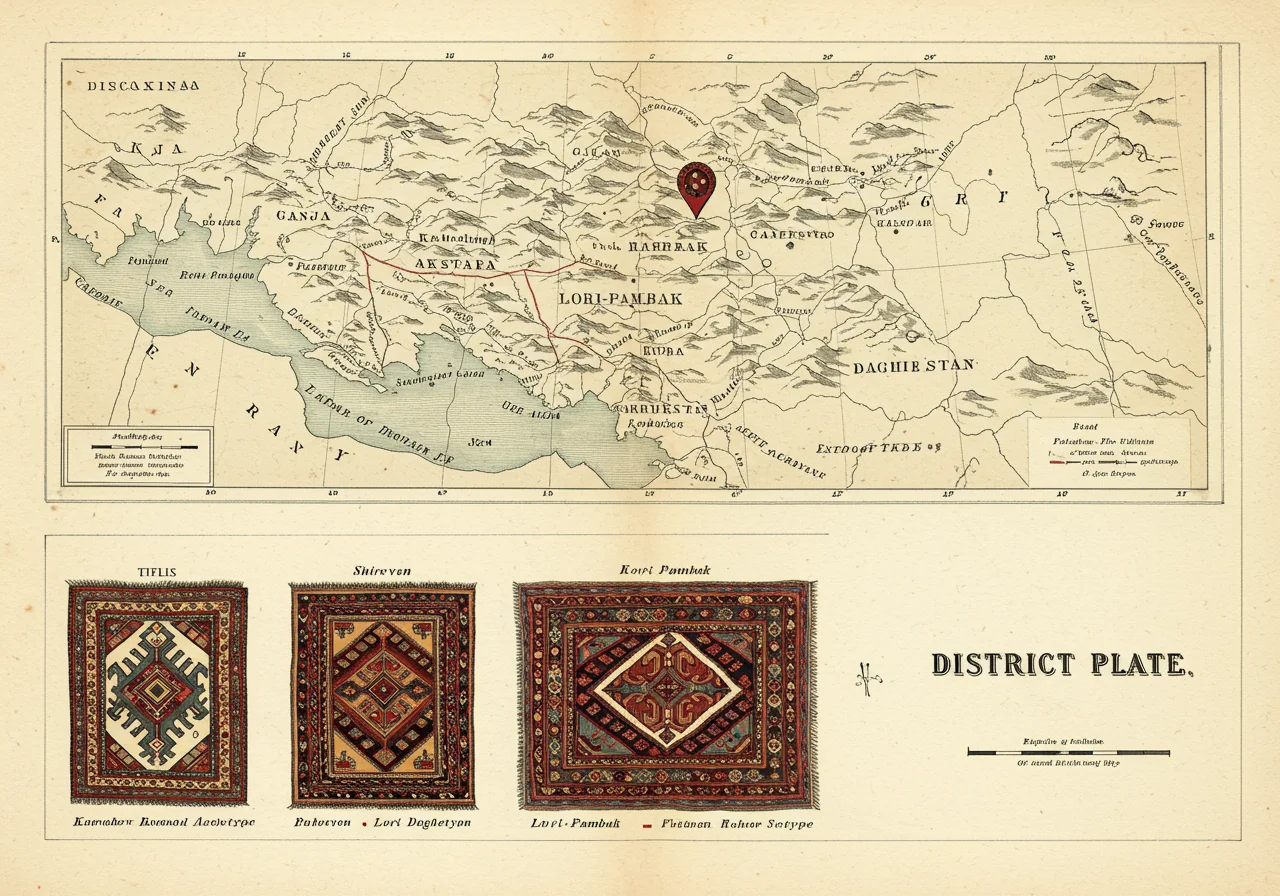
A page from a Victorian connoisseur’s portfolio on the Caucasus rug-weaving region — the district map locating the principal sub-regions of Caucasian weaving (Ganja, Karabagh, Lori-Pambak, Borchalo, Akstafa in the south-western Kazak-producing zone; Shirvan, Kuba, Daghestan in the eastern and northern finer-weaving zones) on a map of the southern Caucasus, with three small archetype rug drawings at the bottom showing the principal Kazak sub-type designs (Karachov medallion, Lori-Pambak diamond, Sewan anchor-hook). The plate is the kind of reference page that would have appeared in the serious European dealer portfolios of the 1880s and 1890s, and is what one consults when trying to locate a candidate Caucasian rug within the broader regional taxonomy.
A note on the dating of antique Kazaks, because the chronology matters for both collector interest and price. Pre-1860 pieces are rare and largely museum-held. 1860–1880 pieces (the first generation of the modern export trade) are the most-prized antique Kazaks and command the highest current prices — these are the pieces with the fullest vegetable-dye palette, the most individualistic weavers’-hand drawing, and the most authentic tribal character. 1880–1900 pieces are the standard antique-grade — solid commercial work, often still on natural dyes, generally well-drawn, the substantial bulk of the surviving antique inventory. 1900–1914 pieces are still antique by most dealer definitions but often show the first aniline-dye intrusions and somewhat more standardised drawing. 1914–1920s pieces are increasingly rare as wartime and revolution disrupted production. Soviet-era (1920s–1980s) Caucasian production is generally not classed as antique in the collector vocabulary, with quality varying considerably across the period.
What It Is Not
Several rug types stand near enough to Kazak that the beginner confuses them with it, and distinguishing them is most of the work of reading the Caucasian weaving tradition.
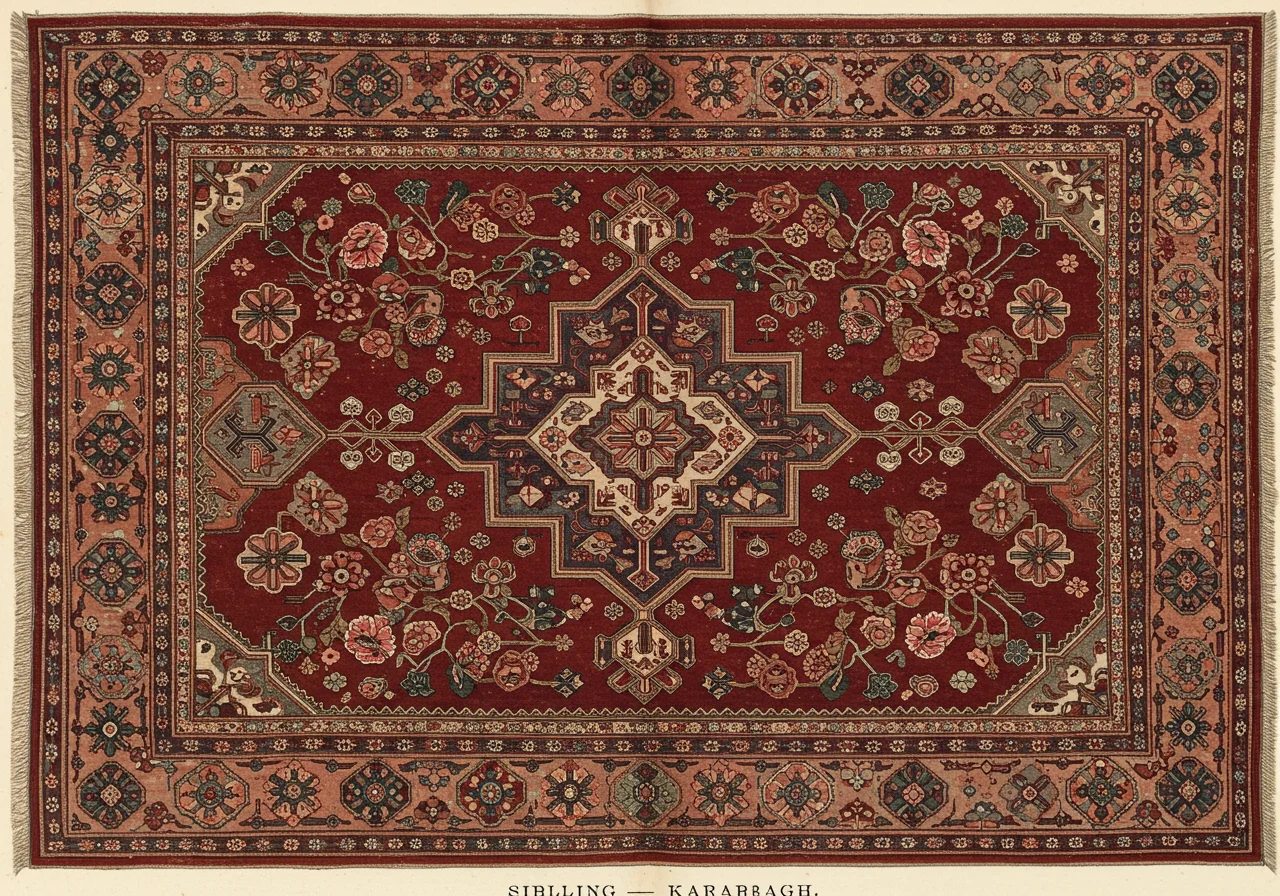
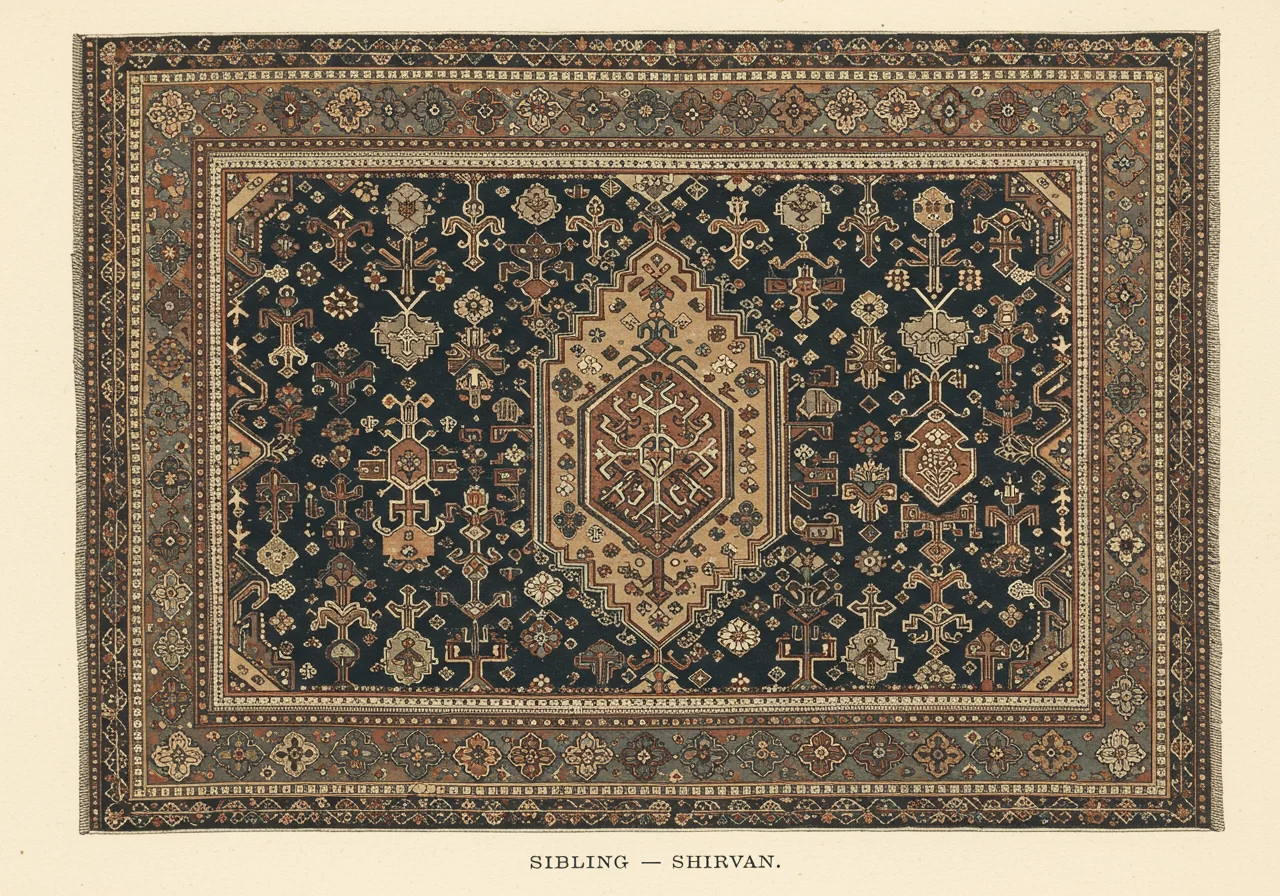
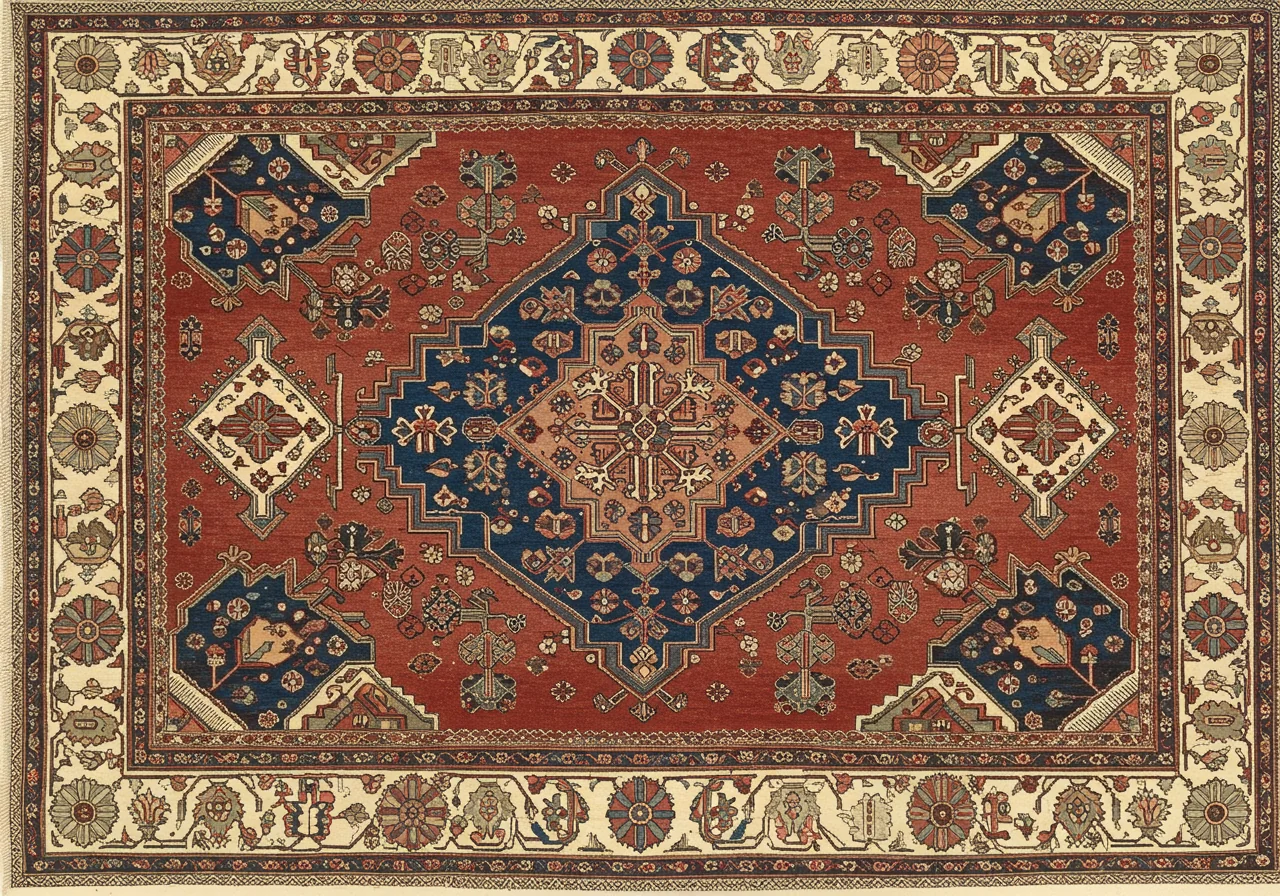
A Karabagh is the rug from the Karabagh region of southwestern Azerbaijan — the same broader geographic zone as the Kazak-producing villages, but with a distinct workshop-and-village tradition that produced rugs of more refined drawing and (after about 1850) often with French-influenced floral vocabulary in the field. The “Karabagh rose” — a stylised pink-and-red rose drawn in the late-nineteenth-century European-decorator manner — appears on many Karabagh rugs of the period and is a strong identifier of the type. Karabagh rugs often have a darker overall palette than Kazak (deeper reds, navy grounds rather than brick-red), and the drawing is more refined and less aggressively tribal. The rule of thumb: bold tribal medallion with latch-hook border is Kazak; refined Karabagh-rose vocabulary on a darker ground is Karabagh.
A Shirvan is the rug from the Shirvan region of eastern Azerbaijan (around modern Baku). Shirvan rugs are typically smaller than Kazak (three by five to four by six feet is common), with substantially finer knot count (a hundred to a hundred and fifty kpsi rather than the Kazak’s fifty to eighty), more rectilinear allover field designs (less emphasis on the bold central medallion), and often in prayer-rug format with the characteristic mihrab arch. Shirvan is one of the finer Caucasian traditions, and the type’s smaller format and finer drawing place it closer to the eastern Caucasian finer-weaving zone (Kuba, Daghestan) than to the Kazak’s southwestern tribal zone. The rule of thumb: large bold geometric medallion in saturated red is Kazak; small finely-knotted rectilinear allover field is Shirvan.
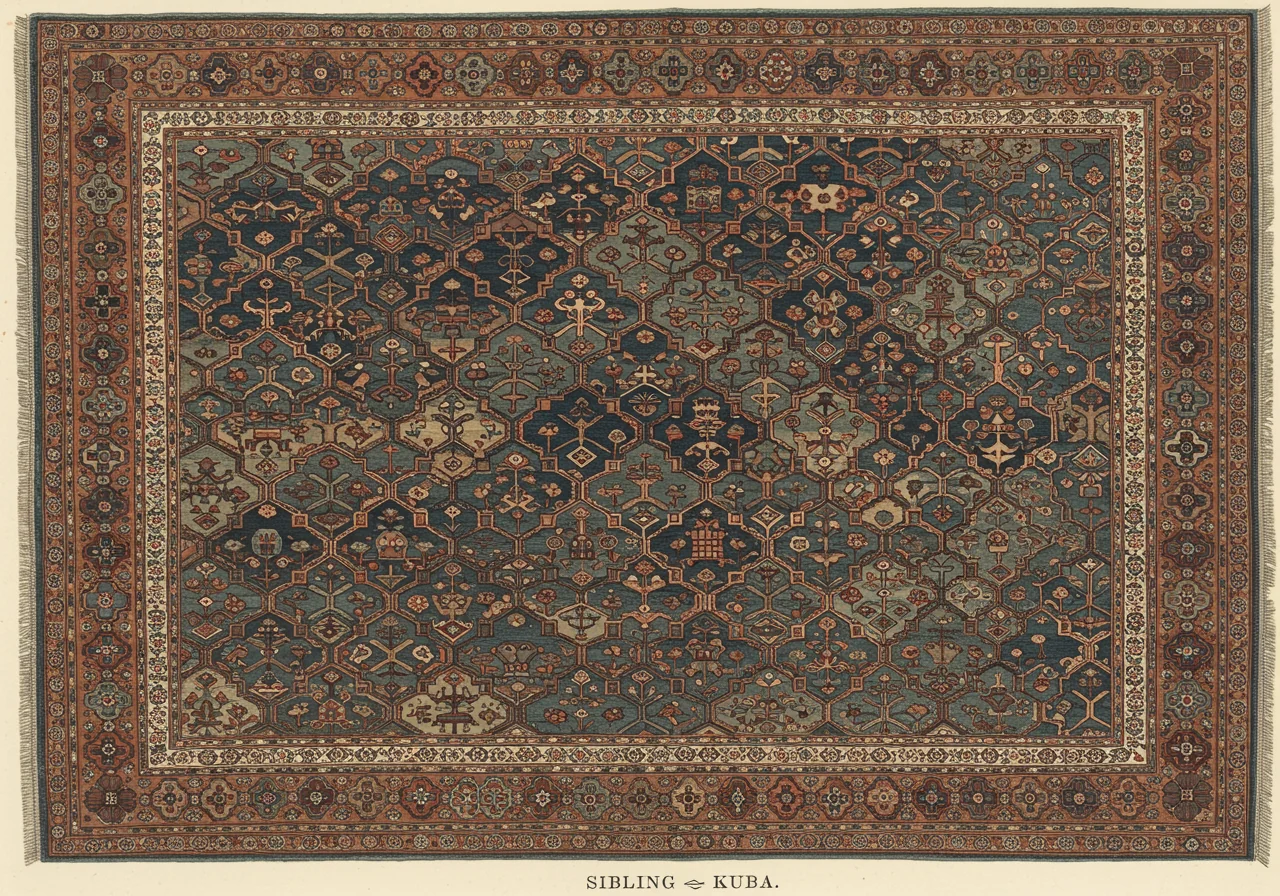
A Kuba is the rug from the Kuba region of northeastern Azerbaijan (around the city of Kuba on the Caspian-coast plain). Kuba is the finer of the Caucasian traditions, with multiple distinctive sub-types (Konagkend, Perepedil, Seichour, Chichi) each of which has its own characteristic vocabulary. Kuba rugs generally have small-pattern allover field designs rather than bold central medallions, often quite refined drawing, and the Perepedil sub-type in particular carries the distinctive “wurma” (curling-ram’s-horn) motif that is a strong Kuba identifier. Kuba rugs are smaller than Kazak (the format is typically three by five to five by seven), and the finer drawing and quieter palette distinguish them visually at a distance. The rule of thumb: bold saturated central medallion is Kazak; refined small-pattern allover field with characteristic sub-type motifs is Kuba.
A Heriz — the Persian village rug treated in the first post in the arc — is the most-confused-with type for the Kazak beginner, because the two traditions share a great deal of design vocabulary (bold geometric, stepped medallion, ivory spandrels, saturated reds), share the Turkish knot, and sit only sixty kilometres apart geographically. The decisive separator is the foundation: Heriz is cotton, Kazak is wool. The secondary separators are: the Kazak palette is more saturated (deeper tomato-red versus Heriz brick-red, deeper indigo versus Heriz navy); the Kazak format is smaller (Kazak is four-by-six to six-by-eight, Heriz is room-size); the Kazak border is latch-hook (Heriz uses a walnut-brown vine-and-palmette pattern); the Kazak knot count is lower than Heriz (fifty to eighty kpsi versus Heriz’s sixty to a hundred). Together these differences are sufficient to separate the two types reliably, but the design vocabulary is similar enough that a careful inspection is required for a candidate piece. The rule of thumb: wool foundation, smaller format, more saturated palette, latch-hook border is Kazak; cotton foundation, room-size, brick-red palette, walnut border is Heriz.
These are the four most-confused-with types within the Caucasian tradition and across the immediate Persian frontier. There are others (the Turkmen Tekke and Yomut share some Kazak vocabulary but use Turkmen-specific gul motifs and a darker overall palette; the various smaller Caucasian villages produce idiosyncratic local variants), but the four above account for the great majority of misattributions in the wild.
What One Looks At
The practical discipline of identifying a Caucasian Kazak, when one is standing in front of a candidate rug, comes down to a short ordered checklist.
One looks first at the foundation. Wool warp and wool weft is the Caucasian signature. Cotton foundation makes it a Persian rug — most likely Heriz, Bidjar, or one of the central-Iranian workshop traditions. Inspect the fringe (white tight cotton versus off-white soft wool) and the back of the rug (cotton weft as a tight white line versus wool weft as a wider woollier line). The foundation is decisive at first inspection and is the single most important evidence the post is teaching the reader to read.
One looks next at the format. Four-by-six to six-by-eight is the canonical Kazak range. A runner format (three feet wide and seven to twelve long) is consistent with Kazak (particularly Akstafa). A room-size format (nine by twelve or larger) is inconsistent with Kazak and suggests Persian provenance — even with wool foundation, a room-size geometric rug is unlikely to be Kazak.
One looks at the design vocabulary. Bold geometric medallion — stepped angular outline, often with smaller medallions stacked above and below, scattered geometric ornaments across the field, latch-hook border — is the Kazak signature. If the design is curvilinear it is not Caucasian at all. If the design is geometric but with a refined small-pattern allover field, it is more likely Shirvan or Kuba than Kazak. If the design is the Karabagh-rose floral vocabulary, it is Karabagh.
One looks at the palette. Deep tomato-red ground, deep indigo medallion, vibrant ivory spandrels with yellow and green accent colours is the Kazak palette. If the palette is brick-red and walnut and muted ivory, the rug is more likely Heriz. If the palette is the darker navy-and-burgundy of the eastern Caucasus, the rug is more likely Karabagh or Shirvan.
One looks at the border. Wide latch-hook border with one or two narrower latch-hook guard bands is the Caucasian signature. The latch-hook is the surest single visual identifier of Caucasian (versus Persian) provenance, and its presence settles much of the regional question on first inspection.
One looks at the knot. Symmetrical Turkish knot at fifty to eighty knots per square inch is the Kazak commercial range. The Turkish knot is expected; a Persian-knot rug attributed to the Caucasus warrants scepticism. The low knot density is consistent with the bold vocabulary the type uses.
One looks at the pile. Long shaggy wool pile with substantial physical weight per square foot is the Kazak character. If the pile is short and finely cut, the rug is more likely Persian workshop or one of the finer Caucasian types (Kuba, Daghestan, Shirvan).
And one looks at the wear pattern and the dyes. Vegetable dyes age into patina; aniline dyes age into flatness. In the better antique pieces (pre-1900) one is looking at vegetable dyes throughout; in the 1900–1914 period the mix is common; in Soviet-era pieces the dyes are often mixed or entirely synthetic. The wear pattern of an old Kazak is silvery in the high-traffic centre, more saturated in the protected margins, and the long pile means the worn areas are more visible than on a short-pile rug.
The next post in the rug arc will be either Bakshaish — the older Heriz district village tradition that the Heriz post pointed toward but did not treat in detail, and which would complete the northwestern Persian triangle (Heriz / Tabriz / Bakshaish) — or one of the eastern Caucasian types (most likely Shirvan or Kuba), which would extend the Caucasian region now opened. The choice will depend on what photographic material is available at the time of writing.