The three prior posts in this arc — Louis XV, Louis XVI, and Biedermeier — described one diagonal across the eighteenth- and early-nineteenth-century European furniture landscape: the French royal tradition from rocaille curve through neoclassical straight line, and the Continental bourgeois reaction that displaced both. What that diagonal does not yet contain is the Anglophone response to the same rococo impulse — the body of work that English cabinet-makers produced in parallel to the French royal tradition, drawing on the same Parisian sources but executing them in a different material register for a different patron class. That body of work has a single common name: Chippendale. The post that follows is what the Louis XV post pointed toward across the Channel.
English Chippendale is, in the strict accounting, the Anglophone translation of the French rococo into the cabinet-making vocabulary of mid-eighteenth-century London. Where the Parisian ébénistes worked the rococo in marquetry-veneered exotic woods with gilt-bronze ormolu mounts, the London cabinet-makers worked it in solid mahogany with carved-rather-than-applied ornament. The same impulse — the broken symmetry, the asymmetric scroll, the rocaille shell, the cabriole leg — passed through the Channel and arrived in a different language. Where Louis XV addressed the French royal court, Chippendale addressed the English country gentleman; where Louis XV ornamented through applied gilt-bronze, Chippendale ornamented through carved wood; where Louis XV was anonymous workshop production within the Jurande des Menuisiers-Ébénistes, Chippendale was signed-and-published from the start. The two styles are siblings of the same period, but the difference in material register is most of what one needs to know to distinguish them at three paces.
This is the fourth post in Reading the Period Cabinet, and the first to leave the Continental tradition for the English one. It treats Chippendale fourth not because Chippendale is less important than the Continental styles already covered — it is in fact more documentarily anchored than any of them — but because the Louis XV/XVI pair had to be in place before the cross-Channel translation could be read against its source.
The Specimen
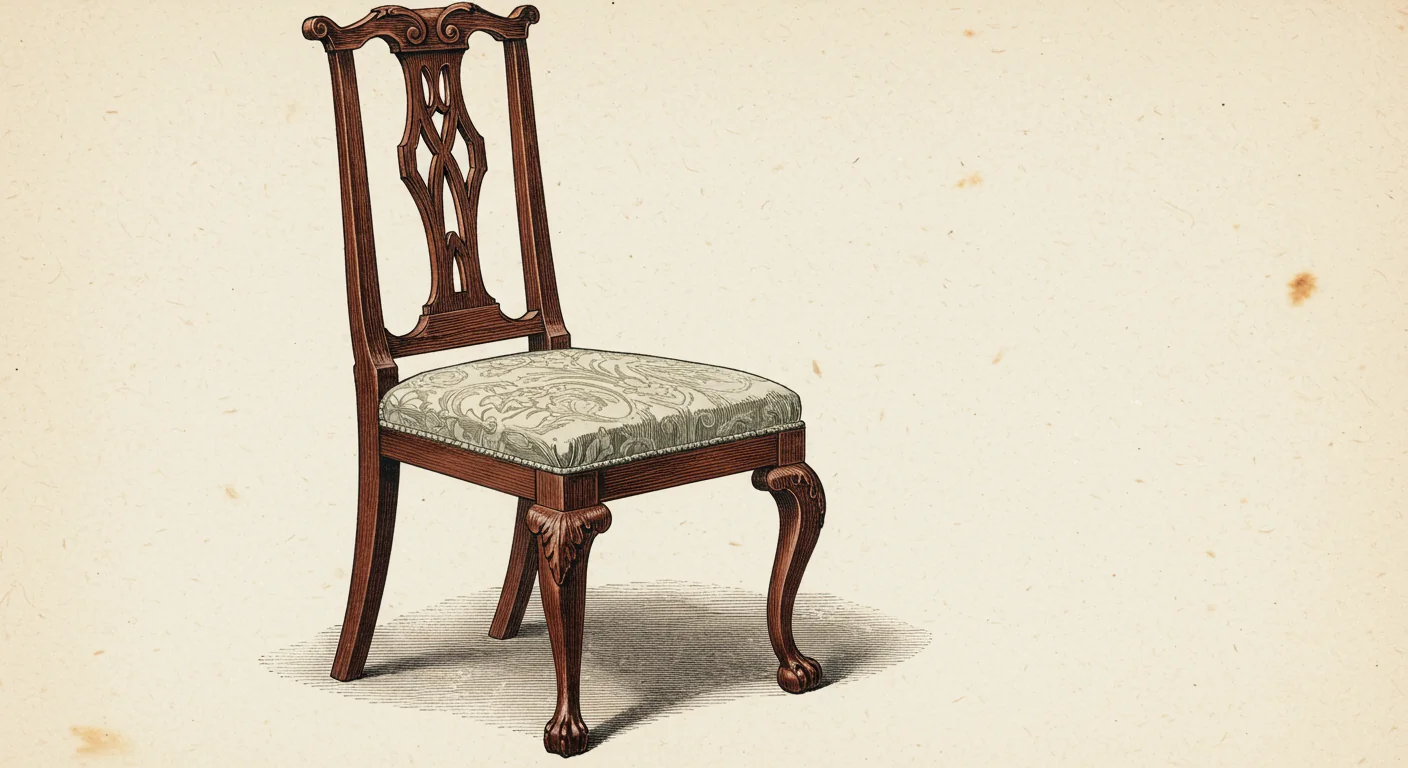
The canonical Chippendale piece, for the purposes of beginning to read the style, is the side chair — the dining-room chair that the country-house dining suite reproduced in eight or twelve identical examples, and that the Director (Chippendale’s 1754 pattern book, of which more shortly) illustrated in the greatest profusion. The chair is the form in which the Chippendale principles are most fully concentrated, and its ball-and-claw foot is the single most-recognisable Chippendale signature.
A canonical Chippendale side chair, then. It stands on four legs of the cabriole form — the S-curved English-and-French rococo leg, curving outward at the knee and inward at the ankle, terminating in a foot of one of two types: the ball-and-claw (a carved bird’s-foot gripping a ball, the most-recognisable terminus, derived ultimately from the Chinese long-and-pearl motif via the late-seventeenth-century English East-India trade) or the simpler paw foot. At the knee of each leg, a carved acanthus scroll or carved shell provides the principal applied ornament, executed in the wood of the leg itself rather than as an applied mount. The seat is a drop-in upholstered seat, covered in silk damask, needlework, or — for the country registers — leather. Above the seat, the chair’s back rises as a frame for the splat, which is the principal locus of ornamental work and the principal differentiator between Chippendale’s three published registers.
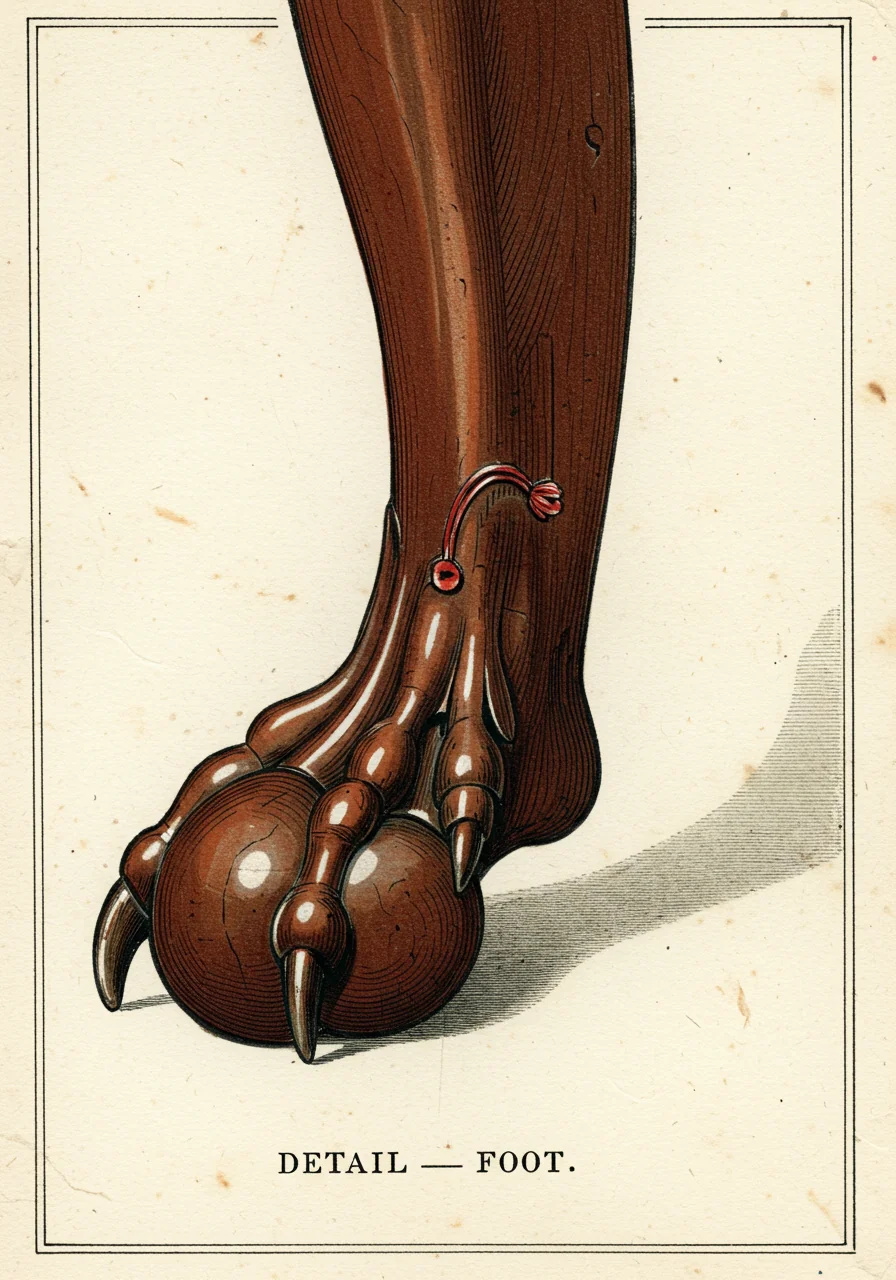
A close detail of a Chippendale ball-and-claw foot on cabriole leg — the canonical English rococo form-signature, the carved bird’s-foot talons gripping the ball at the leg’s terminus. The form descends from the Chinese long-and-pearl motif via the English East-India trade and the Queen Anne period that preceded Chippendale, but it was the Director that codified it across the broader London cabinet trade. The carving is in the wood of the leg itself; this is the principle that distinguishes the English register from the French ormolu equivalent.
The Director illustrated three distinct registers, and the distinction matters for attribution. The standard (or French-influenced) Chippendale carries a pierced-and-carved splat in rococo vocabulary — the ribbon-back (carved to suggest a knotted silk ribbon, the most virtuosic of the published designs) is the apex form. The Gothic Chippendale splat carries pointed-arch tracery and quatrefoils in conscious quotation of medieval window-work. The Chinese Chippendale splat carries rectilinear fretwork in conscious quotation of Chinese architectural lattice. All three registers appeared in the Director, all three were produced by Chippendale’s workshop and by the London cabinet-trade at large, and the three were often combined in a single country-house suite — standard Chippendale chairs alongside Gothic-Chippendale side tables alongside Chinese-Chippendale china cabinets.
The decorative apparatus, beyond the splat and the foot, has two further components. The first is the carving across the chair’s other elements — the acanthus at the knees, the gadrooning along the seat-rail, the scrolled cresting at the back’s top — all executed in the chair’s mahogany itself rather than as applied ornament. The second is the brass hardware, where the form requires it: escutcheons and bail handles on the case furniture, brass-bound mouldings on the better pieces. Chippendale brass is restrained in register compared to the contemporary French ormolu — smaller in scale, simpler in casting, more obviously workmanlike. A Chippendale piece beside a Louis XV piece reads at once: the English piece is carved, the French piece is applied, and that single distinction carries most of the differentiation.
The Evidence
The wood, first, and the wood is most of what one is reading for. Solid mahogany is the canonical Chippendale material, with the better pieces using Cuban mahogany (the densest and most figured of the period’s tropical-American mahogany supply, imported through London via the West India trade) and the country-grade work using Honduras or Jamaican mahogany. The mahogany is solid rather than veneered — Chippendale chairs are carved from solid mahogany blocks, and the carving exposes the wood’s figure at every cut. This is the structural enabling condition for the carved-rather-than-applied ornament: solid mahogany takes deep carving without splintering, where the French walnut-veneered carcase work could not. The mahogany is also what gives the Chippendale piece its characteristic deep red-brown patina, the colour that two and a half centuries of furniture wax and natural oxidation produce on Cuban mahogany.
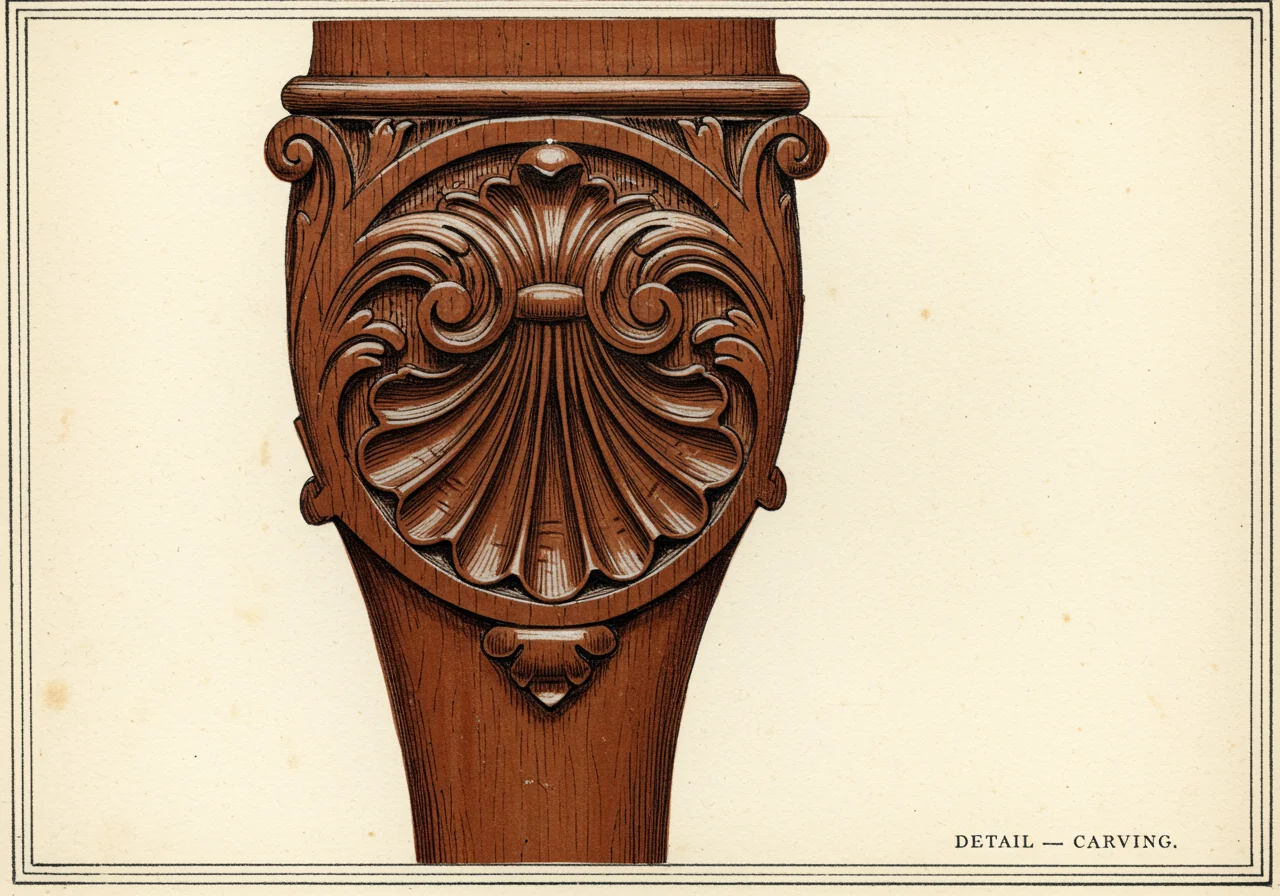
A close detail of Chippendale carved ornament on a chair knee — the acanthus scroll and shell motif carved in the solid mahogany of the cabriole leg itself, not applied as a separate mount. The carved-not-applied principle distinguishes English Chippendale from the contemporary French ormolu tradition at the most fundamental material register, and is most of what one needs to read at the leg to settle the broad attribution.
The construction, second. Hand-cut dovetails of period irregularity on the case furniture, the dovetails proportioned and spaced by the workshop hand rather than a machine. Period brass hardware where the form requires it, cast and chased by the contemporary London brass-trade — Gilbert Wright, Charles Hoole, and the broader brass-founders’ shops that supplied the major cabinet workshops. The seat rails and the chair’s structural members should be examined for evidence of period tools and hand-finishing rather than any modern restoration. Original upholstery is essentially impossible to find intact on antique Chippendale seating — the upholstery wore out within a generation and was replaced — and a Chippendale chair with original upholstery is a rare and substantial provenance event.
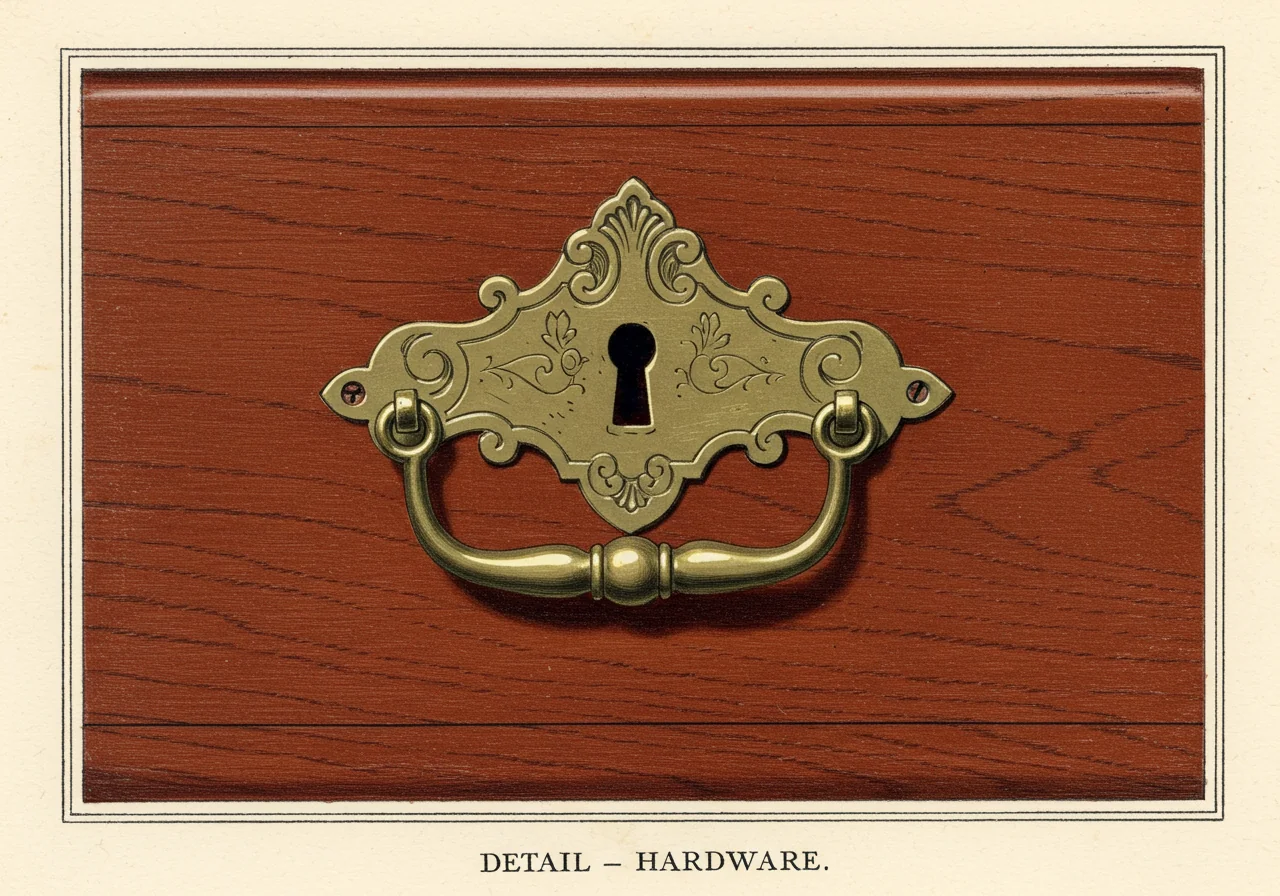
A close detail of Chippendale brass hardware — the rococo-cartouche escutcheon and bail handle on a mahogany drawer front. The brass is restrained in register: smaller in scale, simpler in chasing, more obviously workmanlike than the contemporary French ormolu. This is the English hardware vocabulary the Director illustrated and that the broader London cabinet-trade then reproduced.
The Period
The Chippendale period proper runs from about 1750 to about 1780, with the documentary anchor being Thomas Chippendale’s The Gentleman and Cabinet-Maker’s Director, first published in 1754 and reissued in two subsequent editions (1755 and 1762). Chippendale himself (1718–1779) operated his workshop at 60 St. Martin’s Lane, London, from 1753 until his death; the workshop continued under his son Thomas Chippendale the Younger until 1820. The principal documented commissions are for the great Whig country houses of the period — Harewood in Yorkshire (the largest documented ensemble), Nostell Priory, Dumfries House in Ayrshire, Burton Constable — and the surviving workshop accounts, together with the Director plates, constitute the documentary basis for modern Chippendale attribution.
The Director itself is the single most consequential document in English furniture history, and an account of it is what most distinguishes a Chippendale post from a post on the styles already covered. The book was published by Chippendale in 1754 by subscription, the subscribers including the major Whig peers and the broader London cabinet trade. It illustrated, across some hundred and sixty plates, the full range of Chippendale’s workshop production — side chairs, library chairs, dining tables, dressing tables, china cabinets, library bookcases, beds, mirror frames — in all three Chippendale registers. The Director’s principal effect was not to advertise Chippendale’s own shop, though it did that too, but to codify the Chippendale register across the broader London cabinet trade. Most surviving pieces in the Chippendale register were not made by Chippendale’s St. Martin’s Lane workshop but by other London cabinet-makers (Wright and Elwick of Wakefield; Vile and Cobb; Ince and Mayhew) and by provincial workshops working from copies of the Director. The trade name “Chippendale” attached itself, in the nineteenth-century collector market, to the whole body of work in the Director register rather than to the narrow body of pieces produced by Chippendale’s own shop. This is the attribution-complication every serious collector eventually meets: a documented Chippendale-shop piece commands a substantial premium over an equivalent piece in the same register from another workshop, but the distinction at first inspection is not always available. The Director plates are the principal reference tool; the workshop records are the second-order evidence; the carving’s hand and the construction’s quality are what the connoisseur reads at close range when neither is available.
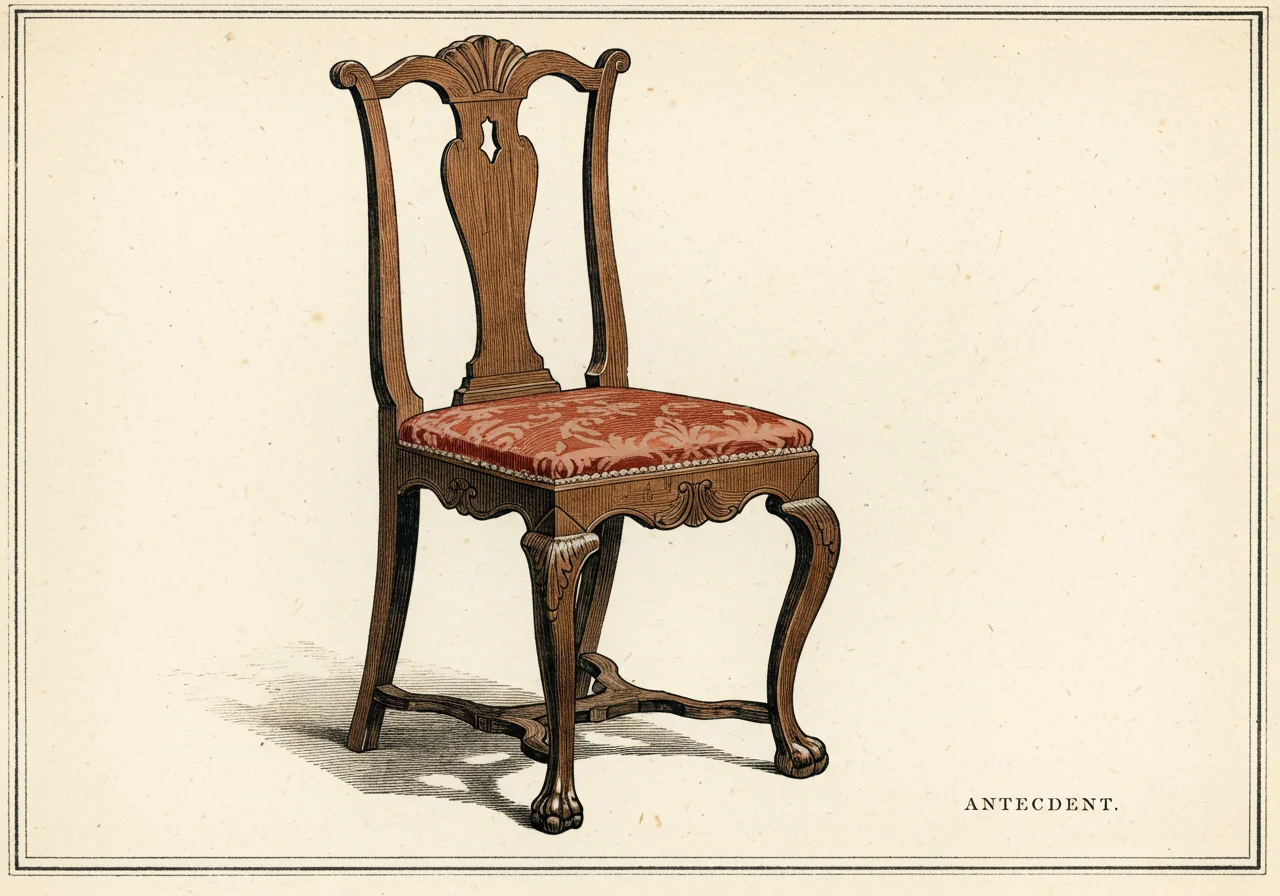
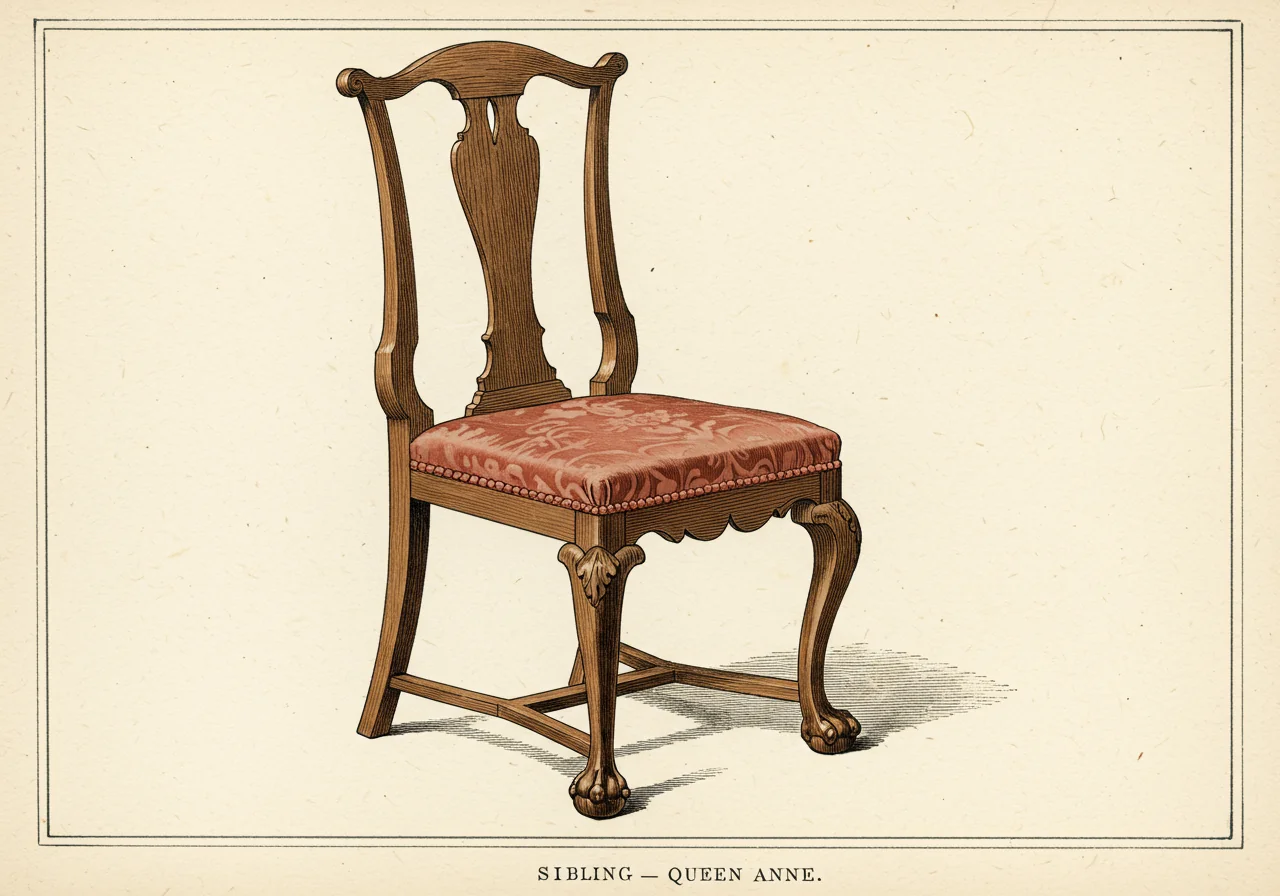
A Queen Anne English walnut chair of about 1720–1740 — the predecessor English style that the Chippendale period elaborated. The cabriole leg is present, but with a pad foot rather than ball-and-claw; the splat is vase-shaped and undecorated rather than pierced-and-carved; the wood is walnut rather than mahogany. The Chippendale period inherited the Queen Anne form and added the rococo ornament, the carved foot, and the mahogany substitution that became the English mid-eighteenth-century cabinet vocabulary.
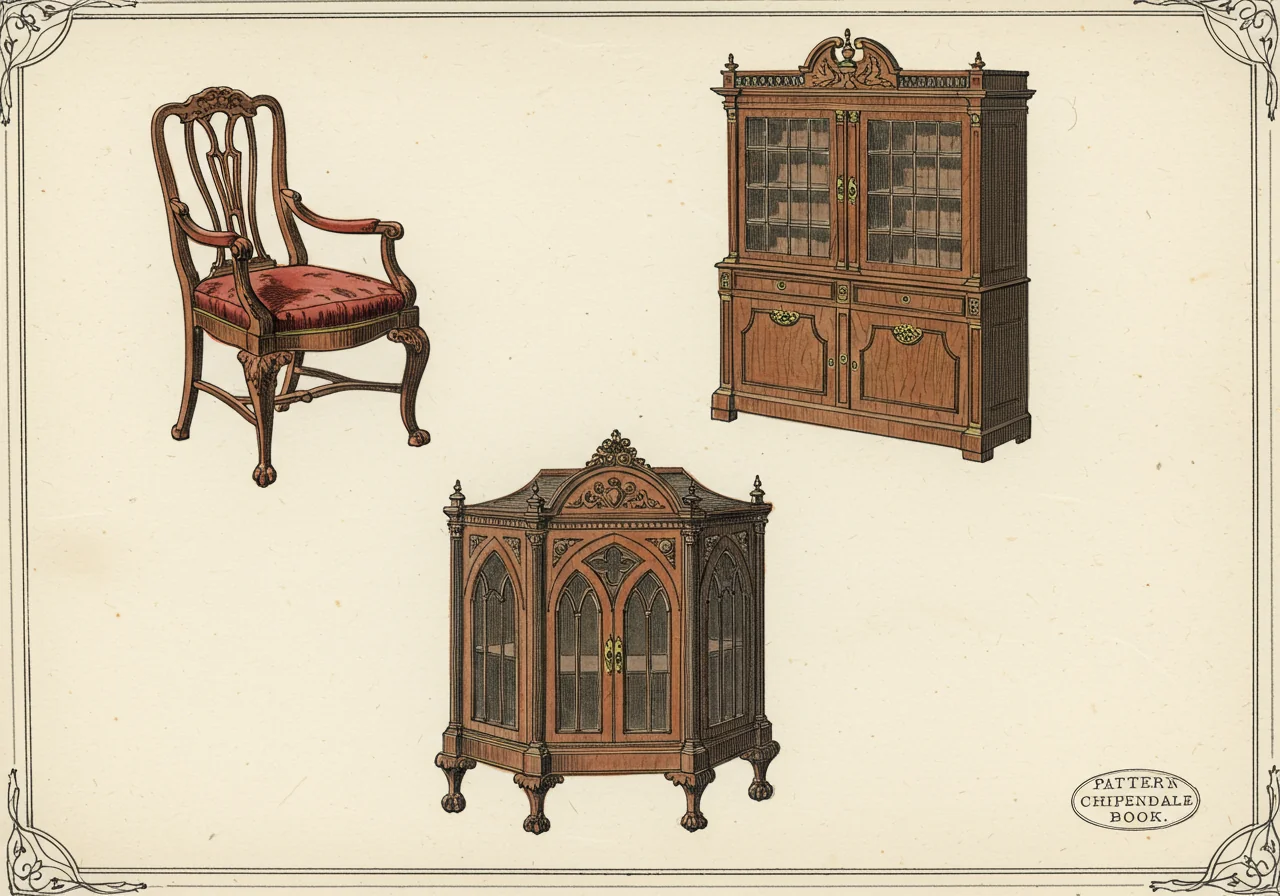
A page from Thomas Chippendale’s 1754 The Gentleman and Cabinet-Maker’s Director — engraved plates of the canonical forms across the three registers: the ribbon-back side chair (standard rococo, the workshop’s most-virtuosic chair design), the library bookcase with broken-pediment top, the china cabinet with Gothic glazing (the Gothic-Chippendale variant). The Director ran to some hundred and sixty plates across its three editions, and is the principal documentary source for the Chippendale register that the broader London cabinet-trade then reproduced.
What It Is Not
Four styles stand near enough to Chippendale that the beginner confuses them with it, and distinguishing them is most of the work of reading mid-eighteenth-century English-and-related furniture.
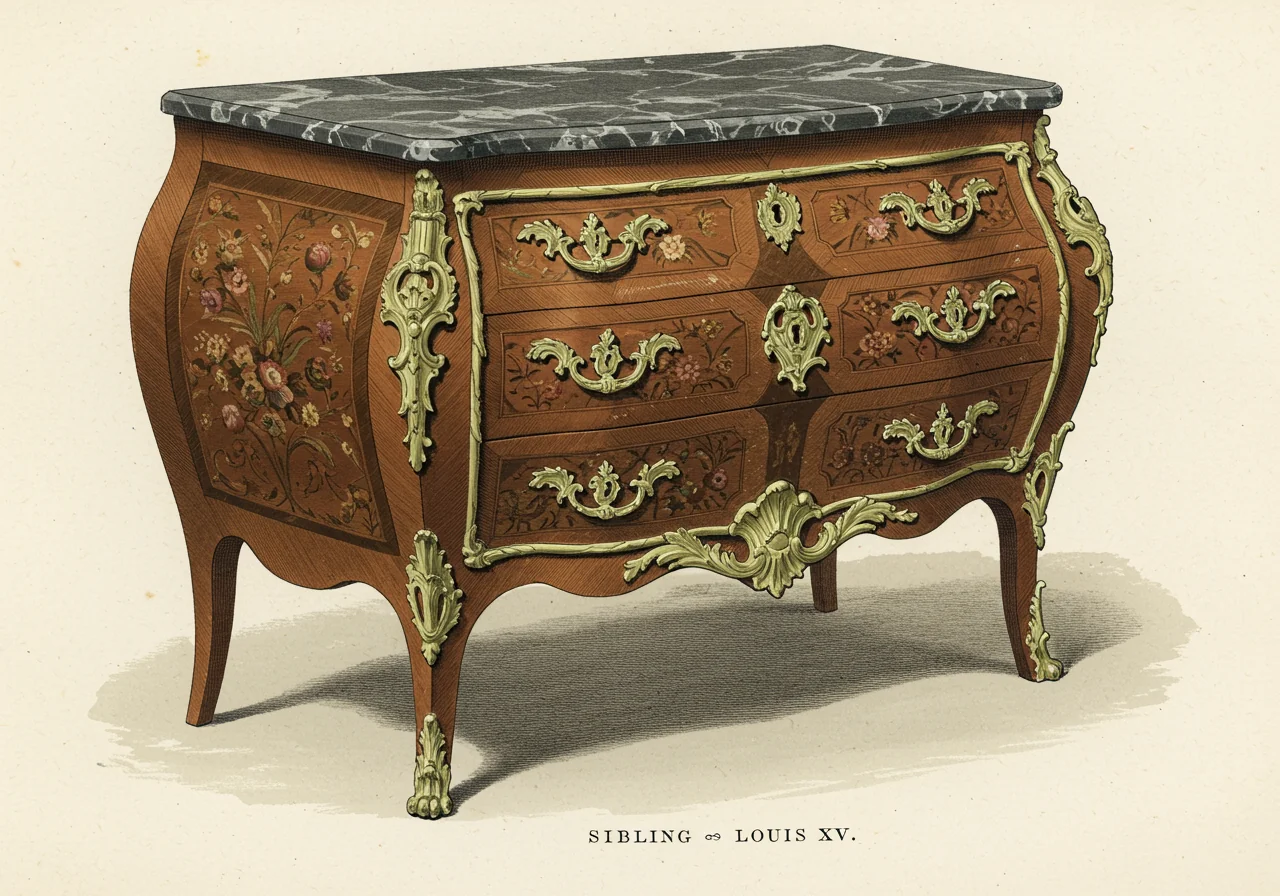
A Louis XV is the French royal rococo source the English Chippendale translated across the Channel. The French piece is veneered (not solid mahogany), ornamented with applied gilt-bronze ormolu (not carved wood), and produced by workshop-anonymous ébénistes under the Jurande (not a single named master with a published pattern book). The rule of thumb: carved mahogany with restrained brass is Chippendale; veneered exotic wood with elaborate gilt-bronze ormolu is Louis XV.
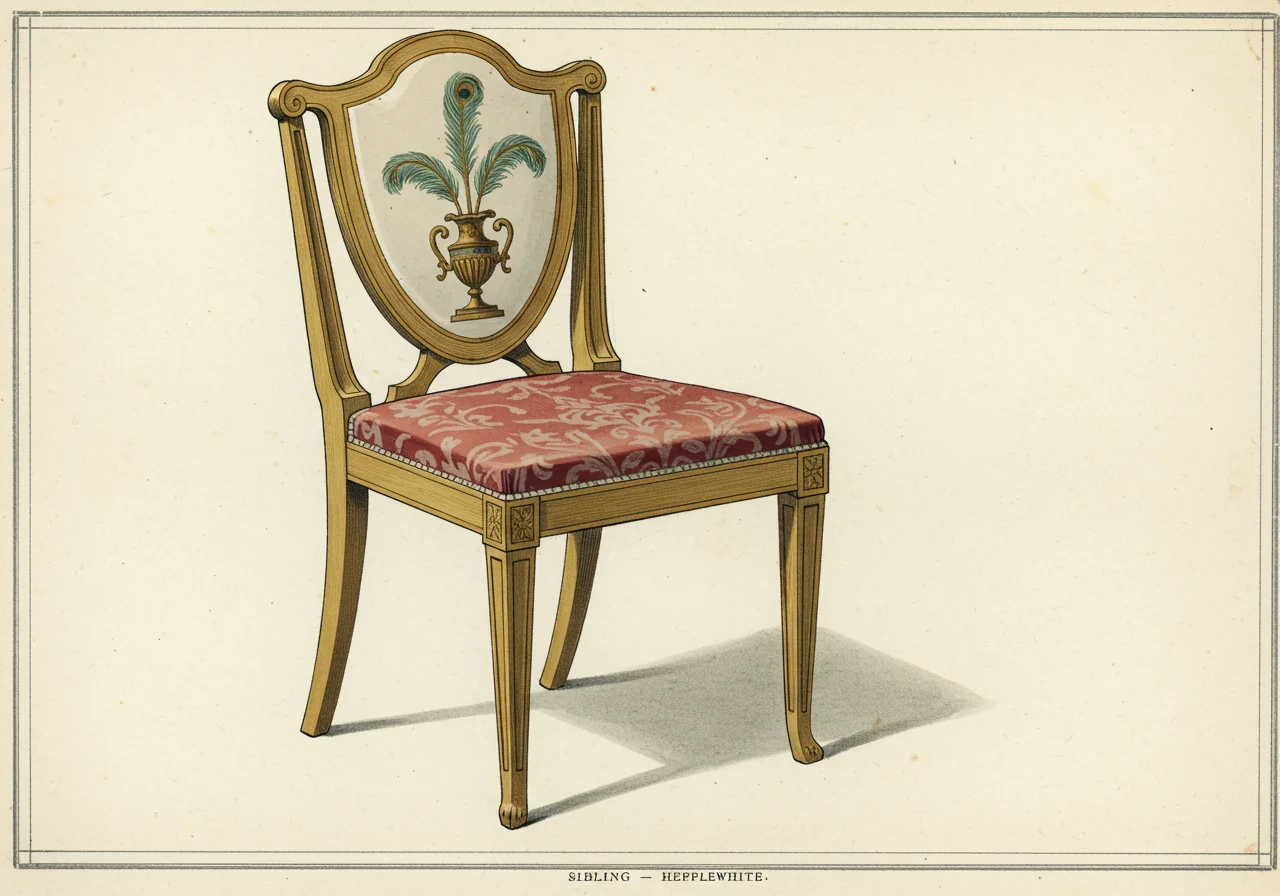
A Hepplewhite is the English neoclassical succession after about 1780, with the rococo cabriole-and-ball-and-claw replaced by the straight tapered leg with spade foot, and the carved mahogany replaced by pale painted-and-inlaid satinwood. The rule of thumb: cabriole leg with carved mahogany is Chippendale; straight tapered leg with painted satinwood is Hepplewhite.
A Queen Anne English is the predecessor English style of about 1700–1740, with a simpler cabriole leg terminating in a pad foot rather than ball-and-claw, a vase-shaped undecorated splat rather than the pierced-and-carved Chippendale splat, and walnut rather than mahogany as the principal wood. The rule of thumb: walnut with pad foot is Queen Anne; mahogany with ball-and-claw is Chippendale.
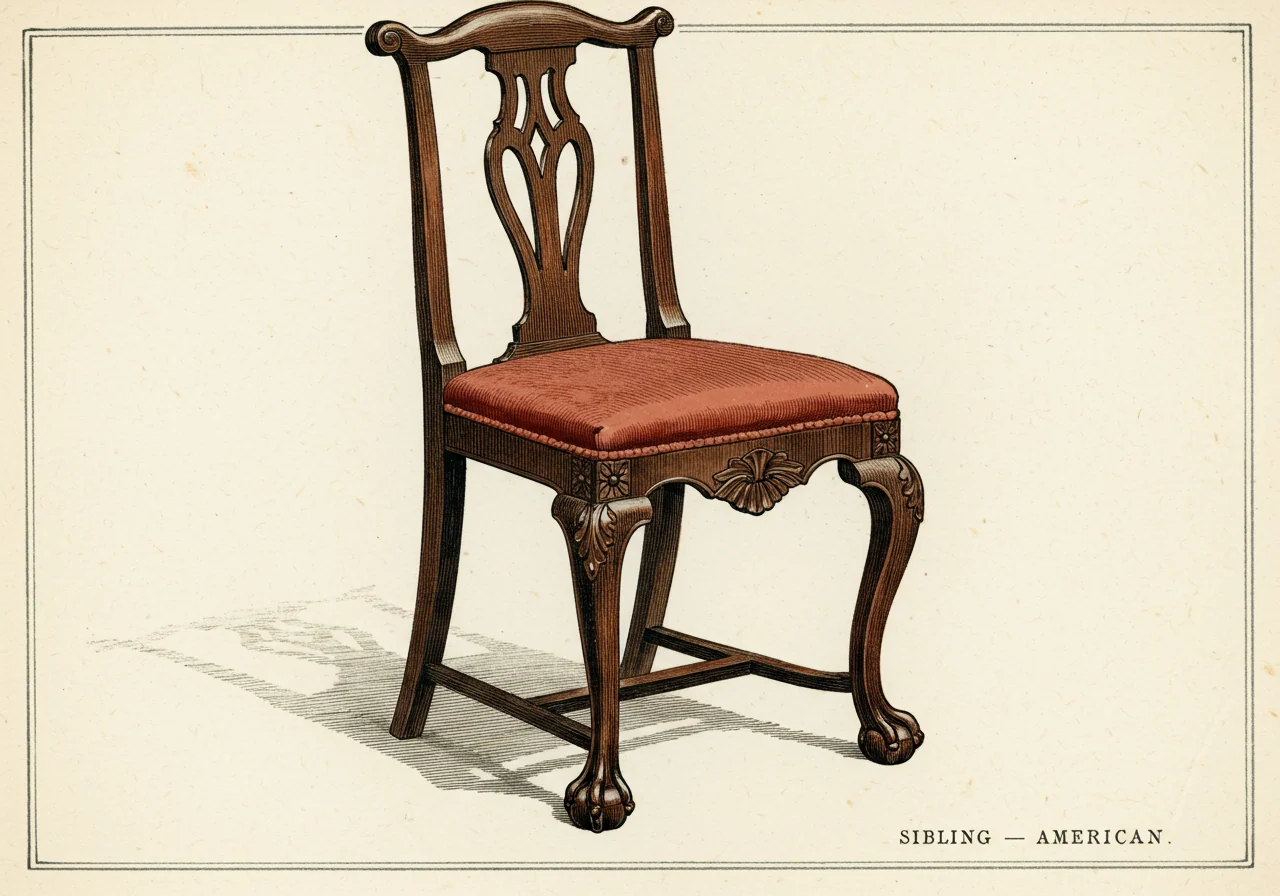
An American Chippendale is the colonial American adaptation, produced principally in Philadelphia (the Quaker workshops under Thomas Affleck and William Savery) and Newport (the Townsend-Goddard workshop family). American Chippendale uses the same vocabulary as the English original but executes it in regional American mahogany with slightly different carving conventions — the Philadelphia carved shell, the Newport block-and-shell case-furniture variant — and provincial-workshop construction. The rule of thumb: English Chippendale with London workshop attribution is the original; same vocabulary with colonial American attribution is American Chippendale.
What One Looks At
One looks first at the wood, and the wood settles the broad attribution at three paces. Solid mahogany with the deep red-brown Cuban-mahogany patina is Chippendale; pale satinwood with inlay is Hepplewhite or Sheraton; walnut with the lighter Queen-Anne patina is the predecessor; veneered exotic woods with applied gilt-bronze are the French Continental tradition. The single material distinction carries most of the differentiation across the Anglophone and Continental eighteenth-century registers.
One looks next at the foot and the leg. Ball-and-claw on cabriole is canonical Chippendale; pad foot on cabriole is Queen Anne; straight tapered leg with spade foot is Hepplewhite. The leg is the second-order distinction after the wood and is what most differentiates the English period registers from one another.
One looks at the splat and the carving. Pierced-and-carved splat in one of the three Director registers (rococo, Gothic, Chinese) is Chippendale; undecorated vase splat is Queen Anne; shield-shaped splat with neoclassical inlay is Hepplewhite. The carving’s hand — the depth of relief, the sharpness of the acanthus, the proportions of the ball-and-claw — distinguishes the workshop quality range from the apex Chippendale-shop piece down through the broader London trade and out to the provincial cabinet-makers.
And one looks for the documentary attribution. A piece documented in the Chippendale workshop accounts (Harewood, Nostell, Dumfries, Burton Constable) is the apex of the type. A piece in the Director register but undocumented to Chippendale’s shop is in the broader Chippendale-trade category — the great majority of surviving Chippendale-register pieces are in this category, and the distinction from the documented shop pieces is principally a question of price-grade and connoisseur prestige rather than of stylistic vocabulary. The Director plates are the principal reference tool; the surviving workshop records are the second-order evidence; the carving and construction are what the connoisseur reads when neither is available.
The next post in the furniture arc will be either Hepplewhite — to set out the English neoclassical succession after the Chippendale rococo, with the pale-satinwood variety break that the wood-tone variety table calls for — or Gustavian, to open the Scandinavian neoclassical tradition with its painted gris-blanc register. The choice will depend on what photographic material is available at the time of writing.