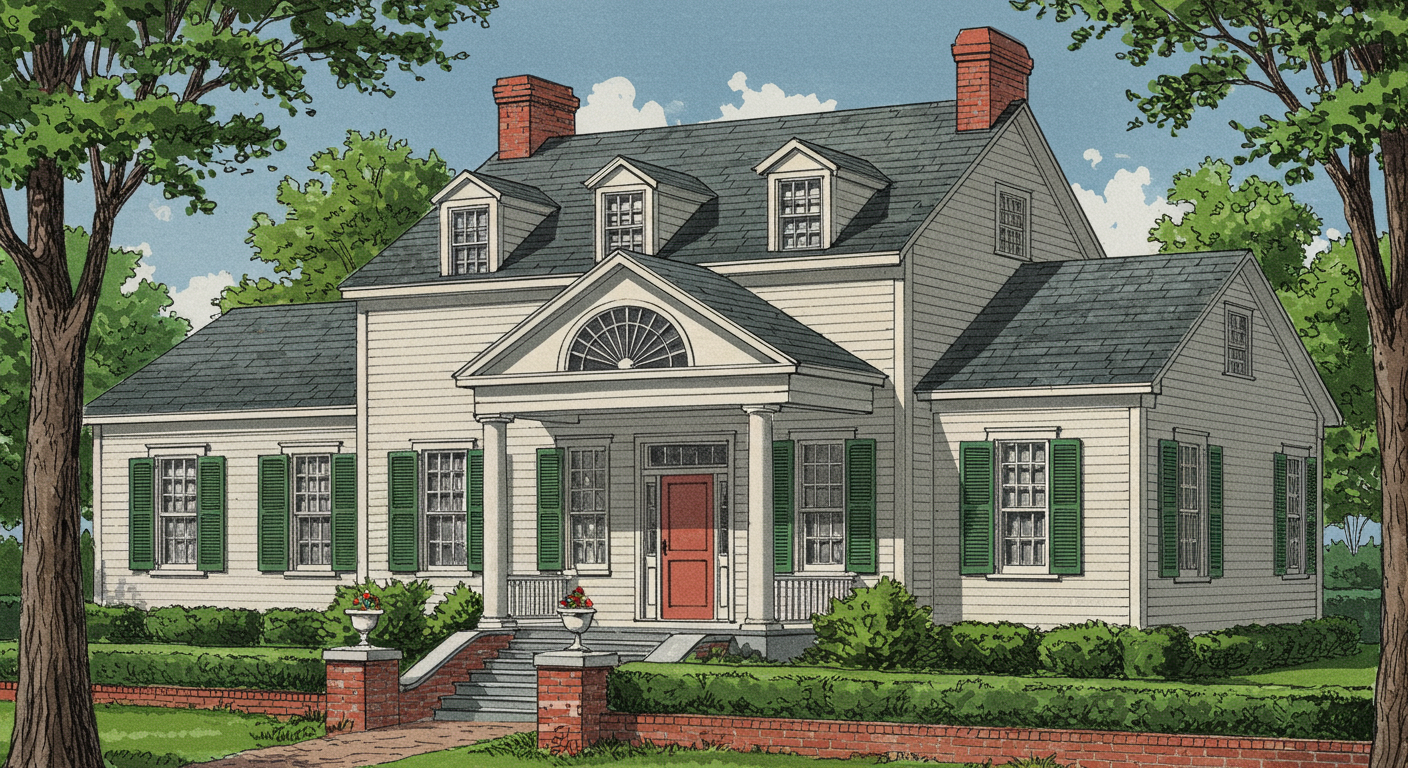
The Colonial Revival is the only style in this series that arrived as a revival of a revival. The American Colonial Georgian of the eighteenth century, which the Colonial Revival was claiming as its source, had been itself a provincial adaptation of English Georgian; English Georgian had been an academic revival of Italian Renaissance classicism; Italian Renaissance classicism had been a fifteenth-century rediscovery of classical Roman architecture; and the classical Roman, in its own time, had been a Mediterranean elaboration of Hellenistic Greek forms it could not have built without first copying them. To build a Colonial Revival house in 1905 was to participate, knowingly or otherwise, in a chain of borrowing that ran back two and a half millennia to the Augustan villas of central Italy. The chain, by the time it reached an American suburb, was so long that the Colonial Revival could legitimately claim to be reviving its own grandfathers.
This is the Colonial Revival, and the long chain is the joke at its centre. What follows is the ninth in a series that has been, in a quiet way, trying to read American houses for what they were trying to say. The first eight posts covered the styles of the long nineteenth century — from the Greek Revival of the 1820s through the Queen Anne, Shingle, and Romanesque Revival of the 1890s. The Colonial Revival is the first style in the series to run substantially beyond that century — emerging in the 1880s alongside the Shingle, but persisting through academic, suburban, and mid-century forms all the way into the 1950s. By the time the style faded after the Second World War, it had been the dominant American residential idiom for the better part of seventy years. No other style in this series came close to that arc.
The Misnomer
The first thing worth knowing about the Colonial Revival is that it is mostly post-Colonial, mostly not American, and mostly invented.
The American Colonial period proper ran from the first English settlements at Jamestown and Plymouth — 1607 and 1620, respectively — to the end of the Revolutionary War in 1783. During those one hundred and seventy-six years the colonies produced an extremely varied architectural record: the timber-frame saltboxes and Cape Cods of New England; the Dutch Colonial farmhouses of the Hudson valley, with their characteristic gambrel roofs; the French Colonial poteaux-en-terre cottages of Louisiana, raised on piers against the floodwaters of the lower Mississippi; the Spanish Colonial adobe missions of Florida, New Mexico, and California; the brick rowhouses of Philadelphia and Annapolis; the plantation manors of tidewater Virginia. To call any of this “Colonial American architecture” is, on inspection, to gesture at a half-dozen quite different regional building traditions, joined chiefly by the fact that they happened on the same continent during the same two centuries.
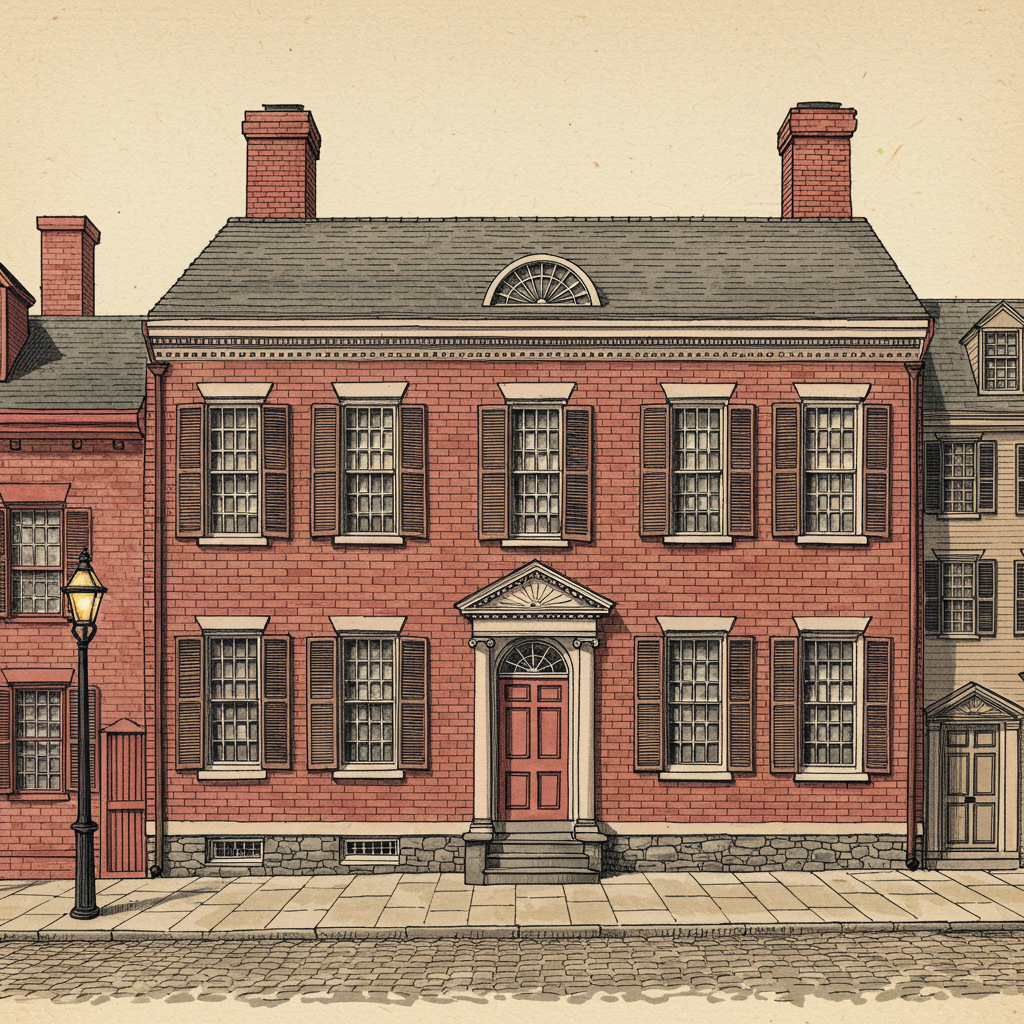
A New England Federal townhouse, roughly 1810 — red brick walls, strict symmetric front elevation, a pedimented central entrance with a Palladian fanlight and flanking sidelights, six-over-six wooden sash windows with white-painted shutters, two matching brick chimneys at the gable ends. The Federal/Adamesque style of the early American republic was the actual ancestor the Colonial Revival was claiming — though even the Federal style itself was a provincial adaptation of English Georgian, which was in turn an academic revival of Italian Renaissance classicism.
What the Colonial Revival narrowed in on, of this whole variety, was the Anglo-American Georgian and Federal townhouse and farmhouse tradition of New England, the Mid-Atlantic, and the Tidewater South — symmetric brick or clapboard houses with central pedimented entries, Palladian fanlights, double-hung sash windows with shutters, and matching gable-end chimneys. The Dutch, French, Spanish, and frontier traditions were largely ignored. (Dutch Colonial Revival, as a sub-style, would emerge separately around 1900 and develop its own modest following; the French and Spanish sub-styles followed regionally, and the frontier got nothing.) The “Colonial” in the Colonial Revival’s name, in other words, picks out one of several Colonial-era traditions and calls it the American one. It is a synecdoche, and a selective one.
The post-Colonial part is more obvious. Most Colonial Revival houses were built between 1890 and 1940 — a hundred and twenty to forty years after the period the name names. The actual Colonial-era buildings the style was reviving had stood for a century or more by the time the revival began; the architects who built Colonial Revival houses had grown up surrounded by Italianate, Second Empire, and Stick-style Victorian houses, not by Federal townhouses. They were looking back at a period twice their lifetime away. (The 1925 Williamsburg restoration, on which more later, was the largest single product of this looking-back: an entire town reconstructed to a 1770 standard for an audience of 1930 tourists.) The Colonial Revival is, in this sense, the first style in the series whose ancestors had survived as preservation rather than as living tradition. The continuity ran through scholarship rather than through carpentry.
The invented part is harder to describe but worth naming. The Colonial Revival’s typical features — strict symmetric facade, central portico with classical columns, fanlight transom, dentil cornice, six-over-six sashes, matching shutters — are real Federal-period elements, but the combination in which they appear on a typical Colonial Revival house is more idealised than historical. Most actual Federal-period houses were plainer, more asymmetric, and less ornamented than the typical 1910 Colonial Revival’s. The revivalists picked the most academically correct examples — the high-style townhouses of the wealthy — and treated them as standard, while the more numerous vernacular Federal cottages and rural farmhouses were quietly excluded from the canon. The Colonial Revival house of 1910 is, on close inspection, a slightly improved version of the historical building that almost any actual Federal-era family would have lived in. It is the past, edited.
One is obliged to concede that this is, in its way, the most thoroughly American thing one could have done with the American Colonial past.
The Specimen
If one is to identify a Colonial Revival house — and they are, by some considerable margin, the most numerous specimen type in this entire series — the simplest exercise is, as before, to walk around a specimen and assemble the evidence.
Begin at the facade. A Colonial Revival house presents, almost without exception, a strictly symmetric front elevation. The composition is organised around a central axis: a centred front door flanked by an equal number of windows on either side, a centred dormer or fanlight in the upper storey aligned with the door below, and two matching chimneys at the gable ends. The symmetry is the most reliable identifier from a distance. Where the Victorian styles — Queen Anne, Stick, Shingle — had argued for asymmetric massing, the Colonial Revival argues for symmetric repose. A glance at the front elevation of an unfamiliar house tells one whether it is broadly pre-1880 or broadly post-1890: symmetric is post-1890 Colonial Revival; asymmetric is the long Victorian century.
Now look at the entrance. The Colonial Revival door sits at the centre of the front elevation, almost always raised slightly on a stone or brick stoop, and is always framed by some flavour of classical surround. The grandest examples carry a full projecting portico — a small temple-front composition with two or four classical columns (Doric, Ionic, or Tuscan, depending on the architect’s preference) supporting a pedimented entablature. The more modest examples carry a pilaster surround — flat classical pilasters flanking the door, with a horizontal entablature or small triangular pediment above. The smallest examples carry only a broken-pediment door hood on console brackets. In every case there is some classical reference at the door; the bare unornamented door of a Stick-style cottage is foreign to the Colonial Revival vocabulary.
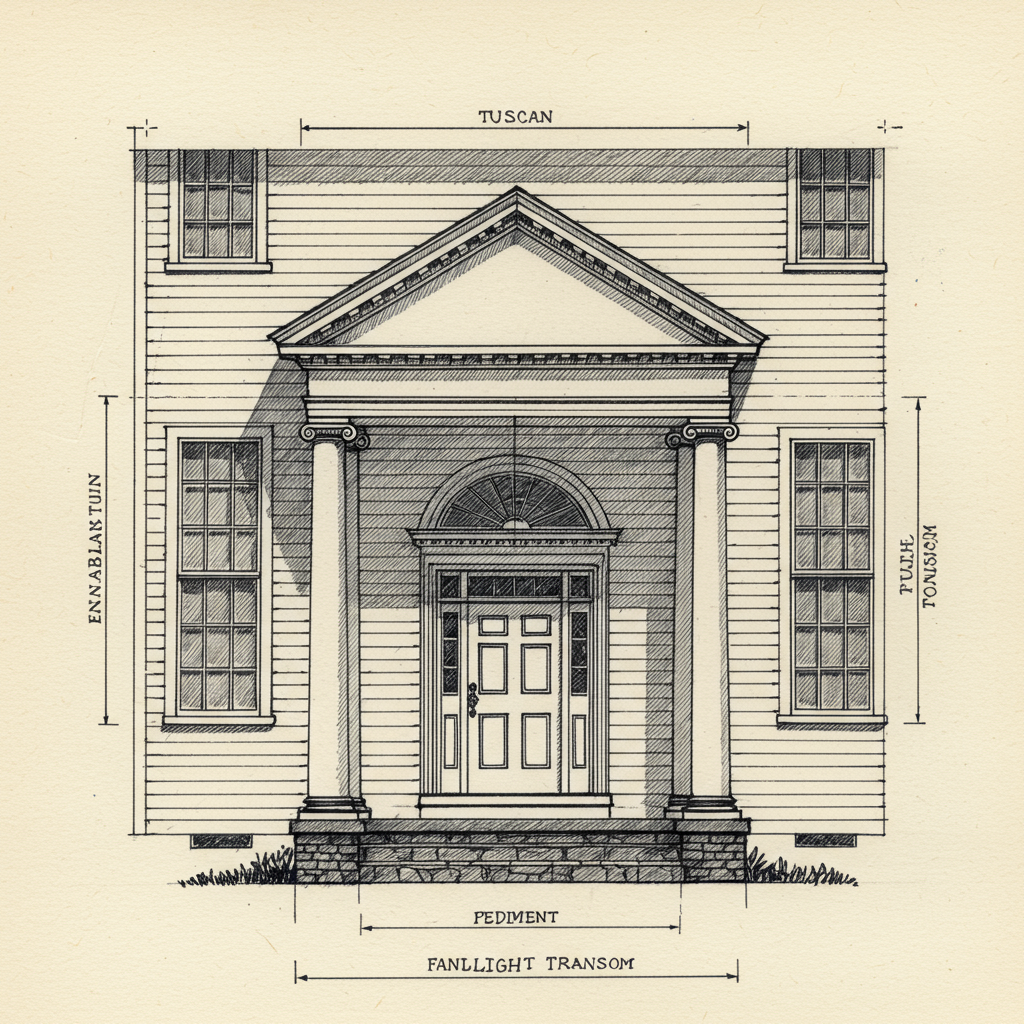
A central pedimented portico — Tuscan columns supporting a deep entablature crowned by a triangular pediment, with the front door visible in the shadow beneath. The Colonial Revival’s first signature, and the most reliable indicator of the style after the symmetric facade itself. The columns are slender and freestanding, in classical proportion; this is what distinguishes them from the short heavy attached columns of the Romanesque Revival.
Look above the door. The Colonial Revival’s second signature feature is the fanlight transom: a semicircular or elliptical window set above the front door, divided into radiating muntins like the ribs of an opened fan, often filled with leaded or stained glass. The fanlight may stand alone or be flanked on either side by narrow rectangular sidelights of plain glass. The fanlight is a direct quotation from the Federal-period vocabulary — Charles Bulfinch’s Boston townhouses and Samuel McIntire’s Salem mansions both used them extensively in the 1790s — and the Colonial Revival’s revival of them was sufficiently academically literal that one can often date a Federal house by its fanlight’s spoke pattern, and an early Colonial Revival house in turn by its quotation of a specific Federal spoke pattern.
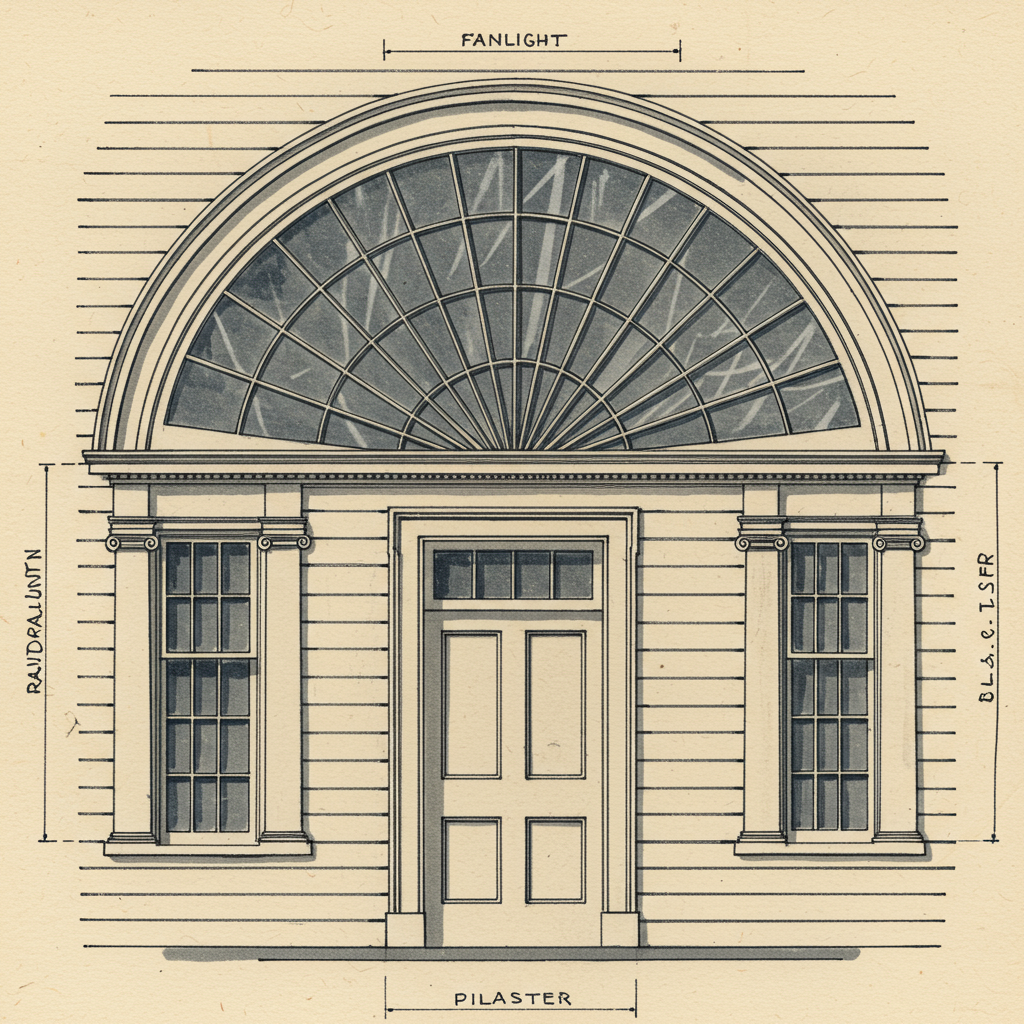
A Palladian fanlight transom above the front door — a semicircular window divided into radiating muntins like the ribs of an opened fan, flanked on either side by narrow rectangular sidelights. The fanlight is a direct quotation from the 1790s Federal vocabulary — Bulfinch’s Boston townhouses and McIntire’s Salem mansions used it extensively — and the Colonial Revival’s revival of it was literal enough that one can occasionally date a revival house by which 1790s prototype its fanlight is copying.
Examine the walls. Colonial Revival walls are either red brick (in the Georgian-Federal townhouse mode) or white-painted clapboard (in the New England farmhouse mode). The brick examples often carry belt courses — thin horizontal stone or brick bands marking each storey — and quoins at the corners. The clapboard examples are almost always painted bone-white with bottle-green or black-painted shutters at every window; the two-colour scheme is part of the identification. Where the Italianate had argued for warm earth-tones and the Queen Anne for elaborate polychrome, the Colonial Revival argues for bone-white walls and crisp dark shutters — a deliberate visual quotation of the painted Federal vernacular of New England.
Examine the windows. Colonial Revival windows are double-hung wooden sash with multi-pane muntins — six-over-six, nine-over-nine, or twelve-over-twelve glazing patterns, depending on how academically literal the architect wished to be. The muntins are slender, white-painted, and meticulously divided. There are wooden shutters at every window, hinged at the side, often functional in earlier examples and purely decorative in later. The window is never round-arched (which would be Italianate) and never pointed (which would be Gothic Revival). It is always rectangular, always sashed, and always six-over-six minimum.
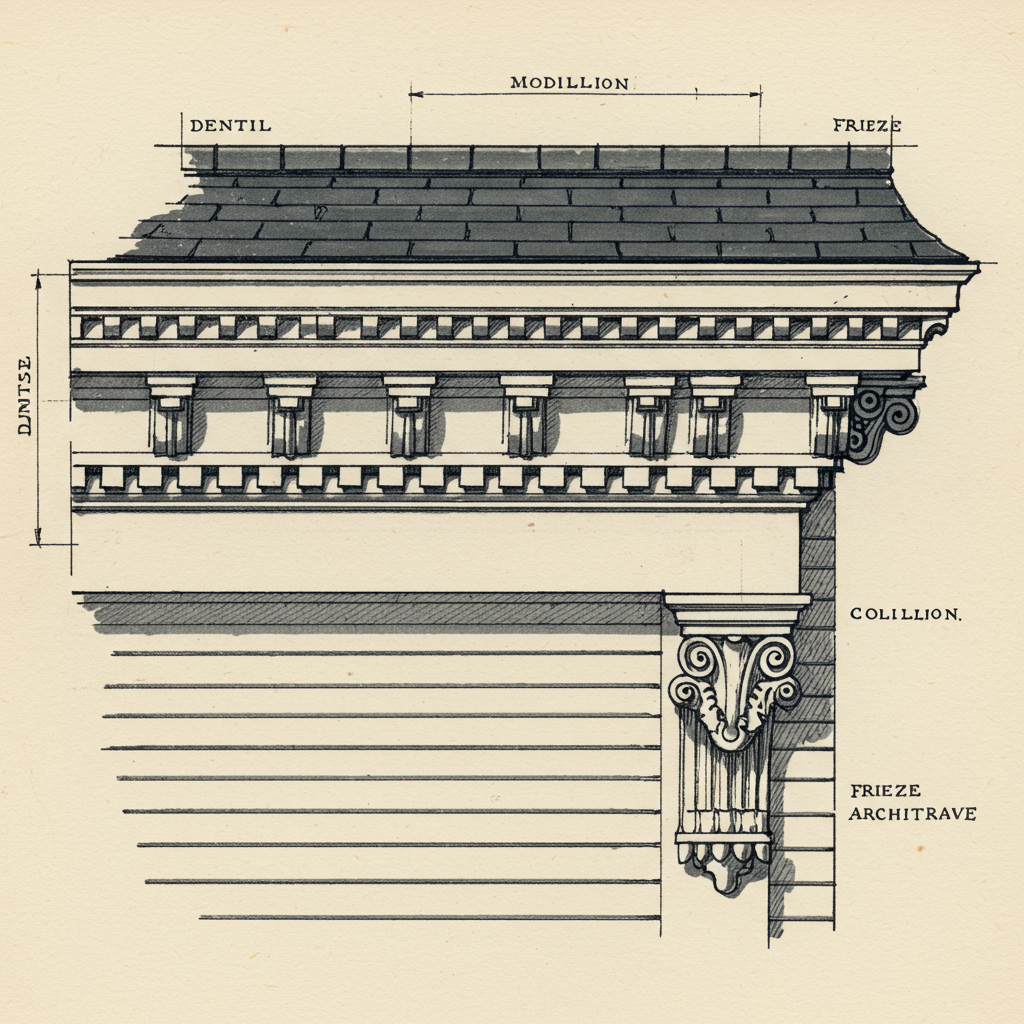
A dentil-and-modillion cornice running along the eave — small repeated tooth-like dentils in a single row, with larger bracket-like modillions at regular intervals above them. The Colonial Revival’s third signature, after the symmetric facade and the centred classical entry. The dentil cornice is a direct revival of the Federal Adamesque vocabulary, and the slightly heavier modillion version is closer to the Anglo-Georgian source.
Two more details round out the specimen. The roof of a Colonial Revival house is almost always side-gabled — gable ends at the sides, with the long axis of the roof parallel to the front elevation, and the front roofline running unbroken from corner to corner. (A few hipped-roof variants exist, particularly in the larger Georgian-style examples.) Dormers are common in larger examples, almost always set in the front slope at regular intervals matching the bay rhythm below. And the cornice along the eaveline is almost always trimmed with a dentil-and-modillion band — a row of small tooth-like dentils with larger bracket-like modillions above, both quotations from the Federal vocabulary.
Assemble these — the symmetric facade, the centred classical entry, the fanlight transom, the white clapboard or red brick walls, the multi-pane sash windows with shutters, the dentil-and-modillion cornice, the side-gabled roof, the matching gable-end chimneys — and one has a Colonial Revival. A 1905 New England specimen with all of them is a McKim-Mead-and-White-era academic Colonial Revival; a 1925 Williamsburg-influenced specimen is the literal-academic phase; a 1940 suburban Cape Cod with the same vocabulary at a smaller scale is the mid-century vernacular; a 1950 ranch-influenced Colonial with a one-storey side wing and a centred portico is the post-war suburban final form. The style scales across half a century without changing its grammar.
The American Past
The historical arc of the Colonial Revival begins, almost exactly, at the 1876 Centennial Exposition in Philadelphia — the celebration of the United States’ first hundred years, held on a 285-acre site in Fairmount Park, attended by some ten million visitors, featuring a building called the New England Kitchen that was a full-scale reconstruction of a Colonial-era farmhouse interior with a working hearth and an actress in eighteenth-century costume churning butter for the benefit of the crowds. The Centennial Exposition was the moment, more than any other, when the American public began to take its own Colonial past seriously as a subject of architectural interest. Before 1876 the Colonial period had been largely invisible to American architecture; after 1876 it was difficult to avoid.
The Centennial was followed almost immediately by the architects’ sketching tour. In 1877 Charles McKim, Stanford White, William Rutherford Mead, and William Bigelow — most of whom would shortly form the firm McKim, Mead & White — took a sketching tour through Colonial New England: Salem, Marblehead, Portsmouth, Newport, Newburyport. They were looking for an American architectural vocabulary, and they found two: the looser, weathered, asymmetric saltbox-and-cottage vernacular, which they translated into the Shingle style examined in the seventh post of this series; and the tighter, more formal, symmetric Georgian-and-Federal townhouse, which they translated into what would become the Colonial Revival. The two styles emerged from the same tour and the same architects, and they ran in parallel through the 1880s. By 1893 the Colonial Revival had begun to overtake the Shingle in residential commissions; by 1900 it had overtaken it entirely, and the loose Shingle vernacular was already old-fashioned.
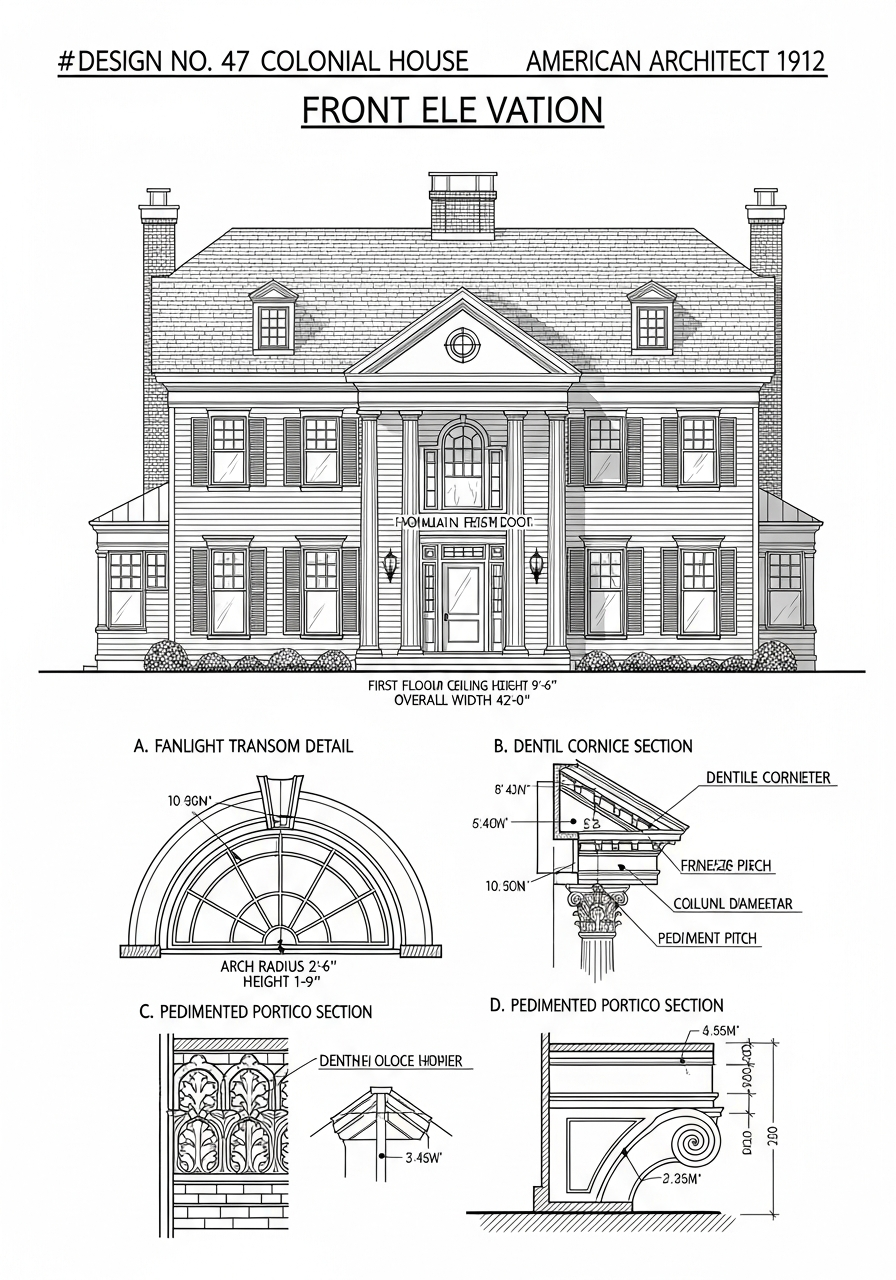
A plate from a 1910s American architectural pattern-book — elevation, floor plan, and detail vignettes of a Colonial Revival house. Unlike the Romanesque Revival’s architect-to-architect dissemination through professional journals, the Colonial Revival returned to the pattern-book economy of the Italianate and Stick. By 1908 Sears Roebuck was selling Colonial Revival house kits in its mail-order catalogue, shipped in pieces by railroad and assembled by the homeowner or a local carpenter. The style scaled down to the mass market more thoroughly than any predecessor.
The next moment of consolidation was the 1898 Spanish-American War. The patriotic reaction to the war, and the country’s emergence from it as a modest international power, sharpened the architectural conversation around American identity. The Colonial Revival, by 1900, was the architecture of that identity — the past the country wanted to claim — and the wealthy houses of the next twenty years were built almost entirely in its idiom. McKim, Mead & White’s Hill-Stead in Farmington (1898-1901), Charles Platt’s Sylvania at Barrytown (1904), Aldrich and Delano’s Oheka Castle at Cold Spring Harbour (1914-19) — these are the high-academic Colonial Revival, in which the architects studied actual Federal-period precedents (often the surviving houses they had sketched on the 1877 tour) and reproduced them at scale for the new American moneyed class. The style’s literalness sharpened across the 1900s and 1910s: where an 1890 Colonial Revival might still carry traces of Shingle looseness, a 1915 Colonial Revival was almost academically perfect, drawn from precise drawings of specific Federal originals.
The third consolidation came in 1925, with the beginning of the Williamsburg restoration. Reverend W. A. R. Goodwin of Bruton Parish Church in Williamsburg, Virginia, persuaded John D. Rockefeller Jr. to fund the restoration of the entire colonial-era town as a living museum. The project ran from 1926 through the 1950s — eventually restoring more than ninety original eighteenth-century buildings, reconstructing some five hundred lost ones, and producing measured drawings, photographs, and scholarly documentation of the Tidewater Georgian vocabulary at a scale and precision the American architectural profession had not previously had access to. The Williamsburg drawings were published, photographed, distributed through pattern-books, and absorbed by every American residential architect of the 1930s. The literal-academic phase of the Colonial Revival reached its maturity in this decade; the 1930s and 1940s Colonial Revival is, almost without exception, working from Williamsburg-derived precedents.
The fourth consolidation, simultaneous with Williamsburg, was the Sears Roebuck catalogue. Sears had been selling pre-cut house kits — shipped by railroad, assembled by the homeowner or a local carpenter — since 1908. By the 1920s Colonial Revival models dominated the Sears line: the Magnolia, the Lexington, the Honor, the Crescent, the Newcastle. The catalogue scaled the style down to the mass market more thoroughly than any predecessor; a small family in any American town with a railroad spur could order a Colonial Revival cottage, have it shipped in two boxcars, and put it up over the summer for less than the cost of building from scratch. The mid-century suburban Colonial Revival — the brick-and-shutter house that came to define the postwar American suburb — descended directly from these Sears patterns through the developers Levitt and Burns and Toll, who absorbed the Colonial Revival vocabulary into the mass-produced suburban house of the 1940s and 1950s.
The style faded after about 1955. The mid-century modern reaction against historical revivalism — Frank Lloyd Wright’s Usonians, Marcel Breuer’s flat-roofed houses, the California ranch — finally displaced the Colonial Revival from new residential construction, though the style’s influence persisted in vernacular suburban builder-Colonial well into the 1970s and beyond. By 1980 Colonial Revival was old-fashioned in the same way the Italianate had been in 1900: still everywhere as surviving stock, no longer being put up new at any serious rate. The style had run for seventy-five years — from the late 1880s to the late 1950s — and produced more individual houses than any other style in this series by at least an order of magnitude.
This last fact is worth pausing on. The Colonial Revival is the modal American house. If one selects a random pre-1960 American single-family residence — across all regions, all class levels, all builder traditions — the most likely style by far is Colonial Revival, and the second most likely is some near-relative of it (Cape Cod, Dutch Colonial Revival, Georgian Revival, Federal Revival). The styles examined in the previous eight posts are mostly minority traditions; the Colonial Revival is the majority tradition. To read American houses honestly is to recognise that this particular long-running style was, for three generations, what American house meant in everyday usage. The Italianate, the Second Empire, the Queen Anne — these are styles one studies. The Colonial Revival is the style one lives in.
What It Is Not
Four styles stand near enough to the Colonial Revival that the beginner confuses them with it, and distinguishing them is most of the work of reading the post-1880 American suburban house.
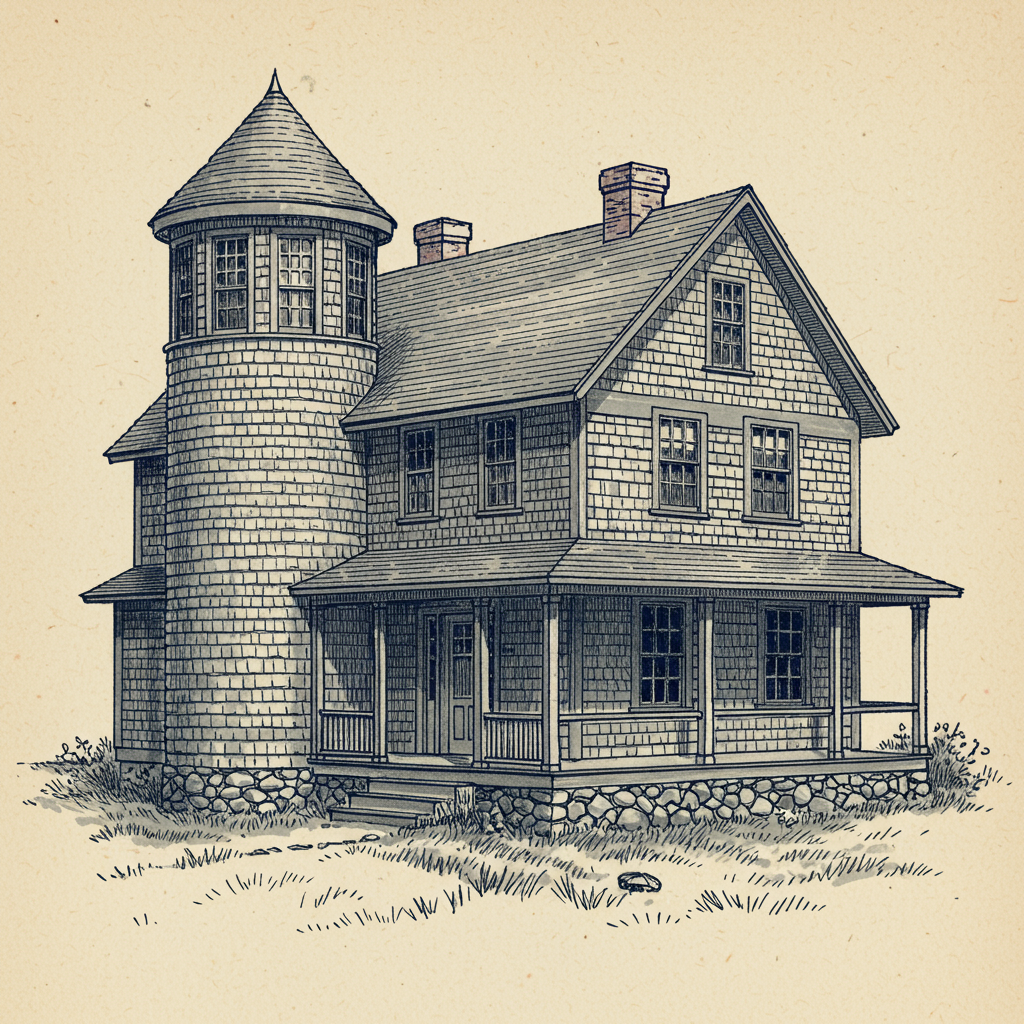
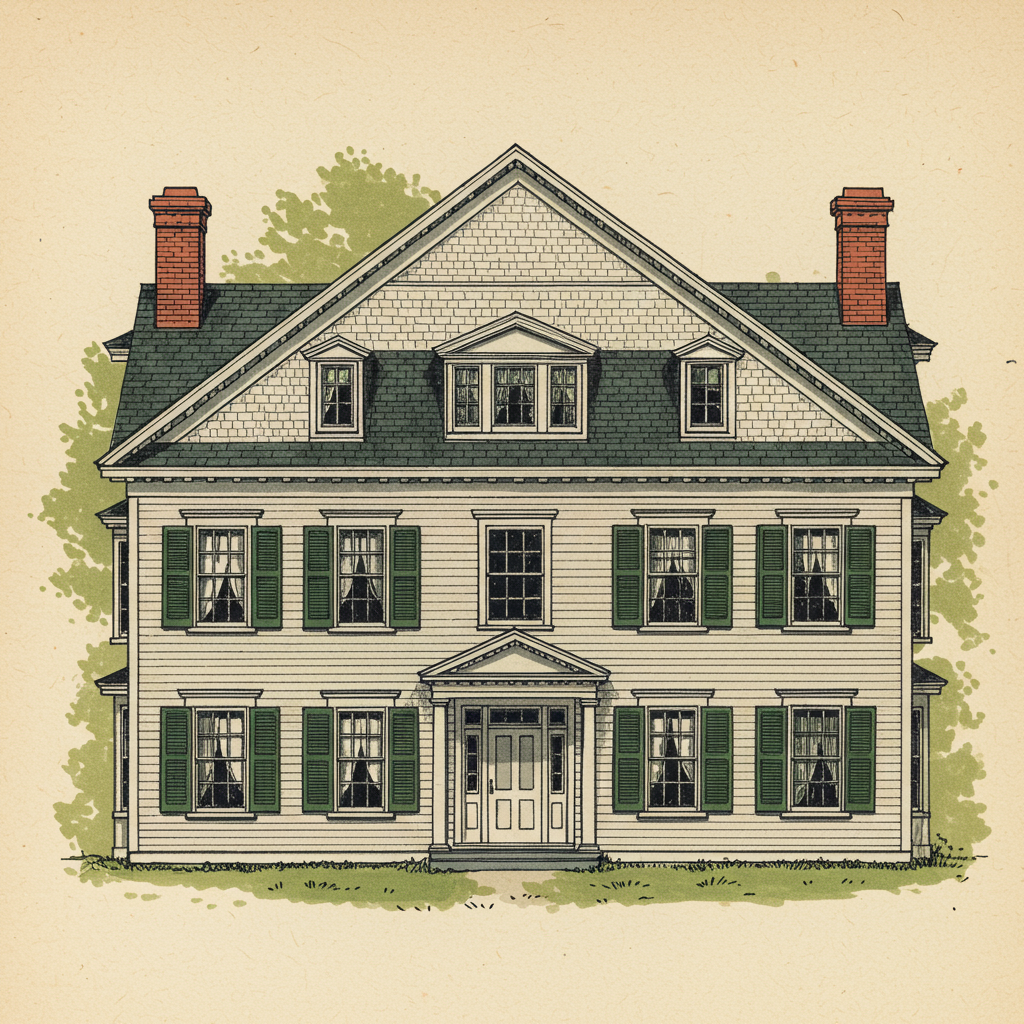
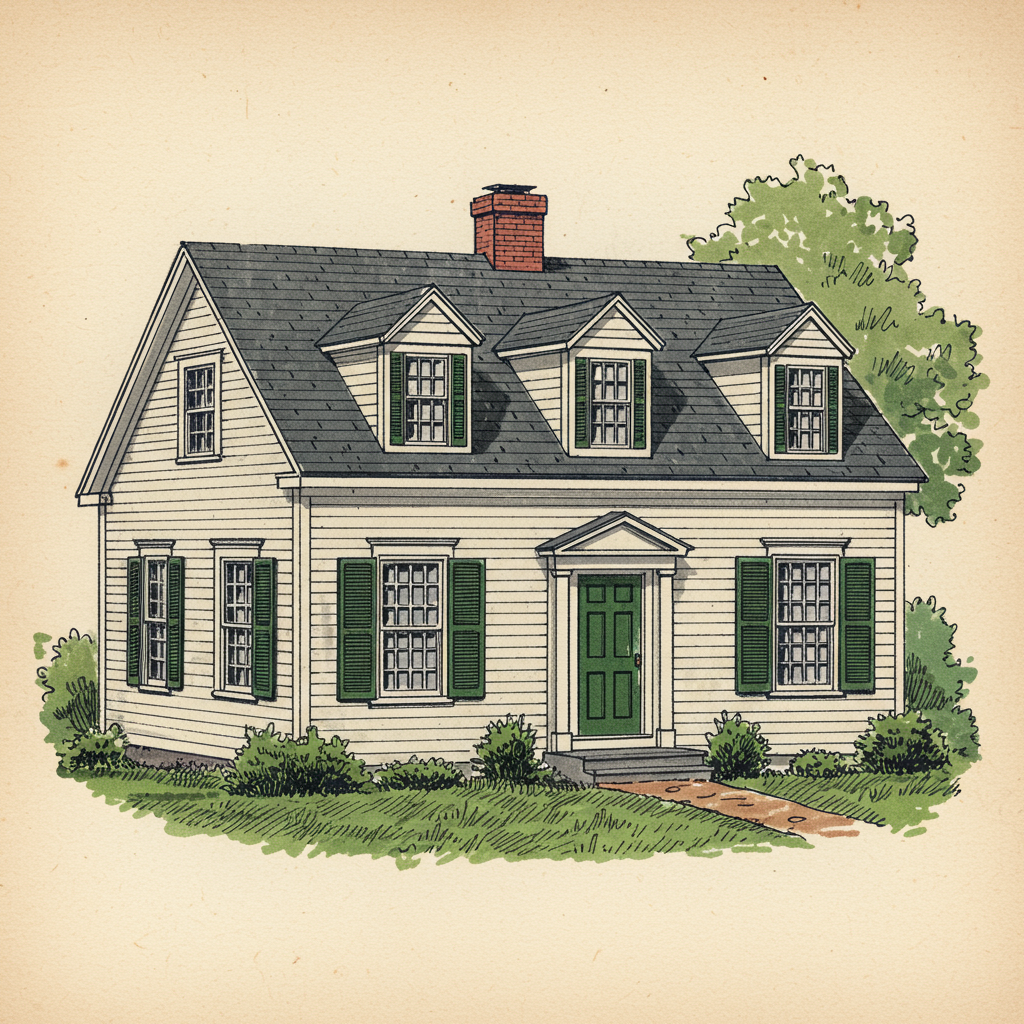
The Shingle — the Colonial Revival’s looser predecessor, examined in the seventh post — emerged from the same 1877 McKim Mead & White New England sketching tour as the Colonial Revival itself, but the two styles took opposite positions on how Colonial sources should be used. The Shingle quoted the saltbox in feeling — silhouette, materials, integration with site — while remaining loose, asymmetric, and improvisational. The Colonial Revival quoted the Federal townhouse in detail — fanlight, portico, sash glazing, dentil cornice — while remaining strict, symmetric, and academically literal. The two styles are siblings whose parents were the same architects on the same tour. The Shingle is the more poetic answer; the Colonial Revival is the more correct.
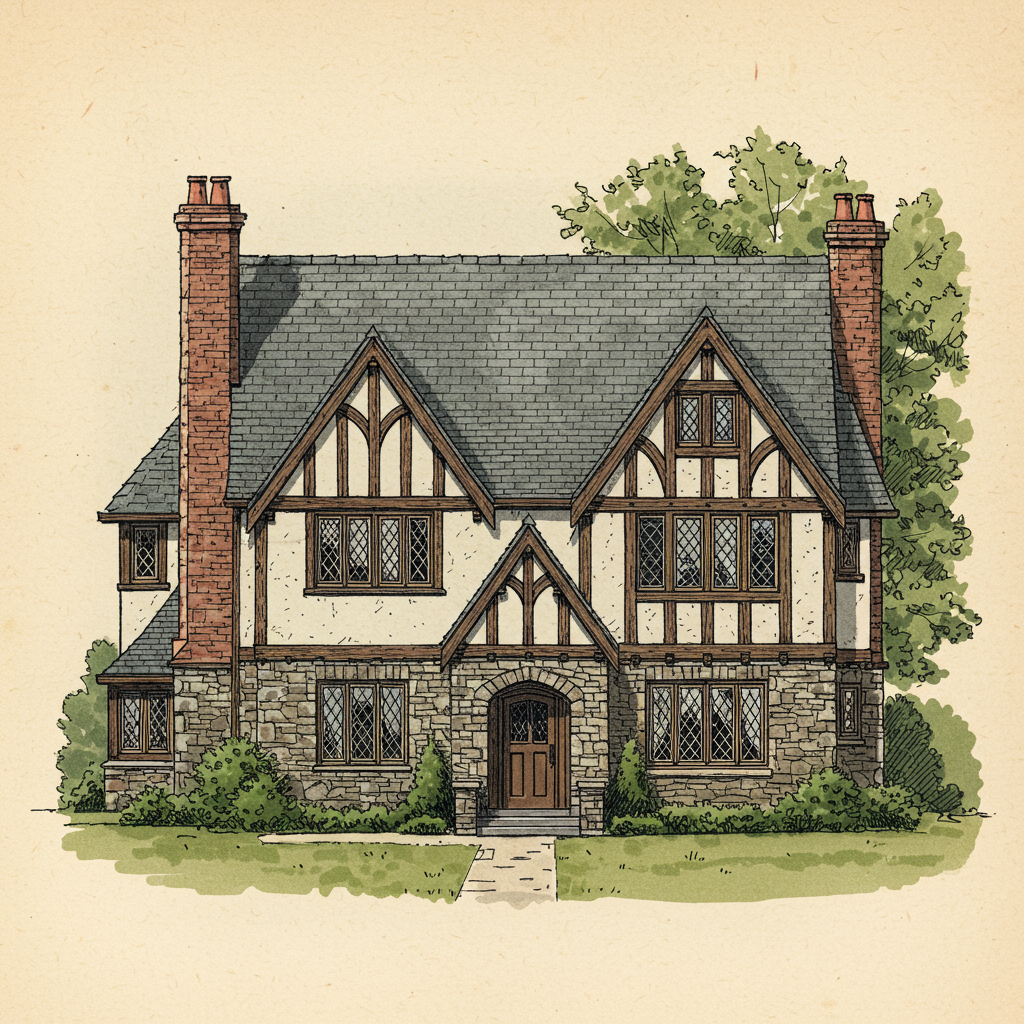
The Tudor Revival — the Colonial Revival’s English-country contemporary, dominant from about 1890 through 1940 — drew on Tudor-and-Jacobean English sources rather than American Colonial ones, and produced houses with half-timbered upper storeys, steeply pitched roofs with multiple cross-gables, mullioned casement windows in groups of three or four, and prominent brick or stone chimneys. The two styles competed directly through the 1920s for the suburban American residential commission: the Colonial Revival arguing that the right past for an American suburb was American, the Tudor Revival arguing that the right past was the English-country one the American suburb’s residents were sentimentally most attached to. The rule of thumb: if the upper storey is half-timbered and the windows are mullioned casements, the house is Tudor Revival; if the upper storey is clapboard or brick and the windows are double-hung sashes with shutters, the house is Colonial Revival.
The Dutch Colonial Revival — a Colonial Revival sub-style that emerged around 1900 and ran in parallel through about 1930 — picked up the seventeenth-and-eighteenth-century Dutch Colonial farmhouse tradition of the Hudson valley and New Jersey rather than the Anglo-Georgian townhouse tradition of New England. The defining feature is the gambrel roof: a two-pitched roof with a shallow upper slope and a steep lower slope, often broken by a long horizontal shed dormer running nearly the full length of the front. The body of the house — symmetric facade, centred entry, sash windows with shutters, clapboard walls — is otherwise Colonial Revival in vocabulary, and the two styles are best read as variants of the same revival impulse applied to different regional Colonial sources. A Colonial Revival house with a gambrel roof is a Dutch Colonial Revival; the same house with a side-gable roof is a standard Colonial Revival.
The Cape Cod — the Colonial Revival’s smallest and most vernacular subtype, dominant in the 1930s through the 1950s — is essentially the Colonial Revival reduced to one and a half storeys, three or five bays, a centred entrance, a side-gabled roof, and a centred chimney. The Cape Cod is the form the Colonial Revival took when it scaled down to the post-war suburban mass-market lot: simple, symmetric, white-painted clapboard with bottle-green shutters, four small dormers in the front slope, a centred door with a small classical surround. Levittown and its successors put up thousands of Capes in the late 1940s and early 1950s, and the form became, for a decade, the American suburban house in the most ordinary sense.
What It Was Trying to Say
The Colonial Revival flourished in America between roughly 1880 and 1955, with its sharpest periods falling in three waves: the academic emergence (1880-1900), the literal-academic maturity (1900-1940), and the suburban vernacular (1940-1955). The style faded after the mid-fifties under the pressure of mid-century modernism, but its influence in suburban builder-Colonial work has continued, in residual form, into the present day. No other style in this series matches the Colonial Revival’s combination of historical reach, geographic spread, and total volume of houses built. It is the dominant American residential tradition of the late nineteenth and twentieth centuries.
What it was trying to say is best taken, again, as the sum of two arguments running in parallel.
The first is the historical-consciousness argument. The Colonial Revival was the first American style that looked back — that took the country’s own architectural past as a source rather than reaching across the Atlantic for one. The Greek Revival had needed Athens; the Gothic Revival had needed Salisbury; the Italianate had needed Tuscany; the Second Empire had needed Paris; the Stick had needed the moral arguments of mid-Victorian English Gothic theory; even the Shingle, despite its claim to American vernacular, had drawn quietly on Norman Shaw’s English Domestic Revival. The Colonial Revival drew on Salem and Annapolis and Williamsburg. It was a moment of architectural self-recognition — the country old enough by 1890 to have a domestic past worth reviving rather than only a European past worth borrowing. That this self-recognition selected the Anglo-Georgian and edited out the Dutch, French, Spanish, and frontier variants is a real critique of the style; but the gesture of looking back to American sources was, for the first time in the series, the architectural argument the style was making.
The second is the academic-literacy argument. The Colonial Revival was the first American style in which historical accuracy became a value architects pursued for its own sake. Where the Greek Revival had been content with a temple-front silhouette and a few Doric columns, the Colonial Revival of 1915 was studying specific 1790 fanlight spoke patterns and reproducing them precisely. Where the Gothic Revival had been content with a steep gable and a scrolled vergeboard, the literal-academic Colonial Revival of 1935 was working from the Williamsburg measured drawings and reproducing Tidewater Georgian to the inch. This was new in American architecture, and it would persist beyond the Colonial Revival itself: every subsequent American revival style (Tudor, Spanish Colonial, Mediterranean, Pueblo Revival) inherited the Colonial Revival’s commitment to academically literal source-quotation. The architectural profession had, by 1900, accumulated enough scholarly apparatus — measured drawings, photographic archives, regional historical societies, university programs in architectural history — to make this possible, and the Colonial Revival was the first style to use it systematically.
What I find most telling about the Colonial Revival, taking these two arguments together, is its durability. The Colonial Revival is the only style in this series that the present-day American can still order new. The contemporary residential market still produces “Colonial Revival” cottages and “Cape Cods” and “Center Hall Colonials” in numbers that, while smaller than mid-century, are not negligible. Drive through any post-war American suburb and one will find Colonial Revival of every vintage — 1925 academic, 1948 vernacular Cape, 1985 builder-Colonial, 2018 new-construction Center Hall Colonial. The style outlived its own moment and became, in the way Greek and Gothic Revival did not, simply what American houses look like. The other styles in this series ran their fifteen or twenty or forty years and ended; the Colonial Revival ran seventy-five years as a self-consciously revival style and then transitioned into a background vocabulary that no longer needs naming. It is the style that won.
The next specimen I should like to take up is the Craftsman — the Arts and Crafts movement’s American expression, which emerged after 1905 as a deliberate reaction against the Colonial Revival’s academic literalism and the Queen Anne’s elaborate ornament, and which spoke, in dark-stained wood and exposed handcraft joinery, of a generation that had decided the long chain of revivals had finally exhausted itself.