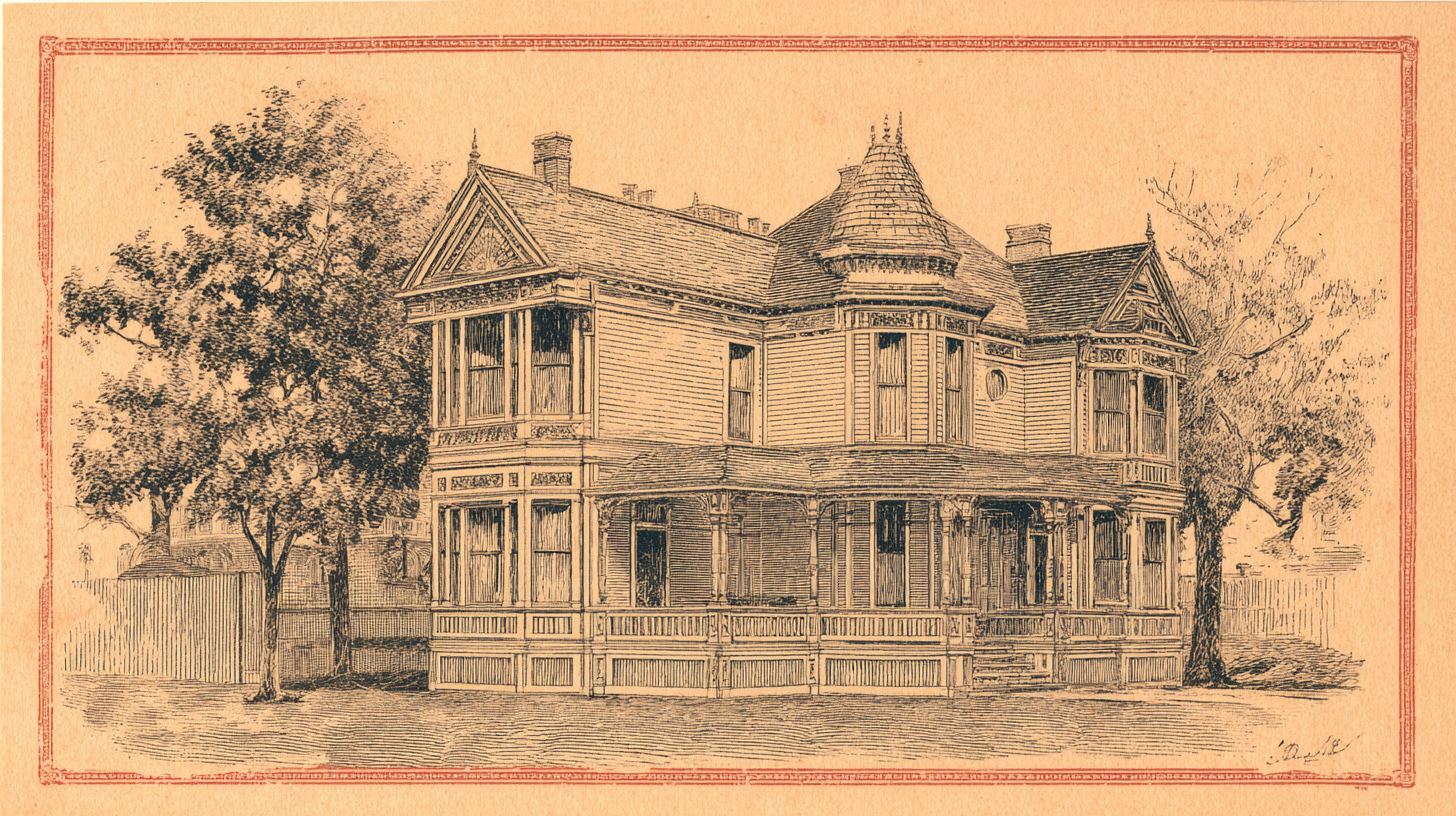
A late-1880s American house of the Eastlake register — the wrap-around veranda fitted with a spindle-work frieze between turned posts, the posts and balusters incised with geometric line ornament, the gable filled with a low-relief sunburst. The vocabulary is the machine-turned and machine-incised ornament a mill could ship by the running foot; the house carrying it is, in plan, simply a Queen Anne.
There exists a small and faintly comic class of architectural style whose named author publicly disowned the thing named after him, and went to his grave protesting that he had had nothing to do with it. The American Eastlake is the largest and most thoroughly disowned of these. Charles Locke Eastlake, the English design reformer whose 1868 Hints on Household Taste in Furniture, Upholstery, and Other Details had appeared in an American edition in 1872 and run through six editions inside a decade, used the new preface to the 1878 fourth London edition of his book to insist, in print and at some length, that the wooden American houses then being put up under his name had no connection of any kind to the book or to his own designs. What American tradesmen were pleased to call Eastlake furniture, he wrote there, was a thing with the production of which he had had nothing whatever to do, and for the taste of which he should be sorry to be considered responsible — the formulation passing into the trade press as extravagant and bizarre. The name stuck regardless. By the time he died in 1906, the Eastlake style had been a fixed and catalogued thing in America for thirty years, and had been built across the country in numbers his printed protests could only have multiplied.
This is the twenty-fourth post in Reading the American House. It takes up the Eastlake — the late-Victorian American style of the 1870s and 1880s identified by its turned-spindle-work porches, machine-cut geometric ornament, and low-relief incised line-decoration applied across posts, balusters, brackets, and frieze panels. The Eastlake is most often described as a sub-register of the Queen Anne and properly grouped there: an Eastlake house, in plan and silhouette, is almost always a Queen Anne. But the ornamental grammar is distinct enough to read on its own. The load-bearing distinction is the ornament, and the ornament is the machine’s. Where the Queen Anne post read a style whose decoration was industrial, the Eastlake reads what that decoration looked like at its most concentrated — the late-Victorian moment when the steam-powered lathe, the scroll saw, and the small incising chisel produced a domestic woodwork vocabulary one could order by the running foot, and almost everyone did. The irony of the namesake’s protest is the small bow tied around the whole arrangement.
The Misnomer
The first thing worth knowing about the Eastlake is that the man whose name it bears would have been within his rights to sue.
Charles Locke Eastlake — nephew of the more famous Sir Charles Lock Eastlake, who had presided over the National Gallery — was an English architect and design reformer of the second generation of the Pugin/Ruskin tradition. Hints on Household Taste was an argumentative book about the moral character of the things one lived among. Eastlake had spent three hundred pages arguing for honesty in domestic ornament. Furniture should declare its construction; ornament should be restrained, geometric, low-relief, derived from natural form by careful abstraction; the mortise should show; the dovetail should show; the wood should not be carved into pretences of materials it was not. The plates illustrated his own furniture — sideboards and washstands and chairs in dark stained oak, rectilinear, sparing in their ornament, the carved details shallow and geometric. The book was less a manual than a manifesto, and its closest American analogue in tone is the Eastlake-influenced argument that produced the Stick style — an argument the Stick borrowed from at one remove, through the furniture-and-interiors register in which Eastlake had set it out. The whole production was sober, careful, intellectual, and committed.
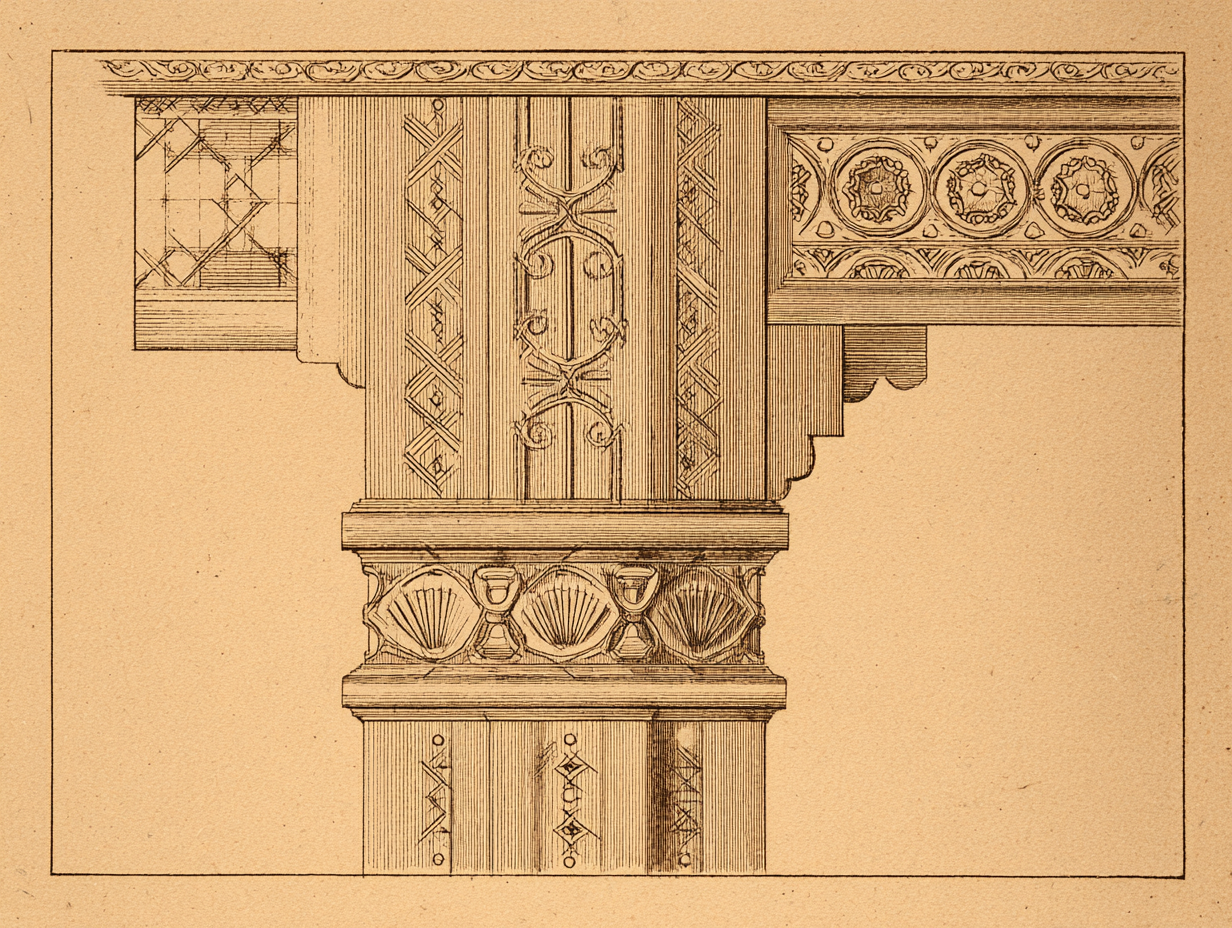
The Eastlake’s signature ornament — the incised line, cut shallowly into a wooden member in regular geometric patterns. Low-relief, never high-relief; geometric, never figural; cut by a small powered chisel against a template, never by hand. Severe and abstract on the page, fluent and slightly chattering in mass production. Eastlake would have approved the principle and plainly not the execution.
What the American carpenter and mill catalogue did with it was something else. Beginning in the early 1870s — and accelerating after the 1876 Centennial Exhibition, where the Eastlake vocabulary was prominently displayed — American woodworking shops and pattern-book authors took the geometric, low-relief ornamental vocabulary from Eastlake’s plates and applied it, with the unembarrassed energy of an industry that had just acquired the means to do so cheaply, to almost every available surface of a wooden domestic building. The turned spindle from the leg of an Eastlake chair became the porch post; the incised geometric line from the carved detail of an Eastlake sideboard became the ornament of the porch post; the sawn geometric frieze from the gallery of an Eastlake bookcase became the spindle-work above the porch. By 1880 every mill catalogue in the country was offering porch parts, brackets, and ornamental panels under the heading Eastlake, in numbered patterns and standard dimensions, on a price list. By 1890 the style — which had, in any meaningful sense, been the catalogue’s invention rather than Eastlake’s — was the standard ornament of the American middle-class house, and the man on the other side of the Atlantic was writing in the prefaces of his later editions that he had never meant any of it.
One is obliged to concede that this is, in its way, the most thoroughly American thing one could have done with an English moral argument about furniture. Eastlake had wanted honest construction, restrained ornament, and a chastened domestic interior. America had taken him at the word ornament, multiplied it by the run of a lathe, and shipped him the bill, posthumously, in the form of his own name. The name is not going anywhere.
The Specimen
If one is to identify an Eastlake house — and they are, once one knows where to look, on side streets in every American town that built between 1875 and 1895 — the exercise is the inverse of most of the styles in this series. One does not look at the silhouette. The silhouette is a Queen Anne’s. One looks, instead, at the porch.
The Eastlake’s principal feature is the spindle-work porch frieze. Across the front of the house, often wrapping a corner, runs a wooden veranda — the same wrap-around veranda one met in the Queen Anne post — and immediately above the porch posts, in the band between the post tops and the underside of the porch roof, runs a frieze of machine-turned spindles. The spindles are short turned dowels, four inches to a foot long, profiled with small bulbs and grooves cut on a powered lathe in regular pattern, arranged vertically in close ranks under a top rail or captured between two rails. The resulting frieze runs the full length of the porch in a continuous pierced screen. Where the Queen Anne porch was identified by spindle-work as one element among many, the Eastlake porch is dominated by it. The frieze is the visual event of the front of the house.
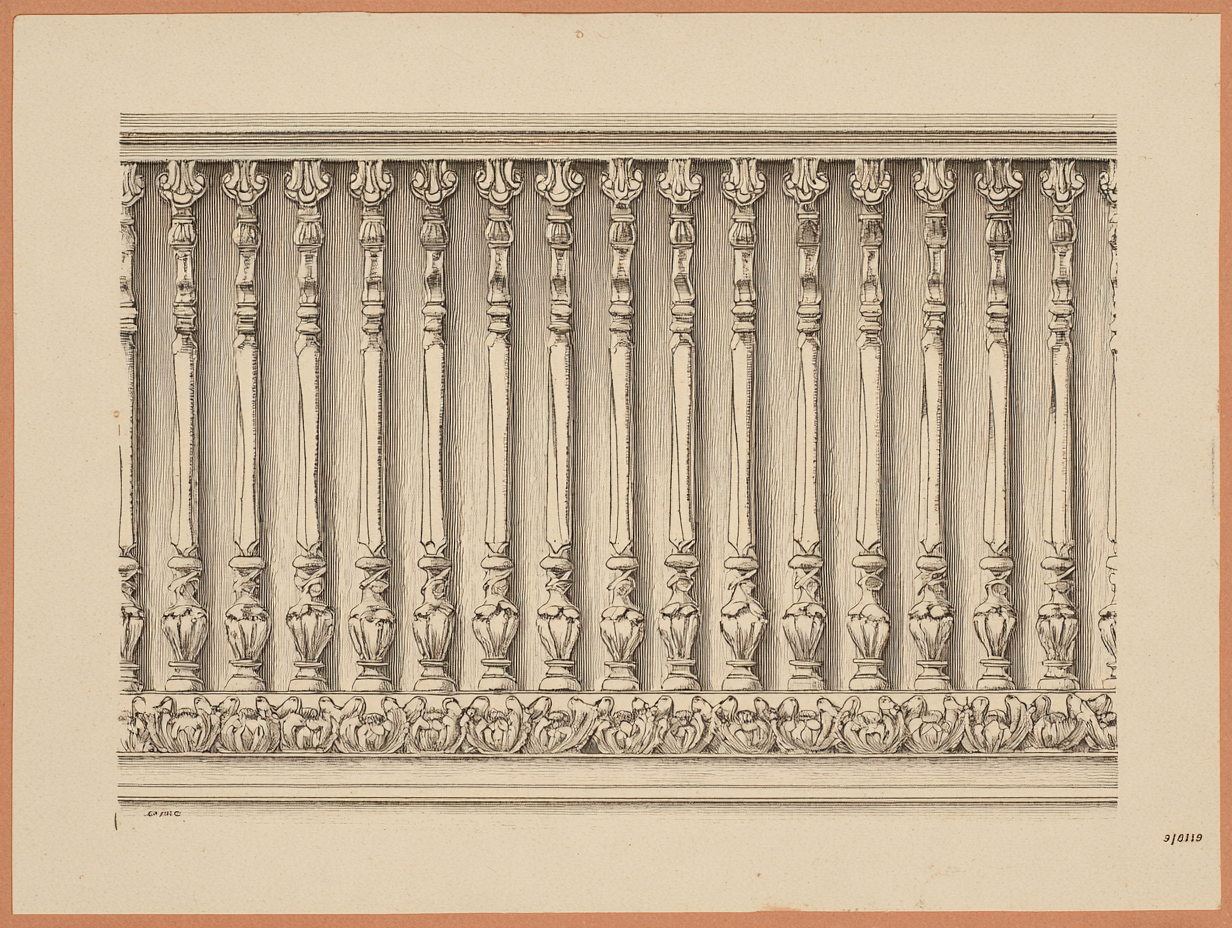
The spindle-work porch frieze — the Eastlake’s most concentrated feature. Each spindle is a short turned dowel cut on a steam-powered lathe to a standard profile; the spindles are hung in close ranks between an upper and a lower rail, the whole forming a pierced wooden screen between the porch posts and the porch ceiling. The carpenter has ordered the spindles by the gross from the mill catalogue; the mill has turned them by the thousand. The screen is the catalogue’s particular aesthetic event, made visible on the front of a house.
Come down to the porch posts. An Eastlake post is turned — shaped on the lathe in a profile of grouped beads, swells, and grooves running its full height. The shape is not the plain chamfered square of the Stick, nor the slender column of the Federal verandah, nor the curved bracket of the Italianate; it is a turned post, the work of the lathe visible down its length. Many Eastlake posts are then further worked: an incised geometric pattern is cut into the smooth panels between the turned beads, in shallow lines forming small repeated motifs — a row of dots, a chain of squares, a fan of radiating lines around a centred rosette. This incised ornament is the post’s second feature, and it is also the second feature of every other Eastlake member. The balusters carry it. The brackets carry it. The frieze panels carry it. The gable peak carries it. Where the surface is wood and large enough to take a small powered chisel, the carpenter ran the chisel across it in a geometric line pattern, and the catalogue had supplied the template.
The incised geometric ornament distinguishes the Eastlake from the broader Queen Anne more reliably than any other detail. Eastlake’s furniture argument had been particularly insistent on low-relief, geometric ornament — abstract pattern cut shallowly — as opposed to the high-relief carved naturalistic ornament (cherubs, swags, foliage) of the taste he had been arguing against. The American mills, having to choose between high-relief naturalism (which required hand work) and low-relief geometric incising (which could be machined), took the second on grounds Eastlake would have endorsed, for reasons he did not endorse. The Eastlake porch, by 1885, was dressed almost entirely in low-relief geometric line ornament, and it is the relief, more than any other single detail, that tells the trained eye an Eastlake porch from a Queen Anne one. Shallow, geometric, abstract — Eastlake. Deeper, naturalistic, figural — broader Queen Anne.
The third feature is the machine-sawn ornamental panel, set into the gable peak and over the front door. The panel is a flat board, often a rough circle or octagon, with a geometric figure — a sunburst of radiating spokes, a sunflower of concentric incised circles, a chain of incised diamonds — sawn and incised across its face. It sits where the carved vergeboard would have sat on a Gothic Revival, and where the patterned shingle would have sat on the broader Queen Anne. It is a small thing — a foot or two across — but it caps the front of the house, and once one has noticed it on one Eastlake porch one sees it on a dozen others.
The brackets under the eaves and the balusters of the porch railing are turned and incised in the same vocabulary as the porch posts, and they are where the catalogue made its money — both were ordered in larger numbers per house than any other ornamental member. The paint scheme is the late-Victorian polychrome of the Queen Anne and Stick: three or four colours per elevation, picking out the spindles, the incising, and the panels in contrasting tones against a darker field — sage, terracotta, deep red, mustard, olive, slate-blue — the painter’s job being to make the cheap machined ornament legible against the wall plane behind it.
Assemble these — the spindle-work porch frieze, the turned and incised porch posts, the incised low-relief geometric ornament across every member, the sawn geometric gable panel, the Victorian polychrome — set them on the Queen Anne plan and silhouette of an irregular wooden two- or three-storey wrap-around-verandahed corner-towered house, and one has an Eastlake. The carpenters who built the houses called them, when they called them anything in particular, Queen Annes; the mill ordered the parts under Eastlake; the homeowner picked from a pattern book and was told what he had bought afterward.
What It Is Not
Four styles stand near enough to the Eastlake that the beginner confuses them with it.
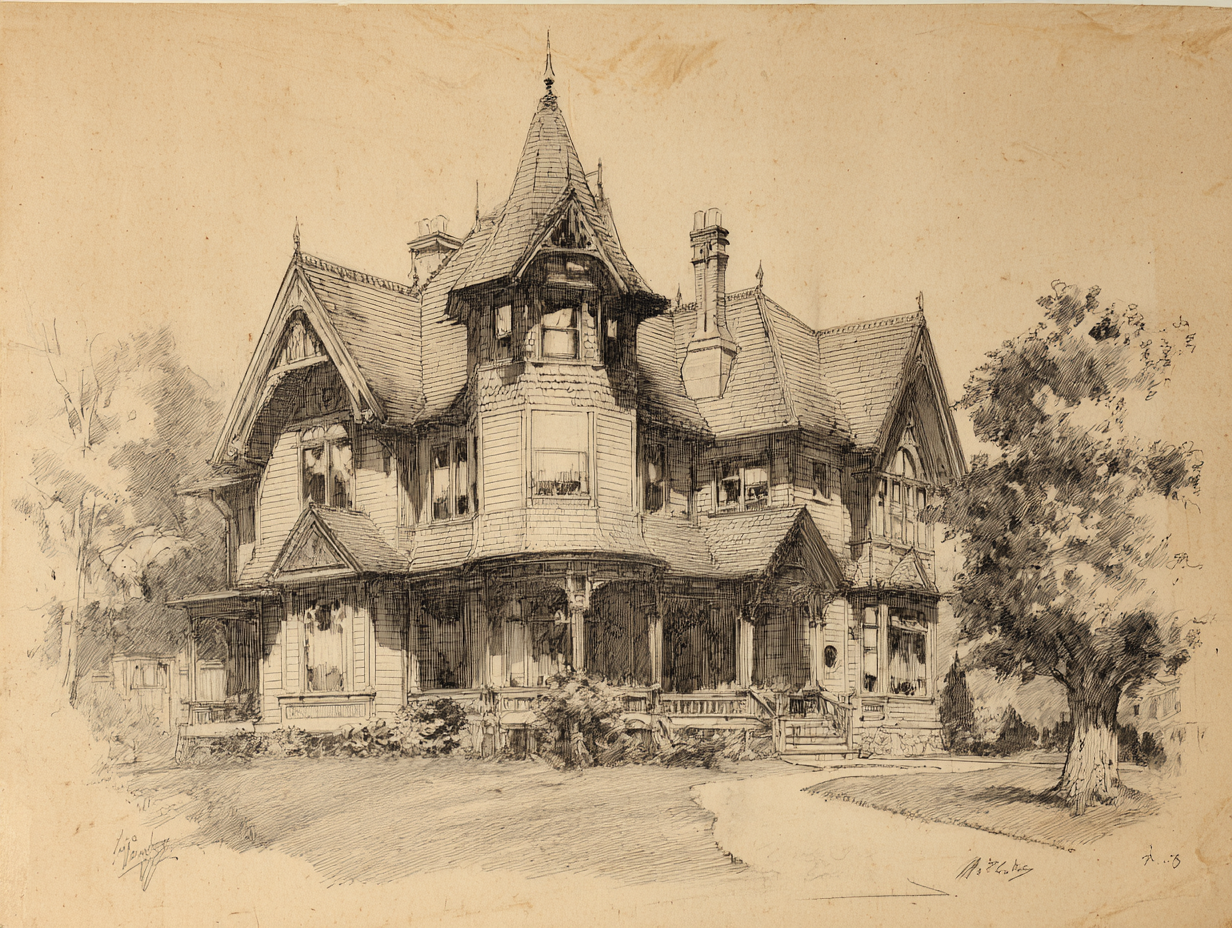
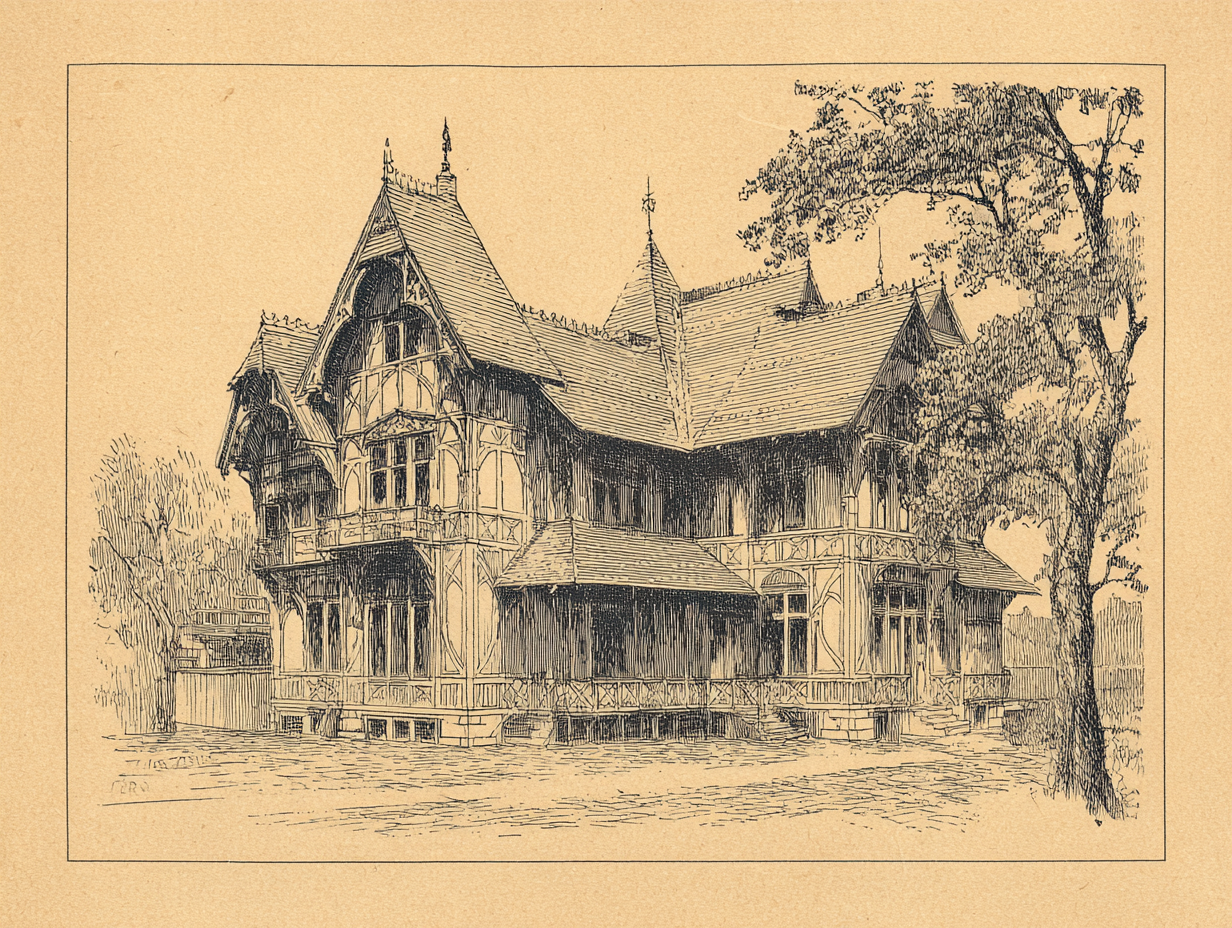
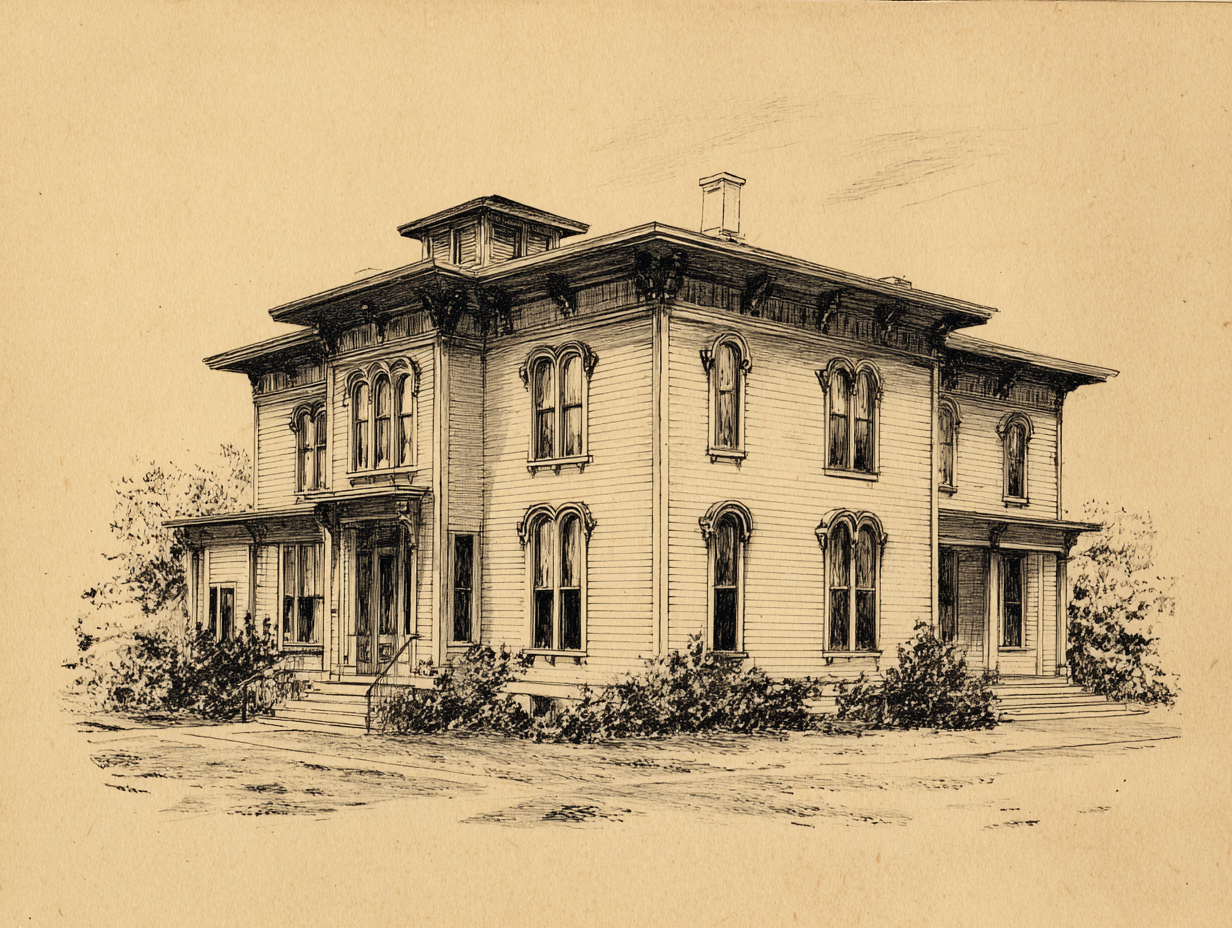
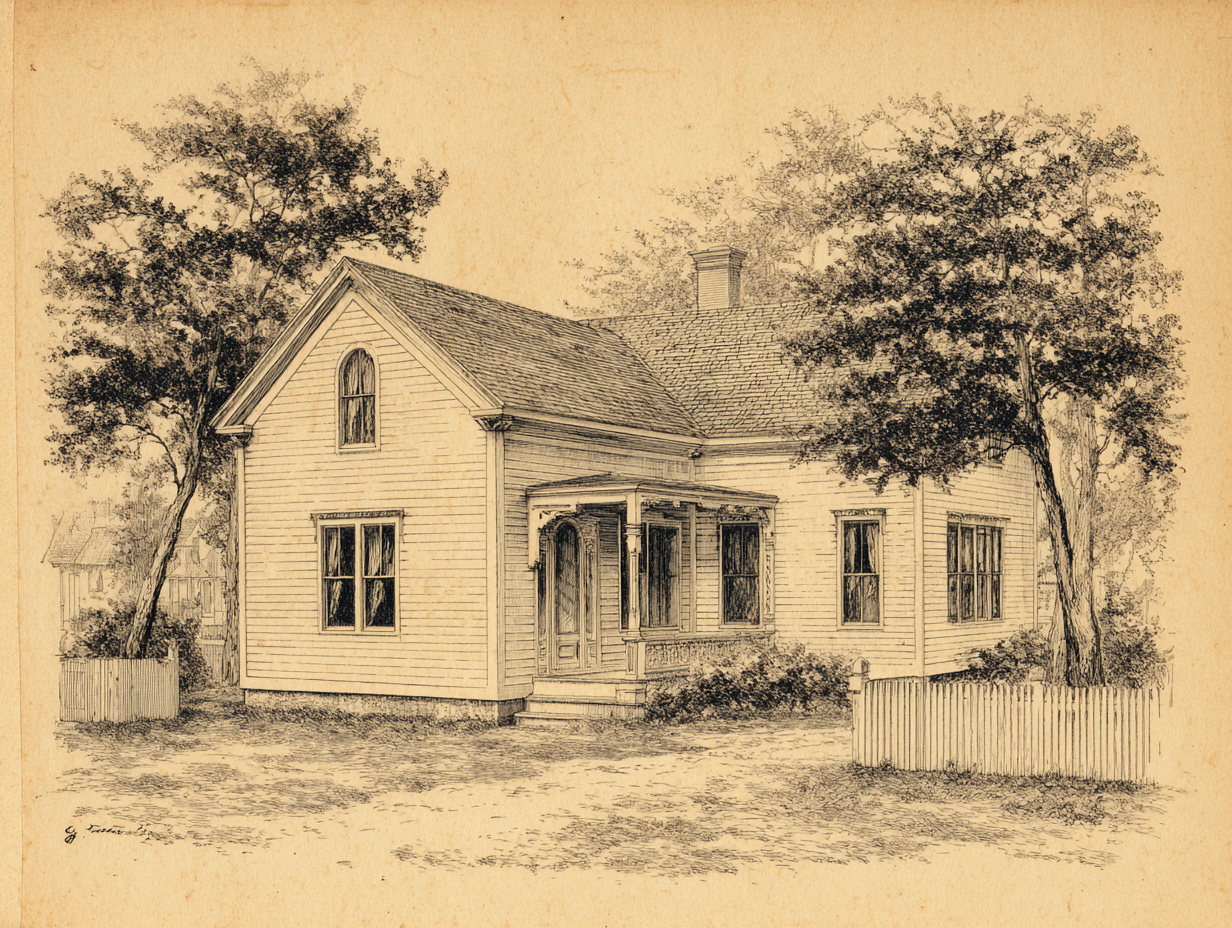
The Queen Anne is the parent style. The two share plan, silhouette, and almost the whole of their building campaign — flourished in the same years, built from the same pattern books, sold by the same mill catalogues, often the same house with different parts ordered. The Eastlake is properly thought of as the register of late-Victorian woodwork in which porch and ornament are machine-turned, incised, and geometric in the low-relief Eastlake-furniture vocabulary; the Queen Anne is the broader style that includes the Eastlake along with sister registers of high-relief carved ornament, fish-scale shingle, and half-timbering. The rule of thumb: a porch dominated by turned spindles and low-relief incised geometric line ornament is in the Eastlake register; the same plan with fish-scale shingle, sunburst gables, and high-relief naturalistic carving is in the broader Queen Anne. The two are the same building seen by two ornament catalogues.
The Stick style is the Eastlake’s older intellectual cousin — the same Pugin/Ruskin/Eastlake argument applied to a different part of the building. The Stick took Eastlake’s argument about expressed structure and applied it to the wall plane, with sawn flat boards in vertical, horizontal, and diagonal patterns suggesting the timber frame underneath. The Eastlake took the same author’s argument about restrained geometric ornament and applied it to porch and surface decoration. Henry Hudson Holly, whose Modern Dwellings in Town and Country (1878) introduced the Queen Anne Revival to America, was a principal American champion of the Eastlake argument as well, and one finds, in the field, houses combining Stick wall ornament with Eastlake porch ornament in such free combination that the cataloguer must choose which label to put on the form. The rule of thumb: ornament dominating the wall plane with applied flat boards, Stick; ornament dominating the porch with turned spindles and incised geometry, Eastlake; both, both — and the cataloguer is to be forgiven for choosing whichever is in the worse repair.
The Italianate is the preceding American bracketed style, and the one most likely to be misread as Eastlake by an eye that has noticed the brackets and stopped there. Both styles use sawn wooden brackets under projecting eaves. The distinction is in what the bracket is doing. The Italianate bracket is paired, deep, S-curved, and supports a wide flat overhanging roof over a square hipped-roofed two-storey house. The Eastlake bracket is single, shallower, more sharply geometric, incised with low-relief line ornament, and supports a porch roof over an irregular Queen Anne-plan house with a wrap-around veranda. The two are a generation apart, and one was passing from fashion when the other began.
The Folk Victorian is the form in which the Eastlake catalogue reached the country town that could not afford a full Queen Anne. Strip the Queen Anne plan and the wrap-around veranda away, leave a plain side-gabled vernacular two-storey farmhouse, nail the same catalogue porch parts onto its plain front, and one has a Folk Victorian wearing Eastlake clothing. The ornament is from the same mill catalogue. The plan beneath has nothing to do with the Queen Anne. Eastlake ornament on a high-style Queen Anne plan is Eastlake; the same ornament on a plain folk vernacular is Folk Victorian. The catalogue did not care which one the customer was; the customer did not always know.
What It Was Trying to Say
What I find most telling about the Eastlake is the gap between its name’s intention and its built reality — a gap so wide that the namesake denied the building, and the building denied the namesake, and the style settled comfortably into the gap and got on with covering the country.
Eastlake the man had wanted restraint. He had wanted geometric, low-relief, abstracted ornament because abstract restraint was, for the Pugin/Ruskin/Eastlake school, a moral virtue. The Victorian high-relief naturalistic carving of cherubs and foliage was, for that school, ornament that lied about itself — pretending to be sculpture, pretending to have sprung from the wood by the hand, pretending to be expensive. Low-relief geometric incising was honest: it did not pretend to be sculpture, it admitted itself a surface decoration cut by a tool, and it did not pretend to be expensive. The Eastlake furniture vocabulary was, on its own terms, a morally serious answer to a Victorian ornamental problem.
What the American carpenter took from that argument was the part that could be machined. What the steam-powered lathe and the small powered incising chisel could machine, in 1880, was precisely the low-relief geometric ornament Eastlake had drawn in his plates. The catalogue’s adoption of Eastlake was not, on inspection, a cynical misappropriation. It was a genuine alignment: Eastlake had argued for geometric machine-makeable ornament on moral grounds, and the machine had arrived to make exactly that ornament on commercial ones. The argument and the means agreed. The result is that the Eastlake porch, on a small middle-class American house in 1885, is more closely faithful to Eastlake’s actual ornamental principles than a great deal of the explicitly Eastlake-labelled hand-carved furniture being produced in the high-end New York shops. The mill was doing what Eastlake had asked for. He hated the result.
The reason he hated it was not the ornament. It was the quantity. Eastlake had imagined his geometric vocabulary used sparingly — a single carved panel on the front of a sideboard, a row of incised lines down the chamfer of a chair leg, a small detail performing a small office. The American carpenter, having a catalogue that offered the ornament by the running foot and a porch that needed filling, applied it everywhere. Every post, every baluster, every bracket, every panel, every gable peak. The principle was honoured; the proportion was not. The geometry crowds itself; the restraint becomes its opposite. Gaudy is exactly the right word for what happens when restraint is multiplied by a lathe.
There is a smaller and quieter point sitting underneath the louder one. The Eastlake is the late-Victorian point at which the American building industry first proved that it could take a foreign design idea, machine it, distribute it, and saturate the country with it inside ten years. The Italianate had taken longer; the Greek Revival had taken longer; the Gothic Revival had been a slower and patchier business. The Eastlake — published in London in 1868, named in America by 1872, peaking at the 1876 Centennial, fully catalogued by 1880, ubiquitous by 1885, beginning to fade by 1895 — was the first style in the series to move through its arc in a single generation, on the rails of a commercial machine-woodwork industry that had not existed twenty years earlier. The disowning by its namesake is the index of how fast the industry had moved: the man could not keep up with the catalogue. By the time he came to write the angry preface of 1878, the style bearing his name had built more houses than he had ever drawn.
The next specimen I should like to take up is one of those later styles the Eastlake catalogue helped pave the way for — an American house of the same building industry and the same wooden vocabulary, but turned, in the last years of the nineteenth century, away from the catalogue’s commercial cheerfulness and back toward an argument the Eastlake’s namesake would have recognised. The Eastlake gave the country its first catalogue style; what came next gave it the first style that consciously refused the catalogue.