The ninth post in this arc treated Thomas Sheraton, and closed by promising one of two continuations: the heavier Regency succession that displaced Sheraton after 1800, or an extension of the Sheraton-and-Hepplewhite vocabulary into the post-colonial American workshops. This is the first of those — English Regency, the early-nineteenth-century English style, running from roughly 1800 to 1830, in which the late-neoclassical tradition turned from refinement to weight, from the pale satinwood of the Sheraton pair to dark rosewood, from fine wood-stringing to brass, and from a neoclassicism that adapted the antique to one that copied it. As with the Hepplewhite and Sheraton posts before it, this is a taxonomy post: a description of a type and the evidence by which one reads it, not a personal narrative. Thomas Hope’s Household Furniture and Interior Decoration of 1807 and George Smith’s Collection of Designs of 1808 are the documentary sources.
One fact about the Regency this post will return to repeatedly, the fact from which every distinction descends, is load-bearing in the same way the rectangular back was load-bearing for Sheraton. The Sheraton cabinet-maker, and the Hepplewhite one before him, adapted the antique: they took the urn and the swag and the paterae the architects had drawn from Greece and Rome, lightened them, fitted them to a chair back or a drawer front, and made of them recognisably modern furniture wearing classical ornament. The Regency cabinet-maker did something else. He copied the antique — copied it with a new and deliberate literalism, reproducing not the ornament of an ancient object but the object itself, its whole form and proportion. That is the boundary this post exists to establish: the Regency is archaeological classicism, and the difference between archaeology and adaptation is what one is reading for throughout.
The Specimen
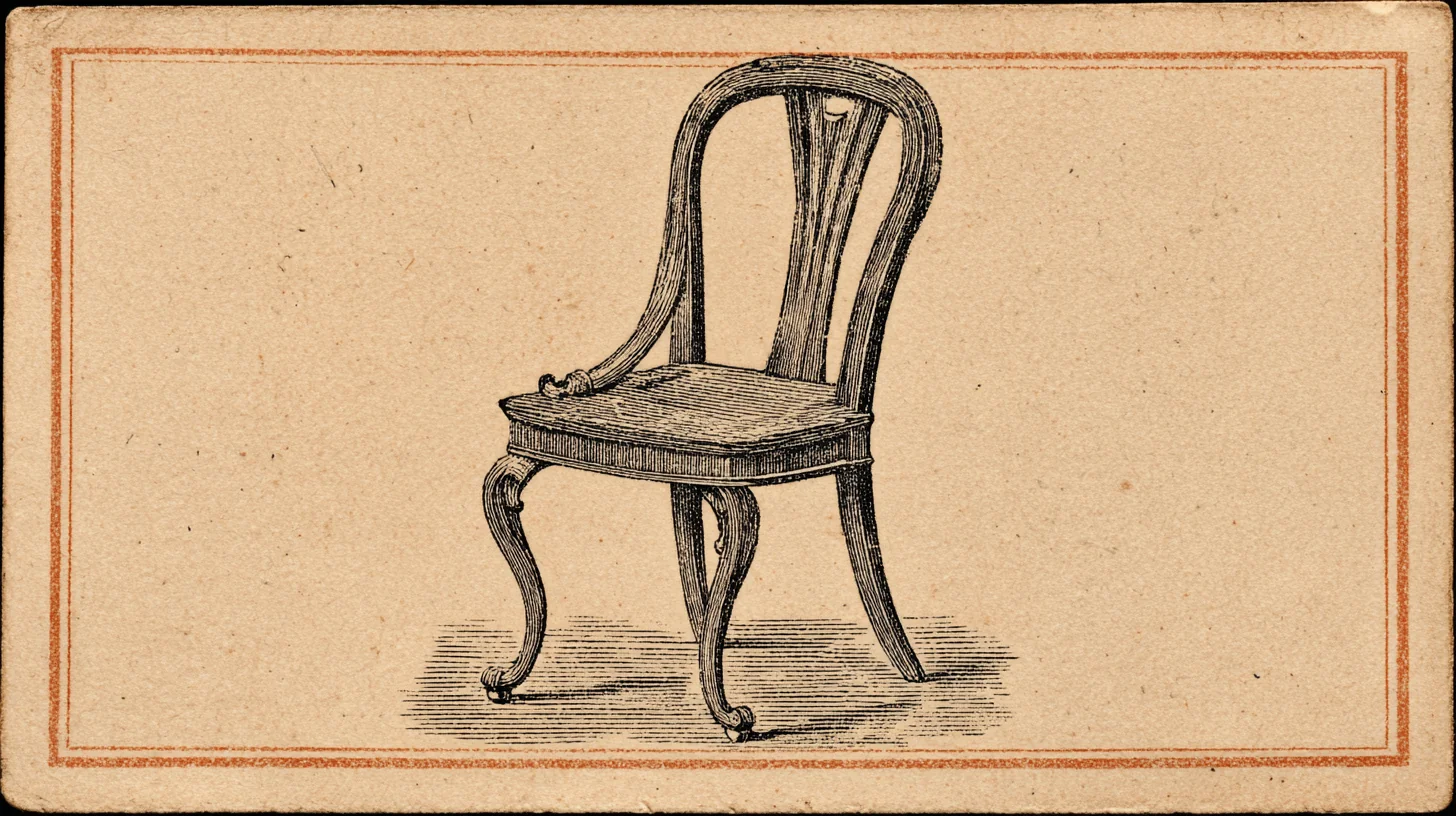
The canonical Regency piece, for the purpose of beginning to read the style, is the side chair — canonical because it concentrates the whole vocabulary into a single object the eye can take in at once, and because it is the clearest demonstration there is of what archaeological copying means. The Sheraton chair back is a rectangle, the Hepplewhite a shield: both are forms the English workshop devised. The Regency chair is not a devised form at all. It is, very frequently, a near-literal copy of a specific ancient object — the Greek klismos, the light side chair of the fifth and fourth centuries before Christ, known to the Regency designer not from any surviving example but from its image on the red-figure vases the antiquarian collections of the period were rapidly accumulating. The Regency chair reproduces its shape: a back of two curved uprights sweeping outward and a single broad concave splat between them at shoulder height, the whole back leaning back from the seat in one continuous curve; and, beneath the seat, the sabre leg — the bold concave-curved leg drawn directly from the klismos and named for its likeness to a cavalry blade. This is the single most important member in the style. A Sheraton leg is straight, turned, reeded; a Hepplewhite leg straight, square, tapered. The Regency sabre leg is a curve — a strong, simple, concave sweep that carries the whole chair, and that no amount of adaptation produced, because it was copied, not adapted.
The chair states the principle, but the case furniture carries it as plainly as the seat furniture does. The Regency workshop made the sofa table — a long narrow table with two small hinged end-flaps, to stand behind a sofa — on lyre-shaped or Grecian-cross end-supports; it made the circular “loo” table, the large round table for cards and tea, on a single stout central pedestal rising from a low platform base on lion-paw feet or brass castors; it made the chiffonier, a low side cabinet with a shelved superstructure, in rosewood with a brass-trellis grille across the cupboard doors. And the archaeological habit ran further still: after Napoleon’s Egyptian campaign of 1798 — and, more particularly, after Baron Vivant Denon’s lavishly illustrated Voyage dans la Basse et la Haute Égypte of 1802 carried the measured antiquity of Egypt into the print trade — the Regency designer added Egyptian forms to his Greek and Roman ones: sphinx heads at the terminals of chair arms, lotus ornament, the tapering pylon-like leg, the whole class of work the period itself called the “Egyptian taste.” Chair, sofa table, loo table, chiffonier, sphinx-headed Egyptian piece — between them they set out the entire Regency manner, and every one of them is a quotation.
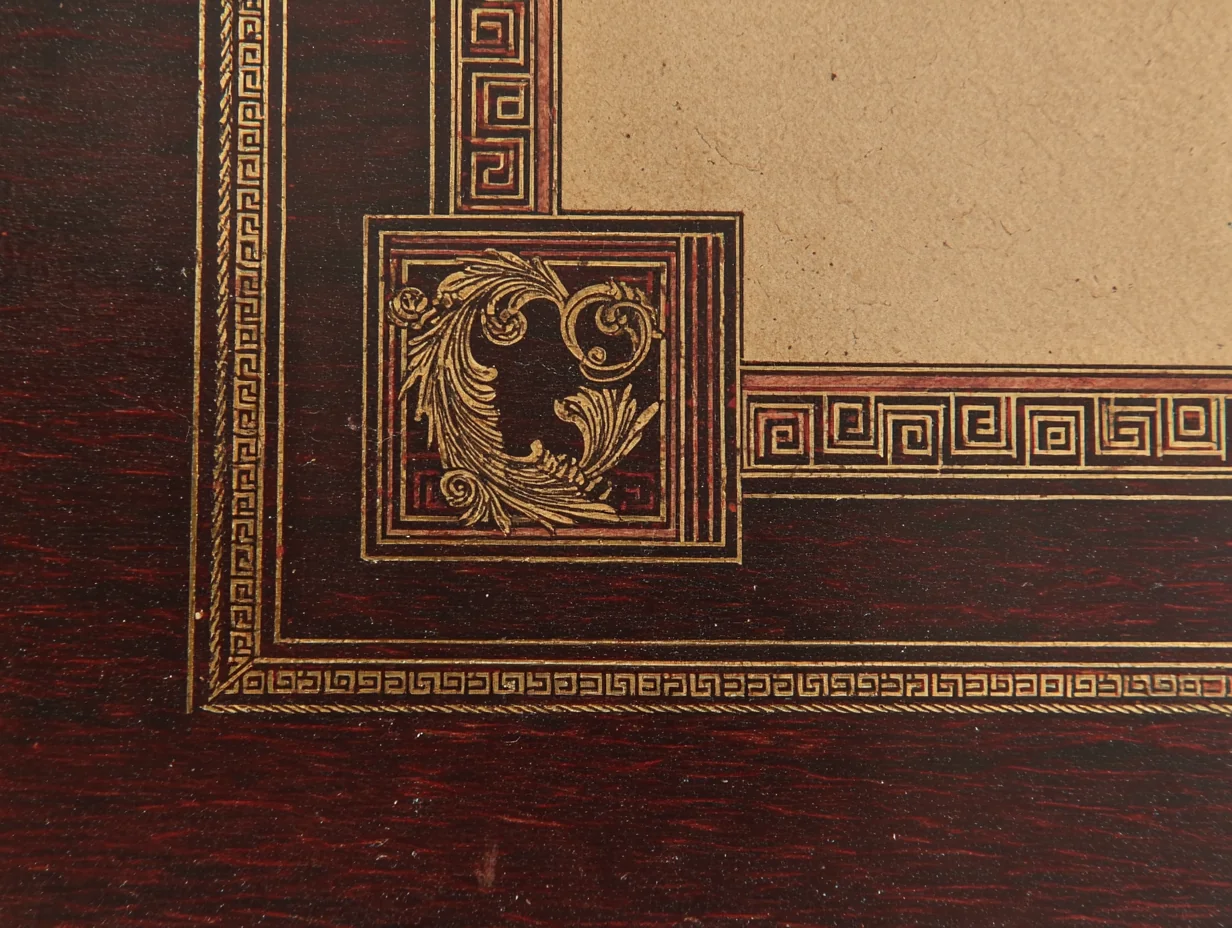
A close detail of Regency brass inlay on rosewood — the Greek-key border or laurel-wreath repeat in the Buhl-work brass-and-rosewood combination that is the English Regency signature.
The Evidence
The wood, first, because the wood is most of what one is reading for, and here the Regency parts decisively from the two pale styles that preceded it. The Sheraton and Hepplewhite tradition worked in satinwood — the pale golden timber, light in colour and light in weight. The Regency turned to dark timbers, and to one above all: rosewood — the dense, hard, dark-brown timber, streaked with near-black, of a gravity the Sheraton register never sought. Mahogany returned to favour beside it, and the period reached also for the rarer exotic woods the expanding colonial trade was bringing in — calamander, the brown-and-black banded timber of Ceylon, and the boldly striped zebrawood. But rosewood is the type-timber, and the choice of it is not incidental: a style that meant to copy the gravity of antique marble and antique bronze wanted a wood with weight and darkness in it. The change from Sheraton is the largest change of timber in the whole English neoclassical succession — not a finer satinwood but a darker wood altogether.
The brass, second — and brass is to the Regency what the fine line of stringing was to Sheraton, the material through which the eye reads the style. The Sheraton workshop drew the architecture of a piece in a thread of dark wood let into a pale ground; the Regency reversed the contrast and changed the metal, drawing its architecture in brass let into the dark rosewood. The brass appears in several registers the collector should know apart. Brass stringing — narrow lines inlaid along every edge and panel, the direct counterpart of the Sheraton ebony line, bright metal against dark wood. Brass marquetry — broader cut-brass ornament, scrolling foliage and anthemion, let into the rosewood in flat sheet, a revival of the technique of the seventeenth-century French ébéniste André-Charles Boulle, which the Regency trade called “buhl.” And brass in three dimensions: galleries, the low pierced rails round the top of a table or cabinet; mounts and capitals; lion-paw feet and the castors set into them. Stringing, buhl, gallery, mount, paw, castor — the brass-on-rosewood combination is the single surest signature of the English Regency.
The ornament, third, is where the archaeological habit shows itself plainest. The Regency designer did not invent his decorative motifs; he quoted them, from a known and namable source. The Greek key — the running fret of right-angled meanders — runs as a border along table edges and cabinet friezes. The anthemion or honeysuckle, the stylised palmette of Greek architecture, sits in the centre of a chair splat or a frieze panel. The lyre appears as the support of a sofa-table end or the splat of a chair back. The lion appears entire and repeatedly: as the mask, as the paw foot, and as the monopodium — the carved support, drawn from Roman furniture, that combines a lion’s head and a single lion’s leg into one upright member at the corners of cabinets and the ends of tables. And after the Egyptian campaign the sphinx head, the lotus, and the tapering pylon leg join the Greek and Roman stock. Every motif has an ancient address, and the Regency designer meant the address to be read.
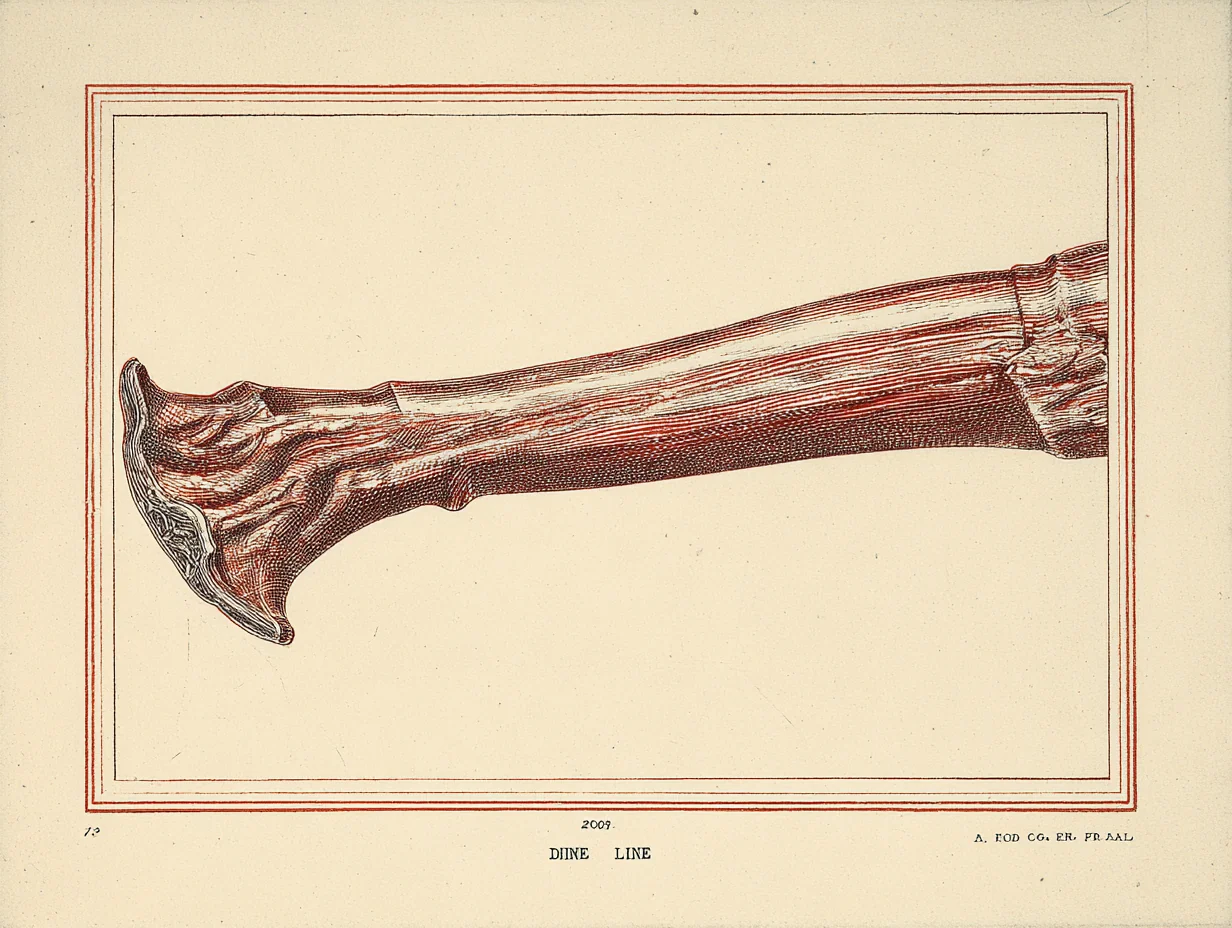
A close detail of a Regency sabre leg — the Greek klismos-derived curving form on a chair, brass-mounted at the foot. The same Greek-revival source that the Continental Biedermeier drew on, translated here into the English Regency register.
The construction, fourth. The Regency piece is heavier than the Sheraton piece — the frame members more substantial, the timber not pared away but allowed its weight — and the heaviness is itself the structural expression of a manner that wanted gravity. On a genuine period example the workshop hand shows in the ordinary places: hand-cut dovetails of irregular spacing, hand-laid veneer over a hide-glue ground, two centuries of shrinkage and oxidation on the backboards and undersides. But the Regency piece carries one further class of evidence the pale styles did not, and it is evidence in metal: the brass stringing and cut-brass buhl, let into the wood by hand, work loose against the rosewood over two centuries — the two materials expanding and contracting at different rates — in a way a later machine-set imitation does not reproduce. The lifting line of brass, and the fine dark gap that opens beside it, are as much a period tell as the dovetail.
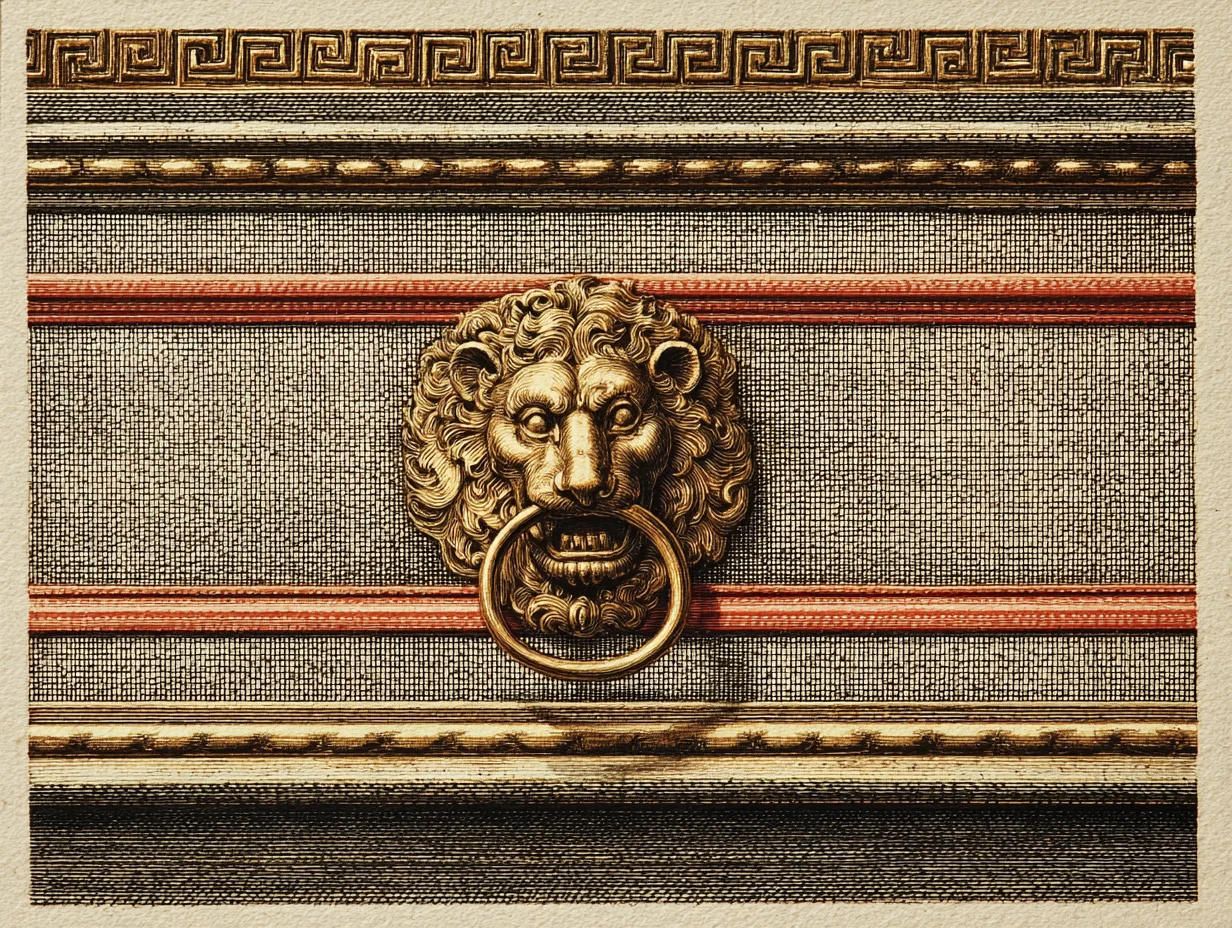
A close detail of Regency brass hardware — the ring pull, lion-mask escutcheon, and Greek-key border in brass that distinguish the English Regency from the contemporary French Empire ormolu.
And the pattern book, fifth — for the Regency, as for Sheraton and Hepplewhite, the published design is the document against which a piece is judged. The Regency presents that pattern book in an unusual doubled form, and the doubling is itself worth reading. There is, first, Thomas Hope’s Household Furniture and Interior Decoration of 1807 — Hope being no cabinet-maker nor designer for the trade, but a wealthy connoisseur who furnished his own London house in the archaeological taste and published the engraved record of it. And there is, second, George Smith’s Collection of Designs of 1808 — Smith being a trade figure, an upholsterer and cabinet-maker who took the connoisseur’s archaeological manner and issued it as a working pattern book for the ordinary shop. Hope coined the look; Smith carried it to the trade.
The Period
The Regency takes its name from a constitutional arrangement of strictly limited duration. In 1811 the madness of George III was judged settled and permanent, and his eldest son, the Prince of Wales, was made Prince Regent to govern in his father’s name; the arrangement lasted until the old king’s death in 1820, when the Regent succeeded as George IV in his own right. The Regency proper is therefore that single decade, 1811 to 1820 — but the furniture style is not bounded by it. The archaeological manner had begun to form before 1811 and was carried on well after 1820, and the useful span this post adopts runs from about 1800 to about 1830, taking in the Regency, the further decade of George IV’s reign, and the opening of the heavier William IV taste that followed. The style, in short, is named for the decade but lived for a generation.
What gave the style its character was a particular relation between a connoisseur, a king, and an antiquarian moment. The antiquarian moment was Europe-wide: the excavations at Pompeii and Herculaneum had been feeding accurate drawings of ancient furniture into the print trade for half a century, the publication of Greek vase collections had made the klismos a familiar shape, and Napoleon’s expedition to Egypt had returned with a corps of scholars whose measured drawing — Denon’s above all — put Egyptian ornament suddenly within reach. The connoisseur was Thomas Hope — of a wealthy Dutch banking family, a collector of antique marbles and vases who had travelled in Greece, Egypt, and the Levant, and who furnished his Duchess Street house in London as a set of archaeological rooms designed around his collection. In 1807 he published the engraved record of those rooms, and the book did a particular and unusual work: it gave the archaeological taste a name, an author, and a standard of correctness. The king’s part was the part of the patron: the Prince Regent, at Carlton House in London and the Royal Pavilion at Brighton, spent on a scale that made his commissions the most visible furniture in the kingdom, and the taste he broadcast was the Greek and the archaeological. A scholar coined the look; a prince made it conspicuous.
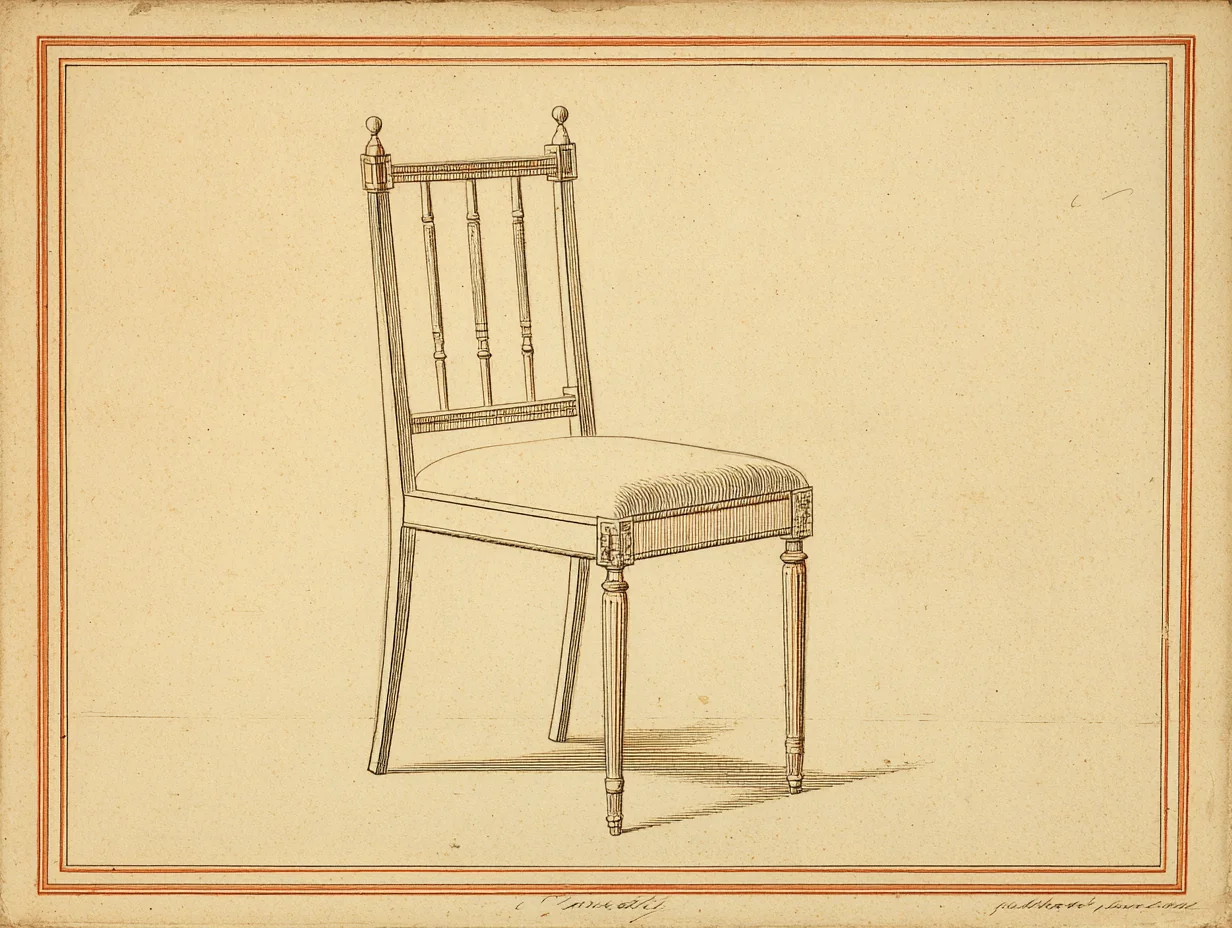
A Sheraton chair — the immediate predecessor. The Regency period kept the rectangular form but moved from satinwood to rosewood, from inlay to brass, from straight legs to sabre legs, and added Greek-revival and Egyptian-revival vocabulary.
The antecedent the Regency grew out of was, in the first place, Sheraton — the immediate English predecessor, treated in the post before this one. The relation is one of succession and weighting, not of opposition: the Regency kept the English neoclassical line and much of the cabinet repertory, and simply pressed the whole of it in the contrary direction to the one Sheraton had pressed it — where Sheraton had attenuated, the Regency thickened; where Sheraton had gone pale, the Regency went dark. But the Regency had a second antecedent that Sheraton did not, and it lay across the Channel. The archaeological turn — the move from adapting the antique to copying it — was a Continental movement before it was an English one: the later phase of the French Louis XVI style had already begun to take its furniture forms more literally from the antique, and the emerging French Empire style, forming in exactly the years Hope was furnishing Duchess Street, was an archaeological classicism of imperial ambition. English and French archaeology are siblings, drawing on the same Pompeian and Greek and Egyptian sources at the same moment; the difference between them is one of material and of temper, not of source.
The load-bearing distinction every Regency collector must master is therefore not, in the first place, between this style and a neighbouring one — that is the work of the next section — but the distinction this post opened with, between copying and adapting the antique. With Sheraton and Hepplewhite the antique furnished a vocabulary of ornament that the English workshop fitted to forms of its own devising; the shield back and the rectangular back are English inventions wearing classical dress. With the Regency the antique furnished the form itself: the klismos chair is not an English chair with Greek ornament but a Greek chair reproduced, and the sabre leg is not a leg an English designer drew but a leg copied off a vase. This changes what the collector reads for: with Sheraton one asks how fluently the published vocabulary has been realised; with the Regency one asks, additionally, how literally the ancient model has been quoted — because literalism of quotation is the thing the style was made to achieve.
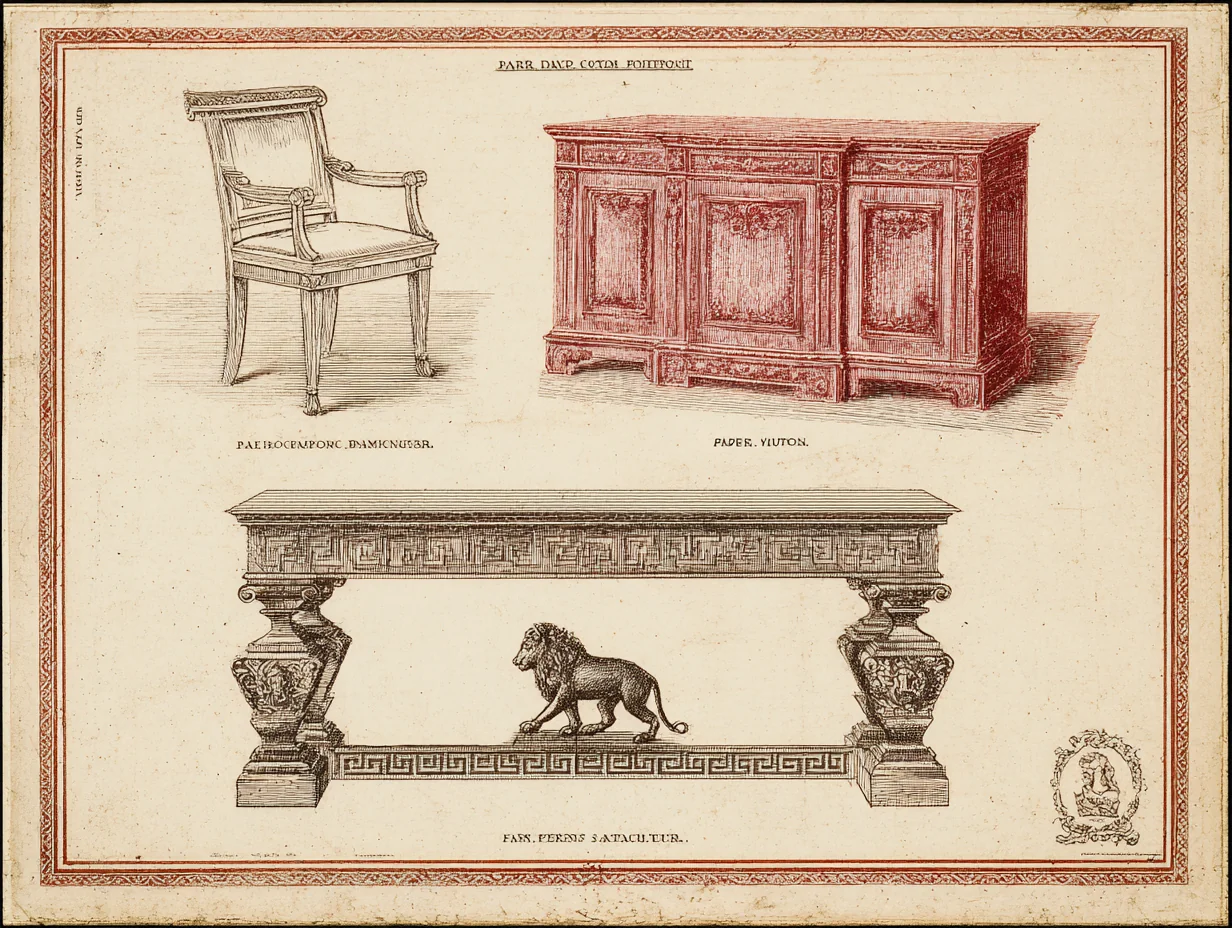
A page from Thomas Hope’s 1807 Household Furniture and Interior Decoration — engraved plates of the principal Regency forms: the klismos-sabre-leg chair, the Egyptian-revival cabinet with sphinx supports, the Greek-key console table.
What It Is Not
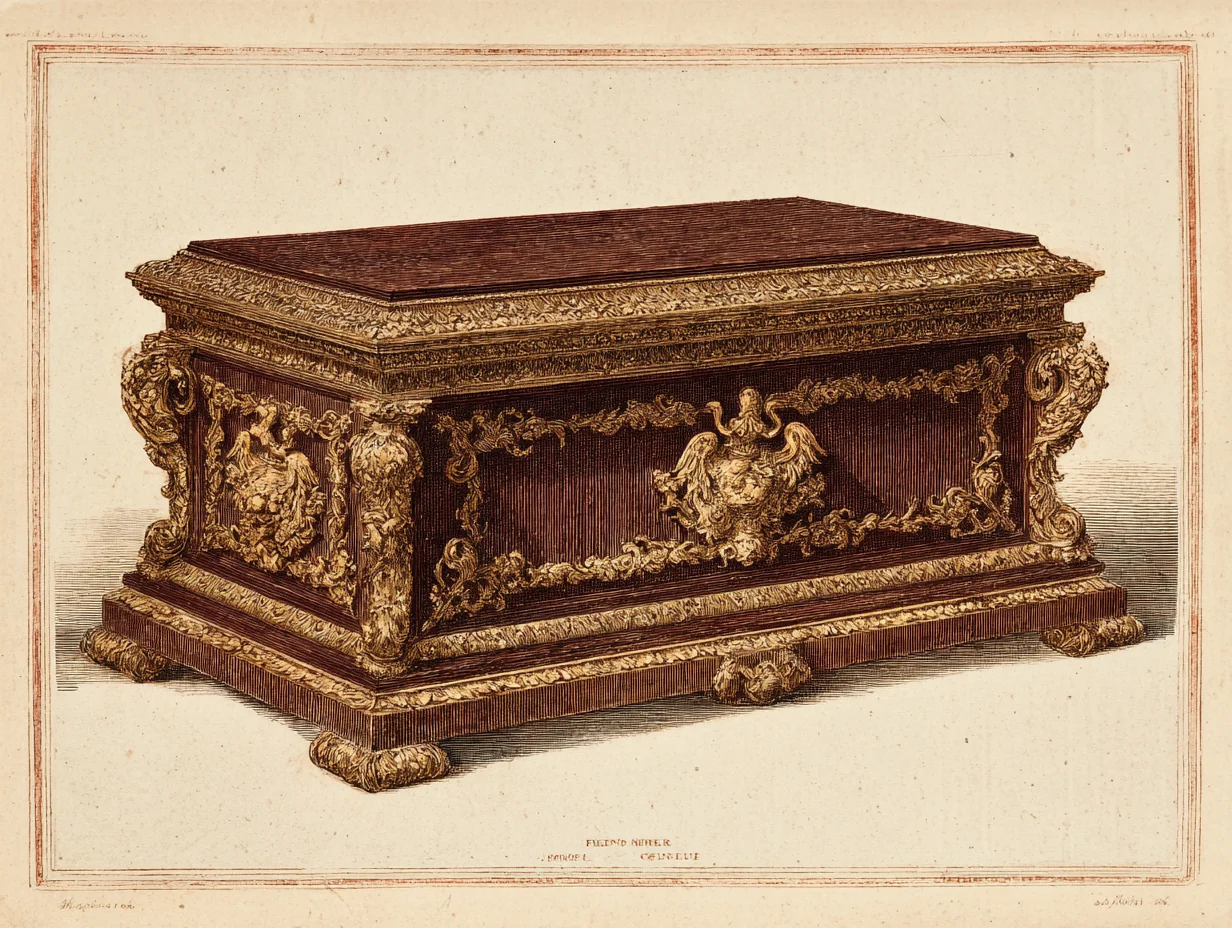
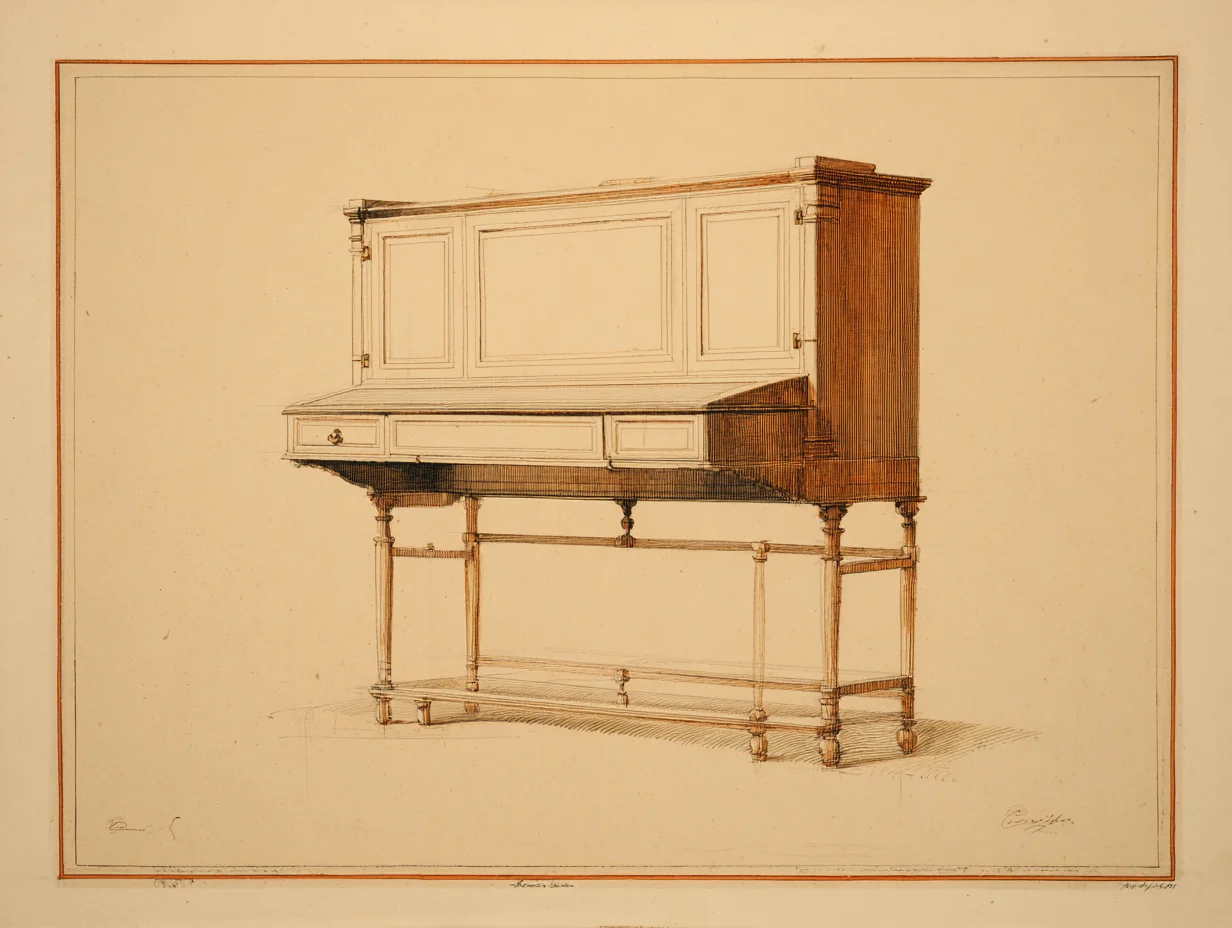
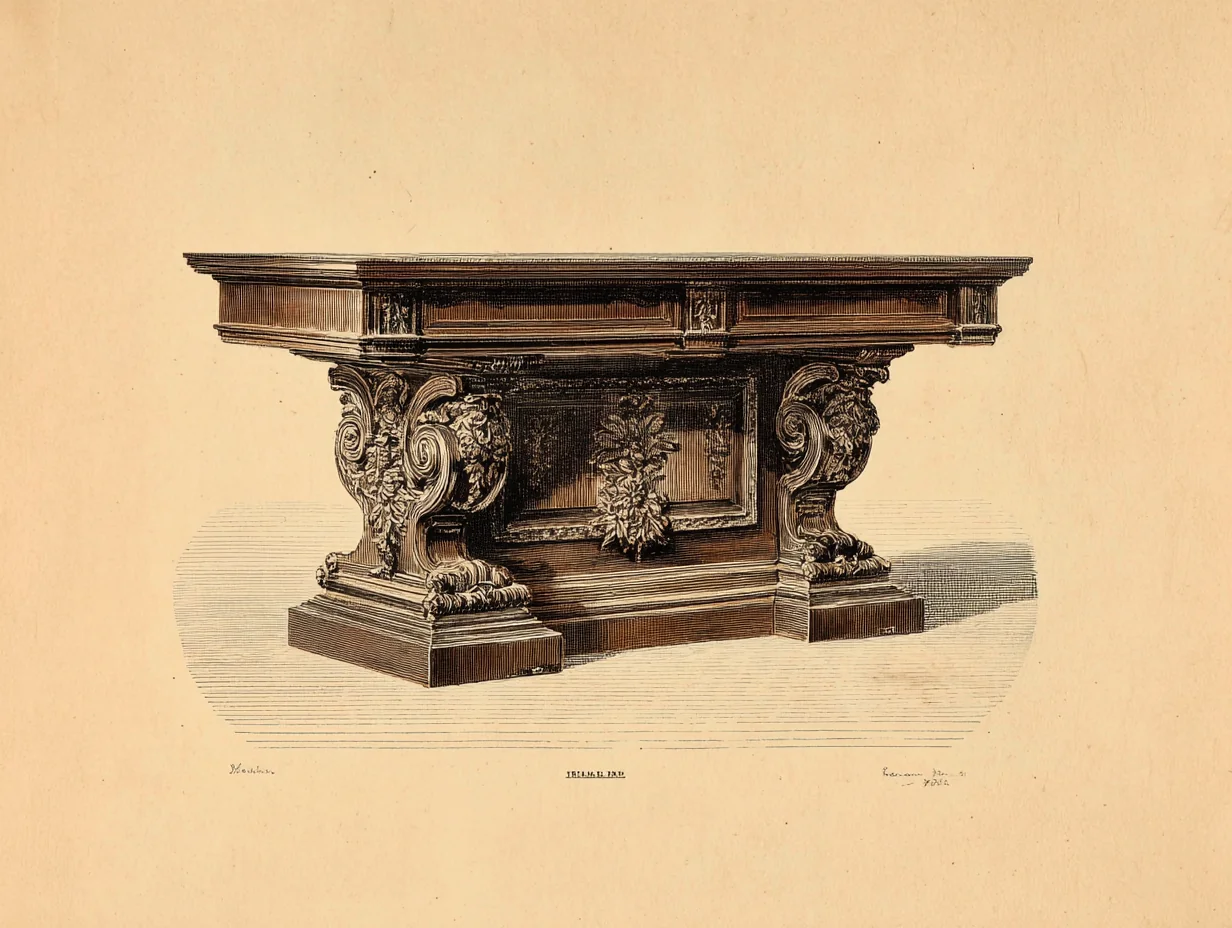
A French Empire piece is the Continental counterpart — the imperial style of Napoleonic France, contemporary to the Regency almost year for year and drawing on the very same archaeological sources. This is the closest of the four distinctions, and so the one to give the most care: the temptation to treat the two as one style under two flags is real. They share the archaeological literalism — both copy the antique rather than adapting it, both quote the klismos and the sphinx and the lion monopodium — but they part sharply on material and on temper. The Regency carries its metal as brass: stringing and cut-brass buhl let flat into the surface of dark rosewood, the mounts modest, linear, almost draughtsman’s. The Empire carries its metal as ormolu — gilt-bronze, cast in relief, chased, and mercury-gilt — applied in bold three-dimensional mounts to broad surfaces of richly figured mahogany; and its iconography runs to the imperial programme, the bee and the eagle and the laurelled “N”. The rule of thumb: brass inlaid flat into rosewood, with restraint, is Regency; gilt-bronze mounted in relief onto mahogany, with imperial display, is Empire. The first is a connoisseur’s archaeology; the second is an emperor’s.
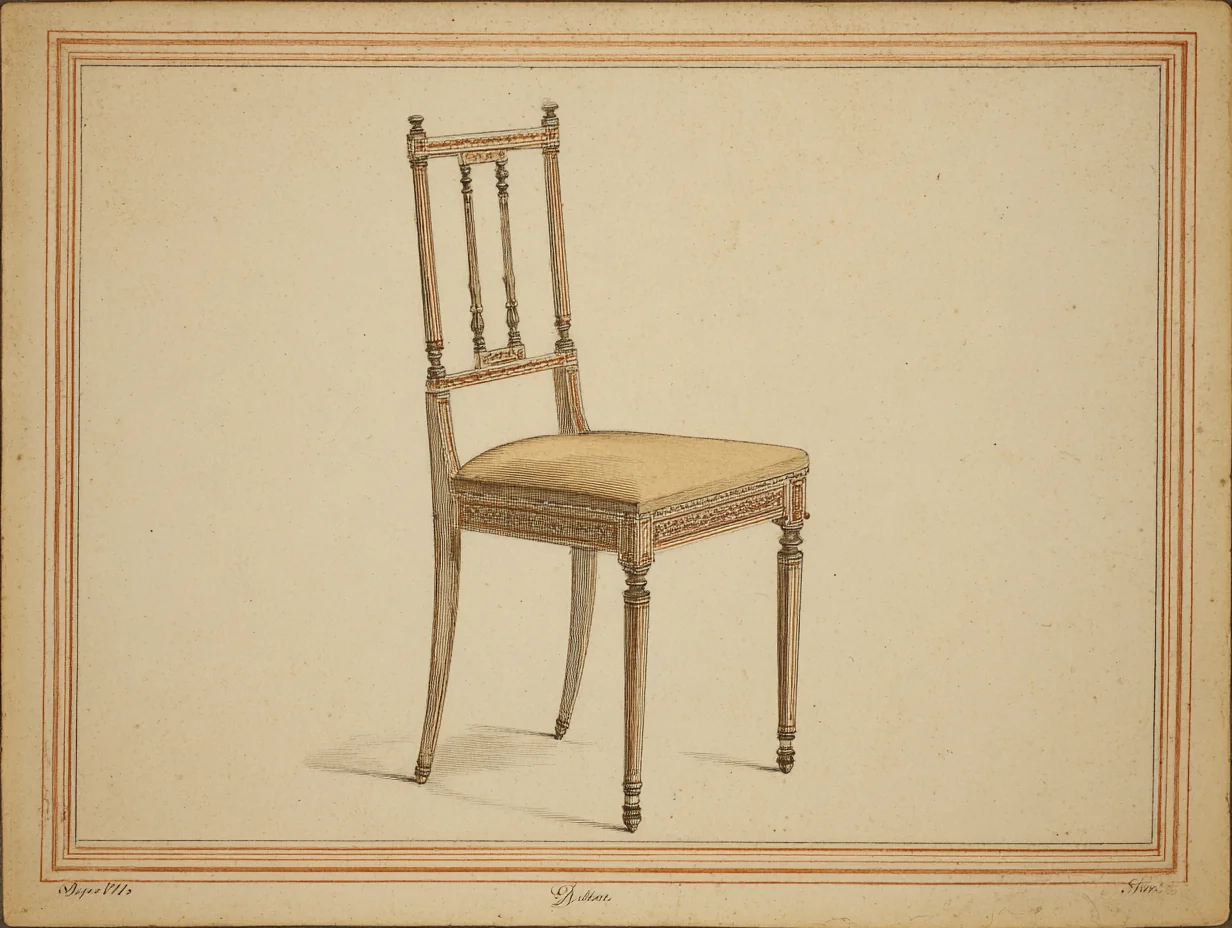
A Sheraton piece is the immediate English predecessor — the post just before this one in the arc, the style the Regency displaced after 1800. Both are English and both neoclassical, but they sit at opposite ends of the English neoclassical succession: Sheraton is its lightest and most refined phase, the Regency its heaviest and most archaeological. Sheraton works in pale satinwood, stands its slender chairs on straight turned-and-reeded legs, draws its ornament in fine dark line-inlay, and adapts the antique to forms of its own; the Regency works in dark rosewood, stands its chairs on curved sabre legs, draws its ornament in brass, and copies antique forms outright. The rule of thumb: pale satinwood, straight slender legs, fine wood-stringing is Sheraton; dark rosewood, sabre legs, brass inlay, copied Greek and Egyptian forms is Regency — the move from one to the other being the move from refinement to weight, and from adaptation to archaeology.
A Biedermeier piece is the Continental bourgeois contemporary — the furniture of the German-speaking lands and Scandinavia in the same decades, 1815 to 1835, drawing on the same neoclassical milieu. The kinship is real: the Biedermeier chair, too, knows the klismos and the sabre leg. But the register is altogether different, and the difference is one of colour and of class. Biedermeier is the style of the prosperous middle-class household, not the connoisseur’s room or the prince’s palace, and it works characteristically in pale native woods — cherry, pear, birch, ash — set off by sparing dark accents, the surfaces broad and plain, the ornament minimal. The rule of thumb: dark rosewood inlaid with bright brass is Regency; pale fruitwood, broad plain veneers, and a restrained simplicity is Biedermeier. The two are cousins in form and opposites in colour.
An American Empire piece is the American descendant — furniture made in the workshops of the eastern United States in the decades after about 1815, taking the late-neoclassical archaeological vocabulary across the Atlantic. It knows the lion-paw foot, the sabre leg, the pedestal table, and the classical mass; but it tends to read in a heavier and a plainer register than its English parent, working characteristically in solid or boldly figured mahogany rather than rosewood, and leaning on bold carved ornament and gilt-stencilled decoration rather than fine brass inlay. The rule of thumb: dark rosewood with fine brass stringing and buhl is English Regency; figured mahogany with bold carving, gilt stencilling, and a heavier mass is American Empire — the connoisseur’s archaeology of the English drawing-room against its broad-shouldered American successor.
What One Looks At
One looks first at the leg, because the leg is the signature and the sabre leg is the type-specimen — and because it states, more plainly than any other member, whether one is looking at archaeology or at adaptation. The canonical Regency leg is a sabre: a bold concave curve, splaying forward at the front and back at the rear, copied directly from the Greek klismos. A straight leg, turned and reeded, points back to Sheraton; a straight square tapered leg points further back to Hepplewhite. The sabre curve, and the klismos back above it, belong to the Regency because they were quoted, not designed.
One looks next at the wood and the brass together, read as one combination. The piece should be dark — rosewood above all, or mahogany, calamander, or zebrawood — and the ornament carried in brass: fine stringing along the edges and panels, broader cut-brass buhl in the surface, galleries, mounts, lion-paw caps and castors. A pale satinwood ground with fine dark wood-stringing belongs to Sheraton; gilt-bronze mounts standing in relief on figured mahogany belong to the French Empire. The brass-on-rosewood combination is the surest single tell the style affords.
One looks then at the ornament and the form together. The Regency motif has an ancient address — the Greek key, the anthemion, the lyre, the lion mask and monopodium, the sphinx head and the lotus — and the Regency form is itself a copy: the klismos chair, the lion-monopodium-cornered cabinet, the pedestal loo table. One asks not merely whether the vocabulary is present but how literally the ancient model has been quoted.
And one looks, finally, at the documentary standard. A genuine period Regency piece is a piece of the roughly 1800–1830 English cabinet trade, worked in the archaeological manner that Hope’s 1807 Household Furniture coined and Smith’s 1808 Collection of Designs carried to the trade, and showing the period hand in its construction — the dovetails, the hide-glued veneer, the brass worked loose against the rosewood over two centuries. The collector reads leg, wood and brass, and ornament and form against those pattern books, reads the construction for date and the literalism for rank, and asks of the word Regency what it can honestly bear — not that the piece was made by Hope or by Smith, but that it stands faithfully in the archaeological manner the two books between them defined.
The next post in the furniture arc will be either Italian Renaissance — to backfill the 16th-c Italian tradition out of which the Italian Baroque emerged — or American Federal, to extend the late-neoclassical English influence into the new American republic. The choice will depend on the photographic material available at the time of writing.