The American Foursquare is unusual in this series in that it has, by any reasonable reckoning, no architect, no manifesto, no period name of its own, and no architectural press to speak of. The eleven styles that preceded it in these posts all carry, at minimum, a published source — Asher Benjamin’s plates for the Greek Revival, Andrew Jackson Downing’s Cottage Residences for the Gothic, the Aesthetic Movement magazines for the Queen Anne, The Craftsman magazine for the Craftsman, the Ladies’ Home Journal articles for the Prairie. The Foursquare carries no such thing. The houses simply appeared, in their hundreds of thousands, between roughly 1895 and 1935, on the residential streets of every American town of any size, and they were, as far as the period’s architectural press was concerned, beneath notice. They were not styled. They were not authored. They had no name in their own time — when one wanted to refer to one, one referred to “the new house,” or perhaps “the modern square house,” or, in catalogue copy, “the modern residence.” The term American Foursquare was a later historiographical convenience, applied retroactively in the same mid-twentieth-century moment that gave the Prairie its name, when architectural historians needed a label for the most numerous American house shape of the early twentieth century.
This is the Foursquare, then, by historiographical convention. What follows is the twelfth in a series that has been, in a quiet way, trying to read American houses for what they were trying to say. The eleven previous posts have covered the long nineteenth century and the early twentieth, with the Prairie of the immediately preceding entry standing as the architect-defined high-style version of an idiom whose mass-market version is the present post’s subject. If the Prairie was Frank Lloyd Wright’s argument about the American house, the Foursquare was no one’s argument — and yet the Foursquare was built in numbers two orders of magnitude greater than the Prairie, on lots and in towns the Prairie never reached. Some accounting of the unnamed style is owed to the series, and this post is that accounting.
The Anonymous House
The first thing worth knowing about the Foursquare is that it had no author and made no argument.
Every preceding style in this series can be traced to a recognisable body of published prose. The Gothic Revival was Downing’s argument that the American country house should evoke the moral seriousness of an English parsonage. The Italianate was the argument, drawn from Loudon and from the Tuscan-villa images circulating in the architectural press of the 1840s, that an American country gentleman should live in something faintly Mediterranean. The Queen Anne was the argument, drawn from Norman Shaw and the Building News of the 1870s, that the modern house should be playful, irregular, ornamentally elaborate. Even the Craftsman — which was, in the end, a mass-market vernacular style — had Stickley’s The Craftsman magazine making the argument explicitly in prose for the decade of its dominance. Every previous style on this list could, in some real sense, be read in its own time.
The Foursquare could not. There is no Foursquare manifesto. There is no architect of record. There is no critical defence of the form in any of the architectural periodicals of the period — not The American Architect, not Architectural Record, not Country Life, none of them. One searches the period’s architectural press for the Foursquare, by any of its later names, and one finds nothing. The style, if one can call it that, lived entirely in two other places: the residential builder’s plan-book of the 1900s and 1910s, and the mail-order kit-house catalogues of Sears, Aladdin, Gordon-Van Tine, and Montgomery Ward. Neither of those venues produced architectural argument. The plan-book offered a buildable house at a quoted lumber cost; the kit catalogue offered the same house in a boxcar.
The trouble — and it is more an analytical trouble than a defect of the houses themselves — is that this leaves the historian with no text on which to anchor a stylistic reading. One cannot ask what the Foursquare was trying to say, because the Foursquare did not have a voice with which to say anything. One can only read the houses themselves, in their enormous numbers, and try to recover the argument that the architecture was making by its very ubiquity. The Foursquare is the unique style in this series whose meaning must be reconstructed from the buildings alone, without the assistance of a single page of architectural prose.
What the buildings make plain, on reading them carefully, is that the Foursquare was an argument about plan rather than style. The other entries in this series are defined by their elevations — by what one sees standing on the sidewalk looking at the front of the house. The Foursquare is defined by what one cannot see from the sidewalk at all: the interior arrangement of four rooms downstairs and four rooms upstairs, organised around a central staircase, with each room a generous square and the whole occupying a near-cubic two-storey volume of roughly thirty feet on a side. The name Foursquare does not refer to the elevation. It refers to the plan. To call the style by its elevation would require some less reliable feature — the hipped roof, the central dormer, the broad porch — that the Foursquare shares with multiple competing idioms and that the Foursquare itself adopted with quiet indifference. The plan is what is the same across the entire corpus. The elevation is whatever was popular when the catalogue was issued.
This is, on inspection, a more radical break with the nineteenth-century American residential tradition than any of the high-style movements that surrounded it. The Foursquare was the first American house defined by its functional logic rather than by its ornamental vocabulary.
The Specimen
If one is to identify a Foursquare — and one will find them in great numbers on the inner-ring residential streets of nearly every American town built up between 1895 and 1930, often constituting half or more of the housing stock of those streets — the exercise has a different shape than for any previous style in this series. The Foursquare is read at the plan first and the elevation second.
Begin at the silhouette. A Foursquare presents, almost without exception, a square or near-square two-storey volume capped by a low-pitched hipped roof with a single central dormer. The volume is the determinant. Most Foursquares occupy a footprint of roughly twenty-eight to thirty-two feet square, with two full storeys (each of around nine feet) for a total height of about twenty-five feet to the eave. The proportions are nearly cubic. The hipped roof descends on all four sides at a low pitch, broad enough at the eaves to throw the corners into shadow but not so broad as the Prairie’s projecting sweep. A single dormer rises from the front slope of the roof, almost always centred above the main entrance, and almost always small — large enough to light the upper hall or the central upstairs bedroom, not large enough to constitute a separate architectural mass. This is the silhouette, and one identifies it from a hundred yards down the block: a tall plain cube with a low hipped cap and a single dormer above the front door.
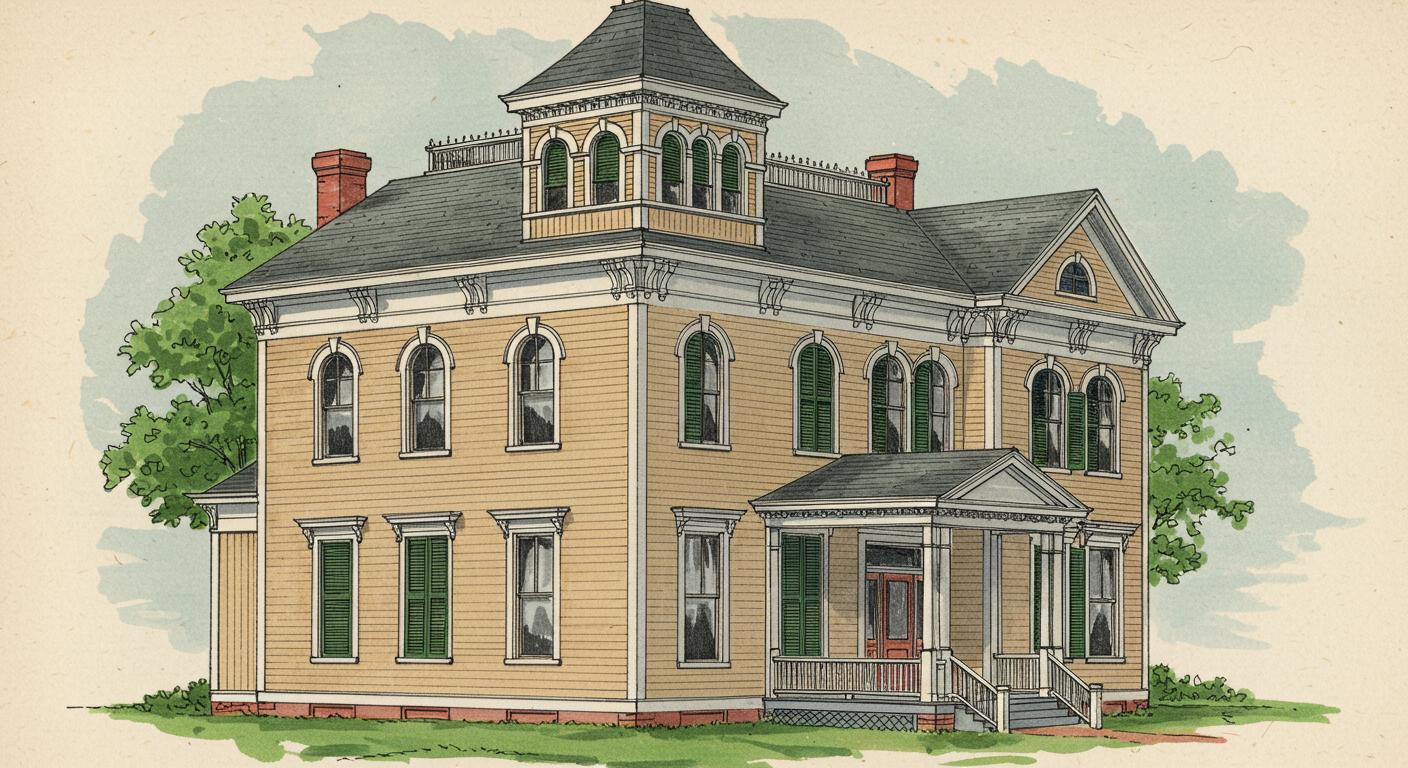
An Italianate cube of the 1860s — a tall square two-storey volume capped by a low hipped roof with broad eaves, ornamented with brackets at the cornice and segmental window heads, and crowned by a central cupola. The Foursquare is the Italianate cube stripped of its ornamental apparatus, given a full-width front porch in place of the cupola’s vertical emphasis, and reduced to a residential vernacular for the mass market. The cubic massing, the hipped roof, and the central vertical emphasis above the entrance all descend from the Italianate template; the brackets, the segmental heads, and the cupola itself were removed in the simplification, leaving the underlying geometry intact.
Examine the front porch. The Foursquare almost invariably presents a full-width front porch — running the entire width of the principal facade, occupying its own depth of perhaps eight to ten feet, and roofed by a simple low-pitched shed roof that returns into the main house at the level of the first storey. The porch posts are heavy, usually four in number, often tapered Craftsman-style posts on stone or brick piers (when the catalogue was selling the house in the 1910s) or plain boxed posts on a low brick wall (when the catalogue was selling the same house in the 1920s) or simplified classical columns with a low railing (when the catalogue was selling it in a more Colonial-leaning register at any point in the period). The porch is the second decisive identifier of the Foursquare and the principal site of stylistic borrowing: whatever the dominant decorative idiom of the moment was, the Foursquare absorbed it onto the porch and changed nothing else.
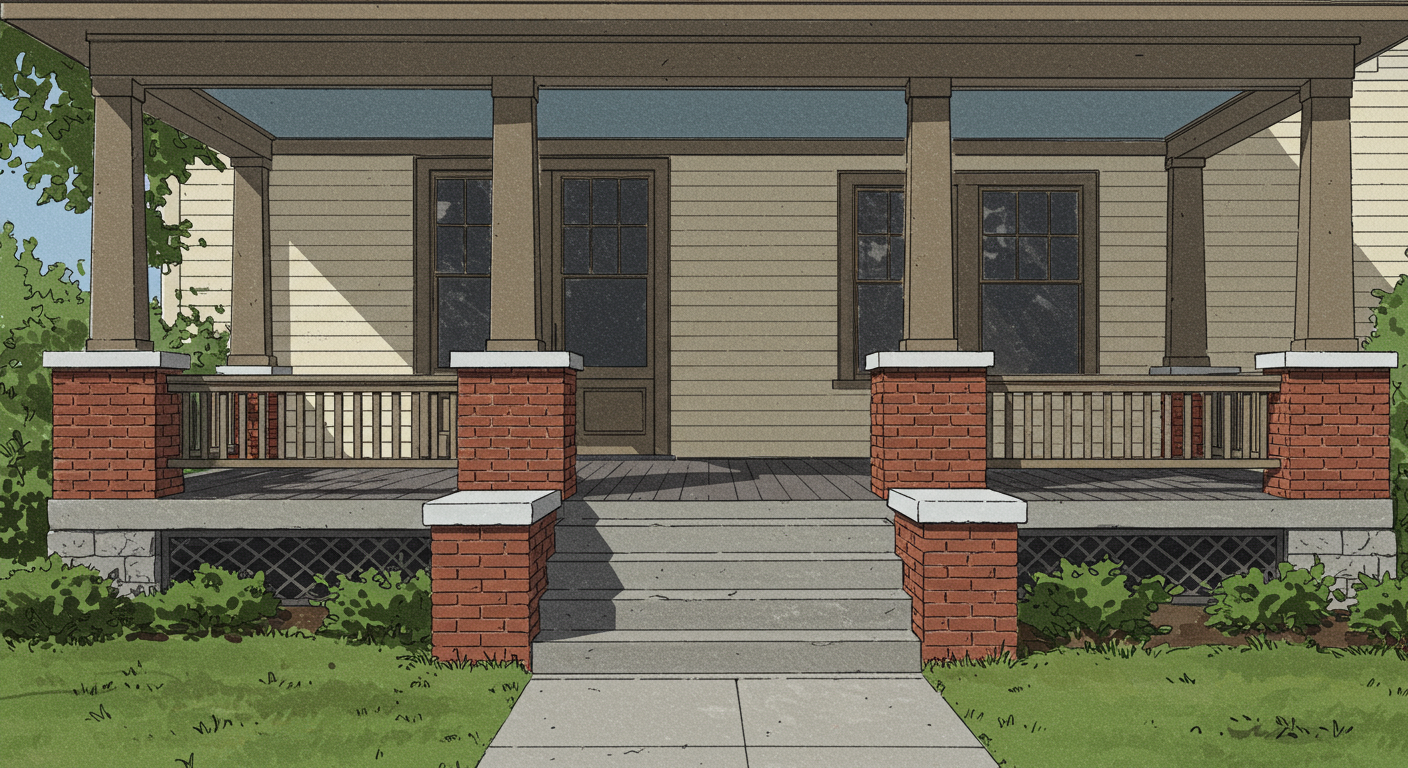
A full-width front porch on a Foursquare specimen of the 1910s — running the entire width of the principal facade, eight feet deep, roofed by a low shed roof returning into the main house at the first storey. The posts are tapered Craftsman-style on brick piers, which dates this particular specimen to the post-1905 period when Craftsman vocabulary had penetrated the kit-house catalogues. An earlier specimen would carry plain classical columns on a low railing; a later one would carry boxed Colonial Revival posts. The porch is the Foursquare’s principal site of decorative borrowing — whatever was fashionable went there, while the rest of the house remained constant.
Examine the windows. Foursquare windows are double-hung sashes, almost always one-over-one on the early specimens (1895–1910) and one-over-one or one-over-six on the later (1910–1930), arranged with quiet symmetry across the principal facade. The standard Foursquare elevation carries two windows on each side of the central entrance on the first storey and three windows across the second storey, symmetrically placed, all of identical proportions. There are no ribbon bands of casements as in the Prairie, no varied window shapes as in the Queen Anne, no leaded glass except occasionally in the upper light of the front entrance hall. The windows do their work without comment. They are the same window, repeated, on each elevation, in modest numbers — the elevation reading more as a fenestrated wall than as an arrangement of architectural openings.
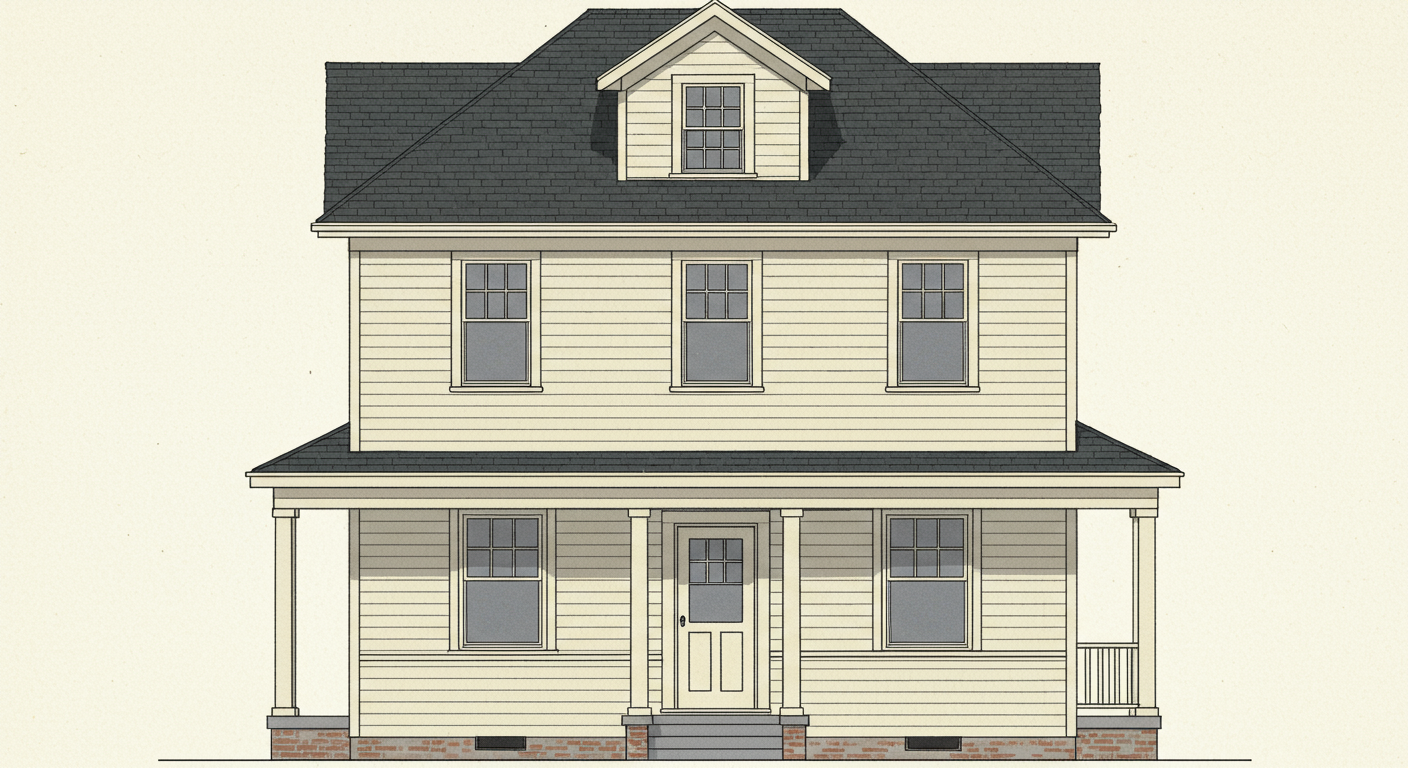
The principal facade of a Foursquare specimen, showing the symmetric double-hung sash arrangement — three identical one-over-one sashes across the second storey, and two pairs of identical sashes flanking the central entrance on the first storey. The windows are the same window throughout, repeated in modest numbers, without varied shape or decorative leading. The composition is the residual symmetry of the cube: the elevation is symmetric not because the architect has composed it that way, but because the four-square plan inside is itself symmetric and the windows are placed where the rooms put them. The reading is one of a fenestrated wall, rather than an arrangement of architectural openings.
Examine the plan. This is the Foursquare’s defining feature, the one from which the style takes its name, and the one that distinguishes it from every other style in this series. The plan is a square footprint of roughly thirty feet on a side, divided into four rooms downstairs (typically a living room, a dining room, a kitchen, and a smaller study or sitting room) and four rooms upstairs (four bedrooms, or three bedrooms and one bathroom), organised around a central straight-run staircase that rises from a small entry hall just inside the front door. Each room is a generous near-square of roughly twelve to fifteen feet on a side. The geometry is severe: the plan can be drawn on graph paper in two minutes, the rooms can be framed by a carpenter with a tape measure and a square, and the joists can be cut in two perpendicular lengths to span the square in either direction.
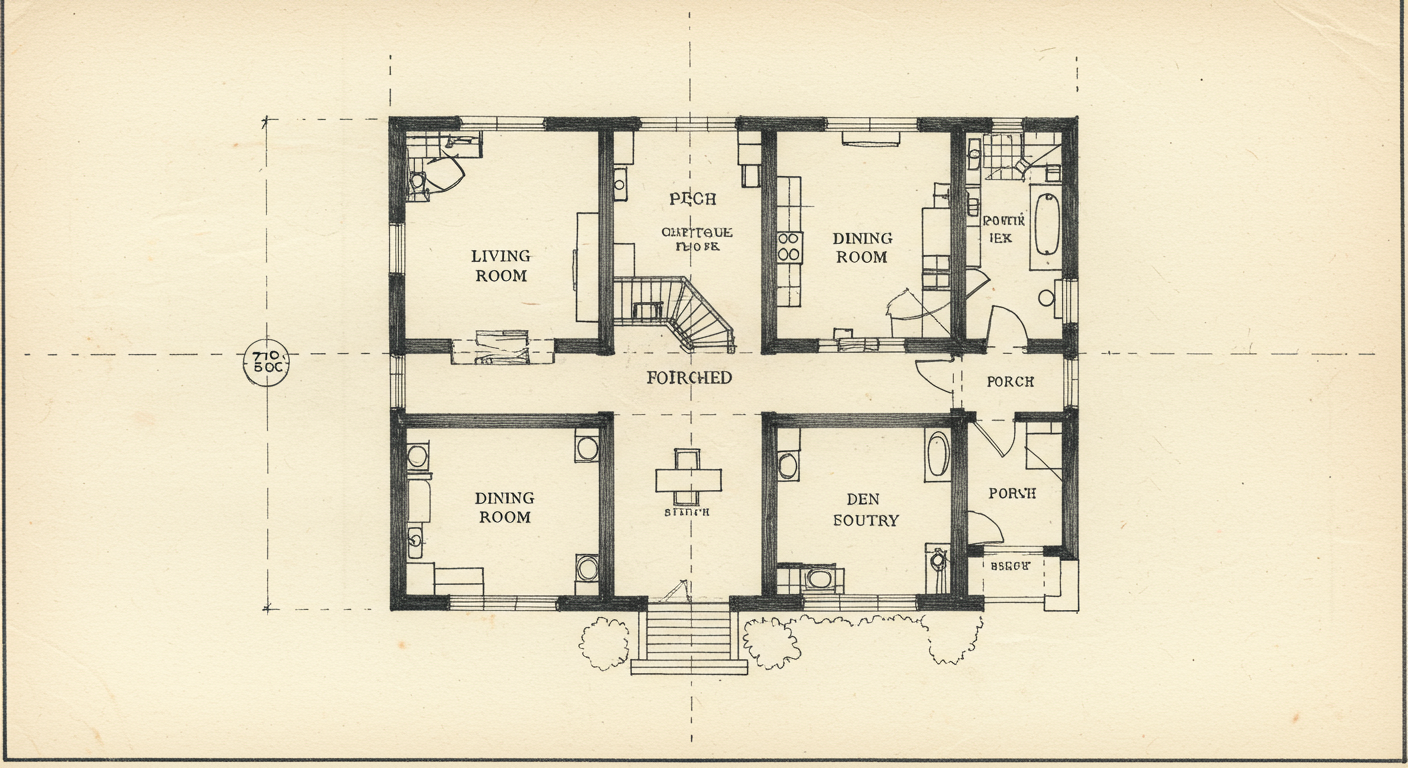
The four-square plan from which the style takes its name — a square footprint of roughly thirty feet on a side, divided into four rooms downstairs (typically living room, dining room, kitchen, and a smaller study or sitting room) and four rooms upstairs (four bedrooms, or three bedrooms and one bathroom) around a central straight-run staircase. The plan is the Foursquare’s defining feature: it is what makes the style identifiable independent of its ornament, and it is what made the style buildable as a kit, since the framing was efficient, the joists ran in two perpendicular directions across the square, and the carpenter assembled the same plan whether the catalogue called the house Colonial or Craftsman or Modern.
Look at the wall surface beneath the roof. Foursquare walls are usually clapboard (the most numerous treatment, painted in any colour the catalogue offered — white, cream, pale yellow, grey-green) or shingle in the upper storey with clapboard in the lower (a treatment borrowed from the Queen Anne and Shingle but applied with restraint), or, on the more substantial specimens, brick (red, brown, or buff), or, on the most affordable, stucco over a wood frame. The cladding is, like the porch, a site of stylistic borrowing — the catalogue offered the same Foursquare plan with clapboard for the modest buyer, shingled for the middle buyer, brick or stucco for the substantial buyer, and the buyer chose by cost rather than by stylistic conviction.
Now examine the entrance. The Foursquare’s entrance is almost always central, set under the central dormer above and approached through the centre of the front porch. The door itself is, in the early specimens, a single panelled door with a transom and sidelights; in the middle period, a Craftsman-style panelled door with a small glazed upper light; in the later period, a Colonial Revival door with a fanlight or a six-panel pattern. The entrance is centred and symmetric in nearly all cases. The symmetry of the entrance is part of what distinguishes the Foursquare from the Prairie, which deliberately conceals its entrance, and from the Queen Anne, which surrounds its entrance with asymmetric porches and turrets. The Foursquare’s symmetry is quiet, almost reflexive, the residual symmetry that survived the ornamental complexity of the late nineteenth century by being too plain to bother breaking.
Assemble these — the near-cubic two-storey volume, the low-pitched hipped roof with a single central dormer, the full-width front porch with whatever posts were fashionable, the symmetric double-hung sash windows, the four-square plan inside, and the central entrance — and one has a Foursquare. The variations are entirely in the secondary register. The ornamental vocabulary that appeared on the porch and on the front door shifted decade by decade, as the catalogues responded to the dominant idiom of the moment, but the cube and the hipped roof and the central plan never shifted. A Foursquare with Colonial Revival columns and a Foursquare with Craftsman tapered posts are the same house with different paint, and a careful eye reads them as such.
The Catalogue
The historical arc of the Foursquare is the story of the American mail-order kit-house industry and the residential builder’s plan-book economy — neither of which produced an architectural argument, and both of which produced houses by the tens of thousands.
The roots are in the late-Victorian plan-book trade. By the 1880s a number of American architectural firms had begun to publish books of buildable plans aimed not at the architect but at the local builder: George F. Barber’s Modern Dwellings, Robert W. Shoppell’s Modern Houses, the Palliser brothers’ Palliser’s American Cottage Homes. The plan-book offered a builder, for a few dollars, a set of construction drawings, a specifications list, and a recommended materials cost. The builder bought the plan, sourced his own lumber and millwork from the local yard, and built the house for a customer who had likely picked the design out of the same book at the builder’s office. The trade was substantial — Barber alone is estimated to have sold plans for some twenty thousand houses across the 1890s — but the dominant idiom in the plan-books of the 1880s and early 1890s was the Queen Anne, in its modest builder’s version, and only in the 1895–1900 transition did the cubic two-storey form that would become the Foursquare begin to predominate.
The shift had two causes. The first was practical: the Queen Anne’s irregular massing, asymmetric porches, varied window placements, and elaborate ornamental trim were difficult and expensive to build. Each Queen Anne house required custom cutting at the carpenter’s mill, custom carpentry on site, and a substantial volume of millwork-trim that was time-consuming to install. The cubic plan, by contrast, used dimensional lumber in repeated lengths, framed with a regular pattern of joists, and required almost no custom millwork outside the porch. The contractor’s profit margin on a Foursquare was substantially higher than on a Queen Anne of equivalent square footage, and the contractor’s labour was deployed for fewer days. The second cause was aesthetic: the same Edward Bok who had commissioned the Ladies’ Home Journal “ideal house” series ran a parallel editorial campaign through the late 1890s and 1900s against what he called ornamental excess in American residential design, and the plan-book trade responded by simplifying their offerings. By 1905 the Queen Anne had largely disappeared from the plan-books, and the Foursquare — in its plainest form, often with a Colonial Revival porch as its only ornamental concession — had taken its place as the default offering.
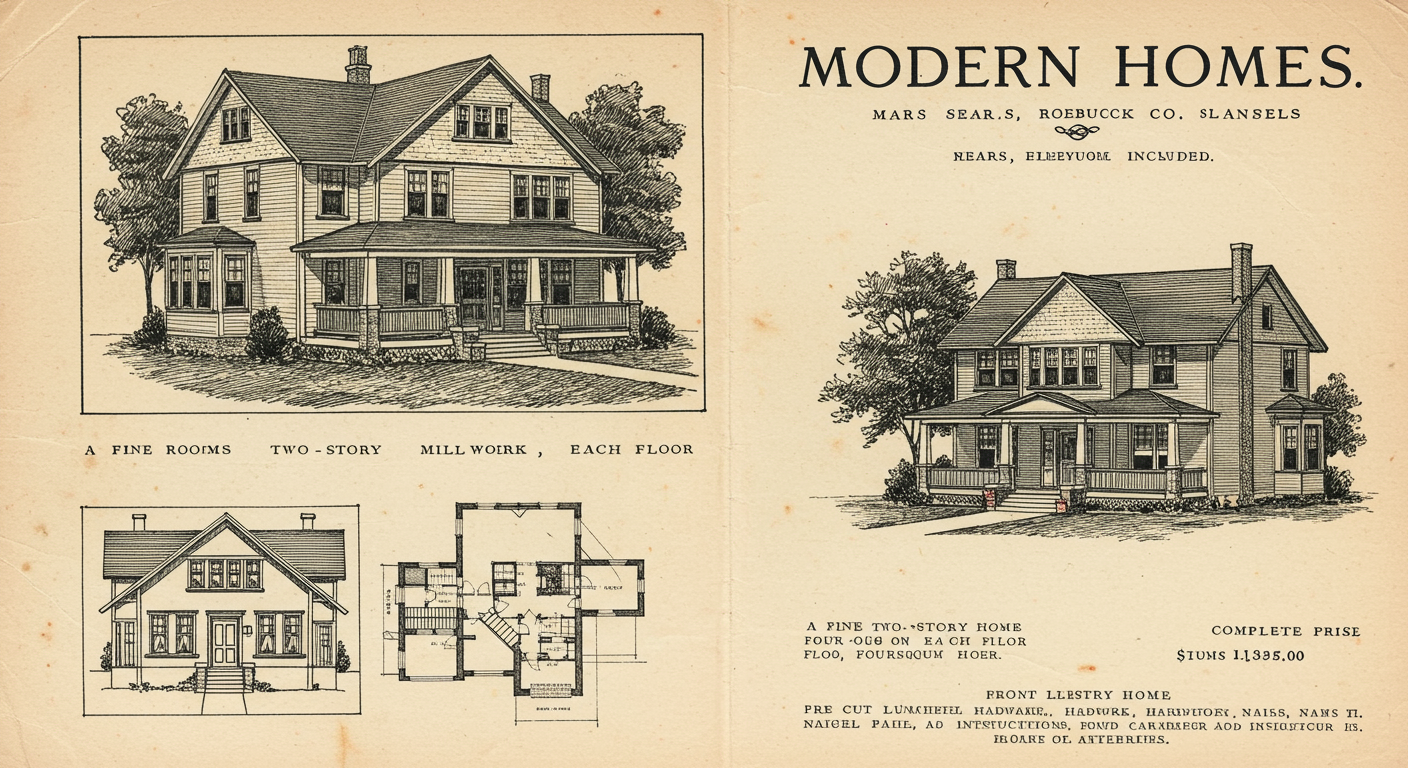
A page from a Sears Modern Homes catalogue of approximately 1918 — perspective rendering, elevation, ground-floor plan, and pricing for a complete pre-cut kit shipped by rail from the Sears mill at Cairo, Illinois. The kit included framing lumber pre-cut to length, millwork, hardware, paint, nails, and a hundred-page assembly manual; the buyer or the buyer’s contractor assembled the house from the kit on a prepared foundation. The catalogue offered the same Foursquare plan in several treatments — Colonial, Craftsman, Modern Square — at slightly different prices, with the differences amounting to porch detailing, front-door treatment, and trim. Sears alone is estimated to have shipped some seventy thousand kit houses between 1908 and 1940, of which a substantial fraction were Foursquares; Aladdin Homes, Gordon-Van Tine, and Montgomery Ward operated parallel programmes.
The kit-house catalogue followed the plan-book by a few years and superseded it in significance after 1908. The Aladdin Company of Bay City, Michigan launched its mail-order kit-house programme in 1906, advertising a complete house — pre-cut framing lumber, millwork, hardware, paint, and a manual — shipped by rail to the buyer’s site for assembly by local labour. Sears, Roebuck & Co. followed in 1908 with its Modern Homes programme, operating out of a mill at Cairo, Illinois that produced pre-cut lumber for some four hundred different house designs across the catalogue’s thirty-two-year run. Gordon-Van Tine of Davenport, Iowa entered the trade in 1907; Montgomery Ward in 1910. The four major kit-house companies between them shipped, by the most careful surviving estimates, somewhere between 100,000 and 200,000 houses in the period 1908–1940, and the Foursquare was the single most numerous plan among the offerings of all four. The reasons were the same as in the plan-book trade: the Foursquare’s cubic geometry made it efficient to pre-cut, efficient to ship, and efficient to assemble. A skilled local crew could erect a Sears Foursquare in perhaps three to four weeks. A Queen Anne kit, had Sears offered one, would have taken twice as long, required substantially more skill, and produced a thinner margin for the company.
The mature period of the Foursquare ran from roughly 1905 to 1925. In that span the style was the dominant new-construction shape in American towns at virtually every price point: the substantial brick Foursquare on a middle-class lot, the clapboard Foursquare on a working-class lot, the shingled Foursquare on a craftsman-influenced lot, and the stucco Foursquare on a southwestern lot. By 1915 a typical block of new construction in a typical American town would have been three-quarters Foursquare, with the remaining quarter divided between Craftsman bungalows and the occasional Colonial Revival on the more expensive lots. The form’s dominance was, by the standards of any other style in this series, total — and its total dominance went almost entirely unremarked by the architectural press of the period.
The end came, as for the Prairie, in the years after the First World War, but for different reasons and at a slower pace. Three forces compressed the Foursquare out of new construction. The first was the rise of the Tudor Revival and the Spanish Colonial Revival, which dominated upper-middle commissions through the 1920s and offered the architect-author argument that the plain Foursquare conspicuously lacked. The second was the rise of the smaller bungalow and the still-smaller cottage as the dominant working-class new-construction shape after about 1920, in part driven by the shrinking lot sizes of inter-war American suburbs and in part by the increasing cost of construction lumber, both of which favoured one-storey shapes over the two-storey Foursquare. The third was the arrival, after roughly 1925, of the small one-storey ranch house and the still-smaller Cape Cod, which would supersede the Foursquare for the working-class market in the 1930s and 1940s. By 1935 the Foursquare was no longer being built in significant numbers, and by 1940 the kit-house catalogues — Sears Modern Homes shut its programme in 1940 — had ceased to offer it.
The Foursquare’s total production, summed across the plan-book era and the kit-house era and the local-builder vernacular that paralleled both, is somewhere on the order of a million and a half houses across roughly 1895 to 1935. This figure is itself uncertain — there is no central registry, the kit-house records are incomplete, and the plan-book records are largely lost — but the order of magnitude is well established by survey work in particular cities (Lincoln, Nebraska; Indianapolis, Indiana; Topeka, Kansas; the inner suburbs of Boston and Philadelphia; and many others), where Foursquares constitute between thirty and fifty per cent of the surviving early-twentieth-century residential stock. The Foursquare is, by any defensible accounting, the most numerous house shape in the American early twentieth century. It is also the only style in this series whose total production exceeds a million.
What It Is Not
Four styles stand near enough to the Foursquare that the beginner confuses them with it, and distinguishing them is most of the work of reading the early-twentieth-century American residential street at the mass-market end of the market.
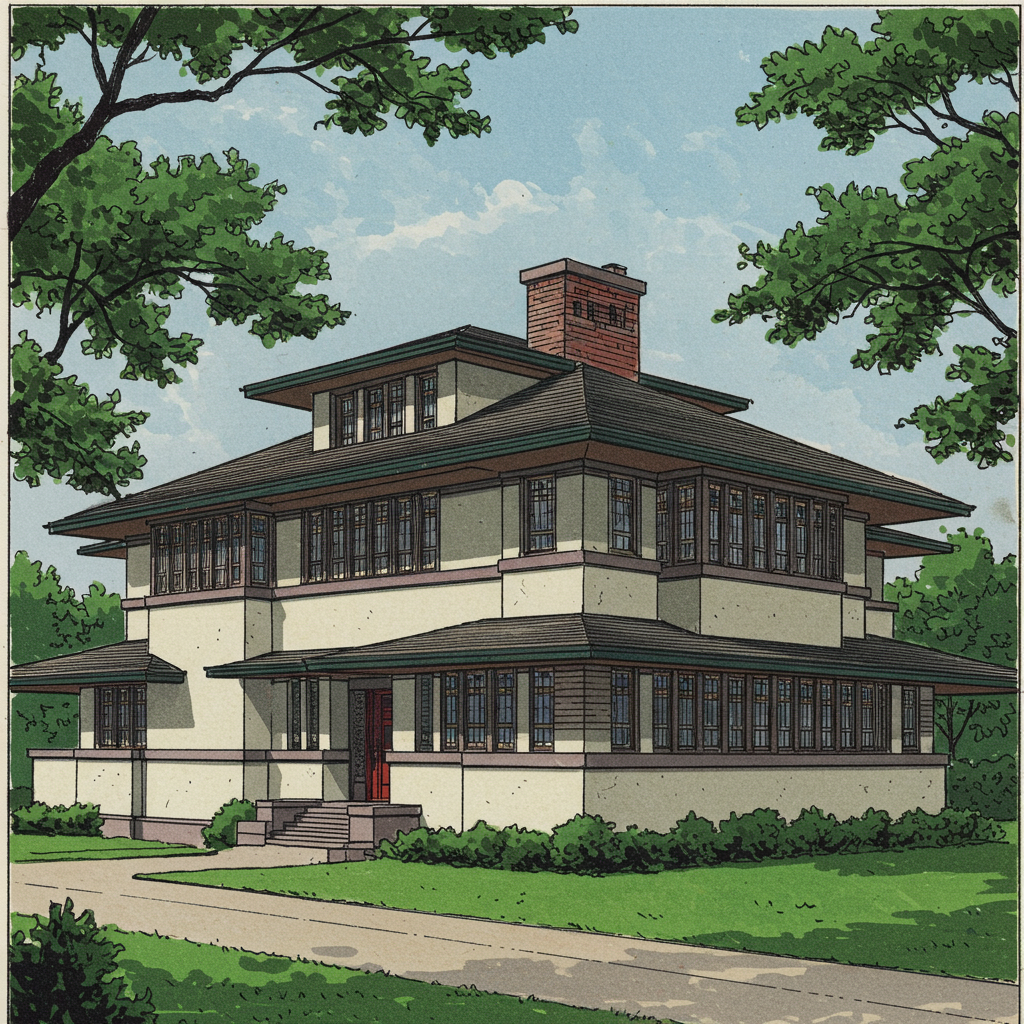
The Prairie — the immediately preceding post’s subject, the Foursquare’s architect-defined cousin — shares the hipped roof, the central dormer, and the broad horizontal massing that the beginner most reliably confuses with the Foursquare’s. The Prairie is, on inspection, what the Foursquare looked like when a Wright-trained architect drew it: the eaves projected further, the wall surface acquired continuous horizontal banding at the floor and sill and lintel levels, the windows became casements in ribbon bands with art-glass leading, and a massive central chimney was treated as the vertical anchor against the horizontal sweep. The Foursquare carries none of these refinements. Its eaves project modestly, its wall surface is plain, its windows are conventional double-hung sashes, and its chimney is a working flue rather than an architectural feature. The two styles competed for the same hipped-roof silhouette but at radically different price points and with radically different intellectual ambitions. The rule of thumb: continuous horizontal banding and ribbon casements is Prairie; plain wall surface and double-hung sashes is Foursquare.
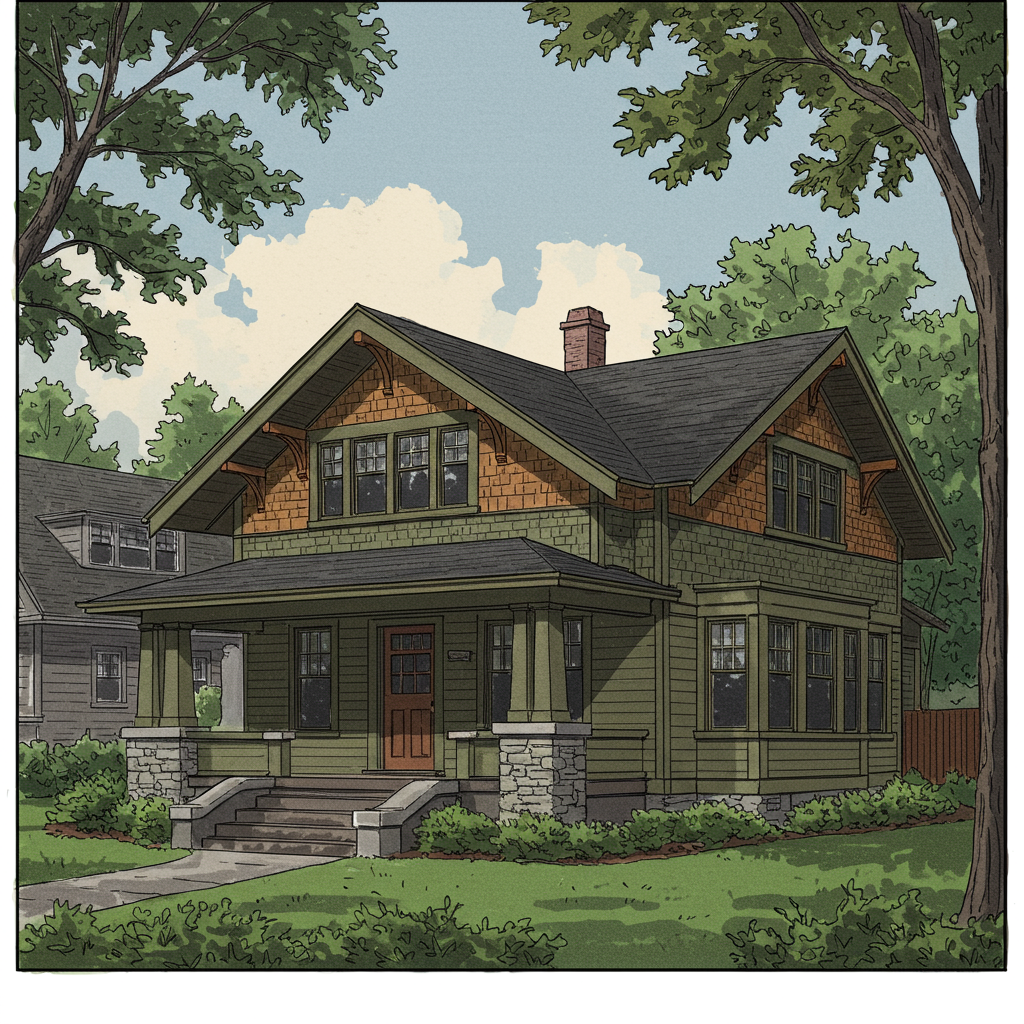
The Craftsman — the Foursquare’s pattern-book contemporary, examined two posts ago — was sold through the same plan-book and kit-house catalogues but in a one-storey bungalow configuration with a low-pitched front-gabled roof, exposed rafter tails, decorative knee braces, and a wide porch on tapered posts on stone piers. The Craftsman and the Foursquare were the two mass-market shapes of the period, and the catalogues offered both at competing price points. They differed at the silhouette: the Craftsman was one storey and gabled, the Foursquare was two storeys and hipped. They differed at the plan: the Craftsman was elongated, with rooms in a sequence, while the Foursquare was square, with rooms in a quadrant. They differed at the market: the Craftsman addressed the smaller-family or starter-home buyer, the Foursquare addressed the established middle-class buyer who needed four bedrooms upstairs. The rule of thumb: one storey and gabled is Craftsman; two storeys and hipped is Foursquare.
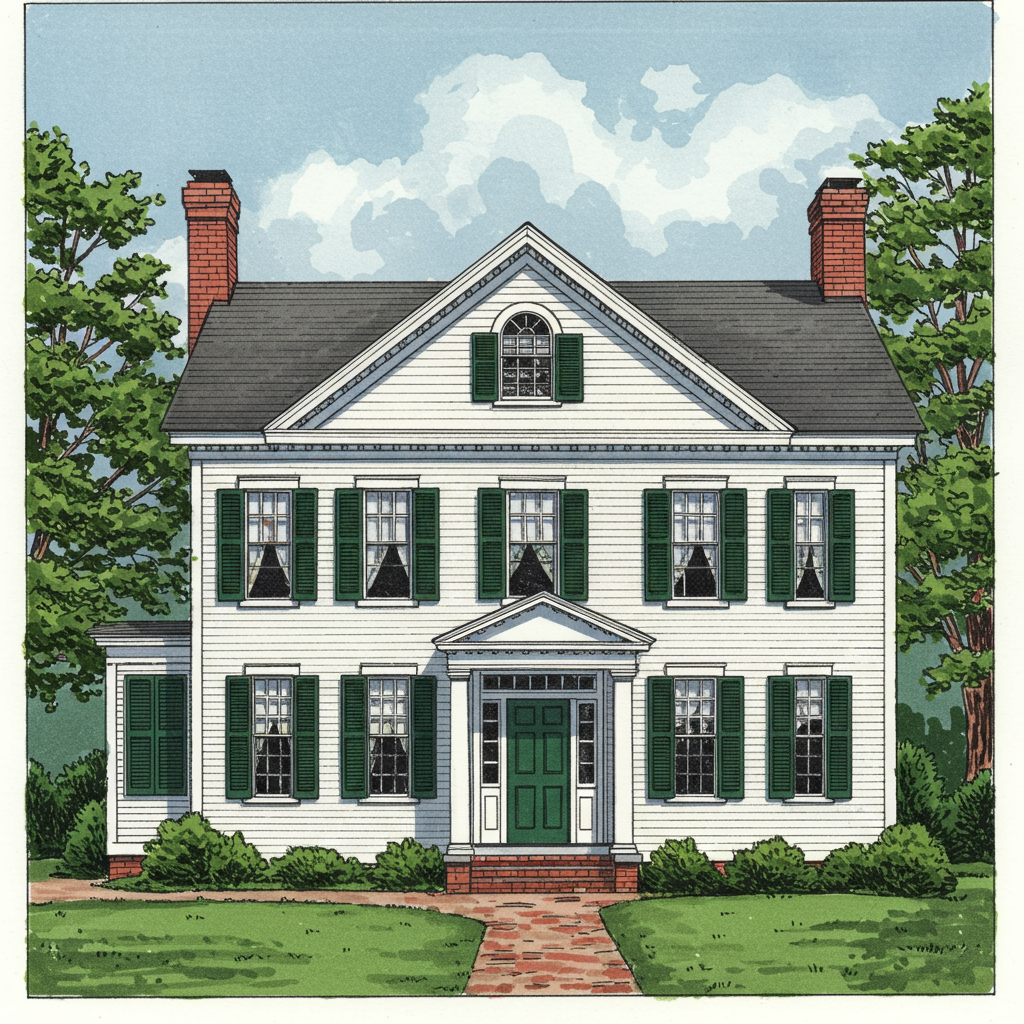
The Colonial Revival — the academic competitor for the same suburban lot, examined three posts ago — argued for symmetry, classical ornament, white-painted clapboard, and historical reference to the country’s Anglo-Georgian past. The Foursquare’s symmetry was the residual symmetry of the cube; the Colonial Revival’s symmetry was the deliberate symmetry of academic plate-and-pediment composition. A Colonial Revival house carries a pedimented portico over the entrance, shuttered six-over-six sashes, a balustraded roof or a fanlight over the door, white-painted clapboard or red brick with white trim. A Foursquare carries a plain full-width porch, one-over-one or one-over-six sashes without shutters, no portico, no fanlight, and clapboard or shingle or brick in muted colours. The two styles competed directly for the early-twentieth-century middle-class commission, and they often appeared on the same block in the same year — the Colonial Revival was what the buyer commissioned from a local architect, the Foursquare was what the buyer ordered from the catalogue. The visual distinction is straightforward: pedimented portico and shuttered sashes is Colonial Revival; full-width porch and unshuttered sashes is Foursquare.
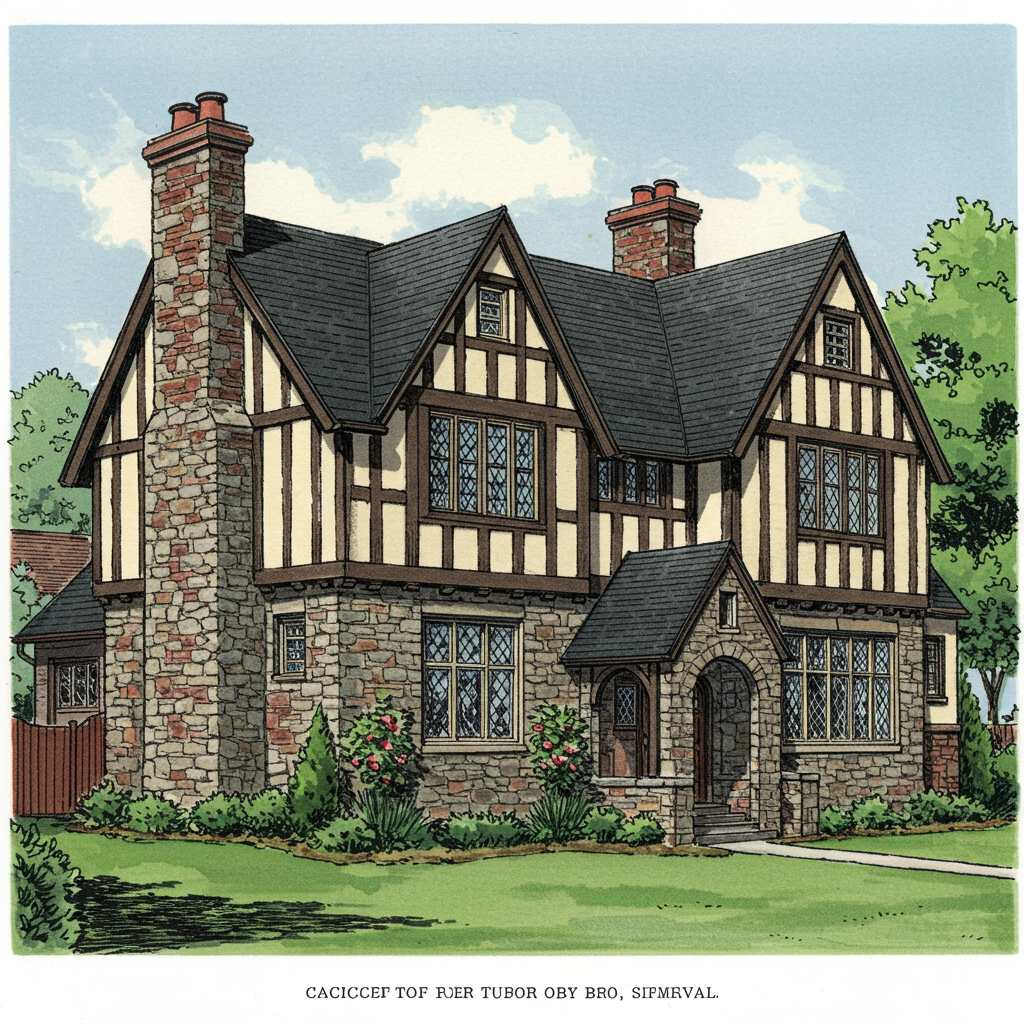
The Tudor Revival — the architect-defined upper-middle commission of the inter-war American suburb, which would dominate country-club neighbourhoods of the 1920s and 1930s — drew on English Tudor-and-Jacobean sources and produced houses with half-timbered upper storeys, steep cross-gables, and mullioned casement windows. The Tudor Revival rose as the Foursquare faded, and the two styles in many cases occupied the same blocks at the same moment in the mid-1920s: a developer’s tract of new construction in 1924 would commonly carry Foursquares on the lower-priced lots and Tudor Revivals on the higher-priced ones. The architectural arguments were entirely different — the Foursquare made no historicist argument at all, the Tudor Revival quoted an English past — but the buildings sat side by side. The visual distinction is straightforward: half-timbered upper storey and steep cross-gables is Tudor Revival; plain cube and low hipped roof is Foursquare.
What It Was Trying to Say
The Foursquare flourished in America for forty years — its peak running from about 1905 to 1925 — and produced, in that span, more houses than any other style in this series. The cultural temper that had supported it was the practical, plain, post-Victorian sensibility of the early-twentieth-century American middle class, which had grown weary of the Queen Anne’s ornamental complexity and which now sought, in its residential architecture, an efficient and unfussy modern house. The Foursquare was the architectural answer to that demand, and it provided that answer at a price point — through the catalogue and the plan-book — that no architect-defined style could match.
What the style was trying to say is best taken, as in the previous post, as the sum of two arguments running in parallel. The arguments differ from the Prairie’s in an instructive way: where Wright made his arguments in prose, the Foursquare made its arguments in the buildings themselves, with no prose to clarify them, and the historian must reconstruct them from the architecture alone.
The first argument is the plan-as-primary argument. The Foursquare was the first American house in this series whose defining feature was its plan rather than its elevation. Every previous style was identified by what the front looked like — the columned portico of the Greek Revival, the steep gables of the Gothic, the bracketed eaves of the Italianate, the irregular massing of the Queen Anne, the wide porches of the Craftsman. The Foursquare can be identified by these only loosely; its real signature is the cubic plan of four rooms downstairs and four rooms upstairs around a central staircase, which is what the kit-house catalogue actually sold the buyer. The decorative apparatus on the front was secondary, and one can find Foursquares with Colonial Revival columns, Craftsman tapered posts, and minimal classical trim, all sitting on the same fundamental plan. This was a quietly radical move: it argued, by demonstration rather than by prose, that the modern American house should be efficient at its functional task — providing four bedrooms upstairs and the standard arrangement of public rooms downstairs — and that the decorative idiom was a matter of taste applied to the structural reality rather than the other way round. The argument prefigures the modernist position that would come into American architecture two decades later: that form should follow function, and that the ornamental vocabulary should be subordinate to the plan. The Foursquare made this argument silently, in tens of thousands of houses, before any American architect made it in prose.
The second argument is the catalogue-as-architect argument. The Foursquare was the first American residential style in this series whose authorship resided not in an architect’s office but in a catalogue’s production system. The buyer of a Foursquare did not commission a design from an architect; the buyer ordered a kit from Sears, or pulled a plan from a builder’s book, or copied a neighbour’s house with the help of a local carpenter. The plan came from a draftsman’s bench at the kit-house company’s mill, was checked for buildability by a foreman, was distributed through a national catalogue to a customer who might never have set foot in an architect’s office. The architectural authorship was distributed across the catalogue economy — across the company’s draftsmen, the catalogue’s editors, the local builder’s preferences, the buyer’s selections from the available options. This was not, in any meaningful sense, anonymous: the houses were authored, but the authorship was institutional and commercial rather than personal and intellectual. The implications for the subsequent twentieth century are substantial. The catalogue-as-architect was the precursor to every post-war American suburban builder’s house — the Levittown ranch, the tract subdivision Cape Cod, the developer-built split-level — all of which would adopt the same model of plan-driven, catalogue-distributed, locally-assembled residential construction at vastly greater scale. The Foursquare was the first American demonstration that the architect was not, in fact, necessary to the production of American residential architecture, and that a commercial catalogue could perform the architect’s office at a hundredth of the cost.
What I find most telling about the Foursquare, taking these two arguments together, is its complete absence from the period’s architectural record. There is no contemporary defence of the form. There is no architect who claimed it. There is no critic who reviewed it. The form was produced in numbers an order of magnitude greater than any other style in this series, occupied a majority of the new-construction housing stock of its decades, and remained almost entirely invisible to the architectural press that was, in those same decades, producing extensive coverage of the Prairie, the Tudor Revival, the Spanish Colonial, the late Colonial Revival, and every other architect-defined idiom of the period. The architectural press was, in some real sense, looking past the most numerous American house of its own era. The Foursquare’s silence in the period was not the silence of an unrecognised style — it was the silence of a style so beneath the architectural press’s notice that there was nothing to discuss. One built one; one did not write about it.
This is, on inspection, the most thoroughly American thing one could have done with the residential market of the early twentieth century: produce, in the millions, the house that was beneath the period’s architectural press’s notice, and let the architectural press cover the few thousand high-style examples while the actual residential streets filled up with the catalogue version. The Prairie has a few thousand houses and an enormous secondary literature. The Foursquare has a million and a half houses and almost no secondary literature at all. The historian must read the Foursquare from the houses themselves, and the houses themselves are, in their thousands of inner-ring American neighbourhoods, the surviving evidence of a residential moment that took place almost entirely outside the architectural conversation of its own time.
The next specimen I should like to take up is the Tudor Revival — the architect-defined upper-middle commission of the inter-war American suburb, which dominated the country-club neighbourhoods of the 1920s and 1930s after both the Prairie and the Foursquare had begun to fade, and which made an architectural argument of a very different kind from either: the argument that the modern American house should not be modern at all, but should instead quote an English past.