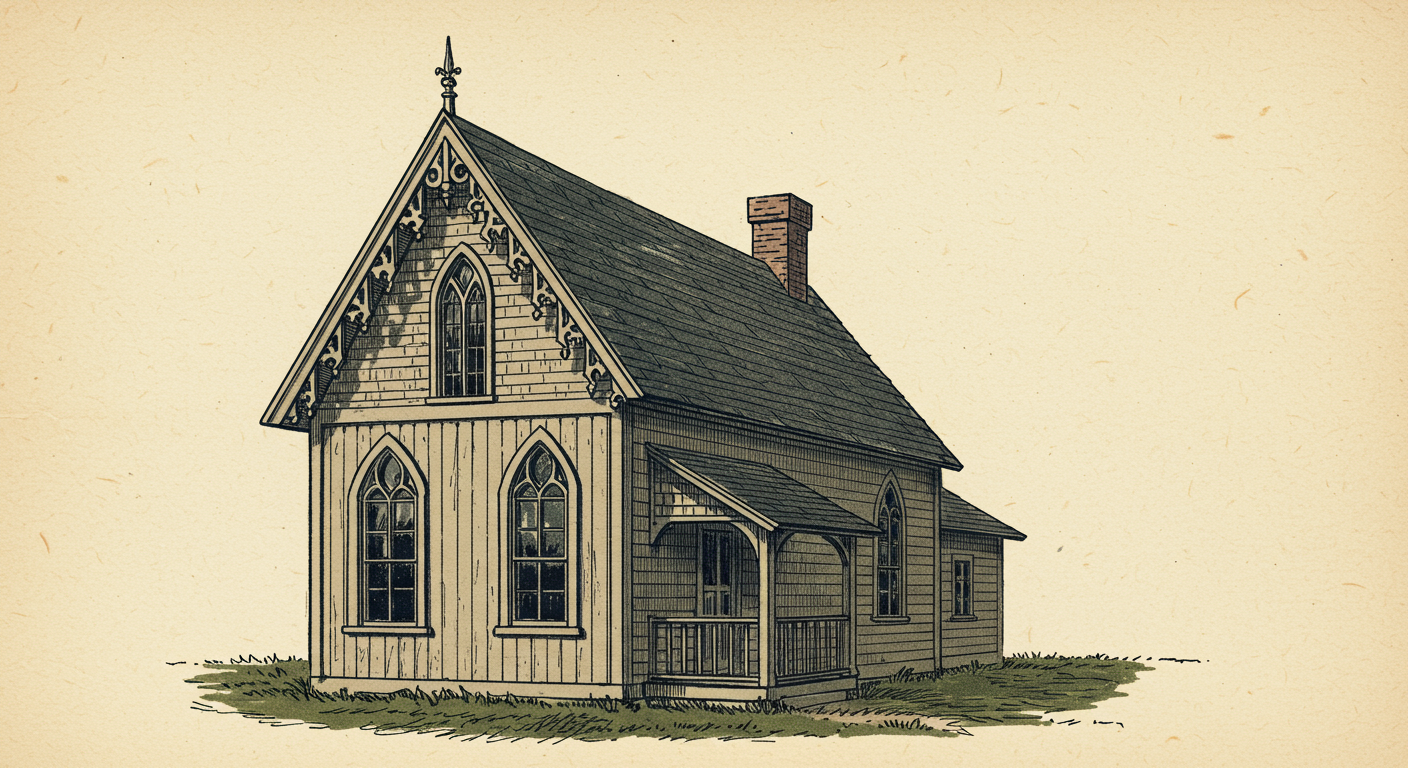
There is a small wooden cottage one finds, in older parts of the Hudson valley and the upper South and the New England villages settled before 1860, that defies easy naming. It is painted white, often, or in a soft buff. Its roof is steeply pitched — much steeper than any of the houses around it, rising in a sharp acute triangle to a high peak — and the gable end faces directly out at the road, presenting to the passerby an almost startling vertical thrust. From the rake of the gable, where the roofline meets the wall, hangs a fringe of sawn-wood scrollwork in scallops and trefoils, descending the slope of the roof in a continuous lacework, as one sees on the cuffs of a Victorian boy’s shirt in a faded photograph. The siding runs vertically: long boards from foundation to gable peak, with thin battens covering the seams between them, so the whole front of the cottage is pinstriped in dark and pale. There is, often, a single tall pointed-arch window set high in the gable peak, coming to a point at the top, like the windows of a country church. The chimney is straight and unornamented. The whole house has the air of a parsonage drawn by an architect who had once visited a village in Yorkshire and never quite forgotten it.
This is the Carpenter Gothic — the wooden American cousin of the Gothic Revival proper, and the word carpenter is doing a great deal of work in that name. What follows is the third in a series that has been, in a quiet way, trying to read American houses for what they were trying to say. The Queen Anne (the first post) said the middle class has arrived and is making no apologies. The Greek Revival (the second) said we are the new Athens; please do not look too closely at how we are financed. The Gothic Revival was a counter-strike to the second of those, and a peculiarly tender one — it argued, with all the moral seriousness of mid-Victorian America, that the right house for a republican Christian family was not a temple at all but a small picturesque cottage with a steep roof, set among trees, beside a stream if possible, and lived in by people who read poetry on Sundays.
The Misnomer
The first thing worth knowing about the Gothic Revival is that the cathedrals it was reviving were a thousand years older than its cottages and made of stone.
The actual Gothic — the architecture of Notre-Dame and Salisbury and Chartres, of pointed arches and ribbed vaults and flying buttresses, built between roughly 1140 and 1450 — was a public, ecclesiastical, masonry tradition. It had nothing to do with cottages. The buildings that survived from that period in the English-speaking world were churches and the occasional collegiate quadrangle, and the form one associated with the word Gothic, in any language, was the great pointed-arch window in stone tracery filled with stained glass.
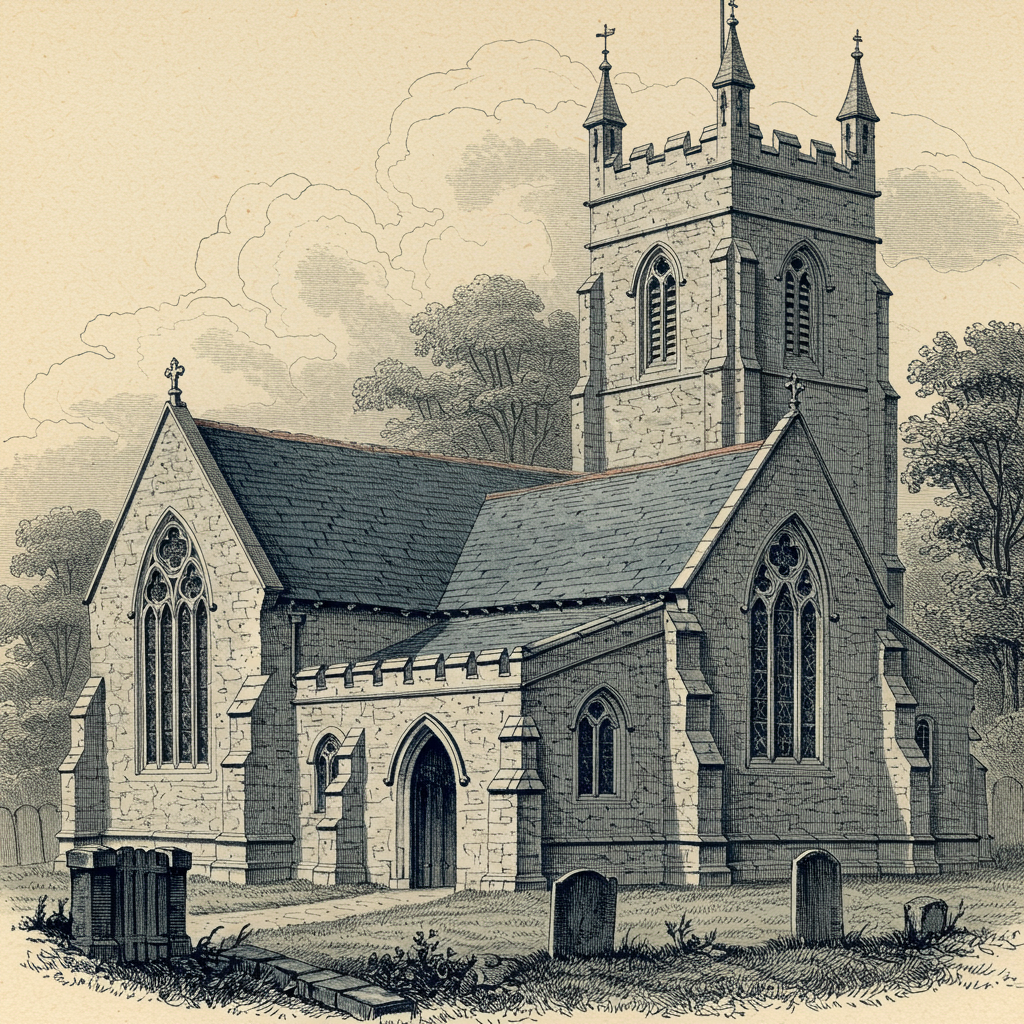
A medieval English parish church, roughly 1300 — stone tracery, pointed arches, ribbed vaults. The Gothic that the American Gothic Revival was reviving. The wooden cottages it produced are translations of this material into a different language altogether.
What happened in nineteenth-century America was a sequence of translations. English Romantic taste, particularly Pugin and the Cambridge Camden Society, insisted that Gothic was the morally right Christian style; English country builders began applying Gothic detailing to ordinary houses; Andrew Jackson Downing, an upstate New York landscape gardener with an outsized literary gift, translated this into an American pattern-book idiom in the 1840s; and small-town carpenters across the eastern United States, working from those pattern-books, built thousands of wooden cottages with sawn vergeboards and pointed-arch windows that had, on inspection, the ghost of a cathedral in them and very little of the substance.
The result is the Carpenter Gothic. The substance — the masonry, the buttresses, the mass — is gone. The silhouette and the ornament are translated into wood. A pointed-arch window in a stone cathedral was structural; a pointed-arch window in a clapboard wall is decorative, applied to a square frame and trimmed to look correct. The vergeboards on the gable end are quotations from the Gothic, abstracted into pure ornament that no medieval mason would have recognised. None of this is to say the result is dishonest, exactly — these cottages are perfectly themselves, and what they were doing was what the Greek Revival had also been doing, applying a remembered silhouette to a vernacular house — but the gap between Gothic and Carpenter Gothic is wider than any other naming gap in the American style sequence, and the word does not, on a careful reading, do all the work the buildings ask of it.
One is obliged to concede that this is, in its way, the most romantic possible misnomer.
The Specimen
If one is to identify a Gothic Revival cottage — and they are, once one has begun looking, surprisingly common in the older parts of the country — the best exercise is once again to walk around a specimen and assemble the evidence.
Begin at the silhouette. A Gothic Revival house presents a steeply pitched gable to the street — much steeper than a Greek Revival pediment, often approaching sixty degrees, in some cases steeper. The gable rises to a sharp peak at the top, often crowned with a finial — a small turned wooden ornament resembling a steeple’s tip. Where a Greek Revival cottage’s roof was low and held the eye horizontally, the Gothic Revival’s roof drives the eye upward. The picturesque verticality is the central design move; everything else descends from it.
Come down to the gable rake. Where the roofline meets the wall — what would be the simple raking cornice on a Greek Revival — there hangs an ornamental vergeboard (also called a bargeboard), sawn in scallops, trefoils, quatrefoils, or running curves. This is the Gothic Revival’s signature ornament. The patterns came directly out of the pattern books — Downing illustrated dozens of vergeboards in The Architecture of Country Houses — and a small-town carpenter with a scroll saw could produce them, on commission, by the running foot. They are the wooden equivalent of the stone gable trim on an English country church, abstracted into something hangable from a board.
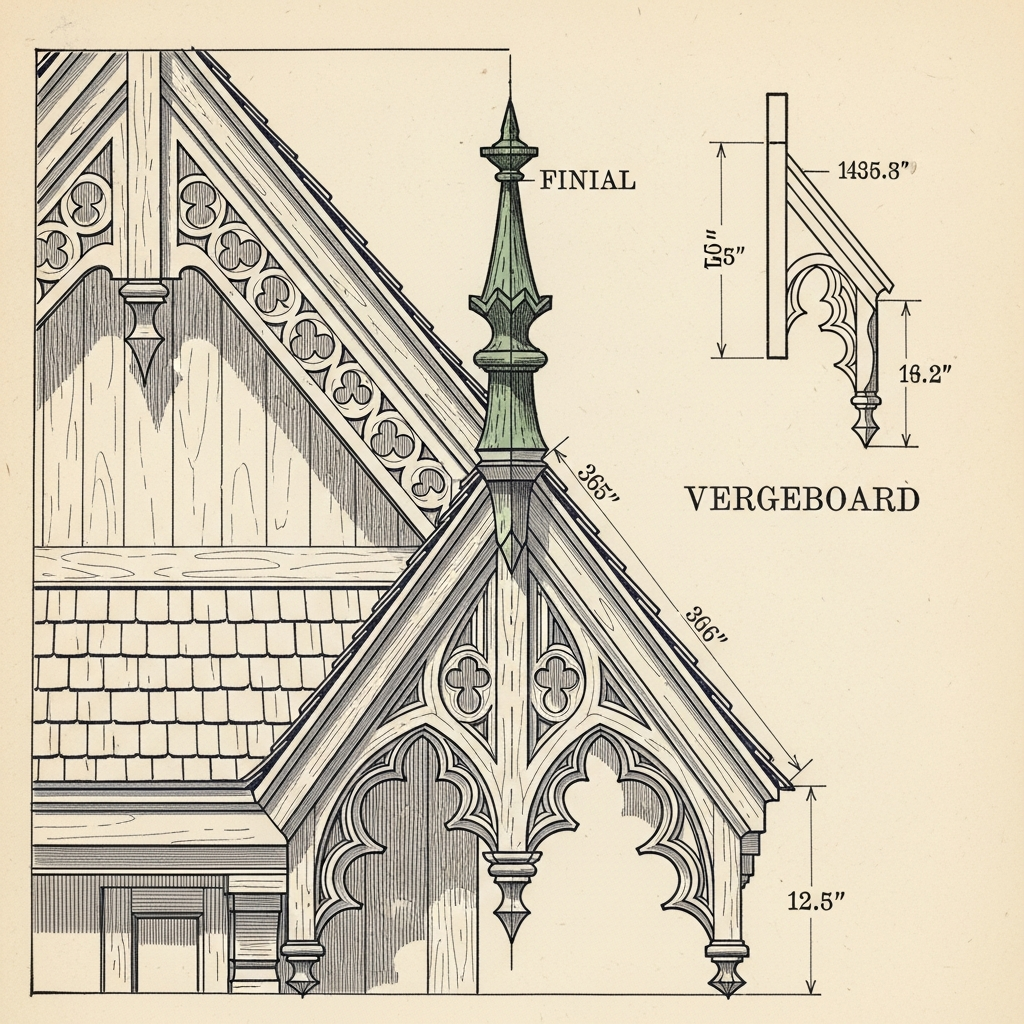
The vergeboard, hanging from the rake of the gable. Sawn scrollwork in trefoils and scallops, descending in a fringe. This is the Gothic Revival’s signature ornament — a pattern-book quotation, cut on a scroll saw, hung on the simplest possible structure.
Look at the windows. Gothic Revival windows are tall, narrow, and pointed at the top — they imitate, in a wooden frame, the lancet windows of a small parish church. The most prominent example is usually the gable-end window, set high in the steep gable peak; smaller pointed-arch windows often appear elsewhere. Where the budget did not run to a true pointed-arch frame, the carpenter compromised — a square sash with a small triangular gable cap above it accomplishes the same visual effect, more cheaply.
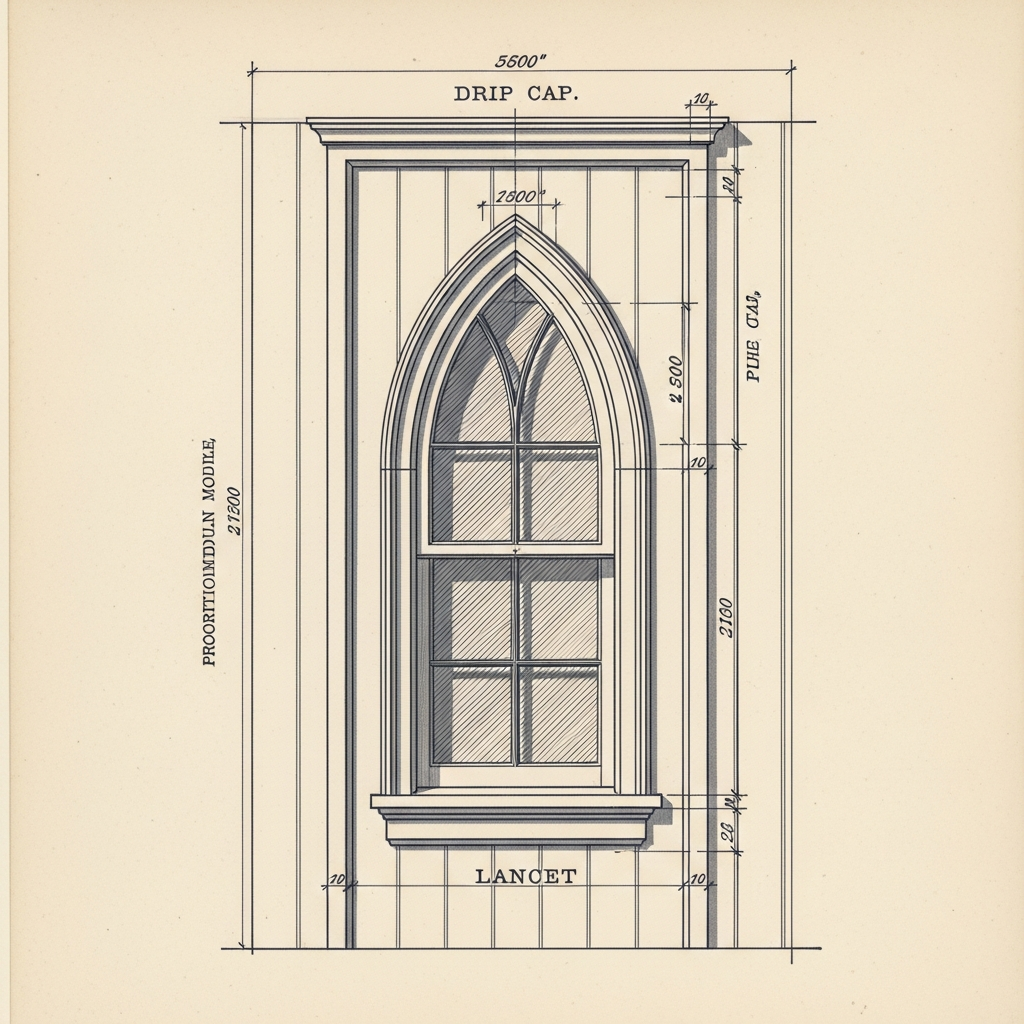
A pointed-arch window — the lancet, borrowed straight from the parish-church vocabulary. In stone it would have been structural; in a clapboard wall it is decorative, applied to the frame and trimmed to look correct.
Examine the walls. The Gothic Revival prefers board-and-batten siding over the horizontal clapboard the Greek Revival used. Long vertical boards run from the foundation to the eaves, with thin wooden battens nailed over the seams between them. The result is a striped vertical surface that, like the steep gable, drives the eye upward. Downing argued for board-and-batten on quasi-moral grounds — vertical lines were honest and aspirational, where horizontal clapboard was passive and recumbent — though one suspects a more practical concern that vertical boards shed water faster off a steep wall.
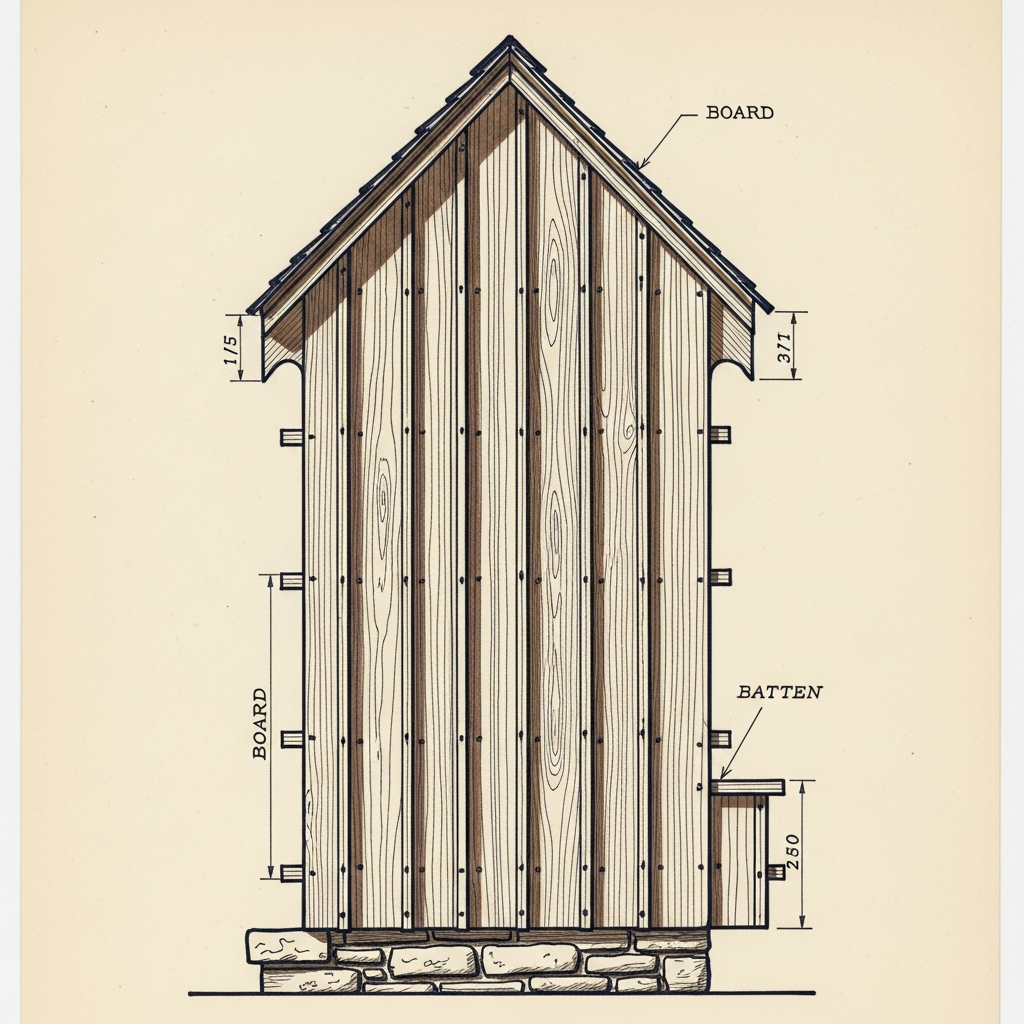
Board-and-batten siding — long vertical boards with thin wooden battens nailed over the seams. Downing argued for it on quasi-moral grounds: the vertical lines were honest and aspirational. Whether one believes that or not, the vertical stripe drives the eye upward, which is the design’s actual point.
Two more details round out the specimen. Front porches, where they exist, are narrow and decorated with chamfered or turned wooden posts that often pick up the pointed-arch motif in their bracing. And there is, very often, a small cross-gable rising from the side wall — a secondary gable, sometimes also vergeboarded, that breaks up the long roof slope and adds a vertical accent at the centre of the elevation. The cross-gable is a stronger identifier than most beginners realise, because it appears on Gothic Revivals of every size, from the smallest cottage to the most ambitious country house.
Assemble these — the steep gable, the vergeboard, the pointed-arch window, the board-and-batten, the cross-gable — and one has a Gothic Revival cottage. One also has, by inspection, the cheapest house in the architectural sequence so far: less expensive than a Greek Revival, dramatically less expensive than a Queen Anne, and built in numbers that the modern reader will not have suspected.
The Carpenter’s Gothic
The economics of the Gothic Revival are the economics of two technologies coming of age at the same time. The first is the steam-powered scroll saw, which by 1840 could cut sawn ornament — vergeboards, brackets, decorative window-caps — at a quality and cost that hand carpentry could not approach. The second is the pattern book, in particular the work of one man.
Andrew Jackson Downing, who lived from 1815 to 1852 (a steamboat fire on the Hudson took him at thirty-six), was the most influential single figure in nineteenth-century American domestic architecture. He was not, by training, an architect — he was a horticulturist who had married into the Hudson valley nursery trade — but his books Cottage Residences (1842) and The Architecture of Country Houses (1850) reached a national audience at the precise moment a national house-building industry was emerging. Downing’s plates illustrated dozens of cottages, with floor plans, elevations, ornamental details, and detailed prose arguments about why a particular form suited a particular kind of household. He believed, sincerely and at length, that architecture was a moral instrument — that the right house, sited correctly with respect to landscape, decorated with restraint, and proportioned to the family within it, would tend to produce better citizens than a wrong house would. The argument is by turns charming and sentimental, and one can take it as far as one likes; the point for our purposes is that Downing illustrated, in those plates, what a Gothic Revival cottage looked like, and small-town carpenters across the country built from his plates for the next thirty years.
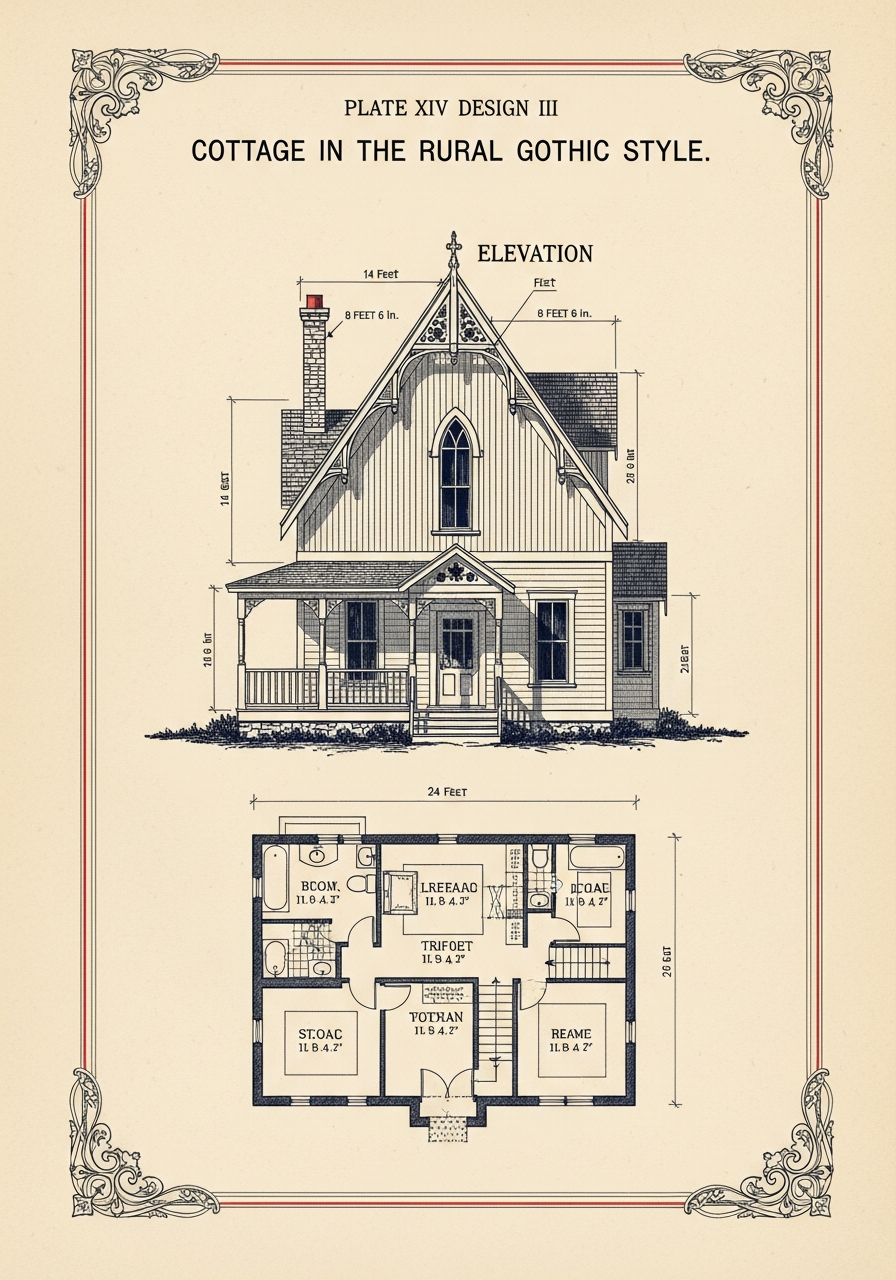
A plate from A. J. Downing’s The Architecture of Country Houses, c. 1850. Elevation and floor plan of a Gothic Revival cottage, with annotated dimensions and ornament details. Most American Gothic Revival cottages descend, by inheritance one or two generations distant, from a plate something like this.
This is a different industrial story from the Queen Anne’s. Where the Queen Anne would, forty years later, depend on mill catalogues and railroad distribution to put standardised parts into every county in America, the Gothic Revival depended on a printed book. There was no mass-produced vergeboard. The local carpenter cut his own, on his own scroll saw, working from a printed plate Downing had drawn in a Newburgh study. The system was looser than Queen Anne’s catalogue economy and produced more local variation — two Gothic Revival cottages in the same county might have measurably different vergeboard patterns, depending on which plate the carpenter had liked, or whose taste he had been working to. The result is more individual than the Queen Anne and, by precisely the same token, less uniform.
The other thing the pattern books did, which is less appreciated, is set the style’s tone. Downing’s prose was not neutral. He wrote about the Gothic cottage as a moral and aesthetic ideal, set among trees, beside a stream, occupied by a family of modest republican character. The style as built carried this freight: a Gothic Revival cottage was, on Downing’s argument, the right house for a Christian middle-class family to grow virtuous in. One could not have said this about a Greek Revival without sounding strange. One could about a Gothic Revival, and one did; the literary culture of antebellum America is full of sentimental novels set in Gothic cottages, with the architecture doing the moral work in the margins of the prose.
It was, I think, the only American style in which the architecture and the morality were openly named in the same sentence.
What It Is Not
Three styles stand near enough to the Gothic Revival that the beginner confuses them with it, and distinguishing them is most of the work of reading the picturesque-era American house. There is also a fourth one might mention in passing.
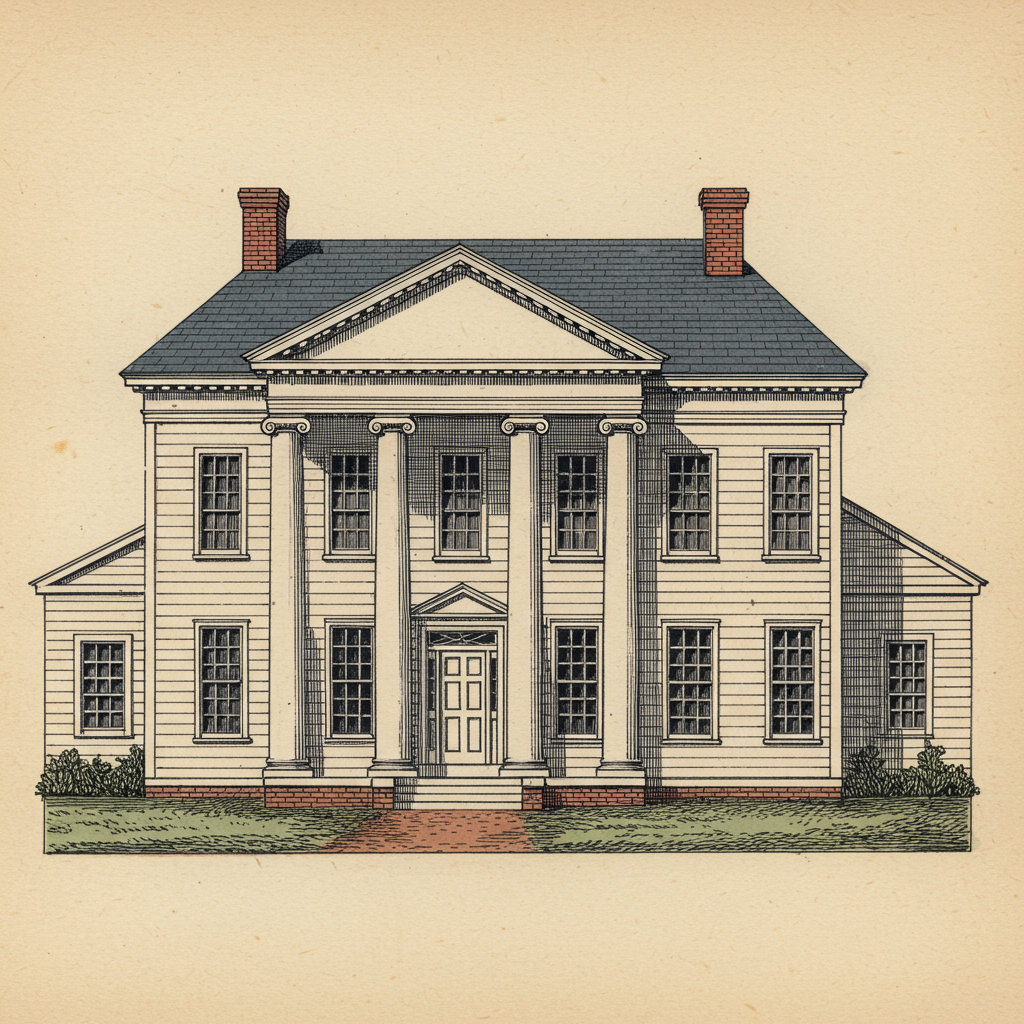
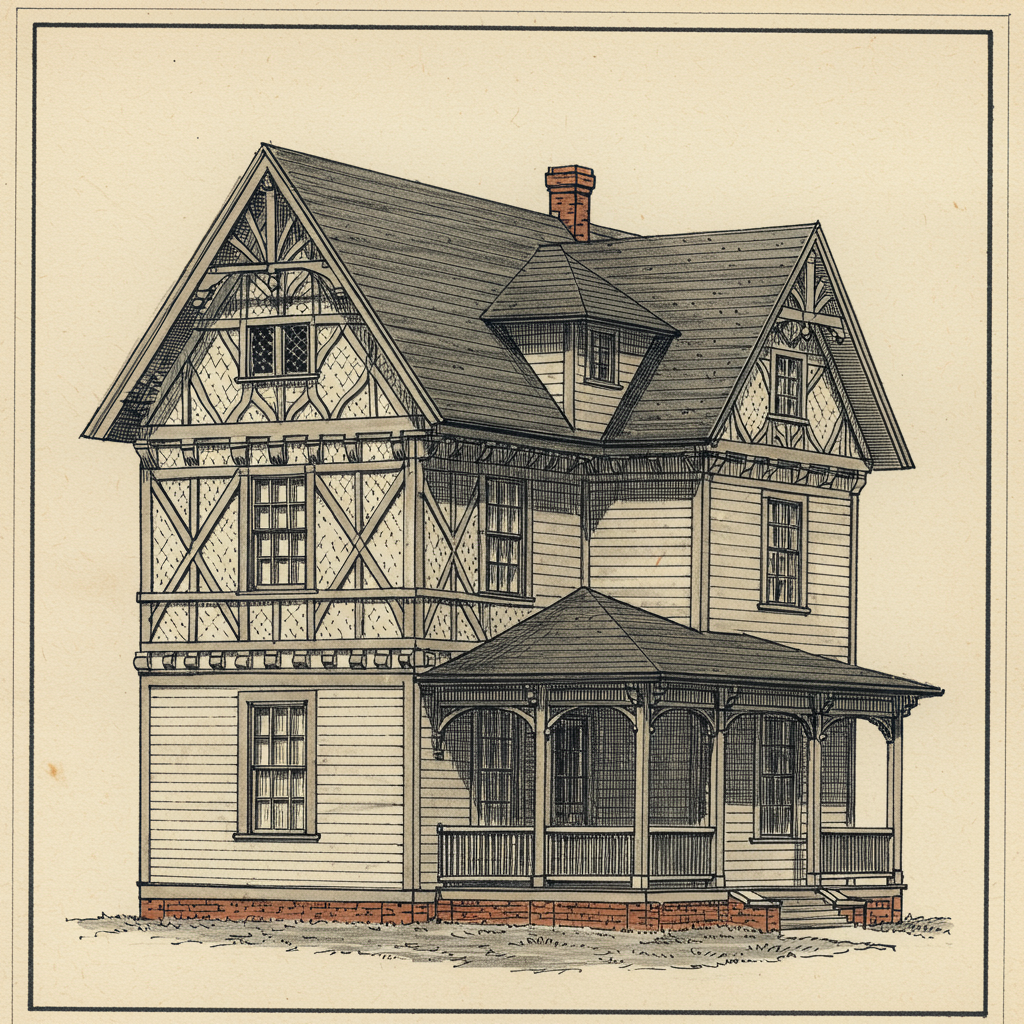
The Greek Revival — the predecessor, the contemporary, and the deliberate adversary — is the classical opposite of the Gothic. Symmetric where the Gothic is asymmetric, white-painted where the Gothic is often a soft buff or grey, low-pitched where the Gothic is steep, horizontally cornice-driven where the Gothic is vertically gable-driven. A Greek Revival presents its temple front to the street; a Gothic Revival presents its steep gable. The two are easy to tell apart at any distance and were understood, at the time, as opposing arguments — the Greek Revival making the case for classical republican virtue, the Gothic Revival making the case for Christian rural domesticity. One was the public style and one was the private style, and which one a household built said something about which argument it found more congenial.
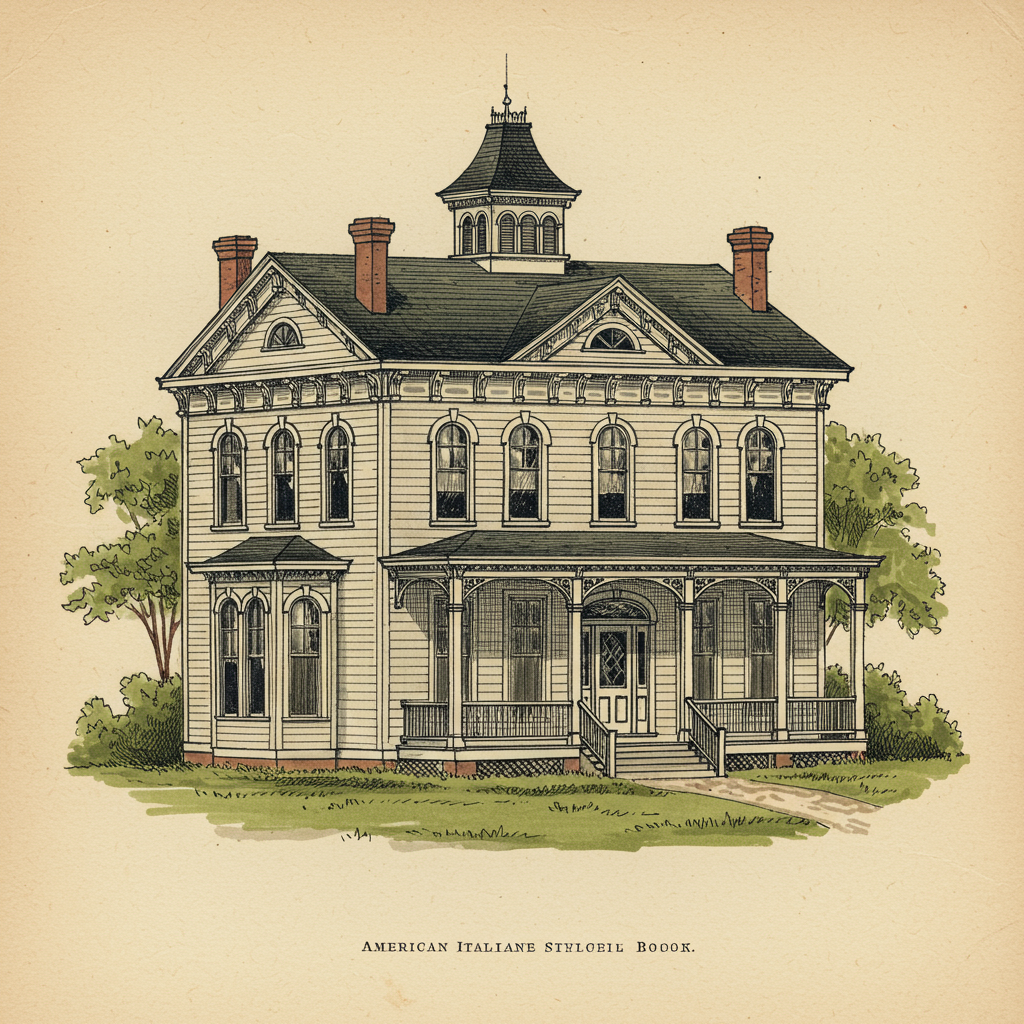
The Italianate — the Gothic Revival’s contemporary and eventual successor, roughly 1840 to 1885 — borrowed the picturesque asymmetry of the Gothic but rendered it with bracketed cornices, tall narrow round-arched windows, and a low-pitched hipped or gabled roof rather than the Gothic’s steep pointed gable. An Italianate is a Gothic Revival that has gone to Tuscany rather than to Yorkshire. The two styles share the picturesque-cottage genealogy and overlap in their pattern-book sources (Downing wrote about both), but the visual distinction is clean: a roof with brackets is Italianate; a roof with vergeboards is Gothic.
The Stick style — the Gothic Revival’s wooden inheritor in the 1860s and 1870s — kept the steep gable and the love of decorative woodwork but expressed the frame of the house rather than its silhouette. Stick houses bear vertical, horizontal, and diagonal sticks applied across the wall plane, mimicking the internal framing. A Stick is a Gothic Revival that has stopped pretending to be Gothic and started showing its bones. By the 1870s the two styles bled into each other in the work of the same carpenters; by the 1880s the Stick had largely absorbed what the Gothic Revival had been doing.
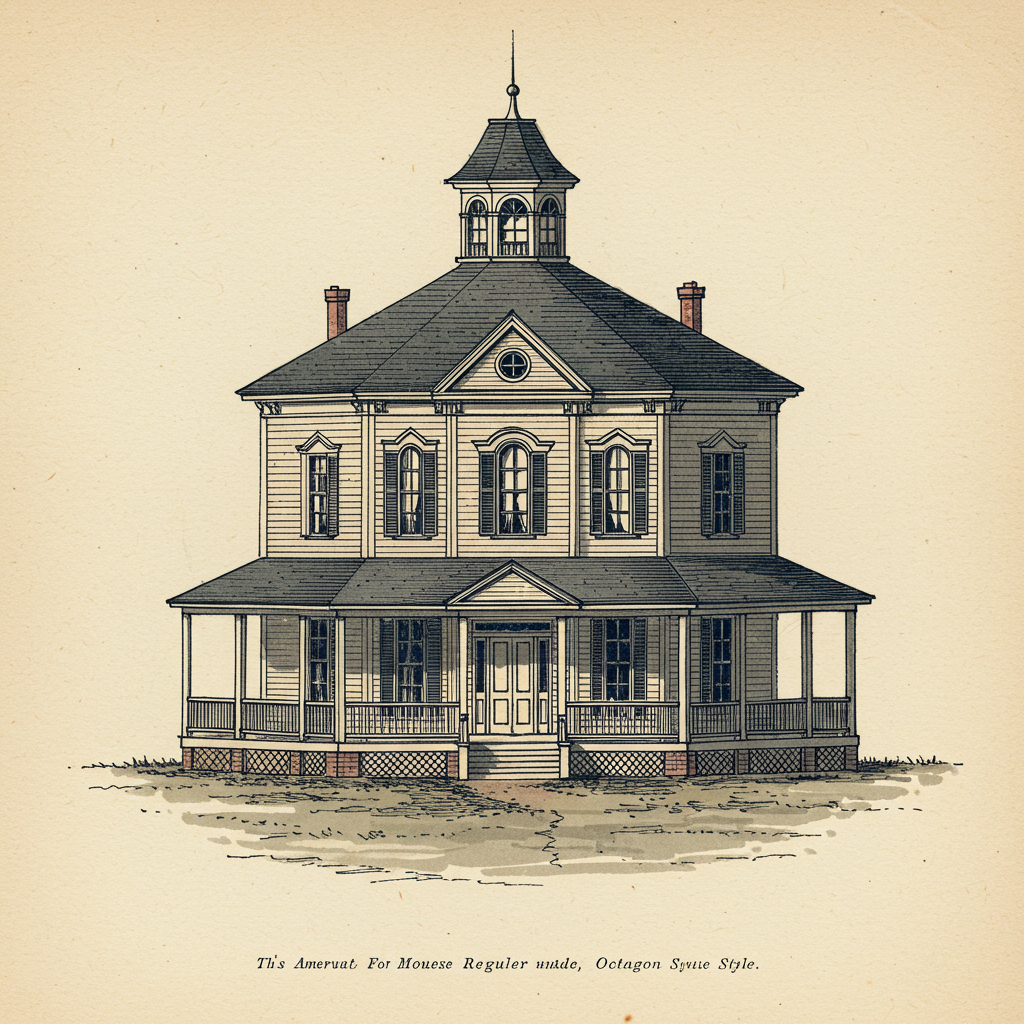
The fourth — the Octagon style of the 1850s — was an eight-sided house associated with the phrenologist Orson Squire Fowler, who argued (with no small confidence) that the eight-sided plan was healthier and more efficient than the rectangular. They are not common, but they are unmistakable, and they show up in the same picturesque-cottage moment as the Gothic Revival. A Gothic Revival is not octagonal; an Octagon is not Gothic; one will not, on inspection, confuse them.
What It Was Trying to Say
The Gothic Revival flourished in America between roughly 1840 and 1880, with its sharpest period falling in the two decades on either side of the Civil War. It declined as the Italianate, and then the Queen Anne, took the country’s domestic fashion in increasingly elaborate directions. By 1880 it was already sentimental and antiquarian; by 1900 the only Gothic Revival buildings still going up were churches, and even those had largely shifted toward a heavier Gothic Revival in stone.
What it was trying to say is best taken as the sum of two arguments running in parallel.
The first is the romantic argument against the classical. The Greek Revival had been the architecture of the early American republic — civic, public, rationalist, Athenian. The Gothic Revival was its romantic counter, Christian rather than classical, rural rather than civic, picturesque rather than monumental. To choose a Gothic cottage over a Greek Revival farmhouse was to make a statement about what kind of life one wanted to be seen leading. It was the architectural equivalent of preferring Wordsworth to Pope. The two readings of America — classical and romantic — would continue to wrestle in the country’s architecture for the rest of the century, but the Gothic Revival was the moment when the romantic side put up its first sustained challenge.
The second is the moral argument about the family. Downing and his successors argued, again and again, that the home was the moral centre of the republic — that a well-designed cottage, set among trees, occupied by a virtuous family, would produce virtuous citizens for the next generation. This argument is foreign enough to modern ears that one has to translate it carefully when reading the period sources, but it was sincere, it was widespread, and it was answered by every Gothic Revival cottage built between 1842 and 1875. The architecture made the argument; the prose explained it; the country built the buildings.
Whether one calls this earnest or saccharine is a question of temperament. I notice that I find it earnest. The Gothic Revival is the only American style in which the country was building, with a straight face, what it believed homes were for, and the buildings it left behind have an honesty that the more cynical later styles do not quite attain.
The next specimen I should like to take up is the Italianate — the Gothic Revival’s picturesque sibling, which abandoned the moral cottage for a hipped Italian villa and which became, by the time of the Civil War, the dominant fashion for the wealthier American house.