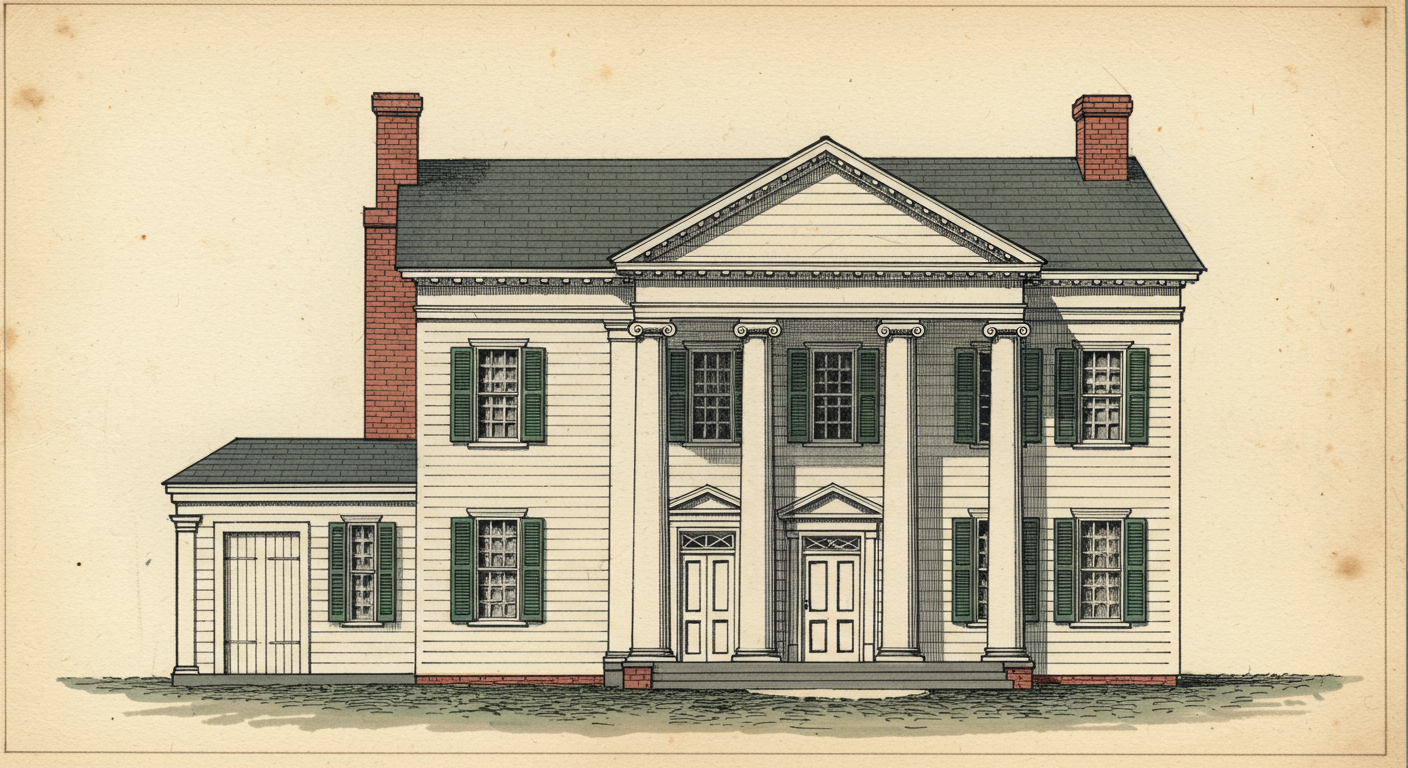
Some weeks back, on a back road in southern Vermont — one of those roads that loses the centre of any town it passes through, and re-emerges into pasture before the pasture has fully understood it has been disturbed — I stopped in front of a clapboard house no bigger than a generous shed, painted white, and admitted that I had been calling things like it “old farmhouses” for the better part of forty years.
It had two columns flanking the front door. Doric, plain-shafted, with simple capitals — and behind them the door itself sat in a heavy frame of pilasters and entablature, with a wide horizontal transom over the top. Above all this, the gable end of the roof faced directly out at the road, and a heavy cornice ran across the top of the entablature and returned around the corner in two short horizontal hooks that seemed, on inspection, to be the entire point. Six-over-six sash windows in regular bays; one storey and a half; clapboard siding; nothing else of interest until the chimney. The colour was white throughout. The house was, I realised, a temple. A very small and slightly comic temple, with a chimney rising out of one side, but a temple all the same.
The style is the Greek Revival, and the Queen Anne post that opened this series ended with a forward look at it — calling it the style the Queen Anne was, in its cheerful asymmetry, refusing. That is true enough as a sentence, but it does not do justice to what the Greek Revival actually was: the closest thing the American republic has had to a national style, a near-religious commitment to the architecture of fifth-century Athens, applied with varying degrees of seriousness from the Mississippi cotton mansion down to the Vermont farmhouse with the two-column portico, and built — in numbers most of us will not have suspected — across the entire eastern half of the country between roughly 1825 and the Civil War.
The Misnomer
Unlike the Queen Anne, the Greek Revival is at least named after the thing it was attempting to revive. One could not accuse the Americans who built these houses of having got the wrong century. They knew what they were doing. The trouble is what they thought “Greek” was.
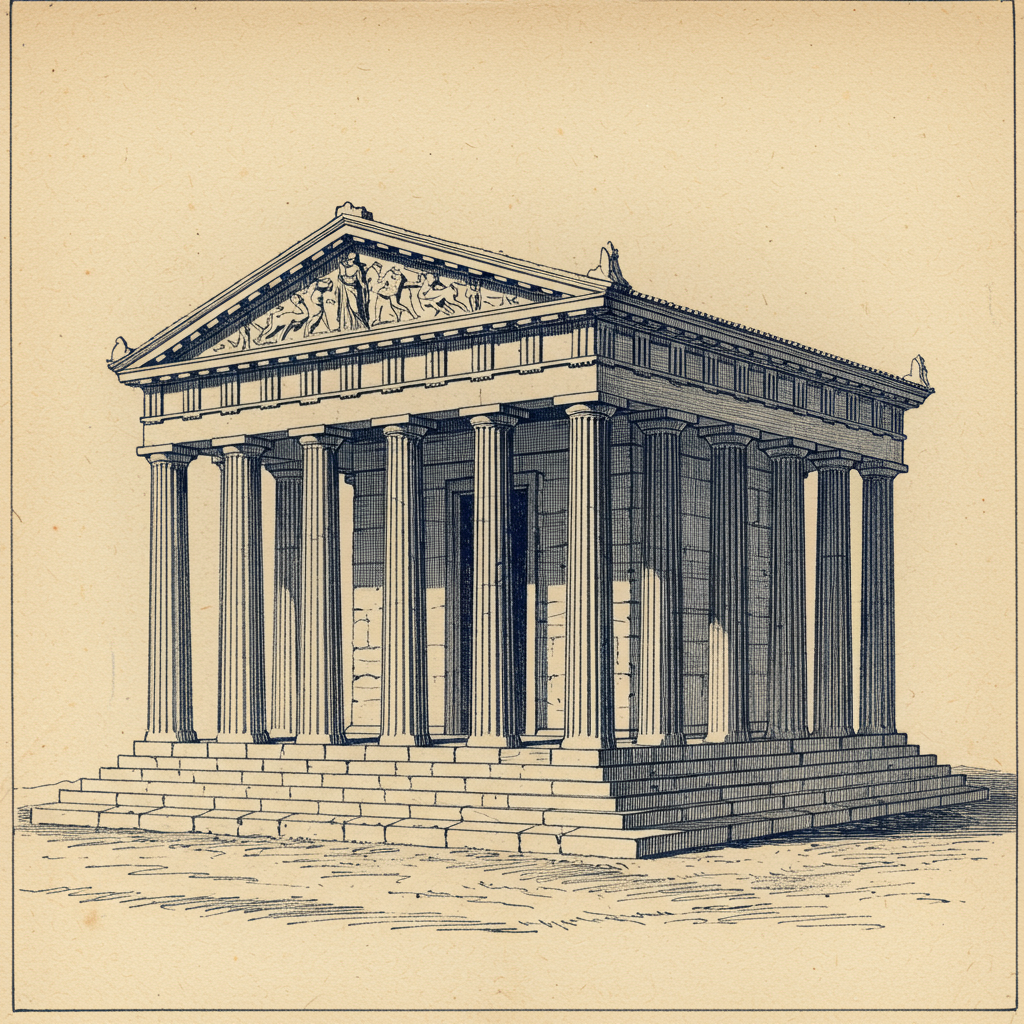
A fifth-century Greek Doric temple, roughly as the Americans imagined it. White marble, austere proportions, no ornament beyond the orders themselves. The originals had, in fact, been painted in vivid colour — but no nineteenth-century European or American knew this, and the all-white temple of the imagination is what the Americans set out to build.
The American Greek Revival drew its precedent not from Athens directly but from the books that European antiquarians had been publishing for the better part of a century — Stuart and Revett’s The Antiquities of Athens, the great folios of Greek and Roman ornament that had filtered the actual stones of the Acropolis through the careful hands of British and French draughtsmen. The drawings in those books were, on the whole, accurate to the geometry. They were exceedingly inaccurate to the colour. The Greeks had painted their temples in vivid reds, blues, and golds, with figural friezes picked out in detail; we know this now because chemical residues have been found in the carved letters of the architraves and on the surviving cornice fragments. We did not know it in 1825. The Americans, like the Europeans before them, took it as established that a Greek temple had been white as bone, and built their own white temples accordingly. One walks past, today, hundreds of small wooden Athenian Doric façades painted white because the originals were thought to be — when, had the chronology run differently, those same façades might have been painted oxblood and indigo.
There is, too, the question of what the Americans were borrowing. A Greek temple is a public building — a house for a god — designed for its exterior, with a cool dim interior most people never entered. The Americans took its silhouette and adapted it for the smallest and most domestic purpose: a one-and-a-half-storey clapboard farmhouse. No Athenian would have understood this. To live inside the temple of Athena — to put a kitchen in the cella and a bedroom in the pronaos — was, by Athenian lights, a kind of polite blasphemy. The Americans either did not know this or, more likely, did not care. The temple front was a powerful image, and the new republic wanted powerful images, and so the temple front was put to work as a doorcase, a porch, a façade-end — anywhere it would fit, and a great many places where it would not.
One is obliged to concede that this is, in its way, the most American thing one could have done with a Greek temple.
The Specimen
If one is to identify a Greek Revival — and the great pleasure of the style, after the Queen Anne’s complications, is that one can identify it from across a parking lot — the best exercise is once again to walk around a specimen and assemble the evidence.
Begin at the silhouette. A Greek Revival house presents its gable end to the street. This is the temple front: the triangular pediment of the gable looks down on the passer-by, framed by a heavy cornice that runs all the way around the building. Where the cornice meets the corner of the gable end, it does not simply stop; it returns — a short horizontal segment of cornice that wraps a foot or two around the corner, before terminating cleanly. A Greek Revival house with cornice returns is a Greek Revival house. They are the most reliable identifier the style has, for the simple reason that no other style does them.
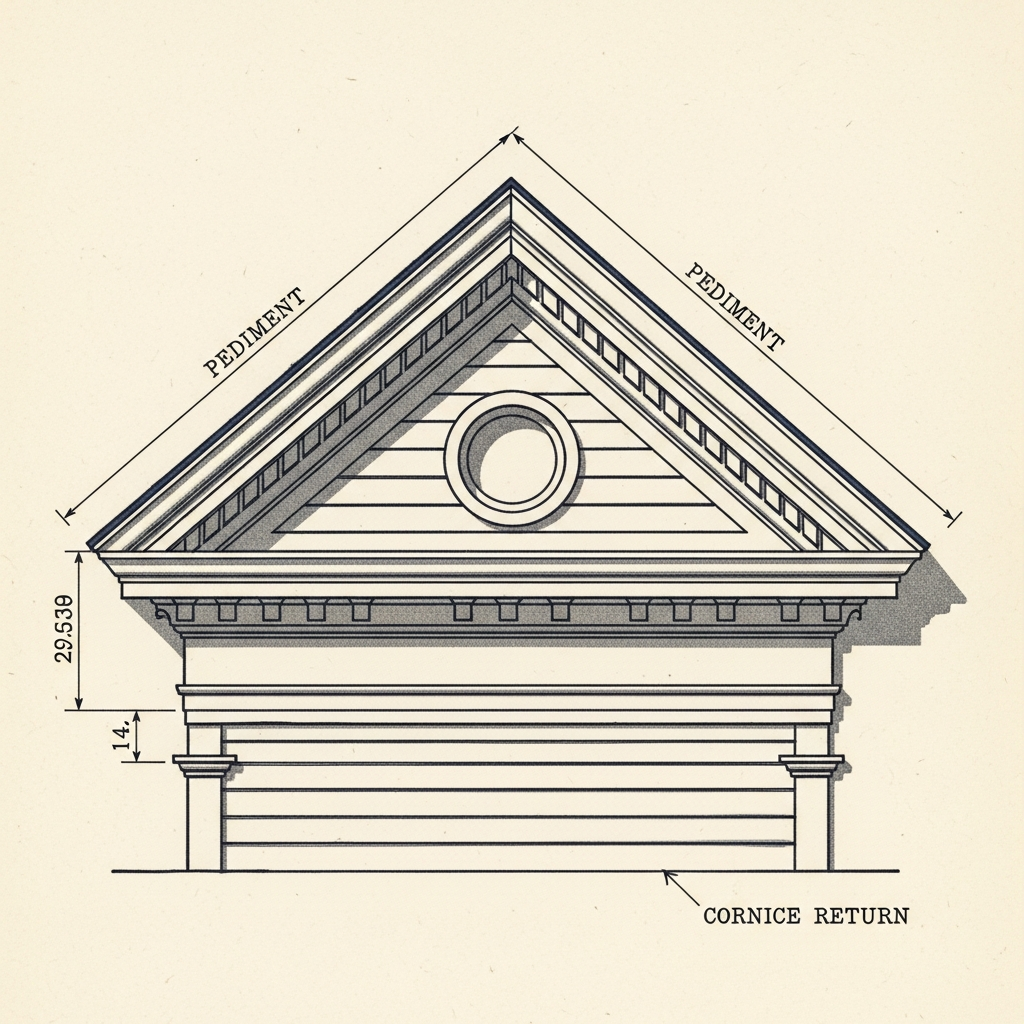
The pediment with cornice returns. The horizontal moulding that wraps from the gable end around the corner — visible from the street as two short hooks at the bottom of the triangle — is the most reliable identifier of the style.
Come down to the columns. The very grandest Greek Revivals carry a full portico of free-standing columns across the front of the house, four or six tall columns supporting a deep entablature and the pediment above; one finds these in the Mississippi plantations, in the New England banking houses, and on the better courthouses. The middling examples have a smaller entrance portico — two or four columns, supporting only the porch roof and a small entablature. The smaller examples have applied pilasters at the corners of the house and flanking the front door, declaring the temple form without quite paying for it. The plainest have only the pediment and the cornice returns, with no columns or pilasters at all, and rely on the silhouette alone.
Whatever the scale, the columns will almost always be Doric — plain shaft, simple round capital, no fluting on the smaller examples — because Doric is the cheapest of the three Greek orders and required the least specialised work from the local carpenter. Ionic, with its scrolled capital, appears on the more serious houses. Corinthian, with its acanthus-leaf flourish, is rare in domestic work; one finds it on the courthouses and the high-society mansions, almost never on the farmhouse.
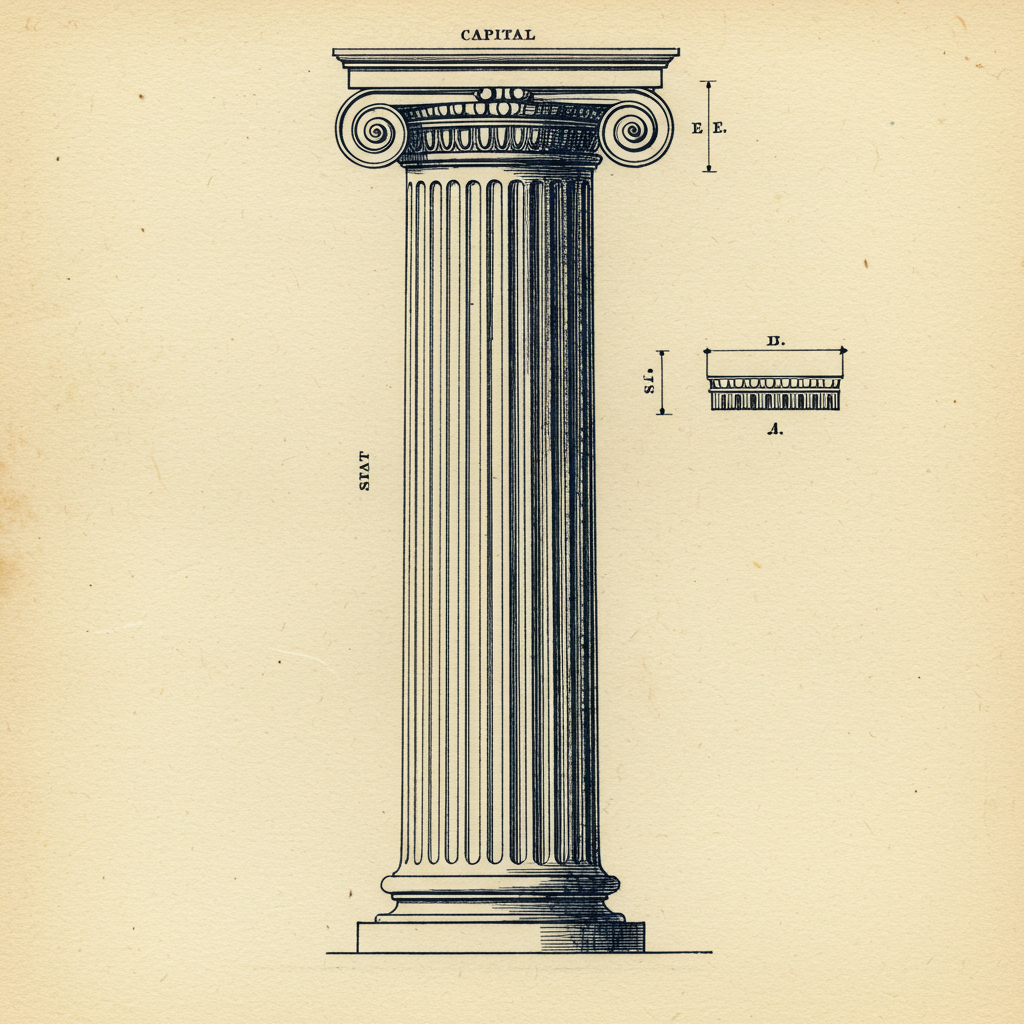
An Ionic column — fluted shaft, scrolled volutes at the capital — as found on the more serious Greek Revivals. The plainer Doric, with a simpler round capital and no volutes, was more common at every scale; the proportions of either order came directly from pattern books, where Asher Benjamin set them down in 1806 and small-town carpenters copied them for fifty years.
The doorcase is the third giveaway, and on a small house often the only declaration of style the budget allowed. A Greek Revival door sits in a heavy classical surround: pilasters flanking the door on either side, supporting a small entablature directly above. Sidelights — narrow vertical windows running floor-to-ceiling beside the door — flank the door itself; a wide horizontal transom of small panes runs above the entablature, sometimes as a row of square lights, sometimes as a single rectangular sash. The whole composition is a miniature temple front around the front door, set into the wall of an otherwise plain rectangular house. It is the doorcase that does the work of telling the visitor, before the visitor has crossed the threshold, that the household has gone to the trouble of being civilized.
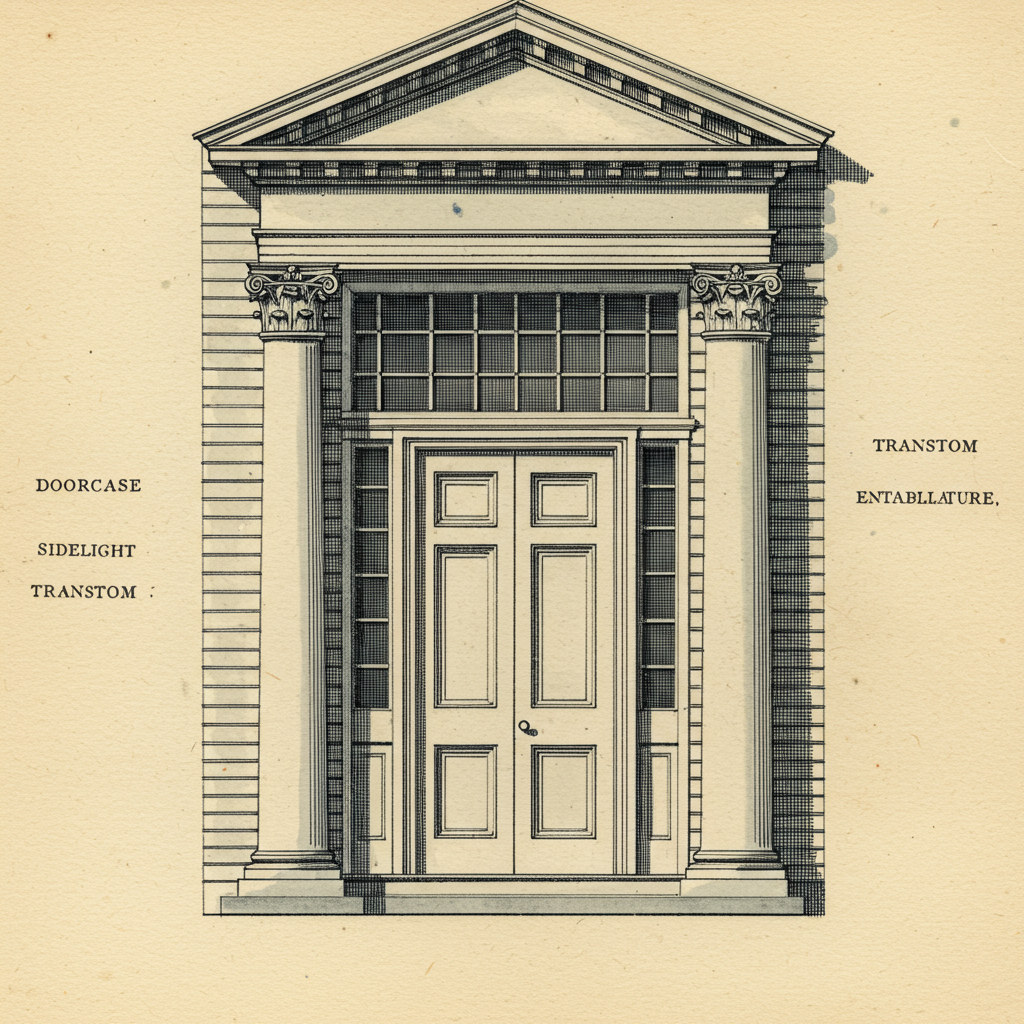
The doorcase — pilasters, sidelights, transom, and entablature. The miniature temple front set into the wall of an otherwise plain rectangular house.
Two more details round out the specimen. The windows are nearly always six-over-six or nine-over-nine sash, in regular bays, with simple flat trim. The walls are clapboard if wood, or stuccoed brick painted white if masonry — both materials in service of the same project, which is to imitate the marble of the Athenian original. The colour is overwhelmingly likely to be white. There are exceptions — the painted-Lady palette did not exist yet, but a sober buff or pale yellow was tolerated — but white was the expected colour, and the colour the style still wears in the public mind.
Assemble these — the gable-end-to-street, the cornice with returns, the columns or pilasters or the doorcase, the regular sash windows, and the white paint — and one has a Greek Revival. One also has, on closer inspection, an architectural argument: this house is descended from a Greek temple, and would like you to know it.
The Carpenter’s Greek
Where the Queen Anne rose on the back of the steam-powered scroll saw and the railroad lumberyard, the Greek Revival rose on the back of a different mechanism altogether: the pattern book.
The Greek Revival predates American industrial woodwork by two generations. There were no mill catalogues offering Doric capitals by the gross in 1830. The local carpenter who built these houses was a skilled tradesman with hand tools — saws, planes, chisels, a turning lathe perhaps, a moulding plane for each profile — and the Greek details were cut and assembled by hand, on site, from rough lumber. What the carpenter did not have, and could not have produced from his own training, was the design: the proportions of the Doric order, the rules for laying out an entablature, the geometry of the pediment, the relations of column to capital to base. These had to come from somewhere.
They came from books. Asher Benjamin’s The American Builder’s Companion, first published in 1806 and revised through several editions, set down the classical orders for the use of any small-town carpenter who could read a printed plate. Minard Lafever’s The Modern Builder’s Guide (1833) and The Beauties of Modern Architecture (1835) followed at the precise moment the Greek style was becoming fashionable, with cleaner and more usable plates. These were not pattern books in the later Queen Anne sense — they did not specify part numbers from a mill catalogue, because no such catalogues existed. They were instruction manuals. They taught the carpenter how to lay out a column, how to draw a Greek doorcase, how to proportion a Doric entablature, what mouldings to cut by hand for the cornice. A carpenter with Asher Benjamin’s book on his bench could build a small Greek Revival house from rough timber and his own labour, anywhere there was a sawmill and a customer.
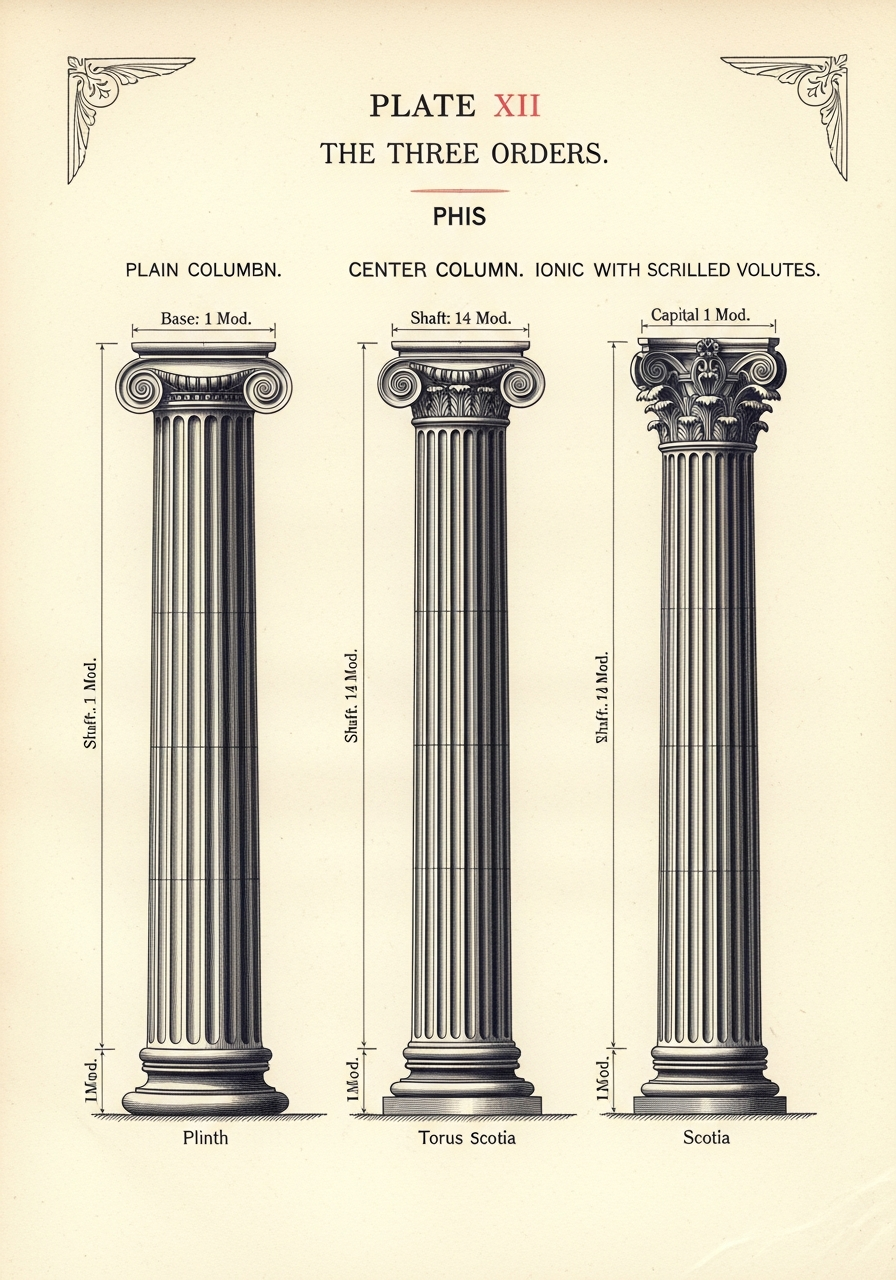
A plate from Asher Benjamin’s The American Builder’s Companion, c. 1830. Not a parts catalogue but a geometry lesson — the proportions of the classical orders set down so that any competent carpenter could build a column from rough lumber.
The result was a peculiarly democratic distribution. Where the Queen Anne required a mill, a railroad, and a catalogue, the Greek Revival required only a book, a sawmill, and a competent carpenter. This is why one finds Greek Revivals on the back roads of Vermont and the back roads of Mississippi and the back roads of Indiana — not just in the cities and the cotton plantations. The style went anywhere a copy of Asher Benjamin could go, which by 1840 was almost everywhere a literate housewright was practising. There are more small Greek Revivals in the old-settled parts of America than there are mansions, by perhaps a factor of a hundred. The style was not, at its base, a style of the rich. It was a style of the carpenter who could read.
This produced a second consequence worth naming. Because the same handful of pattern books circulated everywhere, a small Greek Revival in central Ohio looks uncannily like a small Greek Revival in central Maine — not because they were built from the same mill’s catalogue, as the Queen Annes were, but because they were built from the same pattern book’s plates. The mechanism is different, the result is the same. A national style emerged from a national book trade.
What It Is Not
Four styles stand near enough to the Greek Revival that a beginner confuses them with it, and distinguishing the four is most of the work of reading the early American house.
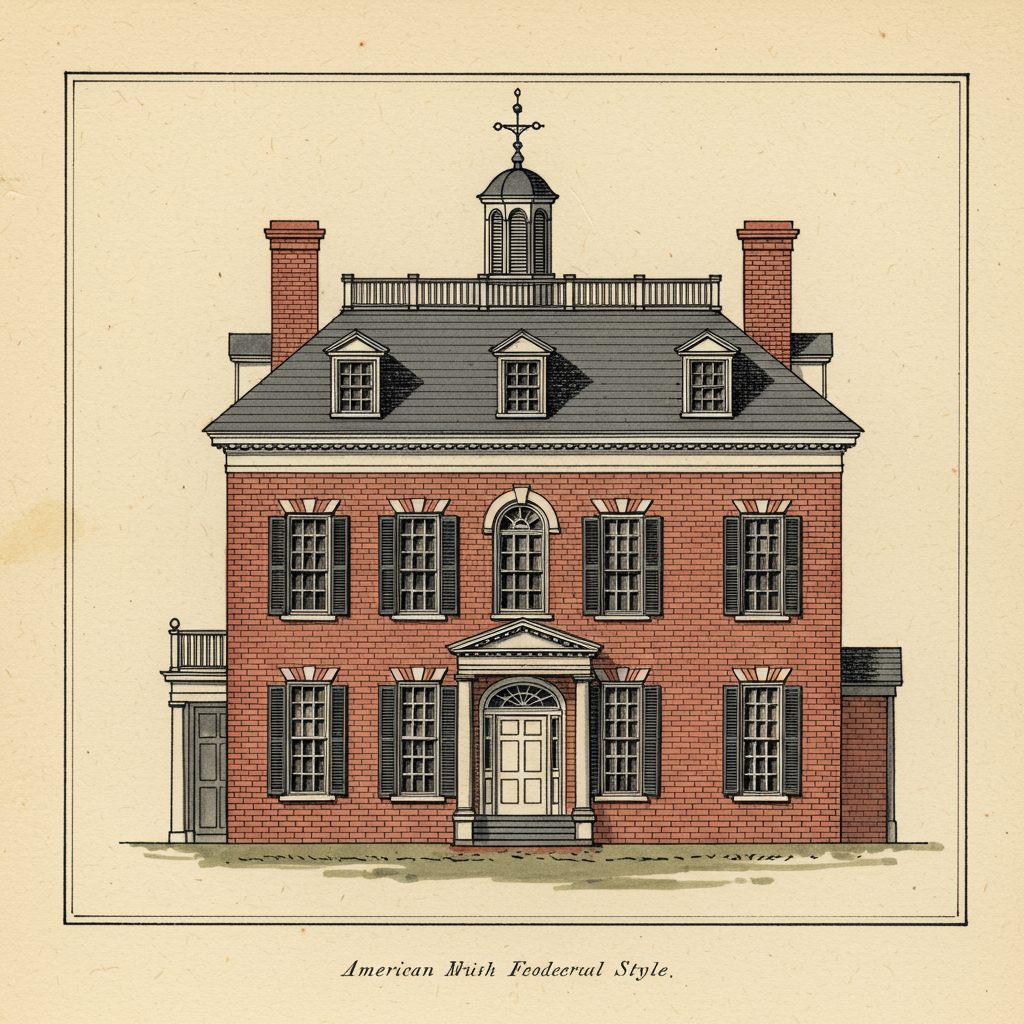
The Federal style — the predecessor, roughly 1780 to 1820 — is the lighter, more delicate cousin that preceded the Greek Revival and prepared the country for it. Federal houses are also classical, also symmetrical, also white-painted in their wooden examples; but the detailing is finer and the proportions slimmer. Where a Greek Revival doorcase has heavy pilasters and a full entablature, a Federal doorcase has slender colonnettes and an elliptical or semicircular fanlight above the door. Where a Greek Revival pediment is heavy and shadowed, a Federal cornice is delicate and almost decorative. A Greek Revival is a Federal house that has been to the gymnasium.
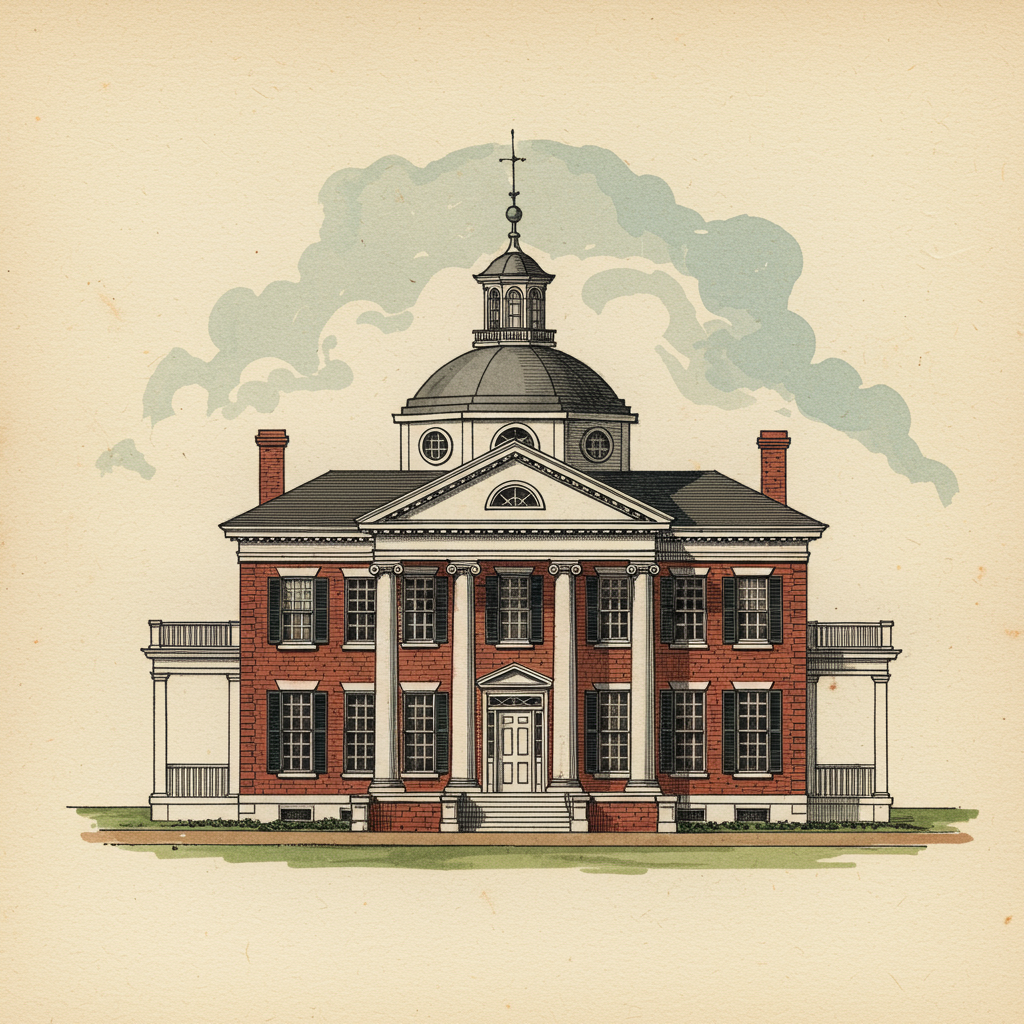
The Jeffersonian or Roman Revival — overlapping the Federal and the early Greek, roughly 1780 to 1830 — drew on Roman rather than Greek precedent, and is rare in domestic work but dominant in the early federal civic buildings (the U.S. Capitol, the Virginia State Capitol, Monticello). Its giveaways are the rotunda, the dome, the Tuscan order (a Roman simplification of the Doric), and a fondness for octagonal rooms. A Jeffersonian house is a Greek Revival that has read Cicero rather than Plato, and prefers the architectural language of Augustan Rome to that of fifth-century Athens.
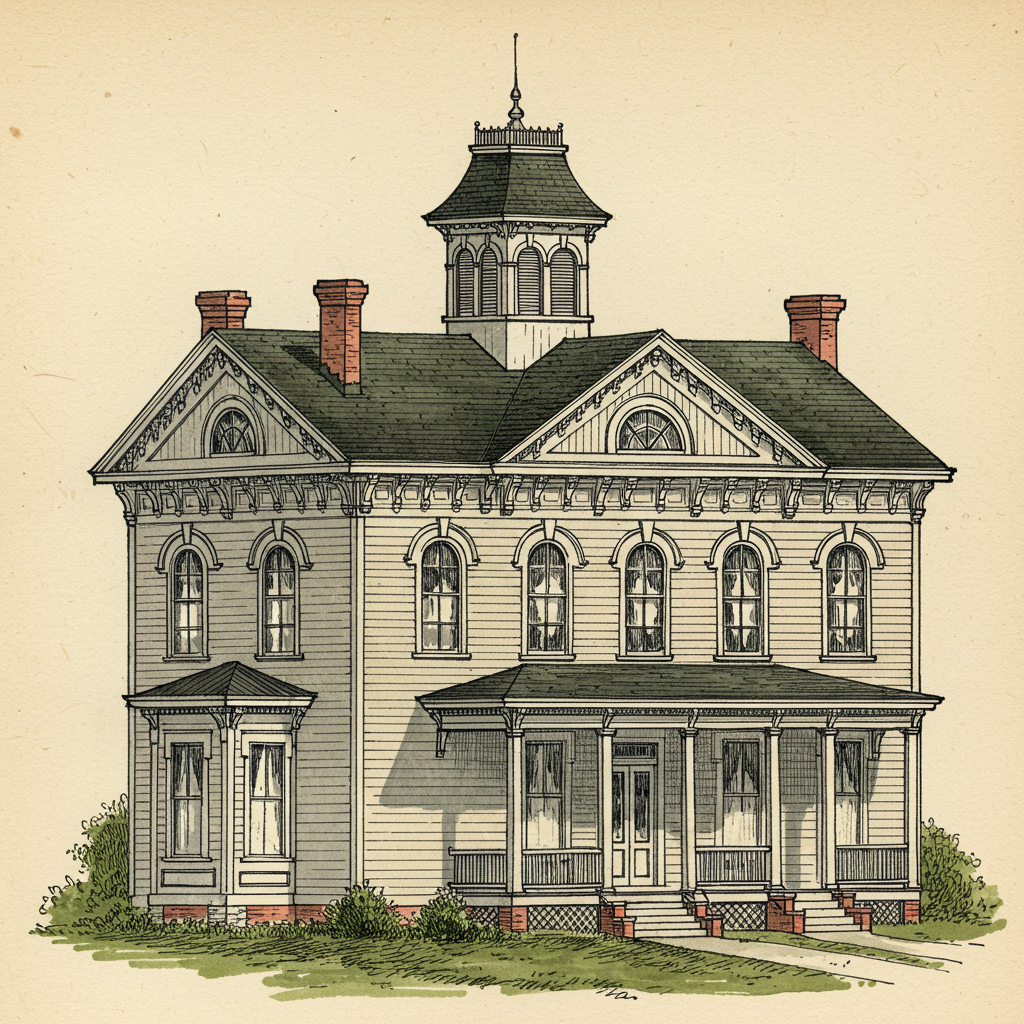
The Italianate — roughly 1840 to 1885, succeeding the Greek Revival — abandoned the temple front and the classical symmetry for low-pitched roofs, heavy bracketed cornices, tall narrow windows often with rounded tops, and frequently a small square cupola or belvedere on the roof. The Italianate is what fashionable America turned to when the Greek Revival had run its course. The two styles can be told apart at a glance: a Greek Revival presents its gable to the street with a triangular pediment; an Italianate presents a horizontal eaveline with a heavy bracketed cornice and no pediment at all.
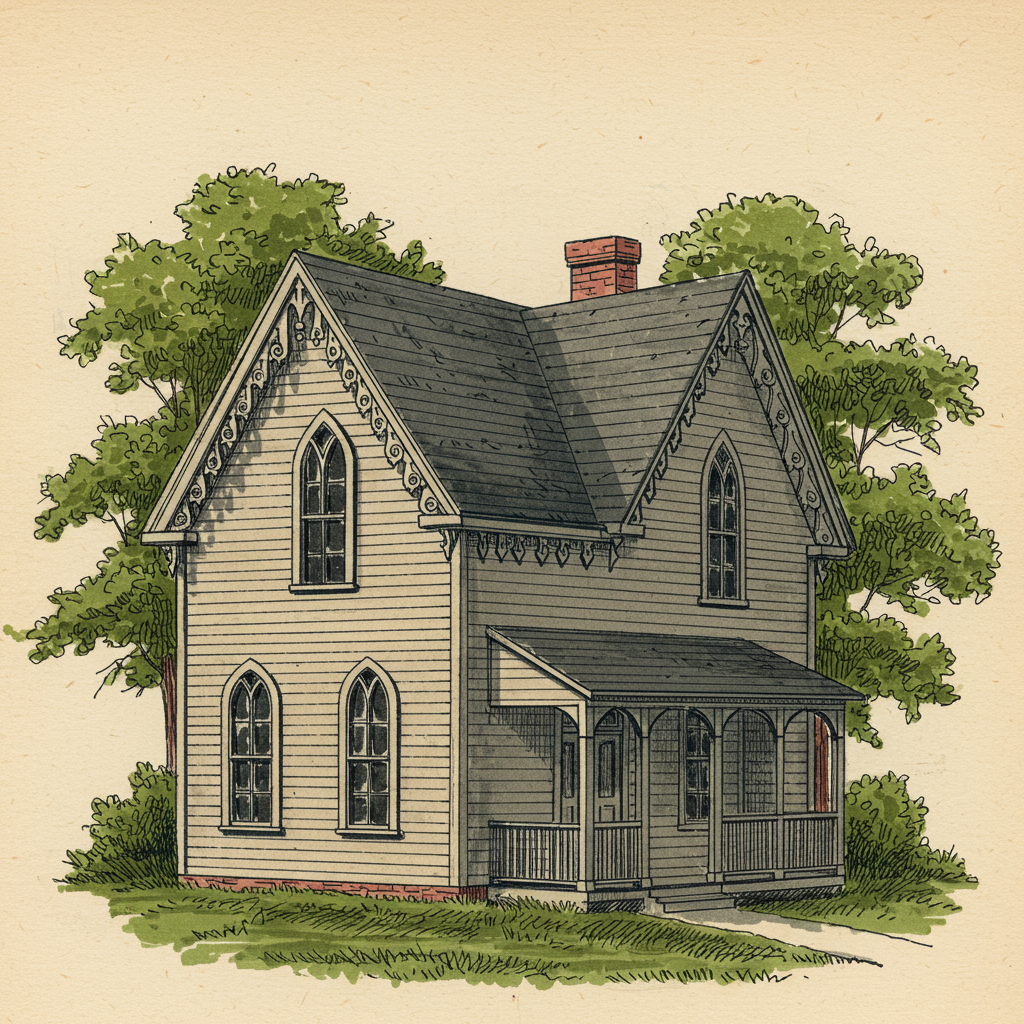
The Gothic Revival — roughly 1840 to 1880, contemporary with the late Greek Revival but representing the opposite cultural impulse — rejected the classical for the medieval. Steep gables, pointed-arch windows, vergeboards (the sawn ornamental boards that hang along the rake of the gable, what Americans came to call gingerbread), and board-and-batten siding mark the style. A Gothic Revival is the house the Greek Revival’s romantic younger brother built in deliberate opposition: vertical where the Greek is horizontal, pointed where the Greek is rounded, picturesque where the Greek is austere.
What It Was Trying to Say
Every style that becomes a national fashion expresses something about its moment, and the Greek Revival is one of the clearer cases on record.
The early American republic identified itself, almost from its founding, with the city-states of classical antiquity — and in particular with Athens, the inventor of the political form the new country was trying to put into practice. The Founders read Plutarch and Thucydides; they named their political papers after Roman and Greek statesmen; they built a Senate on a Roman model and a House on a Greek one, and they argued the merits of their constitution by reference to debates two thousand years dead. By the time the Greek War of Independence broke out in 1821, with the Greeks attempting to throw off Ottoman rule, the American identification with Greece had a fresh and immediate political content. Lord Byron sailed to fight at Missolonghi; American newspapers ran weekly dispatches from the Greek front; subscription drives funded Greek patriots across the country. The Greek Revival, which had been a quiet undercurrent in American architecture since the early 1800s, became in the 1820s and 1830s the architectural expression of a national philhellenism. To build a Greek temple on Main Street was to declare that Main Street was a piece of the same project as the Athenian agora.
This is the rosier version of what the style was saying. There is a darker version that has to be named. The grandest examples of the American Greek Revival were the slave-built mansions of the cotton South — Stanton Hall in Natchez, Belle Helene in Louisiana, Belle Meade in Tennessee, the great houses of the Mississippi River. These mansions, with their full porticoes of Corinthian columns and their immense pedimented façades, were built by enslaved Black workers under enslaved Black overseers, on plantations whose entire economy depended on slave labour. The architectural language they spoke — the language of Athenian democracy and Roman civic virtue — was being put to use by men who understood themselves as free citizens of a republic, while owning hundreds of human beings as property. This is one of the great moral contradictions of American architecture, and it sits, plainly visible, in every Greek Revival mansion of the cotton belt. Athenian democracy, after all, had also rested on slavery; perhaps the parallel was not so inappropriate as the planters thought, only differently embarrassing.
The Northern Greek Revival escapes this particular charge — small farmhouses in Vermont and Massachusetts and central New York were built by freehold farmers, often by their own hands and the labour of their neighbours — but inherits the same architectural vocabulary, and was making the same democratic-republican claim at a smaller scale. The country house that flies the temple flag does not flinch about which republic it is referencing.
The style ended with the Civil War. It is striking how completely. By 1870, almost no one was building Greek Revivals. The classical-republican rhetoric, the Athenian parallels, the great pedimented temple fronts — they had been thoroughly discredited by what they had come to mean, or at least by what they had been unable to prevent. The country pivoted to the Italianate, and then to the Gothic Revival, and then to the Queen Anne — picturesque styles, asymmetrical styles, styles that did not invoke ancient republics one had recently torn apart over. The Greek Revival left the field, and the temple fronts the country had built before the war stayed where they were, slowly losing their paint, becoming whatever the next century decided to call them. “Old farmhouses,” among other things.
The next specimen I should like to take up is the Gothic Revival — the romantic counter-strike, contemporary with the late Greek Revival, that argued the country should be drawing its architecture from medieval cottages rather than from Athenian temples.