
The four prior posts in this arc — Louis XV, Louis XVI, Biedermeier, and English Chippendale — have together described the eighteenth-century European cabinet tradition along its two principal axes: the French royal source (Louis XV’s rocaille curve, Louis XVI’s neoclassical straight line), the Continental bourgeois reaction that displaced both (Biedermeier), and the Anglophone cross-Channel translation of the same rococo impulse into solid mahogany (Chippendale). What that account does not yet contain is the Northern response — the Swedish translation of the French neoclassical register into a different material idiom altogether, and one that breaks, with great visual conspicuousness, from the dark mahogany run of the prior three posts. That body of work has a name attached to a king: Gustavian, after Gustav III of Sweden, whose reign (1771–1792) is the period proper of the style.
English Chippendale translated French rococo into the carved-mahogany Anglophone register; Gustavian translated French neoclassicism into the painted-pine Swedish bourgeois register. The form vocabulary in both cases is preserved — the cabriole and ball-and-claw in the one, the fluted columnar leg and Louis-XVI paterae in the other — and the translation is principally a translation of materials and finish. Where the French ébénistes worked Louis XVI in mahogany veneer with ormolu mounts, the Swedish cabinet-makers worked the same form in Swedish pine or birch under a gris-blanc paint, with the neoclassical ornament rendered as painted-and-gilt decoration rather than as cast gilt-bronze. The result is a recognisably Louis-XVI piece in silhouette — the rectilinear case, the fluted leg, the laurel-wreath cresting — executed in a pale Northern palette that would have been unthinkable at Versailles. The variety, on the category-page mosaic, is conspicuous: after the long dark-mahogany run of Louis XV, Louis XVI, Chippendale, and even the cherry of Biedermeier, the Gustavian piece arrives in pale grey-white paint, and the difference is immediate.
This is the fifth post in Reading the Period Cabinet, and it does two things at once. It opens the Scandinavian tradition (which the rest of the arc has so far not touched), and it provides the painted-pale break that the wood-tone variety table calls for after the prior four entries — the first painted-finish post in the arc, and the most strongly contrasting hero on the category-page thumbnails to date.
The Specimen
The canonical Gustavian piece, for the purposes of beginning to read the style, is the commode — the chest of drawers that the Swedish bourgeois interior reproduced in slightly varying scales for parlour, bedroom, and salon, and that the Stockholm royal workshops produced in their greatest numbers, with apex pieces preserved today at Gripsholm and Drottningholm. The form follows Louis XVI almost directly; the finish does not.
A canonical Gustavian commode, then. The case is simple and rectilinear — a straight-fronted body with squared corners, two or three graduated drawers, and a flat or shallowly-moulded top. The proportions are Louis XVI’s proportions, lightened only slightly by the Swedish tendency toward smaller-scaled bourgeois rooms; the silhouette is one a French cabinet-maker of the 1780s would recognise at once. The legs are fluted columnar in the full Louis XVI register — square or round in section, terminating in restrained block or turned feet, the flutes either left raw in the painted ground or picked out with a thin gilt line. At the top of each leg, a carved paterae (the small circular neoclassical rosette) and along the case’s upper edge, a carved-and-painted Greek-key band or laurel-wreath cresting in the Louis XVI ornamental vocabulary.
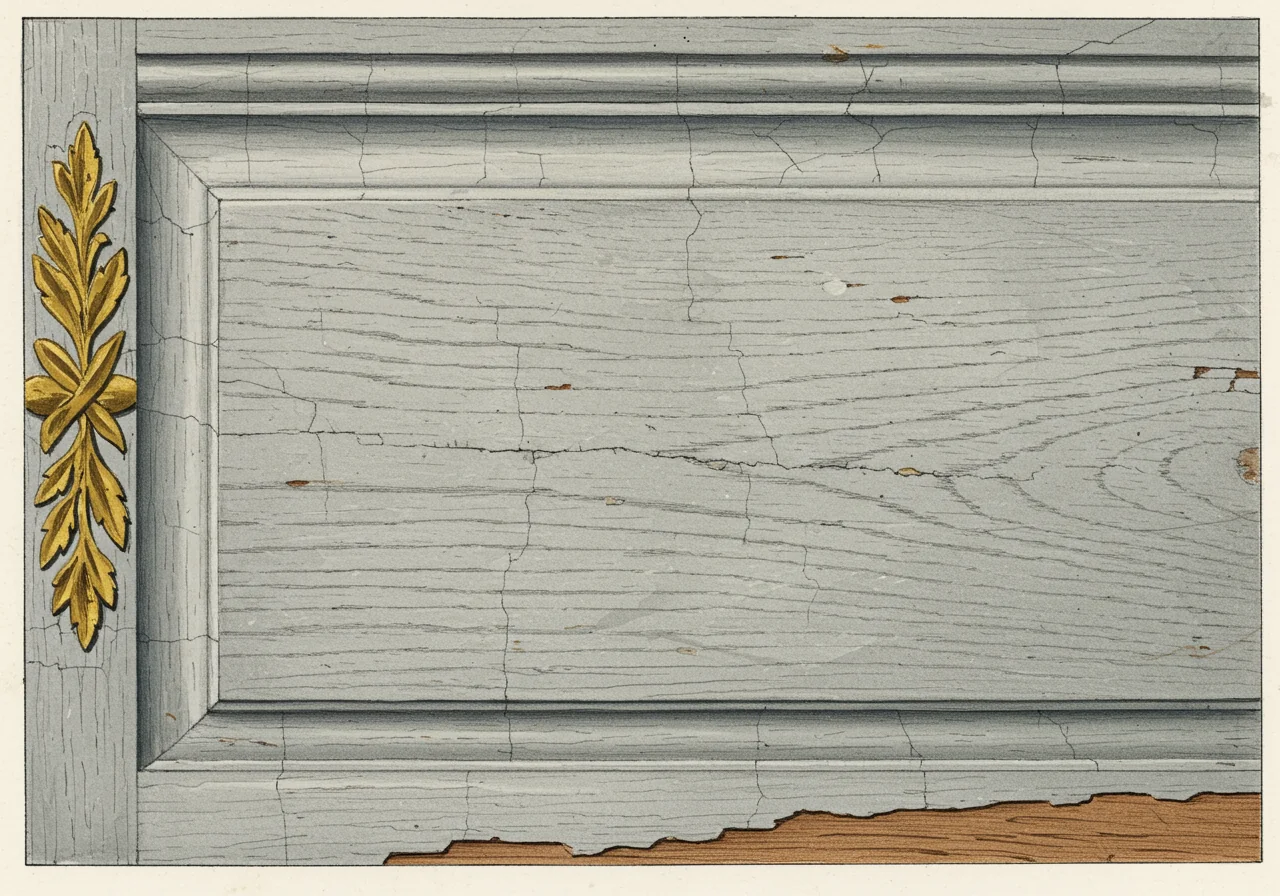
A close detail of a Gustavian gris-blanc painted finish — the pale grey-white paint over a Swedish pine carcase that is the canonical surface-signature of the style. The finish reads, at both the royal Stockholm-workshop register and the broader bourgeois Swedish trade, as a deliberate translation of the French royal ormolu-and-mahogany vocabulary into a Northern painted-pine idiom: the same neoclassical form, in a different material and palette altogether. Period craquelure and the slight chalkiness of two-centuries-aged oil-bound paint are what the connoisseur reads at close range.
The principal palette signature, and the single feature that distinguishes the Gustavian from every other neoclassical tradition in the European cabinet manifest, is the gris-blanc painted finish — a pale grey-white paint, oil-bound in the period work, applied over the bare Swedish pine or birch of the carcase. The gris-blanc is not a single colour: workshop practice ranged from a near-white off-cream through a soft warm grey to a cool blue-grey, and within a single piece the principal case-paint was often picked out in second and third tones for the mouldings, the flutes, and the carved ornament. Over the gris-blanc ground, the neoclassical ornament — paterae, Greek-key, laurel-wreath, swag-and-ribbon — was rendered either in painted gilt (an applied gold paint, oil-bound and worked over the carved relief) or in gold leaf on the apex pieces. The combination of the gris-blanc ground with the gilt-painted ornament is the Gustavian visual signature at a single glance, and the chief practical thing to learn to read.
The wood under the paint is Swedish pine — and this matters. Not the dense Cuban mahogany of Chippendale, not the burled cherry of Biedermeier, not the geometric-marquetry oak or walnut carcase of Louis XVI, but the cheap, soft, abundant pine that grew across the Swedish forest and that the Stockholm workshops bought by the cord. Birch served as the harder secondary wood — for the drawer fronts, the carved-relief ornaments, the legs where the fluting required cleaner cuts — but the principal carcase was almost always pine. The pine was meant to be hidden under the paint; this is the structural-economic enabling condition for the whole Gustavian register. A piece in Louis-XVI form in solid mahogany would have been prohibitively expensive for the Swedish bourgeois interior the style addressed, and the painted-pine substitution made the Louis XVI vocabulary affordable for the Stockholm merchant and the provincial Swedish landowner, producing in the process a new visual register that was not available to the French royal tradition at all.
The brass hardware, third. Period Swedish brass at restrained scale — small bail handles on the drawer fronts, simple oval or rectangular escutcheons over the locks, cast and chased in Stockholm or imported in the cheaper registers from the broader Baltic brass-trade. The Gustavian brass is even more restrained than Chippendale’s English brass: smaller, simpler, often plain-cast rather than relief-worked, and frequently picked out with the same gilt paint used on the ornament rather than left as raw brass. The principle of the painted-and-gilt register extends to the hardware as it does to the ornament.
The Evidence
The finish, first, and the finish is most of what one is reading for on a Gustavian piece. Two centuries of oil-bound paint over Swedish pine should show period craquelure — the fine network of cracks that develops in oil-bound paint over a slowly-shrinking softwood substrate across a hundred and fifty years — and a chalky, slightly absorbent surface where the oil binder has aged out. The paint should be thin enough that the wood grain reads through it in slight relief; the eighteenth-century gris-blanc was a thin oil-bound paint, not a thick modern acrylic, and the pine’s grain remained dimly visible under the paint as the workshop intended. The gilt picking-out, where present, should show the same wear pattern as the rest of the surface — high-touch areas (the handle plates, the apex of the cresting, the front edges of the drawers) should be more rubbed than the recessed areas, and the gilt should sit in the hollows of the carving rather than ride the high points.
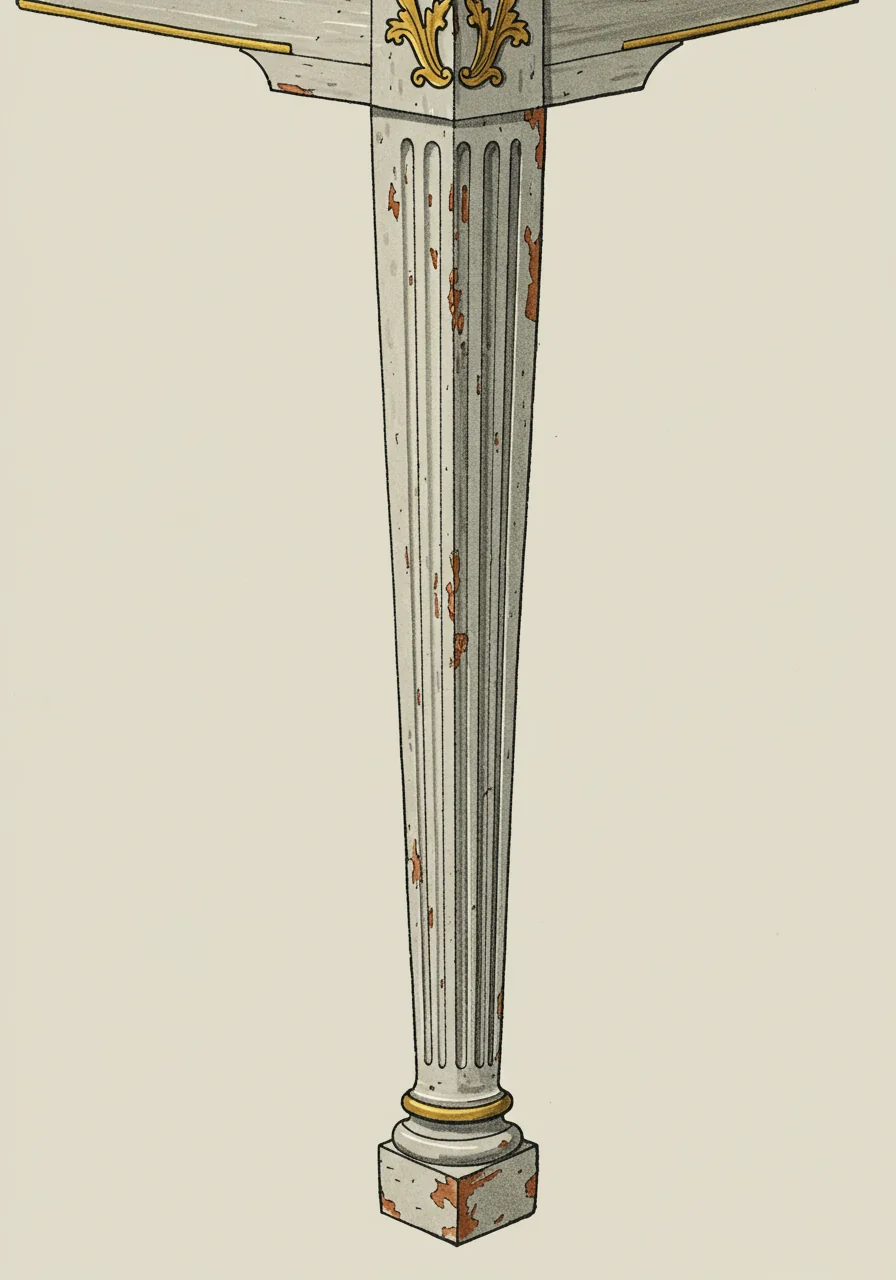
A close detail of a Gustavian fluted columnar leg — the Louis XVI form vocabulary preserved exactly, executed in pine under gris-blanc paint rather than the French mahogany-with-ormolu original. The flutes are picked out with a thin gilt line at the apex; the foot terminates in a restrained turned block. The translation principle of the entire Gustavian register is visible in this single detail: French royal form, Northern painted-pine finish.
The construction, second. Hand-cut dovetails of period irregularity on the case furniture, the dovetails proportioned by the Stockholm royal-workshop hand — somewhat coarser than the contemporary Parisian dovetails (the pine was easier to cut and the workshop standards more practical than aristocratic), but recognisably eighteenth-century period work. The pine carcase should show the original wood pegs and hand-driven nails of the workshop, not modern screws. The birch drawer fronts and ornament-pieces should show period adhesive and the slight gaps that arise from a hundred and fifty years of Swedish humidity cycles. The piece should feel light in the hand — pine is dramatically lighter than mahogany or walnut — and this lightness is itself part of the authentication: a Gustavian-style piece that feels heavy almost certainly has a hardwood substitution under the paint, and the substitution is the Karl-Johan-period or revival giveaway.
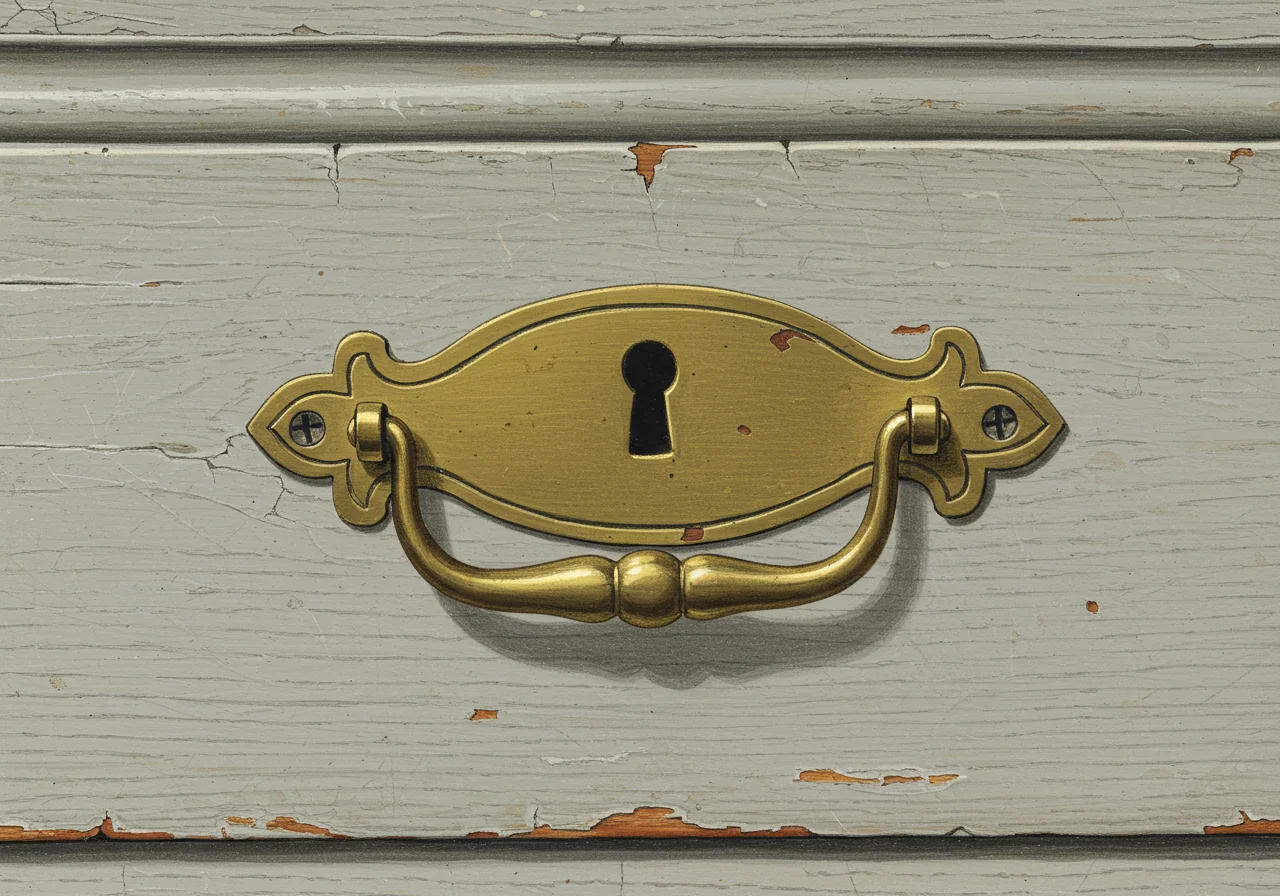
A close detail of period Gustavian brass — the small bail handle and the plain oval escutcheon on a drawer front in gris-blanc paint. The brass is restrained even by Chippendale’s English standards: smaller in scale, simpler in casting, often picked out with the same gilt paint used on the ornament rather than left as raw brass. This is the Stockholm and Baltic-trade hardware vocabulary the Gustavian workshops standardised in the 1770s and 1780s.
The Period
The Gustavian period proper runs from 1771 to 1792 — the regnal dates of Gustav III of Sweden — and its documentary origin is more sharply localised than any of the styles previously covered in this arc. (Gustavian proper is sometimes extended through Gustav IV Adolf’s reign to 1809; the post here uses the tighter 1771–1792 bracket because the assassination of Gustav III marks the clean end of the principal patron’s commissioning activity.) Gustav III’s 1771 Paris visit as Crown Prince — cut short on 25 March of that year by his father’s death, which made him king before the journey home — and his subsequent Grand Tour of 1783–84 through Paris, Rome, and Venice are the two principal occasions on which the Swedish king absorbed the Louis XVI neoclassicism then in its first flowering at Versailles. He returned to Stockholm with the explicit ambition of importing the French royal vocabulary into the Swedish court, and the principal workshops of the period — the Stockholm royal workshops under the master cabinet-makers of the Royal Court (Georg Haupt, Gottlieb Iwersson), with apex pieces preserved at Gripsholm and Drottningholm — produced the apex pieces under direct royal commission. Georg Haupt (1741–1784), royal cabinet-maker to Gustav III, is the principal documented master of the period and the maker most often cited in surviving attributions; the chair-maker (stolmakare) Johan Eric Höglander (1748–1813) worked the seat-furniture side of the same royal register. The Stockholm bourgeois trade then reproduced the royal register in the painted-pine substitution that made the style affordable for the broader Swedish middle class, and by the 1780s the Gustavian vocabulary had become the standard Swedish bourgeois cabinet idiom for the salon, the parlour, and the bedroom interior.
The load-bearing distinction every Gustavian collector must master, however, is not the period chronology in the broad — it is the four-way distinction between Gustavian proper, late-Gustavian, Karl Johan, and the late-nineteenth-century Gustavian revival, and at the centre of it the painted-finish-versus-fresh-paint identification that is the chief practical problem of the style. Gustavian proper (1771–1792) is the Gustav III reign — Louis XVI form translated into painted Swedish pine, restrained painted-and-gilt ornament, Stockholm royal-workshop production at the apex (with apex pieces preserved at Gripsholm and Drottningholm), the broader Swedish trade beneath. Late-Gustavian (1792 through about 1810) is the post-Gustav III continuation under Gustav IV Adolf and the regency, the style holding to the Gustavian register in form and finish while loosening in workshop discipline. Karl Johan (c. 1810 through about 1840 — Karl XIV Johan, formerly the Napoleonic marshal Bernadotte, arrived as Crown Prince in 1810 and took the throne in 1818) is the Swedish Empire register that succeeds late-Gustavian: Empire influence enters from France, proportions become heavier, ornament more substantial, and — critically — mahogany substitution begins to appear in the better workshops, replacing pine under the paint or appearing as unpainted hardwood altogether. The Karl Johan period bridges from late-Gustavian into the broader Continental Empire register and is now collected as a related-but-distinct style. The late-nineteenth-century Gustavian revival, finally, is the most consequential of the three for the practical buyer: from about the 1890s through the early twentieth century, Swedish (and Continental) workshops produced reproduction pieces in the Gustavian register, often with fresh paint applied to new pine in deliberate imitation of the period look. The fakeability is structural — pine remains the cheap, abundant wood it always was, and a competent reproduction shop can produce a Louis-XVI-form pine commode and paint it gris-blanc in a single workshop week. Distinguishing 150-year-aged oil-bound paint over period-pine from fresh paint over new-pine is therefore the connoisseur’s central practical skill for this style, and the basis of every serious Gustavian attribution at any price point. The aged paint shows craquelure of a characteristic period network, the chalkiness of an oxidised oil binder, and a wear pattern that respects two centuries of household use; fresh paint over new pine shows none of these, no matter how it is artificially distressed. The buyer who cannot read the paint at this level is at a serious disadvantage in the Gustavian market in a way that has no exact parallel in the mahogany-and-ormolu traditions, where the wood itself is harder to fake.
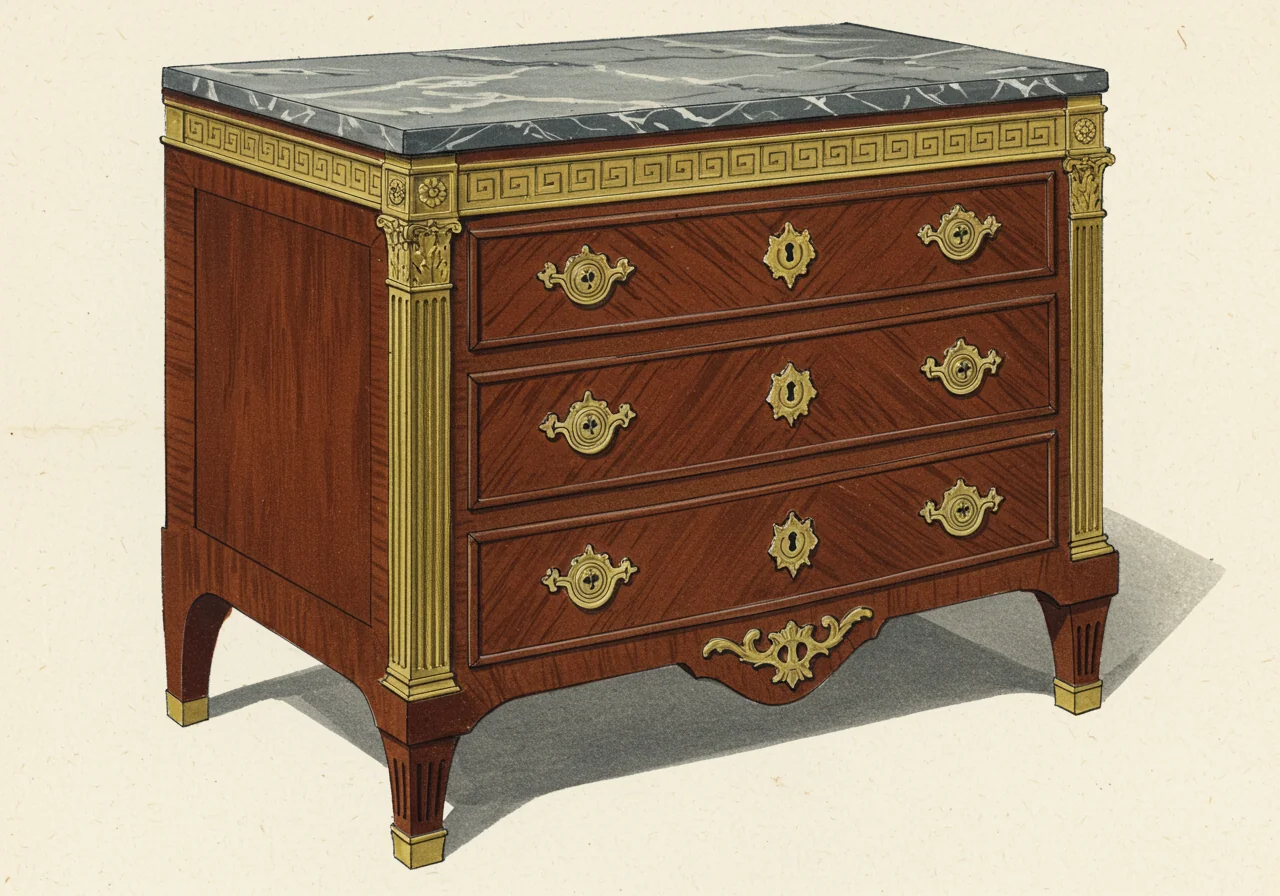
A French Louis XVI commode of about 1775–1785 — the direct royal antecedent of the Gustavian register. The form is what Gustavian preserves exactly: the simple rectilinear case, the fluted columnar legs, the neoclassical paterae and laurel-wreath cresting. The materials are what Gustavian translates: where the French original is mahogany veneer with cast gilt-bronze ormolu mounts, the Swedish translation is pine under gris-blanc paint with painted-and-gilt ornament. Gustav III’s 1771 Paris visit as Crown Prince and his 1783–84 Grand Tour through Paris, Rome, and Venice are the direct documentary channels by which the Louis XVI vocabulary entered the Swedish royal workshops.
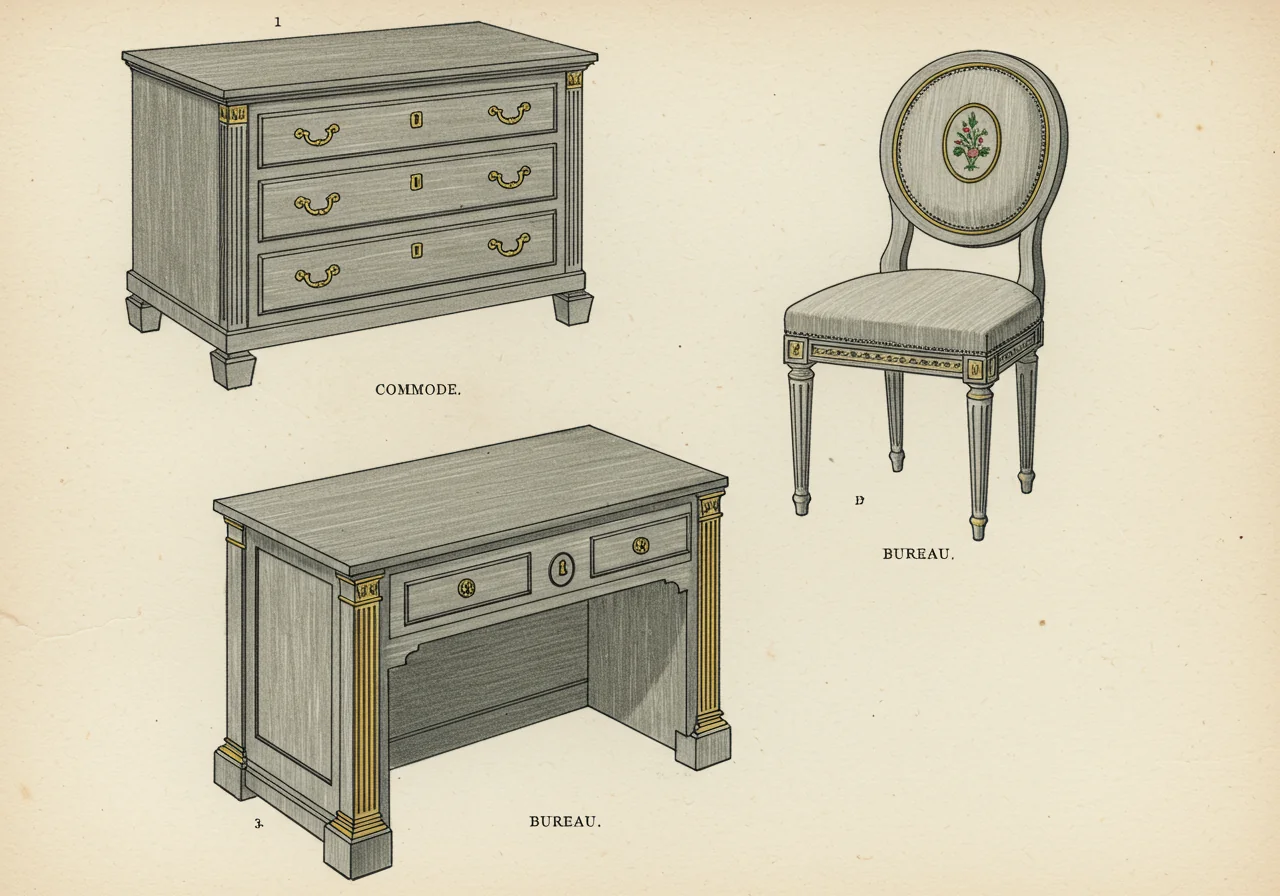
A page from a Swedish cabinet-maker’s pattern book of the 1780s — engraved plates of the canonical Gustavian forms: the commode with fluted columnar legs, the side chair with the round-back medallion splat, the small writing-desk with painted-and-gilt Greek-key band. The Swedish pattern books served, for the Gustavian register, the function the Director served for English Chippendale — codifying the royal vocabulary across the broader workshop trade — but circulated more locally and survive in fewer copies; the Stockholm royal workshops remain the principal documentary anchor.
What It Is Not
Four styles stand near enough to Gustavian that the beginner confuses them with it, and distinguishing them is most of the work of reading European neoclassical furniture in the painted and unpainted registers together.

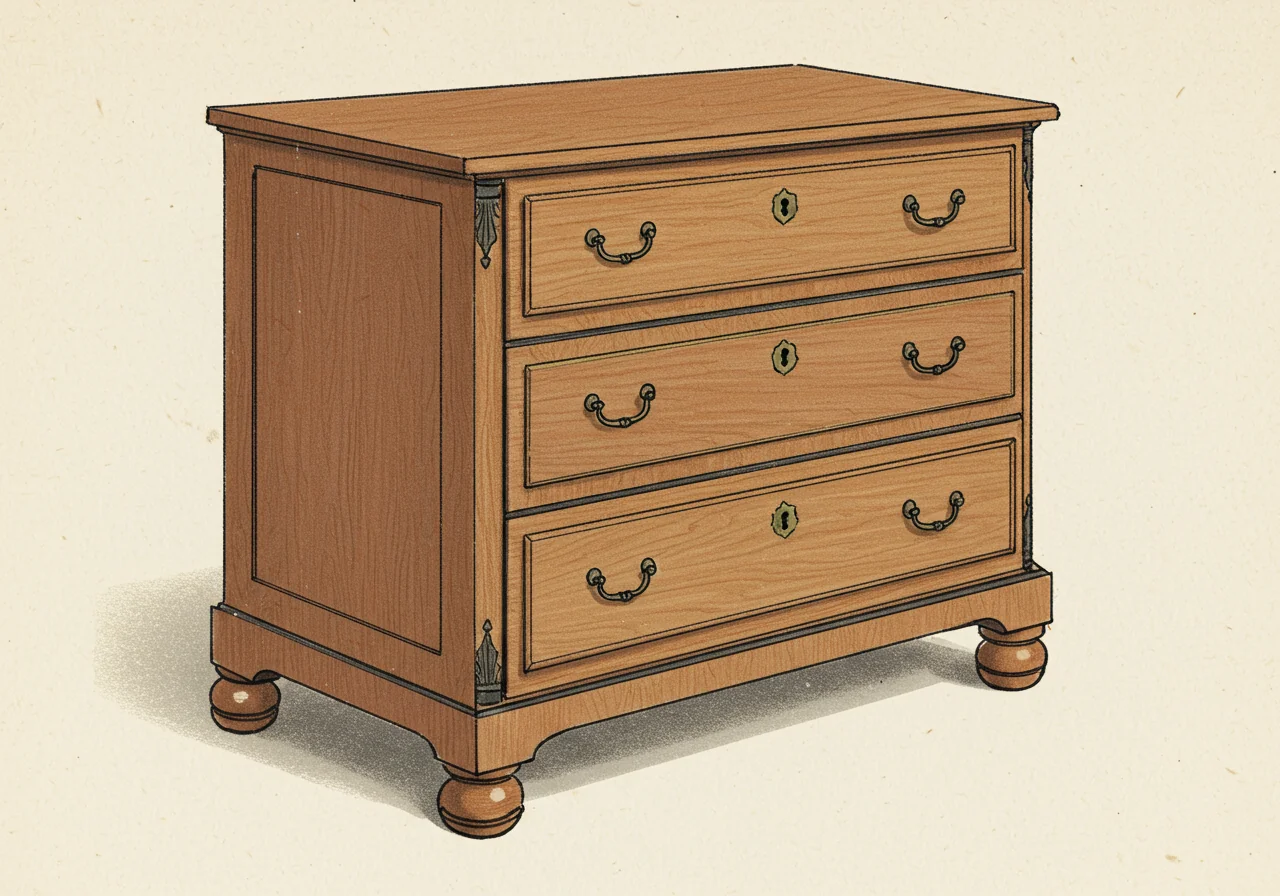
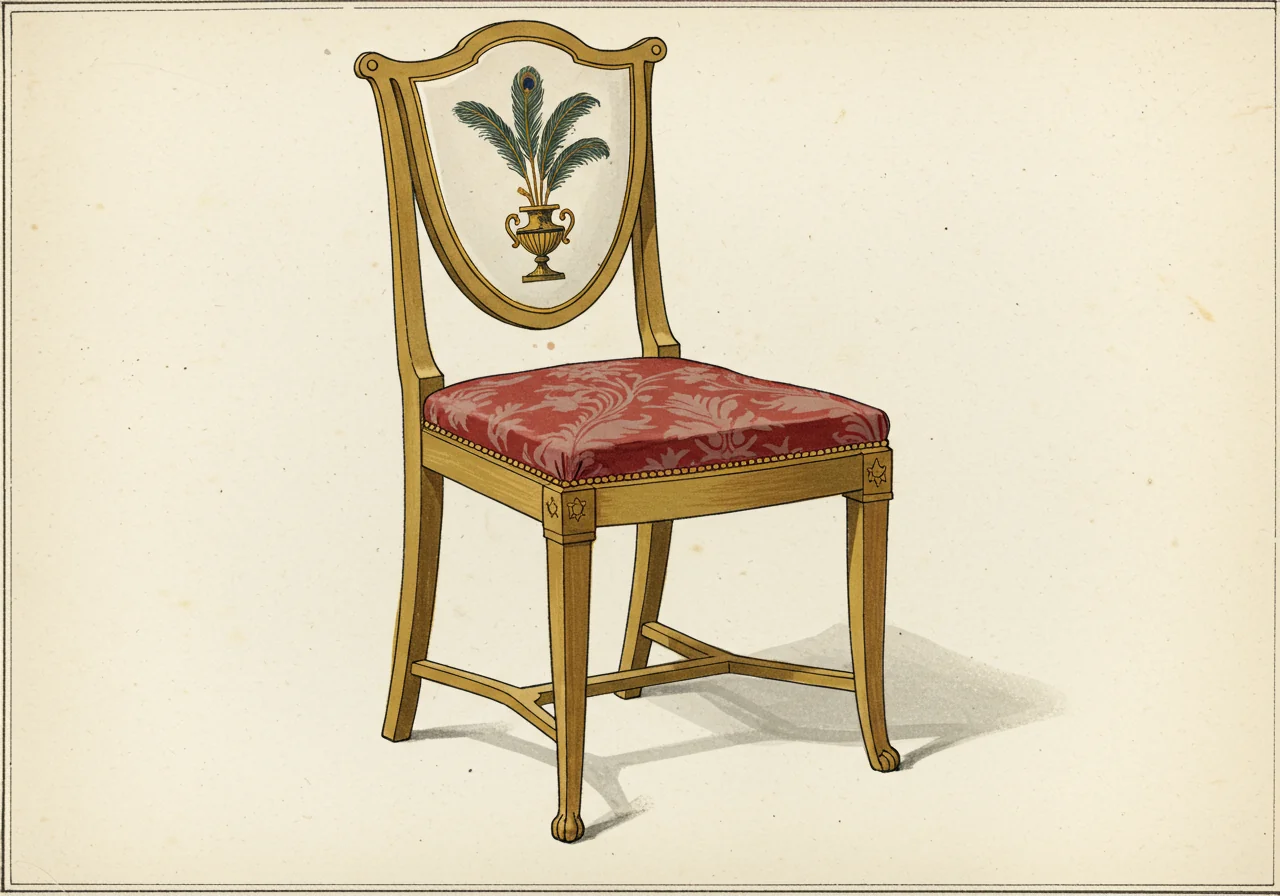
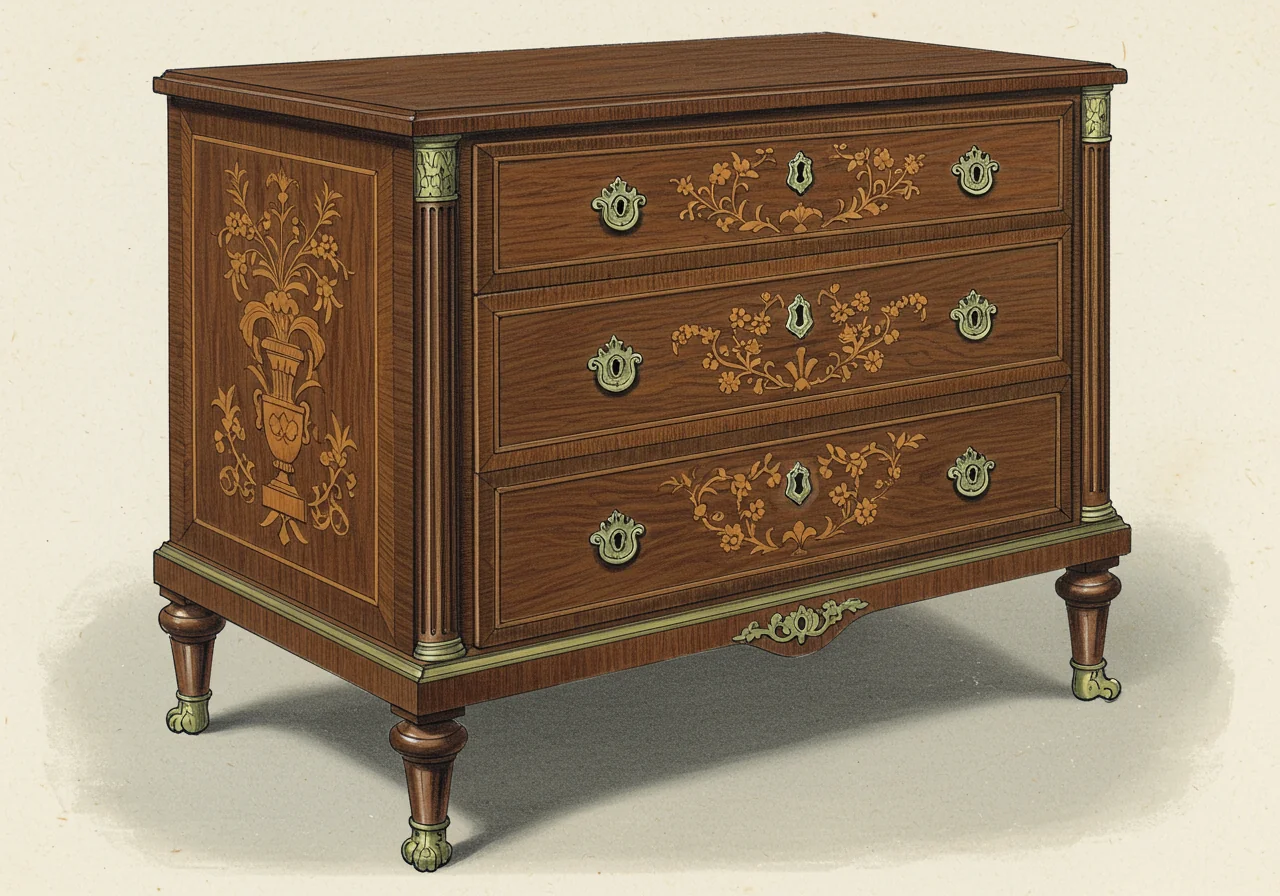
A Louis XVI is the French royal source the Gustavian translated across the Baltic. The form is identical in silhouette — the rectilinear case, the fluted columnar legs, the neoclassical paterae and laurel-wreath ornament — but the materials are entirely different: mahogany veneer rather than painted pine, cast gilt-bronze ormolu mounts rather than painted-and-gilt ornament, anonymous Parisian ébéniste workshop production under the Jurande rather than Stockholm royal-workshop attribution. The rule of thumb: pale gris-blanc paint over pine with painted-and-gilt ornament is Gustavian; mahogany veneer with cast gilt-bronze ormolu is Louis XVI.
A Biedermeier is the Continental bourgeois sibling — and the comparison is instructive, because Gustavian and Biedermeier share the bourgeois-anti-historicist axis of the arc despite their utterly different visual registers. Both styles arose from bourgeois adoption of the prevailing royal vocabulary at affordable substitutions; both made the substitution principally through materials rather than form; both reject the heavy ornamental apparatus of the French royal tradition they descend from. But Biedermeier substitutes pale cherry with restrained brass and ebonised banding; Gustavian substitutes gris-blanc paint over pine with painted-and-gilt ornament. The rule of thumb: pale cherry with ebonised banding is Biedermeier; pale gris-blanc paint over pine is Gustavian.
A Hepplewhite is the English neoclassical sibling — produced in the same decades (1780s–1800s) as the broader Gustavian and addressing the same Louis-XVI-derived neoclassical impulse, but executed in the English material register: pale satinwood with painted-and-inlaid neoclassical decoration rather than gris-blanc paint over pine. The shield-back chair and the straight tapered leg with spade foot are the canonical Hepplewhite signatures; the round-back medallion chair and the fluted columnar leg are the canonical Gustavian signatures. The rule of thumb: pale satinwood with painted decoration is Hepplewhite; pale gris-blanc paint over pine with painted-and-gilt ornament is Gustavian.
A Dutch neoclassical is the Northern Continental sibling — the Dutch bourgeois translation of the same Louis-XVI impulse into the Dutch material register, which is marquetry over walnut rather than painted pine. The form vocabulary is similar — the rectilinear case, the fluted leg, the neoclassical ornament — but the surface is the dense floral-and-geometric marquetry that the Dutch had practised since the William-and-Mary period, executed now in a neoclassical vocabulary. The rule of thumb: marquetry over walnut is Dutch neoclassical; gris-blanc paint over pine is Gustavian.
What One Looks At
One looks first at the finish, and the finish settles the broad attribution at three paces. Pale gris-blanc paint over an apparently softwood substrate, with restrained painted-and-gilt ornament and period craquelure, is Gustavian; mahogany veneer with cast gilt-bronze ormolu is Louis XVI; pale cherry with ebonised banding is Biedermeier; pale satinwood with painted-and-inlaid decoration is Hepplewhite. The painted-finish-over-pine signature carries more of the differentiation for Gustavian than the wood does for any other style in the manifest, because for Gustavian the paint is the principal material statement and the pine beneath is structural rather than visual.
One looks next at the form, and the form should be Louis XVI’s form almost exactly. Rectilinear case, fluted columnar legs (square or round in section, terminating in restrained block or turned feet), small paterae rosettes at the leg-tops, Greek-key bands or laurel-wreath cresting along the case’s upper edge. The form has none of Biedermeier’s curved bourgeois softening and none of Hepplewhite’s pale-satinwood delicacy; it is the French royal silhouette translated into the Northern painted-pine register with the silhouette preserved exactly. A piece in apparent Gustavian gris-blanc but with a non-Louis-XVI form (heavy rococo curve, Anglophone ball-and-claw, Empire scrolled volutes) is almost certainly a later painted-over piece rather than period Gustavian, and the form mismatch is the first thing to read after the paint.
One looks then at the wood under the paint, and the wood is the structural-economic enabling condition for the whole register. The wood should be Swedish pine (the principal carcase) or birch (the harder secondary, for drawer fronts and carved ornament). The piece should feel light in the hand — a Gustavian commode is dramatically lighter than a Chippendale chest of the same scale, because pine is roughly half the density of mahogany — and the lightness is part of the authentication. Where the paint has been worn through at the high-touch areas (drawer pulls, edges, the apex of carved ornament), the exposed wood beneath should be the soft, slightly-yellow pine or the harder pale birch of the period Swedish workshop. Mahogany or oak substitution under the paint — visible at the worn spots, or audible in the heavier feel of the piece — is the Karl Johan period or the revival giveaway.
And one looks, finally and most carefully, at the paint itself, because the antique-paint-versus-revival-paint distinction is the chief practical problem of the style and what most distinguishes a period Gustavian from a late-nineteenth-century reproduction or a recently-painted fake. Period oil-bound gris-blanc shows craquelure of a characteristic network — fine, multi-directional, deeper at the corners and high-touch areas where two centuries of expansion-contraction cycles have worked the paint hardest — and the chalkiness of an oxidised oil binder, slightly absorbent to the touch and matte rather than reflective. Period gilt picking-out shows the same wear pattern as the surrounding paint, with the gilt rubbed at the high points and surviving in the hollows of the carving. Fresh paint over new pine, by contrast, shows uniform surface, no craquelure or a too-regular artificial craquelure, a too-shiny or too-rubbery binder, and gilt that either rides too cleanly on the high points (newly applied) or has been artificially distressed in a pattern that does not respect actual household wear. The connoisseur who has handled twenty period Gustavian pieces can read the paint in seconds; the buyer at first acquaintance with the style is at the mercy of the dealer’s attribution, and should buy from a dealer whose attributions on Gustavian pieces have stood up over time rather than from a market in which the painted-finish-over-pine fakeability has been allowed to do its work undetected.
The next post in the furniture arc will be either Italian Baroque — to open the Italian tradition with the heavy carved-walnut-and-gilt register that anchors the Continental Mediterranean side of the manifest — or Hepplewhite, to set out the English neoclassical succession to Chippendale with the pale-satinwood variety register that the wood-tone table calls for next. The choice will depend on what photographic material is available at the time of writing.