The six prior posts in this arc — Heriz, Tabriz, Caucasian Kazak, Bakshaish, Kashan, and most recently Bidjar — treated, between them, two or three named places apiece, each with its own clean attribution: a city, a village, a Kurdish district. Hamadan is a different kind of subject altogether. It is not a place so much as a label, and the label covers more ground than any other in the Persian trade. The Hamadan district is the largest Persian weaving region by village count — the figure most often cited runs past eight hundred weaving villages, and some authorities push it past a thousand — and the rugs that come out of it reach the dealer under one word that internally divides into a dozen sub-types. This is the seventh post in Reading the Antique Rug, and it treats Hamadan in the village-region position the arc has not yet had occasion to treat.
It also breaks the palette. Bidjar closed the arc to date on the dark wine-red and dark navy of the Kurdish district — the deepest, most saturated band the arc had reached. Hamadan opens a new one entirely: the Hamadan ground is rust, camel, brown, the earth-tones of the dry Zagros foothill country, and a reader coming to a Hamadan straight from a Bidjar will register the change before reading a single motif. The break is deliberate. But the palette is not what unifies the eight hundred villages, and a post that rested its attribution on colour would mislead from the first paragraph. The thing that unifies the Hamadan district is structural, and not visual at all: the single-weft Hamadan construction — a single shoot of weft passed between each row of knots, where the Heriz, Tabriz, and Kashan workshops pass two. That single weft is the load-bearing collector distinction for the entire region, and the post will carry it the way the Bidjar post carried the handle test.
The Specimen
A Hamadan that one will encounter is, in its commonest form, a small-to-medium piece — the zaronim and dozar sizes, three feet by five and four feet by six and a half — with runners exceedingly common, because the Hamadan village loom is narrow and the runner is the size the narrow loom produces most naturally. Larger Hamadans exist, but the district’s centre of gravity sits well below the room-size carpet; one meets far more Hamadan scatter rugs and runners than carpets, and the proportion is itself a soft diagnostic. The Hamadan rug wears its village constraints visibly.
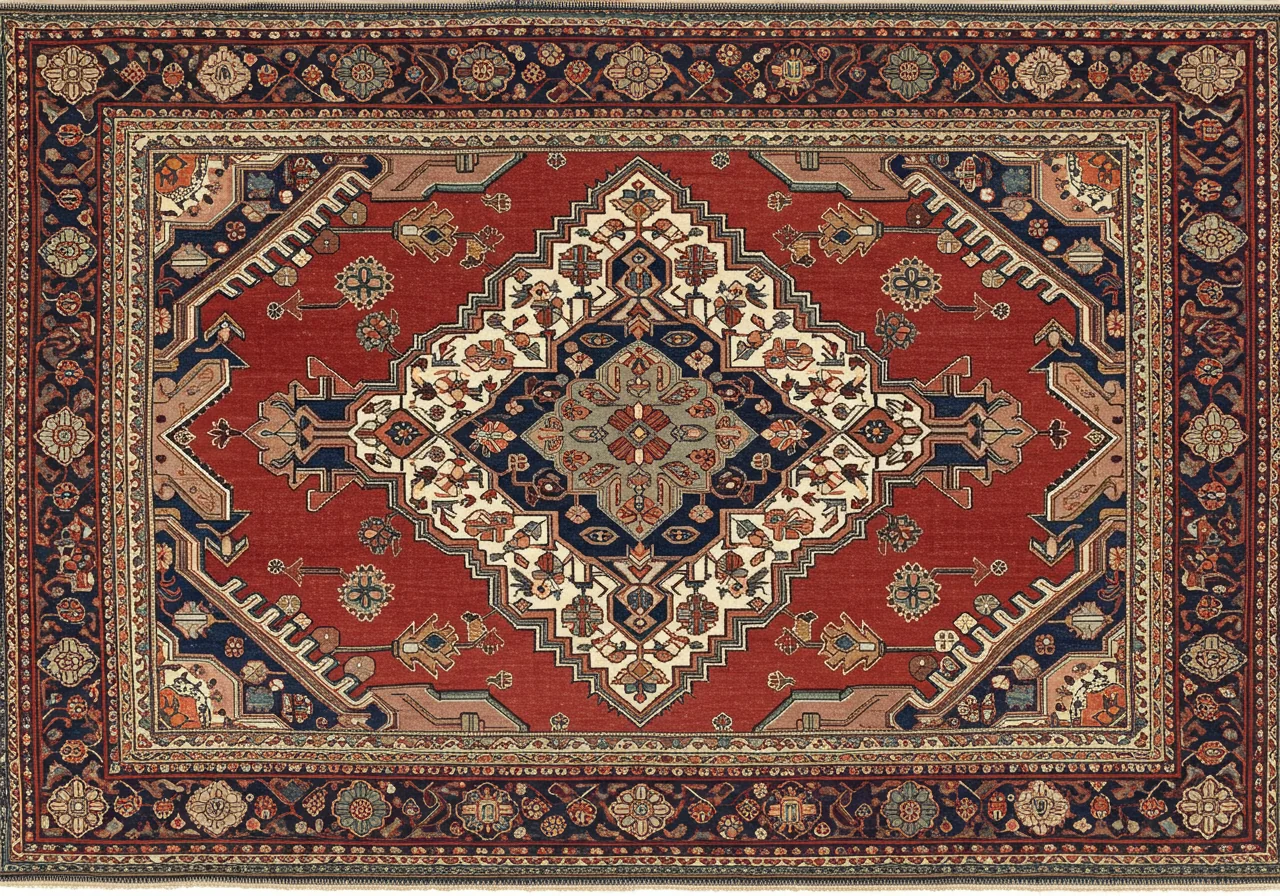
The composition, on the canonical pieces, is one of a few related village vocabularies. The most familiar is the single central medallion — one bold medallion, often a hooked or pole-ended diamond, set on an open or sparingly-figured ground, with plain or contrasting corner spandrels; the drawing is heavy in the line and a little irregular in its symmetry, drawn from memory and the loom rather than from a cartoon. A second is the repeat across the field — boteh in vertical rows, the herati motif, or a small disconnected floral spray at village scale. A third, common on the camel-ground pieces, is the open camel field with a small medallion floated in it and little else, the empty ground left to do the work that figuration does elsewhere. None of these is a workshop composition. The Hamadan is, before it is anything else, a village rug.
The palette is the rust / camel / brown earth-tone register, and it is worth being precise — and properly cautious — about the camel. On many of the better antique Hamadans the camel-coloured ground is an undyed natural fleece, used at its own colour, neither dyed nor bleached; and whether that fleece is camel hair proper or simply the wool of a camel-toned sheep is a question on which the literature has never wholly settled, the older pieces apparently giving examples of both. What is not in doubt is that the warmth is the fibre’s own and not the dyepot’s, and the undyed camel ground, of whichever origin, is one of the surer marks of the older village production. Around it the palette runs rust-red, a soft madder well short of the Bidjar oxblood or the Heriz brick; terracotta; walnut brown; a sparing indigo for outline and border-ground; ivory and ochre in small quantities. The whole reads warm, dry, and earthen, and it reads that way by district habit, not by accident of fading.
Several sub-types are worth naming, because the dealer’s single word “Hamadan” conceals them and the reader will meet them under their own names as often as under the district label. Malayer, from the town to the south, is the finest and most prized of the Hamadan-district weaves — denser, better-drawn, and frequently sold on its own name. Tafresh, to the east, runs a more curvilinear and floral drawing than the typical Hamadan village. Lilihan, a village near Malayer but properly in the Arak district to its south, produced a distinctive Sarouk-influenced floral rug, often single-wefted in the Hamadan manner despite the Sarouk drawing. The Hamadan-area Sarouks — the dealer’s Sarouk-Mahal — are the district’s commercial floral production, drawn toward the central-Persian Sarouk style for the export market. And the oldest label of all, now largely retired, is Mosul — a name that never meant the Iraqi city but was the trade’s nineteenth-century word for the Hamadan-district village rug as a class, shipped west through the Mosul route. A rug catalogued as a “Mosul” in an old sale record is, almost always, a Hamadan.
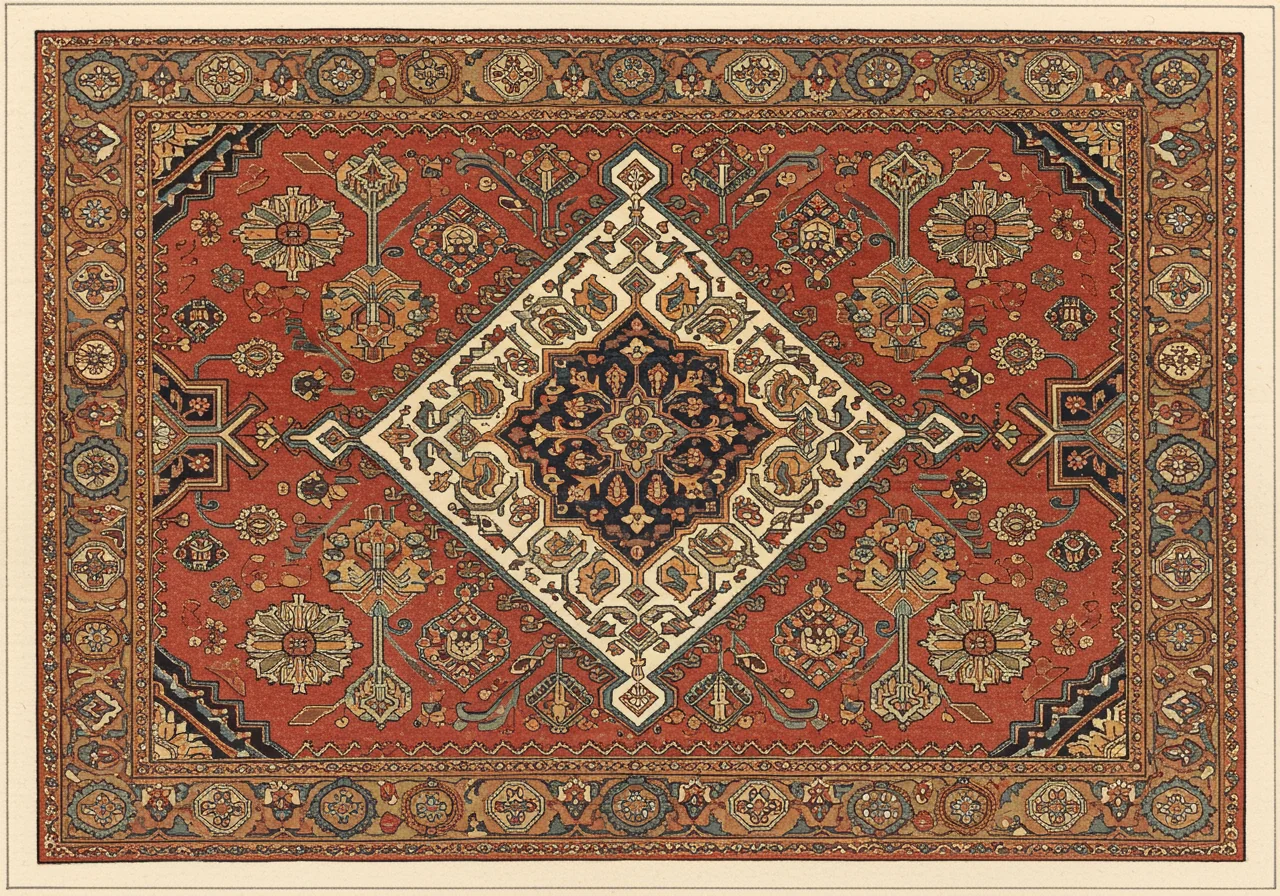
A close detail of a Hamadan central medallion — the village-loom drawing in the rust / camel earth-tone register that distinguishes Hamadan from the redder Persian districts.
The Evidence
The foundation is where the Hamadan district is one thing, and it is worth laying out the single-weft construction with some care, because it is the diagnostic on which the whole post rests. In the standard Persian practice — the practice of the Heriz, Tabriz, Kashan, and Bidjar workshops — the weaver ties a row of knots, then passes two weft shoots across before tying the next row: a first pulled tight, a second left slack. The two-weft system holds alternate warps at two different depths; it makes the warps lie in two planes, one set depressed behind the other, and it produces the firm, two-level back those workshop rugs share. The Hamadan weaver does something simpler. After each row of knots, a single weft shoot is passed across, and the next row is tied directly against it. One weft, not two.
The consequence is immediate and visible, though it is not the consequence the beginner expects. With a single weft between knot rows, the warps lie in one plane — neither set is depressed behind the other — and a single shoot of weft, lacking the second shoot that would bury the alternate warps, leaves every other warp exposed on the back. The Hamadan back accordingly shows a regular ribbing — a series of fine raised lines running the width of the rug, one for each exposed alternate warp — and that striped, ridged, faintly spackled back is the thing to look for. A single-weft rug is, to the hand, looser and more pliable than a double-weft rug at the same knot count; it drapes readily and folds without protest. This is neither a defect nor a sign of low grade. It is the structural signature of an entire weaving region, and it is the single most reliable thing one can establish about a candidate Hamadan: turn the rug over, and if the back shows that regular ribbing of exposed alternate warps over a single-plane foundation, one is very probably in the Hamadan district, whatever the medallion says.
The knot itself is the symmetric Turkish knot, used throughout the district — which places Hamadan, structurally, with the Turkic weavers of the Sahand district at Heriz rather than with the asymmetric-knot workshops of the central Persian court, and which is consistent with the broadly Turkic-speaking population of much of the Hamadan countryside. Knot density runs at the village register: roughly sixty to ninety knots per square inch on the typical antique Hamadan, with the finer Malayer pieces reaching higher. This is not a fine rug by the standard of the Kashan court at two hundred KPSI, and it is not meant to be read as one. The Hamadan is a village rug, and its virtues are village virtues — the wool, the dye, the directness of the drawing — not the count.
The wool, on the better Hamadans, is very good wool indeed. The Zagros foothill flocks supply a long-stapled, lustrous, high-lanolin fleece, and the village weaver, working close to the source, had first call on it; a well-kept antique Hamadan has a sheen and a resilience under the hand that the knot count alone would not predict. The foundation is cotton — warp and weft alike, on the great majority of the district’s production — and the cotton foundation under a single weft, with the flat level back, is a combination the Hamadan district produces and the wool-warp Caucasian and Turkmen rugs do not.
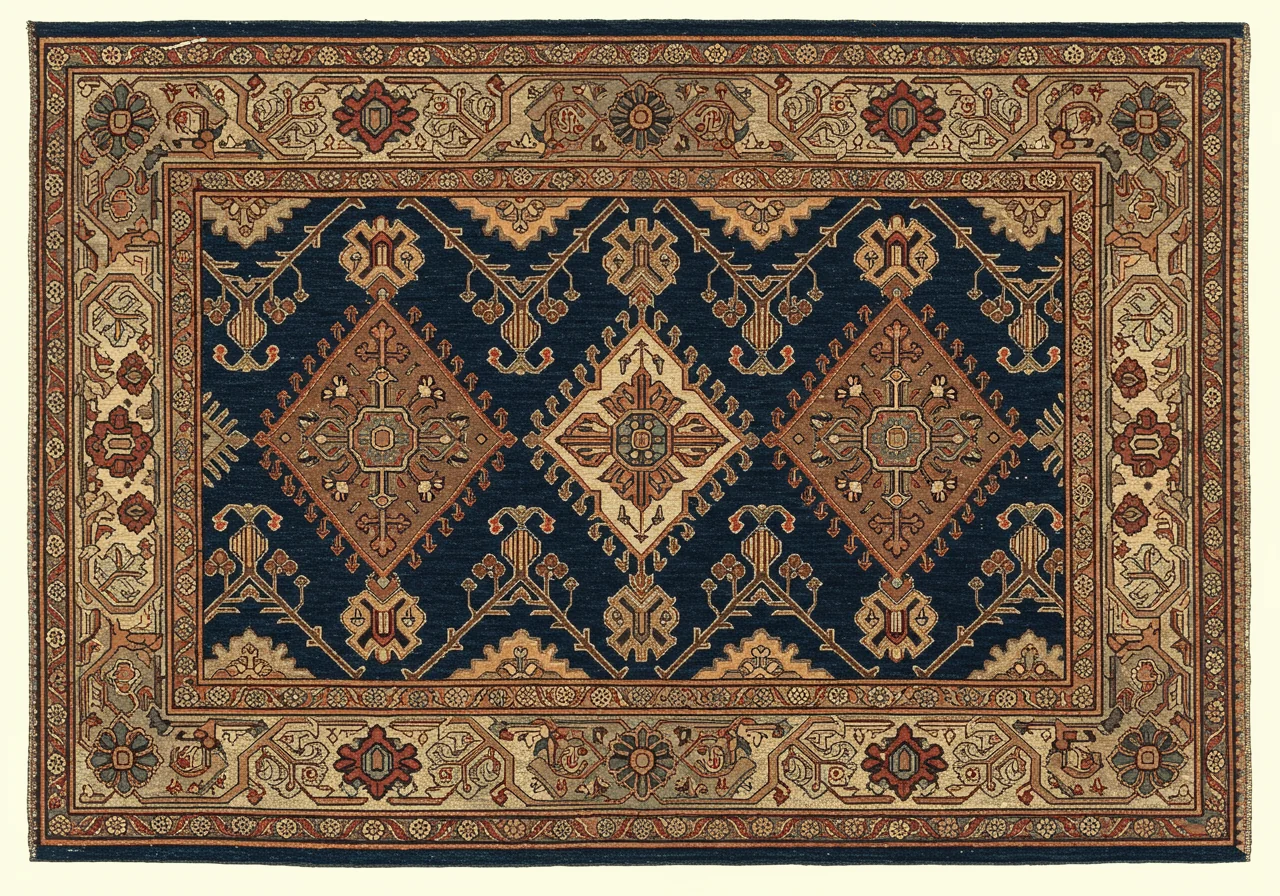
A close detail of a Hamadan main border — the village-grade boteh or rosette repeat in earth-tone palette.
The last constraint is the loom. The Hamadan village loom is narrow — a village fixture, built to the dimensions of a village room — and it is the reason the district’s output skews so heavily toward runners and small scatter pieces. A weaver cannot produce a rug wider than the loom, and the narrow loom produces, by simple geometry, far more long-and-narrow rugs than square ones. When one notices that a great many Hamadans are runners, one is noticing the loom.
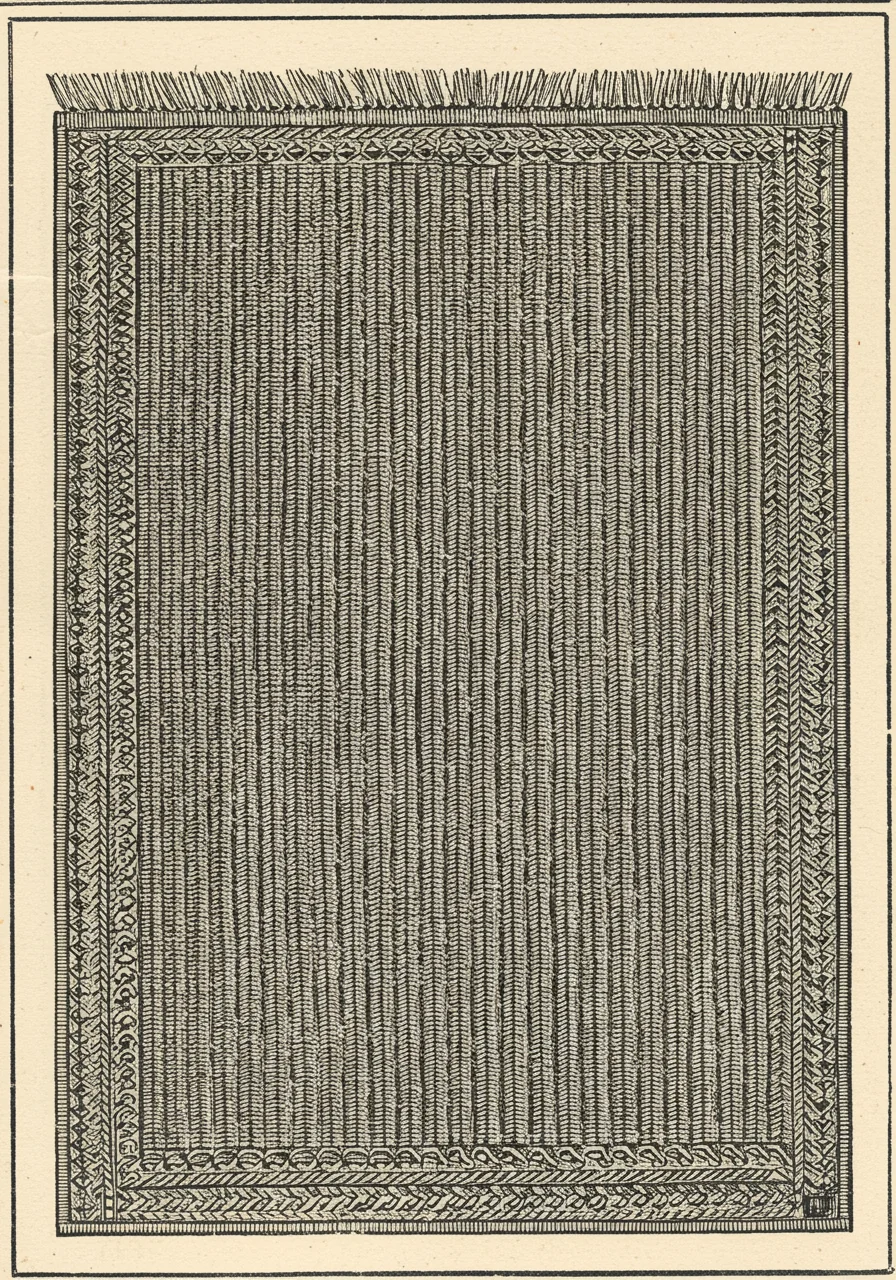
A close detail of the back of a Hamadan rug — the single weft shot between knot rows is the principal structural diagnostic for the Hamadan region, distinguishing it from the two-weft Tabriz / Heriz / Kashan workshops.
The Period
The city of Hamadan is one of the oldest continuously inhabited places in Persia. It is Ecbatana of antiquity — the summer capital of the Median kings, taken into the Persian empire by Cyrus, old enough that the rug trade of the nineteenth century was a recent event in its history rather than a defining one. The city sits at the foot of Mount Alvand, in the dry foothill country on the eastern flank of the Zagros, and the eight hundred villages that the dealer’s word “Hamadan” gathers up are scattered across that country in every direction — south toward Malayer, east toward Tafresh, out across a region large enough that no single weaving tradition could ever have unified it by style. What unified it was the city, and the road, and the merchant.
For the Hamadan district is, before it is a weaving region, a trade region — and the rug label is, in the end, a fact about commerce rather than about craft. Hamadan city sat astride the old caravan route running west toward Mesopotamia, and the village rugs of the whole foothill country were carried into the city, sorted, baled, and shipped out along that route. The trade graded and named them not by their village of origin — there were too many villages, and the buyer in London or New York had heard of none of them — but by the port of exit and the class of goods. Hence “Mosul,” the nineteenth-century label, which named the route and not the rug. The single word survived because it was useful to everyone except the scholar: the weaver was paid, the merchant shipped a known quantity, the buyer received a rug of predictable character. That the word covered a thousand villages was precisely the point of it.
The commercial export trade, intensifying through the 1880s and 1890s as European and American demand grew, did to the Hamadan district what it did to every Persian weaving region — it regularised the production. The older village rug had been woven for use, or for a dowry, or for the floor of the house that wove it; its drawing followed the weaver’s memory and its palette followed whatever wool and dye the village had. The export trade wanted a predictable product, and it got one: by the turn of the century the Hamadan village was weaving to a more uniform standard, in more uniform sizes, with the rougher edges of village idiosyncrasy planed off. The single-weft construction survived the regularisation — it was the district’s habit, not its irregularity — but much of the older variability did not.
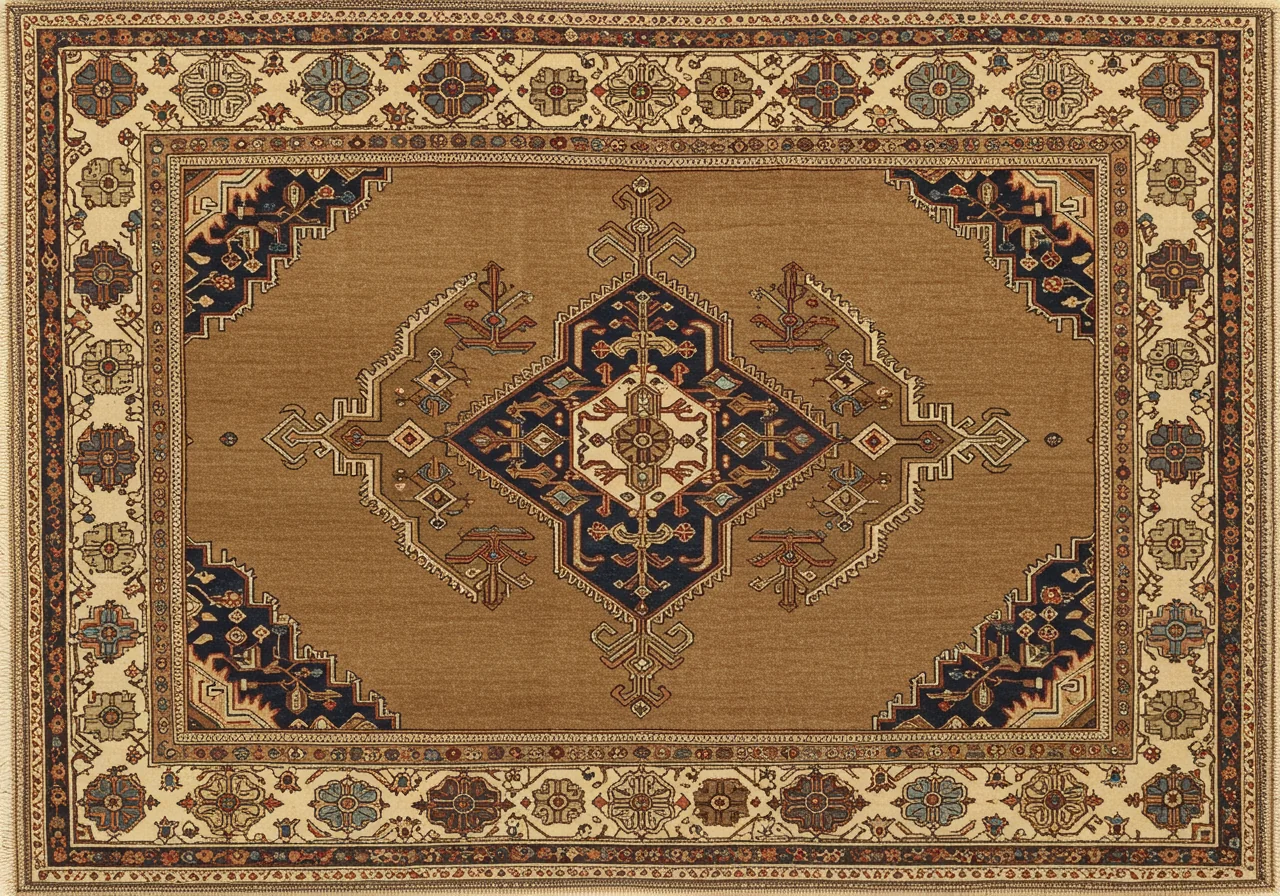
An older Hamadan-district village rug, pre-commercial — looser drawing and more variable palette before the late-19th-c export market regularised the village production into a more uniform dealer-grade product.
The antecedent, accordingly, is the older Hamadan-district village rug — the pre-1880s piece, woven before the export trade reached deep into the foothill country. It is looser in the drawing, more variable in the palette, and altogether less of a product than the dealer-grade Hamadan that succeeded it. The undyed camel ground is more common on it; the medallion is drawn with the freedom of a weaver answering to no cartoon; the colours are whatever the village had, and they vary from rug to rug in a way the regularised production does not. These older pieces are harder to find and harder to attribute precisely, since the very thing the trade later imposed — the uniform district character — is the thing they lack. But they are the ground out of which the familiar Hamadan grew, and a collector who has handled a few of them reads the later dealer-grade rug differently for it.
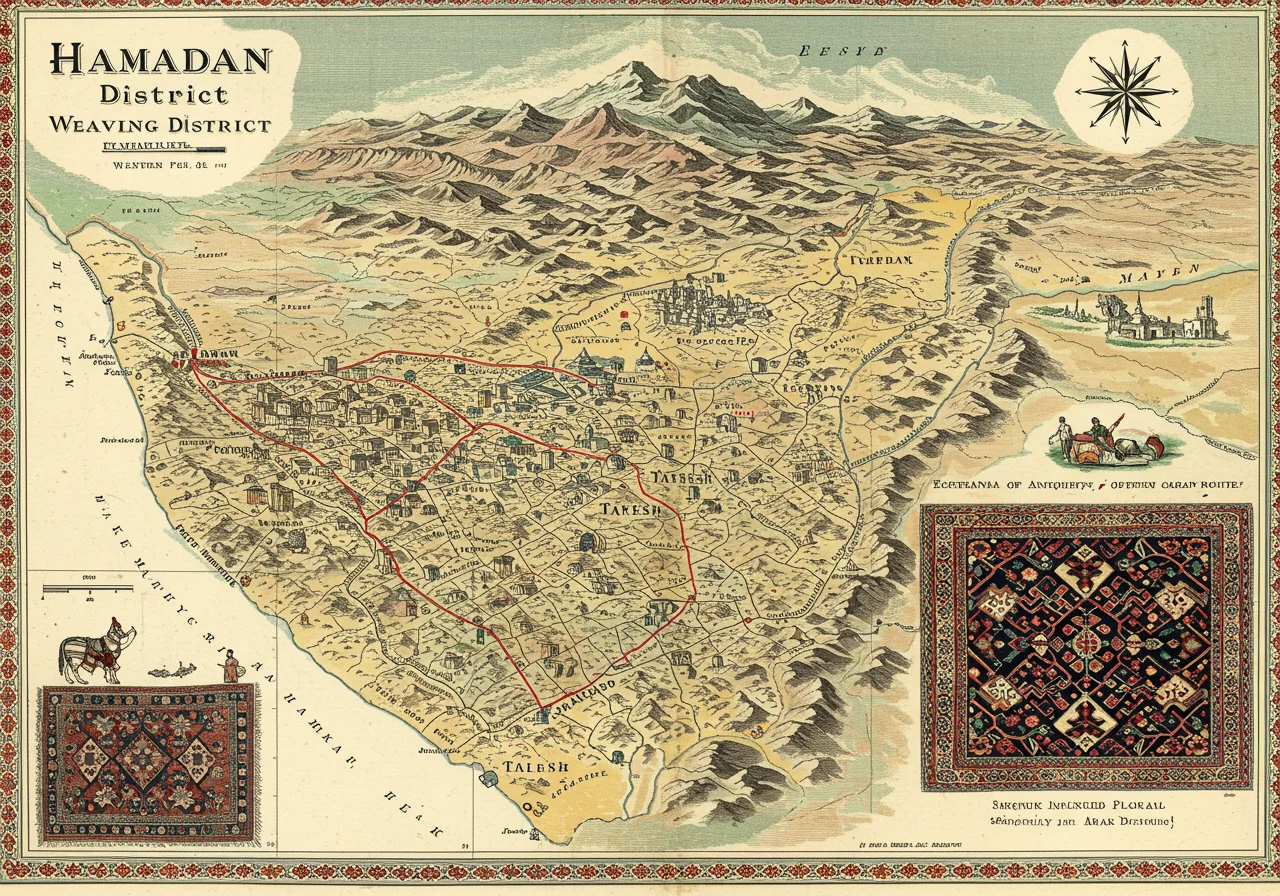
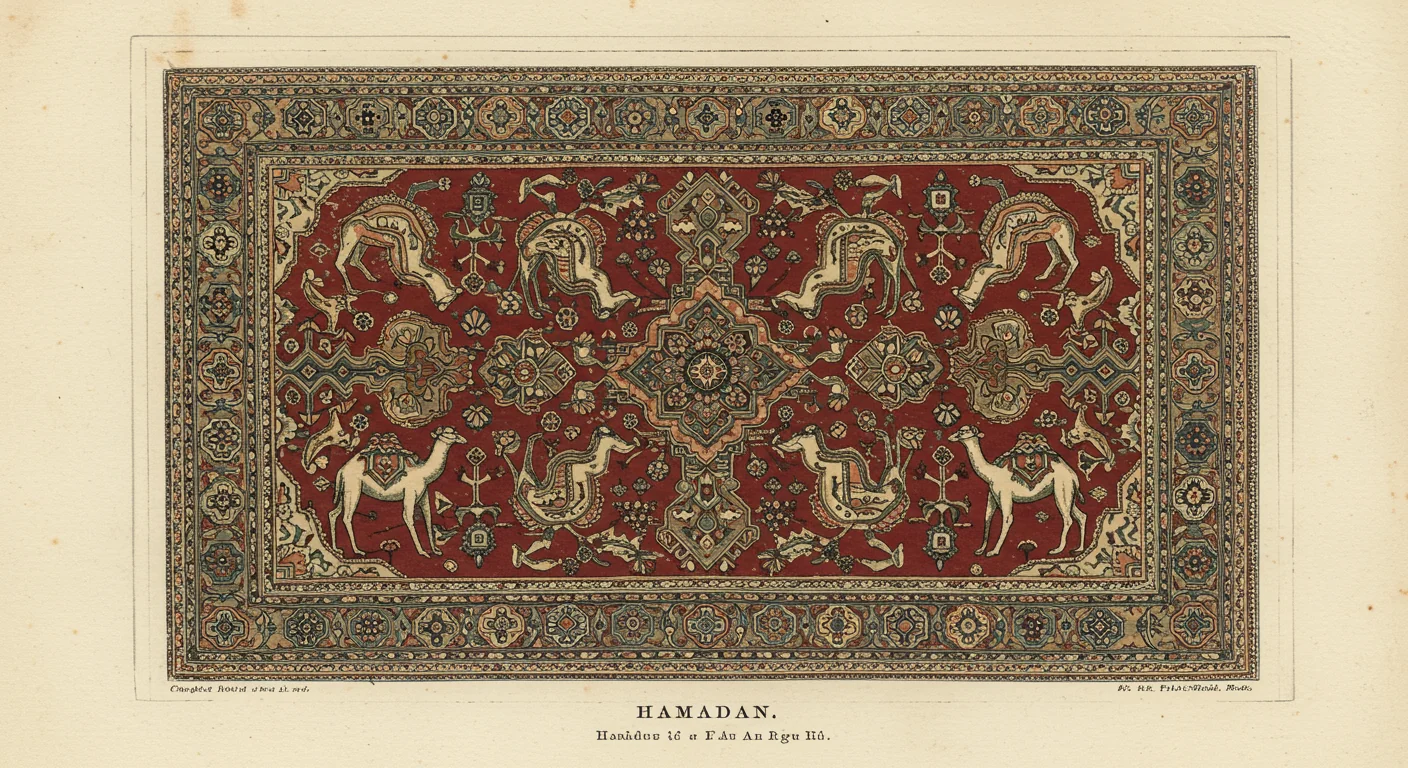
A page from a Victorian connoisseur’s portfolio on the Hamadan district — district map showing the broader region with the principal sub-type villages (Malayer, Tafresh, Lillihan, the Mosul label) located; archetype drawings of three Hamadan sub-types.
What It Is Not
Four types stand near enough to Hamadan that the beginner confuses them with it, and the four divide neatly: two are the Kurdish neighbours to the west whose rugs reach the same dealers, one is the central-Persian commercial production that the Hamadan district itself partly imitated, and one is the district to the north. Distinguishing them is most of the work of reading the Hamadan region — and the single-weft test settles three of the four at a glance.
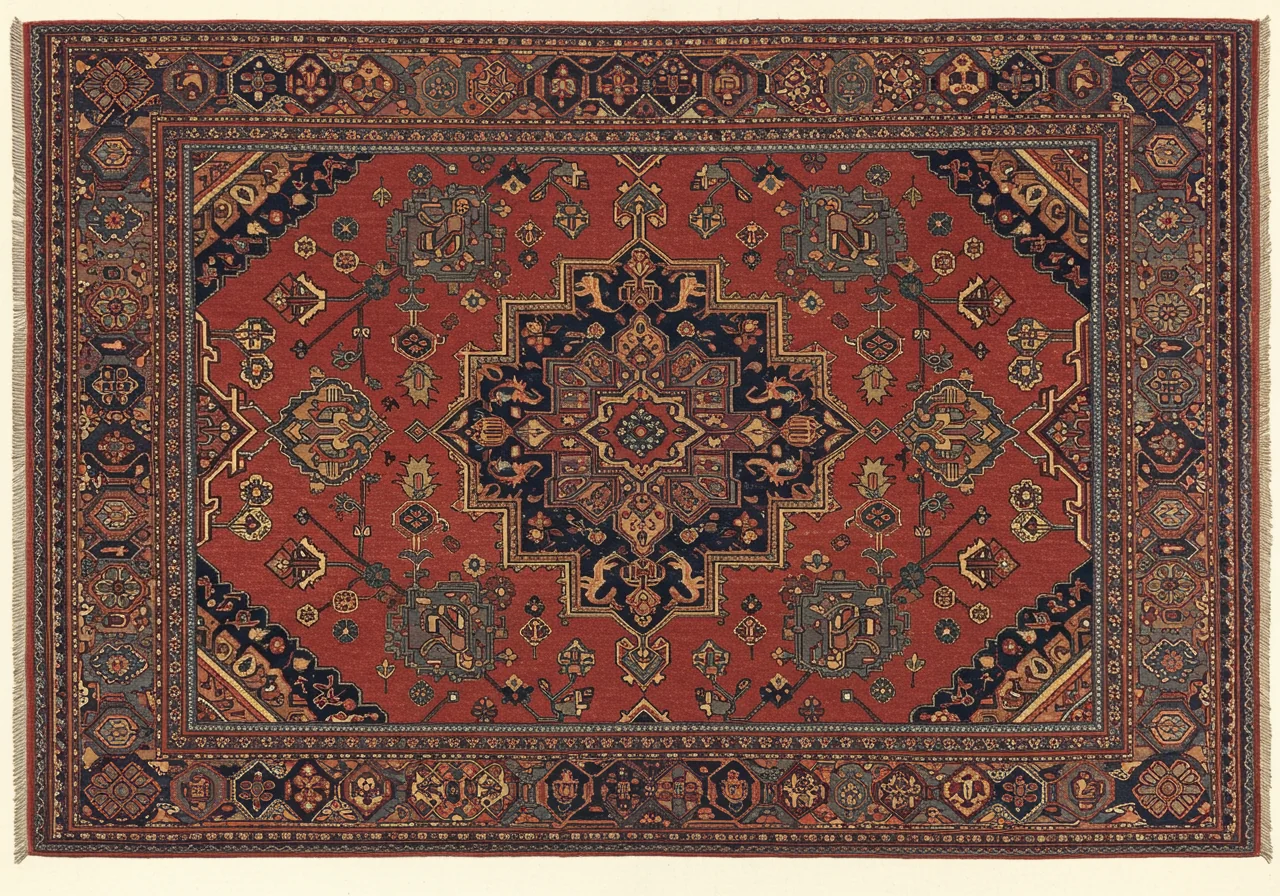

A Bidjar is the dense Kurdish rug treated in the post immediately before this one, and it is the cleanest of the four contrasts because the two rugs disagree on almost everything. Bidjar runs the double weft, the wet-loom compression, the dark wine-red or navy palette, and the heavy rigid handle that earns it the name “iron rug of Persia.” Hamadan runs the single weft, no compression of any kind, the rust / camel earth-tone palette, and a loose pliable handle. The two are geographic neighbours — Bijar town sits in the Kurdish country to the northwest — but they are structural opposites. The rule of thumb: dark, dense, double-weft, heavy in the hand is Bidjar; rust-and-camel, loose, single-weft, light in the hand is Hamadan.
A Senneh is the fine Kurdish city workshop rug from Sanandaj, the other Kurdish neighbour, and it is the type whose name most often misleads — and the name misleads in a way worth pausing on. The asymmetric Persian knot is universally called the Senneh knot in the trade, in honour of the town; yet the weavers of Senneh itself, by one of the small ironies in which the rug literature is rich, do not use it. A Senneh draws at the very fine end of the Persian range — three hundred knots per square inch and finer — on a meticulous workshop cartoon, and it does so with the symmetric knot, the knot that bears another tradition’s name entirely. A Hamadan at sixty to ninety knots, village-drawn and single-wefted, is a wholly different object. The rule of thumb: fine, exact, city-workshop drawing on a thin firm rug is Senneh; coarse, direct, village drawing on a loose single-weft rug is Hamadan.
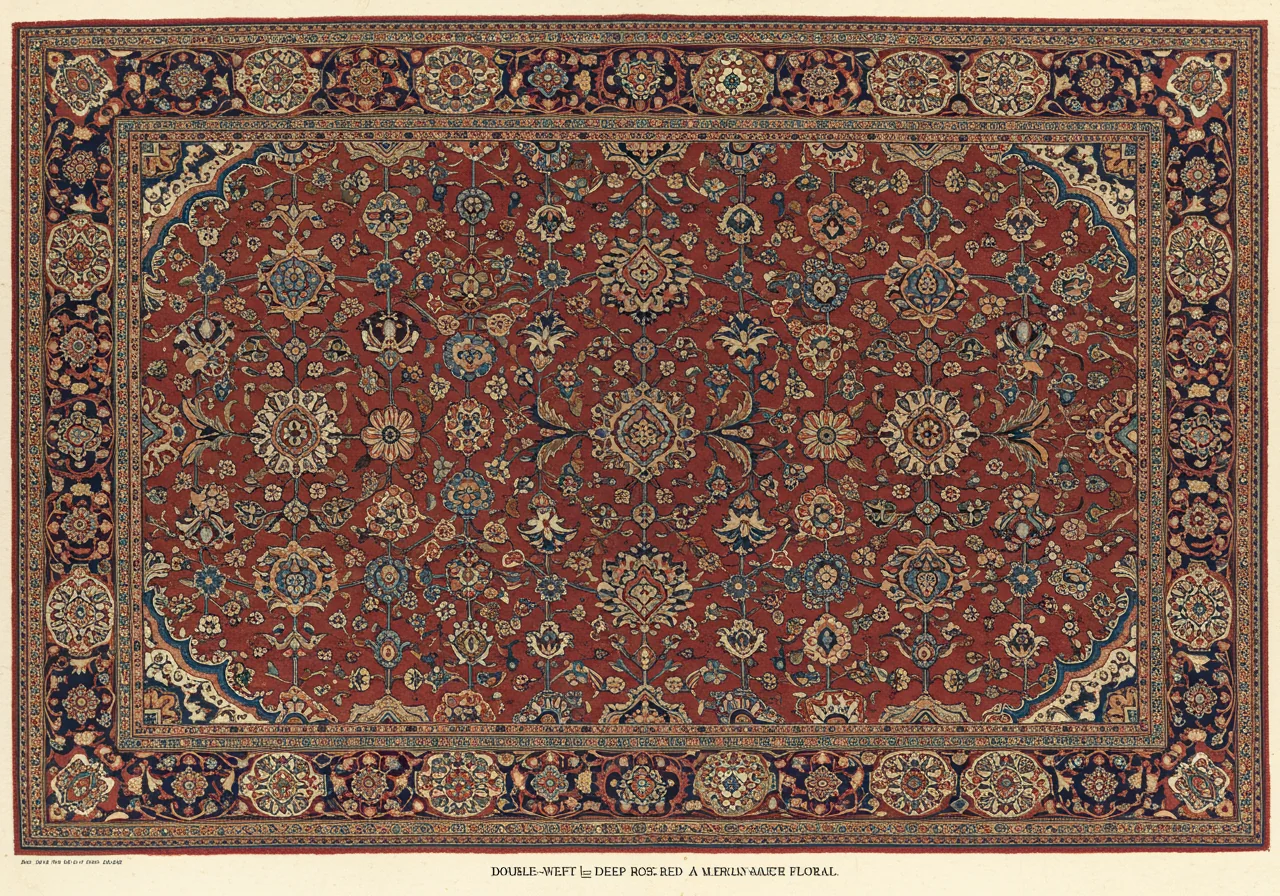
A Sarouk is the central-Persian commercial floral rug, the great staple of the early-twentieth-century American market — and it is the most instructive of the four, because the Hamadan district itself produced rugs in imitation of it. The true Sarouk, from the Arak region, runs the double weft, a denser and more even knot, a deeper rose-red or wine ground, and the dense detached-floral drawing the American trade prized. The Hamadan-area Sarouk-Mahal borrows the floral style but keeps the district’s single weft and earth-tone palette. The rule of thumb: double-weft, deep wine, dense even floral drawing is a true Sarouk; single-weft, earth-toned, looser in the hand, however floral the drawing, is the Hamadan district wearing Sarouk clothes.
A Heriz is the village commercial production of the Sahand district to the north, treated in the Heriz post. Heriz shares the symmetric Turkish knot with Hamadan and a certain village directness of drawing, which is enough to catch a beginner. But Heriz runs the double weft, the large stepped polygonal medallion, and the brick-red palette of the Sahand district — a brighter, harder red than the soft Hamadan rust — and the Heriz back, two-planed and firm, parts company with the flat single-plane Hamadan back at once. The rule of thumb: large stepped medallion, brick-red, double-weft and firm is Heriz; small village medallion or field repeat, rust and camel, single-weft and loose is Hamadan.
The pattern across all four is worth stating plainly, because it is the working value of the whole post. Three of the confusable types — Bidjar, Sarouk, Heriz — are double-weft rugs, and the single-weft test separates Hamadan from every one of them on the evidence of the back alone. The fourth, Senneh, is a single-weft city rug, and there the knot count and the quality of the drawing carry the distinction instead. Establish the weft first; almost everything else follows from it.
What One Looks At
The practical discipline of identifying a Hamadan comes down to a short ordered checklist that the reader of the prior rug posts will find familiar in structure, and that begins — as the Bidjar post began with the handle and the Heriz post with the medallion — with the move that does the most work for the least effort. For Hamadan that move is to turn the rug over.
One looks first, and principally, at the weft. One turns the rug face-down and reads the back. If the back shows a regular ribbing — every other warp left exposed as a fine raised line running the width of the rug, the foundation lying in a single plane with neither set of warps depressed behind the other — one is looking at single-weft construction, and one is very probably in the Hamadan district. If the foundation is depressed into two planes, with alternate warps riding behind their neighbours and buried by the second weft, one is looking at a double-weft rug, and whatever else it is, it is not a Hamadan. This single observation settles the broad attribution and, as the previous section laid out, separates Hamadan from three of its four nearest confusions at a stroke. It is the cheapest reliable test in the whole arc, and it should be done first.
One looks next at the palette. The Hamadan ground is rust, camel, terracotta, walnut brown — the earth-tone register — and a rug that reads as a bright brick-red, a deep wine, or a pale ivory is, palette alone, pointing away from the district. The camel deserves particular attention: a ground of soft, undyed, camel-coloured fleece — whether the hair of the camel itself or the wool of a camel-toned sheep, a point the rug is rarely obliging enough to settle — is a positive Hamadan mark, and on the older village pieces it is one of the surer ones. A rug whose warmth comes from undyed fleece rather than from dye is speaking the Hamadan district’s oldest dialect.
One looks at the proportions and the drawing. The Hamadan loom is narrow, and the district’s output skews toward runners and small scatter pieces; a long narrow rug is, on the balance of probability, more likely to be a Hamadan than a square carpet is. The drawing should be village drawing — a bold single medallion or a field repeat, heavy in the line, drawn from memory rather than from a fine cartoon, a little irregular in its symmetry. Workshop precision argues against the attribution; village directness argues for it.
And one looks, last, at the sub-type within the label. Having established that a rug is a Hamadan-district piece, the further question — and it is a price-bearing question — is which Hamadan. A markedly finer, better-drawn, denser piece may be a Malayer, and is worth more under that name than under the district’s. A curvilinear, floral piece may be a Tafresh. A Sarouk-style floral on the single-weft foundation may be a Lilihan or a Sarouk-Mahal. And a rug catalogued in an old record as a “Mosul” is, almost certainly, a Hamadan-district village rug under the trade’s retired nineteenth-century name. The district label is the beginning of the attribution, not the end of it; the eight hundred villages do not all weave the same rug, and the collector’s work is to hear the sub-type inside the single word the dealer offers.
The next post in the rug arc will be either Tekke — to open the Turkmen tradition and the central Asian wool-warp register — or Sarouk, to extend the central Persian commercial-export tradition into the American-market arc that the Hamadan region partly supplied. The choice will depend on what photographic material is available at the time of writing.