The seven prior posts in this arc — Louis XV, Louis XVI, Biedermeier, English Chippendale, Gustavian, Italian Baroque, and Italian Rococo (Venetian) — have carried the European cabinet tradition from the French royal source through its Continental translations and back again, and the Italian Rococo post closed by promising the arc’s return to the Anglophone line. This is that return. It treats English Hepplewhite, the body of cabinet-making produced under that name between roughly 1785 and 1800, as a taxonomy post in the manner of the two Italian posts before it — not a personal narrative but a description of a type and the evidence by which one reads it.
Hepplewhite is the English neoclassical succession to Chippendale, and the succession is a clean one. The Chippendale post treated a style of carved dark mahogany — the cabriole leg, the ball-and-claw foot, the deep-relief rococo splat. Hepplewhite kept the English cabinet trade and changed nearly everything else: the mahogany gave way to pale satinwood, the carving to painted decoration and delicate inlay, the cabriole leg to the straight tapered leg ending in a small spade foot, the rococo asymmetry to the disciplined symmetry of urn, swag, husk, and paterae. The single most famous object the style produced is the shield-back chair, the form by which one recognises Hepplewhite at a glance — light where Chippendale was substantial, slender where Chippendale was carved, pale where Chippendale was dark. The wood-tone variety table that has run beneath this arc records Hepplewhite, accordingly, as a pale-satinwood post, a deliberate break from the dark-mahogany register.
There is, however, a difficulty in the word Hepplewhite that this post will return to repeatedly, because it is the load-bearing fact of the subject and not an antiquarian footnote. The style is named for a man — George Hepplewhite, a London cabinet-maker who died in 1786 — about whom almost nothing documentary survives, and it is defined not by his furniture, of which not one securely attributed piece is known, but by a book. The Cabinet-Maker and Upholsterer’s Guide was published in 1788, two years after his death, by his widow Alice, trading as A. Hepplewhite & Co.; second and third editions followed in 1789 and 1794. The style is, in the most exact sense available, a pattern book rather than a workshop. One should hold that fact from the first page.
The Specimen
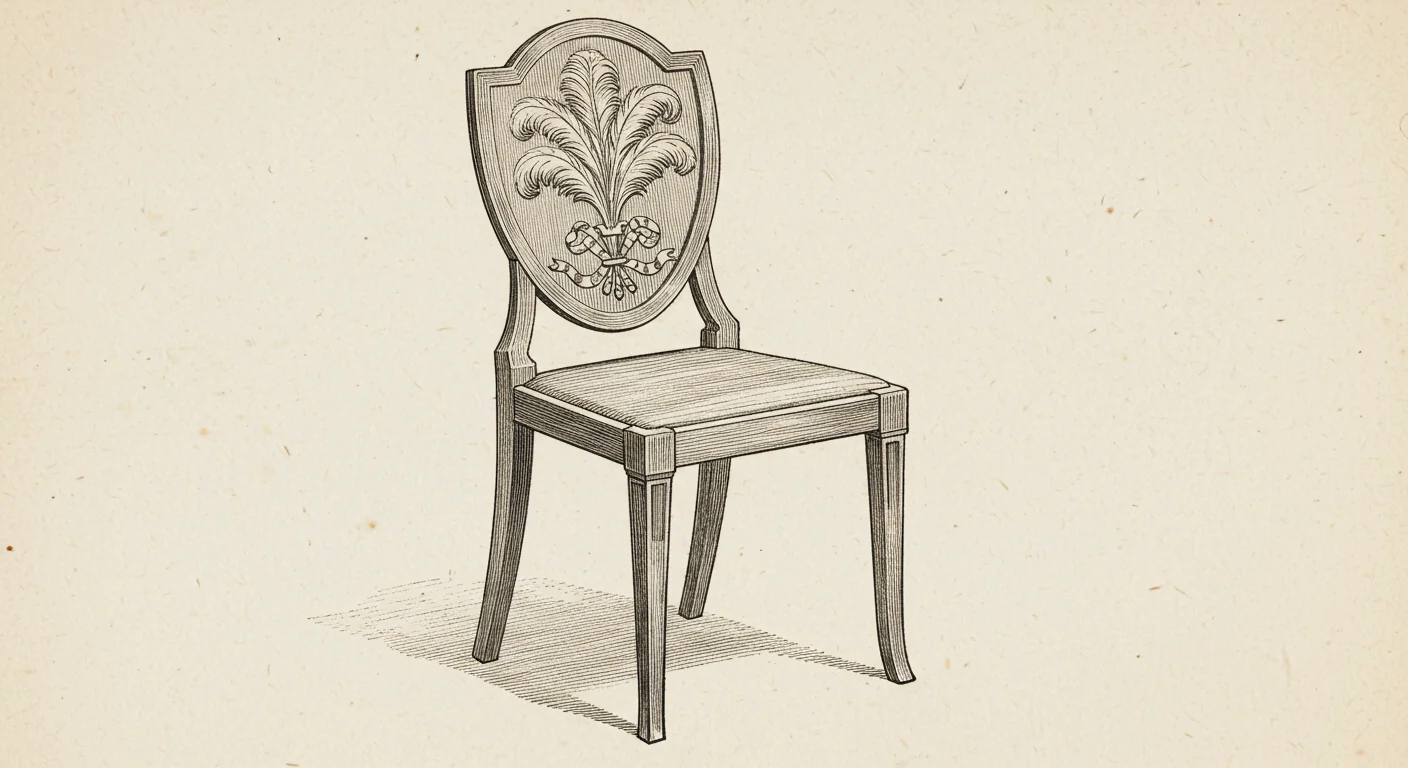
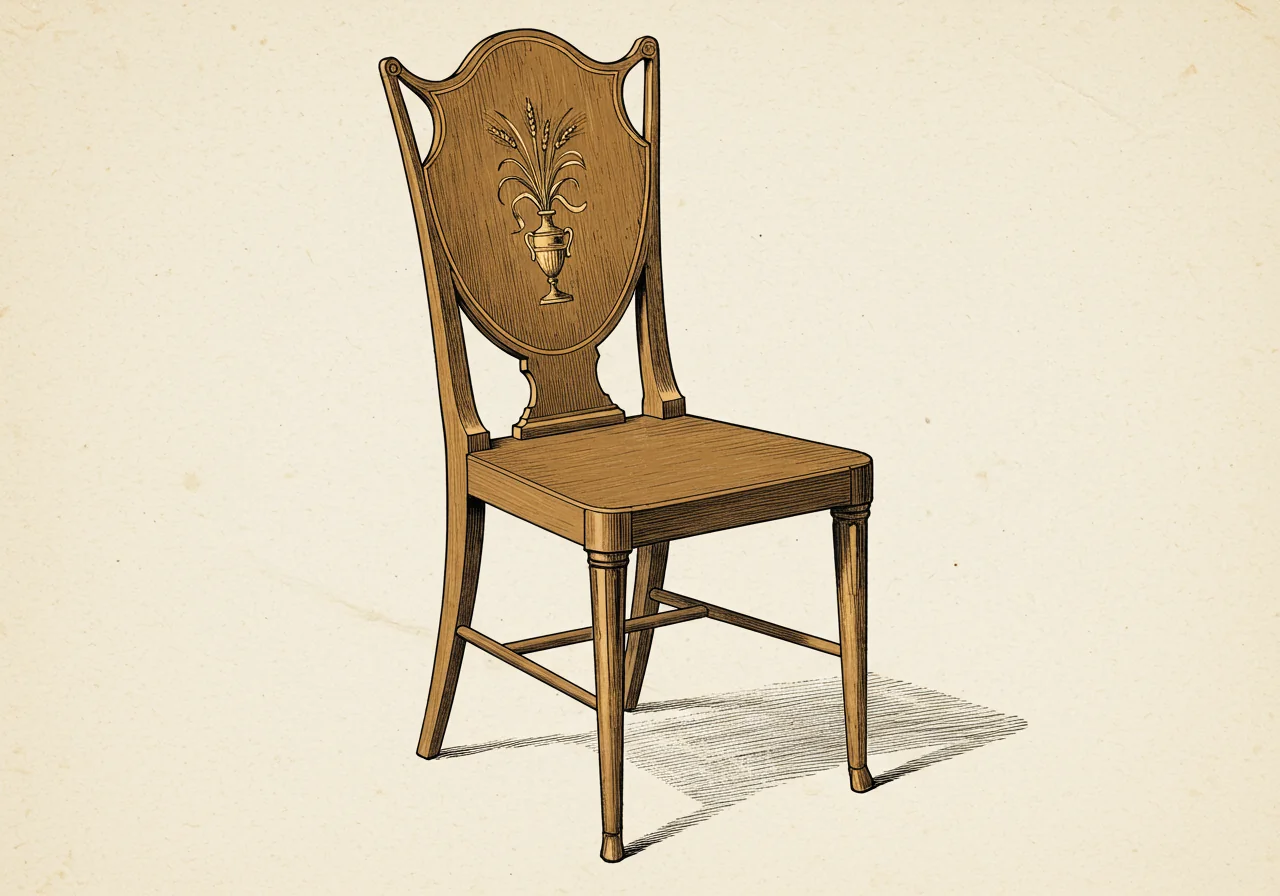
The canonical Hepplewhite piece, for the purpose of beginning to read the style, is the shield-back side chair — canonical not because it is the only Hepplewhite form but because it concentrates the whole vocabulary into a single object the eye can take in at once. The form is what its name describes: an open chair back whose top rail and stiles sweep up and around into the outline of a heraldic shield, broad at the shoulders, narrowing to a point at the base, held clear of the seat by a short open section so that the shield reads as a framed device rather than a continuous back. Within the shield the workshop set its ornament — the second half of the signature — a carved or inlaid neoclassical motif, most characteristically an urn from which husk-chains descend, or, in the form most firmly attached to the Hepplewhite name, the three ostrich plumes of the Prince of Wales’s feathers. The chair stands on straight tapered legs, square in section, each finishing in a small spade foot — a slight rectangular widening at the base, like the head of a spade. The frame itself is pale: satinwood or another pale wood, frequently painted, frequently inlaid, light enough that one can lift the chair with one hand.
This is the chair. But the Guide drew a great deal more, and the case form that carries the Hepplewhite vocabulary most fully is the sideboard — the long serving table with a bowed or serpentine front and flanking pedestals or deep drawers. The form itself was not Hepplewhite’s: the modern sideboard, a side table joined to a pair of flanking pedestal cupboards, is conventionally credited to Thomas Shearer, who first illustrated it in The Cabinet-Makers’ London Book of Prices of 1788, with the three-part composition owing something also to Robert Adam — and there is a quiet irony in the fact that the book which gave the trade a maker-less style did not invent its most famous case form either. What the Guide did was to popularise and standardise that form for the late-Georgian dining room, carrying it to every provincial shop in Britain. It has a serpentine front, a frame of pale satinwood or of mahogany crossbanded in satinwood, neoclassical ornament — urns, paterae, husk swags — laid in as delicate marquetry, and the same straight tapered legs with spade feet the chair stands on. The shield-back chair and the serpentine sideboard between them set out the entire Hepplewhite manner; the rest of the Guide — the secretary-bookcase, the Pembroke table, the bow-front chest — carries that manner across the remaining furniture of the house.
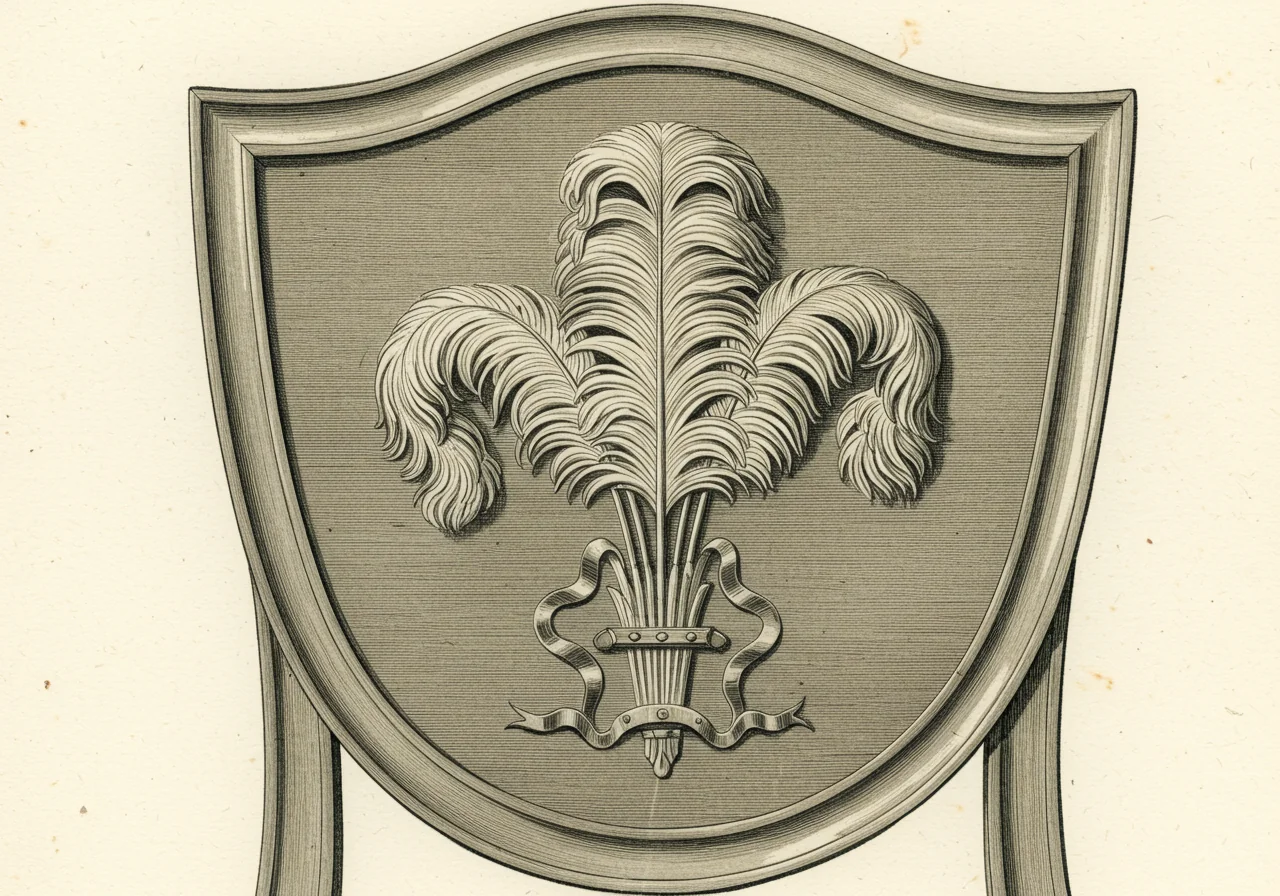
A close detail of a Hepplewhite shield-back chair splat — the canonical Prince-of-Wales feathers or neoclassical urn motif carved or inlaid in satinwood, the form-signature of the Hepplewhite chair.
The Evidence
The wood, first, is most of what one is reading for, because the change of wood is the change of style. The Chippendale tradition worked in mahogany, a dense dark timber that took deep carving and held it; the Hepplewhite tradition turned to satinwood, a pale golden-yellow timber imported from the West and East Indies, hard and close-grained and capable of a high lustrous polish. Where a piece is not satinwood throughout it is very often mahogany used as a ground and crossbanded — bordered in strips of contrasting wood laid with the grain running across the join — in satinwood, tulipwood, or kingwood. The pale ground is not a neutral choice: it is the surface that painted decoration and fine marquetry require, and the move to satinwood and the move to a painted-and-inlaid ornamental register are the same move made in two materials.
The ornament, second. Where the Chippendale cabinet-maker carved his ornament into the wood, the Hepplewhite cabinet-maker laid his onto the surface, and two techniques carry the work: painted decoration — the satinwood ground painted with neoclassical motifs in colour or grisaille, often by a specialist decorator, sometimes with figurative medallions in the manner of the contemporary painters Angelica Kauffman and Antonio Zucchi — and marquetry inlay, the ornament cut from contrasting woods, stained and shaded, sometimes scorched in hot sand to suggest modelled relief, and let into the pale ground. The vocabulary of both is neoclassical and disciplined: the urn, the swag of husks, the paterae, the wheat-ear, the ribboned festoon, the bellflower drop. It is an ornament read in line and colour against a flat surface, where the Chippendale ornament was read in shadow and relief.
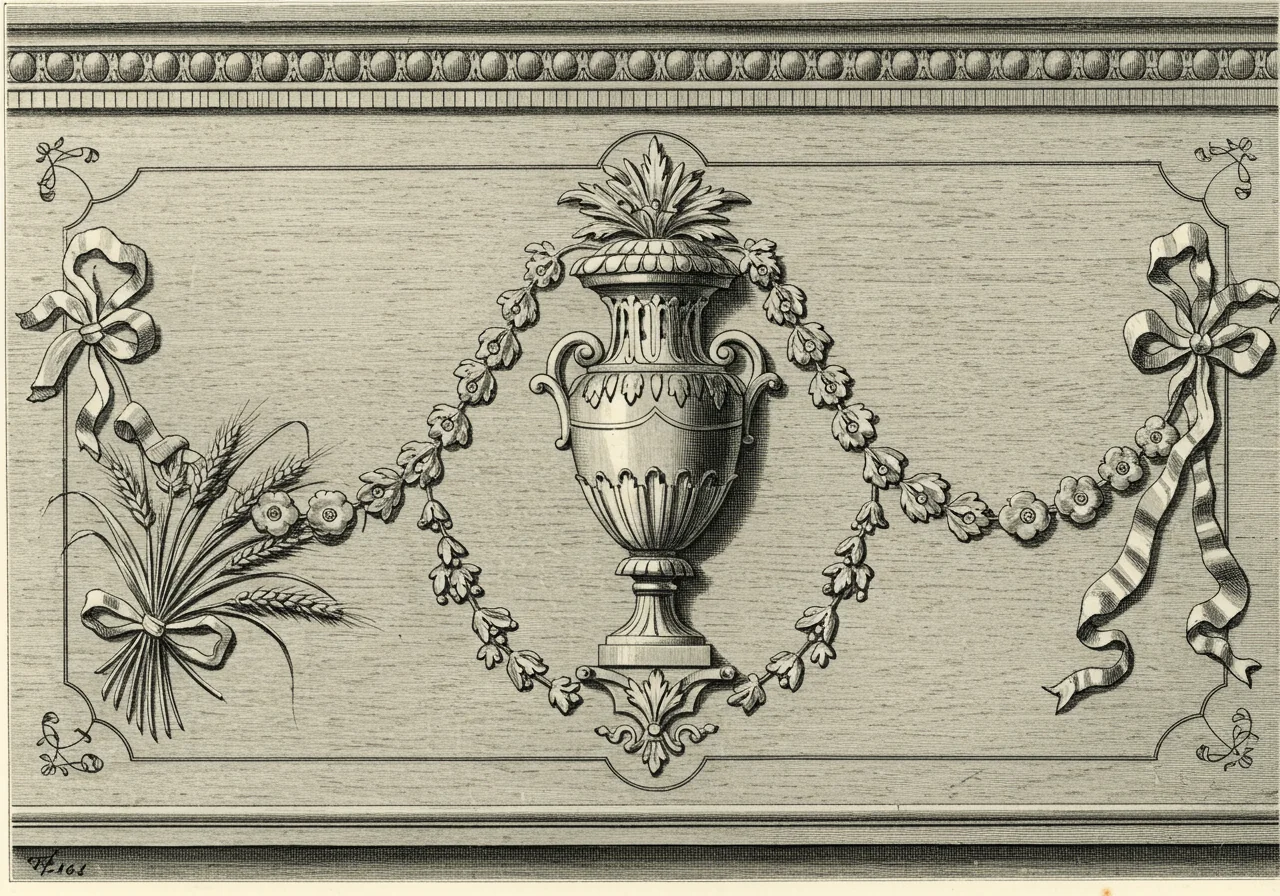
A close detail of Hepplewhite satinwood inlay — the neoclassical urn or paterae motif in stained-and-shaded marquetry, the principal decorative technique of the Hepplewhite tradition.
The leg, third. The Hepplewhite leg is straight, square in section, and evenly tapered, terminating in a small spade foot, a plain tapered end, or occasionally a turned thimble foot. This is the most reliable single discriminator the style offers, because it sits in deliberate opposition to the Chippendale cabriole — which flexes outward at the knee, curves back in, and rests on a carved foot, a sculptural member and an object of carving. The Hepplewhite leg is none of these things. It is a straight architectural support, drawing on the same source the French Louis XVI fluted columnar leg drew on: the classical column, the post-and-lintel logic of antiquity, transmitted to the cabinet trade through the architecture of the period.
The construction, fourth. The Hepplewhite piece is light, and its lightness is structural as well as visual — slender frame members, thin crossbanded veneers, a deliberate paring-away of timber the Chippendale piece would have kept. On a genuine period example this delicate workshop construction shows the period hand: hand-cut dovetails of irregular spacing, pit-sawn or hand-planed secondary timber, hand-laid veneer over a hide-glue ground, two centuries of shrinkage and oxidation on the backboards and undersides. The slightness is not flimsiness; it is the structural expression of a style that wished to be read as graceful rather than substantial.
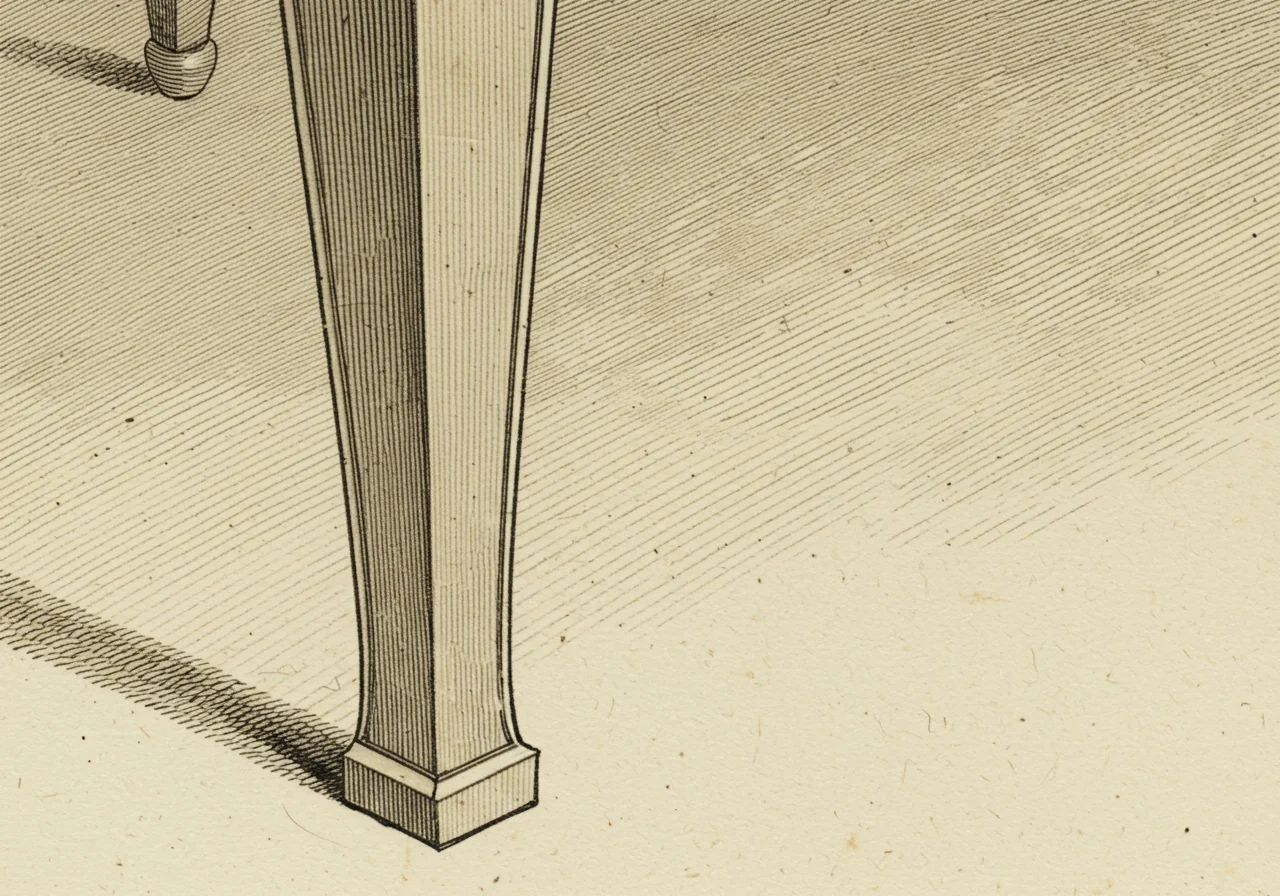
A close detail of a Hepplewhite straight tapered leg terminating in a spade or thimble foot — the neoclassical replacement for the Chippendale cabriole-and-ball-and-claw, drawing on the same Adam-architectural source as the French Louis XVI fluted columnar leg.
And the Guide, fifth — at once the evidence of last resort and of first resort, because for Hepplewhite the pattern book is not a supplement to the furniture but the definition of it. The plates of the 1788 Guide, with their nearly three hundred designs, are the document against which a piece is judged “in the Hepplewhite manner.” There is no maker’s stamp to find, no workshop label; there is only the question of whether the form, the ornament, and the proportion answer to the engraved plates. This is an unusual position for a style to occupy, and the next section sets out why.
The Period
The Hepplewhite period proper runs from about 1785 to 1800, a span shorter than most in this arc and bounded with unusual sharpness at both ends — at its beginning by the publication of the Guide, at its close by the rise of the next pattern book. The man whose name it carries is, by contrast, almost entirely a blank. George Hepplewhite is traditionally said to have been apprenticed to the Lancaster firm of Gillow — though that apprenticeship, like nearly everything else about the man, rests on tradition rather than on any surviving record — and to have afterwards established a modest cabinet-making shop in Cripplegate, in the City of London; no piece of furniture has ever been securely traced to it. He died in 1786. The whole of his documentary existence amounts to an apprenticeship, an address, a death, and a widow — and the widow is the figure who matters. Alice Hepplewhite carried on the business under the style A. Hepplewhite & Co., and in 1788 published, two years after her husband’s death, The Cabinet-Maker and Upholsterer’s Guide. The style is therefore named for a man who never saw the book that defines it, and was launched into the world by his widow: the Hepplewhite manner is a posthumous publication, and the workshop behind the name is, for all practical purposes, undocumented.
What the Guide translated into the cabinet trade had been worked out a little earlier, and at a grander scale, by the architects. The dominant English taste of the 1760s and 1770s had been set by Robert Adam and his brother James, whose classical-revival interiors — the painted ceilings, the delicate plaster relief, the slender ornament of urn and swag and paterae, drawn from the antique remains of Rome and the recently excavated Pompeii — had remade the English interior in a neoclassical key. Adam was an architect, and designed his furniture as part of the room, fitting each piece to a particular wall in a particular house; his neoclassicism was an aristocratic and bespoke affair. What the Guide did — the cabinet-maker’s contribution proper — was to take that architect-led vocabulary down off the wall and put it into a trade pattern book, where any provincial shop could consult it and any patron of moderate means could order from it. Hepplewhite domesticated Adam: the neoclassicism Adam had built into specific houses, the Guide made available to the whole country-house and town-house class as a repertory of forms.
The period closed as it had opened, with a book. Thomas Sheraton’s The Cabinet-Maker and Upholsterer’s Drawing-Book was issued in parts from 1791 and completed in 1793, and through the 1790s the Sheraton designs gradually displaced the Hepplewhite ones as the current taste; the third edition of the Guide, in 1794, already shows the firm revising its plates toward the newer fashion — a quiet admission that the moment had moved on. Between them, the Guide and the Drawing-Book defined the English cabinet trade of the last fifteen years of the eighteenth century so completely that the period is most accurately described not by the names of workshops but by the names of two pattern books.
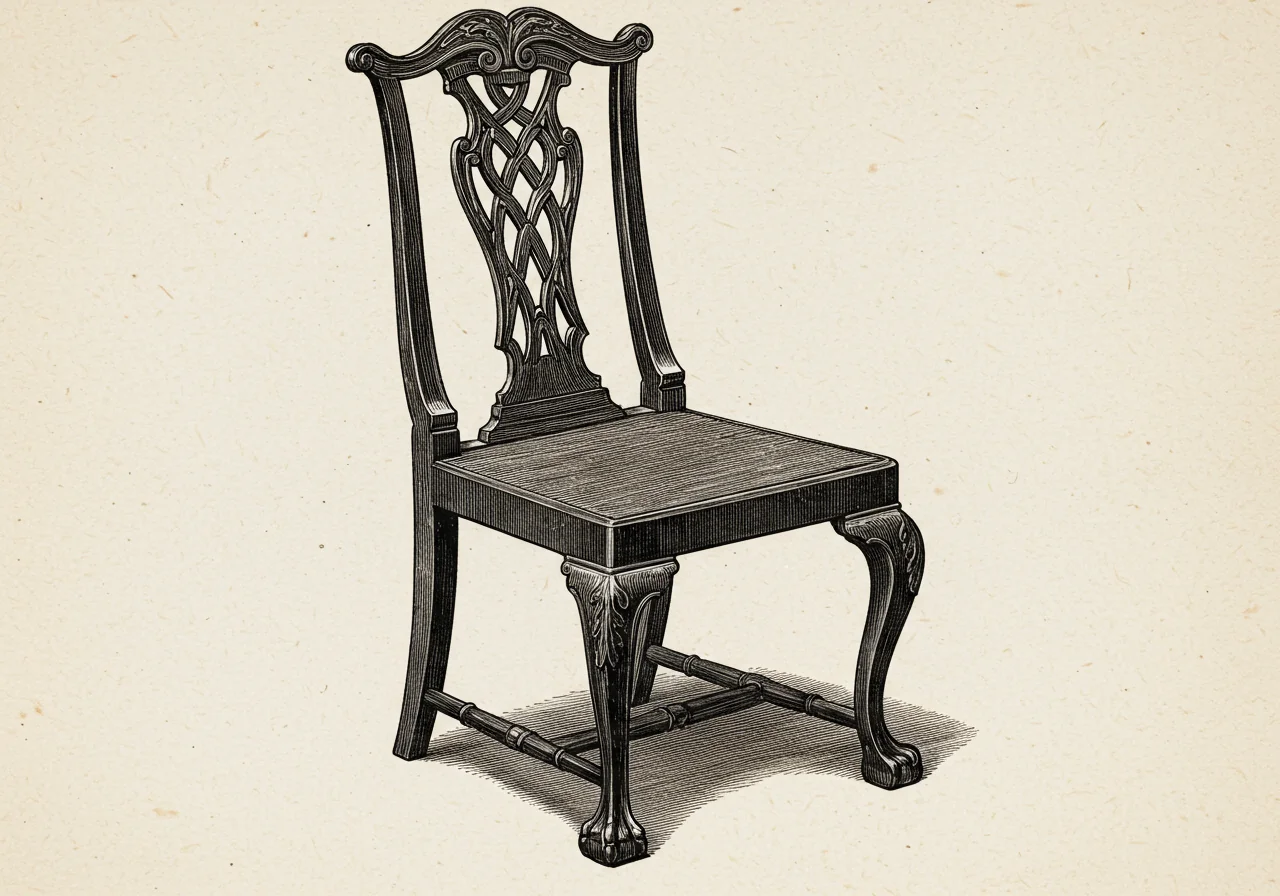
An English Chippendale ribbon-back chair — the rococo predecessor that the Hepplewhite period displaced. The cabriole and ball-and-claw foot were replaced by the straight tapered leg with spade foot; the carved mahogany splat became the satinwood-inlaid shield-back.
The load-bearing distinction every Hepplewhite collector must master is therefore not a distinction between this style and a neighbouring one — that is the work of the next section — but a distinction internal to the word Hepplewhite itself. It is the attribution problem in its purest form, and it runs as follows. No piece of furniture can be securely documented to George Hepplewhite’s own workshop. Not one. There is no signed piece, no labelled piece, no piece with a paper trail back to the Cripplegate shop. When a dealer, an auction catalogue, or a museum label says “Hepplewhite,” the word does not — cannot — mean “made by Hepplewhite.” It means “made in the manner of the Guide,” and the Guide was a public document that any cabinet shop in Britain, and a good many outside it, was free to consult and copy. Hepplewhite furniture was therefore made by hundreds of workshops over fifteen years and more, none of them necessarily connected to the Hepplewhite firm at all, all working from the same set of engraved plates. The style is a book, not a maker.
This inverts the ordinary logic of attribution. With most of the styles in this arc — the Louis XV ébéniste, the Italian Baroque carver — one can at least in principle ask “who made this,” and a signed or documented example settles the question. With Hepplewhite the question is malformed: the honest description of a fine shield-back chair is not “this is a Hepplewhite chair” in the sense of provenance but “this is a chair worked from, or closely after, plate such-and-such of the Guide.” So “is it Hepplewhite” is always a question about conformity to a published design and never about a workshop, and the grading of a piece runs along two axes that must be kept separate. The first is date — a piece of the 1785–1800 period, or a nineteenth-century or later piece worked in the same idiom, since the Guide stayed in print long after the period closed and the “Hepplewhite revival” of the later nineteenth century produced a great deal of honest decorative furniture in the manner that is not period work at all. The second is quality — how fluently the published vocabulary has been realised, since a single plate could be executed by a London shop of the first rank in figured satinwood with painted medallions, or by a country shop in plain mahogany with a single line of stringing, and both are legitimately “Hepplewhite.” The collector keeps date and quality apart, and never expects the third question — who made it — to be answerable at all.
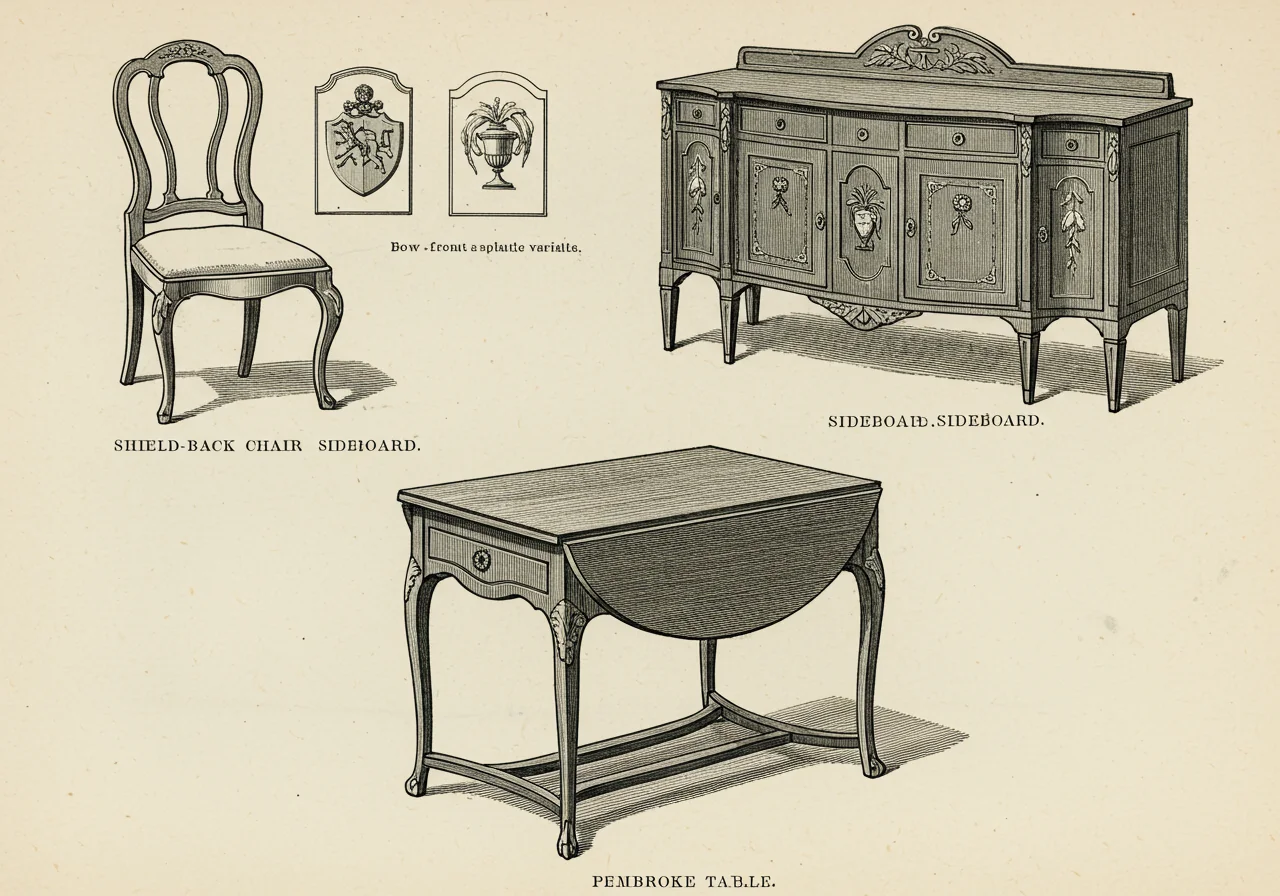
A page from the 1788 Cabinet-Maker and Upholsterer’s Guide — engraved plates showing the canonical Hepplewhite forms: the shield-back side chair (with Prince-of-Wales feathers, urn, and wheatear variants), the bow-front sideboard, the secretary-bookcase, the Pembroke table.
What It Is Not
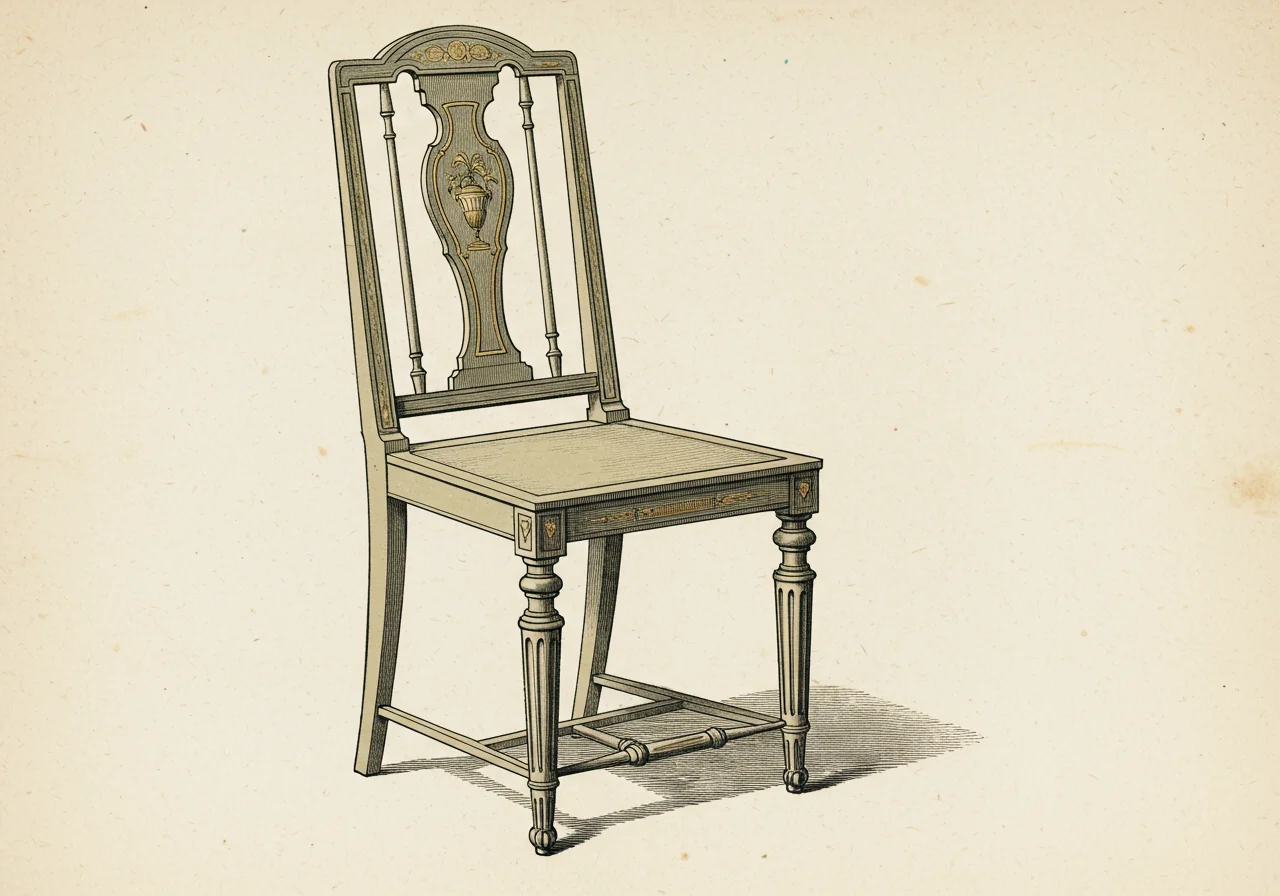
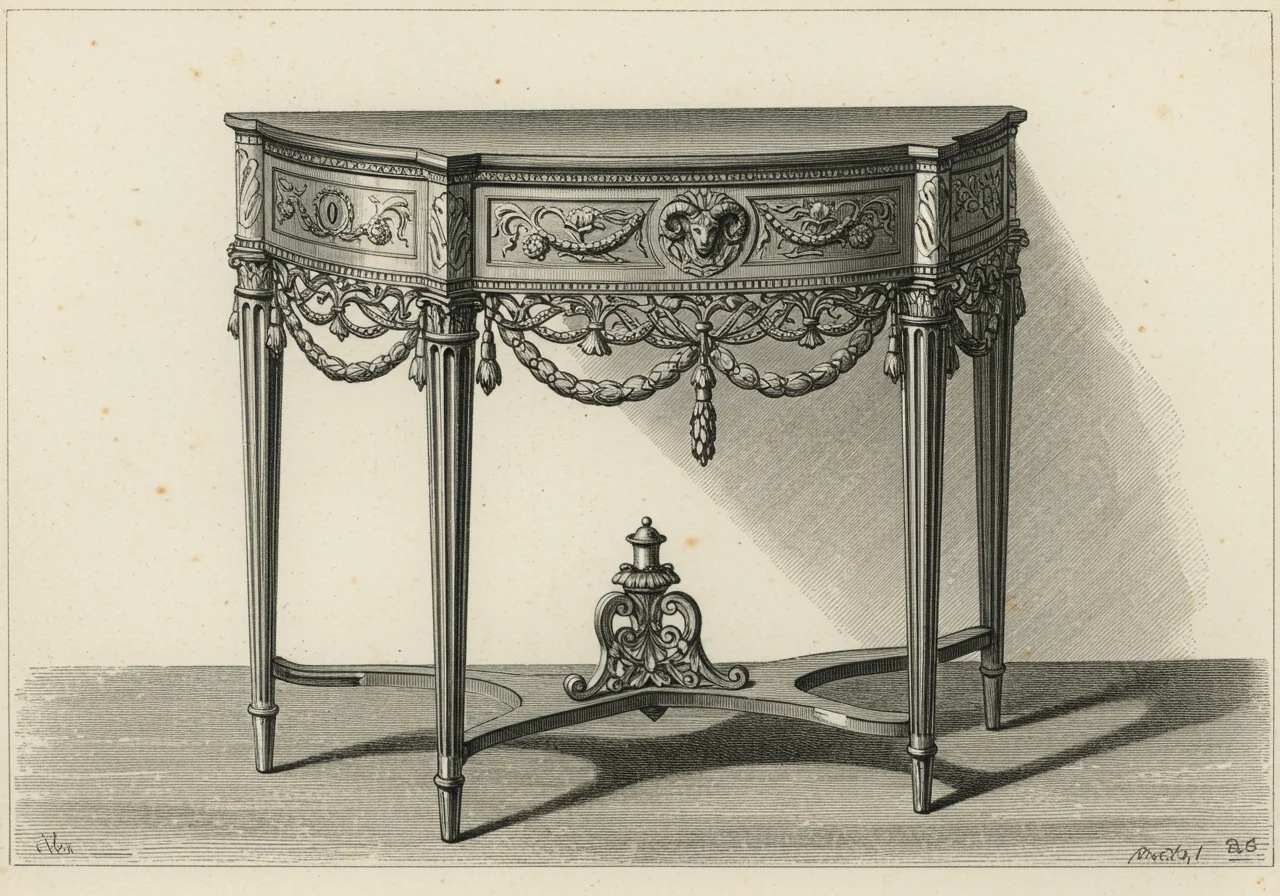
A Sheraton is the immediate English successor — the style of Thomas Sheraton’s Drawing-Book, issued in parts from 1791 and completed in 1793, and the hardest of the four distinctions to draw, because it is the closest. The two pattern books overlap heavily: both English, both neoclassical, both working in pale satinwood with painted and inlaid ornament, both standing their chairs on slender tapered legs, and a great deal of 1790s furniture could be referred to either book with equal honesty. The distinction, such as it is, lies in the chair back and the leg. The Hepplewhite back is curvilinear and open — the shield, the oval, the heart, its outline a closed sweeping curve; the Sheraton back tends to be rectangular, a square or oblong frame with the ornament arranged on straight rails and uprights within it. And where the Hepplewhite leg is square in section and often spade-footed, the Sheraton leg is frequently turned — round in section, reeded or fluted on the lathe — and more slender still. The rule of thumb: a curvilinear open back on a square tapered leg is Hepplewhite; a rectangular back on a slender turned and reeded leg is Sheraton. The rule is sound on the whole, but the honest collector concedes that the two books shade into one another, and that “Hepplewhite-Sheraton” is a defensible label for a great many pieces on the boundary.
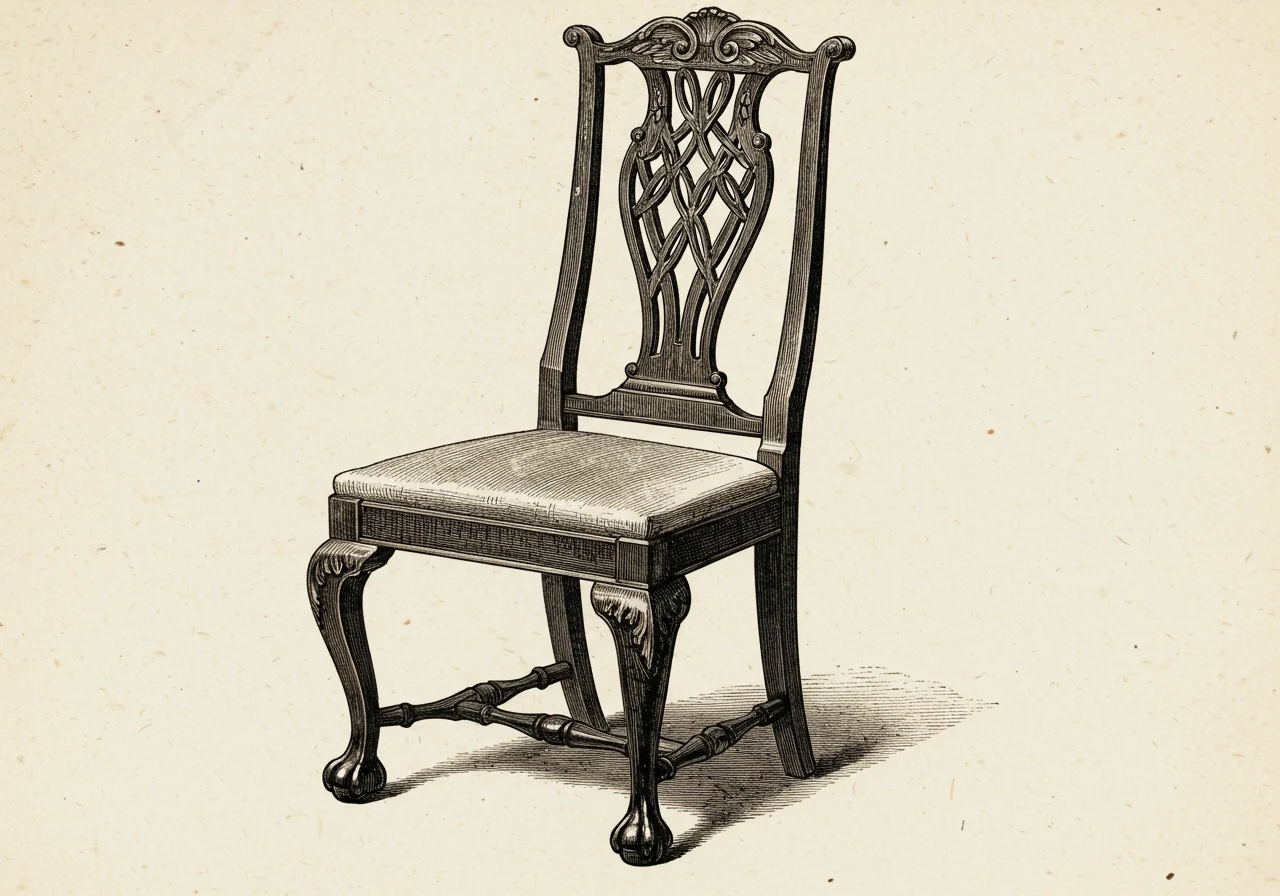
A Chippendale is the rococo predecessor — the post earlier in this arc, the style the Hepplewhite period displaced — and here the distinction is wide and easy, because the two styles are opposites within the same English trade. Chippendale is dark carved mahogany; Hepplewhite is pale inlaid satinwood. Chippendale’s ornament is cut into the wood in relief; Hepplewhite’s is laid onto a flat surface in paint and marquetry. Chippendale’s chair stands on a cabriole leg and a carved foot; Hepplewhite’s on a straight tapered leg and a spade foot. The rule of thumb: carved dark mahogany with a cabriole leg is Chippendale; pale inlaid satinwood with a straight tapered leg is Hepplewhite.
A Robert Adam piece is the architect-led source — the neoclassical vocabulary Hepplewhite translated into the trade pattern book. The two are not opposed; they are the same neoclassicism at two points in its descent, and the distinction is one of register. An Adam piece was designed by an architect for a specific room in a specific house, fitted to its wall, often grander and richer in its gilding and marble than anything in the Guide; it is bespoke neoclassicism. A Hepplewhite piece is the same urn-and-swag vocabulary made repeatable — lighter, cheaper, drawn from a public plate. The rule of thumb: a grand architectural neoclassical piece conceived for a particular interior is Adam; the same vocabulary made portable in a trade pattern book is Hepplewhite.
An American Federal piece is the colonial American descendant — furniture made in the American workshops, chiefly of the Atlantic seaboard, in the decades after Independence, working directly from the Hepplewhite and Sheraton books. The distinction here is genuinely difficult, and at first glance often impossible, because the American cabinet-makers were working from the very same plates. The Federal piece tends to read in a slightly plainer register — frequently in mahogany with satinwood inlay rather than figured satinwood throughout, often sparer in ornament, and with the secondary woods of the American forest (tulip poplar, white pine) in its drawer linings and backboards rather than the oak and deal of the English shop. The rule of thumb: the English Hepplewhite piece works toward figured satinwood and English secondary woods; the American Federal piece works more often in inlaid mahogany and shows American secondary timber — and the secondary wood, examined on the underside, is frequently the most reliable tell of all.
What One Looks At
One looks first at the form of the chair back, because the back is the signature and the shield-back is the type-specimen. The canonical Hepplewhite back is a closed curvilinear sweep — the shield, the oval, or the heart — held clear of the seat by a short open section, with neoclassical ornament set within it. A rectangular back, the ornament arranged on straight rails, points away from Hepplewhite and toward Sheraton; a carved rococo splat in dark mahogany points back to Chippendale.
One looks next at the wood and surface together. The piece should be pale — satinwood throughout, or a mahogany ground crossbanded and strung in satinwood and other pale woods — and the ornament laid on rather than carved in, by painted decoration or by marquetry inlay. A piece in this neoclassical form but executed in carved dark mahogany is the Chippendale antecedent; a piece whose pale surface and slender ornament are grander, more architectural, and fitted to a particular interior is closer to Adam than to the Guide.
One looks then at the ornamental vocabulary, which is small, disciplined, symmetric, and antique in its sources: the urn, the swag of husks, the paterae, the wheat-ear, the ribboned festoon, the bellflower drop — and, as the form most firmly attached to the Hepplewhite name, the three ostrich plumes of the Prince of Wales’s feathers used as a chair-back device. Asymmetric rocaille shellwork belongs to the rococo and to Chippendale; this measured repertory belongs to Hepplewhite. And one looks at the leg — the most reliable single discriminator the style affords — which should be straight, square in section, evenly tapered, finishing in a small spade foot or a plain tapered end. A cabriole leg with a carved foot is Chippendale; a slender turned and reeded leg, round in section, leans toward Sheraton; the straight square tapered leg with a spade foot is the Hepplewhite member.
And one looks, finally, at the question of attribution itself — which is to say, one keeps in mind throughout that there is no maker to find. A genuine period Hepplewhite piece is a piece of the 1785–1800 cabinet trade, worked from or closely after the plates of the 1788 Guide, and showing the period hand in its construction; what it is not, and what no piece of Hepplewhite furniture has ever been shown to be, is documentably the work of George Hepplewhite’s own shop. The collector reads form, surface, ornament, and leg against the Guide; reads the construction for date; reads the quality for rank; and asks of the word Hepplewhite only what it can honestly bear — that the piece is in the manner of the book, made by one of the many shops that worked from it, in the short and well-defined period the book defined.
The next post in the furniture arc will be either Sheraton — to continue the English neoclassical succession into the slightly later, more rectilinear register — or American Federal, to extend the Hepplewhite vocabulary into the post-colonial American workshops. The choice will depend on what photographic material is available at the time of writing.