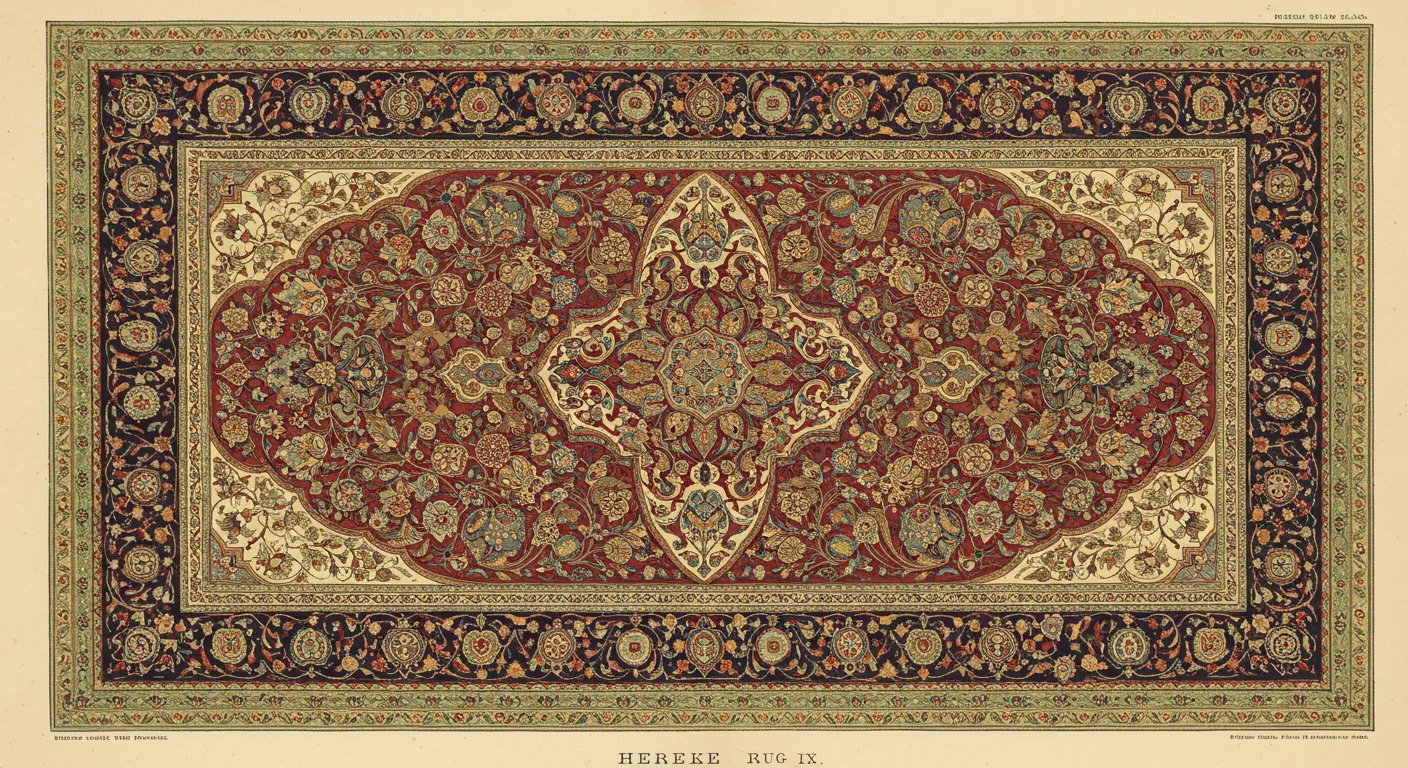
The eight prior posts in this arc divided cleanly among three weaving worlds. The Persian — Heriz, Tabriz, Bakshaish, Kashan, Bidjar, Hamadan — was the largest of them, and within it the arc ran from the district vernacular to the city workshop and back. The Caucasian highland tradition the Kazak post treated. And most recently Tekke opened the third world, the Turkmen tribal weaving of the central Asian steppe. What every one of those eight shares — the city weaving and the village weaving and the tribal weaving alike — is that each was made by a place: a town one can name, a district one can map, a tribe one can locate. Hereke belongs to none of those categories. It was made by an institution. This is the ninth post in Reading the Antique Rug, and it treats the Hereke in the position the arc has reserved for the opening of the Anatolian tradition — and, more particularly, the Ottoman court tradition, the weaving commissioned and controlled by a state.
It breaks the palette as decisively as anything the arc has done, and it breaks it in the opposite direction from Tekke. Where the Tekke carried a single dark madder-brown across a whole tribal production, the Hereke carries no single ground colour at all; it is a multicolor weaving, a jewel-tone field of ivory and gold and jade and rose and indigo set against one another with a deliberate, designed brilliance that no village loom would attempt and no village dyer could supply. But colour, as the prior posts have insisted, is the thing one notices first and trusts last. What organises the Hereke is not its palette but its fineness — the knot density and the silk that carries it, the extreme count of small symmetric knots that places a good Hereke beyond the reach of any village and most cities, and identifies it, before any motif is read, as the product of an imperial manufactory. That fineness, with the material that makes it possible, is the load-bearing collector distinction for the whole of this post, and it will be carried the way the Tekke post carried the gül and the Bidjar post carried the handle test.
The Specimen
A Hereke that one will encounter is, in its commonest fine form, a piece of modest proportions — the silk Hereke was a precious object woven slowly, and the great majority of antique silk pieces are small, prayer-rug or scatter sizes rather than carpets, the room-size silk Hereke being a rarity reserved for the most lavish commissions. The first thing to settle, before any motif is read, is the inverse of the thing the Tekke post had to settle first. There is no tribe anywhere in this account, and no village either. The Hereke rug is a workshop rug from the first knot to the last; more than that, it is the rug of a single, particular workshop — a state manufactory, established and directed by the Ottoman court, executing designs drawn for it by professional designers on professional cartoons. The whole apparatus the Tekke post found absent — the building, the master designer, the commissioned object — is here not merely present but is the entire condition of the thing.
The material is the signature, and one must distinguish two grades of it at the outset. The finest Hereke is woven entirely of silk — silk warp, silk weft, and silk pile, the whole structure of one lustrous fibre — and on the very grandest pieces the silk is supplemented by brocaded areas of metal thread, flattened gold or silver wire worked into the ground to catch the light. Below that grade sits the Hereke woven with a wool pile, very often still on a fine cotton or silk warp, a workshop rug of high quality but without the particular preciousness of the all-silk piece. Both are Hereke; both come from the same manufactory; but it is the silk grade that the tradition is known by, and the silk grade the collector is principally reading for. The composition is itself an attribution: an all-silk rug of extreme fineness, multicolor and court-drawn, is pointing hard toward Hereke before one has looked at a single flower.
The design is the eclectic, the recombined, the deliberately quoted. A classic Hereke carries a central medallion on an open field, framed by a many-banded border of palmette and vine — and the vocabulary of that medallion and that border is, as often as not, Persian. The Ottoman court manufactory drew freely on the Safavid classics, on its own older Ottoman ornament, and on European pattern besides, and recombined them to a master cartoon. The palette completes the specimen: ivory grounds, fields of clear jade-green or soft rose, a gold that the silk takes with a particular warmth, accents of deep indigo — a multicolor jewel-tone scheme of designed brilliance, the opposite in every way of the disciplined single ground the Turkmen post described.
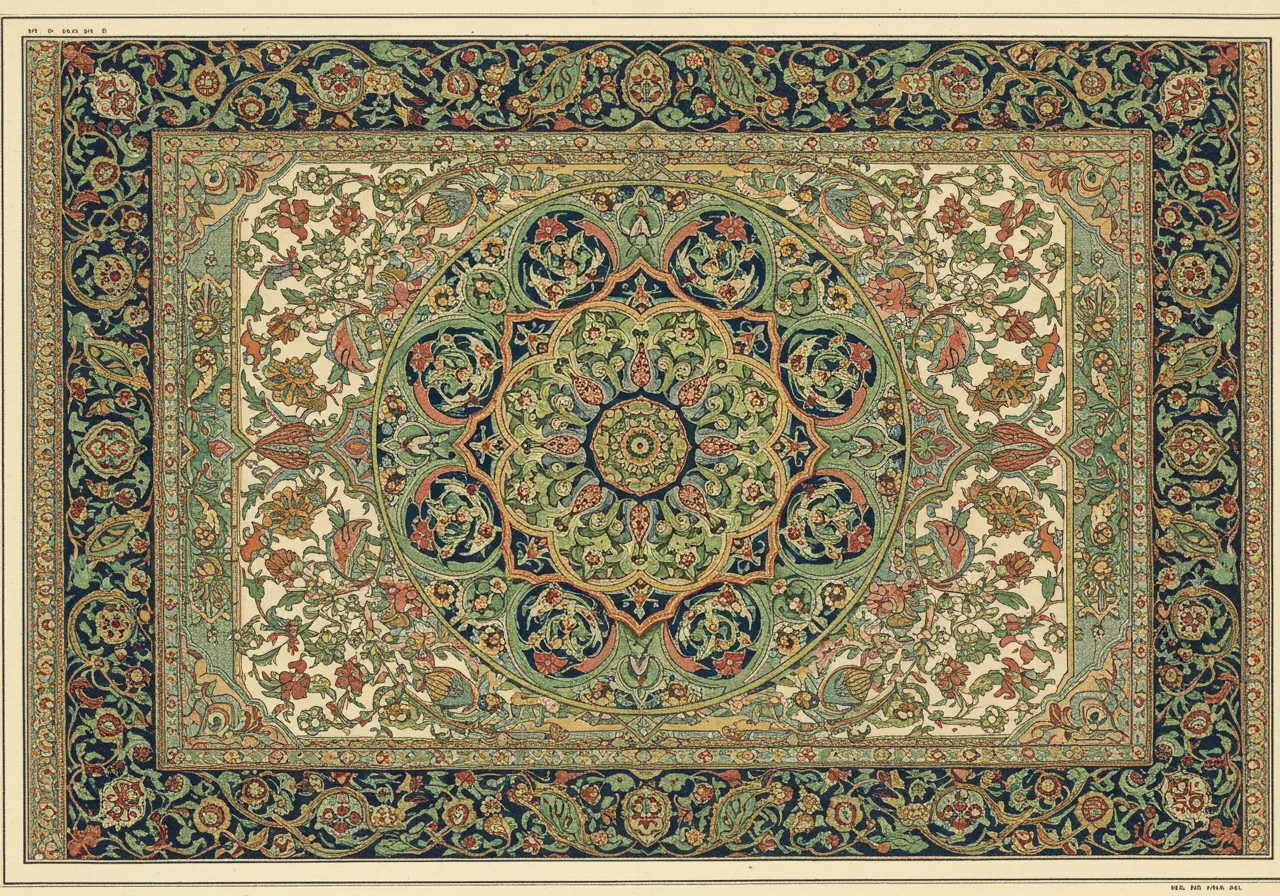
A close detail of a Hereke central medallion — the fine Persian-influenced court vocabulary in jewel-tone silk on an ivory ground, drawn at workshop density.
The Evidence
The knot is where the Hereke declares itself most plainly, and it is the first place the post must correct an assumption a reader might carry in from Tekke. The Tekke, a tribal rug, was tied with the asymmetric knot; one might suppose the asymmetric knot to be the fine knot, since the Tekke was the fine tribal weaving. It is not so. The Hereke is tied with the symmetric knot — the Turkish knot, looped around two warps and drawn down between them — which is the knot of the whole Anatolian tradition, and the Hereke achieves with it a density that no Turkmen tribe and few Persian cities ever approached. A good antique silk Hereke runs into the high hundreds of knots to the square inch — that is the workhorse count for a fine piece — and the rare showpiece, the rug woven small and slow as a deliberate extravagance, can climb past a thousand and into the four-figure range, a fineness at the absolute limit of what a hand can tie. This is the load-bearing fact of the post, and it is worth stating with the bluntness the Bidjar handle test was stated with: the Hereke is identified, before all else, by a knot density that is simply not available to a village or a tribe. Fineness on this scale is an industrial achievement in the literal sense — it requires a manufactory, a fine silk, professional weavers, and a state willing to pay for the months a single rug consumes.
The fineness is legible on the back. One turns a Hereke over, and the knot-grain reads almost as a woven cloth rather than as a pile rug — the knots so small and so densely packed that the back has a smooth, fine, slightly granular surface with none of the coarse nubbed texture a village rug shows. On the all-silk grade the warp and weft seen at the back are themselves silk, fine and lustrous. This evenness is itself evidence of a second kind. A tribal rug is irregular because a tribal weaver wove from memory; the Hereke is regular — its medallion drawn true, its border repeats matched corner to corner, its curved lines carried smoothly through the pile — because the Hereke weaver worked from a cartoon under a quality control that a state manufactory could enforce. Where the Tekke post read the tribal hand’s small irregularities as the proof of authenticity, the Hereke post reads the absence of them: the disciplined exactness is the workshop’s signature, written into every knot.
The third pillar of the evidence is the silk itself, and a particular thing it does. Silk takes dye with a depth and a luminosity that wool cannot match — the same indigo, the same madder, the same yellow read brighter and clearer on silk, because the fibre is translucent and the light enters it — and the Hereke palette depends on this. The jewel tones are not a matter of unusual dyestuffs but of an ordinary dyer’s chemistry carried on a fibre that lets it shine. Silk does one further thing that no photograph records: it changes colour with the angle of the light, so that a Hereke shifts and glints as one walks past it, a field of rose reading pale from one side and deep from the other. Some documented Hereke pieces also carry a woven mark — a workshop signature or an inscription cartouche — and where one is present it is corroborating evidence; but the mark is far from universal, and the collector who has read the knot and the silk and the discipline correctly does not need it.
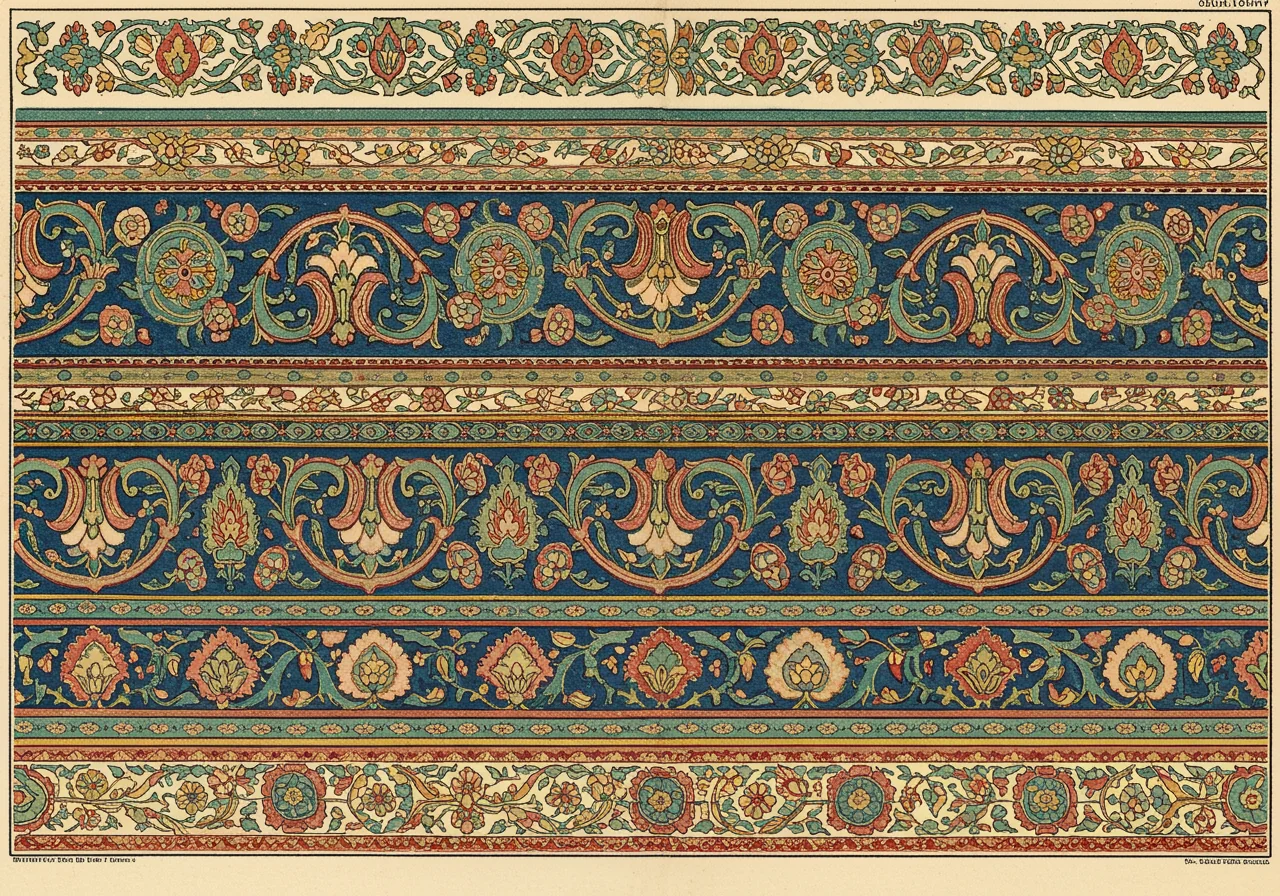
A close detail of a Hereke main border — the fine palmette repeat in silk pile at workshop density, the court vocabulary of the Ottoman state workshop.
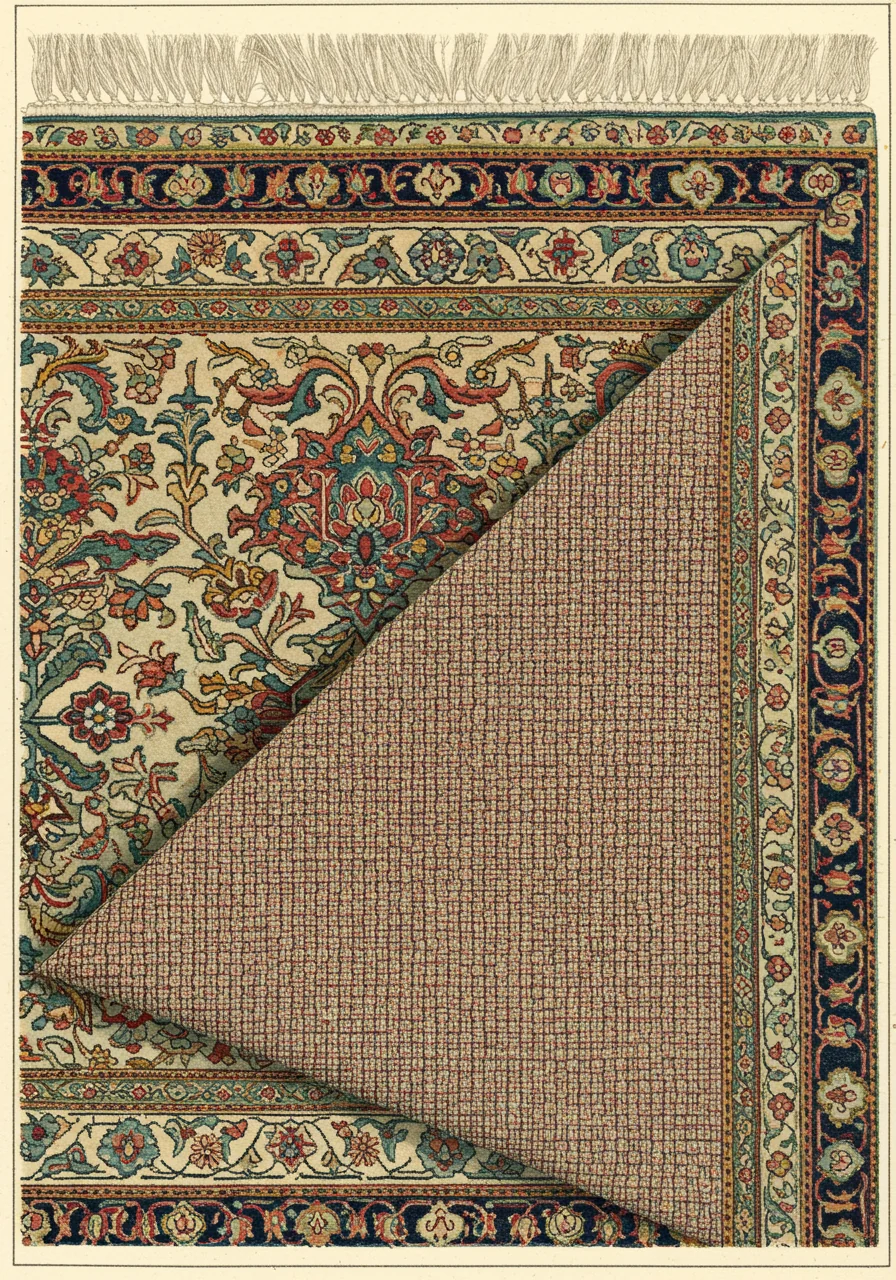
A close detail of the back of a Hereke rug — the extreme knot density visible at the foundation level, the silk warp and weft of the all-silk variant.
The Period
The Hereke manufactory was founded in the early 1840s — the sources do not quite agree, giving 1841 or 1843 for the founding and 1845 for the start of operations under settled palace patronage — on the Sea of Marmara coast at the small town of Hereke, on the gulf that runs inland toward Izmit east of the capital; and it was founded not as a carpet works at all, but as a silk-and-textile mill. This is the fact from which the whole institution must be understood. Sultan Abdülmecid I established it in the first years of his reign, in the period of the Tanzimat, the long programme of administrative and industrial reform by which the Ottoman state set out to modernise itself from above; and the Hereke mill was a Tanzimat enterprise of exactly the characteristic kind, a state manufactory raised to supply the court’s own demand for fine cloth. For its first half-century the looms of Hereke wove silk furnishing fabric, upholstery, and dress silk for the imperial palaces. The carpet was a later addition. It was only from about the 1890s, under Abdülhamid II, that the manufactory took up the knotted pile carpet in earnest, gathering skilled weavers and setting them to produce silk court carpets of the highest grade — and it is that production, the silk Hereke carpet of the last Ottoman decades, that this post is principally concerned with.
The Hereke carpet was, from the first, a court object rather than a market one. It furnished the palaces of the Sultan; it was given as a diplomatic gift to foreign sovereigns and embassies, a piece of woven statecraft, an Ottoman silk carpet arriving at a European court as a deliberate demonstration of what the empire could still command. This origin explains the eclecticism the specimen described. A manufactory whose purpose is to display the court’s reach does not weave a folk tradition; it weaves the best of every tradition it can reach, and the Hereke designers accordingly drew Safavid Persian medallions, classical Ottoman ornament, and European motifs into a single recombined repertoire. The point bears stating directly, because it is the one place a reader new to Hereke is most apt to go wrong: a Hereke design is, characteristically, a quotation — not the slow evolved vocabulary of a place but the considered selection of a state atelier, executed by master designers to order. To ask what the “authentic Hereke pattern” is, in the sense one asks what the authentic Tekke gül is, is to ask a question the manufactory was not built to answer.
The Hereke survived the empire. The manufactory did not close with the Ottoman state; it carried on into the Turkish Republic after 1923, and silk Hereke production continues to the present day, the name now also widely imitated by other Turkish workshops weaving fine silk rugs for the export trade. For the collector the period distinction is therefore the same one the Tekke post drew at Geok Tepe and the Hamadan post drew at the 1880s export boom, only here it falls inside a single named workshop rather than between the tribe and the market. The antique Hereke — the court silk carpet of roughly the 1890s to the early twentieth century, woven for the palace and the diplomatic gift, to the manufactory’s own highest standard — is the rug the connoisseur reads for.
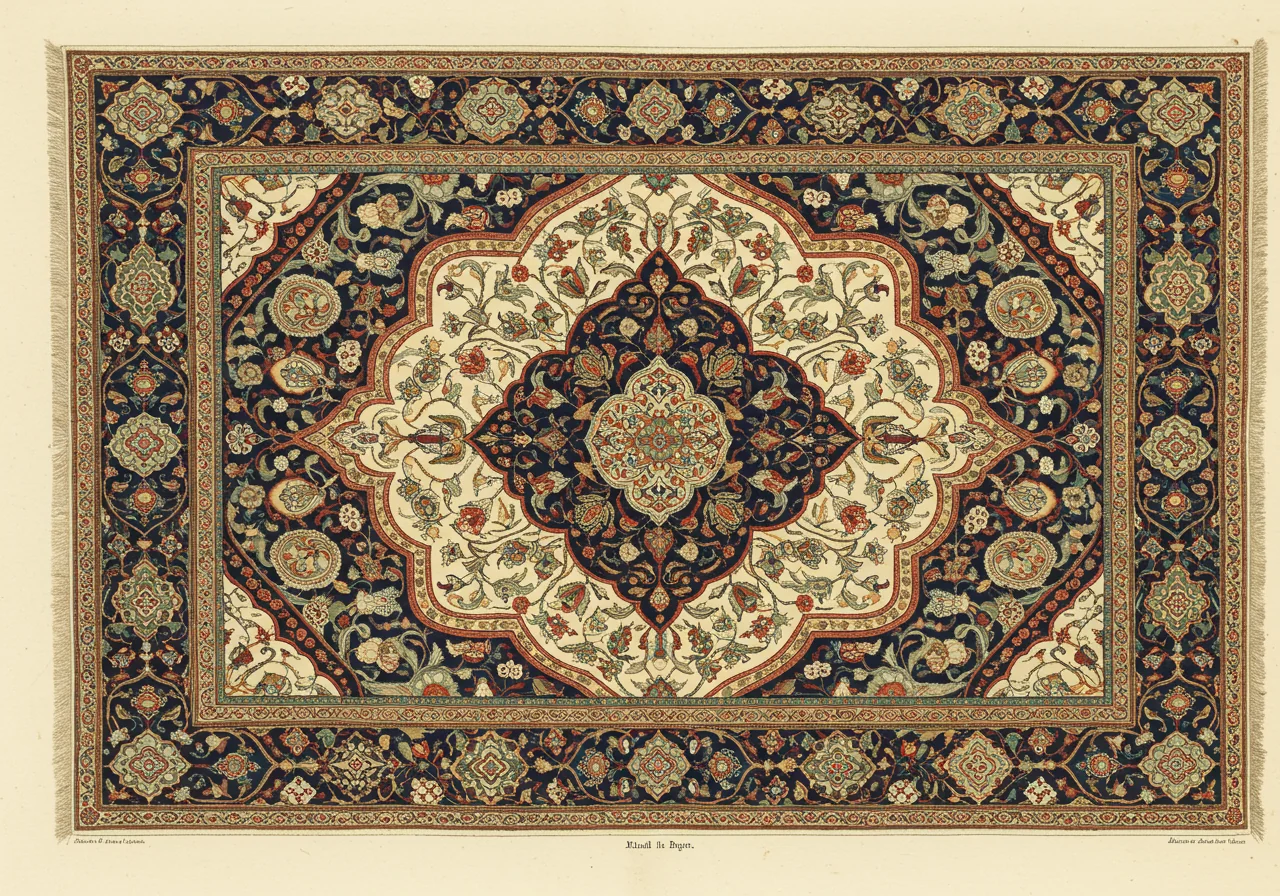
A 16th-c Ottoman Bursa or Istanbul court silk workshop carpet — the older Ottoman court silk tradition that Hereke quoted at its founding. The court silk vocabulary (Persian-influenced medallion, palmette borders, jewel-tone palette) descends from this earlier production.
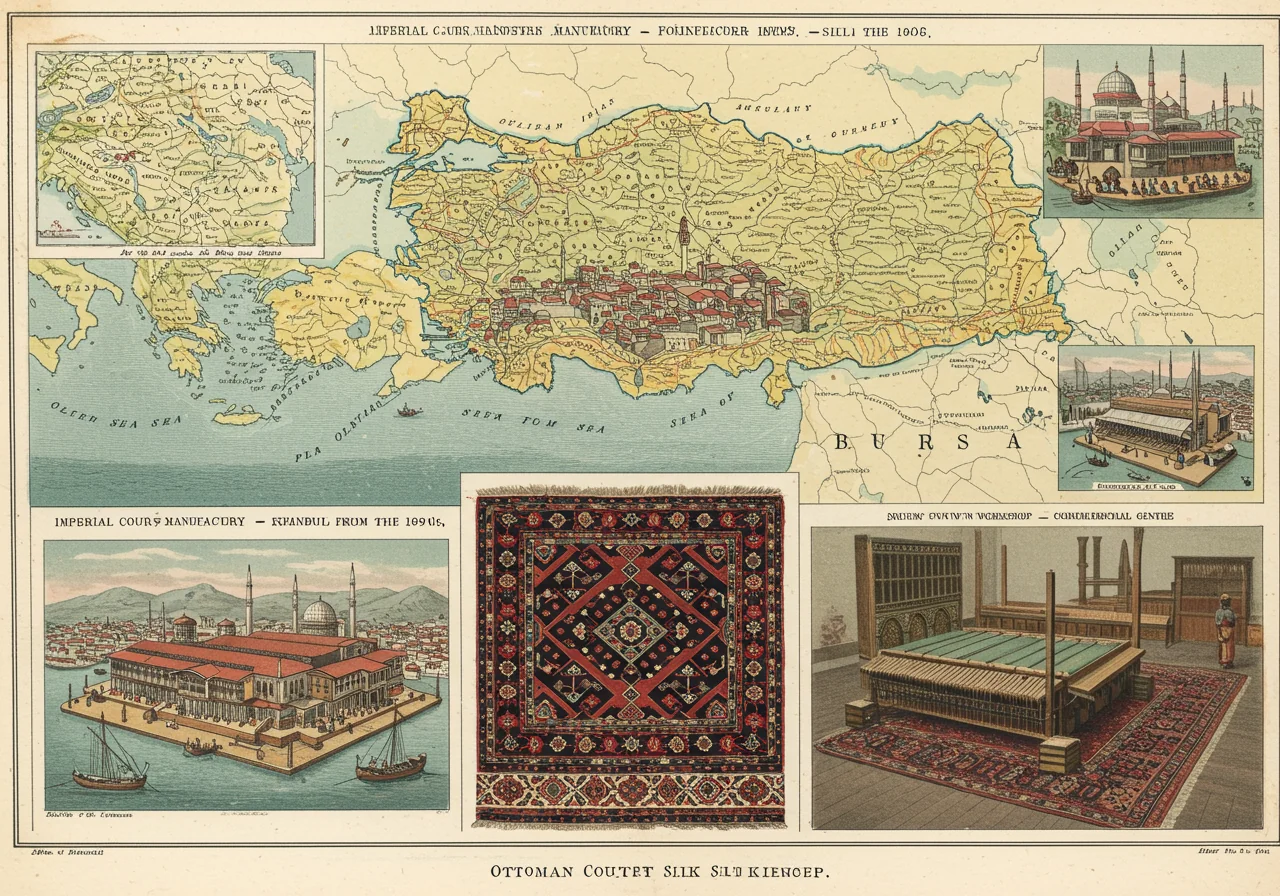
A page from a Victorian connoisseur’s portfolio on the Ottoman court silk workshops — the four principal sites (Hereke, Kum Kapı in Istanbul, Sivas, Bursa) with archetype drawings showing the distinctive vocabulary of each.
What It Is Not
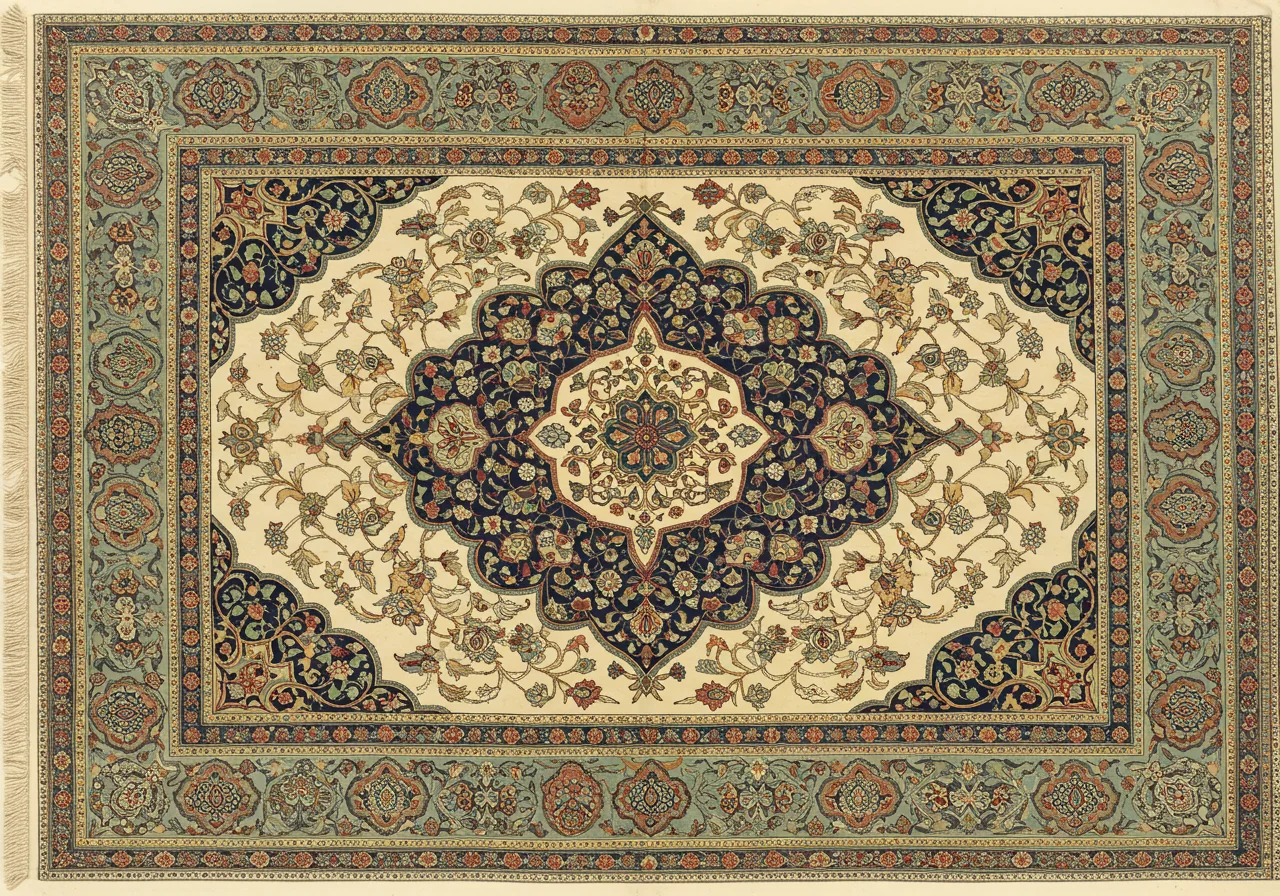
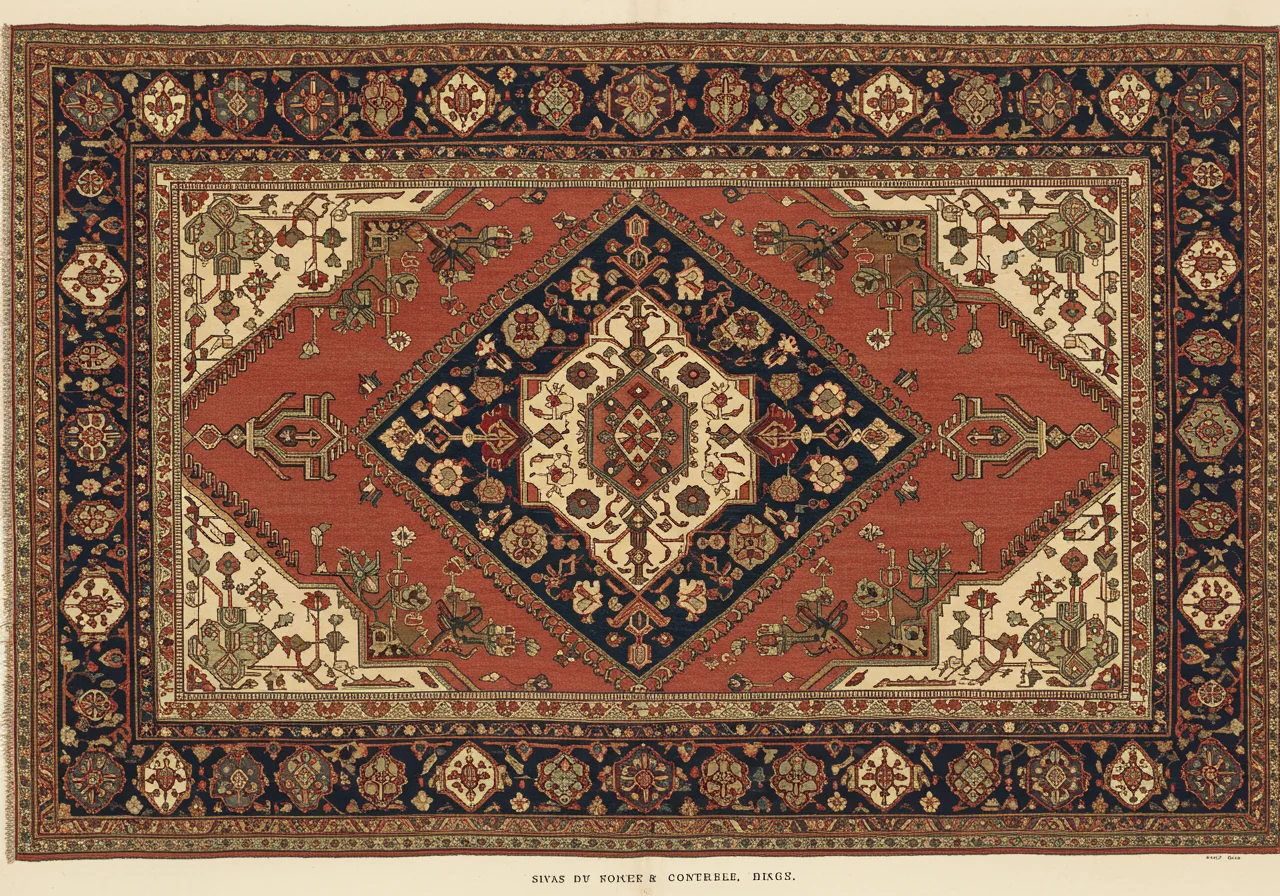
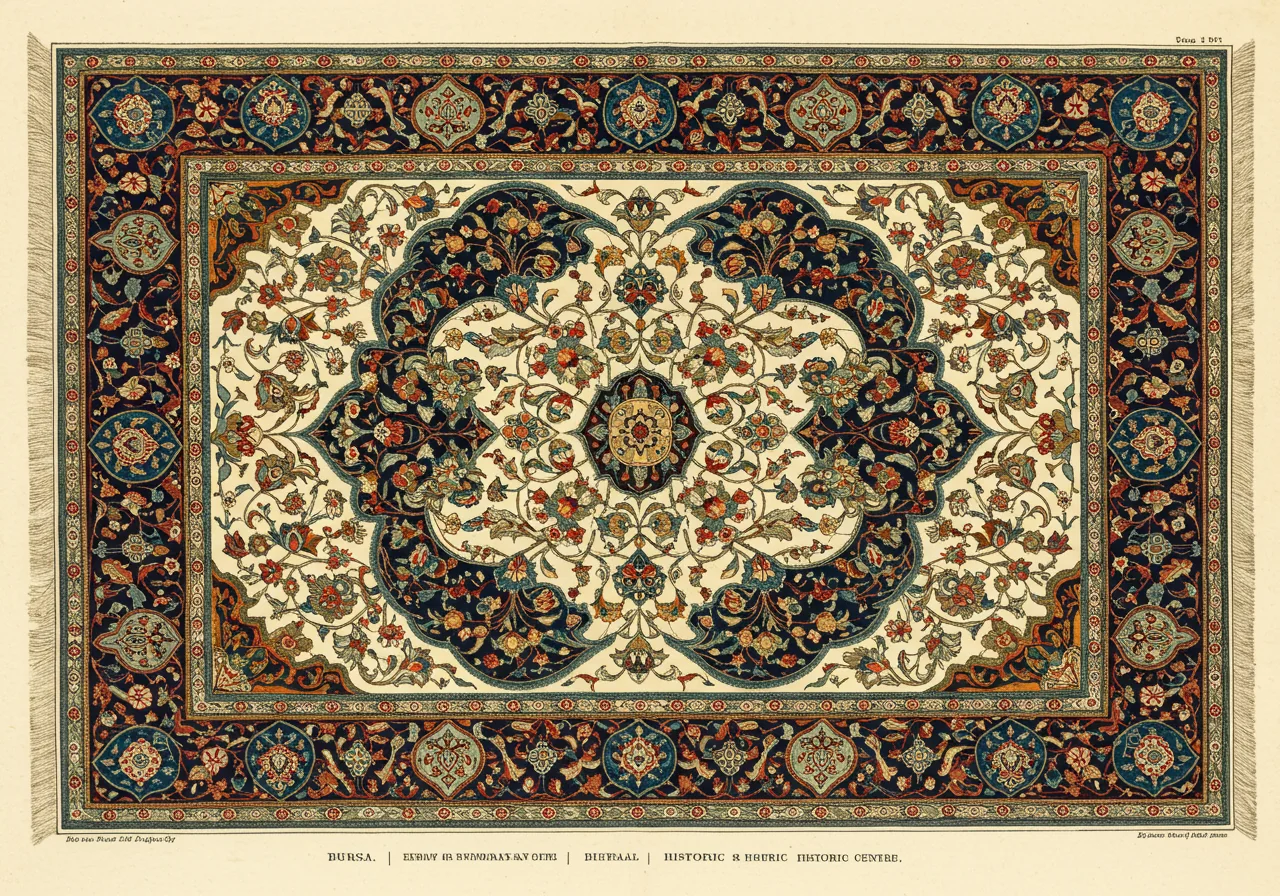
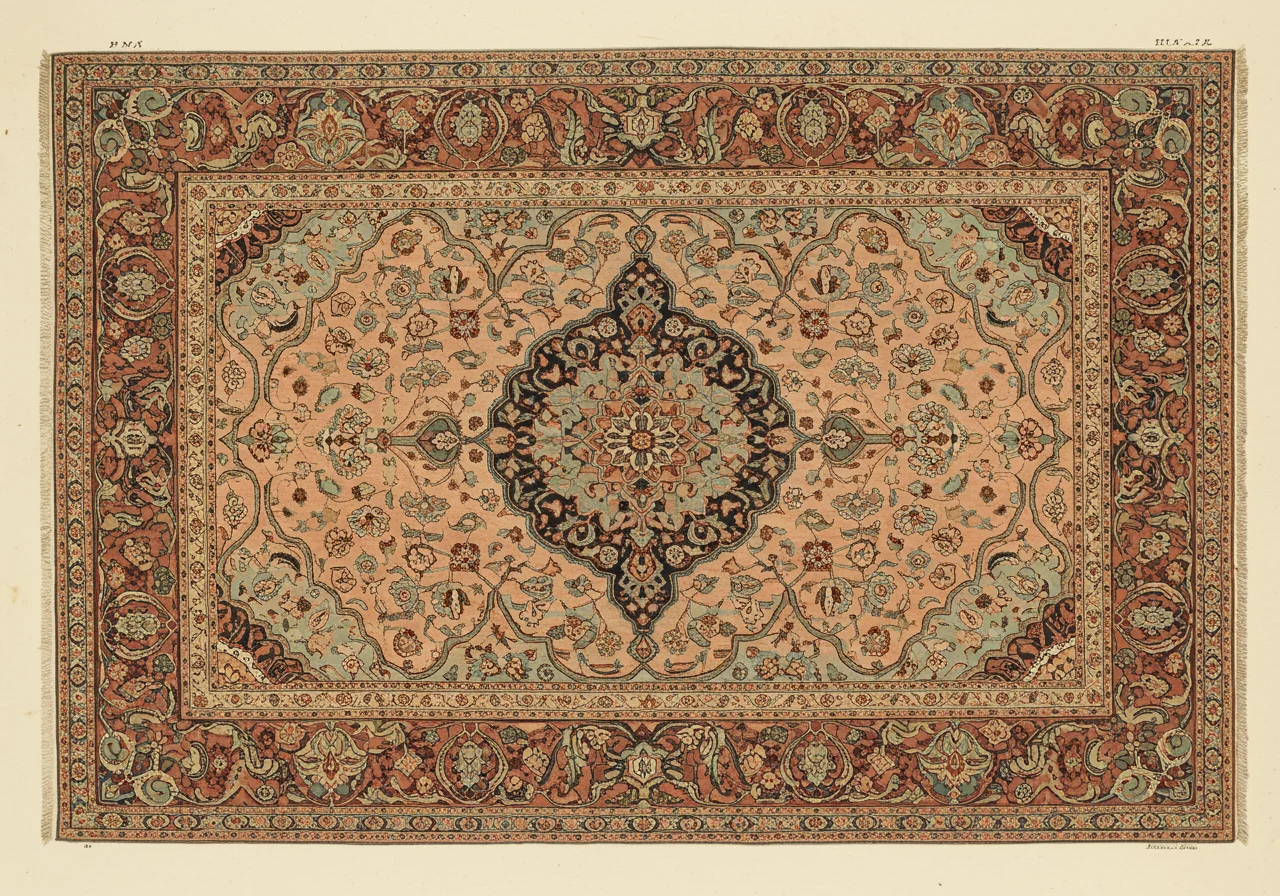
The four traditions set against the Hereke divide along the two axes the arc has used throughout — silk against wool, and the precise origin of the workshop — and the practised eye separates them by reading the material and the fineness together before it reads the design. This is the load-bearing skill for the Anatolian court tradition, and it is worth stating as plainly as the gül test was stated for Tekke: with a fine silk rug of court vocabulary, one attributes by reading where the loom stood and how fine the hand was, because the design alone will not tell — the design was borrowed.
A Kum Kapı is the closest of the four to the Hereke, and the most genuinely difficult to separate, because Kum Kapı is also an Ottoman silk-and-metal-thread weaving of the very highest grade, made in the same years. The difference is one of origin, not of quality. Kum Kapı names a quarter of Istanbul, and the rugs are the work of a small number of independent master weavers active there in the early twentieth century — Zareh Penyamin foremost among them — virtuosi working to their own designs rather than to a state manufactory’s. A Kum Kapı is typically even finer in drawing and more inventive in composition than a Hereke, more the signed work of a particular artist than the institutional product of a workshop. The rule of thumb: a silk-and-metal rug of supreme fineness that reads as the personal masterpiece of an individual hand, often signed, is a Kum Kapı; the Hereke is the manufactory’s product, and the manufactory’s regularity is in it.
A Sivas is the plainest contrast of the four, because Sivas is an Anatolian town workshop weaving wool, not a court silk atelier. Sivas, in central Anatolia, produced a fine commercial workshop rug — well drawn, often in court-influenced medallion designs, but woven in wool pile at a far lower density and a far lower price than any silk Hereke. The rule of thumb: a workshop rug of related court vocabulary that is woven in wool, lacks the silk’s sheen, and shows a knot density well below the Hereke’s is a Sivas — a good rug of its kind, but a town’s rug and not a court’s.
A Bursa is the older Ottoman silk centre, and it stands to the Hereke rather as the antecedent does — a relation in the same family. Bursa, the early Ottoman capital, was the historic heart of the empire’s silk industry, and silk rugs woven there carry related vocabulary; but the Bursa name belongs to the older tradition out of which the Hereke institution itself grew. The rule of thumb: Bursa names the older Ottoman silk centre and the broader tradition; Hereke names the particular nineteenth-century state manufactory that concentrated and surpassed it.
A Tabriz — and here the comparison crosses out of the Ottoman world altogether — is the Persian court counterpart, the fine northwest-Persian city workshop already treated in the second post of this arc. The finest Tabriz workshop rugs, the silk-warp Hadji Jalili pieces in particular, are likewise fine, likewise medallion-drawn, likewise the product of a city atelier; and since the Hereke designers were themselves quoting Safavid Persian models, the design vocabulary of a fine Tabriz and a fine Hereke can run remarkably close. The separation is foundation and knot. A Tabriz is a Persian rug — characteristically a wool pile even on the finest grade, tied with the asymmetric Persian knot; the silk Hereke is silk throughout and tied with the symmetric Turkish knot. The rule of thumb: when a fine medallion rug’s design will not decide the question, the knot decides it — the symmetric knot and the all-silk structure carry the rug to Anatolia and to Hereke.
The pattern across all four is the working value of the post. One does not attribute a fine court rug by its medallion, nor by its border, nor by the mere presence of silk — the Safavid quotation is shared, and Kum Kapı has silk too. One attributes it by reading the foundation, the knot, and the manufactory origin together, and by recognising that the design, in this tradition, is the one piece of evidence that has been borrowed.
What One Looks At
The practical discipline of identifying a Hereke comes down, as in the prior rug posts, to a short ordered checklist — and as the Tekke post began with the move that does the most work for a tribal rug, so this one begins with the move that does the most work for a court rug. That move is to gauge the fineness.
One looks first, and principally, at the knot. One turns the rug over and reads the back, and what a Hereke offers there is a density at the upper limit of the hand — knots so small and so closely set that the back reads almost as a fine cloth, with the symmetric Turkish knot worked at a count that climbs into the high hundreds and, on the best pieces, well past a thousand to the square inch. A rug whose back shows the coarse nubbed grain of a village weaving is not a Hereke and was never near one; a rug of merely good city fineness is more likely a Tabriz or a Sivas. The extreme density is the attribution, because the extreme density is what an imperial manufactory could buy and a place could not. Everything else on this list confirms it or grades it.
One looks next at the material. The finest Hereke is silk throughout — silk warp, silk weft, silk pile — with, on the grandest pieces, brocaded metal thread worked into the ground; the second grade is a wool pile on a fine warp. An all-silk structure, lustrous and supple with the faint cool sheen of the fibre, places the rug in the top grade and points hard toward Hereke or its Kum Kapı sibling; a wool pile does not exclude Hereke, but it moves the piece into the workshop’s lower grade and closer to the Sivas comparison.
One looks at the palette and the drawing together. The Hereke is a multicolor jewel-tone weaving — ivory, gold, jade, rose, indigo — and the silk gives those colours a luminosity and an angle-dependent shift that wool cannot. But one reads the drawing for discipline rather than for identity: the medallion drawn true, the border repeats matched at the corners, this exactness being the manufactory’s quality control made visible. And one remembers the central lesson of the post — the pattern itself is a quotation, Safavid and Ottoman and European recombined, and is not, in this tradition, the thing that decides the attribution.
And one looks, last, for the signature, while expecting to do without it. A minority of documented Hereke pieces carry a woven mark or an inscription cartouche, and where one is present and genuine it is welcome corroboration; but it is far from universal, and not difficult to imitate, so the mark confirms a reading already made — it does not make one. The reading is made by the knot, the silk, and the disciplined hand; the manufactory is legible in the structure long before any name is woven into it. The Hereke is not a place’s rug nor a tribe’s. It is a state’s rug, the woven instrument of a court’s prestige, and the extreme fineness in the field is the measure of the institution that commissioned it.
The next post in the rug arc will be either Oushak — to extend the Anatolian tradition into the village register (pale yellow / apricot palette, larger-scale 15th-c-derived medallions) — or one of the Turkmen types not yet covered. The choice will depend on what photographic material is available at the time of writing.