The five prior posts in this arc — Louis XV, Louis XVI, Biedermeier, English Chippendale, and Gustavian — have together described the eighteenth- and early-nineteenth-century European cabinet tradition: the French royal source through its rocaille and neoclassical halves, the Continental bourgeois reaction that displaced both, the Anglophone cross-Channel translation in carved mahogany, and the Northern translation across the Baltic into painted Swedish pine. What that account has so far not opened is the Italian tradition at all, and the cleanest place to begin is a century earlier than any of the prior five, with the body of work that the seventeenth-century Roman and Bolognese workshops produced for the papal-court patron class under Bernini-circle design influence: Italian Baroque.
The translation principle the prior posts have made familiar — French source, national-register material substitution — does not quite apply to the Italian Baroque, because the Italian Baroque is the source rather than a translation of one. The mid-seventeenth-century Italian register was already at Versailles when the French royal cabinet tradition began to articulate itself in the 1660s under Louis XIV’s Manufacture Royale des Gobelins; Bernini himself was invited to Paris in 1665. Where Louis XV is rocaille and Louis XVI is neoclassical, the Italian Baroque is what stands behind both at a generation’s distance: dark walnut case furniture, heavy carved-and-gilded ornament, deep-relief figurative carving across the panel surfaces, and — on the apex pieces — pietra-dura tops in inlaid coloured marbles. The patron is not the king but the cardinal or the prince, and the documentary anchor is not a pattern book but the architectural-and-decorative work of Bernini’s circle in Rome through the mid-century.
This is the sixth post in Reading the Period Cabinet. It opens the Italian tradition, which the prior posts have not touched, and provides the dark-gilt break the wood-tone variety table calls for after the Gustavian gris-blanc.
The Specimen
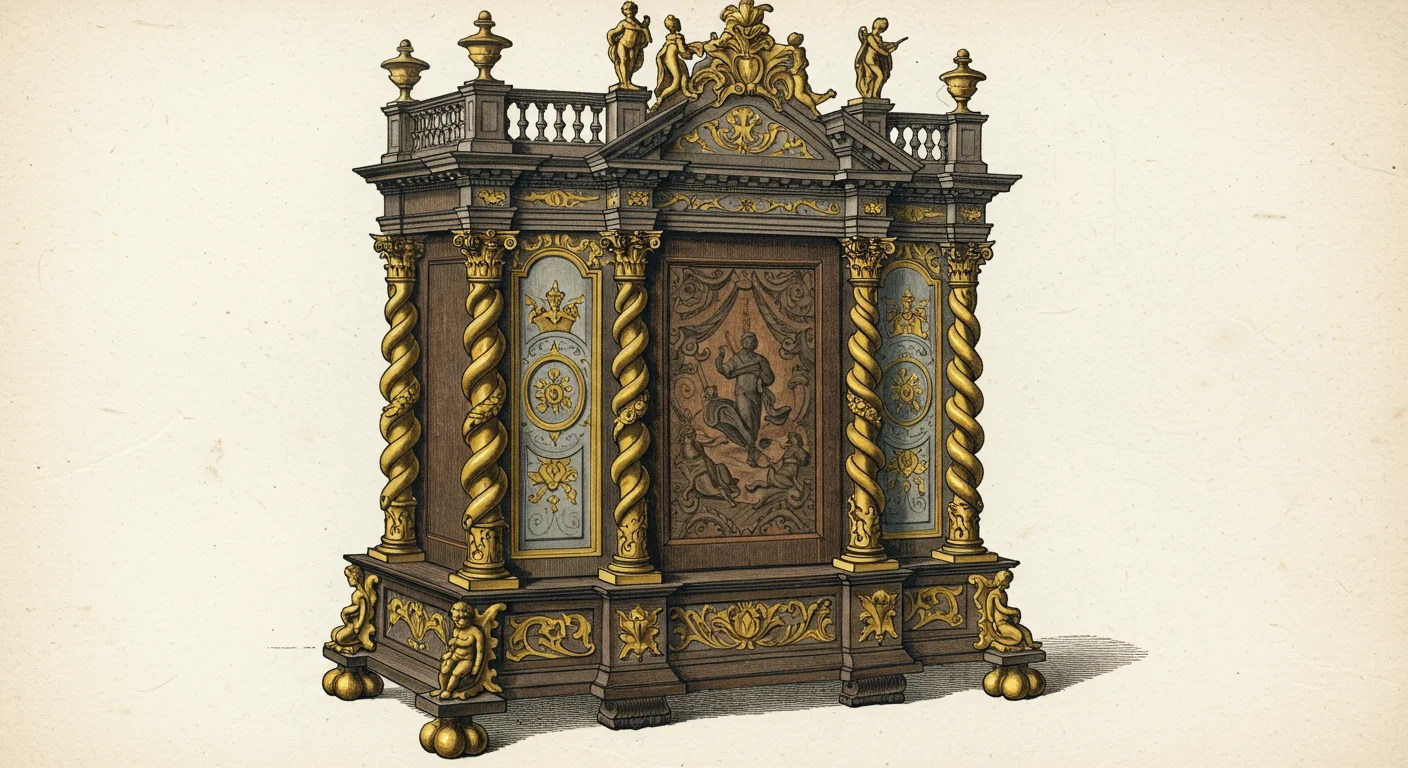
The canonical Italian Baroque piece, for the purposes of beginning to read the style, is the stipo — the architectural cabinet on stand, descended in form from the smaller Renaissance writing-cabinet but elaborated in the seventeenth century into a room-scale architectural object with deep-relief carved figurative ornament, carved-and-gilded structural members, and (on the better pieces) a pietra-dura top. The stipo is what the cardinal-or-prince patron commissioned for the principal salon of the Roman palazzo, and the form in which the Italian Baroque principles are most fully concentrated.
A canonical Italian Baroque stipo, then. It stands on a carved giltwood stand — either a pair of carved Atlas-figures or putti supporting the case directly, or a more conventional console-style base with paw feet and heavy scrolled brackets, the entire stand gilded over a gessoed ground in the Roman papal-court register. Above the stand rises the case proper, in dark walnut — Italian walnut, dense and close-grained, dark-stained or naturally aged to the deep brown that the surviving period pieces all share. The case is architectural in its proportions: it reads as a small palace facade, with central door, flanking compartments, sometimes a central niche, and a heavy entablature above. Solomonic columns — the twisting spiral columns made famous by Bernini’s baldacchino at St Peter’s, completed in 1633 — frame the central door on the apex pieces, executed in carved walnut and gilded at the bases and capitals.
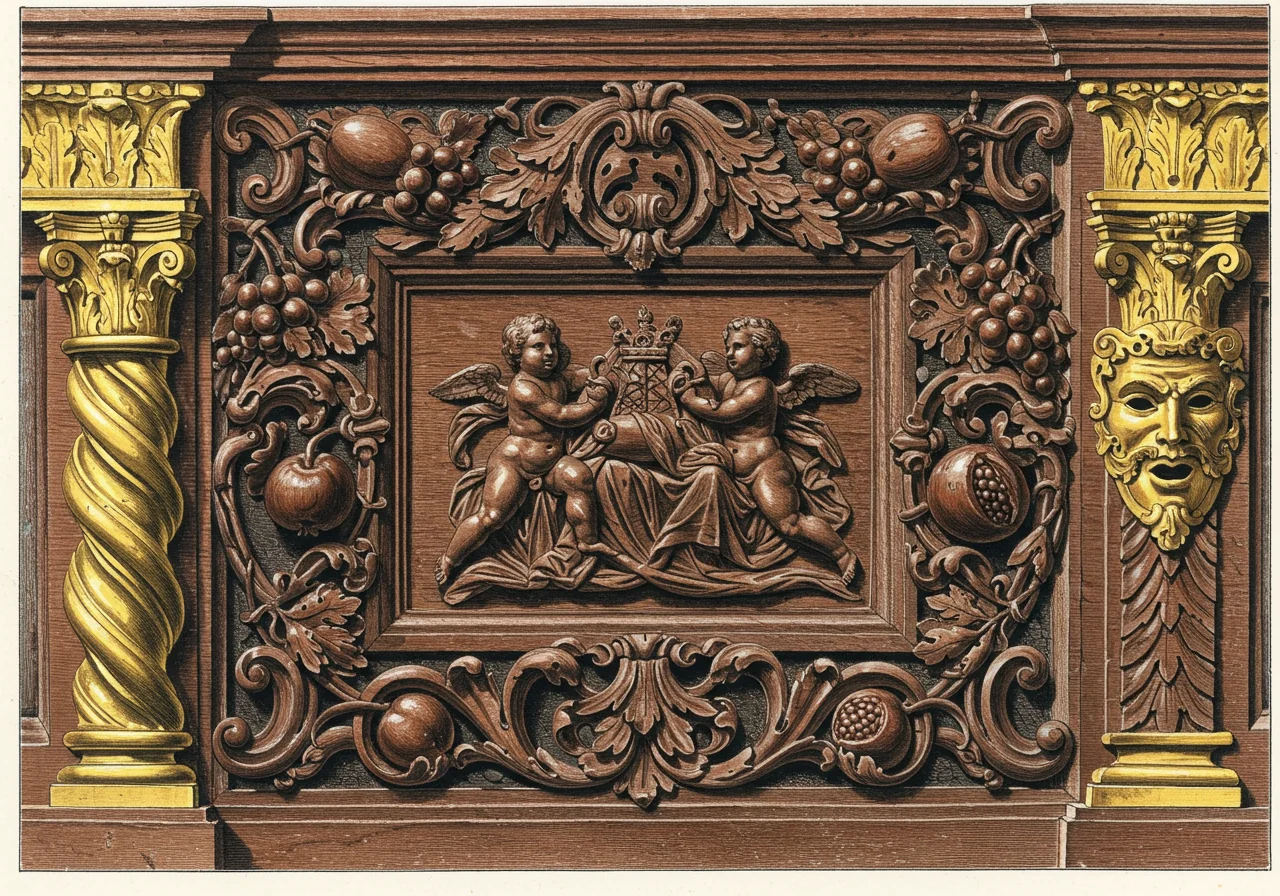
A close detail of Italian Baroque carved-walnut ornament — the deep-relief figurative carving in the dark Italian walnut of the period, with mythological figures, swags of fruit and laurel, and the Solomonic-column elements that Bernini’s baldacchino (1623–1634) had made the canonical vertical-ornament motif of the Roman papal-court register. The carving is in the wood of the case itself, not applied as a separate mount; this is the principle that distinguishes the Italian Baroque from the French Louis XIV ormolu-and-Boulle equivalent and from the Spanish Baroque iron-and-leather sibling.
The ornamental vocabulary across the case is the broader Italian Baroque vocabulary the Bernini circle had already established in stone and stucco. Deep-relief figurative carving — mythological scenes, allegorical figures, putti in clustered groups, swags of fruit and flowers, mascarons, cartouches with cardinal arms — covers the door panel, the case sides, and the upper entablature, cut deep enough into the walnut of the case itself that the figures stand nearly in the round, with the undercutting that produces the strong shadow-and-highlight contrast the Baroque aesthetic depended on. Above the entablature, a broken-pediment cresting of carved giltwood, often with a cartouche bearing the patron’s arms or a sculptural figure (a putto, an allegorical figure, a Marian image on the explicitly devotional pieces). The carved-and-gilded structural register, second, is what most distinguishes the Italian Baroque visually at three paces: the columns, the cornices, the entablature, and the cresting are gilded over a gesso-and-bole ground in the Roman water-gilding tradition the architectural workshops had perfected on church interiors, while the carved walnut of the figurative panels is left exposed. Where the French Louis XIV register would apply gilt-bronze ormolu as a separate metal element bolted to the case, the Italian Baroque gilds the carved wood itself, producing a softer and more sculptural gilt-relief than the crisp ormolu the French would develop a generation later.

A close detail of an Italian Baroque carved-and-gilded element — gilded carved walnut over a gesso-and-bole ground in the Roman papal-court gilding register. The gilt is on the carved wood itself, not on a separately-cast metal mount; the effect is softer and more sculptural than the cast gilt-bronze ormolu the French royal workshops would develop a generation later, and is part of how the Italian Baroque reads at three paces against the contemporary French equivalent.
The pietra-dura top, third, is the apex-piece signature. On the better stipi and on the heavy console tables the principal Roman palazzi commissioned for their galleries, the top is a pietra-dura panel — inlaid coloured marbles and hardstones in geometric, floral, or figurative arrangement, set into a marble or slate ground. The pietra-dura industry is concentrated, with great specificity, in Florence under Medici patronage: Ferdinando I de’ Medici founded the Opificio delle Pietre Dure in 1588 as a court workshop, and through the seventeenth century the Opificio produced the substantial pietra-dura tops that the Roman and Bolognese cabinet workshops then mounted onto their stipi and consoles. The Florentine pietra-dura is therefore not a generic “Italian Baroque” technique distributed across the whole peninsula but a Florentine workshop specialty, and the pieces that carry it bear in their tops the Medici-court industrial relationship to the broader Italian Baroque trade.
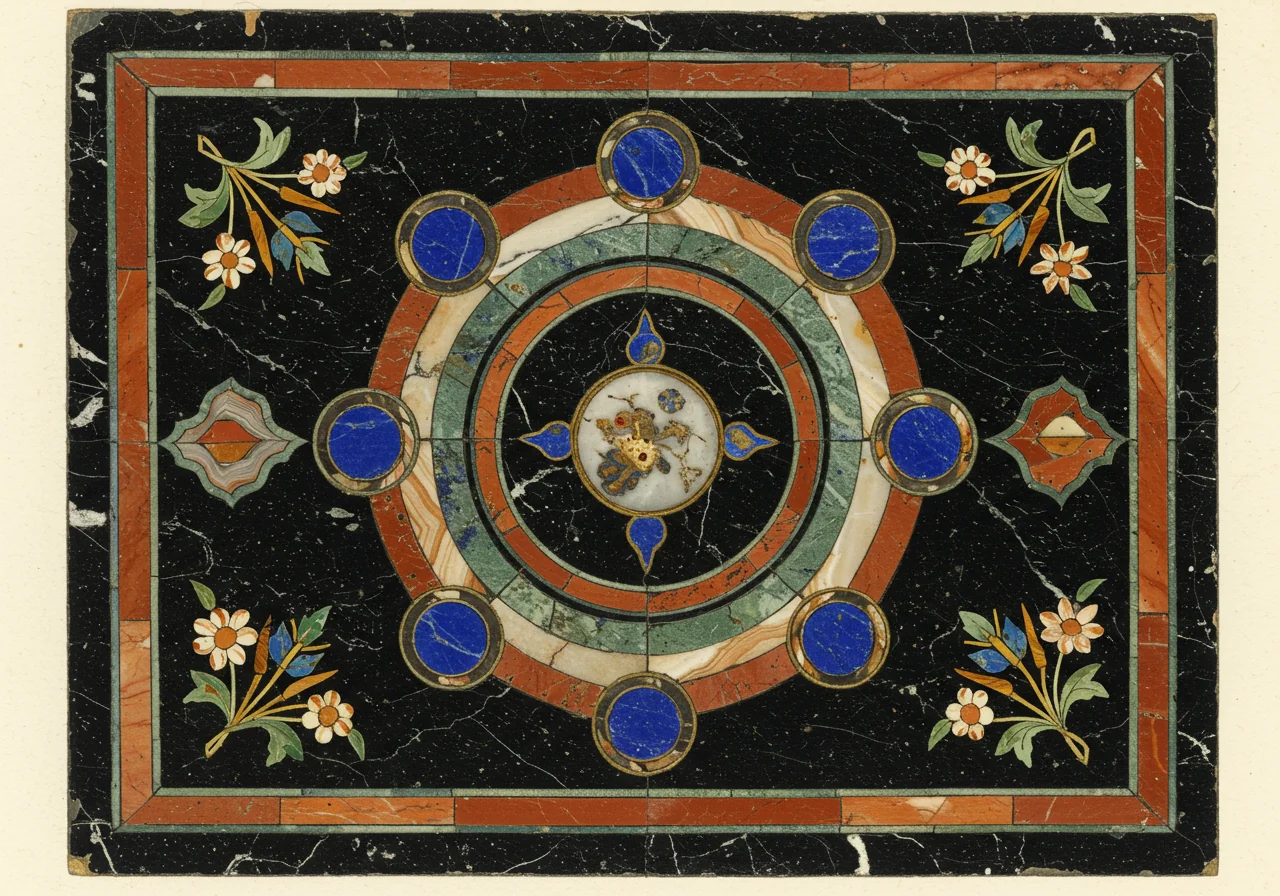
A close detail of a Florentine pietra-dura top — inlaid coloured marbles and hardstones (lapis lazuli, jasper, agate, porphyry) in a geometric and floral arrangement against a black marble ground, executed at the Opificio delle Pietre Dure in Florence and mounted on the cabinet stand by a Roman or Bolognese workshop. Pietra-dura is, with some specificity, a Florentine workshop tradition under Medici patronage rather than a generic Italian Baroque technique; the apex pieces in this medium are Opificio products of the seventeenth century.
The Evidence
The wood, first. Italian walnut — the principal cabinet wood of the Italian peninsula across the sixteenth and seventeenth centuries — is what the surviving period stipi and consoles are made of, with a small minority of pieces in cypress, oak, or fruitwood for provincial registers. The walnut is dense, close-grained, and naturally dark; the seventeenth-century pieces are darker still after three and a half centuries of natural oxidation and accumulated wax-and-oil patina. The wood is solid on the structural members and joined by the period hand at hand-cut mortise-and-tenon and dowel joints; the deep-relief carving cuts into the solid walnut itself rather than into an applied carved appliqué. This is the structural enabling condition for the deep-relief figurative carving the style depends on: Italian walnut takes deep carving without splintering, where the softer woods of the Northern traditions could not.
The carving and the gilding, second, are most of what one is reading for at close range. The carved relief is deep — figures stand nearly in the round, with substantial undercutting — and the figurative-Baroque vocabulary (mythological figures, putti, allegorical females, swags of fruit and laurel, mascarons, and cardinal-armorial cartouches) is what most distinguishes the Italian Baroque from the contemporary French, Spanish, and Northern European Baroque registers. The gilt is water gilt over a gesso-and-bole ground in the Roman ecclesiastical-workshop register, applied to selected structural members rather than to whole surfaces, and should show period wear in a characteristic pattern: rubbed at the high-touch areas, surviving in the hollows, and showing through to a red bole ground at the worn spots rather than to a yellow or white modern gilding-base or to bare wood. The bole-coloured underlayer is itself an authentication indicator the late-nineteenth-century revival workshops did not consistently reproduce.
The pietra-dura, third, where present. The hardstones should be cut and fitted by the period hand — Opificio pieces show the characteristic fine-line joints between the inlaid stones (executed with the bow-saw and abrasive paste over weeks or months per panel), the slight irregularities of hand-fitting at the corners, and the depth of the inlay flush with the marble ground. The hardstone vocabulary of the seventeenth-century Opificio includes lapis lazuli, jasper, agate, porphyry, chalcedony, and various marbles against a black or coloured marble ground; the colour vocabulary is recognisable to anyone who has stood in the Cappella dei Principi in Florence, where the same workshop’s apex output is mounted on the walls.
The Period
The Italian Baroque period proper runs from about 1600 to about 1700, with apex production concentrated in the middle decades — roughly 1620 through 1680 — under the patronage of the great Roman papal-affiliated families. The dating is therefore both earlier and broader than the eighteenth-century styles the prior posts have covered, and the documentary anchor is not a pattern book or a regnal date but the architectural-and-decorative work the Bernini circle was producing in parallel for the same patrons. Gian Lorenzo Bernini (1598–1680) — sculptor, architect, designer of the baldacchino at St Peter’s (1623–1634), of the colonnade in St Peter’s Square (1656–1667), of the Cornaro Chapel — established the design vocabulary in stone, stucco, and gilded wood that the contemporary cabinet workshops then adapted to the stipo, the console, and the cassone; Francesco Borromini (1599–1667) is the second architectural figure, more idiosyncratic, whose ornamental vocabulary the cabinet trade absorbed selectively. The patron class is the cardinal-and-prince Roman families — Borghese (under Paul V), Barberini (under Urban VIII, the central Bernini patron, 1623–1644), Pamphilj (under Innocent X, 1644–1655), and Chigi (under Alexander VII, 1655–1667) — and the surviving apex pieces are preserved in the principal Roman palazzi (Palazzo Barberini, Palazzo Doria Pamphilj, Galleria Borghese) and in the museum collections that have absorbed dispersed family holdings.
The load-bearing distinction every Italian Baroque collector must master, however, is not the chronology or the patron families but the named-master-versus-anonymous-workshop attribution problem that runs through the period and that has no good parallel in the later styles this arc has covered. The Italian Baroque cabinet trade did not produce a pattern book in the Director sense — there is no Italian Chippendale, no published codification of the workshop register under a single master’s name. Italian Baroque furniture is, with very few exceptions, unsigned, and the documentary attribution is therefore principally a workshop attribution rather than a master attribution. Andrea Brustolon (1662–1732), the Venetian late-Baroque virtuoso sculptor-carver, is the partial exception that proves the rule: his signed and documented work for the Venier and Correr families in Venice constitutes the only substantial body of named-master Italian Baroque cabinet-and-carved-furniture, and the trade attribution “Brustolon” therefore has the kind of standing that “Chippendale” has in the English register — with the difference that Brustolon operated at the very end of the Baroque period, in Venice rather than Rome or Bologna, and almost entirely in the carved-figurative-stand-and-frame register rather than in the broader case-furniture trade. Giovanni Giardini (1646–1721), to name a second documented figure, was a Roman silversmith-and-metalworker whose name attaches to certain documented commissions but who operated more at the workshop-administrative level than as a recognisable cabinet-making hand. For the bulk of the surviving Italian Baroque corpus the practical-attention work for the collector is to read at the workshop level — Roman papal-court workshops (anonymous, producing the apex stipi and consoles under direct cardinal-or-papal commission, with the carving hand recognisable to the trade but not traceable to a named master), Bolognese cabinet-making workshops (one of the major production centres alongside Rome, Florence, Genoa, and Venice, with a documented industrial cabinet-making concentration in Bologna through the seventeenth century and a workshop hand distinguishable from the Roman by carving conventions and proportional treatment), Florentine workshops under Medici patronage (specifically the Opificio delle Pietre Dure for pietra-dura tops, and the broader Medici-court furniture workshops for the cassoni and case-furniture that mounted them), Genoese workshops (carrying their own distinct regional register, of which the stipo a bambocci — the cabinet with deeply carved figural caryatids of grotesque children or putti supporting the case — is the most recognisable Genoese seventeenth-century form), and Venetian workshops (operating somewhat apart from the central-Italian axis, working in a slightly lighter register and continuing latest into the eighteenth century where Brustolon’s work belongs). The trade has long argued about specific attributions — what’s Brustolon and what’s a workshop follower, what’s seventeenth-century Bolognese and what’s nineteenth-century Italian revival in the Bolognese register — and the practical knowledge for the buyer is to read at the workshop level confidently rather than chase a named master that the period documentation almost never supports.
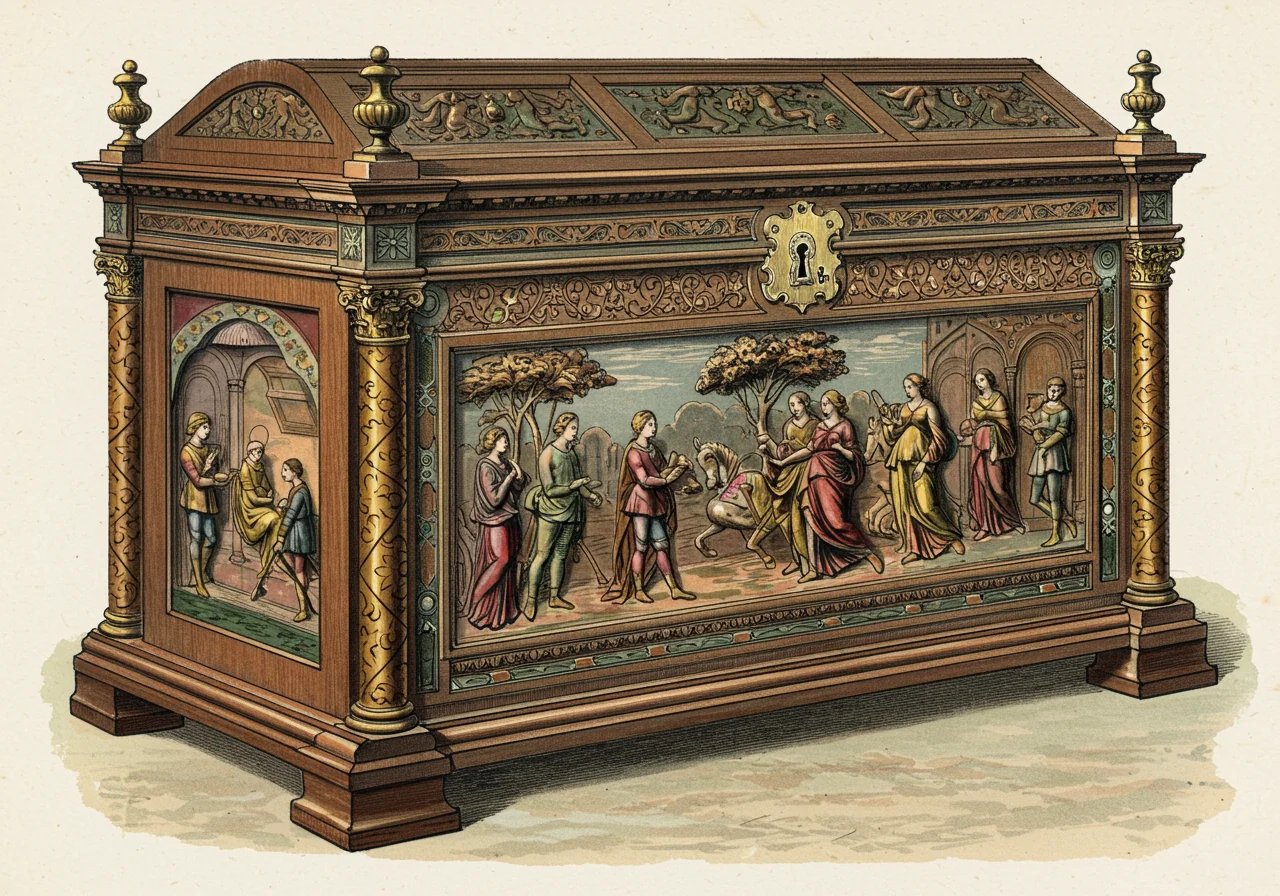
A 16th-c Italian Renaissance cassone — the marriage-chest the principal Italian domestic form of the fifteenth and sixteenth centuries, with rectangular relief-carved panels in walnut, often gessoed-and-painted with mythological scenes, and lower-relief carving than the Baroque period would elaborate. The Italian Baroque inherited the cassone form and the figurative-carving tradition, then elaborated both into the room-scale stipo with deep-relief carving, carved-and-gilded structural members, and pietra-dura tops. The cassone tradition itself continued through the Baroque period at a smaller and more conservative register, but the principal Baroque innovation is the architectural stipo and the heavy console that succeeded the cassone as the principal salon object.
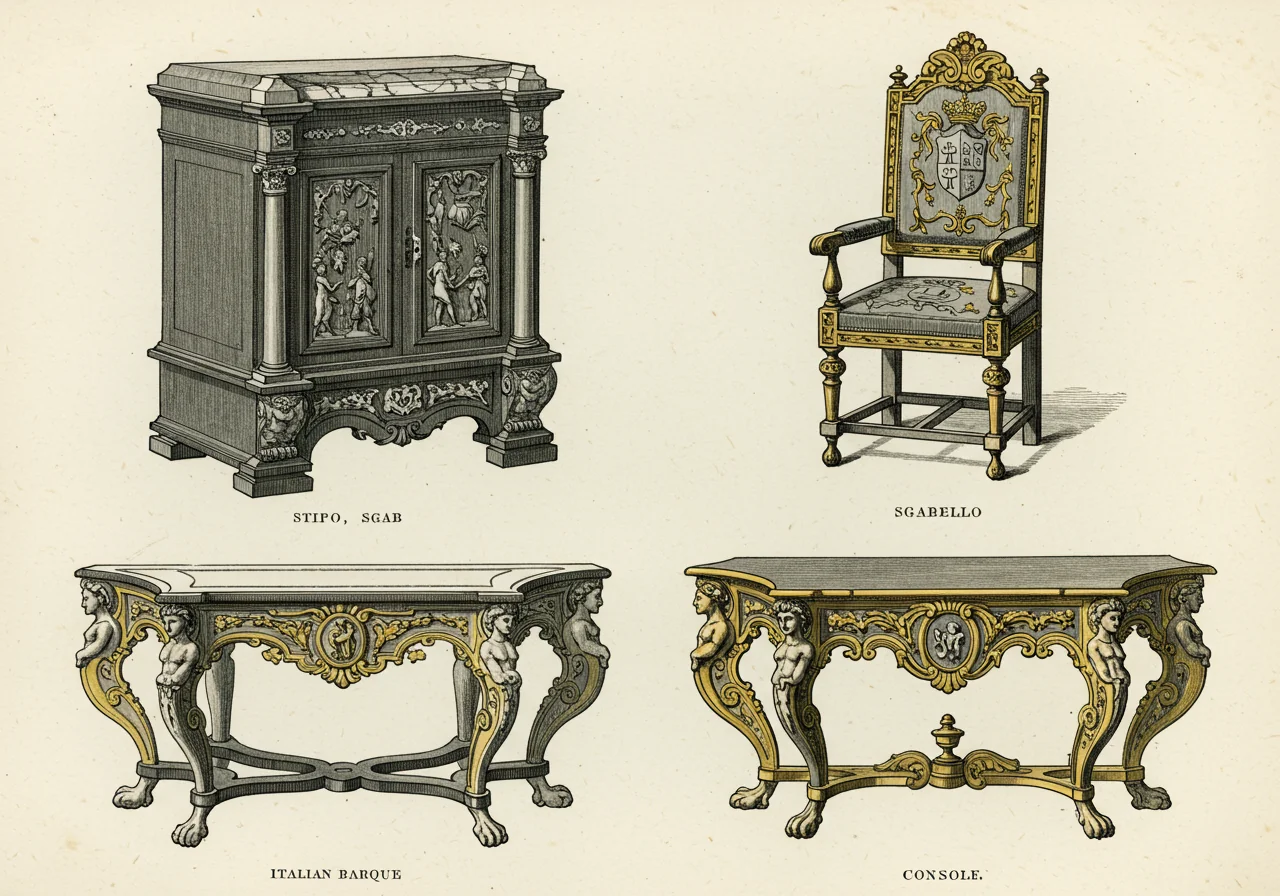
A page from a Bolognese cabinet-maker’s reference plate — perspective drawings of the principal Italian Baroque forms: the architectural stipo cabinet on carved-giltwood stand, the sgabello trestle side chair (a Renaissance form continued into the Baroque) with carved-and-painted back-panel, and the heavy console with Atlas-supported top. The Italian Baroque trade did not produce a published pattern book in the English Director sense; reference drawings of this kind circulated within and between workshops in manuscript and engraved form, and survive in scattered collections rather than as a single codifying document. The Bolognese cabinet-making centre was one of the major production nodes for the broader Italian Baroque trade — alongside Rome, Florence, Genoa, and Venice — and the proportional and ornamental conventions visible in such drawings are the Bolognese workshop register specifically.
What It Is Not
Four styles stand near enough to Italian Baroque that the beginner confuses them with it, and distinguishing them is most of the work of reading seventeenth-century Continental furniture in its national-and-regional registers.
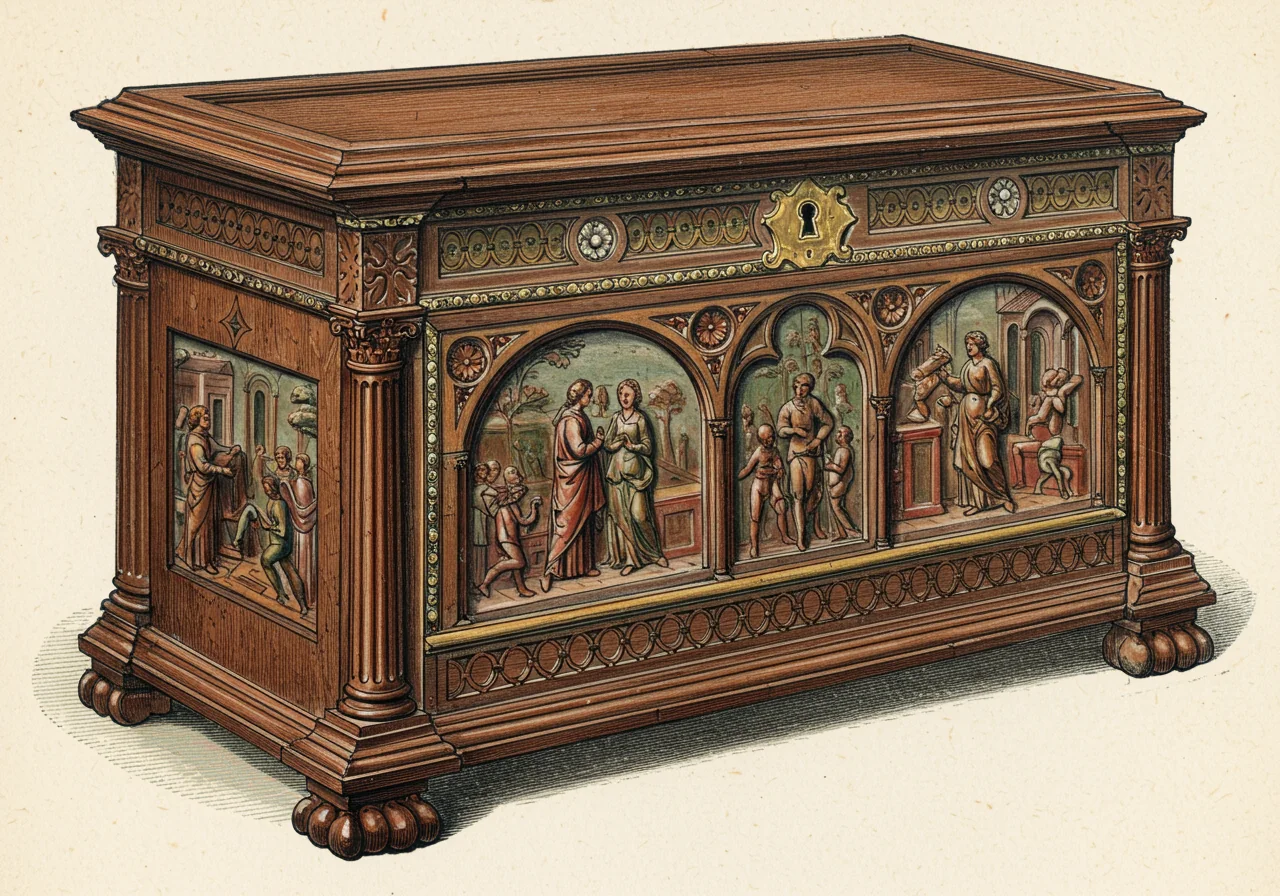
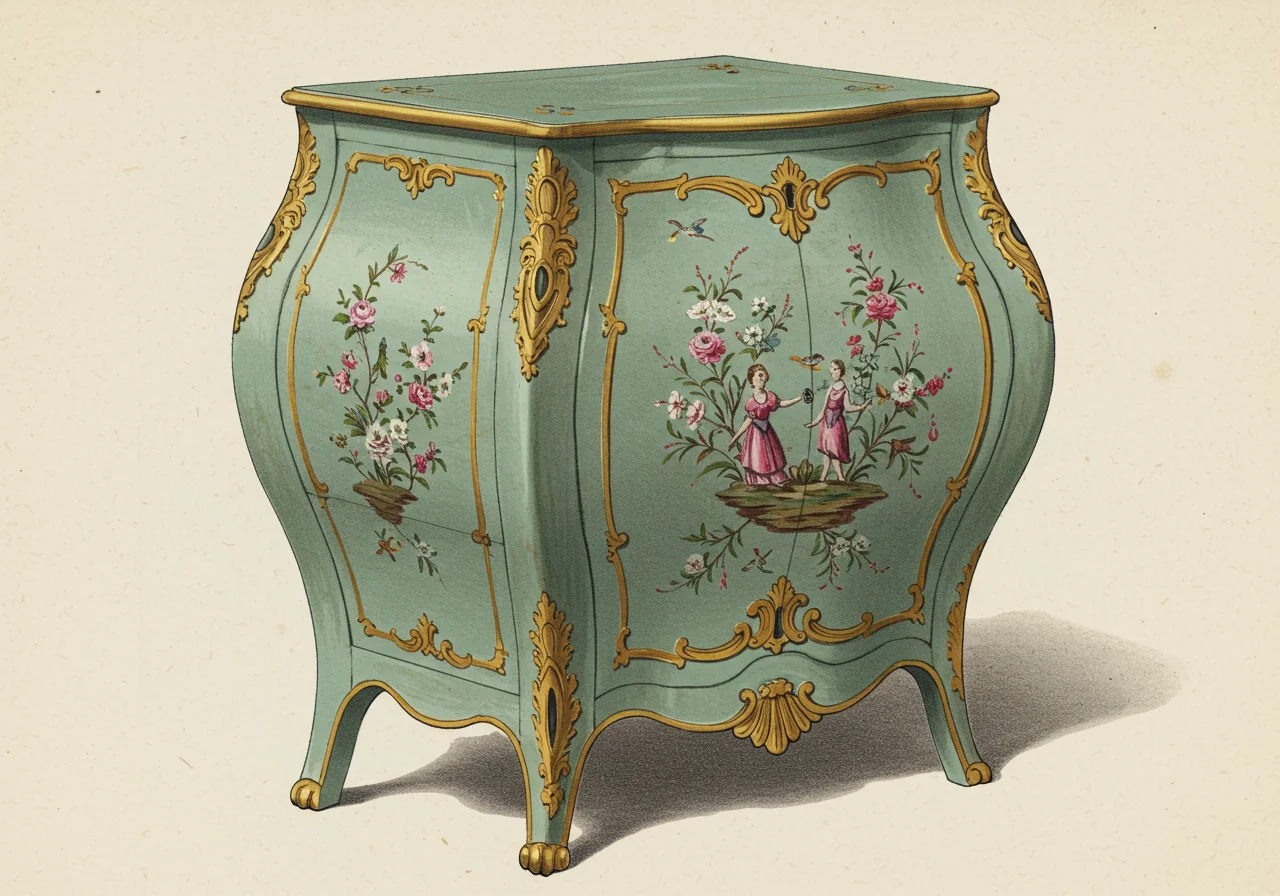
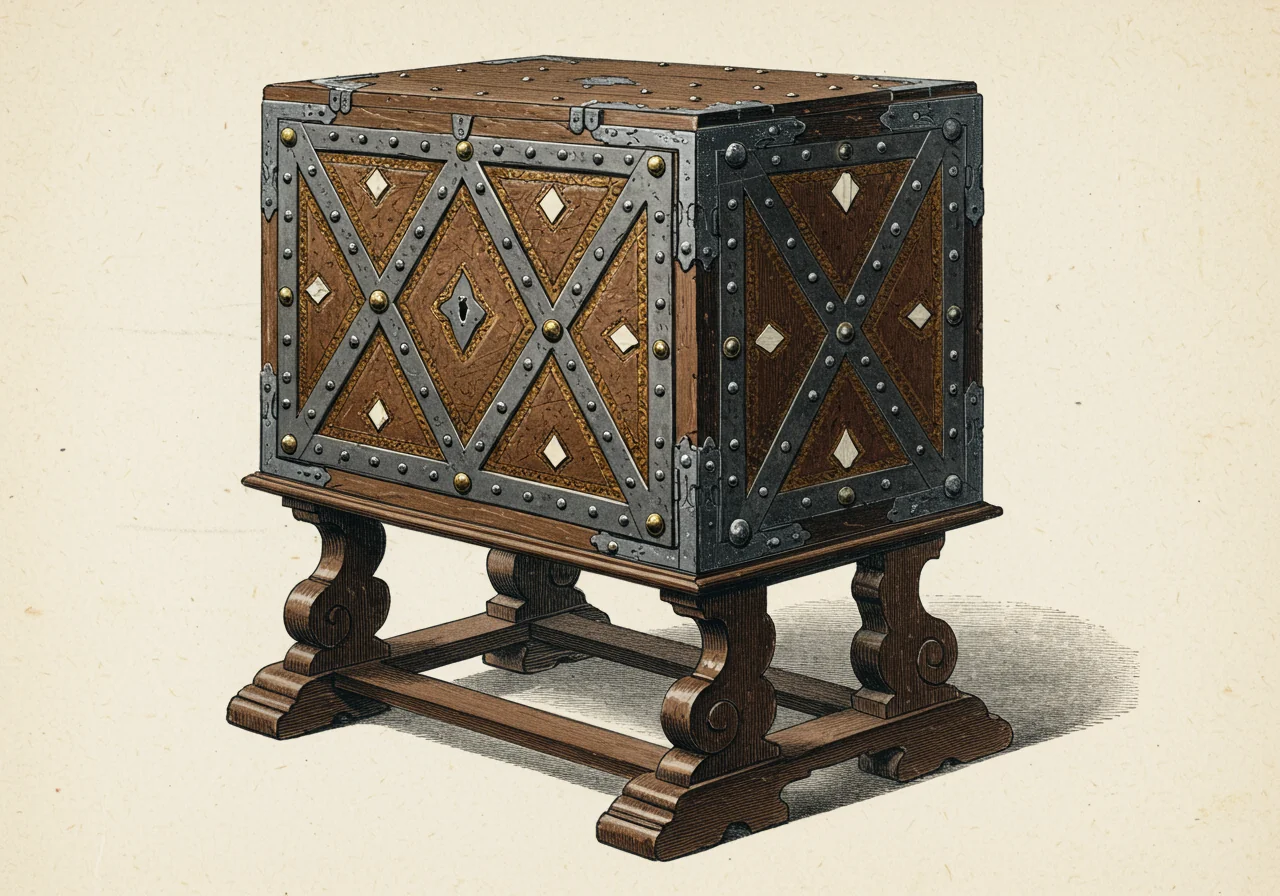
An Italian Renaissance is the sixteenth-century antecedent the Baroque period elaborated. The form vocabulary is in part continuous — the cassone above all, but also the simpler cabinet-on-stand — but the carving is lower in relief (gessoed-and-painted figurative panels rather than the deep undercut walnut of the Baroque), the proportions are simpler, and gilding is applied only to selected accents rather than to whole structural members. The rule of thumb: lower-relief carving with gessoed-and-painted figurative panels is Italian Renaissance; deep-relief figurative walnut carving with carved-and-gilded structural members and room-scale architectural proportions is Italian Baroque.
An Italian Rococo (Venetian) is the eighteenth-century descendant — the lighter Venetian succession that flourished from about 1730 through about 1790, with painted lacquer (red, green, blue, ivory, pale yellow) rather than dark carved walnut, carved giltwood in the rococo curvilinear register rather than the Baroque rectilinear-architectural register, and a domestic-decorative orientation. The Venetian Rococo will earn its own post later in this arc. The rule of thumb: painted-lacquer cases with carved-giltwood rococo ornament are Italian Rococo; dark walnut with deep-relief carved figurative ornament and carved-and-gilded structural members are Italian Baroque.
A Spanish Baroque is the Iberian sibling — produced in the same seventeenth-century decades for the parallel cardinal-and-monarch patron class in Madrid, Seville, and Toledo, but executing the Baroque impulse in an entirely different ornamental vocabulary. Spanish Baroque is also in dark walnut, but the surface vocabulary is iron studs and bands, tooled leather panels, and bone-or-ivory inlay — the Mudejar Islamic inheritance still legible in the seventeenth-century work — rather than the carved gilt and pietra-dura of the Italian register. The vargueño (the Spanish drop-front writing-cabinet, form-parallel to the Italian stipo) is the canonical specimen. The rule of thumb: dark walnut with iron studs, tooled leather, and bone inlay is Spanish Baroque; dark walnut with carved-and-gilded structural members and Florentine pietra-dura is Italian Baroque.
A French Louis XIV is the heavier royal-court sibling — the Continental royal counterpart that developed in parallel from the 1660s under the Manufacture Royale des Gobelins and drew on the same Italian Baroque sources. The French royal register substitutes Boulle marquetry — André-Charles Boulle’s signature tortoiseshell-and-brass inlay — and cast gilt-bronze ormolu mounts in place of the Italian carved-and-gilded-wood structural ornament and pietra-dura tops, and the proportions become heavier still in the French royal direction. The rule of thumb: Boulle tortoiseshell-and-brass marquetry with cast gilt-bronze ormolu is French Louis XIV; carved walnut with carved-and-gilded structural members and Florentine pietra-dura is Italian Baroque.
What One Looks At
One looks first at the workshop attribution, and the workshop settles the broad reading more reliably than any named-master claim. Roman papal-court workshop output is the apex of the type — produced for the cardinal-and-papal patron class, with the strongest deep-relief carving, the most ambitious architectural proportions, and the closest design relationship to the Bernini-circle source. Bolognese workshop output is one of the major production centres alongside Rome, Florence, Genoa, and Venice, with a recognisable carving hand and proportional treatment the trade distinguishes from the Roman; a substantial share of surviving non-apex Italian Baroque furniture carries the Bolognese register. Genoese workshop output carries its own distinct regional vocabulary — the stipo a bambocci, with deeply carved figural caryatids of grotesque children or putti as the supporting members, is the most recognisable Genoese seventeenth-century form and a register the collector reads against the Roman and Bolognese. Florentine workshop output is principally the pietra-dura tops from the Opificio and the case-furniture that mounted them; the medium itself is the workshop signature. Venetian workshop output is the late-Baroque continuation into the eighteenth century, with Brustolon as the only substantial named master in the corpus.
One looks next at the wood and the carving. The wood should be dark Italian walnut (with cypress, oak, or fruitwood permitted at provincial registers); the carving should be deep-relief and figurative in the wood itself; the figurative vocabulary should be the Baroque vocabulary (mythological figures, putti, swags, mascarons, cartouches) rather than the Renaissance vocabulary (gessoed-and-painted panels at lower relief) or the Rococo vocabulary (asymmetric scrolled curves). A piece in apparent Baroque register but with shallow relief at gessoed-panel depth is probably Italian Renaissance or a later revival; a piece with the figurative-Baroque vocabulary but in painted lacquer rather than walnut is Italian Rococo.
One looks then at the carved-and-gilded structural register. The gilt should be on the carved wood itself — columns, cornices, entablature, cresting, stand — not as a separately-cast metal mount, and over a red bole ground in the Roman water-gilding tradition rather than a yellow or white modern ground. The carved-wood-and-gilt structural framing set against the dark-walnut figurative panels is the canonical Italian Baroque surface effect, and the contrast reads at three paces against the French Louis XIV ormolu-and-Boulle equivalent (which substitutes cast metal for carved wood) and against the Spanish Baroque iron-and-leather equivalent (which substitutes metal-and-hide for gilded wood).
And one looks, finally, at the pietra-dura top where present. The hardstones should be cut and fitted by the period hand, with the characteristic fine-line joints of Opificio bow-saw work; the colour vocabulary should be the seventeenth-century Opificio vocabulary (lapis, jasper, agate, porphyry, chalcedony, the Florentine marbles) against a black or coloured marble ground. A piece with pietra-dura is, by that fact, anchored to the Florentine workshop industry under Medici patronage, and the documentary attribution of the top is often clearer than the attribution of the cabinet beneath. The mounting of a Florentine pietra-dura top onto a Roman or Bolognese cabinet stand is one of the most characteristic industrial relationships in the seventeenth-century Italian Baroque trade.
The next post in the furniture arc will be either Italian Rococo (Venetian) — to extend the Italian tradition into the painted-lacquer eighteenth-century descendant, with the colour-painted variety break that the wood-tone variety table calls for next — or Spanish Baroque, to open the Iberian sibling tradition with the iron-and-leather register that the seventeenth-century Continental survey requires. The choice will depend on what photographic material is available at the time of writing.