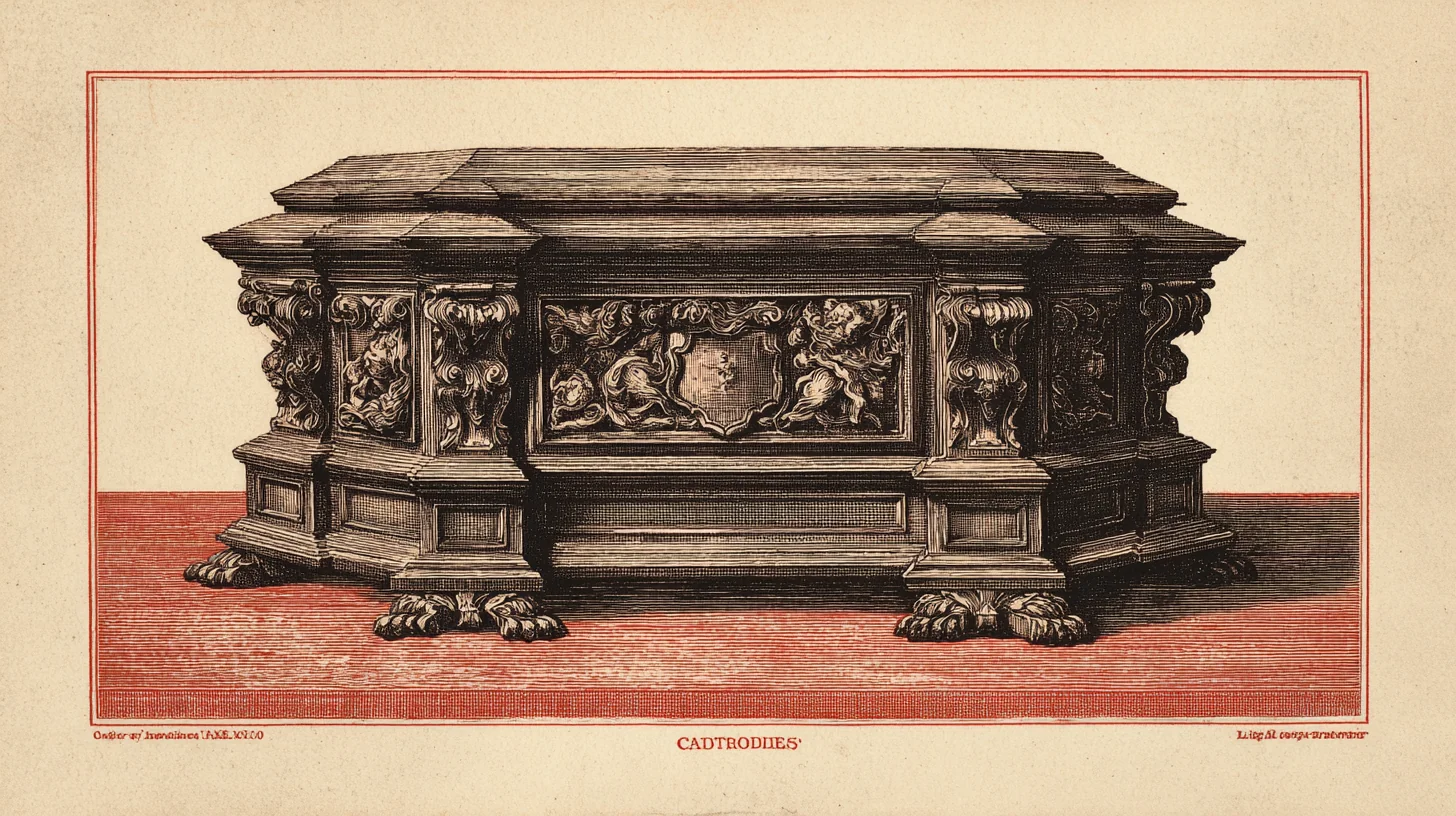
The sixth post in this arc treated the Italian Baroque, and named the Italian Renaissance as the antecedent it had grown out of — the sixteenth-century cassone tradition from which the seventeenth-century stipo was elaborated. That post left the antecedent as a single figure and a paragraph; this one returns to it and gives it the full reading it was promised. For the Italian Renaissance is not merely one tradition among the others this arc has surveyed. It is, by date, the earliest of them all, and something more than early: it is the fount. The fifteenth- and sixteenth-century furniture of Florence, Venice, Rome, and the northern Italian cities is the head of the stream from which the whole European cabinet tradition — French, Spanish, English, German, and the Italian Baroque itself — afterward ran.
This is the eleventh post in Reading the Period Cabinet. As with the Hepplewhite, Sheraton, and Regency posts before it, it is a taxonomy post — a description of a type and of the evidence by which one reads it, not a personal narrative. Its type-specimen is the cassone, the carved walnut marriage-chest; its principal ornament is deep-relief carving drawn directly from classical Roman architecture; and its load-bearing distinction is not between the Italian Renaissance and a neighbouring style at all, but between genuine fifteenth- and sixteenth-century work and the enormous nineteenth-century industry that imitated it.
The Specimen
The canonical Italian Renaissance piece, for the purpose of beginning to read the style, is the cassone — the marriage chest. It is canonical for the same reason the side chair was canonical for the Regency: it concentrates the whole vocabulary into a single object the eye can take in at once, and it carries, besides, the social meaning of the tradition more plainly than any other form. The cassone was the great carved chest given at a wedding — commissioned by the bride’s family, often in a pair, to receive her trousseau and her dowry; carried through the streets in the marriage procession in full public view, so that the wealth and taste of the two houses being joined should be seen and counted. It is furniture and it is also an instrument of display, and the Renaissance made it accordingly grand.
A canonical cassone, then. It is a long rectangular chest of walnut — noce, the dense dark close-grained walnut of the Italian peninsula, the principal timber of the whole tradition. Its proportions are architectural: the front is treated not as a plank but as a facade, divided by carved pilasters into panelled bays, capped by a moulded entablature along the lid, and standing on carved lion-paw feet. The principal ornament is deep-relief carving cut into the solid walnut of the chest itself — classical figures, clustered putti, acanthus foliage, swags of fruit, grotesque masks — deep enough to throw a strong shadow, and drawn, motif for motif, from the architecture and sculpture of ancient Rome. On the better pieces the front is shaped as a Roman sarcophagus, a chest made deliberately in the form of an antique tomb. And the working hardware is iron: a wrought-iron lockplate, hasps, and corner mounts, a genuine and functional period feature, not an ornament — the chest had to secure a dowry.
The cassone states the principle, but the Renaissance interior held several other forms, and the collector should know them by name. The credenza is the side cupboard — a low case of cupboards and drawers on which plate and food were set out, its name carrying the old sense of the tasting by which a servant proved the food safe. The cassapanca is a cassone given a high panelled back, and often arms — a bench-chest, the grandest seat in the Renaissance hall. The sgabello is the distinctive Renaissance hall stool: a small octagonal or shaped seat carried not on four legs but on two solid carved board-trestles, often with a carved upright back-board — a form so particular to the period that it is itself nearly diagnostic. The savonarola and dantesca chairs are the two X-frame chairs descended from the Roman curule seat — the savonarola the folding one, built of many interlaced curved slats; the dantesca the heavier fixed chair, its X-frame rigid; the refectory table is a long plank top carried on two carved trestle-ends. Every one of them is built of walnut and reads as architecture.
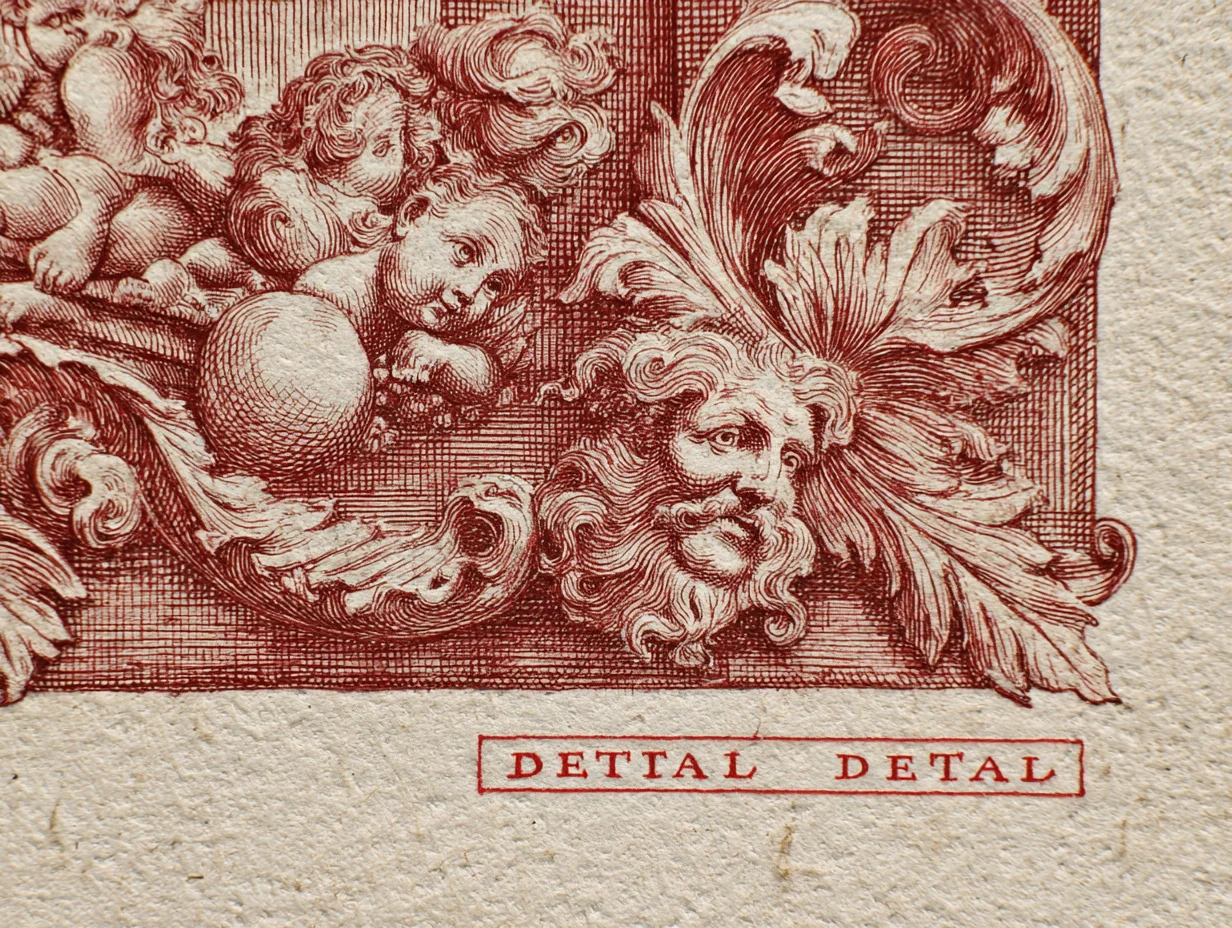
A close detail of Italian Renaissance walnut relief carving — the classical putti, acanthus, and architectural ornament drawn from the Quattrocento and Cinquecento classical-revival vocabulary.
The Evidence
The wood, first, because the wood is most of what one is reading for, and the most reliable single witness to age. The Italian Renaissance worked, with very few exceptions, in walnut — noce — the dense, hard, naturally dark timber of the peninsula, which takes a deep cut without splintering and so made the deep-relief carving structurally possible at all. The northern traditions reached for oak; Italy did not. On a genuine fifteenth- or sixteenth-century piece the walnut has had five centuries to age, and it shows it: a deep oxidised brown that no stain reproduces, a wax-and-handling patina in the hollows of the carving, and — the point the collector should hold on to — the shrinkage. Solid walnut shrinks across the grain over centuries, and a genuine cassone front shows it in the gapped panels, the proud mouldings, the splits that have opened along the boards and been lived with. The timber was hand-hewn besides, and the under-surfaces keep the faint scalloped record of the adze.
The carving, second, is the principal decorative register and the principal field of forgery. The Renaissance carver cut his ornament into the solid walnut of the piece itself — it is not an appliqué glued to a flat ground — and he cut it by hand. Hand carving leaves evidence: the depth varies, the tool has left facets that catch the light unevenly, symmetrical motifs are answered freehand and never quite mirror-perfect, and the relief is genuinely deep, undercut so that the figures stand nearly clear of the ground. The vocabulary is wholly classical — pilasters, entablatures, pediments, egg-and-dart and acanthus mouldings, draped figures, putti, grotesques, lion masks, lion-paw feet — and none of it was invented by the cabinet-maker. All of it was lifted, by carvers working alongside the architects, from the standing ruins of ancient Rome.
The iron, third — a genuine period feature of the chests, not a decorative afterthought, which is why it carries evidence of its own. A Renaissance cassone was a strongbox as well as a piece of furniture, and its lockplate, hasps, drop-handles, and corner mounts are wrought iron — forged by hand at the anvil, the surface faintly irregular, the scrolled and pierced lockplates cut and filed by a smith. Wrought iron is not cast iron, and the distinction is decisive: cast iron is poured into a mould, reproduces every casting in identical detail, and is a nineteenth-century material. A period chest carries hand-forged iron, often pitted with five centuries of corrosion; the metal alone will sometimes settle the question before one has looked at the wood.
The fourth register is the special decoration, where present, and there are two kinds. Some pieces carry certosina — a fine geometric micro-inlay of bone, light and dark woods, and sometimes ivory, set into the walnut in intricate star and interlace patterns, most associated with Venice and Lombardy. And some cassoni are not carved at all but painted: the front is a gessoed panel bearing a narrative scene in tempera — the Triumph of Love, the Continence of Scipio, a classical myth — and the grandest of these fronts were the work of named painters, so that a number now hang on museum walls as pictures, divorced from the chests they once fronted.
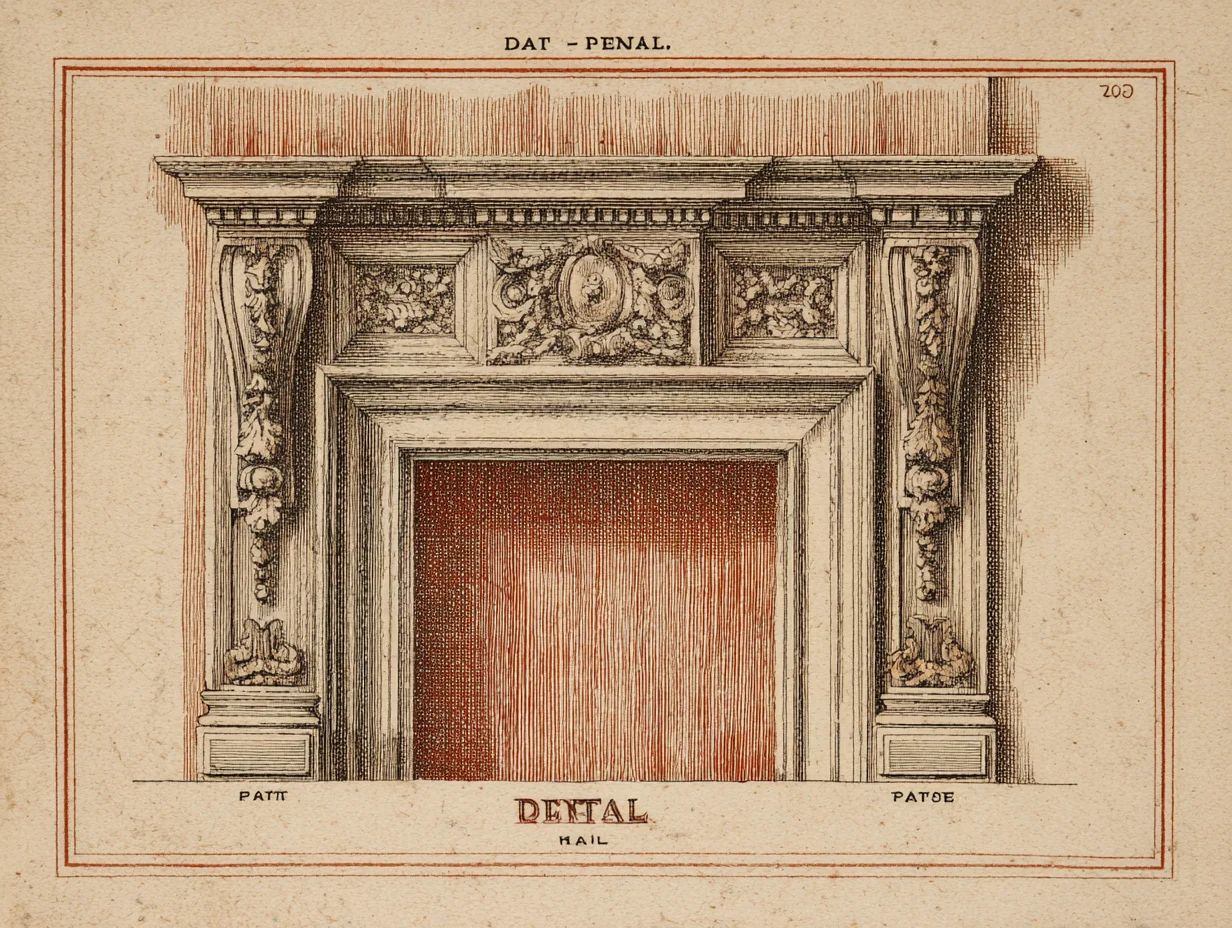
A close detail of an Italian Renaissance cassone painted panel — a classical narrative scene (often the Triumph of Love, the Continence of Scipio, or a mythological subject) in tempera on gesso, the principal decorative surface of the marriage-chest tradition.
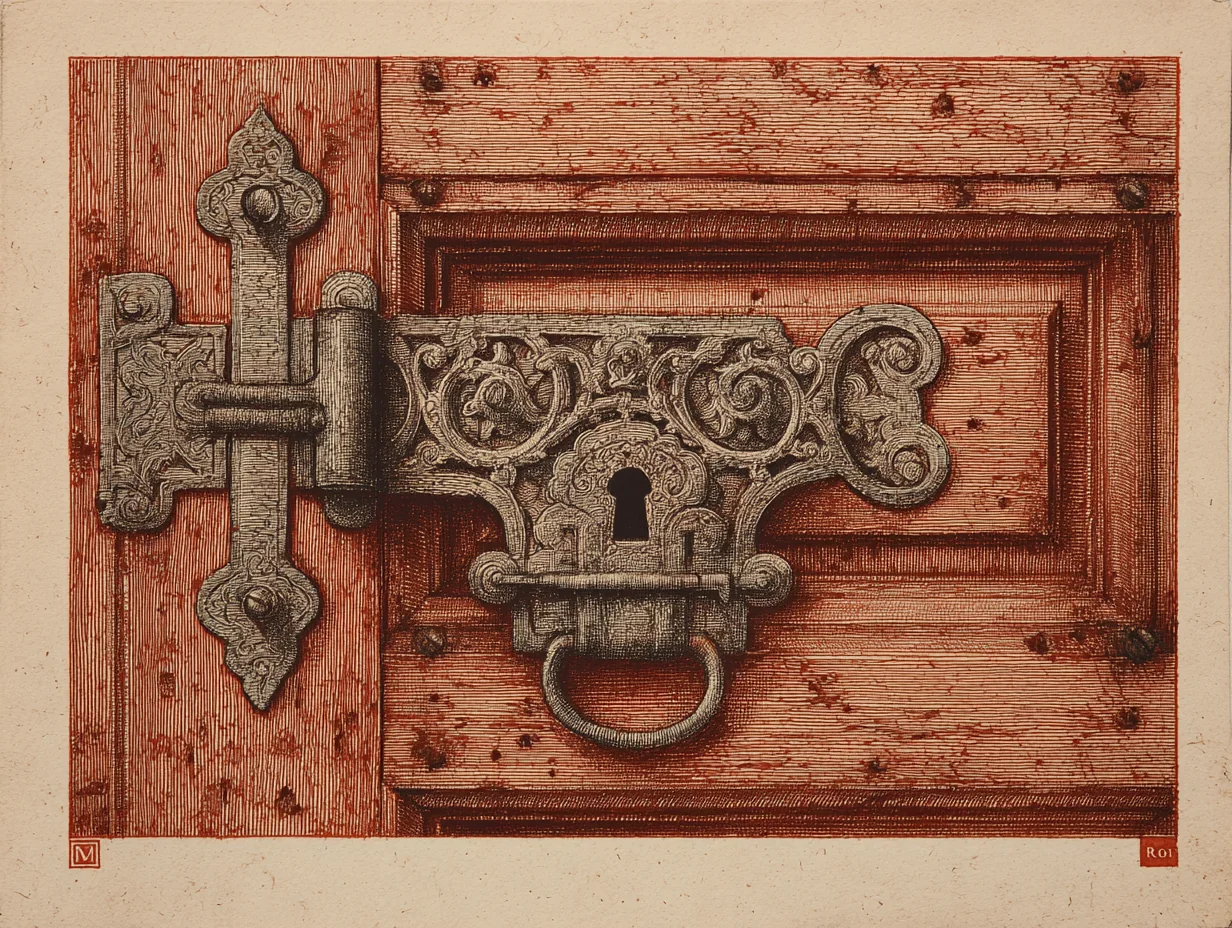
A close detail of Italian Renaissance iron lockwork and corner-mounts on a cassone — the working hardware of the marriage chest, made to secure the bride’s dowry and to last centuries.
The Period
The Italian Renaissance, as a furniture period, runs across the fifteenth and sixteenth centuries — the Quattrocento and the Cinquecento — until the seventeenth-century Baroque elaborated it out of recognition. It is the earliest tradition this arc has surveyed, and it has, in consequence, no documentary pattern book of the kind the later posts have leaned on. There is no Italian Chippendale, no Hope’s Household Furniture. What the period has instead is something the cabinet-maker’s pattern book never had: the standing architecture of the Renaissance itself.
For the central fact of the period is that its furniture was made by the same hands and in the same vocabulary as its buildings. The Italian Renaissance was, before it was anything else, a deliberate revival of classical antiquity — a conscious return, by the architects and humanists of fifteenth-century Florence, to the forms and proportions of ancient Rome, of which the ruins stood all about them. The architects — Brunelleschi, Alberti, and the generation after them — drew the pilaster, the entablature, and the classical mouldings out of the antique and made of them a new architecture; and the furniture followed directly, because the carvers who cut a cassone front were the carvers who cut an altar-frame. This is why a Renaissance chest reads as a small building: it was made by men who thought architecturally because the whole culture around them had decided, as a matter of programme, to think so.
The patron was the merchant-prince and the patrician household. The Italian Renaissance was financed not by a crown — there was no Italian crown — but by the banking and trading wealth of the city-republics, and above all by Florence, where the Medici, bankers before they were anything grander, set the tone the lesser houses followed. The cassone belongs precisely to this world: the marriage of two such houses was a financial and political event, and the commissioning of a carved or painted pair of cassoni was an expenditure undertaken for the same reasons such houses commissioned an altarpiece. The grandeur of the Renaissance interior is the grandeur of a class that had money and meant it to be seen.
The antecedent the Renaissance cassone grew out of was the medieval chest — the plain, functional, iron-bound storage chest of the Italian Middle Ages, and, in its later phase, the Italian Gothic chest with its pointed-arch tracery. The medieval chest was first of all a strongbox: a rectangular box of boarded timber, bound in iron, locked, and either left plain or decorated only with simple geometric and Gothic-arched ornament. The Renaissance did not invent the marriage chest, nor the form of it. What it did was take that medieval box and elaborate it — keep the rectangular body and the iron lock, and cover the front with the classical carving and the painted narrative panel the new antiquarian taste supplied. The cassone is the medieval chest with the Renaissance poured into it.
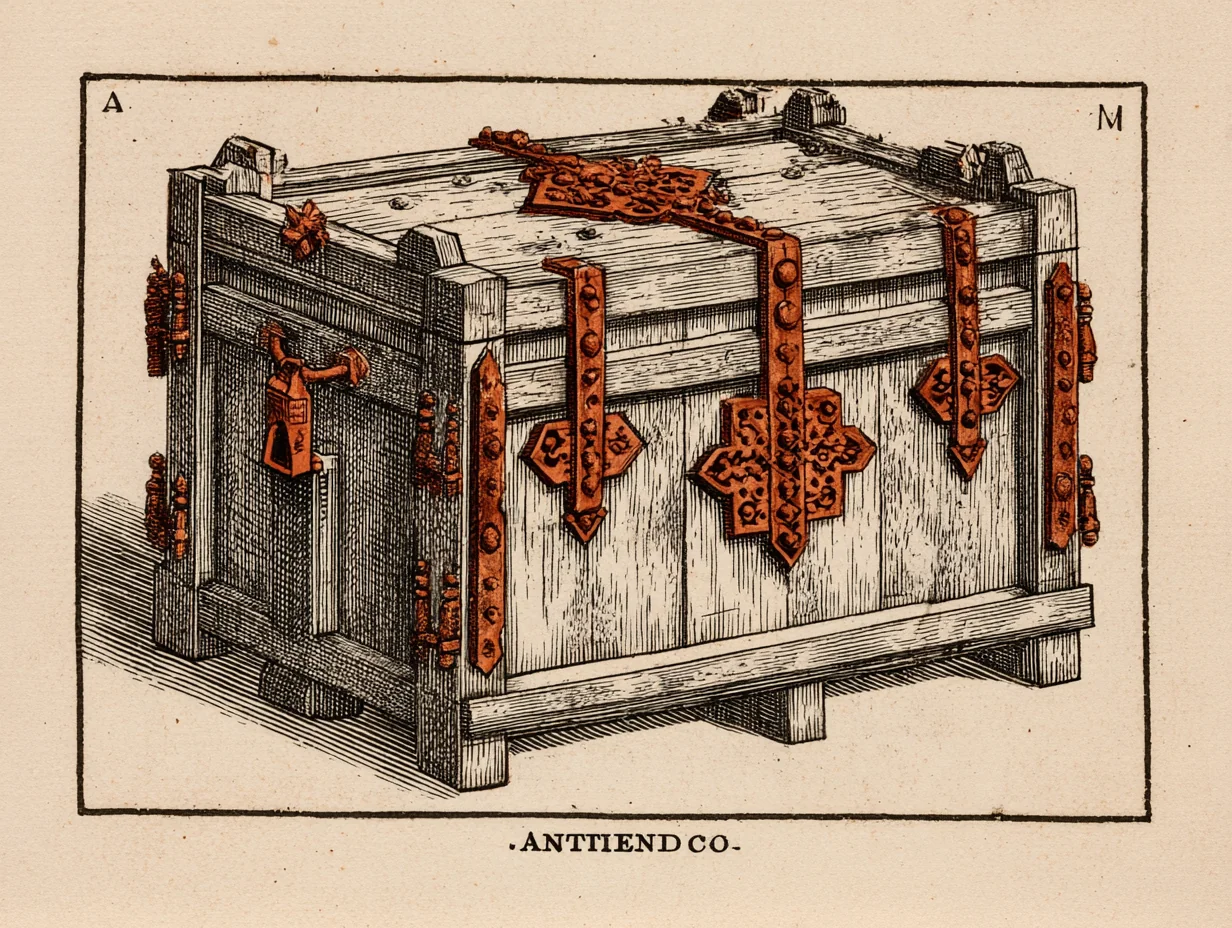
A 14th-c Italian Gothic cassone — the medieval antecedent with simpler iron-bound construction and either no decoration or simple geometric panels. The Renaissance period elaborated this medieval functional form with the classical-revival carving and painting.
The load-bearing distinction every collector of this period must master, however, is not between the Italian Renaissance and a neighbouring national style — that is the work of the next section — nor the chronology or the patron. It is the distinction between genuine fifteenth- and sixteenth-century work and the nineteenth-century reproduction, and it is worth stating without softening: genuine Italian Renaissance furniture is rare. It is five hundred years old; the best of it is museum-grade and seldom changes hands, and a collector may pass an entire career without owning a piece. The default thing a collector actually meets, when a dealer offers a “Renaissance cassone,” is not a piece of the Renaissance at all. It is a piece of the Renaissance Revival — the vast nineteenth-century reproduction industry, much of it carried on in Italy itself, in Florence and the northern cities, expressly for the furnishing of the Victorian and Gilded-Age house.
The nineteenth century admired the Renaissance enormously and reproduced it on an industrial scale, with real skill, in genuine walnut, with carving that is competent and sometimes very accomplished. The revival cassone is not a fraud in its origin — it was made and sold honestly as new furniture in the antique taste — but a century and a half has since passed, the pieces have acquired an age and a wear of their own, and they are now routinely offered, and routinely bought, as Renaissance. Telling the two apart is therefore the post’s load-bearing knowledge, and it comes down to the period hand: the genuine piece is hand-hewn walnut with five centuries of oxidation and cross-grain shrinkage, carved by hand with the unevenness and freehand asymmetry that hand carving leaves, and fitted with hand-forged wrought iron; the revival piece, however accomplished, betrays the machine and the later age — uniform walnut, crisp regular carving with too-perfectly-answered motifs, frequently cast iron, and a contrived wear applied where the eye expects it rather than accumulated where use falls. The collector reads sceptically, because the probability, on any given piece, is that what is before one is the revival.
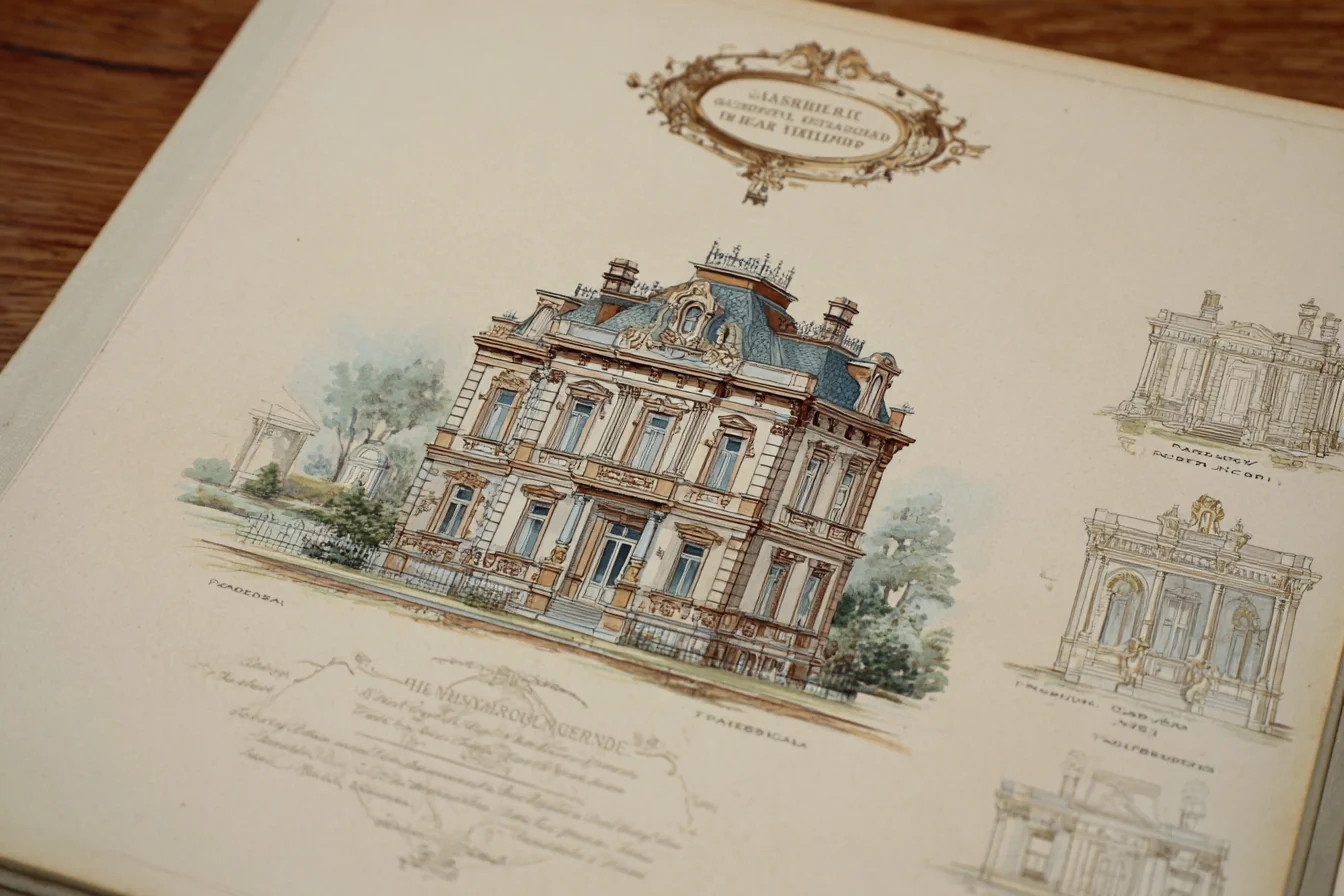
A page from a Florentine cabinet-maker’s pattern book of the 16th c — perspective drawings of the principal Renaissance forms: the cassone marriage chest, the credenza sideboard, the sgabello stool, the savonarola folding chair, the cassapanca bench-chest.
What It Is Not
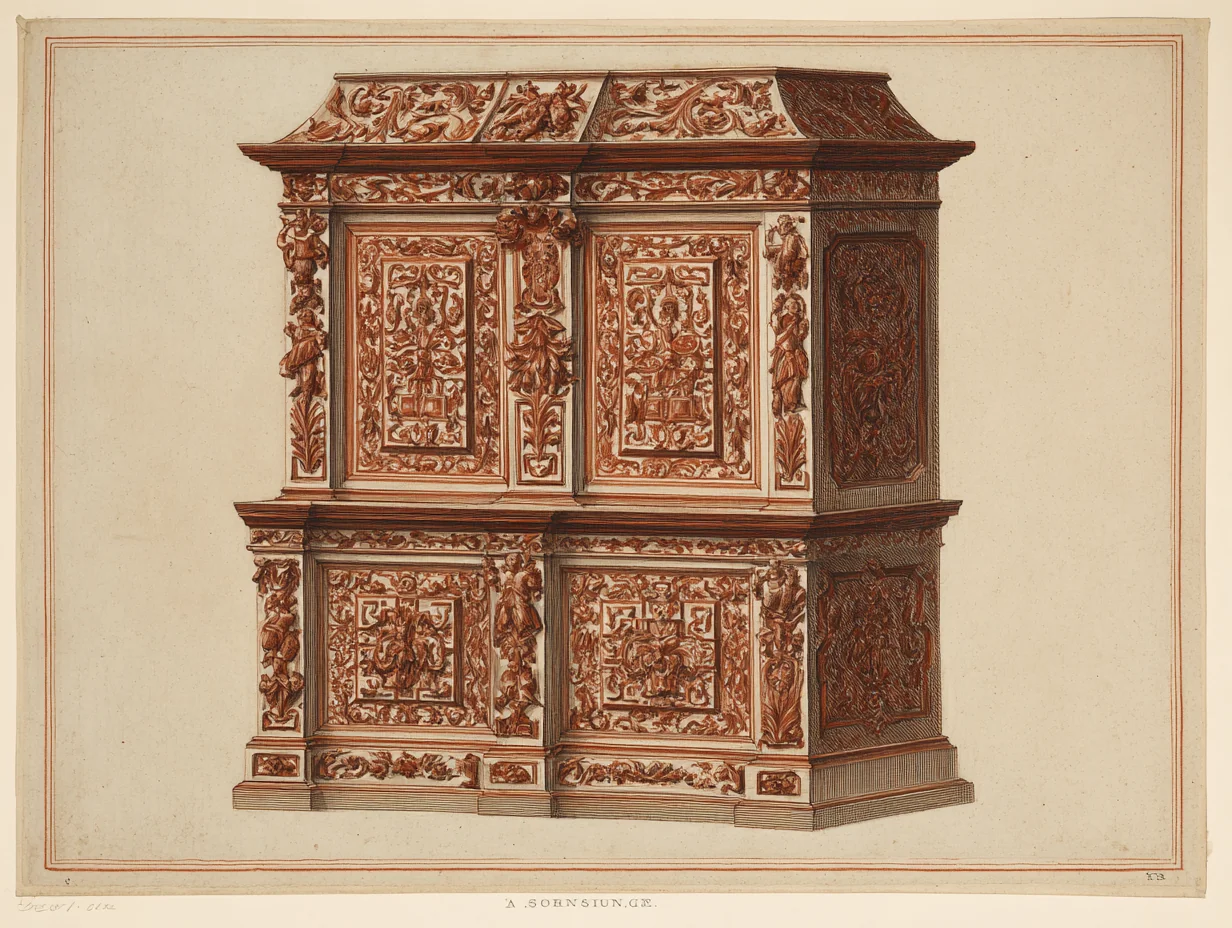
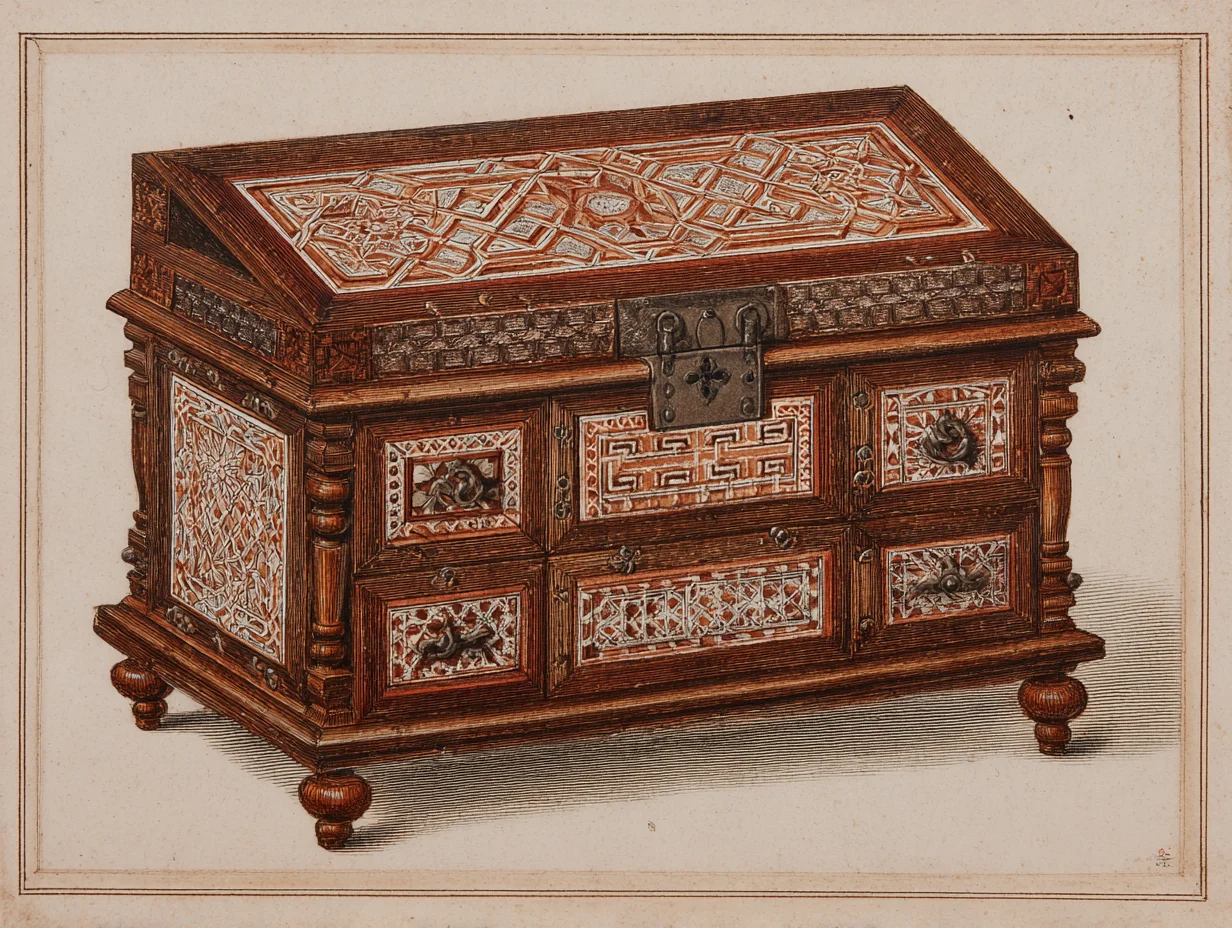
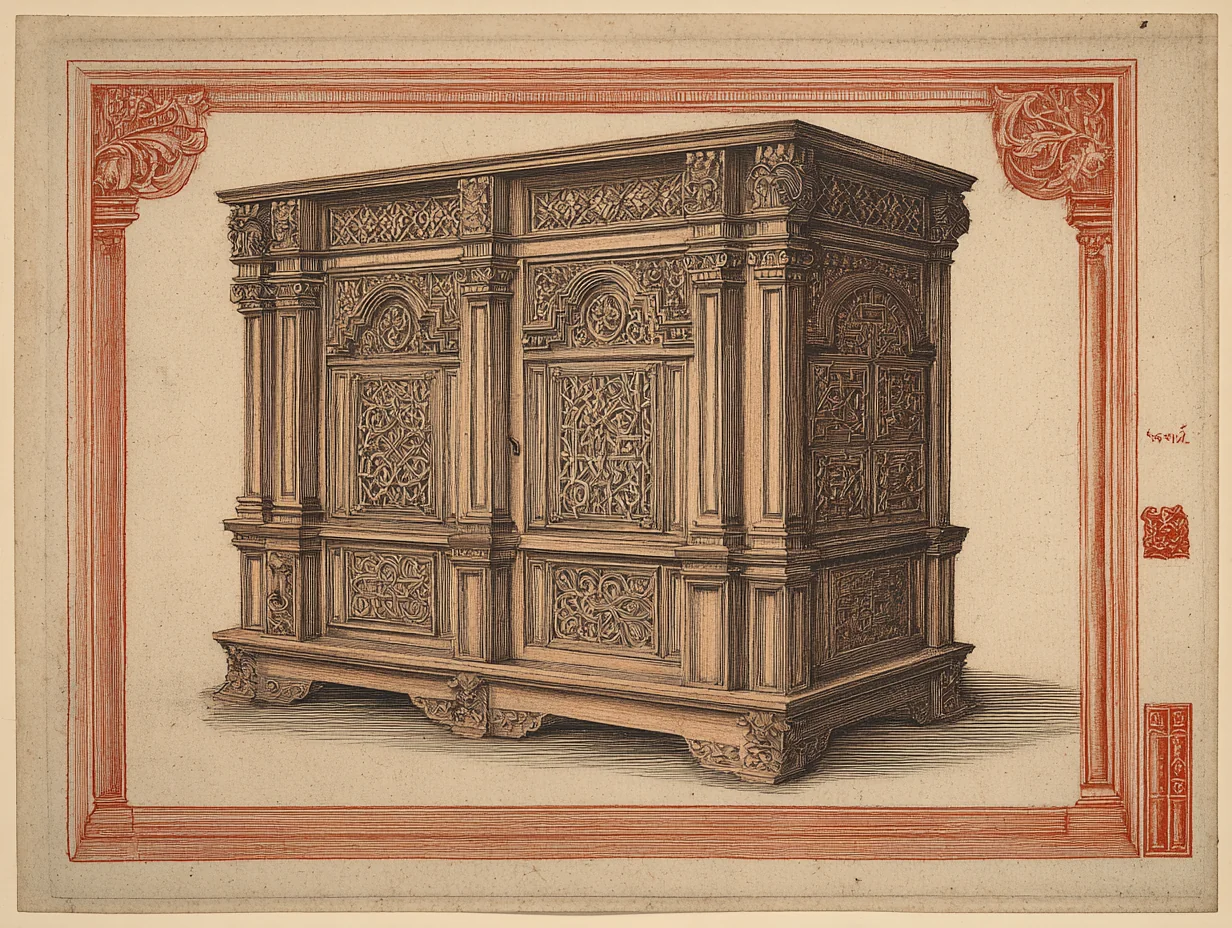
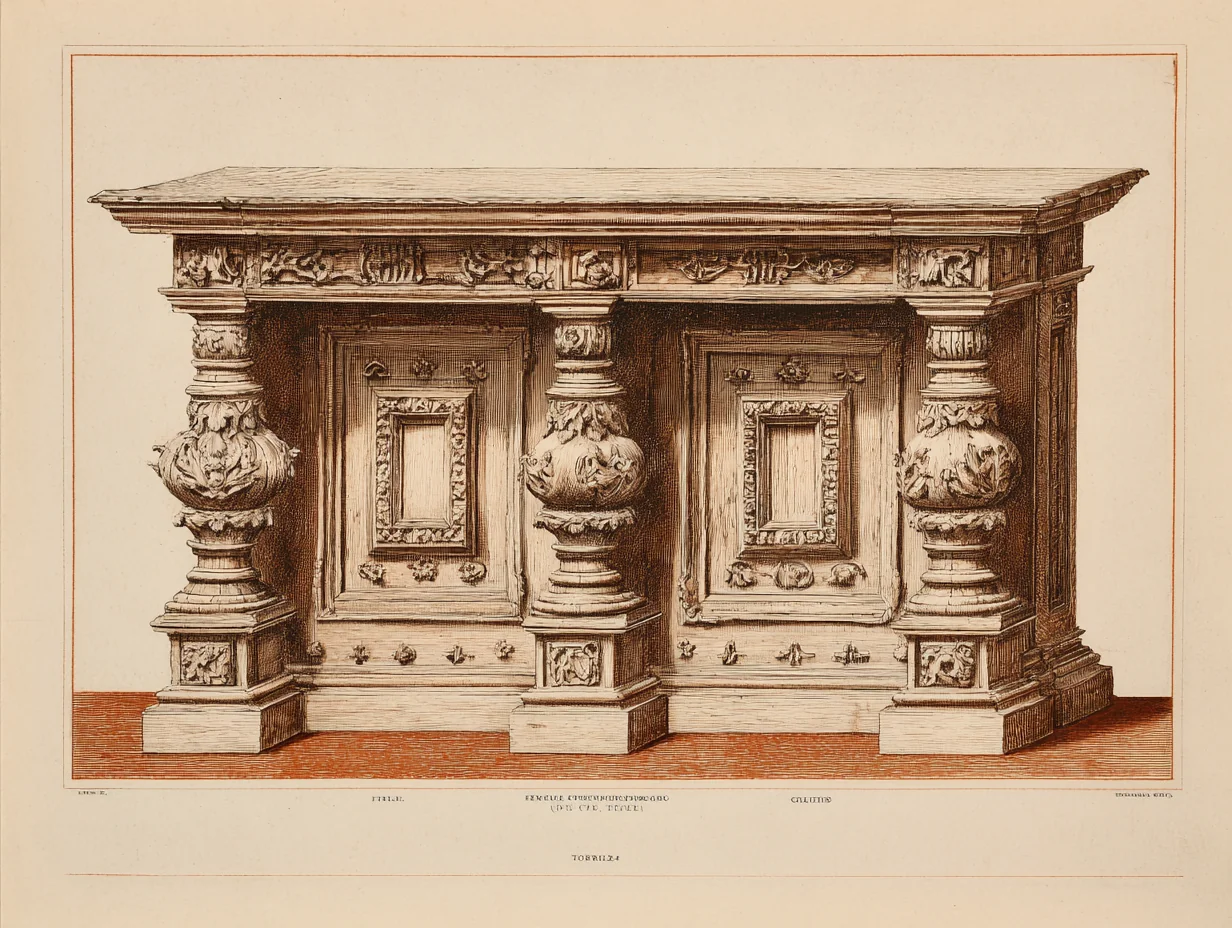
Four styles stand near enough to the Italian Renaissance that the beginner confuses them with it, and all four are confusions of the same kind: they are the other national Renaissances of the sixteenth century — the various ways in which the rest of Europe received the Italian original, which travelled by prints, by emigrant craftsmen, and by the translated architectural books. Each country that received it married it to its own timber and its own older tradition, and to distinguish the four is to read how far each had moved from the Florentine source.
A French Renaissance piece is the closest of the four, and so the one to give the most care. The sixteenth-century French court took the Italian manner directly — Italian craftsmen were brought to Fontainebleau — and the French worked, as the Italians did, in walnut with carved classical ornament. The high French Renaissance cabinet, the armoire à deux corps of the Henri-II period, is the type the collector meets, and it can deceive. The difference is one of architectural intensity: the French cabinet is more densely and sculpturally carved, with deep recession, broken pediments, and high-relief figures crowded across the whole front, where the Italian piece keeps a clearer, calmer division. The rule of thumb: clear architectural panelling on dark walnut is Italian; the densely carved, crowded two-stage walnut cabinet is French Renaissance — the pupil out-elaborating the master.
A Spanish Mudejar piece is the Iberian sibling, and the easiest of the four to tell apart, because Spain received the Italian Renaissance over the top of something the other countries did not have: the Mudejar inheritance, the Islamic decorative tradition of the long centuries of Moorish Spain. The Spanish piece is in walnut, and it may carry classical ornament; but its surface vocabulary runs to geometric inlay — intricate star-and-interlace marquetry of bone, ivory, and contrasting woods — and to tooled leather and iron, the canonical form being the vargueño, the drop-front writing-cabinet. The rule of thumb: deep-relief classical carving in walnut is Italian; flat geometric inlay of bone and wood, the Islamic pattern still legible beneath the classical, is Spanish Mudejar.
A German Renaissance piece is the Northern sibling, and the Northern timber settles it. The German-speaking lands received the Italian classical vocabulary late and grafted it onto a still-living Gothic tradition, working it principally in oak rather than the Italian walnut. The German cabinet is consequently heavier and squarer than the Italian, its classical ornament coarser and often mixed with Gothic survivals and dense strapwork. The rule of thumb: walnut, architectural, classically clear is Italian; oak, heavy, square, with Gothic survival and strapwork is German Renaissance.
An English Tudor piece is the English sibling, and the furthest of the four from the Florentine source. Tudor and Elizabethan England received the Renaissance latest and least directly, at second and third hand through the German and Flemish print trade, and it too worked in oak. The English piece carries carved relief — the bulbous “cup-and-cover” turned supports, gadrooned mouldings, low-relief arcaded panels, strapwork — but the classical vocabulary is partial, provincial, and often misunderstood, applied as ornament without the architectural grammar that holds an Italian piece together. The rule of thumb: walnut with a coherent classical architecture is Italian; oak, with carved relief and bulbous supports but no real architectural grammar, is English Tudor.
What One Looks At
One looks first at the wood, because the wood is the surest single witness. It should be walnut — noce, dark and dense and close-grained — and not the oak of the Northern Renaissances. And it should look its age: a deep oxidised brown that no stain imitates, a waxed patina settled into the hollows of the carving, and the unmistakable evidence of five centuries of cross-grain shrinkage in the gapped panels and the long-lived-with splits. Walnut, not oak, places the piece in Italy; walnut that has genuinely aged and shrunk begins to place it in the Renaissance rather than in the revival.
One looks next at the carving, and reads it for the hand. The relief should be genuinely deep and undercut; the vocabulary classical and architecturally coherent — pilasters, entablature, pediment, egg-and-dart and acanthus, putti and grotesques and lion paws; and, decisively, the cut should be a hand cut, varying in depth, uneven in its facets, answering its symmetries freehand and never quite perfectly. Crisp, machine-even carving with perfectly mirrored motifs is the mark of the nineteenth-century revival.
One looks then at the iron, on the chests, and asks one question of it: forged or cast. Period hardware is wrought iron, hammered out by hand at the anvil, faintly irregular, often pitted with centuries of corrosion, never quite identical mount to mount. Cast iron, crisp and identical and poured from a mould, is a nineteenth-century material, and cast hardware will frequently settle the question against the piece before the wood is examined.
And one looks, finally and throughout, for the period hand against the revival — for this is the distinction the whole subject turns on. A genuine Italian Renaissance piece is rare, museum-grade, and improbable; the default thing offered as one is the accomplished nineteenth-century Renaissance Revival reproduction. The collector reads wood, carving, and iron not as a checklist of style but as a body of evidence for age, and asks of the word Renaissance what it can honestly bear: not merely that the piece is in the Renaissance manner, which the revival is too, but that the hand-hewn walnut, the hand-cut carving, and the hand-forged iron together stand witness that it was made five centuries ago, and not in the century before last.
The next post in the furniture arc will be either Spanish Baroque — to open the Iberian tradition the Italian Renaissance and Baroque are siblings to — or back to the Italian Baroque to deepen the seventeenth-century continuation that this post has named as the Renaissance’s own descendant. The choice will depend on what photographic material is available at the time of writing.