The six prior posts in this arc — Louis XV, Louis XVI, Biedermeier, English Chippendale, Gustavian, and Italian Baroque — have together carried the European cabinet tradition from the French royal source through its Continental and Anglophone translations, and then back a full century to open the Italian tradition with the seventeenth-century carved-walnut work of the Roman and Bolognese workshops. The Italian Baroque post closed by promising its own descendant, and this is that descendant: the eighteenth-century Venetian Rococo, the body of work that the cabinet workshops of the declining Republic of Venice produced for the patrician patron class between roughly 1700 and the Napoleonic conquest of 1797.
The Venetian Rococo is, on the surface, the same translation principle the prior posts have made familiar — and yet it is not. It is not a national substitution of material under a continuing structural register; it is a substitution of register itself. The Italian Baroque carved its ornament into the dark walnut of the case and gilded selected structural members over a red bole ground. The Venetian Rococo kept the carved-giltwood structure but abandoned the walnut entirely, and put in its place a painted-lacquer surface in saturated colour — red, green, blue, yellow grounds, with floral and chinoiserie ornament painted across them. Where the Baroque was a sculptor’s medium read in shadow and relief, the Venetian Rococo is a painter’s medium read in colour and varnish. This is the seventh post in Reading the Period Cabinet, and it provides what the wood-tone variety table has called for since the Italian Baroque furnished its dark-gilt break: the deliberate colour break, the one genre in the arc where the surface is neither timber nor veneer but paint.
The Specimen
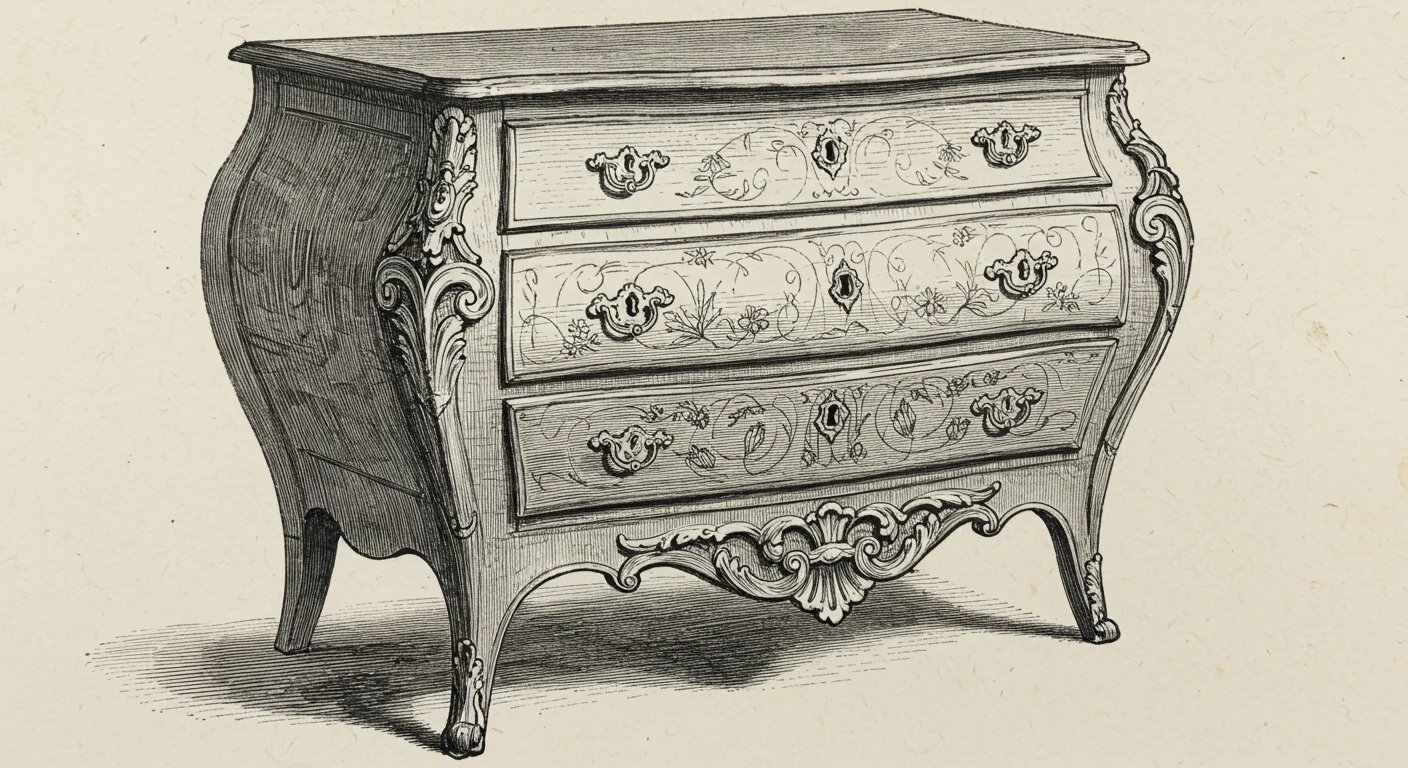
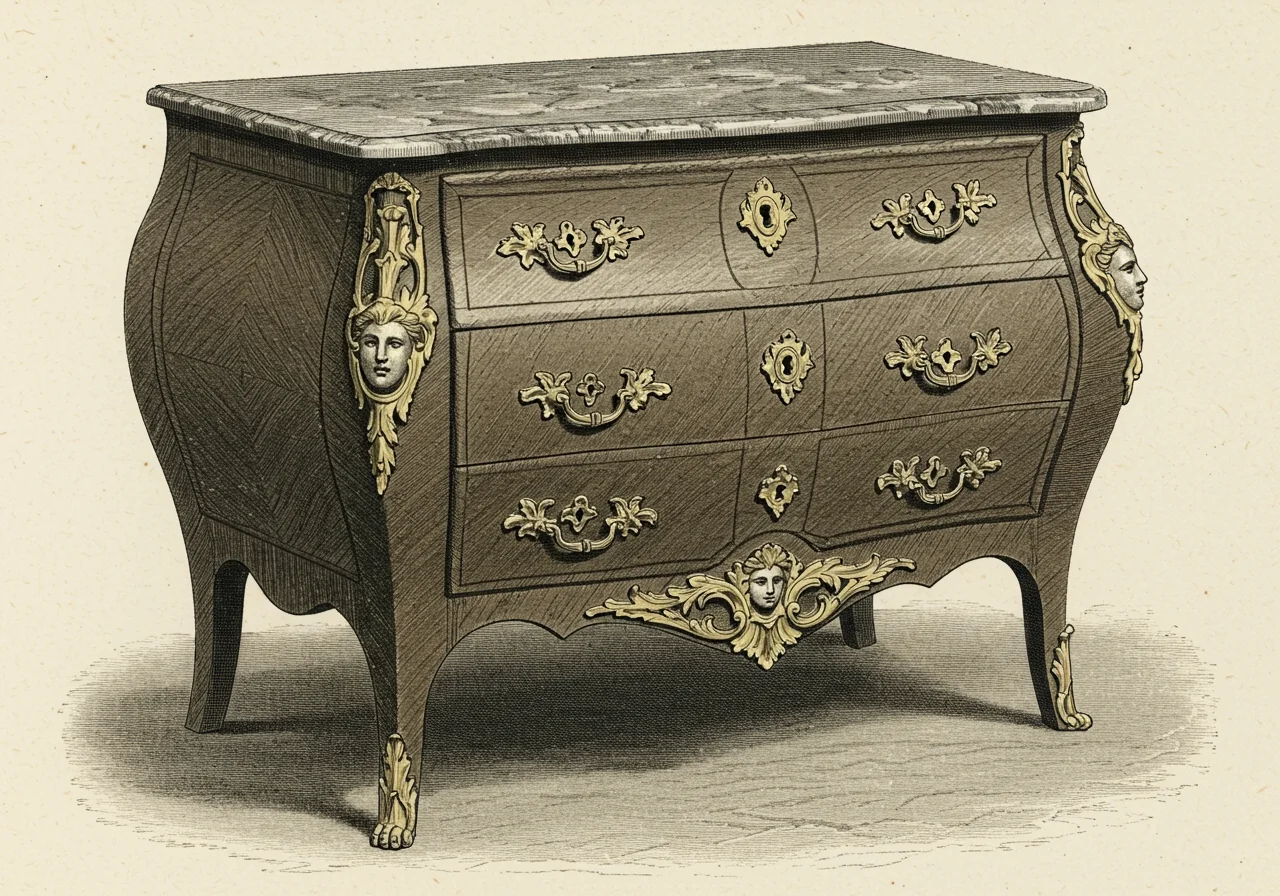
The canonical Venetian Rococo piece, for the purposes of beginning to read the style, is the bombé commode — the serpentine-fronted chest of drawers, swelling outward at the front and sides, standing on short cabriole legs, with a carved-giltwood apron, a moulded marble top, and a painted-lacquer finish across the whole case. The commode is what the Venetian patrician patron commissioned for the principal rooms of the palazzo on the Grand Canal, and the form in which the Venetian Rococo principles are most fully concentrated; the carved-giltwood sofa, the console table, and the side chair carry the same vocabulary at smaller scale and in less concentrated form.
A canonical Venetian Rococo commode, then. Its case is bombé — the word means swollen, and the form is exactly that: a chest whose front and sides bow outward in a continuous serpentine curve, so that no plane of the case is flat and no edge is straight. This is the rococo curve in three dimensions, and it is the structural inheritance the Venetian workshops took from the contemporary French. The case stands on short cabriole legs — the S-curved leg that flares at the knee and tapers to a small scrolled foot — and the legs flow without interruption into a carved-giltwood apron beneath the lowest drawer, the whole lower register reading as a single curved and gilded member rather than as a structure of separate parts. Above the case sits a marble top, cut in the same serpentine outline as the case beneath it and moulded at its edge; the marble is most often a coloured marble — a warm yellow Siena, a grey-veined bardiglio, a red — chosen to sit against the colour of the lacquer rather than to contrast with it.
The surface, and it is the surface that carries the style, is painted lacquer. The entire case — drawer fronts, sides, apron — is grounded in a single saturated colour: a vermilion or coral red, a deep bottle or apple green, a strong cobalt or pale powder blue, a chrome or straw yellow, more rarely an ivory or a black. Over that coloured ground the workshop painter laid floral and chinoiserie ornament — bouquets and trailing sprays of flowers, ribboned cartouches, and the European fantasy of the Orient: pagodas, parasols, bridges, mandarins, exotic birds, all rendered in the cheerful inaccuracy of a painter who had never been east of the Adriatic. The carved-giltwood structure — the apron, the leg fronts, sometimes a carved cartouche at the centre of the lowest drawer — is gilded over the lacquer in the manner the Baroque had established, but it is now subordinate to the painted surface rather than the principal event. The Venetian Rococo, in short, is a piece of furniture conceived as a painted object.
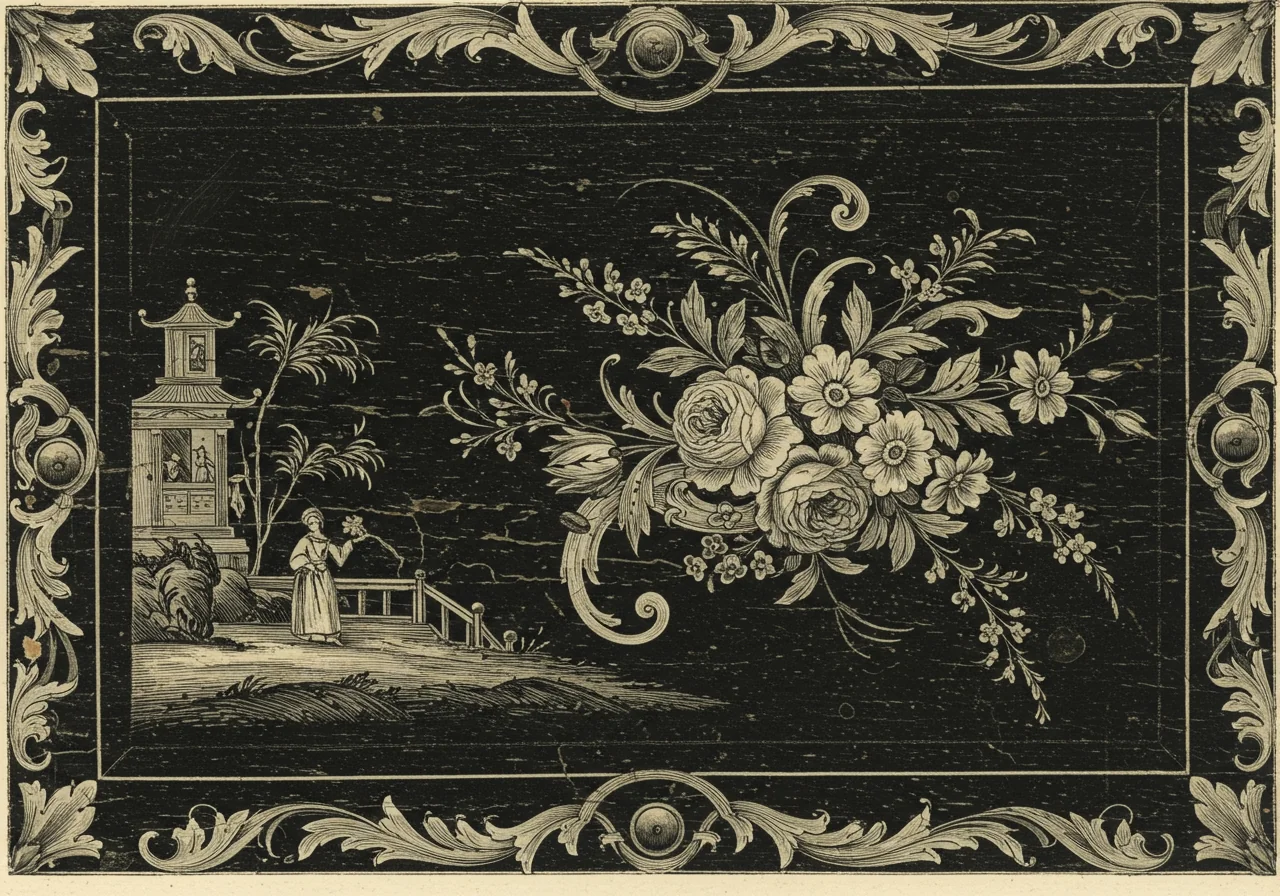
A close detail of a Venetian lacquer surface — the saturated coloured ground (here red) with painted floral and chinoiserie ornament. The hand-painted Venetian technique — lacca veneziana, Venetian lacquer proper — imitated the appearance of Chinese export lacquer at Venetian workshop scale and speed, building up the surface from a gesso ground, coloured paint, and many varnish coats rather than from the East Asian urushi sap that genuine Chinese lacquer required. The two are distinct media, and the distinction is the first thing the collector reads for.
The Evidence
The lacquer, first, is most of what one is reading for. Lacca veneziana — Venetian lacquer proper, the true hand-painted technique — is not a finish but a built-up structure of layers, and the period work shows that structure in its wear and its damage. Beneath the colour lies a gesso ground laid over the prepared wood; over the gesso, the saturated coloured paint; over the paint, the hand-rendered ornament; and over the whole, a succession of varnish coats — sandracca, the local sandarac resin varnish, built up and polished between coats — that gave the surface its depth and its sheen and that yellow and craze with age in a characteristic way. A genuine period lacquer surface shows fine crazing across the varnish, a warm darkening of the originally bright ground, paint losses that step down through the layers to the gesso and the wood rather than flaking off cleanly, and an ornament drawn freehand with the small irregularities of a painter’s hand. It is a surface read at close range in raking light, and its layered construction is the principal authentication evidence.
The carved giltwood, second. Beneath and around the painted case the Venetian workshop kept the carved-giltwood register the Baroque had handed down — but moved it from the rectilinear architectural vocabulary of the seventeenth century into the rococo curvilinear vocabulary of the eighteenth. The scrollwork is now asymmetric, the cartouches are rocaille shellwork, the putti and mascarons are lighter and more playful, and the gilt is water-gilt over a gesso-and-bole ground exactly as the Baroque gilders had laid it. Where the carving survives unrestored it shows the same wear pattern the Baroque post described — rubbed at the high points, surviving in the hollows, showing through to a red bole at the worn spots — and that bole ground is as much an authentication indicator here as it was a century earlier.
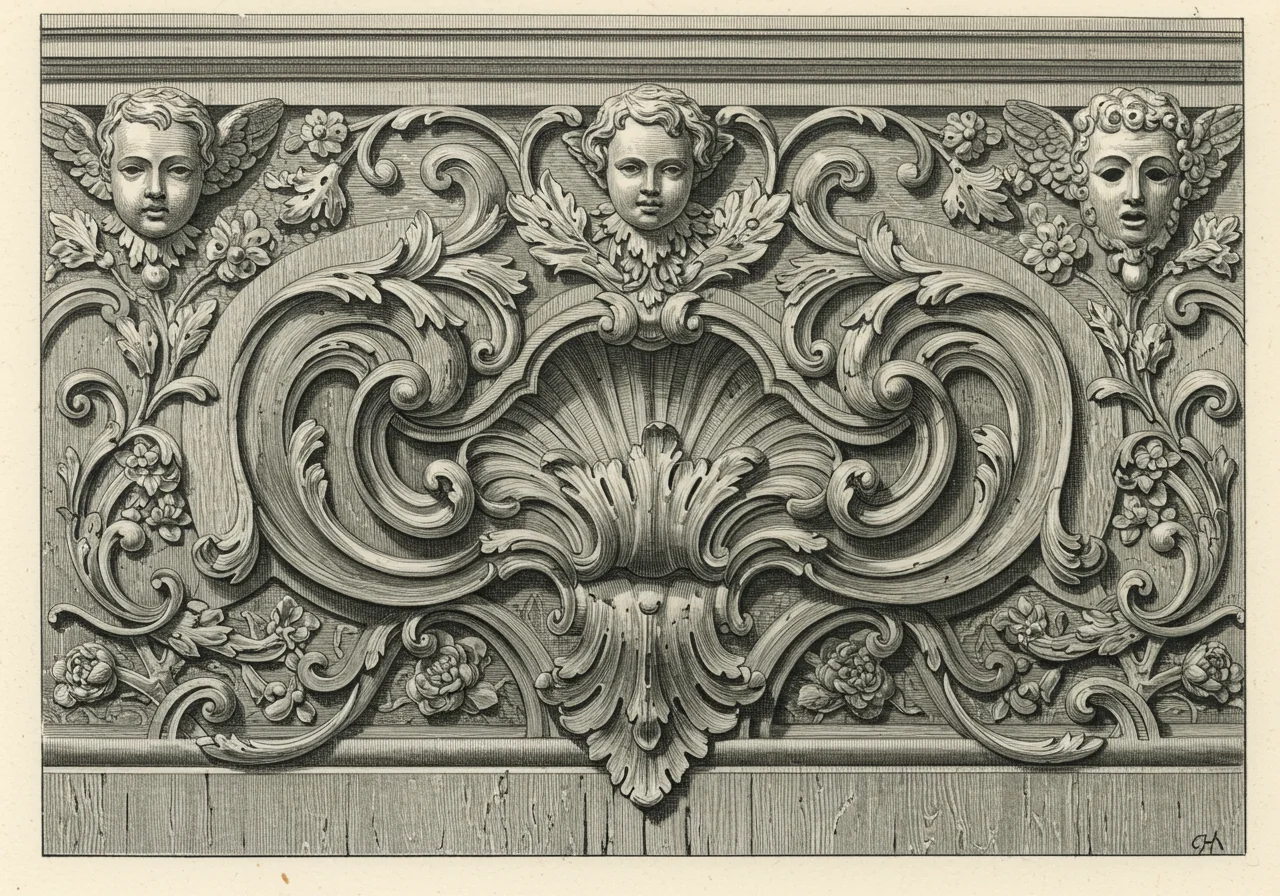
A close detail of Venetian carved-giltwood ornament — the asymmetric rocaille scrollwork, putti, and mascarons that form the structural register beneath and around the lacquer surface. The carving is water-gilt over a gesso-and-bole ground in the tradition the Italian Baroque established; what has changed is the vocabulary, from the rectilinear architectural ornament of the seventeenth century to the curvilinear rococo ornament of the eighteenth.
The marble top, third, where it survives. The Venetian Rococo commode was conceived to carry a marble slab, cut in the serpentine outline of the case and moulded at its edge, and a period commode that has lost its marble has lost an integral element rather than an accessory. The marble is most often a warm coloured stone — Siena yellow, bardiglio grey, rosso red — and the underside, where one can examine it, should show the saw and tooling marks of the period mason and a profile that follows the case exactly. A flat replacement top, or a top in white statuary marble where the case calls for a coloured stone, is one of the commonest later alterations.
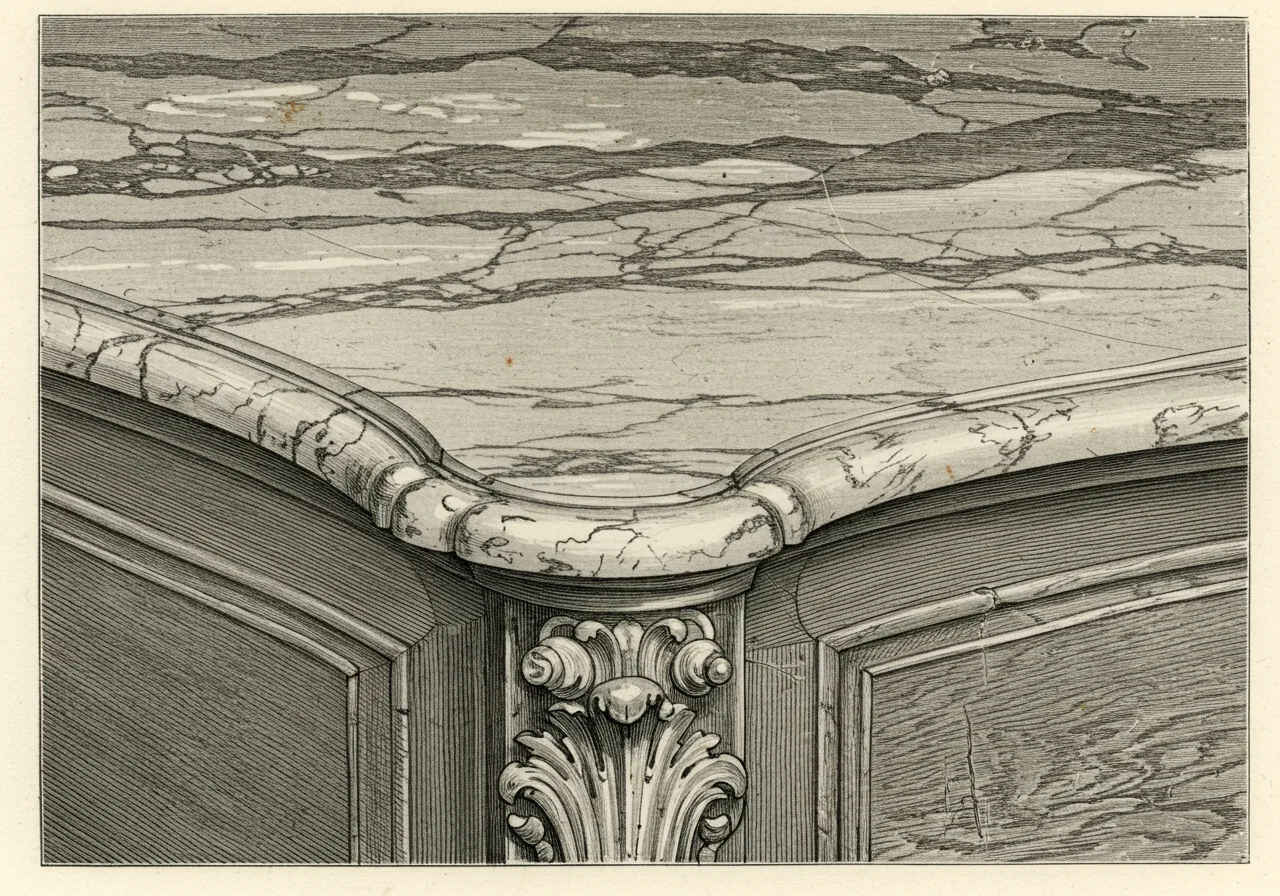
A close detail of a Venetian Rococo marble top — coloured marble cut in the rococo serpentine outline that crowns the bombé case and moulded at its edge. The marble was integral to the commode as designed; a piece that has lost its top, or carries a flat white replacement where a coloured serpentine slab is called for, has lost an element rather than an accessory.
The Period
The Venetian Rococo period proper runs from about 1700 to the Napoleonic conquest of 1797, with apex production concentrated in the middle decades — roughly 1730 through 1780. The political fact that frames the whole tradition is that the Republic of Venice — the Serenissima, the Most Serene Republic, a thousand years a maritime and commercial power — was, across exactly these decades, in a long and not unpleasant decline. The trade routes had moved to the Atlantic; the eastern empire had been ceded; the Republic had withdrawn from the great-power contests of the century and settled into a neutrality that was also an irrelevance. What it had not lost was its wealth, its patrician class, and its appetite for display. The eighteenth century was the century of Venetian Carnevale at its most extravagant — a carnival season that ran for months, conducted behind masks, in which the ordinary distinctions of rank were suspended — and of the Grand Tour, which brought a steady traffic of foreign visitors and foreign money. A society that had stopped governing an empire and turned its full attention to pleasure is, as it happens, an excellent client for the decorative arts.
The Venetian decorative industries supplied that client across the board, and the painted-lacquer furniture is best understood as one product of a city organised around luxury manufacture. The glassworks of Murano produced the mirrors and chandeliers; the textile workshops produced the silks and velvets; the painters — Tiepolo, Canaletto, Guardi, Longhi — produced the ceilings and the vedute and the conversation-pieces; and the cabinet workshops produced the lacquered commodes and consoles that stood beneath the mirrors and the ceilings. The saturated colour of the furniture is the colour of the rooms it was made for, and the chinoiserie ornament is of a piece with the Republic’s long-standing and now largely nostalgic identity as the European city that faced east.
The high tradition ended on a date. In 1797, in the course of his Italian campaign, Napoleon Bonaparte extinguished the Republic of Venice — the thousand-year constitution dissolved, the last Doge deposed, the city handed first to Austria and later absorbed into the Napoleonic order. The patrician patron class did not vanish, and the workshops did not close, but the system that had sustained the apex production was gone, and what followed was a continuation in a diminished and increasingly commercial register. This matters to the collector for a reason the next section will make load-bearing: the painted-lacquer Venetian look outlived the Republic by a long way, and most of the painted Venetian furniture in circulation belongs not to the eighteenth-century high tradition at all but to the nineteenth-century and later trade that imitated it.
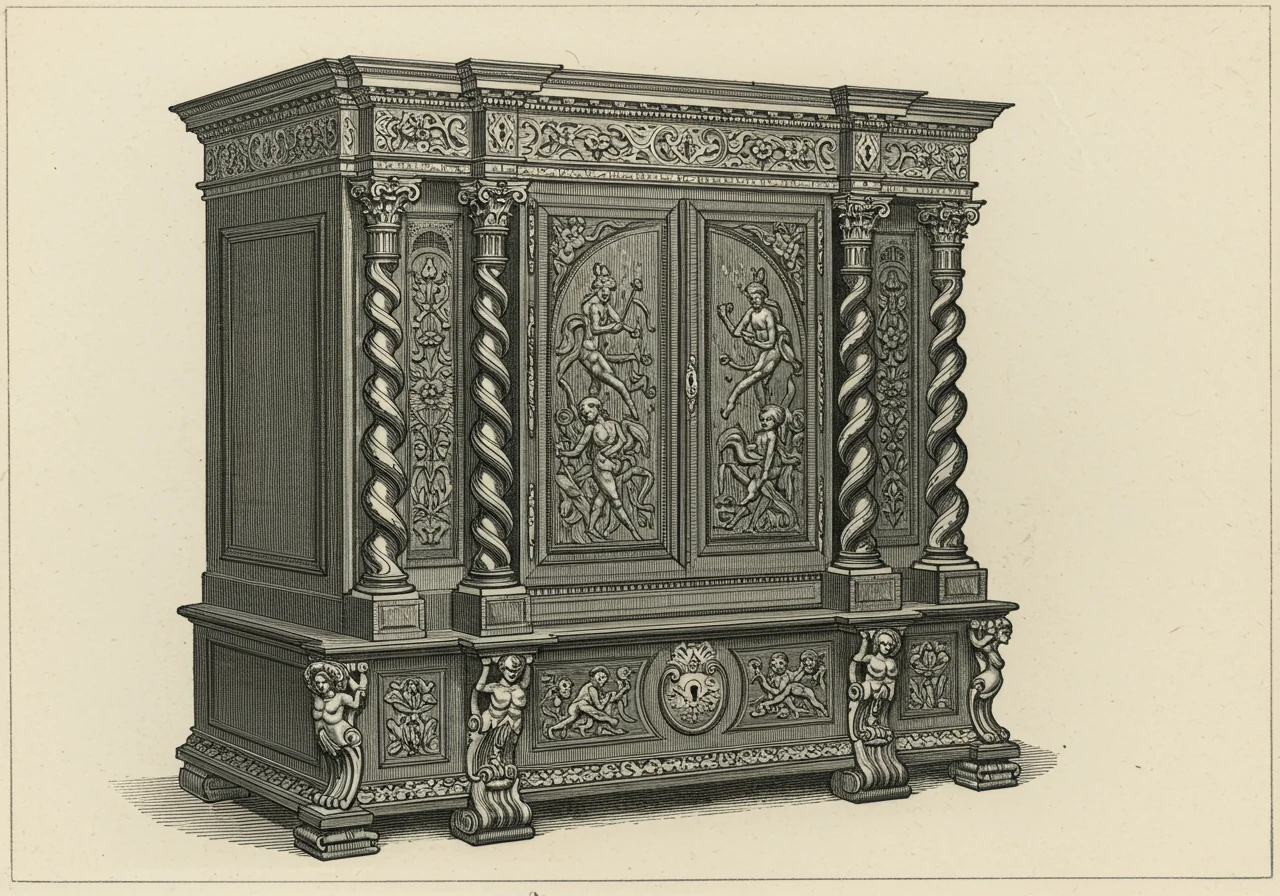
A 17th-c Italian Baroque cabinet — the carved-walnut antecedent. The Venetian Rococo of the 18th c kept the Baroque structural vocabulary (the carved-giltwood ornament, the architectural descent of the case) but translated the surface from dark carved walnut into saturated coloured lacquer, and translated the ornamental register from the rectilinear-architectural Baroque into the curvilinear rococo. The carved giltwood is the continuity; the painted surface is the break.
The load-bearing distinction every Venetian Rococo collector must master is therefore the distinction between genuine eighteenth-century Venetian work and the nineteenth-century and later revival furniture made in the Venetian-style painted register — and it is load-bearing precisely because the revival material is far more common than the genuine article, common enough that an unwary buyer will see a dozen revival commodes for every period one and quite reasonably conclude that the revival commode is what a Venetian Rococo commode looks like. The revival began in earnest in the later nineteenth century, when a prosperous and tourist-conscious Venice rediscovered its own eighteenth-century manner as a marketable identity, and it has not stopped since; “Venetian painted furniture” is a continuously-produced decorative type, and a great deal of it is honest decorative furniture that was never intended to deceive. The distinction is not, then, a matter of catching forgeries — most revival pieces are not forgeries — but of dating accurately what one is looking at.
The genuine eighteenth-century piece reads differently in four respects, and the collector carries all four. First, construction: the period commode is built by the period hand, with hand-cut dovetails of irregular spacing, pit-sawn boards showing the period saw, hand-wrought hardware, and the shrinkage, oxidation, and wear of two and a half centuries on every secondary surface — drawer linings, backboards, underside. The revival piece shows machine-cut dovetails of mechanical regularity, circular-saw marks, modern screws, machine-planed or plywood secondary timber, and a brevity of age that the back and the interior cannot disguise even when the front has been distressed. Second, the lacquer: the genuine lacca veneziana surface is built up in the layered sandarac-varnish structure described above and shows the fine crazing, the warm darkening, and the layered paint losses of real age; the revival surface is most often a thinner modern paint-and-varnish, sometimes sprayed, with crazing absent, uniform, or artificially induced. Third, the drawing: the eighteenth-century ornament is painted by a workshop hand trained in the rococo idiom, fluent and slightly irregular and confident, where the revival ornament is frequently weaker, more repetitive, or — on the cheaper end — a printed-and-applied decoration masquerading as paint. Fourth, the form: the genuine bombé case has the slightly heavy, structurally-resolved curve of the period workshop, where the revival case is often a thinner, more exaggerated serpentine that betrays a maker imitating a shape rather than building from the tradition that produced it. None of the four is decisive alone; together they settle the question, and the collector who learns to read all four at once has the essential Venetian Rococo competence.
A second distinction sits one level down and is worth carrying as a subsidiary discrimination, because it confuses even buyers who have mastered the dating question. It is the distinction between the two Venetian decorative techniques themselves. Lacca veneziana, described above, is the painted technique — coloured paint and hand-rendered ornament built up under varnish, the surface that the workshop painter drew freehand. The other technique travels under several names — lacca povera, arte povera, and, confusingly, lacca contraffatta — and the collector should know at the outset that these three terms are synonyms for one and the same thing. The first two mean, respectively, poor lacquer and poor art; the third means counterfeit lacquer, and it is one of the small ironies of the trade that the most prestigious-sounding of the three names attaches not to the painted work at all but to this, the cheaper method. For the technique itself is decoupage: engraved and hand-coloured printed paper cutouts were pasted onto the prepared and coloured ground and then sealed under the same many-coat varnish. Both produce a coloured-and-ornamented Venetian surface; both belong to the eighteenth-century high tradition; both are genuine and collectable. But one is painted and one is printed-and-applied, and the difference is legible at close range — the lacca povera ornament shows the slightly raised edges of the pasted paper, the flat even tone of an engraving rather than the modulated stroke of a brush, and on damaged examples a lifting paper edge — and it bears materially on value, since the fully hand-painted lacca veneziana piece sits above the lacca povera piece in the period hierarchy. The collector should be able to name which technique is in front of him, and should not let the cheaper word povera mislead him into thinking the technique a fake; it is not a fake, it is a different and genuine eighteenth-century medium.
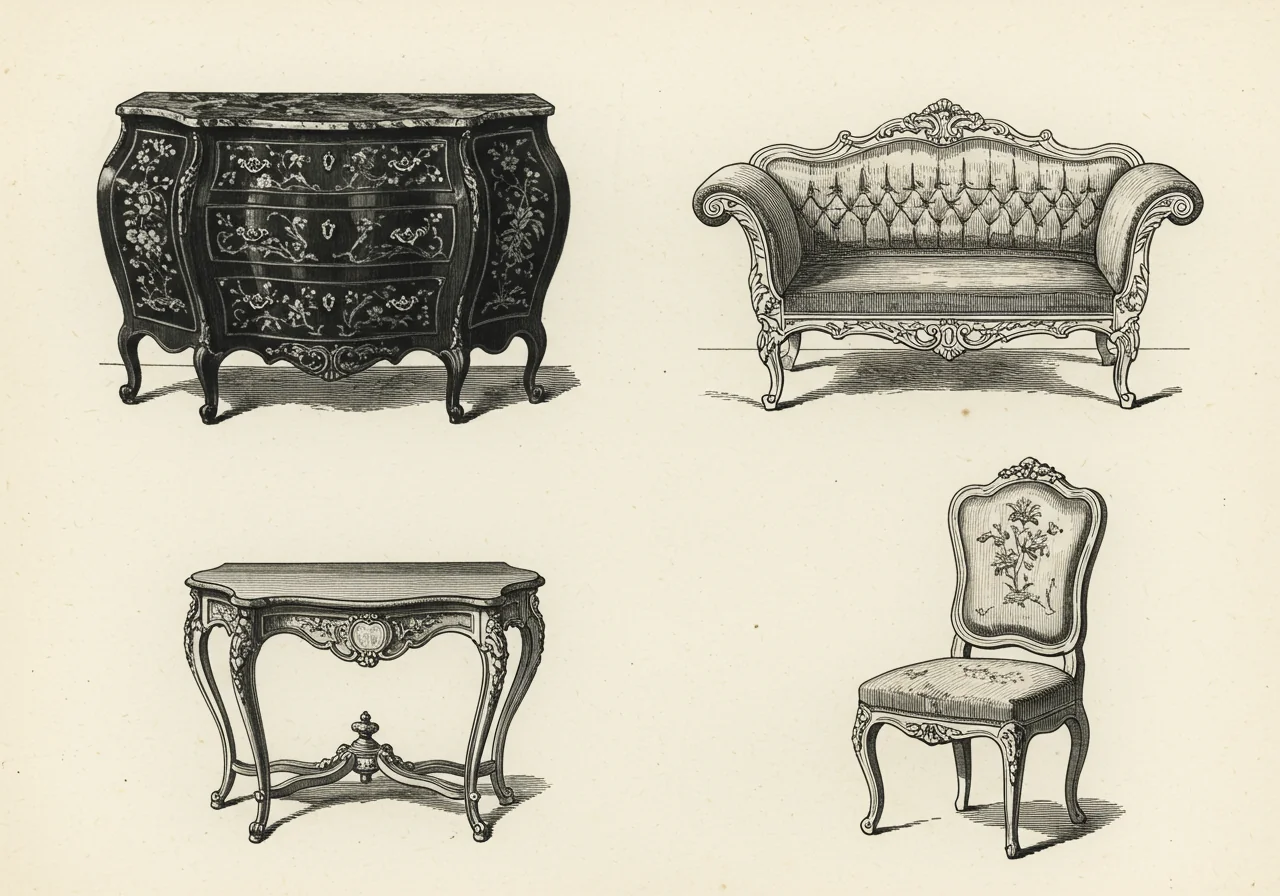
A page from a Venetian cabinet-maker’s pattern book — perspective drawings of the principal forms in the Venetian Rococo register: the bombé lacquered commode, the carved giltwood sofa, the rococo console table, the lacquered chair with cabriole legs.
What It Is Not
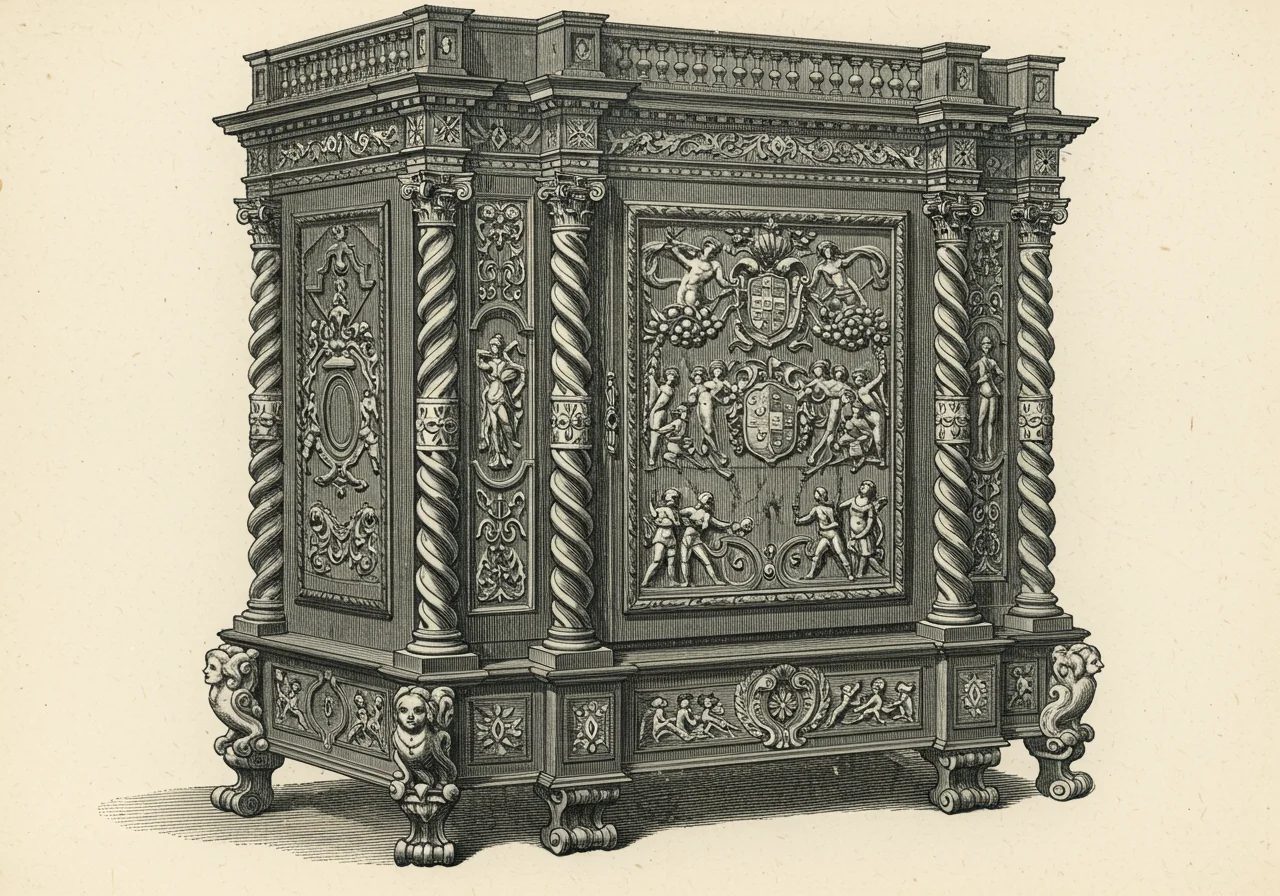
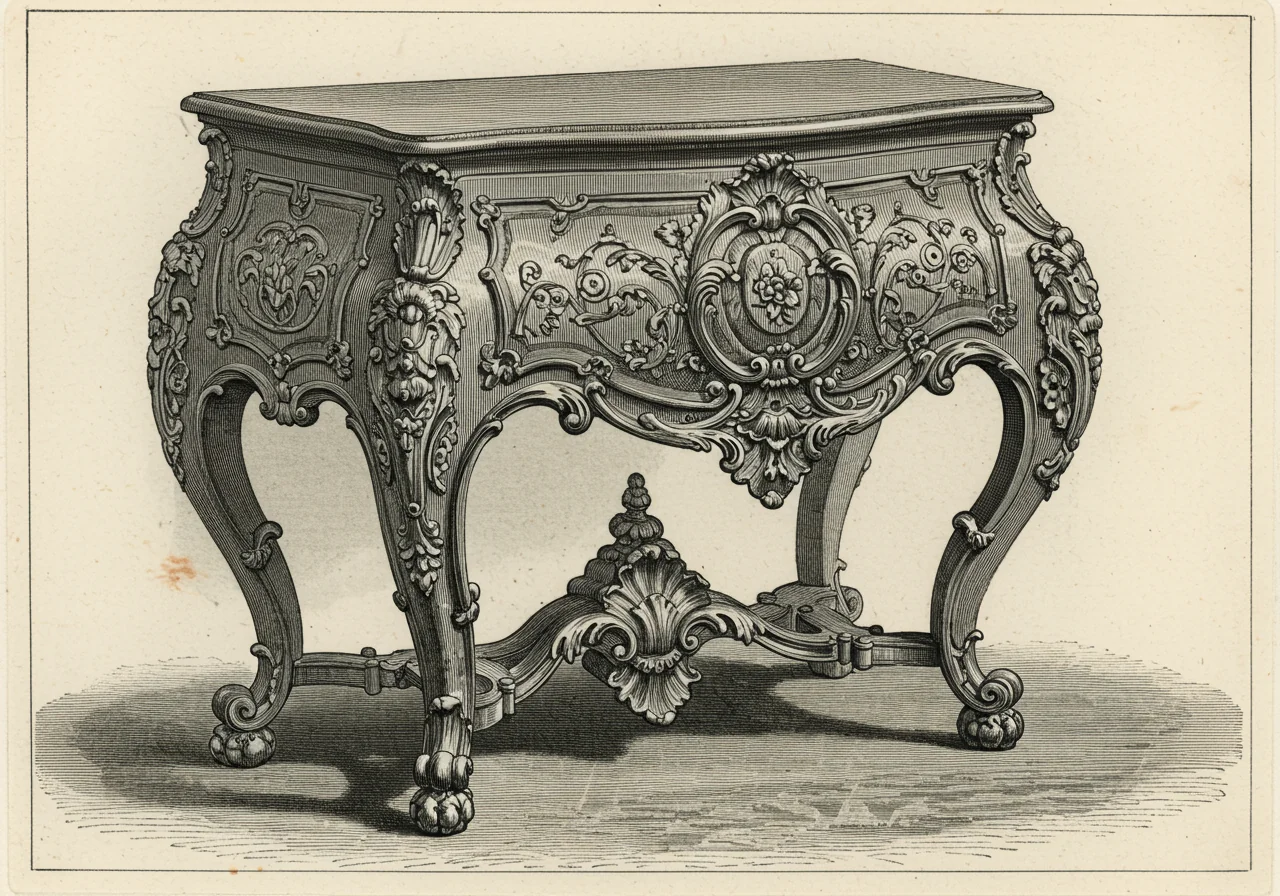
An Italian Baroque is the seventeenth-century antecedent the Venetian Rococo descended from — the post directly before this one in the arc. The continuity is the carved-giltwood structure and the architectural descent of the case; the break is total in surface and register. The Baroque is dark carved walnut, with deep-relief figurative carving in the wood itself and a rectilinear architectural proportion; the Venetian Rococo is painted lacquer in saturated colour, with rococo curvilinear ornament and a serpentine bombé case. The rule of thumb: dark carved walnut with deep-relief figurative carving is Italian Baroque; saturated coloured lacquer over carved giltwood with a bombé case is Italian Rococo.
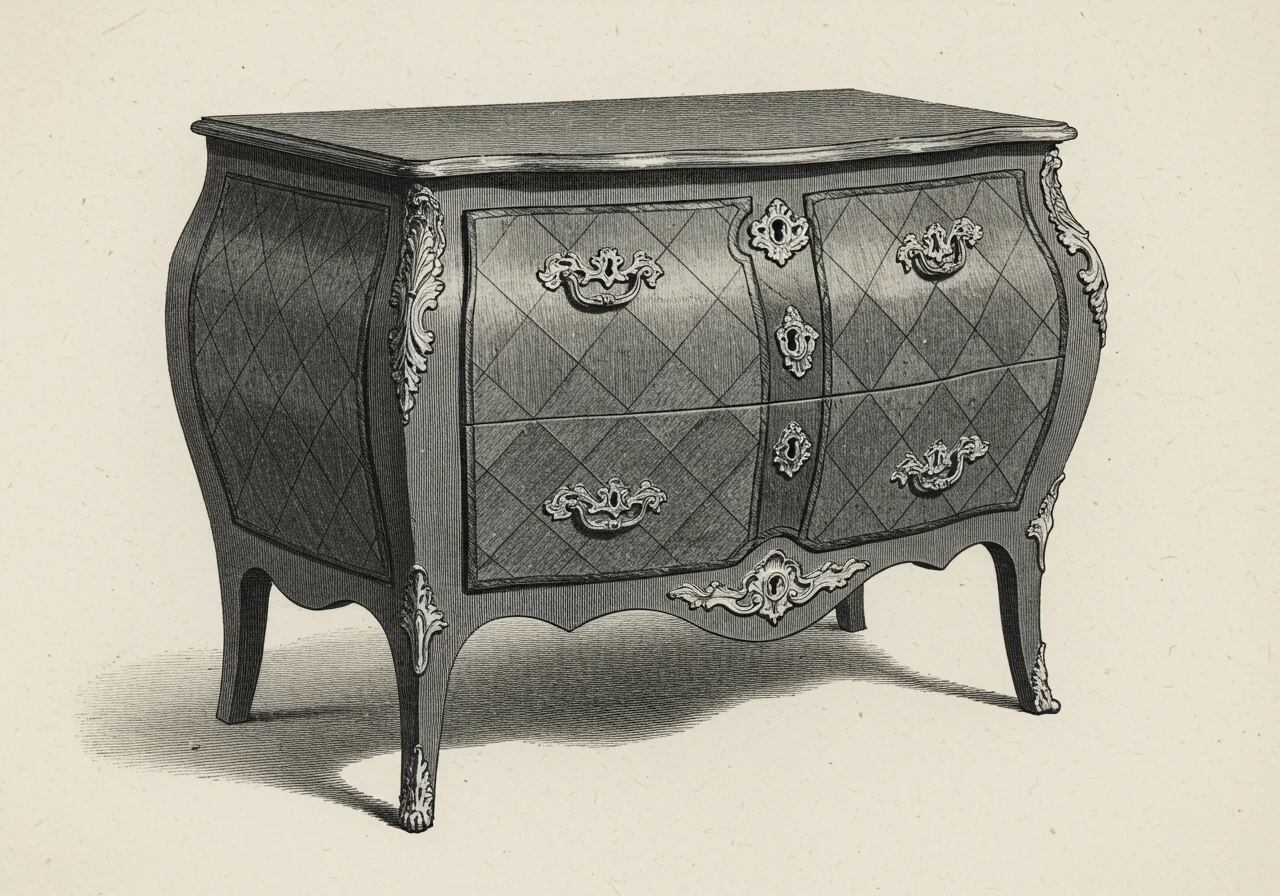
A Louis XV is the French rococo counterpart, the contemporary against which the Venetian is most often weighed, and the comparison is instructive because the two share the rococo form vocabulary exactly — the bombé case, the cabriole leg, the asymmetric rocaille. What they do not share is the surface. The French royal register works in exotic veneer — kingwood, tulipwood, marquetry parquetry — with cast gilt-bronze ormolu mounts bolted to the case, the whole conceived as a cabinet-work-and-bronze object; the Venetian works in painted lacquer over more ordinary local timber, the whole conceived as a painted object. The rule of thumb: bombé case in exotic veneer with cast ormolu mounts is Louis XV; the same bombé case in painted coloured lacquer is Italian Rococo.
A Spanish Rococo is the Iberian sibling — the eighteenth-century Spanish reception of the rococo, produced for the Bourbon court in the same decades. Spain received the rococo through a French dynasty, and the Spanish work shares the curvilinear vocabulary, but carries it in a characteristically Iberian register: heavier proportion, carved-and-gilded or carved-and-painted giltwood at a denser scale, and an ornamental temper inherited from the Spanish Baroque rather than the buoyant painted-chinoiserie lightness of Venice. The rule of thumb: a heavier, more densely carved rococo with the Iberian temper is Spanish Rococo; the lighter painted-lacquer rococo with chinoiserie ornament is Venetian.
A French Régence is the transitional French style — the early-rococo register that bridges the Louis XIV royal Baroque and the mature Louis XV rocaille, named for the regency of 1715–1723. It is rococo in the way an overture is a symphony: the curves have begun, the architectural rigidity of the Louis XIV case has relaxed, but the full serpentine bombé swelling and the full asymmetry of the rocaille have not yet arrived, and the surface is still veneer-and-ormolu in the French manner. The rule of thumb: a transitional, half-relaxed French case in veneer and ormolu is Régence; the fully serpentine painted-lacquer case is the mature Venetian Rococo.
What One Looks At
One looks first at the surface, because the surface is the style. The case should be painted lacquer — a saturated coloured ground (red, green, blue, yellow, more rarely ivory or black) carrying hand-rendered floral and chinoiserie ornament, built up in the layered lacca veneziana structure of gesso, paint, and many varnish coats. A piece in this rococo form but surfaced in exotic veneer is Louis XV; a piece in carved dark walnut is the Italian Baroque antecedent; a piece whose ornament is pasted printed paper rather than brushwork is the lacca povera (also arte povera, also lacca contraffatta) variant of the same Venetian tradition, genuine but a step down in the period hierarchy. The colour itself is diagnostic: the eighteenth-century palette is saturated but warmed and slightly darkened by age beneath a crazed and yellowed varnish, and a surface that is bright, even, uncrazed, and thin is the signature of the revival rather than the period.
One looks next at the carved giltwood beneath the paint — the apron, the leg fronts, the central cartouche — which should be water-gilt over a gesso-and-bole ground in the rococo curvilinear vocabulary, and which should show, where unrestored, the period wear pattern: rubbed at the high points, surviving in the hollows, breaking through to a red bole ground rather than to a modern yellow or white base or to bare wood. The gilding is the line of continuity back to the Italian Baroque, and it is read by the same evidence.
One looks then at the form and the construction together. The case should be bombé — serpentine in front and sides, on cabriole legs flowing into a carved apron — with the particular structurally-resolved curve of the period workshop rather than the thinner, more pointed, more exaggerated serpentine of the revival. And the construction, examined on the secondary surfaces, should be the construction of the period hand: irregular hand-cut dovetails, period saw marks, hand-wrought hardware, and two and a half centuries of oxidation and shrinkage on the backboards and drawer linings. This is where the load-bearing distinction is settled. The front of a piece can be made to look eighteenth-century by a competent hand; the back and the interior almost never can, and the collector who has trained himself to read the secondary surfaces will date a Venetian commode more reliably than one who reads only the painted front.
And one looks, finally, at the marble top, which the period commode was designed to carry — a coloured marble, cut in the serpentine outline of the case and moulded at its edge, with the period mason’s tooling marks on its underside. A lost top, a flat replacement, or a white statuary slab where a coloured serpentine one is called for is a common alteration, and while it does not by itself date the piece, it is part of the integral specification the collector checks against.
The next post in the furniture arc will be either Hepplewhite — to set out the English neoclassical satinwood tradition and return the arc to the Anglophone line — or Spanish Baroque, to open the Iberian sibling tradition with its iron-and-leather register. The choice will depend on what photographic material is available at the time of writing.