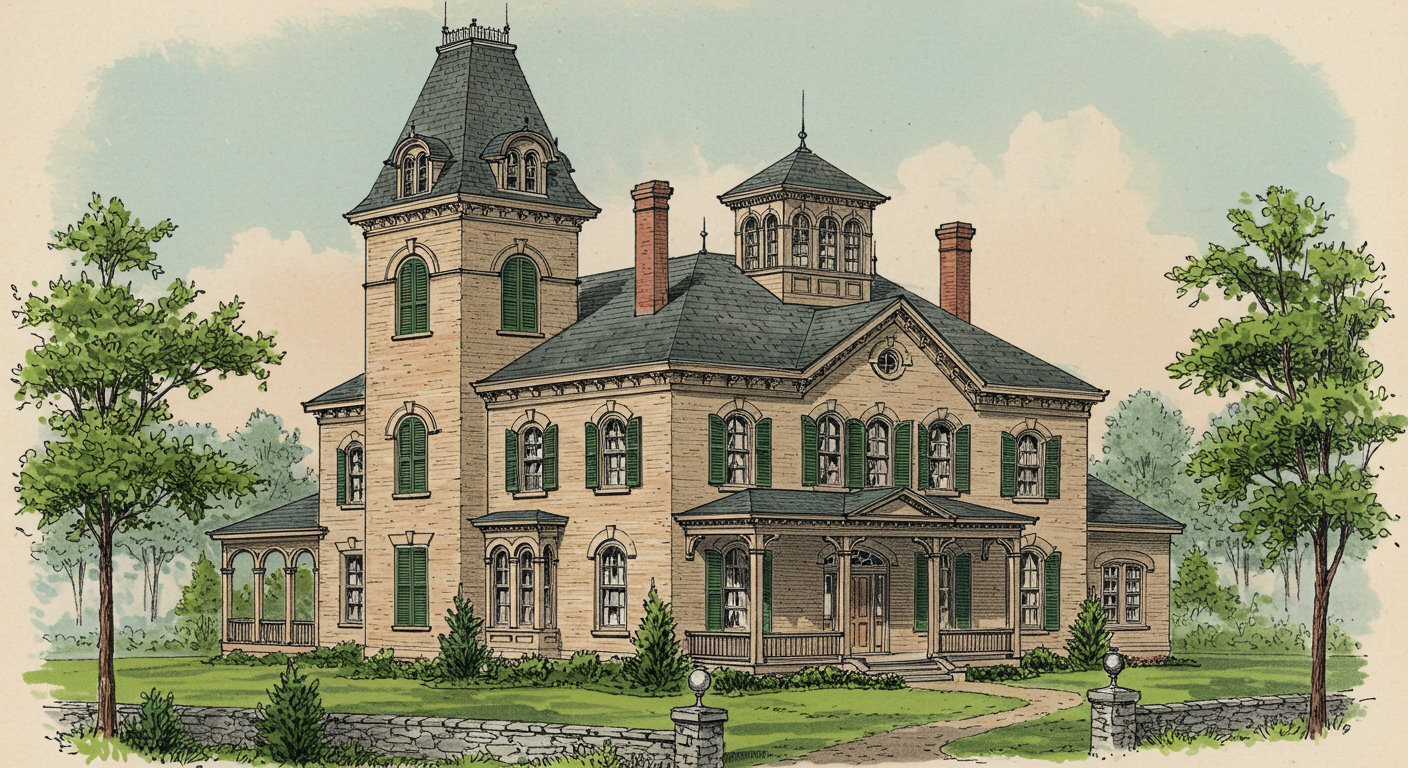
The square wooden cupolas one sees on certain American houses of the 1860s and 1870s have a feature that is easy to miss until one has paid attention. They are not, on close inspection, decoration. There is, almost without exception, an internal stair leading up to the cupola from the second-floor landing of the house; the cupola itself has windows on every face that open from inside; and from inside it, on a clear day, one can see a great deal further than one can from any window in the house proper. The cupola is a viewing platform. The householder climbed it to look at his land or, in town, his neighbours’ yards. The verticality is not picturesque, as the Gothic Revival’s was. It is practical. The owner climbs the cupola, and from the cupola he sees.
The cupolas sit on top of a particular kind of house. It is square, often brick, painted in a soft buff or earth-tone colour. The roof is low and hipped and projects nearly two feet beyond the walls on every side, and the overhang is supported by paired wooden brackets — grouped in twos with a short gap between each pair — running the full perimeter of the cornice in close rhythm. The windows are tall and narrow, twice as tall as they are wide, round-arched at the top under heavy projecting hood molds; the sashes are two-over-two, with larger panes than the houses of a generation earlier could manage. The whole arrangement has the air of a Tuscan farm villa that has been ordered from a catalogue and assembled, with care, in upstate New York snow.
This is the Italianate, and the snow on its cornice is the joke the style cannot quite escape. What follows is the fourth in a series that has been, in a quiet way, trying to read American houses for what they were trying to say. The Queen Anne (the first post) said the middle class has arrived and is making no apologies. The Greek Revival (the second) said we are the new Athens; please do not look too closely at how we are financed. The Gothic Revival (the third) said we are a Christian republic, and the right house for our family is a steep-roofed cottage among trees. The Italianate said something more relaxed than any of these, and more cosmopolitan: we have read of Tuscany, and we should like to imagine ourselves on a hilltop above Florence. It was the architecture of the prosperous American middle class as it began, for the first time and rather self-consciously, to imagine itself at leisure.
The Misnomer
The first thing worth knowing about the Italianate is that the Italians, on inspection, had not put it up that way.
The American Italianate is named accurately enough — after Italy — but it is not directly Italian. It is an English Picturesque idea of an Italian rural villa, filtered through Charles Barry’s English country houses of the 1830s, translated into American pattern-books in the 1840s, and then mass-produced for the American mill-catalogue economy of the 1850s and 1860s. The further one walks back along this chain, the harder it becomes to find any actual Italian building that the American versions look genuinely like.
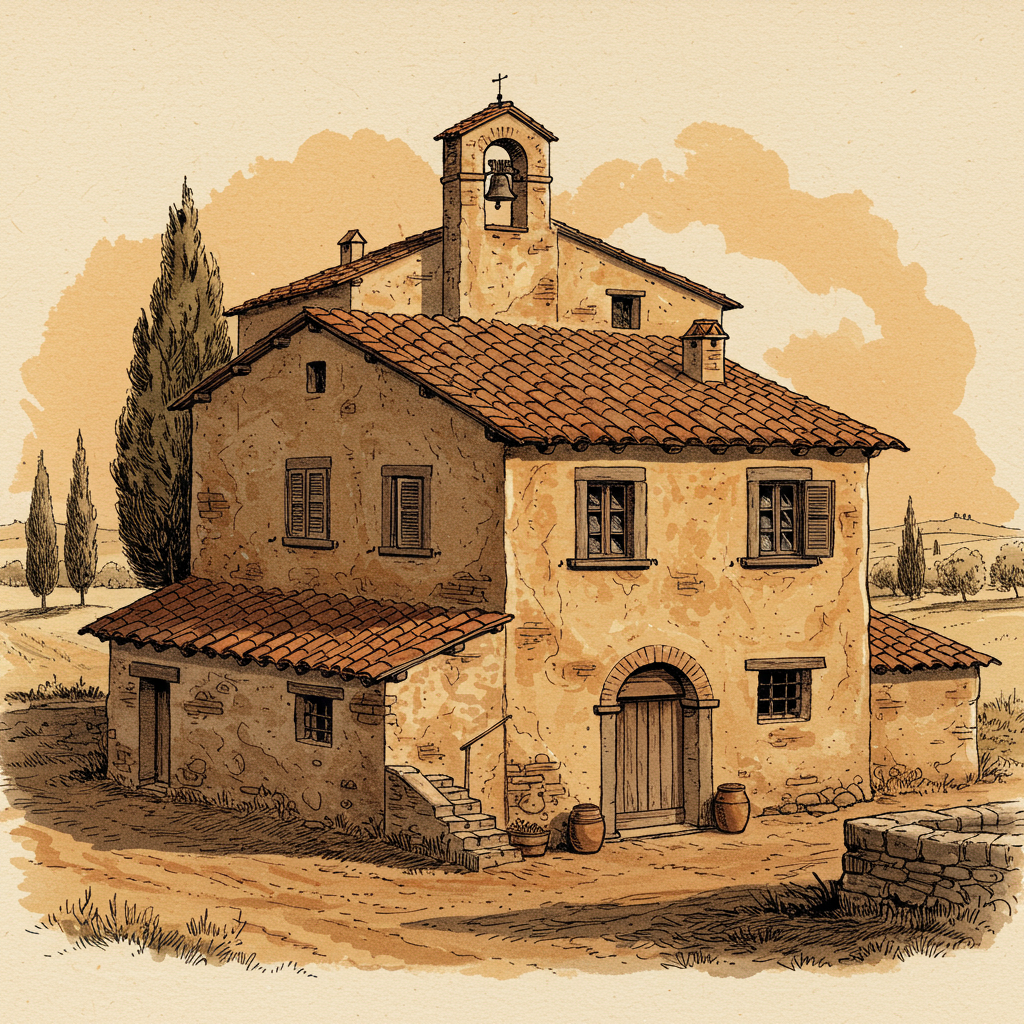
A Tuscan rural villa, roughly 1500 — stuccoed stone, deep eaves, a square campanile rising from the corner of an asymmetric plan. The Italian source the American Italianate was, at five centuries’ and one ocean’s remove, attempting to recall.
The Italian sources, as best the Americans understood them, were two: the Tuscan farmhouse — square, low-roofed, white-walled, with deep eaves casting hard shadow across rough stucco — and the small Florentine palazzo, with its bracketed cornice and its rusticated stone. Neither was built like an American Italianate. The Tuscan farmhouse was a working agricultural building made of stone and stucco; the palazzo was an urban masonry block; neither had the cupola-on-frame, the cast-iron porch, the sawn wooden brackets, or the painted clapboard one finds on the American style. What the Americans actually copied was Charles Barry’s Trentham Hall and Cliveden Estate — Italianate in the sense that English country-house architects called things Italianate when they wanted to suggest the sun and the south, rendered in stucco painted in warm earth-tones, and arranged in asymmetric plans. Barry himself had been to Italy. Most of his American imitators had not.
Andrew Jackson Downing, the same upstate New York pattern-book author one met in the Gothic Revival post, did most of the American translation. Cottage Residences (1842) and The Architecture of Country Houses (1850) illustrated several Italianate cottages and villas alongside the Gothic ones, and the same provincial carpenters who had built Carpenter Gothic from Downing’s plates built American Italianate from the next page. Samuel Sloan’s The Model Architect (1852) extended the style with even more elaborate plates, and the next generation of pattern-books — Cleaveland and Backus’s Village and Farm Cottages (1856), Calvert Vaux’s Villas and Cottages (1857) — completed the dissemination. By 1860 every county seat in the eastern United States had access to the Italianate as a buildable option.
The translation, in other words, ran something like this: a Tuscan villa as Charles Barry imagined it, drawn by Downing in Newburgh, mill-cut in Cincinnati, shipped by railroad to a town in Pennsylvania, and assembled by a carpenter whose nearest experience of the Mediterranean was a steel engraving in a parlour book. The result is recognisably its own thing. It is not, on close inspection, especially Italian.
One is obliged to concede that this is, in its way, the most thoroughly American thing one could have done with an Italian villa.
The Specimen
If one is to identify an Italianate building — and they are, once one has begun looking, almost everywhere — the simplest exercise is, as before, to walk around a specimen and assemble the evidence.
Begin at the roof. An Italianate house presents a low-pitched hipped roof — much shallower than a Gothic Revival’s steep gable, sometimes appearing nearly horizontal from the street, with all four sides sloping gently to a small flat or hipped centre. (A few rural variants use a side-gabled roof instead, but the hipped roof is the standard.) The roofline does not drive the eye upward as a Gothic Revival’s does; it lays the building down horizontally, in the manner of a long Mediterranean farmhouse seen across a vineyard.
Now look at the eaves. This is where the Italianate makes its identity unmistakable. The roof projects far beyond the wall — eighteen inches to three feet on a generous example — and that overhang is supported by paired sawn wooden brackets, marching along the underside of the cornice at regular intervals. The brackets are usually shaped as an elongated S-curve or a scrolled console, with chamfered edges and sometimes a small drop pendant at the tip. They are the signature feature of the style, more characteristic than any other; if a building has paired bracketed eaves, it is Italianate to a strong probability, and if it has not, it almost certainly is not.
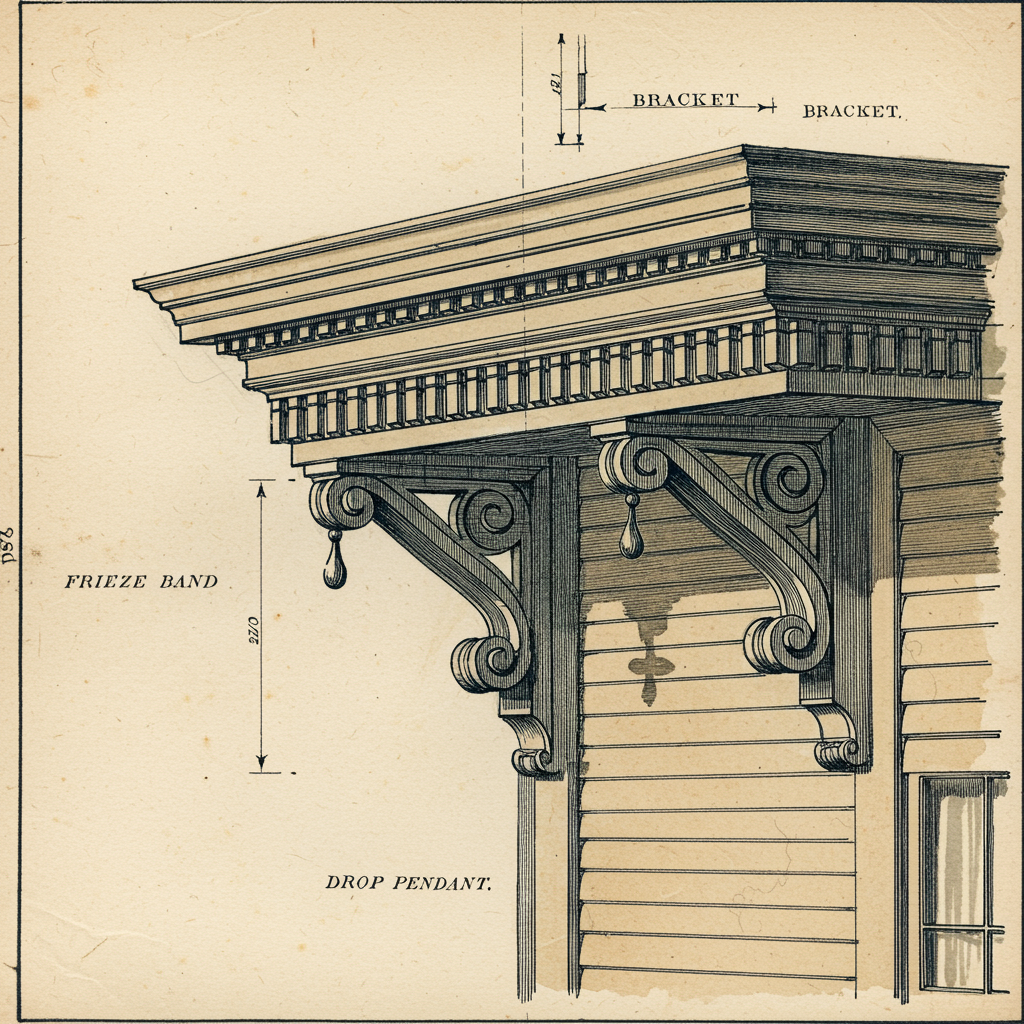
Paired sawn wooden brackets under a wide overhanging cornice — the Italianate’s signature feature. The pair, the rhythm, and the deep shadow they cast across the wall below are the readiest way to recognise the style at a distance.
Come down to the windows. Italianate windows are tall and narrow, often nearly twice as tall as they are wide, and very often round-arched at the top — a clean curve sitting over a flat lower pane, occasionally with a small radiating mullion bar in the arch. Above each window sits a hood mold: a heavy projecting cap, sometimes segmental, sometimes pedimented, sometimes a flat ledge with carved corbels — never a simple lintel. The hood mold is the Italianate’s second signature, and the small downtown storefront’s row of hood-molded second-storey windows is its most ubiquitous form in any American main-street block built between 1855 and 1880.
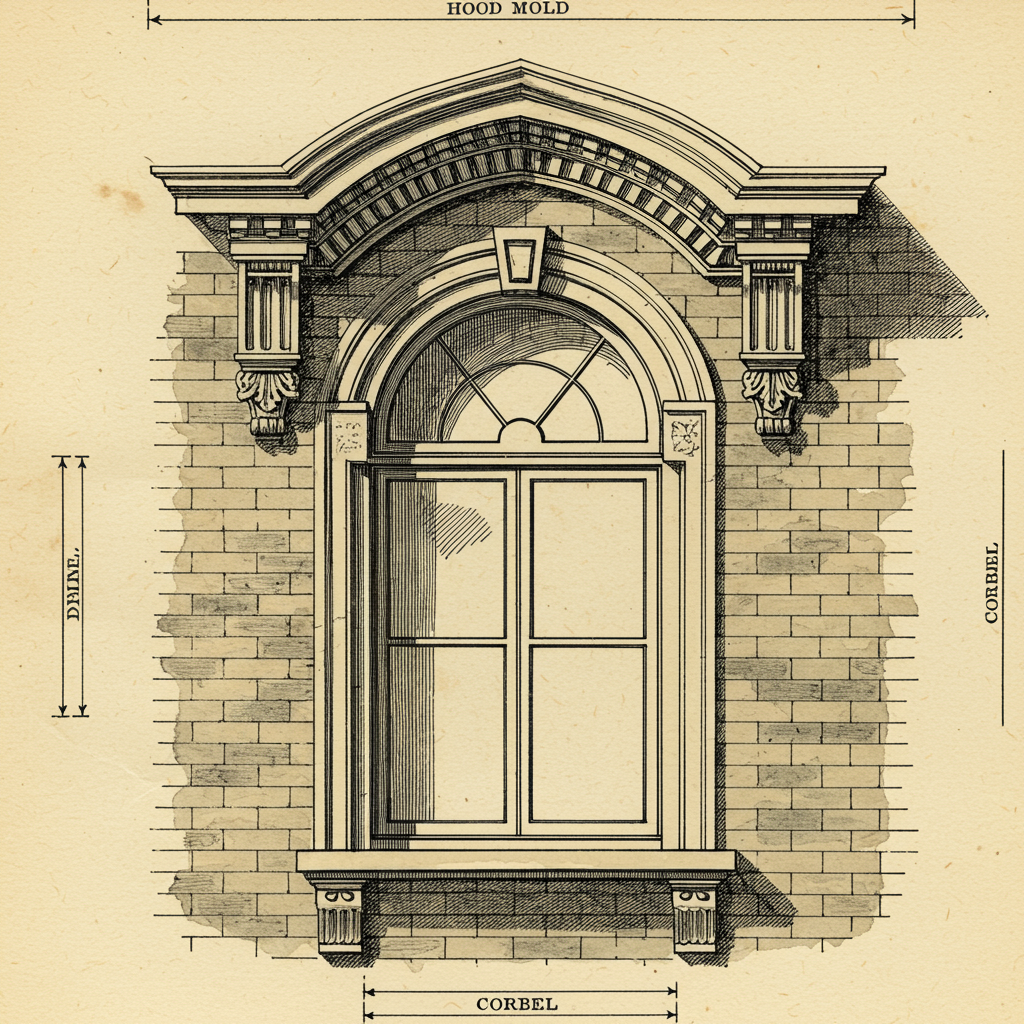
A round-arched Italianate window beneath a heavy hood mold — the second signature, after the bracketed cornice. Tall and narrow proportions; two-over-two glazing; a hood that projects far enough to throw a shadow across the upper sash.
Look up. On grand examples, an Italianate house carries a cupola — a small square box, often four-sided, sitting on the centre of the roof and crowned with a low pyramidal cap. The cupola has windows on every side, an internal stair leading up to it, and was used by the householder to look at his land or, in town, his neighbours’ yards. (Where the Gothic Revival’s verticality had been picturesque, the Italianate’s was practical. The owner climbed the cupola to see.) On smaller specimens the cupola becomes a simple belvedere or merely a square chimney-cap; on the largest, it grows into a full tower — a square asymmetric projection, three or four storeys tall, set off-centre on the front elevation, capped with a low pyramidal roof. The Italianate tower was one of two American architectural moves that broke decisively with the symmetric Greek Revival; the asymmetric Gothic gable was the other.
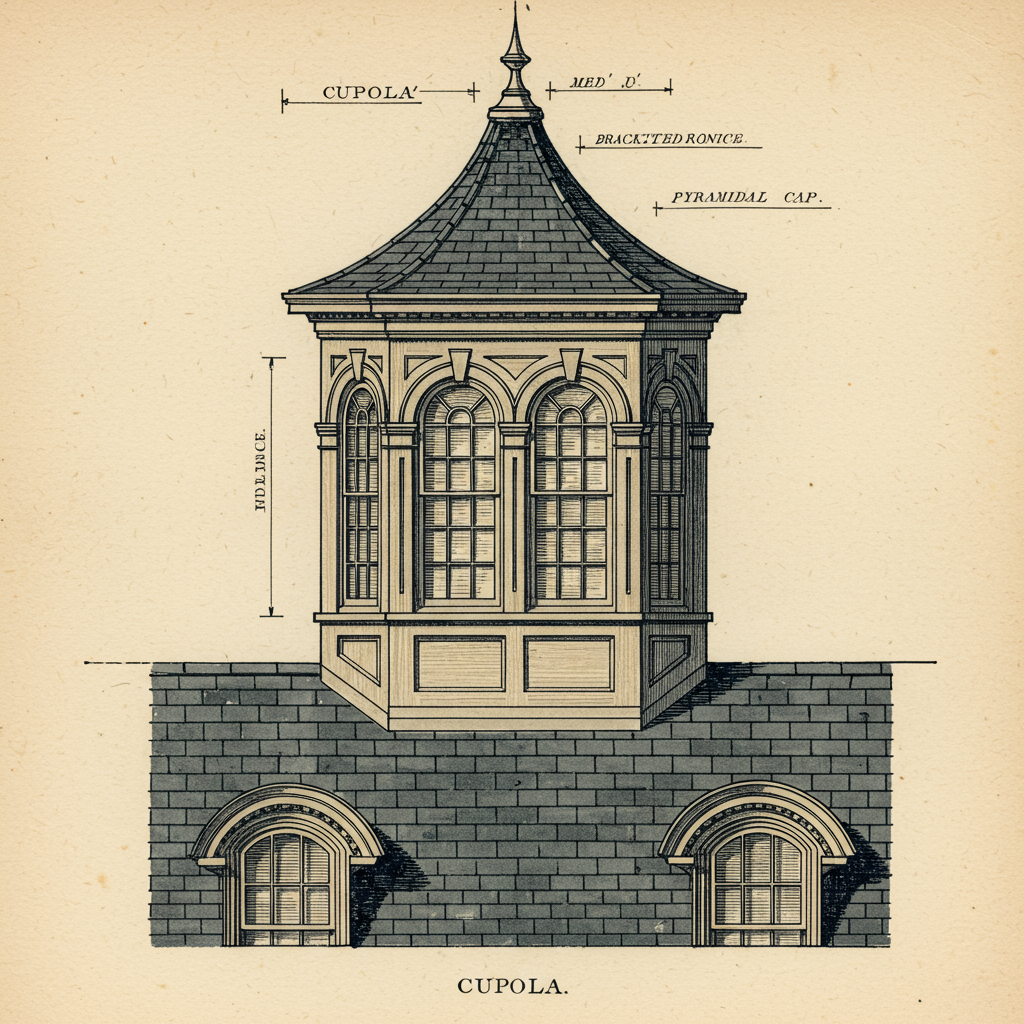
A square cupola sitting on the centre of an Italianate hipped roof — windows on every face, an internal stair, a low pyramidal cap. Where the Gothic Revival’s verticality was picturesque, the Italianate’s was practical: one climbed to it, and one looked out.
Examine the walls. Italianate walls are usually brick or stucco on urban examples and clapboard on rural ones, and the colour is, almost without exception, in a warm earthy palette — buff, soft yellow, terracotta, ochre, or a low rust-red. The Greek Revival’s bone-white had been abandoned with the abandonment of the temple metaphor; the Italianate wanted to look like sun-baked stone, and it got there with paint when it could not afford stone. (The colour is one of the most reliable identifiers in poor light: a white house with a low hipped roof and bracketed eaves is almost always a misjudgement by a later painter.)
Two more details round out the specimen. Two-over-two double-hung sashes replace the six-over-six of the Greek Revival — the panes are larger, because by 1860 the glass industry could roll bigger sheets, and the glazing pattern is plainer to suit the larger pane. And on more elaborate examples, cast-iron porches and balconies show up, often with elaborate New Orleans-style ornamental ironwork, also shipped by railroad from a foundry catalogue.
Assemble these — the low hipped roof, the bracketed eaves, the round-arched window, the hood mold, the cupola or tower, the warm earth-tone walls, the cast-iron porch — and one has an Italianate. A square brick block with all of them is a high-style Italianate villa; a clapboard house with the bracketed eaves and a low hip but no cupola is a vernacular Italianate cottage; a downtown commercial block with the second-storey windows and the bracketed cornice is the most common form of all.
The Catalogue Villa
The economic story behind the Italianate is the story of the American building industry’s transition from the pattern-book to the mill catalogue.
The Gothic Revival, as we saw, depended on Downing’s printed plates and a local carpenter cutting his own scroll-saw vergeboard. The system was loose and produced local variation: two Carpenter Gothic cottages in the same county might have measurably different vergeboard patterns, depending on which plate the builder had liked. The Italianate, by contrast, depended on standardised parts shipped by railroad from a central mill, and as a result two Italianate houses three states apart could carry, more or less, identical brackets.
The shift had two technological causes. The first was the maturation of the steam-powered jigsaw and bandsaw between 1845 and 1860, which let a mill produce bracket-blanks by the gross — paired left-and-right scrolls, drilled and ready to nail — at a price a one-man shop could not approach. The second was the railroad. By 1860 the eastern United States had a railroad network dense enough that a Cincinnati mill could ship a bracket to a Pennsylvania carpenter, in a labelled crate, in under a week, for less than the carpenter could have made it himself. The mill catalogues — Palliser’s, Bicknell’s, Hodgson’s, Wood’s — illustrated brackets, hood molds, cupola panels, porch posts, and cast-iron railings by the page, and a small-town builder, given a homeowner’s preference and a tape measure, could place an order, take delivery in a week, and put up an Italianate cottage from catalogue parts in a month.
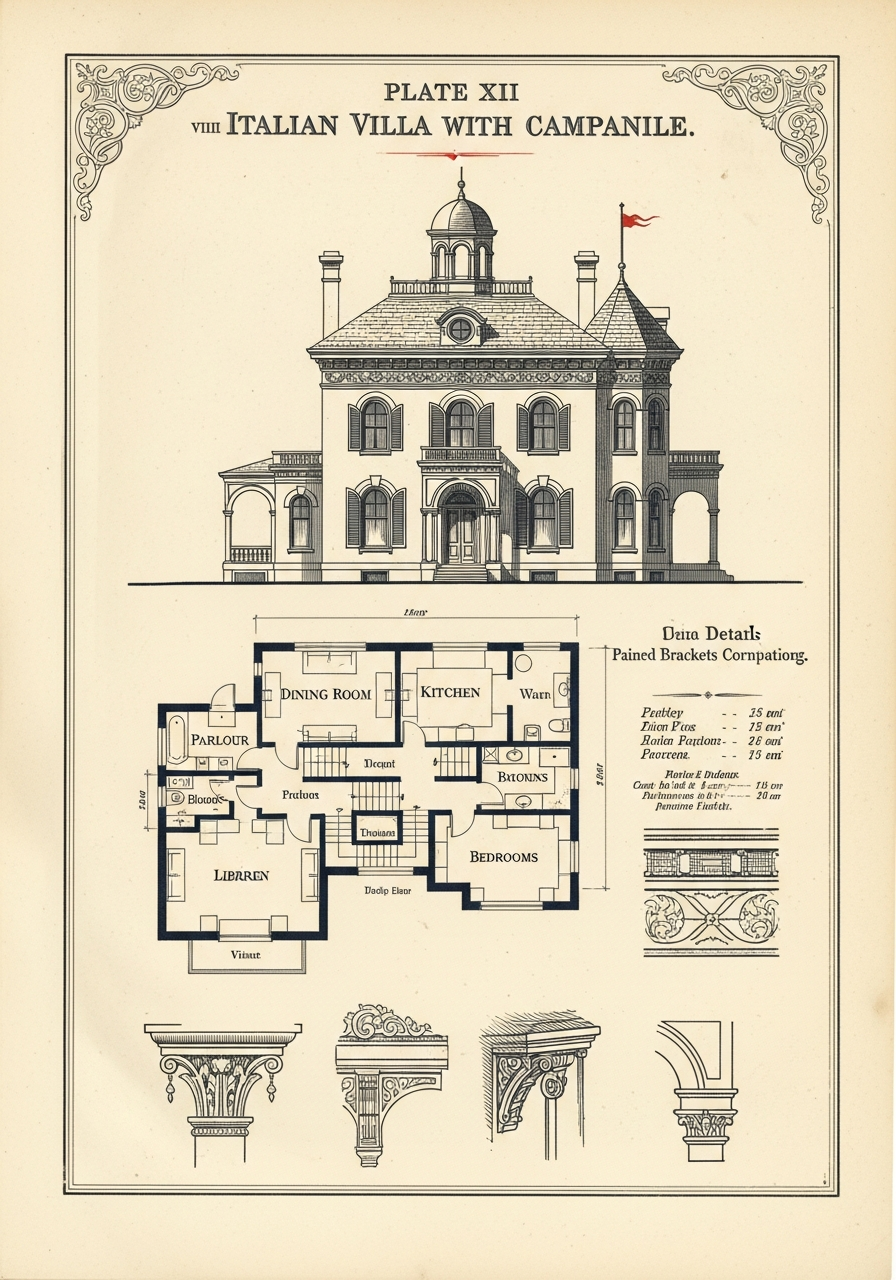
A plate from Samuel Sloan’s The Model Architect, c. 1852 — elevation, plan, and ornamental details for an Italianate villa with cupola. Most American Italianates descend, by inheritance one or two generations distant, from a plate something like this. Sloan illustrated parts that the carpenter could buy by mail; the book was, in effect, the index to a national catalogue.
This was a different industrial moment from the Queen Anne’s later catalogue economy. The Queen Anne (1880-1900) used the same distribution system but ran it at a vastly larger scale, with mass-circulation catalogues like Sears Roebuck eventually shipping entire houses in pieces. The Italianate was the opening of that economy, when a builder was still working from a Downing plate but increasingly buying his ornament from a Cincinnati mill rather than cutting it on his own saw. The hand-cut vergeboard was on its way out; the catalogue bracket was on its way in.
The pattern-book authors caught up to this. Sloan’s plates illustrated parts that one could buy by mail; Vaux explicitly recommended specific mill suppliers. The architecture was hybridising: a Downing-trained carpenter with a Sloan plate and a Palliser catalogue could put up a high-style Italianate villa, on a small farm in Iowa, in 1865, for a price the same farmer could not have managed to build a Greek Revival temple front for in 1835.
The result, paradoxically, was a more uniform style than the Gothic Revival had been. American Italianates from Maine to Iowa show a sameness of bracket and hood-mold profile that betrays their common catalogue ancestry. Two Carpenter Gothic cottages might be visibly individual. Two Italianate houses, even three states apart, are likely to have come out of the same mill.
What It Is Not
Four styles stand near enough to the Italianate that the beginner confuses them with it, and distinguishing them is most of the work of reading the post-1850 American house.
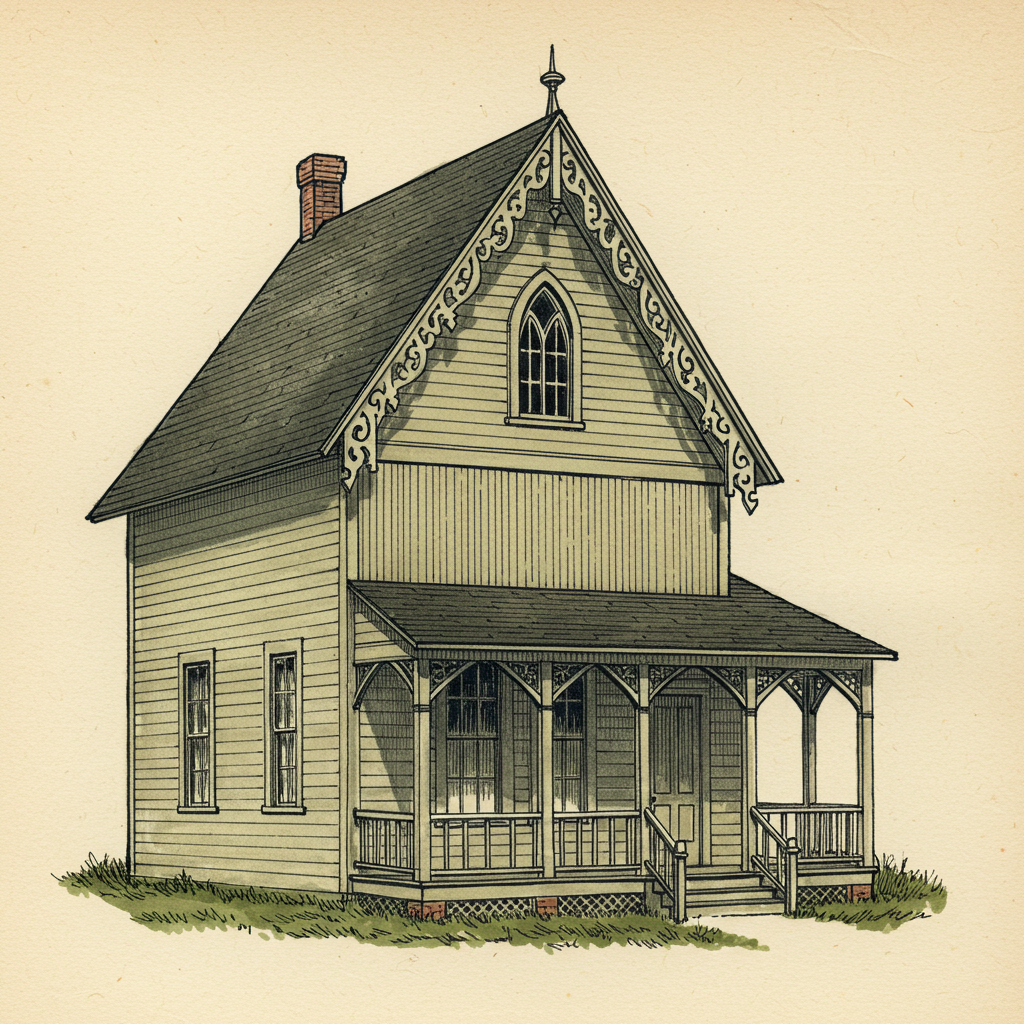
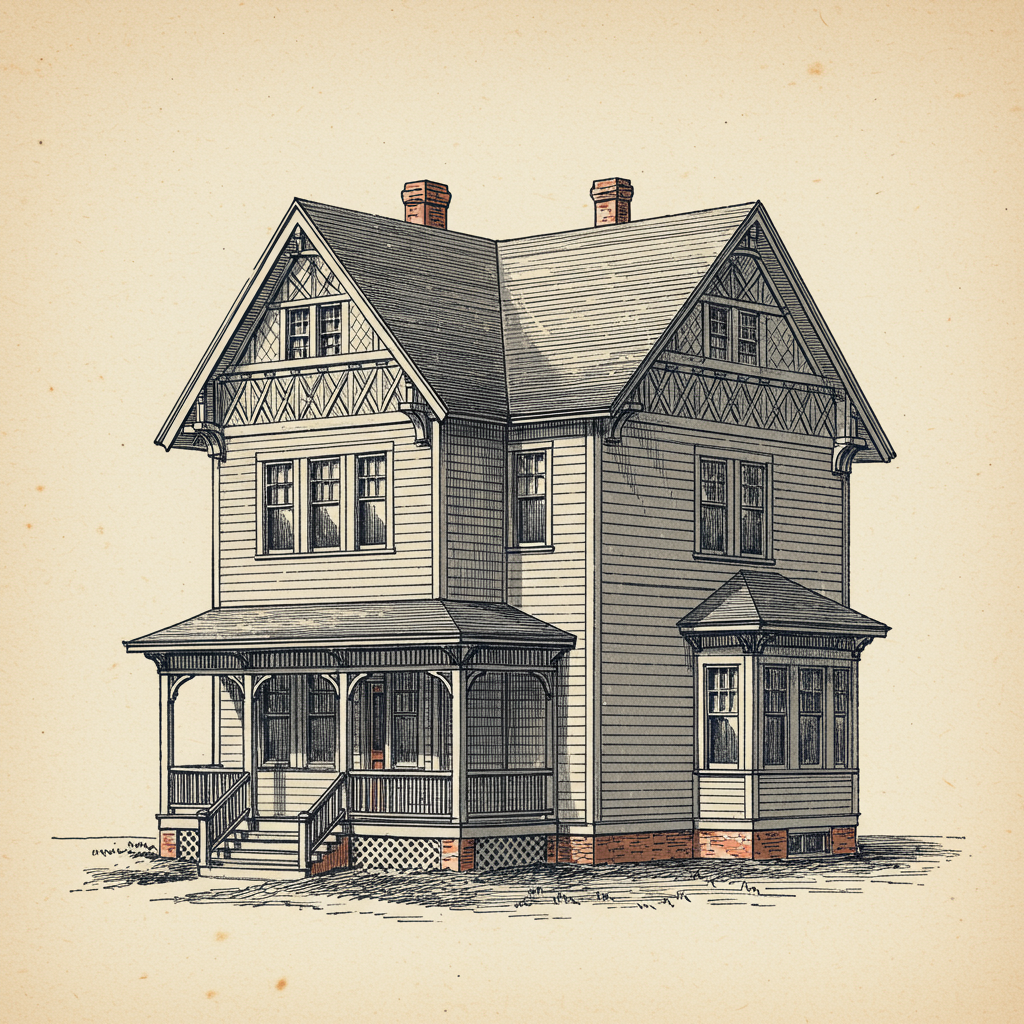
The Gothic Revival — the Italianate’s picturesque sibling, examined in the previous post — shares the Italianate’s pattern-book genealogy and Downing as a common ancestor, but the visual distinction is clean: a roof with vergeboards is Gothic; a roof with brackets is Italianate. Where the Gothic Revival drives the eye up with a steep gable, the Italianate lays the eye down with a low hip; where the Gothic uses board-and-batten siding, the Italianate uses brick, stucco, or horizontal clapboard. The two styles overlap in time (both flourish 1840-1880), but they are arguing for different things — the Gothic Revival for the moral cottage, the Italianate for the cosmopolitan villa.
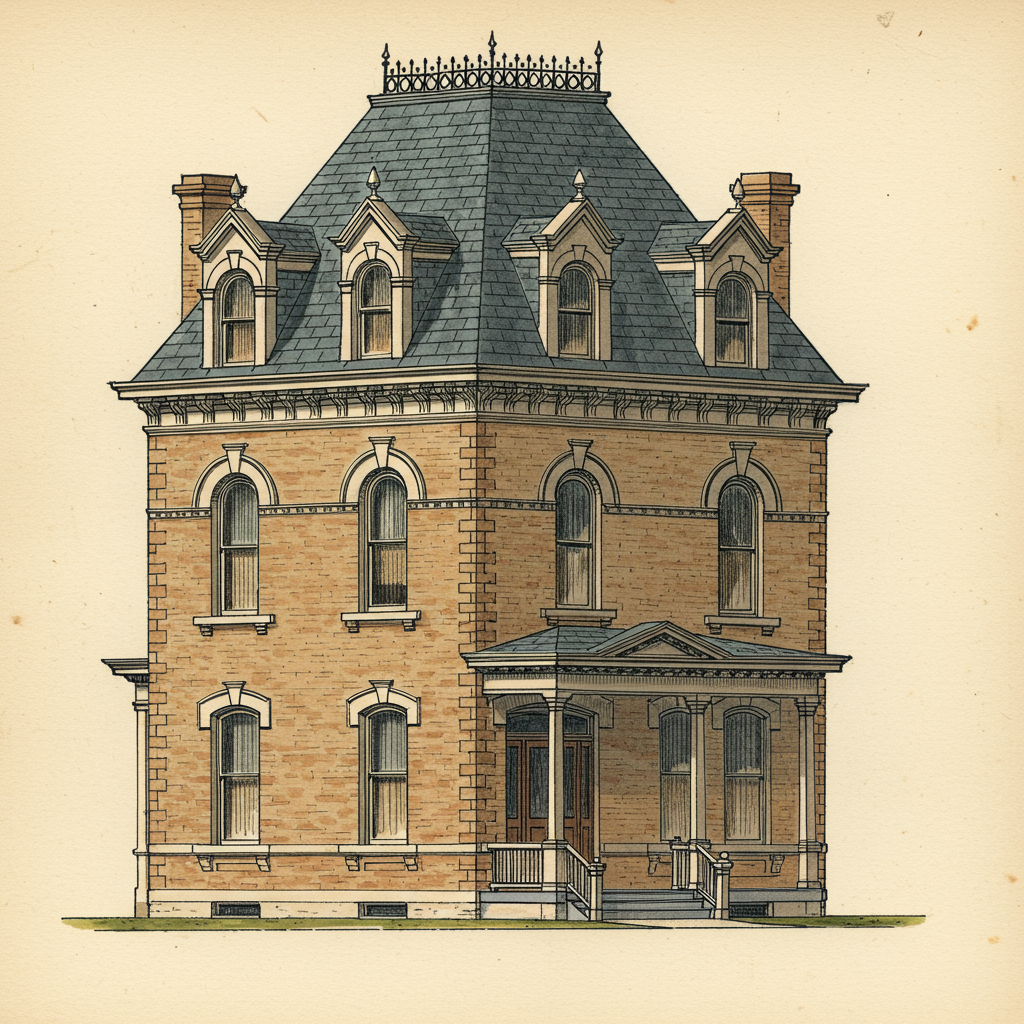
The Second Empire — the Italianate’s elaborated successor of roughly 1860 to 1885 — kept everything Italianate about the body of the house and added one defining new feature on top: the mansard roof, a steep four-sided roof with dormer windows set into the slope, named for the seventeenth-century French architect François Mansart and revived in Paris in the 1850s. A Second Empire is, on inspection, an Italianate that has put on a tall hat. Many actual buildings of the 1860s and 1870s are hybrids — Italianate from the cornice down, Second Empire from the cornice up — and the rule for distinguishing them is straightforward: if the roof is low and hipped, it is Italianate; if the roof is steep and many-sloped with dormers in it, it is Second Empire.
The Stick style — the Italianate’s near-contemporary in the 1860s and 1870s — kept the asymmetric tower and the love of decorative woodwork but replaced the bracketed cornice with applied wooden sticks expressing the frame of the house. A Stick is what happens when an Italianate carpenter decides that the bones of the building, rather than the Tuscan villa, are what want celebrating. The two styles share builders and pattern-books, and a high-Stick from 1875 looks at first glance very like an asymmetric Italianate from 1865 — but the sticks running across the wall plane settle the matter.
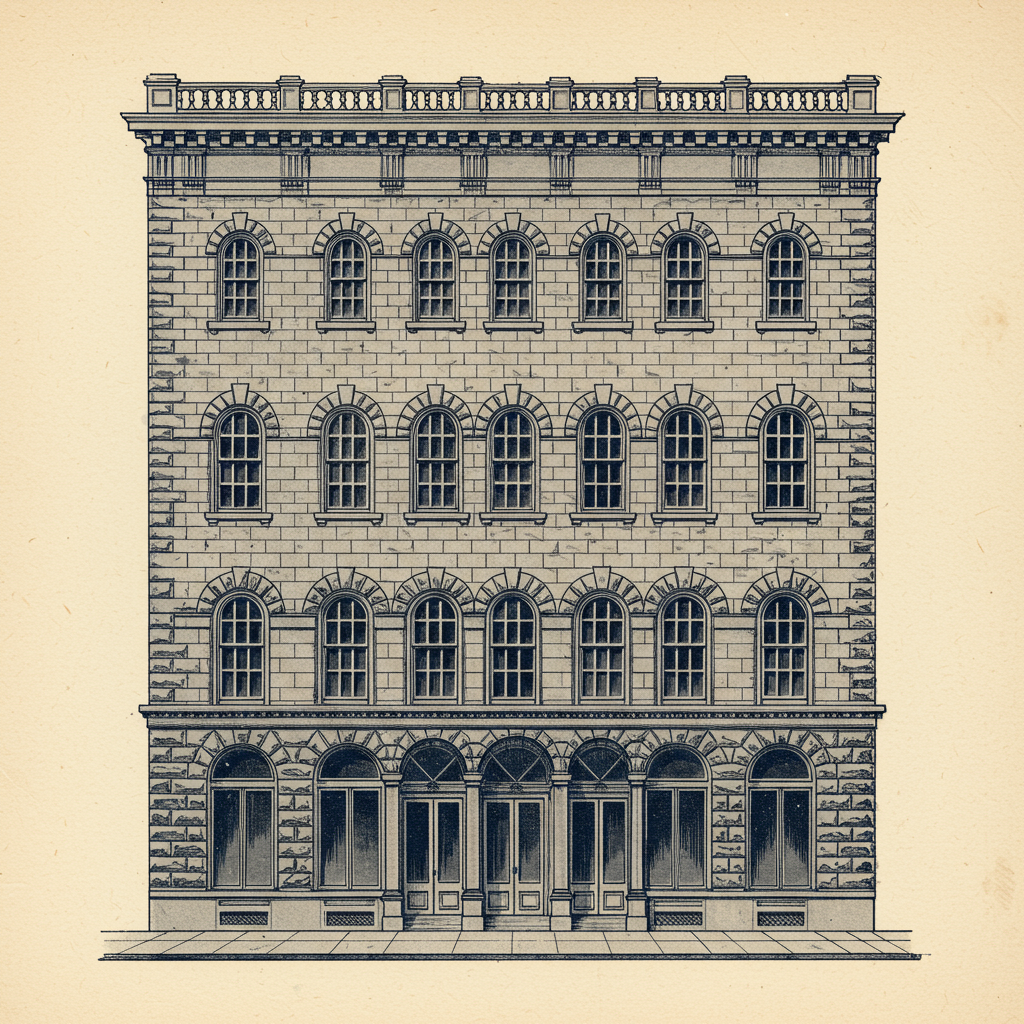
The Renaissance Revival — the Italianate’s urban masonry cousin, also called palazzo style — applied a more disciplined Italian-palazzo grammar to commercial and institutional buildings in cities, with rusticated stone, paired arched windows, and a heavy crowning cornice. Where the rural Italianate was relaxed and picturesque, the Renaissance Revival was formal and symmetric — a downtown bank or office block in 1870 might be Renaissance Revival rather than Italianate, despite sharing a great many of the same window and cornice details. The rule of thumb: if the building is symmetric and rusticated and looks like it could have stood on a Florentine piazza, it is Renaissance Revival; if it is asymmetric and bracketed and looks like a country villa transplanted, it is Italianate.
What It Was Trying to Say
The Italianate flourished in America between roughly 1840 and 1885, with its sharpest and most ubiquitous period falling in the two decades on either side of the Civil War. By 1880 it was being superseded — in town houses by the Second Empire, in country houses by the Queen Anne, on commercial main streets by the Romanesque Revival. By 1890 it was old-fashioned. The style had been the dominant American mode for forty years, and the bulk of the building that defines a nineteenth-century American downtown was put up in its idiom.
What it was trying to say is best taken, again, as the sum of two arguments running in parallel.
The first is the cosmopolitan argument. The Greek Revival had been a national-republican statement about classical virtue; the Gothic Revival a Christian-domestic statement about the moral home. The Italianate was something the American republic had not had before: a cosmopolitan statement, an architecture of leisure and continental sensibility. The cupola was for the view — a gentleman’s lookout over his property — but it was also for the suggestion, the implication that the householder was a man of culture who had read of the Grand Tour and would, given the means, make it himself. The bracketed cornice was a quotation from the small-town palazzi of Tuscany, applied to a frame house in upstate New York and signifying that one had heard of Tuscany and wished to be associated with the suggestion. The Italianate was the first American architectural style that tried to say we have travelled in Europe in our imaginations, and it said it loudly enough that even the most modest village stationer’s storefront could carry the freight.
The second is the industrial argument. The Italianate was the first American style produced as a product. Its parts were standardised, catalogued, and shipped; a builder ordered them by the linear foot. The democratisation of the style is real and quite dramatic: a small-town family in Indiana, in 1870, could afford an Italianate cottage with mill-bracketed eaves, hood-molded windows, and a small cupola for a price that the same family thirty years earlier could not have managed for a Greek Revival temple front. The architecture became cheaper and more cosmopolitan, simultaneously, on the strength of the mill catalogue. This is, on inspection, a remarkable achievement of mid-Victorian American industrial culture, and one the architecture itself does not advertise — the bracketed cornice does not look industrial; it looks Tuscan.
What I find most telling about the Italianate, taking these two arguments together, is the discovery the American middle class made through it: that one could purchase a hint of leisure. The cupola, the hood mold, the bracketed cornice — none of these were structural; all were applied; all could be ordered by mail. They were ornaments of suggestion. They told the visitor that the householder was prosperous enough to afford ornament that did nothing, and cultivated enough to know what to suggest. The Italianate is the first American architecture of image, in the modern sense — the first style in which what one was buying was, transparently, a sign rather than a structure.
The next specimen I should like to take up is the Second Empire — the Italianate’s elaborated successor, which took everything Italianate about the body of the house and put a mansard roof on top, and which became, in the decade after the Civil War, the most fashionable form of the American urban house.