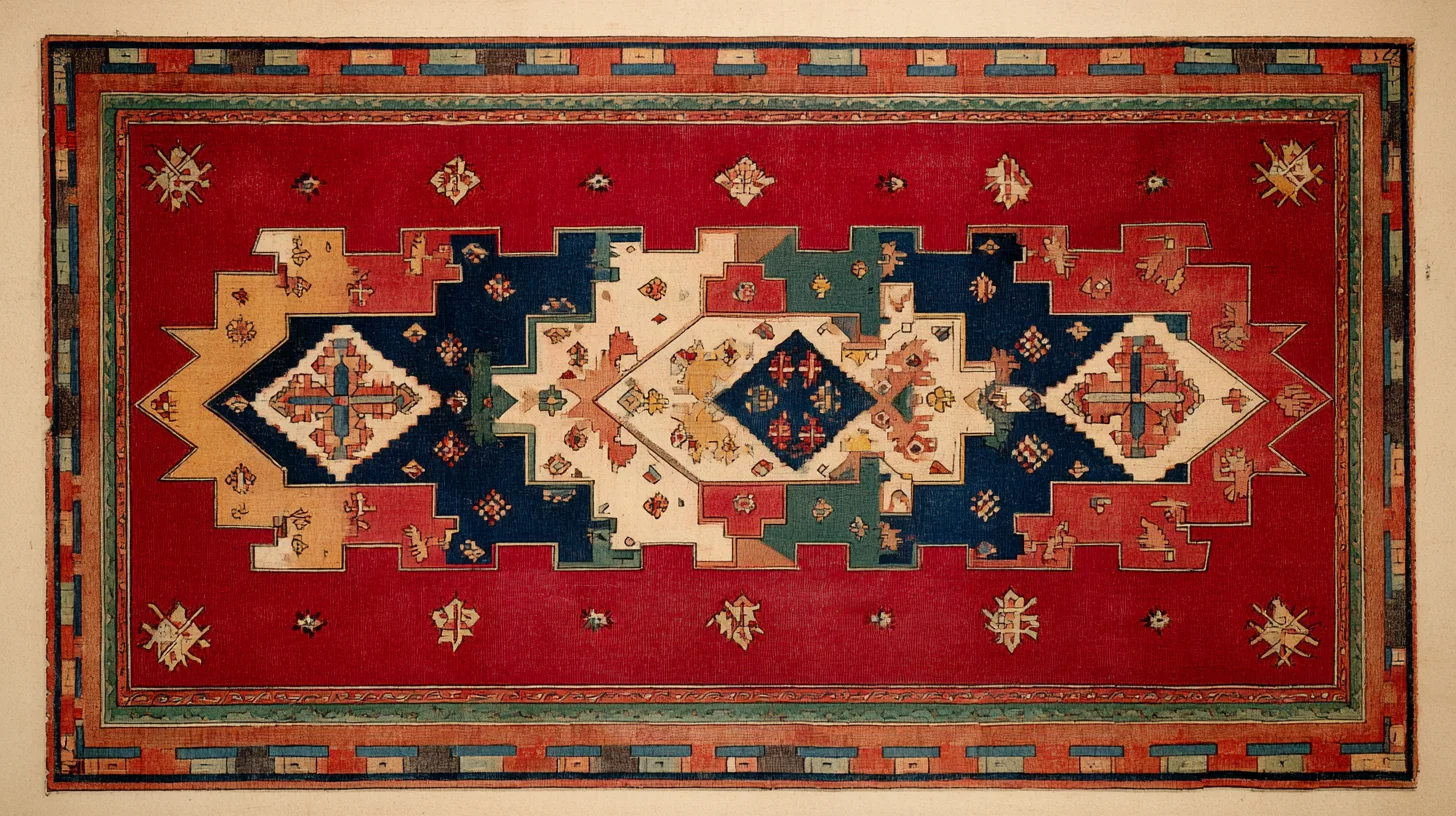
The third post in this arc treated the Kazak, and it opened the Caucasian tradition by setting the bold geometric weaving of the southern highlands against the curvilinear Persian work the arc had been describing until then — the stepped medallion against the scrolling vine, the saturated tomato-red against the city ground, the tribal loom against the workshop. The Kazak post closed by promising that the arc would, in time, come back down out of the highlands and treat the rest of the South Caucasus on its own terms. The eleventh post, on the Isfahan, ended by naming Karabagh as one of the two rugs that might come next, and by noting that the choice would return the account to the Caucasus and to the burgundy-and-rose register. This is that post. It treats Karabagh in the position the arc has reserved for the southern weaving region of the South Caucasus — the mountainous district that lies between the Caucasian rug world and Persia, and that produced, more than any other Caucasian type, a body of work the collector must learn to recognise across an unusually wide range.
This is the twelfth post in Reading the Antique Rug. The Karabagh is the rug in this arc with the most divided identity, and the division is the load-bearing fact of the whole post. The region produced, side by side and from the same villages, two almost opposite kinds of rug. The first is a bold, large-scale geometric Caucasian weaving — stepped medallions, a saturated palette, the strong angular drawing that the Kazak post described as the common Caucasian grammar. The second is a startling body of floral rugs carrying naturalistic European roses and bouquets, drawn so directly from French models that a Karabagh of this kind, met without warning, can be mistaken for an Aubusson. Both are genuinely Karabagh. The post must carry both, and it must hold them together rather than apart; that two-natured identity, the tribal-geometric and the French-floral standing in one tradition, is the distinction this account is built around. One meets it the moment one tries to say what a Karabagh looks like.
The Specimen
A Karabagh that one will most commonly encounter on the open market is a nineteenth-century or early-twentieth-century weaving of the floral kind — and it is worth beginning with the floral kind precisely because it is the one a collector does not expect, and the one the rest of the post must explain. Such a rug is, in its commonest form, a piece of moderate size: a scatter rug, a long runner, a kellegi of the gallery proportion that the Karabagh district favoured for its houses. The first thing to settle, before any motif is read, is the ground, because the Karabagh ground is the type’s signature in the way the wine-red field was the Kashan’s and the pale ivory was the Isfahan’s. It is a deep, saturated burgundy — a dark wine-red that runs warmer and graver than the bright tomato-red of the Kazak, with which it is most often confused — and on the floral pieces it is frequently a near-black aubergine or a deep madder that the eye reads, at a little distance, as black. Against that dark ground the design is drawn in clear pink, in a softer rose-red, in ivory and a clean green, and the relation between the dark field and the pale roses is the whole visual character of the type.
The design completes the specimen, and on the floral Karabagh it is the Gül Farangi — the term is Persian-Turkic and means, in the plainest rendering, “foreign flowers” or “French flowers,” and it is exactly descriptive. The field carries naturalistic roses: full-blown garden roses, drawn with shading and with a sense of light and volume, gathered into bouquets and scattered across the dark ground in a manner that owes nothing to the Caucasian geometric grammar and everything to the floral carpets of France. There are rose-and-laurel borders; there are pink ribbons and trailing sprays; there are, on the more ambitious pieces, the full apparatus of the European bouquet. The drawing is curvilinear in intent — it is trying to be naturalistic — and the quality that most distinguishes the floral Karabagh is precisely the gap between the intent and the means. A Caucasian village loom is a coarse instrument for a French rose. The weaver renders the rose as faithfully as a moderate symmetric knot will allow, and the result is a naturalistic flower carried at a vernacular register: recognisably, unmistakably French in its drawing, and just as unmistakably a hand-knotted Caucasian village rug. That doubled quality — the foreign design honestly attempted on the native loom — is the floral Karabagh’s particular charm, and it is the thing the post is asking the eye to learn.
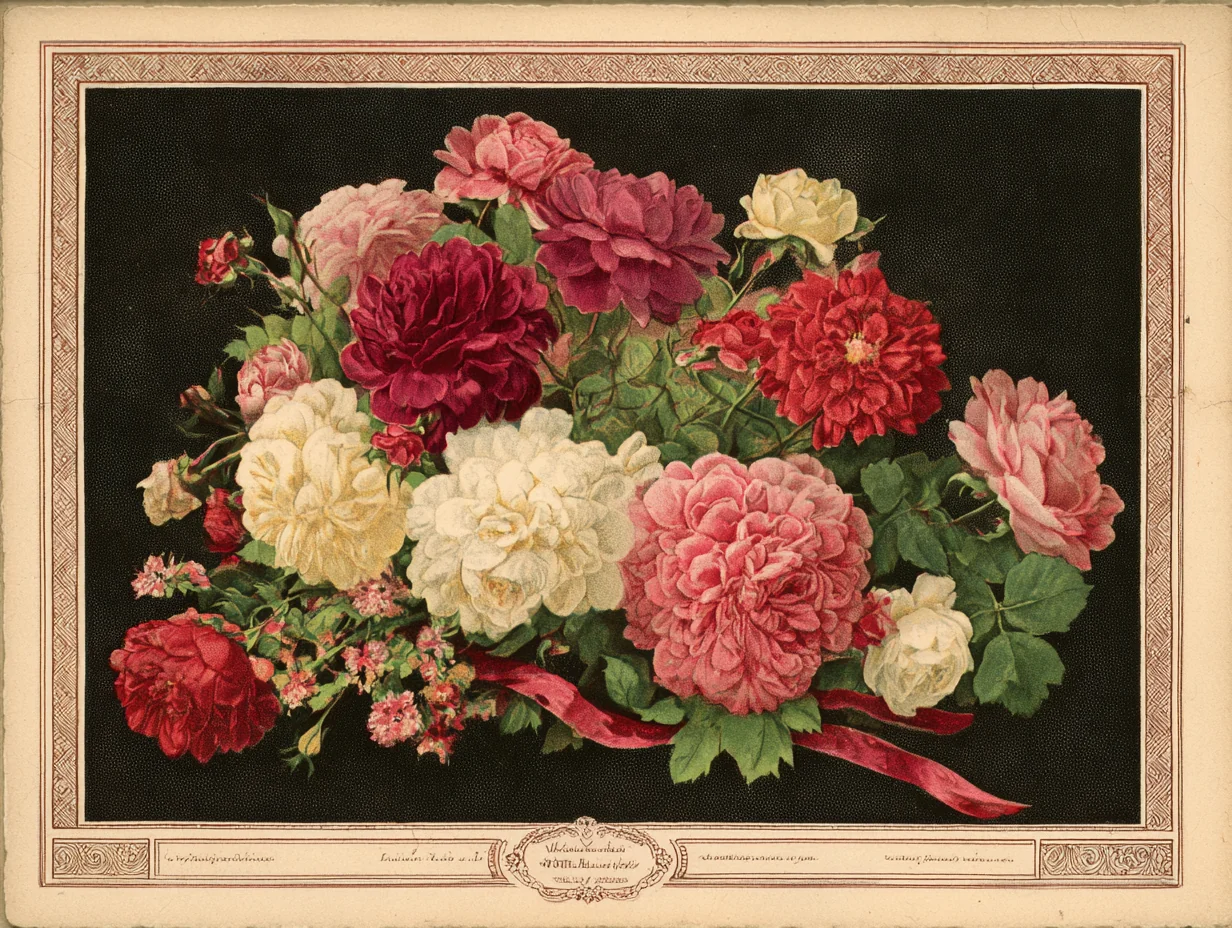
A close detail of a Karabagh French-rose floral bouquet — the Aubusson-derived European vocabulary translated into Caucasian wool pile. The roses are recognisably French in their naturalistic drawing, even at the Caucasian village register.
The Evidence
The foundation is the structural evidence, and for the Karabagh it is the fact that anchors the type firmly within the Caucasian tradition no matter what the field is drawing. The Karabagh is woven on a wool foundation. One turns the rug over, parts the pile at a worn place, or examines the fringe where the warp ends emerge, and the warp threads are wool — and so, on most pieces, is the weft. This is the South Caucasian wool-warp register, the structural signature that the Kazak post established as common to the Caucasian village rugs, and it holds for the Karabagh whether the field carries a stepped medallion or a French bouquet. The collector should grasp the force of this. The floral Karabagh borrows its design from a foreign tradition, but it does not borrow its structure — the foundation remains stubbornly, diagnostically Caucasian, and a rug that looks like an Aubusson but is woven on a wool warp at moderate Caucasian density has already told the careful hand most of what it needs to know. The foundation is the part of the rug the European fashion never reached.
The knot is the second piece of structural evidence, and it corroborates the first. The Karabagh is tied with the symmetric knot — the Turkish knot, used across the whole Caucasian and Anatolian world — set at the moderate village density that is neither the fineness of the Persian workshop nor the deliberate coarseness of the most rustic tribal weaving. The knot is symmetric whether the rug is geometric or floral; the European design did not bring a Persian knot with it. The wool of the pile is of the good mountain grade the South Caucasus is known for, and it is this wool that gives even a modest Karabagh its depth of colour. The palette is the last and most legible evidence, and it is here that the type announces itself across both its kinds. The Karabagh ground runs to burgundy and to deep wine, graver and darker than the Kazak’s bright field; and on the floral pieces the dark ground is set against the pink-and-red European roses in a contrast that no purely Caucasian rug, and no purely Persian one, will quite reproduce. A deep burgundy ground carrying naturalistic roses, on a wool foundation, at a moderate symmetric knot — that combination is Karabagh and is almost nothing else.
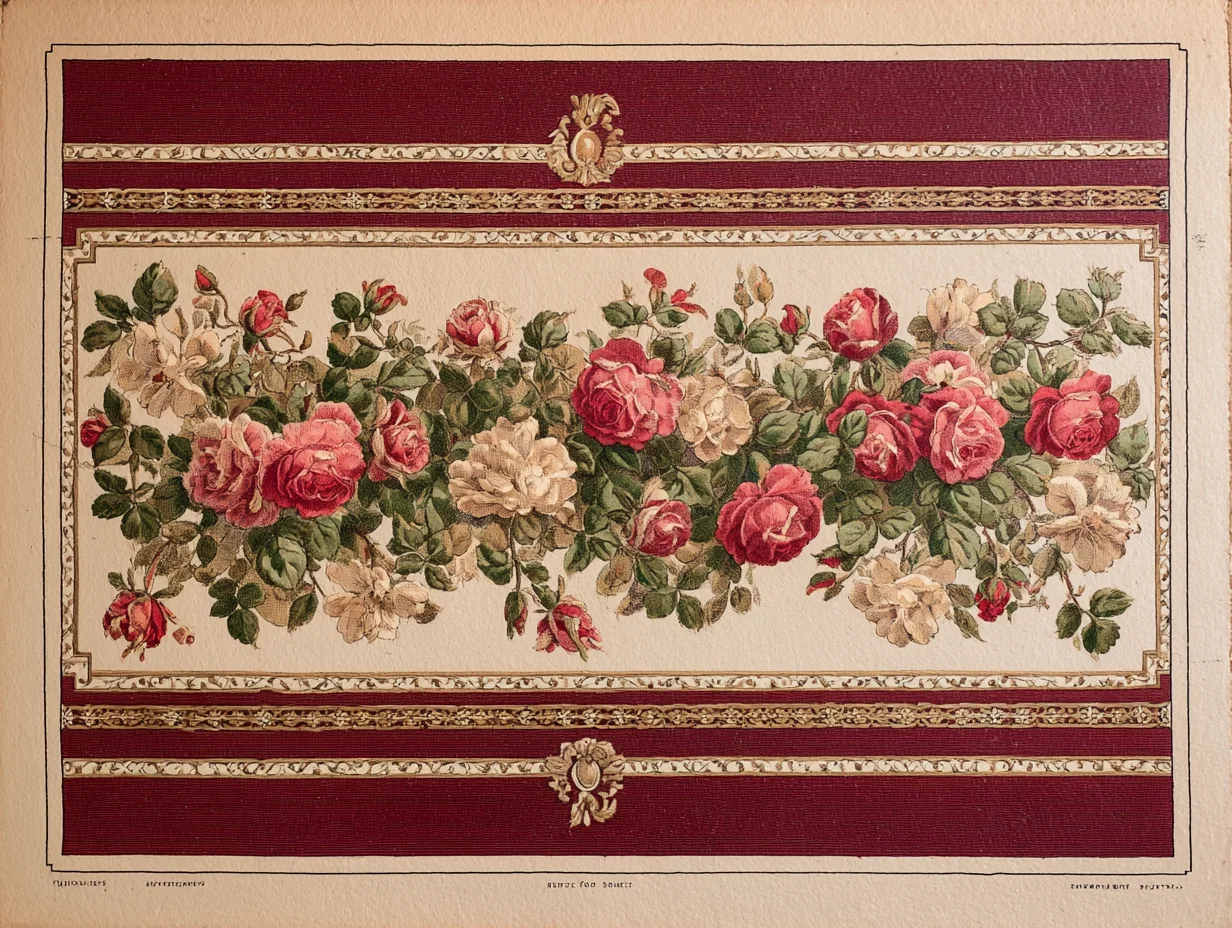
A close detail of a Karabagh main border — the French-rose-and-laurel European repeat that distinguishes Karabagh from the tribal Caucasian neighbours.
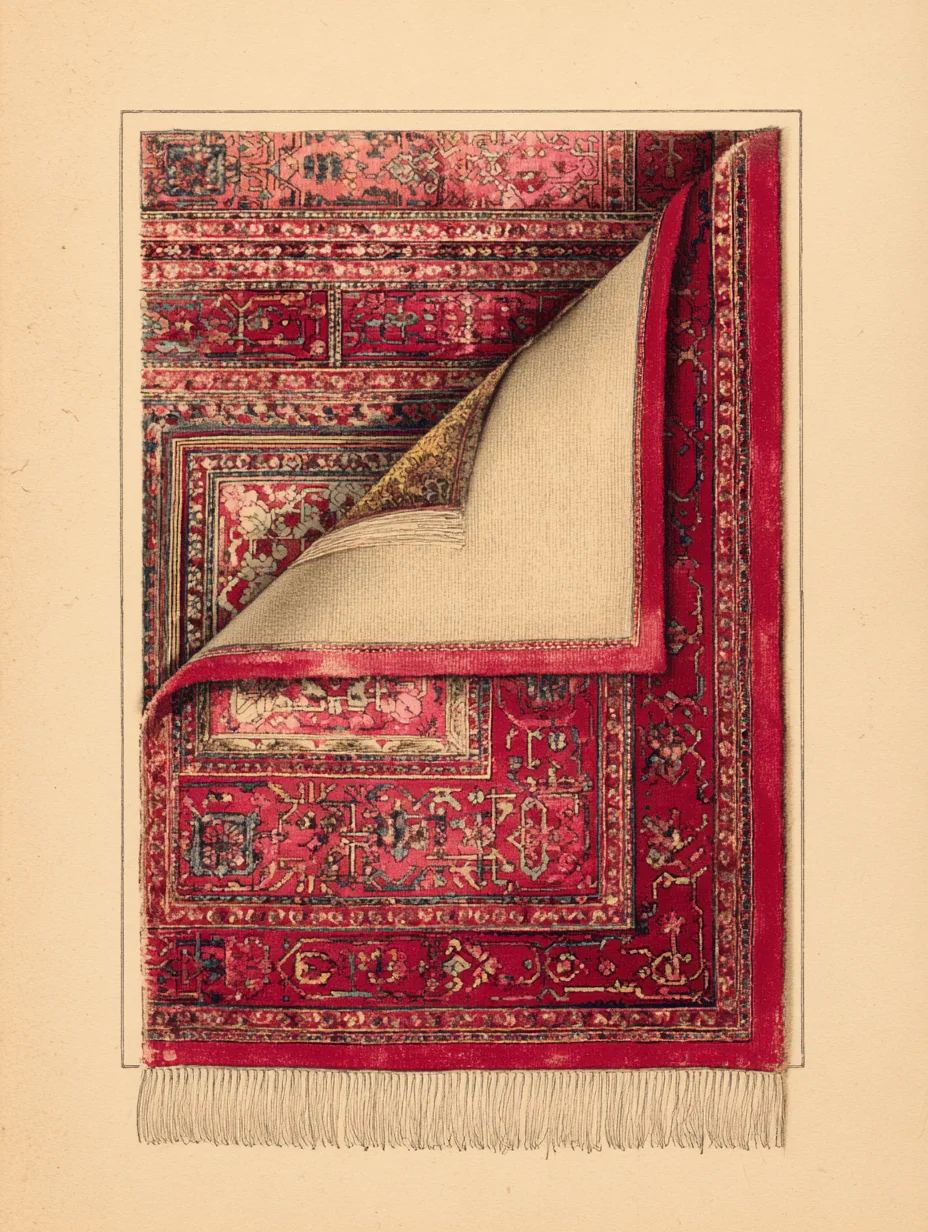
A close detail of the back of a Karabagh rug — the wool warp and wool weft, the symmetric knot at moderate Caucasian density.
The Period
Karabagh is a region, not a town, and the region is a mountainous upland of the southern Caucasus — the country the Persians knew as Qarabagh, the “black garden,” lying between the lowland plains and the high range, straddling what are now the borders of Azerbaijan and Armenia. It is the southernmost of the Caucasian weaving districts, and its position is the first fact the period has to explain: Karabagh sits at the seam between the Caucasian rug world above it and Persia below, and a region at a seam tends to weave like one. The geometric tradition of Karabagh is genuinely Caucasian, of a piece with the highland Kazak and descending, as the Kazak does, from the great seventeenth-century Caucasian carpets. But the region also looked south to Persia and, in the nineteenth century, north and west to Russia and to Europe — and it is that second set of horizons that made the Karabagh the divided thing it is.
The dividing event has a date. In 1828, by the Treaty of Turkmenchay, the Karabagh region passed from Persian to Russian rule, and the South Caucasus was drawn into the commercial orbit of the Russian Empire. What followed was not a change of looms but a change of customers. The Karabagh weavers, who had always woven for themselves and for the local trade, now wove increasingly for a Russian and a wider European market — and that market had a taste, and the taste was for flowers. The floral carpets of France, the Aubusson and the Savonnerie, with their naturalistic rose bouquets on dark grounds, were the furnishing fashion of the age across all of imperial Europe; printed cottons carried the same roses into ordinary rooms. The Karabagh weavers, weaving now for buyers who wanted that fashion, simply gave it to them. They translated the French rose onto the Caucasian loom. The Gül Farangi — the foreign flower — is the direct and traceable result of a tribal weaving region being handed, by the accident of annexation, a commercial market with an imported taste.
The peak of this floral production ran through the middle and later decades of the nineteenth century, and the geometric Karabagh was woven straight through the same period — the two kinds were never successive, never a fashion replacing a tradition, but parallel, made in the same decades and sometimes the same villages, for buyers who wanted different things. Among the named sub-types the trade still recognises, the Kasim Ushag — a village group weaving bold geometric medallion rugs of a particularly archaic and forceful drawing — stands as the clearest reminder that the old Caucasian line ran on undiminished while the roses bloomed alongside it. The early twentieth century brought the decline that came to most of the regional weaving districts; the Soviet period reorganised the looms into managed production and the old freedom of the village weaver was gone, though Karabagh-design rugs continued to be made. The collector should hold the chronology plainly: the Karabagh is a Caucasian tradition of long standing that, for one historically specific reason — a change of empire and therefore of customer — grew a second nature. Both natures are old; both are genuine; neither cancels the other.
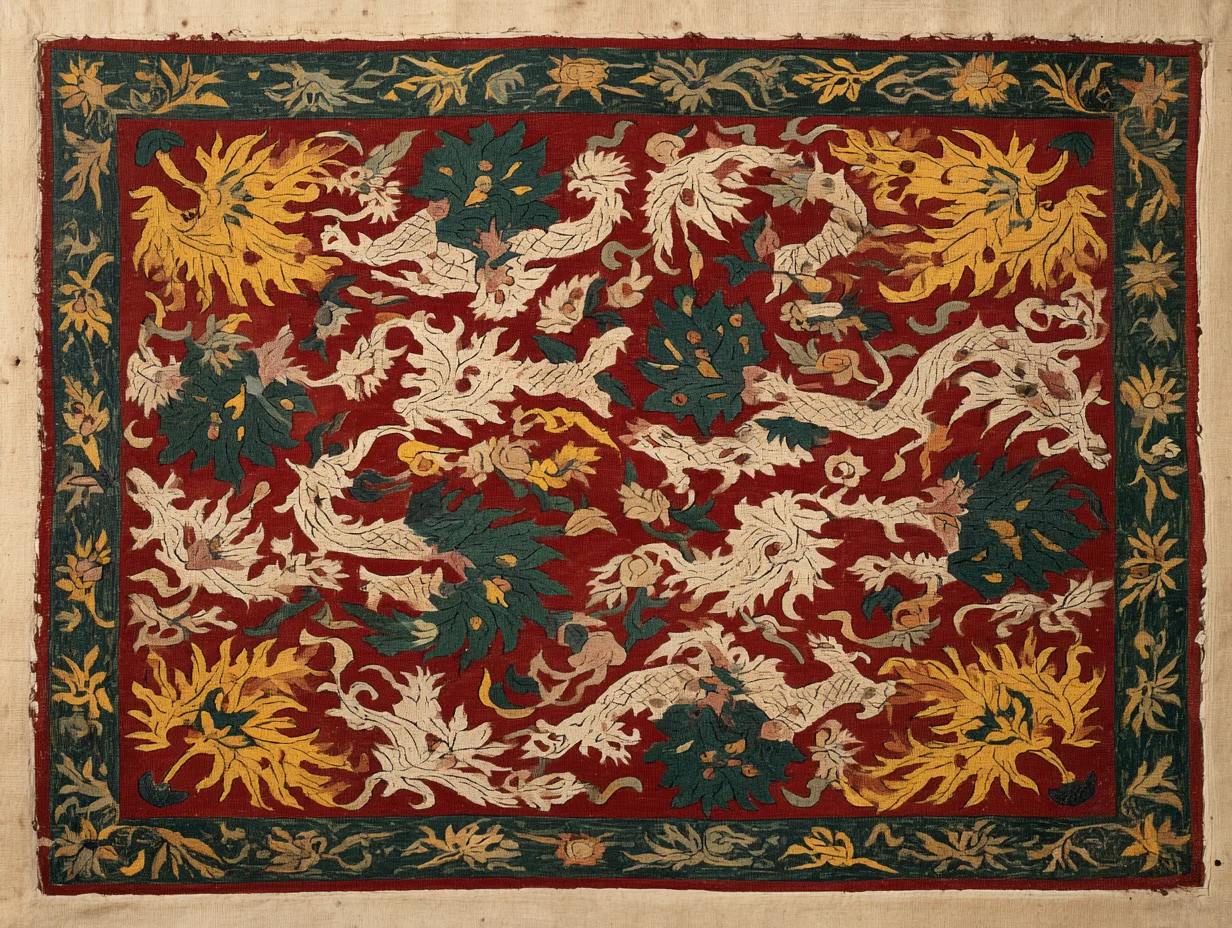
A 17th-c Caucasian Dragon carpet — the shared antecedent of the broader Caucasian tradition that Karabagh and Kazak both descend from. The Dragon carpet vocabulary (the stylised dragon-and-phoenix motifs at large scale) is the older Caucasian baseline; Karabagh diverged from it in the 19th c by absorbing the French-rose European vocabulary.
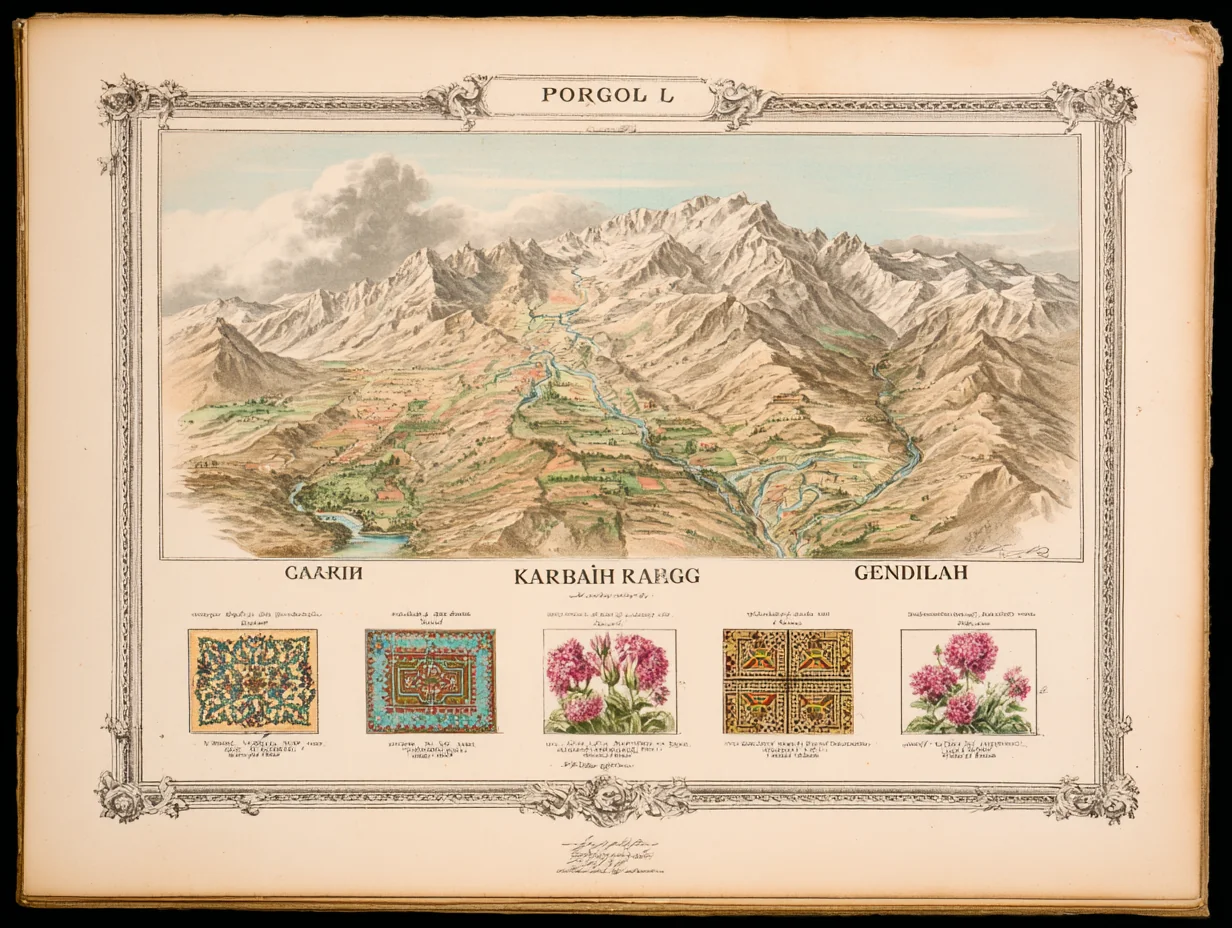
A page from a Victorian connoisseur’s portfolio on the southern Caucasian region — district map locating Karabagh, Gendje, Talish in the mountains south of the Kura river; archetype drawings showing the French-rose Karabagh variant and the more tribal Gendje and Talish neighbours.
What It Is Not
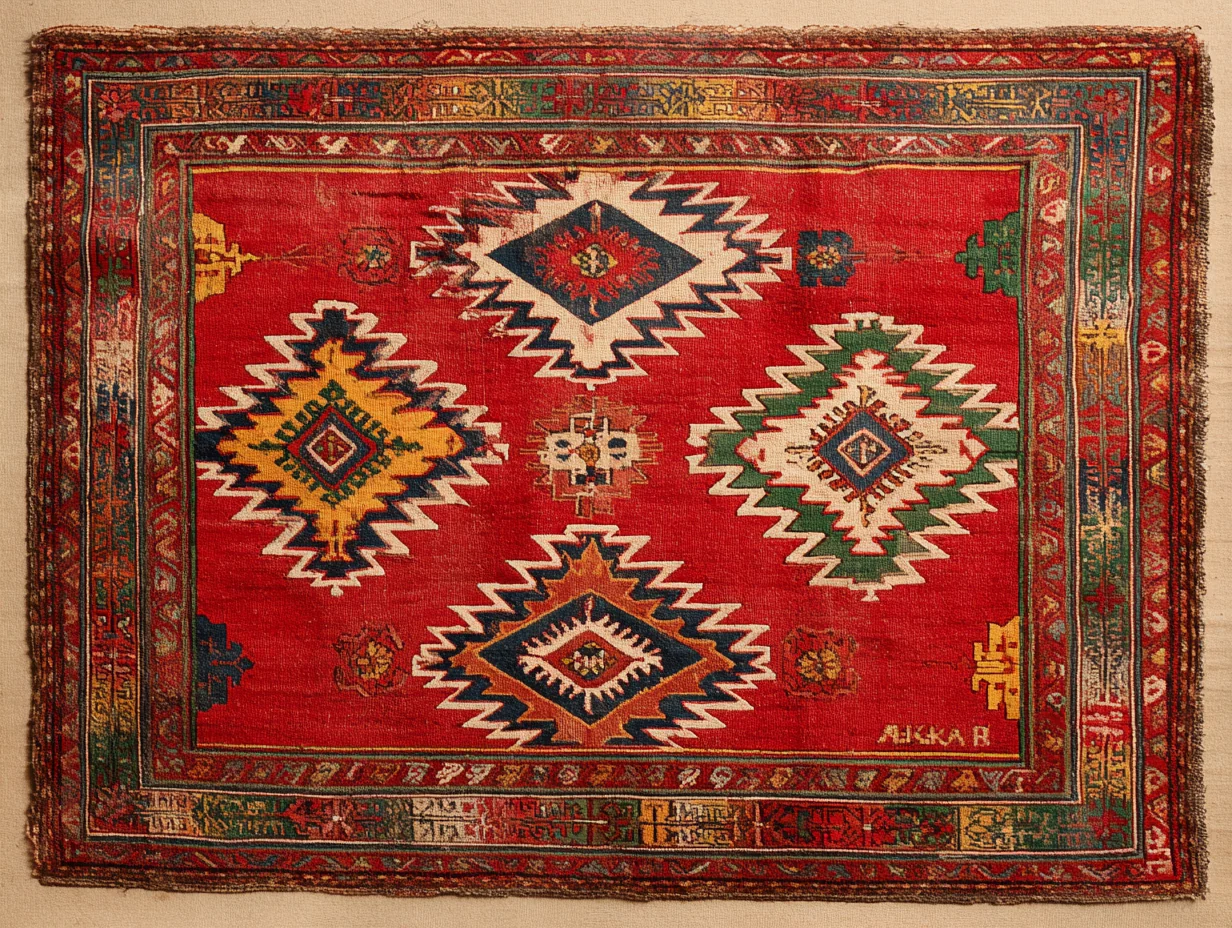
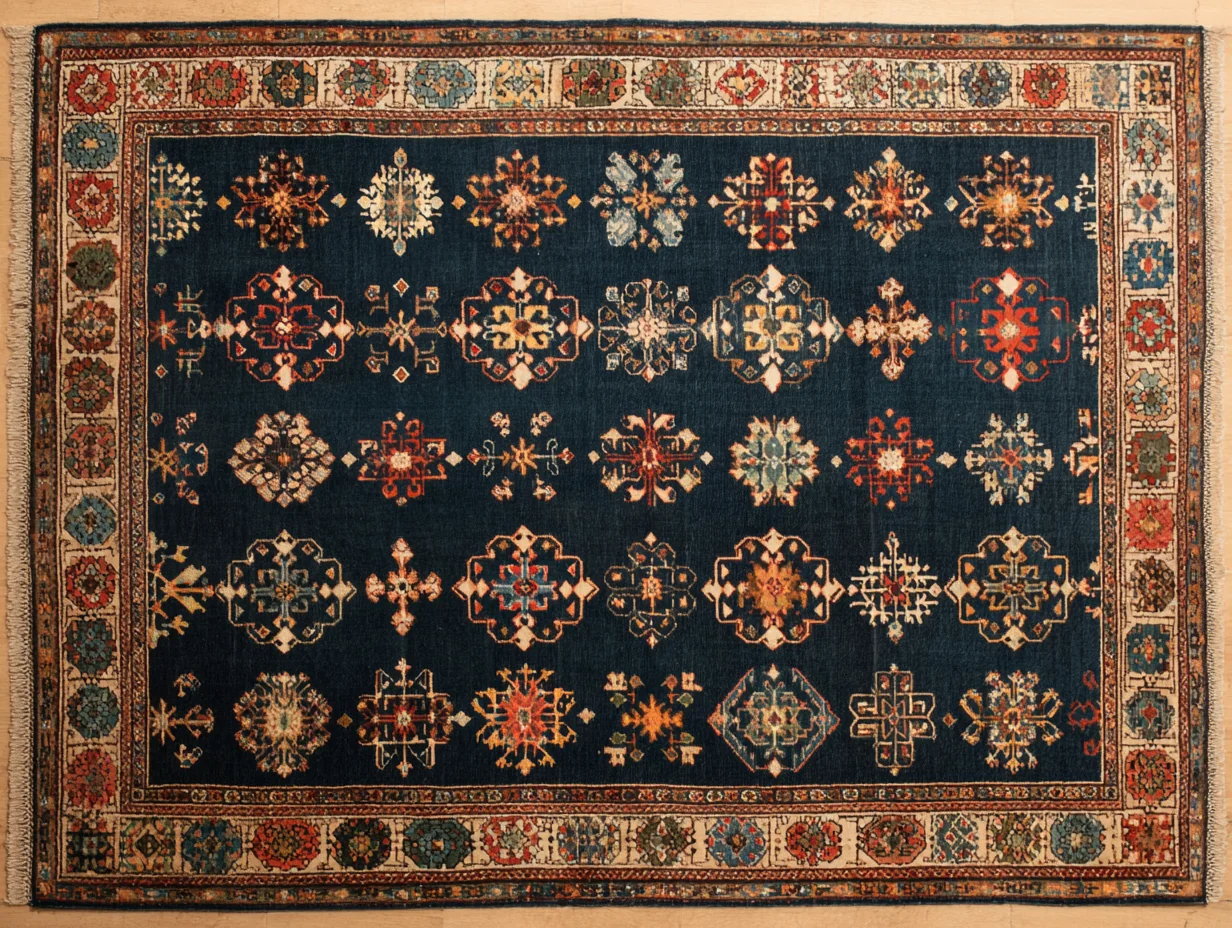
The four types set against the Karabagh are all Caucasian, and all are woven on the wool foundation at the symmetric knot — so neither the structure nor the broad region will separate them, and the practised eye separates them instead by reading palette, scale of drawing, and the particular district habit each type is keyed to. The complication peculiar to the Karabagh is that it must be told apart twice over: the geometric Karabagh against its Caucasian neighbours, and the floral Karabagh, which has almost no Caucasian neighbour at all and is confused instead with the European carpets it imitates. The working rule for the district can be stated as plainly as the Kazak post stated its own: the Caucasian village rugs are told apart not by structure, which is genuinely shared, but by palette, by the scale of the drawing, and by the local design habit — and the Karabagh is the one among them that one must also be prepared to recognise when it is wearing French clothes.
A Kazak is the type the comparison turns on, because the geometric Karabagh and the Kazak are the closest pair in the plate — both southern Caucasian, both descended from the seventeenth-century carpets, both drawing bold stepped medallions in the strong angular grammar. The separation is one of palette and altitude. The Kazak is a highland tribal rug keyed to a bright, almost shrill tomato-red, woven thick and long in the pile; the Karabagh runs to a graver, darker burgundy and a generally finer, lower clip. The rule of thumb: a bright tomato-red ground with a thick shaggy pile is pointing to Kazak; a deep grave burgundy is pointing to Karabagh — and a field of naturalistic roses settles the matter at once, for the Kazak never wove them.
A Shirvan carries the comparison east, to the eastern Caucasus. The Shirvan is an eastern Caucasian type of distinct character — finer in the knot than either southern rug, lower in the pile, and keyed to a darker ground, often a deep navy, carrying small-scale repeat compositions rather than the large stepped medallion of the south. The rule of thumb: a fine, low, small-patterned eastern rug on a dark navy ground is a Shirvan; the large-scale medallion on burgundy, or the rose bouquet, is Karabagh.
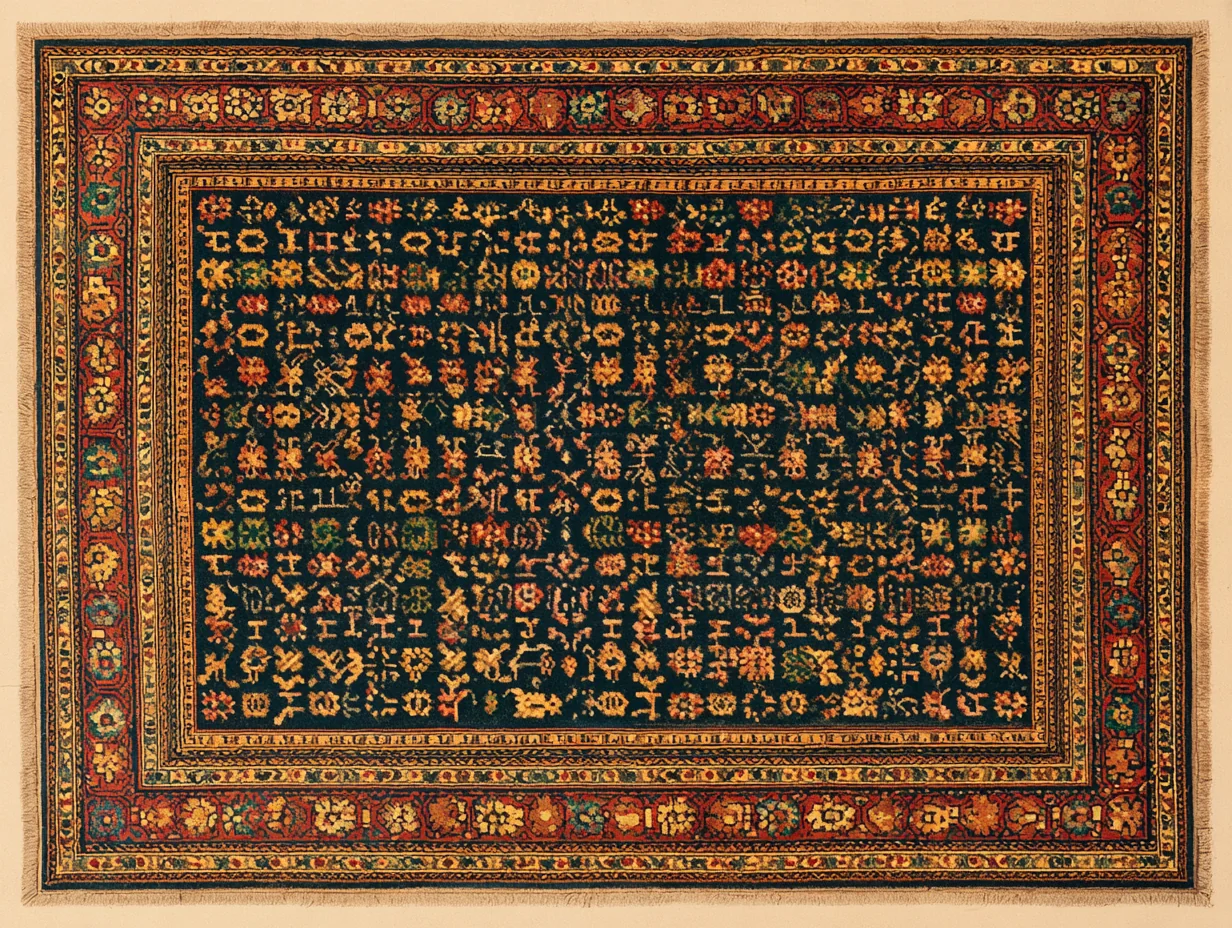
A Kuba is the eastern Caucasian neighbour of the Shirvan, and it presses the same distinction further. The Kuba is finer still, and its character is the dense allover small-pattern field — a surface covered edge to edge with a tight repeating motif on a dark navy or teal ground, with no medallion to rest the eye. The rule of thumb: a dense allover eastern rug, finely knotted on a dark ground, is a Kuba; the Karabagh works at a larger scale and a warmer, redder palette.
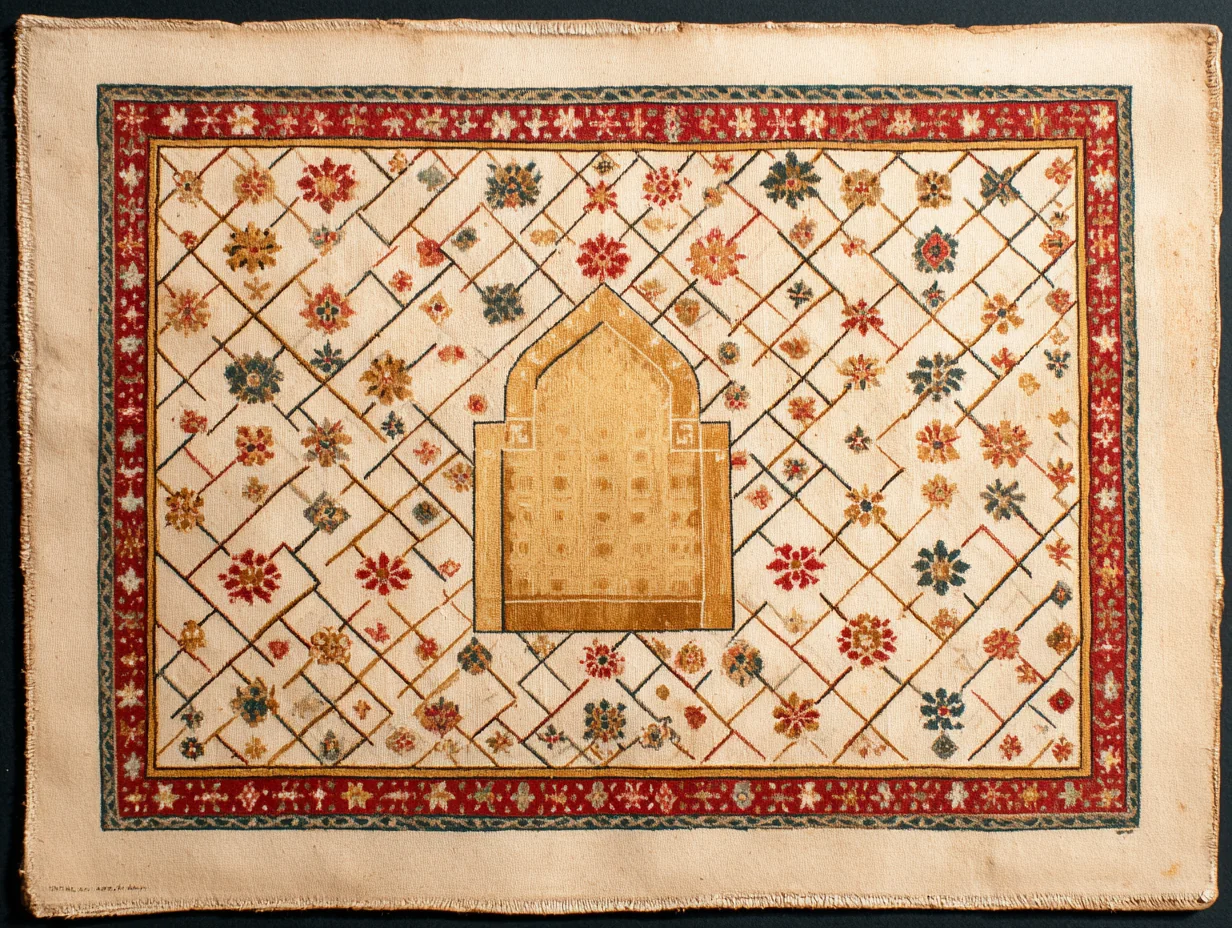
A Daghestan moves the comparison to the prayer rug. Daghestan is the northeastern Caucasian type most associated with the prayer-rug format — a directional niche at one end — drawn very often as a pale-ground lattice, a regular diamond trellis of small flower-heads on an ivory or light field. The rule of thumb: a pale-ground lattice prayer rug from the northeast is a Daghestan; the Karabagh is a dark-ground rug, geometric-medallion or rose-floral, and is rarely a prayer rug at all.
What One Looks At
The practical discipline of identifying a Karabagh comes down, as in the prior rug posts, to a short ordered checklist — and because the Karabagh is the divided type, the checklist must do something the earlier ones did not: it must work on two rugs that look nothing alike. The move that does the most work here is therefore not a move of the eye at all. It is to turn the rug over and read the foundation first, before the field has a chance to mislead.
One looks first, and principally, at the foundation. A Karabagh is woven on a wool warp, generally with a wool weft, at the moderate density of a Caucasian village loom — and one establishes that at the fringe, where the warp ends emerge, or at any worn place where the structure shows through the pile. This single observation does the largest piece of attributing work in the whole inspection, and it does it regardless of what the field is drawing. A wool foundation places the rug in the Caucasian village tradition and rules out the cotton-warp Persian workshops at one glance; and it is the observation that catches the floral Karabagh in particular, because the floral Karabagh is the rug most likely to be mistaken for something it is not. A rug carrying naturalistic French roses, met without its back examined, may be taken for an Aubusson or a Savonnerie — a flatwoven European furnishing carpet of an entirely separate tradition. Turn it over. If the foundation is wool and the surface is a knotted pile at a moderate symmetric density, the rug is not French. It is Caucasian, and it is very probably Karabagh. One reads the foundation first because the foundation never followed the fashion.
One looks next at the palette, which is the Karabagh’s signature across both of its kinds. The ground runs to a deep, grave burgundy — a dark wine-red, or on the floral pieces a near-black aubergine or madder — and it is darker and warmer than the bright tomato-red of the Kazak with which it is most often confused. The burgundy ground is the most characteristic — the floral pieces take it almost without exception, and a great many of the geometric ones besides, though a geometric Karabagh will also be met on ivory or on a darker blue — and it is, where it appears, among the first things the eye should seek once the foundation has been read. A bright or shrill red is pointing away, toward the highland Kazak; a deep even navy across the whole field is pointing east, toward Shirvan or Kuba; the grave burgundy is Karabagh’s own.
One looks next at the drawing, and here the checklist forks, because the Karabagh draws two ways. If the field is geometric, one reads it as one would read any Caucasian rug — a bold stepped medallion, strong angular forms, the saturated palette of the family that descends from the seventeenth-century carpets — and one tells it from the Kazak by palette and clip as the comparison section set out. If the field is floral, one reads it for the Gül Farangi: naturalistic roses, drawn with shading and volume, gathered into European bouquets, set on the dark ground in the manner of a French furnishing carpet. One looks specifically for the gap between the design and the means — the foreign rose honestly attempted at a vernacular village register, recognisably French in its drawing and recognisably hand-knotted in its execution. That gap is the floral Karabagh’s authenticating mark. A rose drawn with the smooth resolution of a true Aubusson is not a Karabagh; a rose drawn with French intent and Caucasian means is.
And one looks, last, for the coherence of the whole. The Karabagh is the divided type, and the temptation, on meeting either of its kinds, is to attribute it to the tradition the field resembles — to call the geometric piece simply Caucasian, and the floral piece simply French. The connoisseur resists both. A Karabagh is the rug on which a wool foundation, a moderate symmetric knot, and a grave burgundy palette are found together, and on which the field may then be either the bold stepped medallion of the old Caucasian line or the foreign roses of the commercial market — both readings equally genuine. One holds the two natures together, as the region itself held them, and recognises the Karabagh as the single tradition wide enough to contain them both. That is the whole skill the post has been asking for: not to identify a rug, but to identify a region across the full reach of what it was willing to weave.
The next post in the rug arc will be either Shirvan — to extend the Caucasian region into the eastern types with their dark-navy palette — or Kuba, to continue the eastern Caucasian arc with the dense allover composition. The choice will depend on what photographic material is available at the time of writing.