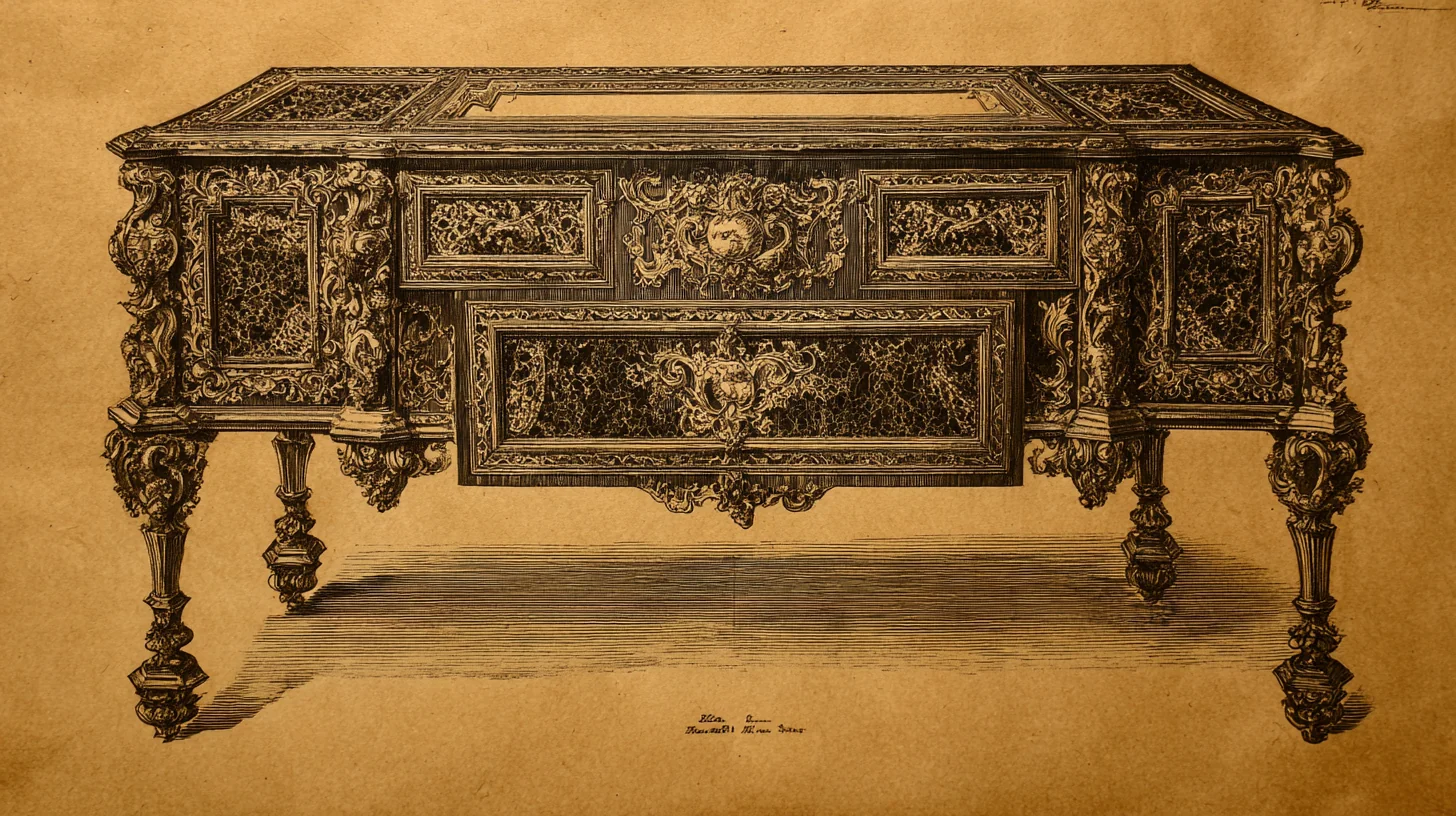
The post that preceded this one read the Spanish Baroque — dark walnut, hand-wrought iron, tooled leather, a severity chosen rather than forced upon it — and named, on either side of its central distinctions, the French royal cabinet of the same decades as the great opposite of the Spanish line: the splendour to Spain’s austerity, the gilt-bronze to Spain’s iron, the public magnificence to Spain’s private restraint. This post is the post the Spanish Baroque kept pointing across the Pyrenees at. It opens the French royal lineage on the blog — a lineage the Louis XV, the Louis XVI, the Régence, the Empire posts have all leaned on at one remove — by going back behind every one of them to the reign in which that lineage was, quite deliberately and quite politically, invented.
This is not the earliest French furniture. But it is the period in which the French cabinet became French in the sense the rest of Europe would thereafter recognise: an industrial product of a state workshop, a designed and not merely a made thing, monumental in scale, of an opulence sustained at the state’s expense and at the state’s command. The Louis XIV cabinet is the furniture of a regime, and the regime knew that the cabinet was part of how it ruled.
This is the thirteenth post in Reading the Period Cabinet. As with the Italian Renaissance, the Italian Baroque, and the Spanish Baroque before it, it is a taxonomy post — a description of a type and of the evidence by which one reads it. Its type-specimen is the bureau Mazarin, the eight-legged writing desk that names a chief minister and consolidates the period’s whole vocabulary into a single object; its load-bearing distinction is the industrialised gilding-and-marquetry combine — Boulle marquetry and chased ormolu produced at scale by the Manufacture Royale — that no other seventeenth-century tradition matched; and its antecedent is the Italian Baroque, which Louis XIV’s ministers brought across the Alps as a matter of policy and then taught the French workshops to outdo.
The Specimen
The canonical Louis XIV piece is the bureau Mazarin — the writing desk on eight legs that became, late in the reign, the form in which the whole vocabulary of the tradition was most fully concentrated. It is canonical for the same reason the vargueño was canonical for the Spanish Baroque and the stipo for the Italian: it presents every register the period worked in. The veneer, the marquetry, the ormolu, the moulded scale, the architectural legs, the figural ornament at the angles — all of it is in the one form, and a collector who has learned to read a good bureau Mazarin has nearly learned to read the reign entire.
It is a desk and not a cabinet: a rectangular case of three drawers, raised on eight legs arranged as two banks of four, with a kneehole between them and a stretcher tying each bank. The eight-legged disposition is itself diagnostic — nothing else in the seventeenth-century European cabinet repertory presents itself in quite this way. The case is not painted. It is veneered, and that veneer is the surface on which every other register is composed.
The veneer, on the apex examples, is Boulle marquetry — the technique that more than any other material distinguishes the Louis XIV piece from every Continental neighbour. André-Charles Boulle (1642–1732), royal cabinet-maker under warrant from 1672, perfected the practice of veneering a case in two materials simultaneously: tortoiseshell and thin sheet brass, glued as a pack, cut by hand with a fret-saw to the same arabesque, and separated into two complementary sheets. The shell-ground is première-partie; the brass-ground is contre-partie; the two are used on facing pieces of a pair so that no cutting is wasted. The pattern is the arabesque drawn from the court ornemanistes’ engraved plates: a glittering pictorial composition in dark and gold, the most precise hand-work the seventeenth-century decorative arts could produce.
A close detail of Boulle marquetry — the tortoiseshell-and-brass arabesque inlay that names André-Charles Boulle (1642–1732). The shell-ground is première-partie, the brass-ground is contre-partie; the two are cut from a single layered pack with a fret-saw and used on a pair or on opposing faces. The pattern is the arabesque of Jean Berain, executed at the Manufacture Royale.
The ormolu mounts, second. Ormolu — bronze doré — is cast bronze, hand-chased, and fire-gilt by the mercury-amalgam process. The Louis XIV piece carries mounts at every structural point: corner mounts, escutcheons, mascarons on the rails, capitals and bases at the legs, sabots at the feet; on the apex pieces the mounts go beyond hardware into figural sculpture — putti, allegorical figures, the royal sunburst, the interlaced L of the king’s cypher. They are not, as on a Spanish piece, hammered iron left frankly visible, nor, as on an Italian piece, gilded carved wood softer than metal. They are cast bronze, fire-gilt to a hard durable gold — and the combination was, in the seventeenth century, more expensive than the case itself.
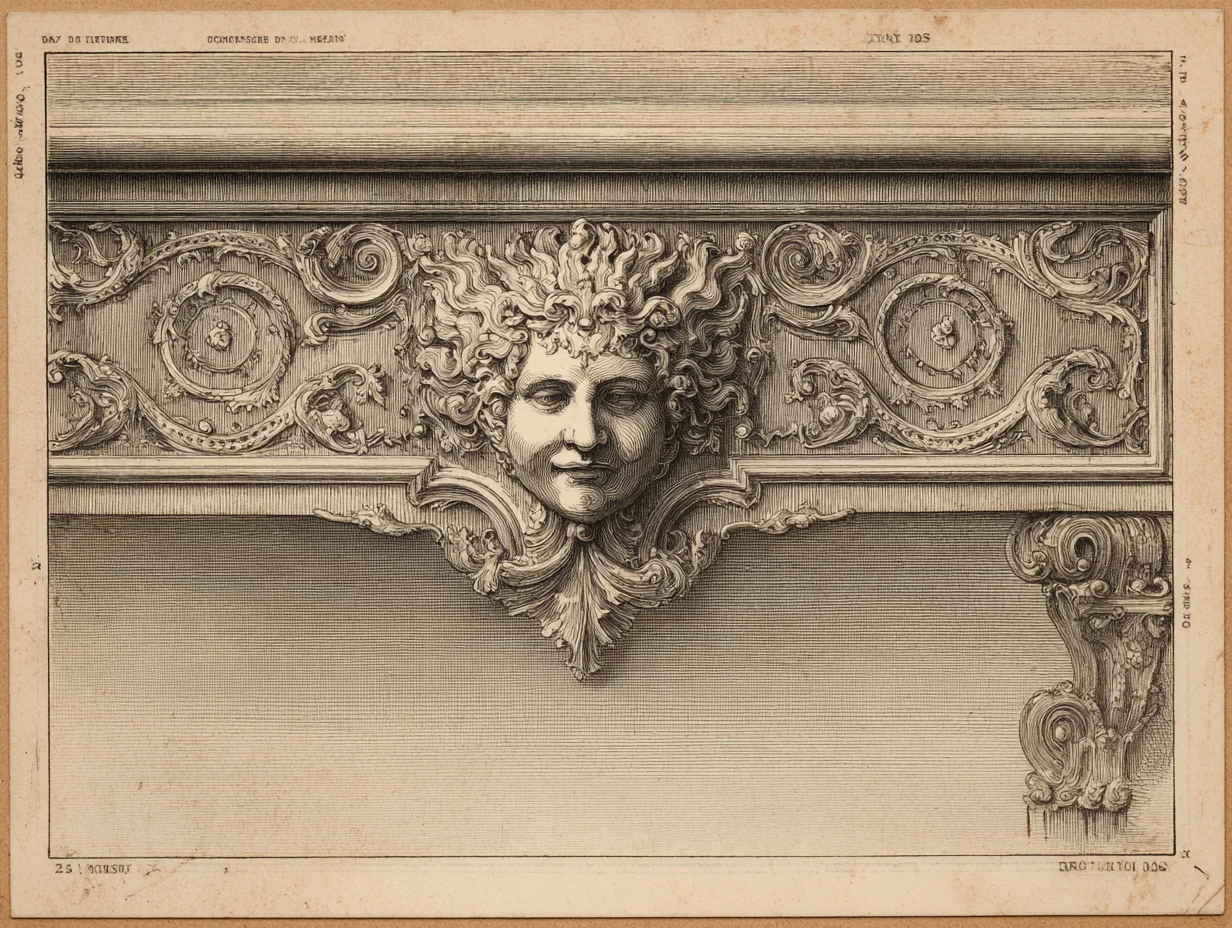
A close detail of chased gilt-bronze ormolu — a Louis XIV figural mount in bronze doré, cast, hand-chased, and fire-gilt by the mercury-amalgam process. The mount passed through the hands of a sculptor, a founder, a chaser, and a gilder before it reached the cabinet-maker — the whole sequence coordinated by the Manufacture Royale.
The veneer ground, where the piece is not in Boulle, is ebony or ebonised pearwood — the dark exotic timber that lent the French word ébéniste its name. On the largest of the early commissions — the great cabinets-on-stand the period produced before the bureau Mazarin took over as the canonical form — the ebony case is supported on a carved giltwood stand of Atlantes, putti, or scrolling consoles, the register borrowed wholesale from the Italian Baroque. The Manufacture Royale produced these carved-giltwood stands concurrently with the Boulle cases that would, by the end of the reign, supplant them.
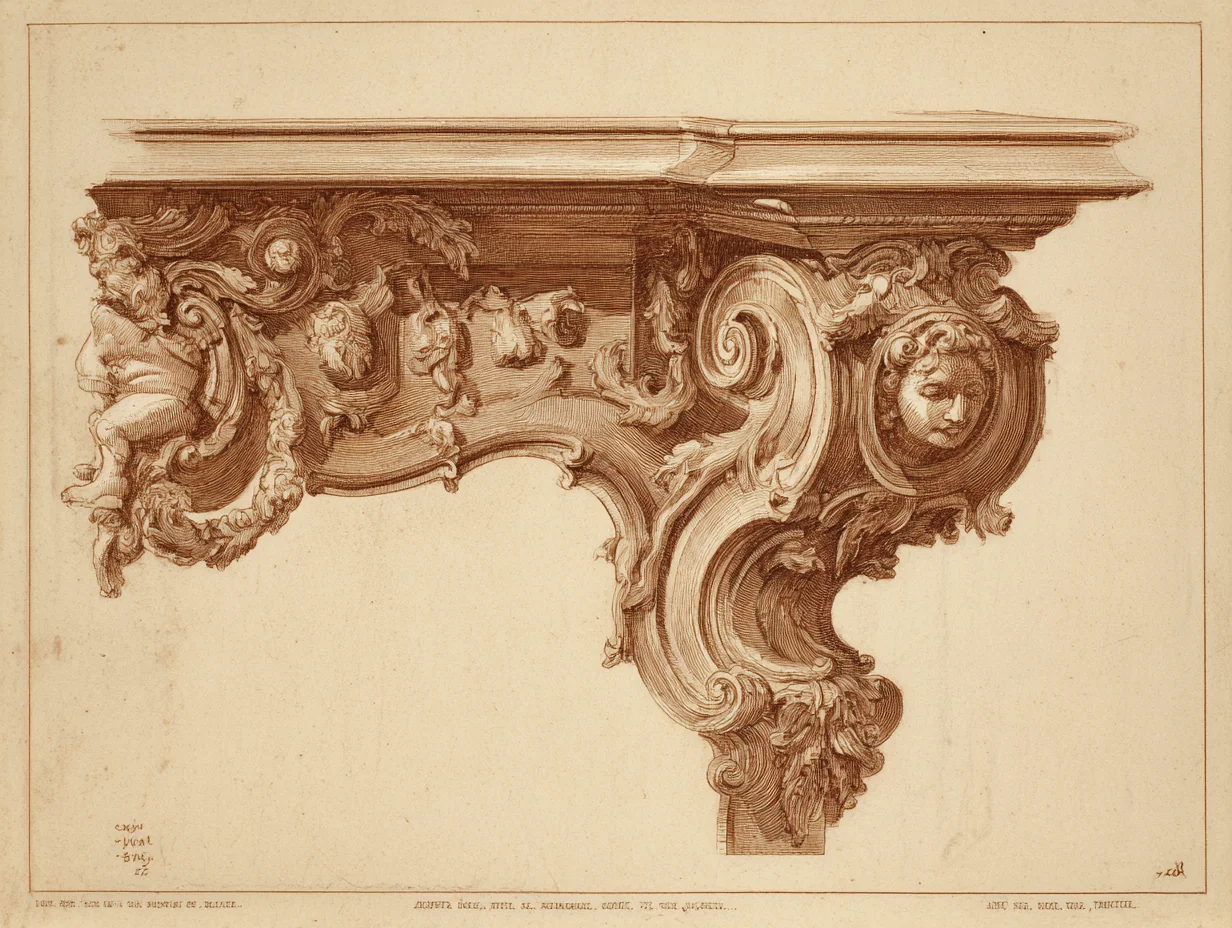
A close detail of carved-and-gilded woodwork — a Louis XIV pier-glass frame or supporting Atlantes, water-gilt over a gesso-and-bole ground in the architectural register the menuisiers and doreurs practised in parallel with the ébénistes. The carved-giltwood register is the inheritance from the Italian Baroque; the apex Versailles commissions combined the two on a single piece — a Boulle case on a carved-and-gilded stand.
The whole is monumental. The great commissions — Boulle’s armoires, the medal-cabinets, the bibliothèques for the king’s cabinet du conseil — run to a scale at which the piece functions as architecture as much as furniture. A piece sized for a Parisian apartment would have looked, in the Galerie des Glaces, like an apology. The period made no apologies.
The Evidence
The wood, first. The structural carcass is oak — French oak, hand-cut, never meant to be visible. The Louis XIV case is veneered; the surface is ebony or ebonised pearwood on the plain-ground pieces, tortoiseshell-and-brass on the Boulle pieces. On the carved-giltwood stands and pier-frames the wood is limewood or poplar, gessoed, bole-grounded, and water-gilt in the architectural register the same studios applied to the chapel and ceiling work at Versailles.
The Boulle marquetry, second, is most of what one is reading for at close range. The materials should be real tortoiseshell — warm translucent, period brown-to-red mottling — set against real cast-or-rolled sheet brass, cut by hand so that the joint reads as a fine hairline rather than a machined edge. The brass should carry hand-engraved internal detail the nineteenth-century revival did not consistently reproduce; the shell is often backed with red foil to enliven the translucence; the pattern is the Berain arabesque, not the later asymmetric scrolling.
The ormolu, third. Mounts should be fire-gilt by the mercury process — a soft warm yellow durable enough that the apex Versailles commissions still carry their original gilding after three centuries — not the thin electroplating that supplanted mercury gilding in the nineteenth century. The bronze should be hand-chased; the chasing on a period piece carries the slight irregularities of hand-work the late-nineteenth-century reproductions do not.
The constructional indicators, fourth, are what one reads against the nineteenth-century revival, which produced Boulle-and-ormolu in such quantity and to such quality that period attribution is the working question on most pieces. Carcass joinery should be hand-cut; the marquetry glued with hide-glue (which carries its own seasonal lift at the inlay edges); and the underside of the piece — least retouched — preserves the original tool-marks and is where dating is most reliably argued.
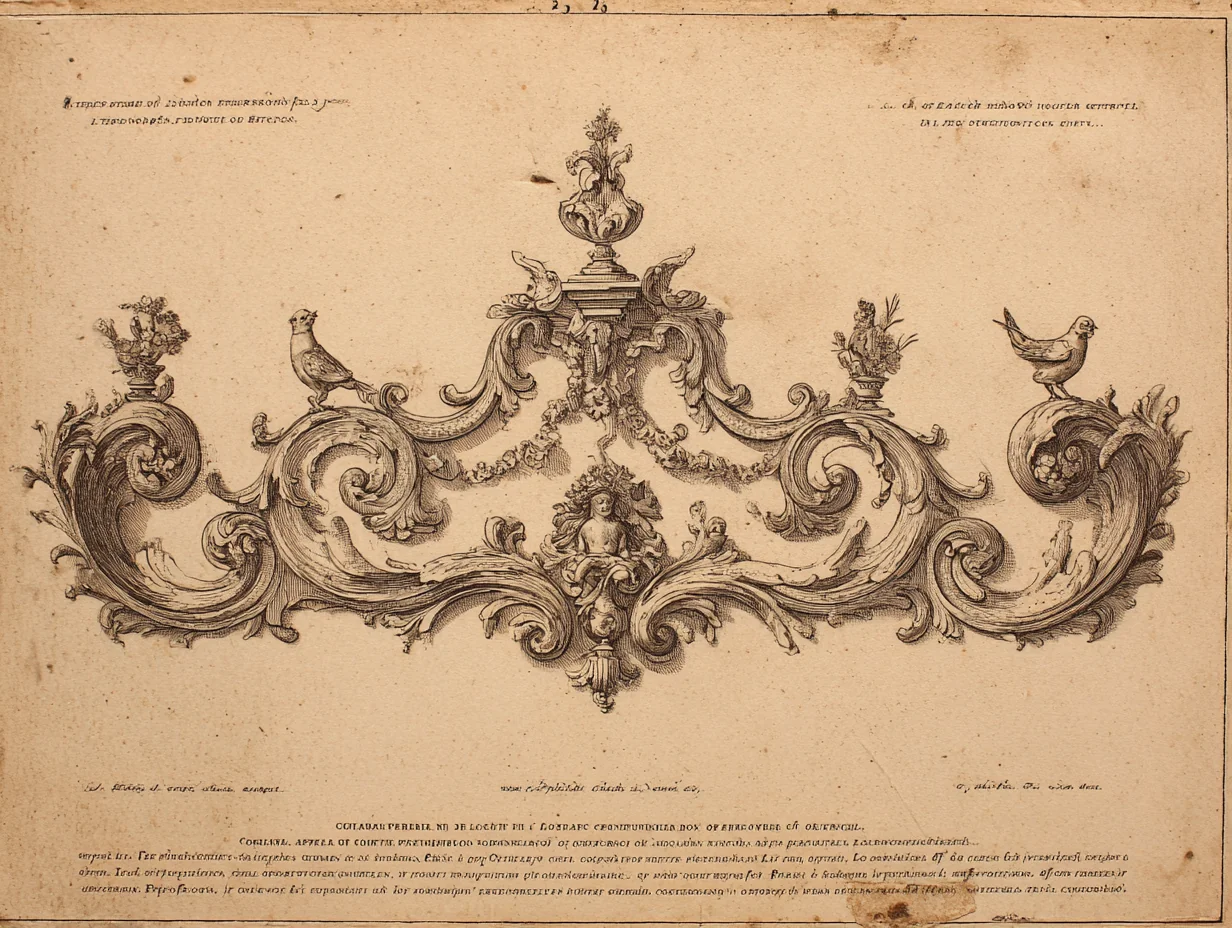
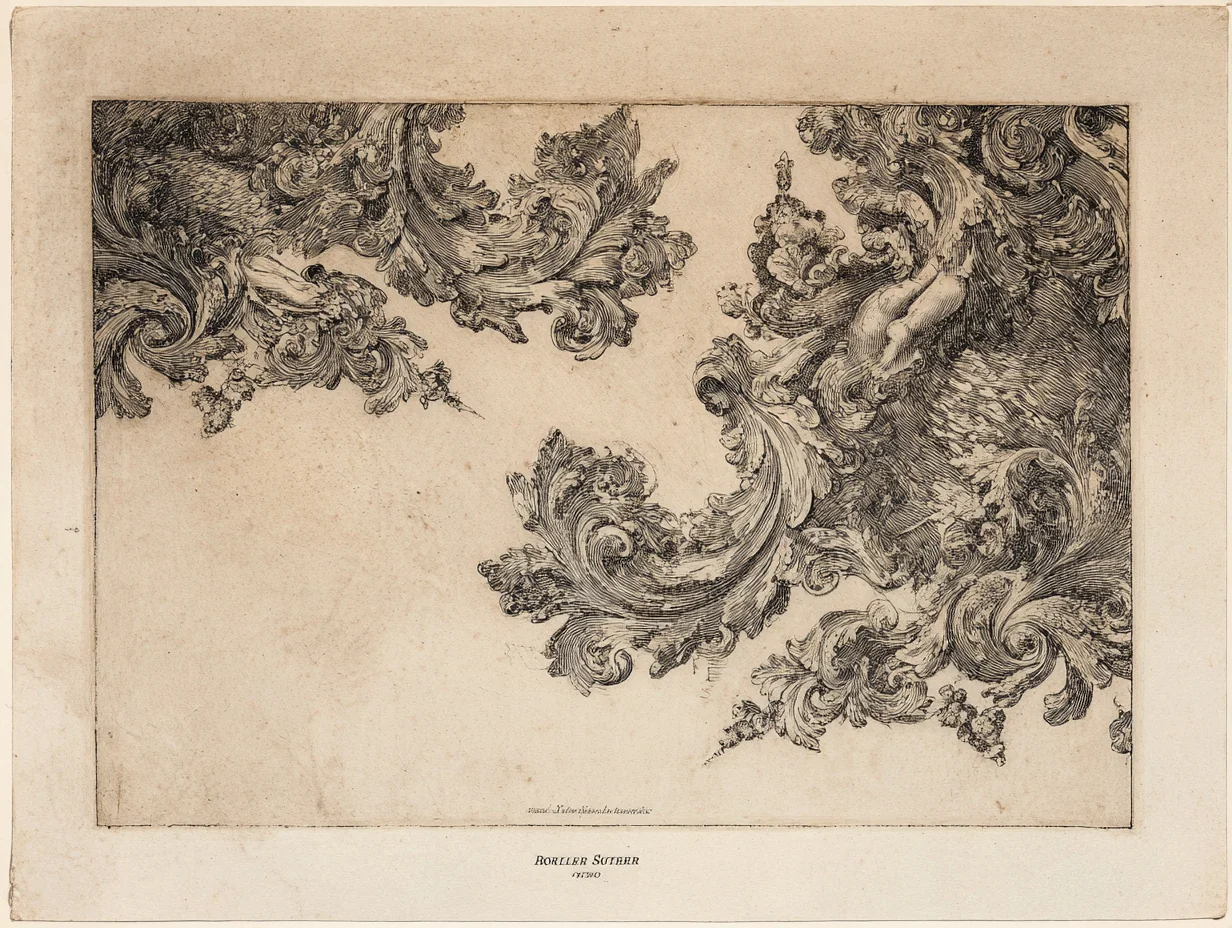
A plate of engraved ornament after Jean Berain (1640–1711) — the principal ornemaniste of the late reign, whose arabesque-and-grotesque vocabulary the Manufacture Royale executed in marquetry, tapestry, and gilt bronze. The Louis XIV cabinet trade is, in this sense, a designed trade — its surfaces the executed form of an engraved ornamental project at the centre of the court.
The Period
The Louis XIV period, as a furniture period, runs from about 1660 — the year the young king began to govern personally after Mazarin’s death — to about 1715. The decisive decades are the 1660s through the 1690s, when the Manufacture Royale’s industrial machinery was at full operation. The state workshop is the load-bearing institution. Colbert — controller-general of finances and architect of the mercantilist policy that organised French manufacturing under state direction — acquired in 1662 the existing dyeing-works on the Bièvre in the Faubourg Saint-Marcel of Paris, the site of the fifteenth-century dyer Jean Gobelin whose family name it had carried ever since, and reorganised it into what would become the Manufacture Royale des Meubles de la Couronne, known thereafter as the Gobelins: a state-owned multi-trade workshop that gathered under one roof the tapestry-weavers, cabinet-makers, bronze-founders, gilders, and sculptors whose combined output furnished the royal palaces. The combined-trade arrangement was the period’s industrial innovation, and the Louis XIV cabinet bears its signature: a single piece carried the work of half a dozen specialised trades, coordinated and centrally designed. This is not Italian Baroque, in which the workshop bought its pietra-dura top in Florence and its stand in Bologna and mounted the two as separate procurements. It is industrial production at state scale.
The designers must be named because the design is the load-bearing intellectual content. Charles Le Brun (1619–1690), named Premier peintre du Roi in 1662 and confirmed in the office in 1664, and director of the Gobelins from 1663, set the iconographic programme — the Apollo iconography, the king-as-Sun. Jean Berain the Elder (1640–1711), at the Menus-Plaisirs du Roi, was the ornemaniste whose engraved arabesques became the vocabulary the cabinet, tapestry, and bronze workshops all executed from. Daniel Marot (1661–1752), a Huguenot in the Berain register, carried that vocabulary to the Netherlands and England after the Revocation of the Edict of Nantes in 1685 — which is how William-and-Mary late-Baroque came to look so substantially French. The antecedent was the Italian Baroque, and the inheritance was deliberate: the young Louis, on Colbert’s advice and Le Brun’s design, set out to make Versailles outdo Rome — importing Italian artists wholesale into the French workshops and teaching them to produce, in industrial quantity, what the Italians had produced at apex-piece scale only. The French innovation was a scale innovation and a technical-register one: Boulle marquetry the Italians had not consolidated, ormolu they had executed only sparingly, the whole produced at Manufacture-Royale scale rather than single-master-workshop scale. The Italian Baroque is the antecedent in the strong sense: not what Louis XIV imitated, but what it set out to surpass.
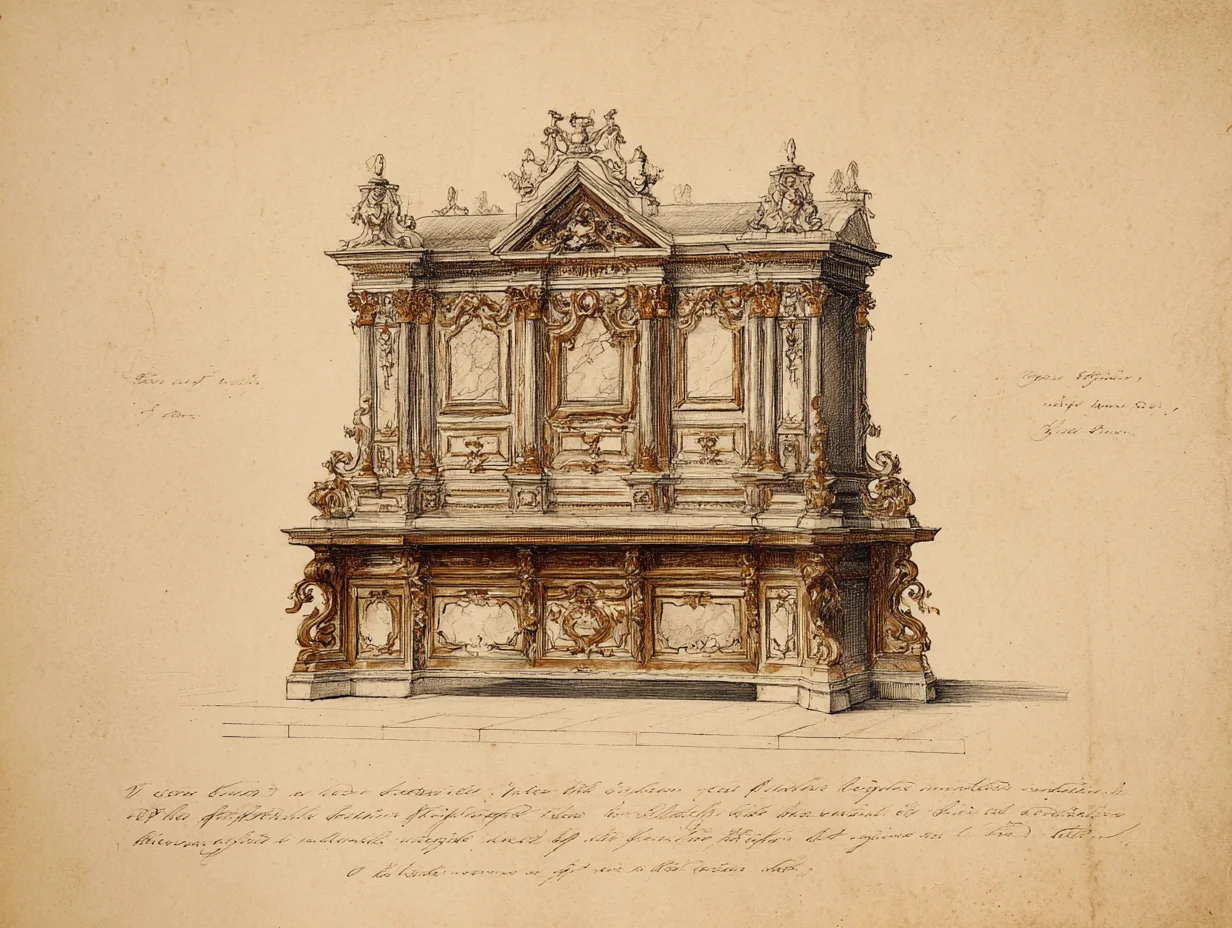
A mid-17th-c Italian Baroque stipo — the immediate antecedent, with carved-and-gilded woodwork and a Florentine pietra-dura panel on the case. The Louis XIV piece is the Italian Baroque carried to a different scale by a different institution: Italian artists imported into the French workshops, Boulle and ormolu added on, the whole coordinated by a single state workshop.
What It Is Not
Four styles stand near enough to Louis XIV that the beginner confuses them with it. Two are seventeenth-century Continental siblings — the Spanish Baroque and the Italian Baroque, contemporaries answering the same century in different national registers. Two are nearer relations of the French line itself — the Régence, the transitional regency that carried Louis XIV into Louis XV, and the William-and-Mary English, the cross-Channel cousin that adapted the French royal vocabulary for a Protestant northern court. To distinguish the four is to fix what is particular to the Louis XIV line.
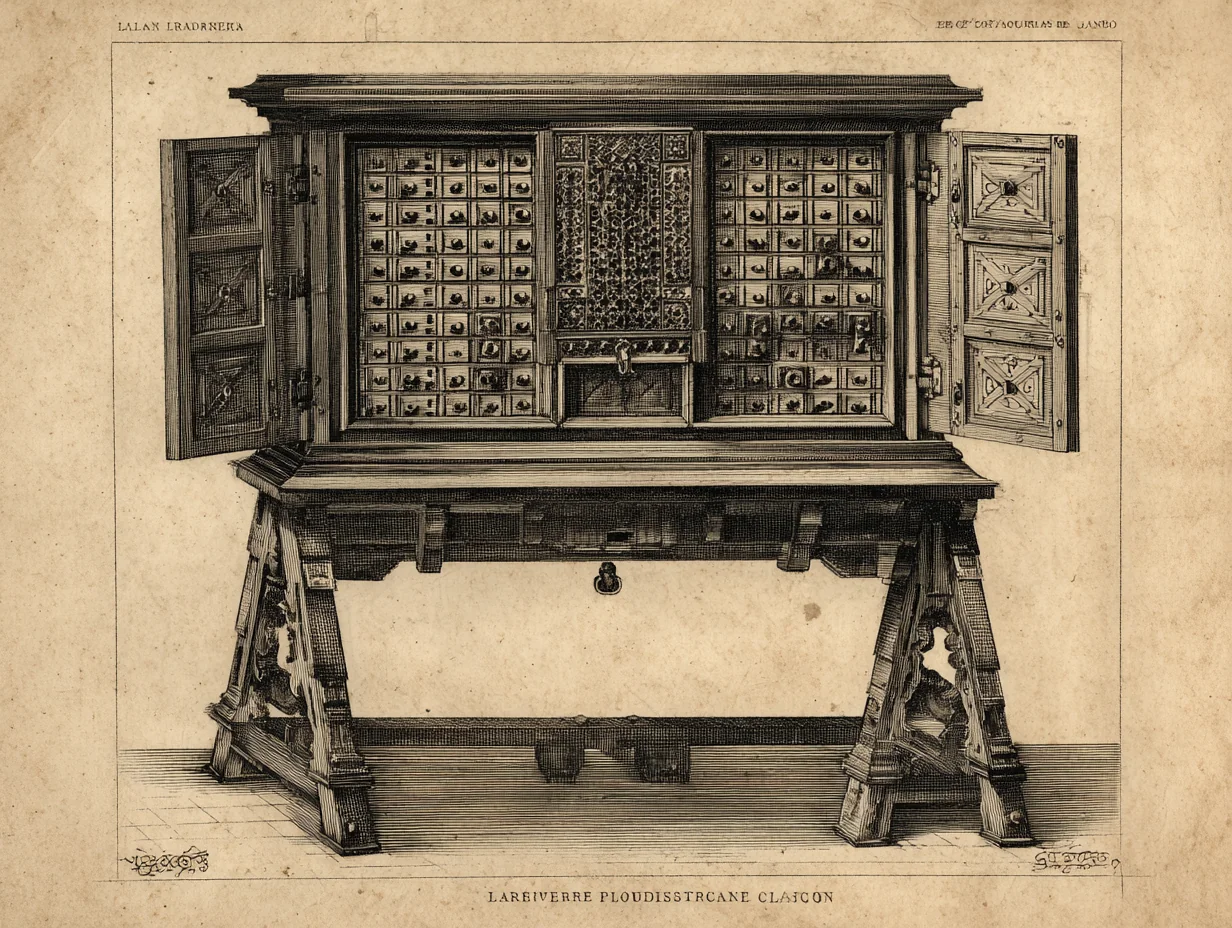
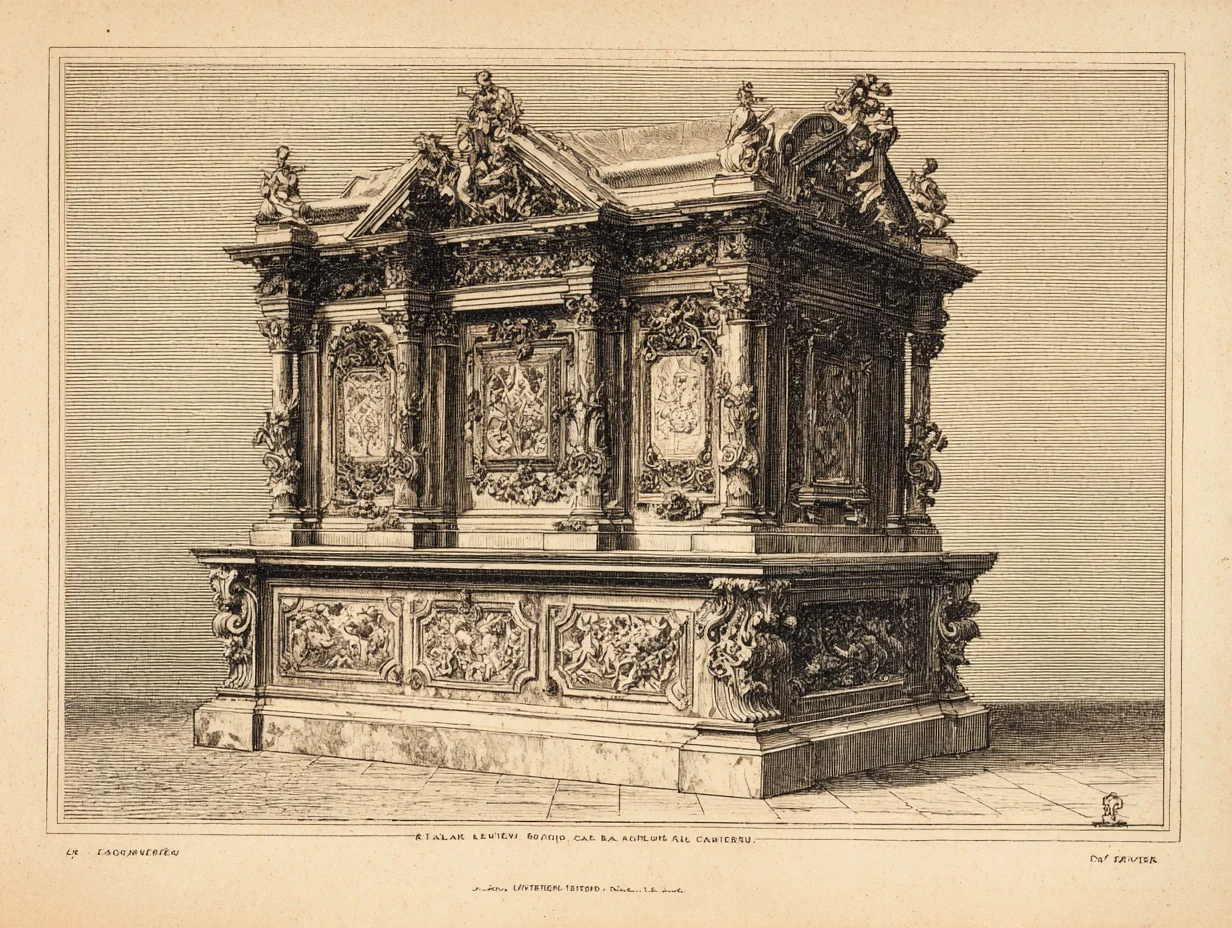
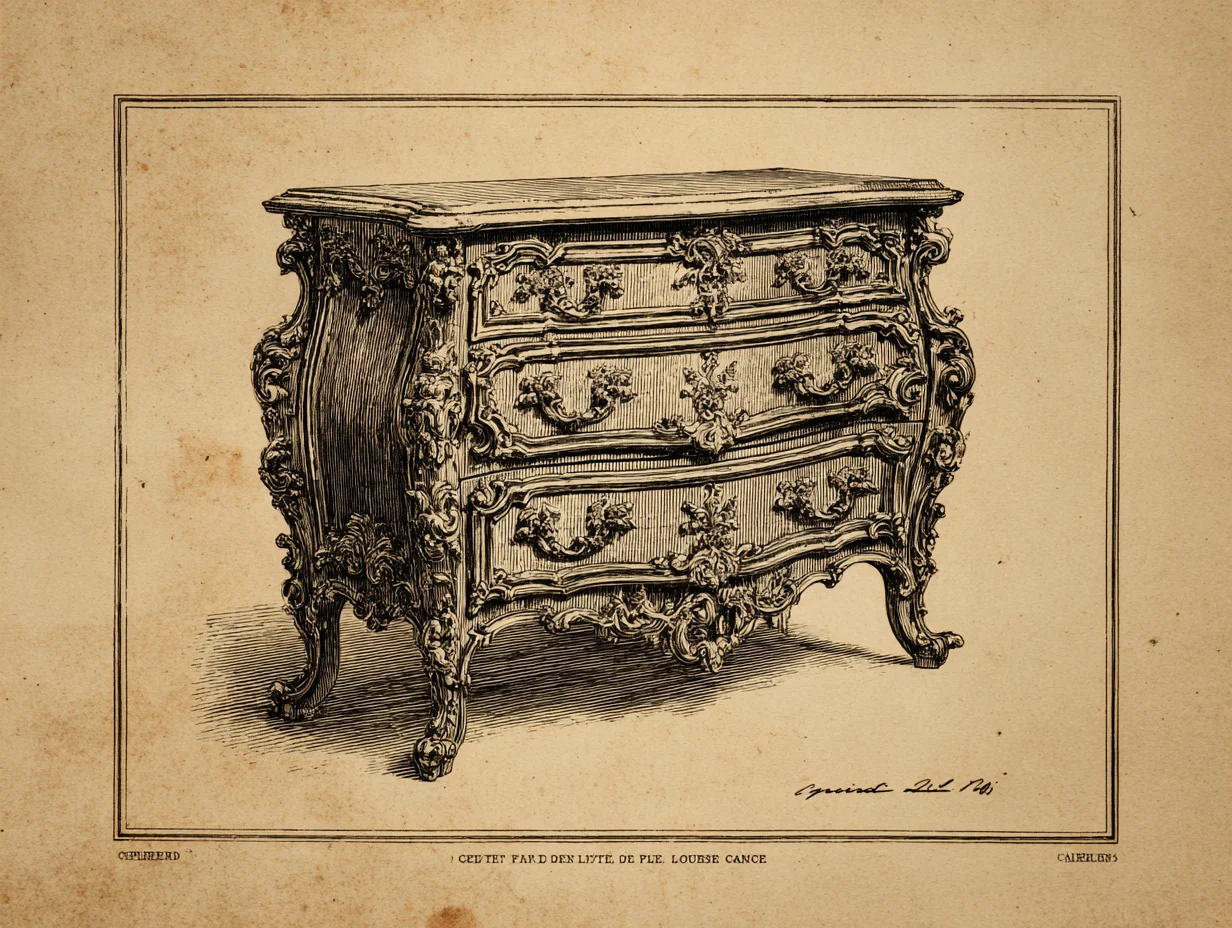
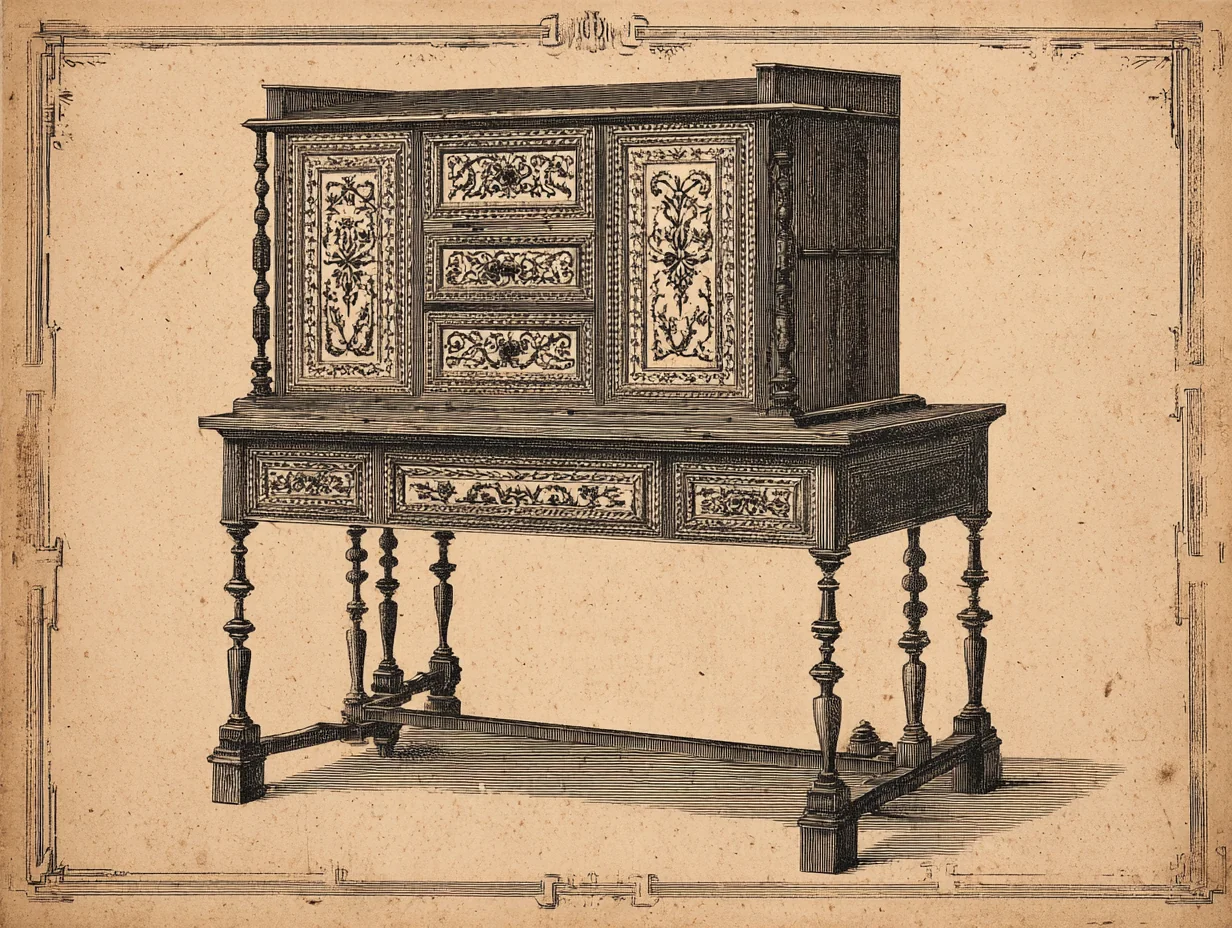
A Spanish Baroque piece is the Iberian sibling and the easiest to tell apart, because it states almost the opposite case. Plain dark walnut, hand-wrought iron, tooled leather, bone-and-ivory geometric inlay, richness reserved for the inside of the fall-front; the Louis XIV piece is Boulle, gilt bronze, ebony, and figural ornament, richness conspicuous on every face. Both were absolutist-court styles. The two courts could hardly have furnished themselves more differently.
An Italian Baroque piece is the Continental antecedent, and the difficulty is precisely that Louis XIV inherited so much of it. The Italian piece is carved walnut with carved-and-gilded structural members and, on the apex pieces, Florentine pietra-dura tops; the Louis XIV piece carries the gilded-structural register on its stands but layers onto it the Boulle marquetry and ormolu the Italians had not consolidated. The Italian gilds the carved wood and lets the case remain walnut; the French veneers the case in tortoiseshell-and-brass and bolts gilt bronze onto every structural angle.
A Régence piece is the transitional French descendant — under the regency of Philippe d’Orléans, 1715–1723 — and carries most of the Louis XIV vocabulary still. The decisive differences are proportional and ornamental: the case lightens (the bureau Mazarin’s eight legs reduce to four, the heavy stretchers fall away, proportions soften toward the commode and the bureau plat); the symmetrical Berain arabesque gives way to the first asymmetric foliate ornament that will become the rocaille; the ormolu thins. Heavy, symmetrically arabesqued, on eight legs with deep stretchers is Louis XIV; lighter and four-legged is Régence.
A William-and-Mary English piece is the Anglo-Dutch cousin — produced for the joint Protestant monarchy of William III and Mary II (1689–1702) — and the cross-Channel relationship is direct enough to be confusing. Daniel Marot carried the Louis XIV vocabulary north after the Edict of Nantes’ revocation. The William-and-Mary case is in the same family — late-Baroque, marquetry-and-mount — but executed in dark walnut rather than ebony, in seaweed marquetry of box-and-holly rather than tortoiseshell-and-brass Boulle, with bun feet or turned columnar legs rather than the eight-legged Mazarin disposition, and with brass hardware at restrained scale rather than figural cast ormolu.
What One Looks At
One looks first at the form, because with the Louis XIV piece the form is unusually diagnostic. The bureau Mazarin’s eight-legged disposition — two banks of four legs flanking a kneehole, tied by stretchers — is so particular that the form alone places a piece in late-seventeenth-century France. The great cabinet-on-stand on carved-giltwood Atlantes or scrolling consoles is the second canonical form. A piece at this scale, in seventeenth-century materials, is almost certainly French royal.
One looks next, and most carefully, at the Boulle marquetry where it is present — the load-bearing authentication question. Both première-partie and contre-partie are period; their use on pairs is itself a positive indicator. The indicators against the nineteenth-century revival are hand-engraved internal detail in the brass, a hand-cut hairline joint between shell and brass, hide-glue’s seasonal lift at the edges, and red foil sometimes backing the shell.
One looks then at the ormolu. Mercury-gilt, hand-chased mounts with hand-cut slotted backing screws is the period combination; thin electrogild on unchased bronze with machine screws is the reproduction. On an apex piece the mounts go figural — mascarons, putti, allegorical figures, the royal cypher.
And one looks, finally, at the combination. A genuine Louis XIV piece brings together monumental scale, an oak carcass of hand-cut joinery, an ebony or Boulle veneer, fire-gilt ormolu at every structural angle, and the arabesque vocabulary of Berain and Le Brun; on the apex examples, a carved-and-gilded stand inherited from the Italian Baroque. Any one of these may appear elsewhere; the four or five together, at the scale Versailles required and through the industrial coordination of the Manufacture Royale, appear only here. The collector reads case, veneer, mount, and gilding not as a checklist but as the evidence of a single workshop tradition operating at state scale — and asks of the word Baroque what, in the French case, it must be made to mean: not the carved exuberance of Rome, not the iron austerity of Castile, but the industrial magnificence of Versailles, splendour produced at state scale by a state workshop on a state mandate, every face elaborated and every angle gilded.
The next post in the furniture arc will be either Régence — to extend the French royal lineage into the transitional regency under Philippe d’Orléans — or William-and-Mary English, to open the Anglo-Dutch late-Baroque cousin with the seaweed-marquetry register the Marot plates carried across the Channel. The choice will depend on what photographic material is available.