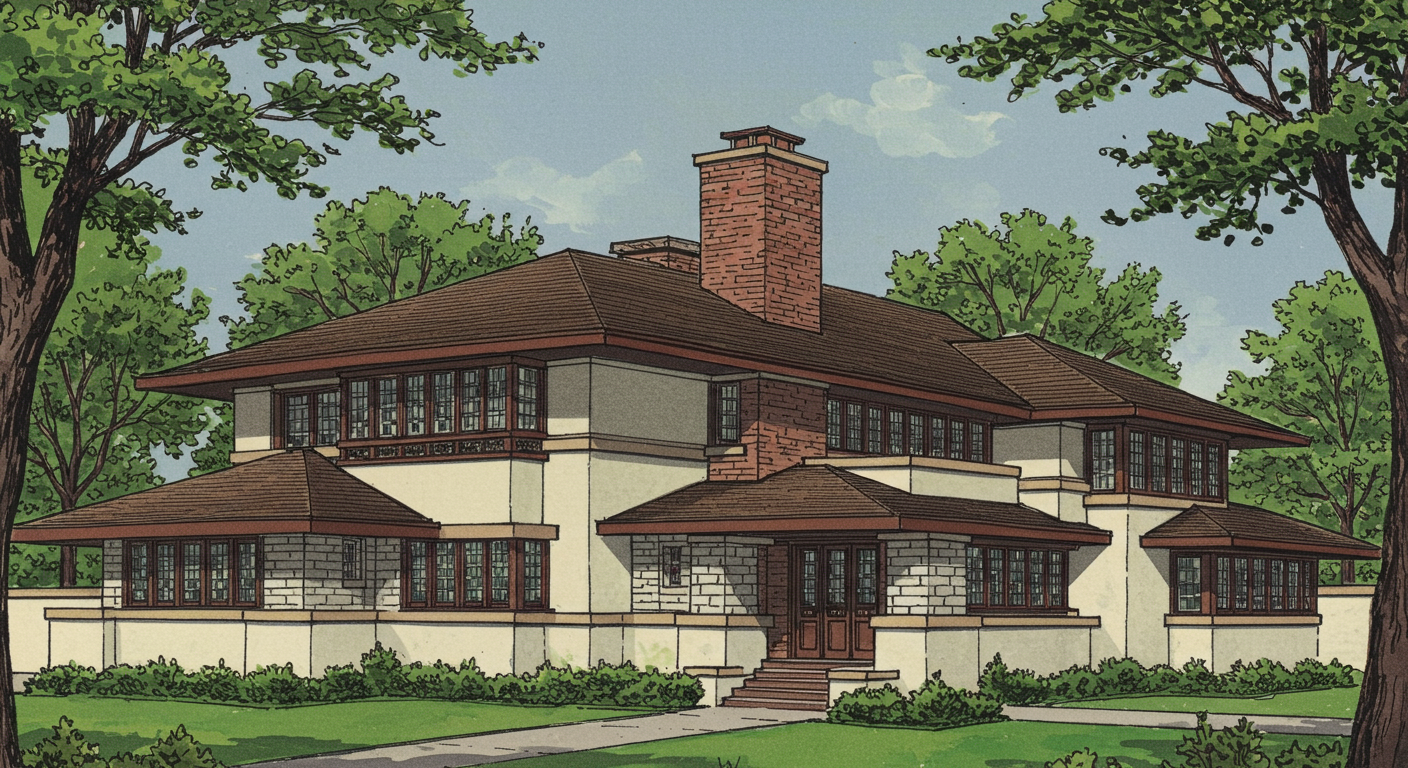
The Prairie is the only style in this series whose name was applied retrospectively, by historians, to architectural work its principal practitioner did not consistently label as such. Frank Lloyd Wright — the architect at the centre of the style, who designed its high-style examples and whose office trained most of its other practitioners — wrote about “a home in a prairie town” in Ladies’ Home Journal in February of 1901, but he did not write or speak of a Prairie style as a coherent stylistic category. The word prairie in his usage was descriptive of the geography for which he was designing, not the name of an idiom he was producing. The categorisation came later, when the architectural historians of the mid-twentieth century — Hitchcock and his successors, eventually H. Allen Brooks in his 1972 monograph — needed a label for the Wright-and-followers residential idiom that ran in the American Midwest between roughly 1900 and 1915. They picked the prairie phrase out of Wright’s own prose, regularised it into a stylistic category, and the category has held.
This is the Prairie, then, by the historiographical convention that named it. What follows is the eleventh in a series that has been, in a quiet way, trying to read American houses for what they were trying to say. The ten previous posts have covered the long nineteenth century and the early twentieth, from the Greek Revival of the 1820s through the Craftsman bungalow of the 1910s. The Prairie emerged in parallel with the Craftsman from the same broader American moment — the Arts-and-Crafts-influenced cultural temper that ran from roughly 1900 to 1920 — but pursued its argument through a quite different channel. The Craftsman was disseminated through pattern books, mail-order kits, and a magazine. The Prairie was disseminated through the work of a single architect’s office, and through the offices of the dozen-or-so other architects whom that architect trained or influenced. The Craftsman, in consequence, produced something close to a million houses. The Prairie produced, by any reasonable accounting, a few thousand. The two styles are sometimes treated together as Midwestern siblings; on inspection, they are siblings in vocabulary but opposites in dissemination.
The Misnomer
The first thing worth knowing about the Prairie is that the prairie had very little to do with it.
Wright’s own prose made the rhetorical move that gave the style its name. The land of the American Middle West, he argued in “A Home in a Prairie Town” and the essays that followed it, was flat — long, level, open, horizontal — and so the architecture of the Middle West ought also to be horizontal. The European house was vertical, fortress-like, defensive, raised on a basement and roofed with a steep slope. The American prairie house should be low, long, broad, anchored to its site rather than rising above it, oriented to the openness of the continent rather than to the closed hierarchy of an old-world streetscape. The argument was, on its own terms, persuasive: one can read it in Wright’s Ladies’ Home Journal plates, and the houses that followed manifestly carry the horizontal vocabulary the argument prescribed.
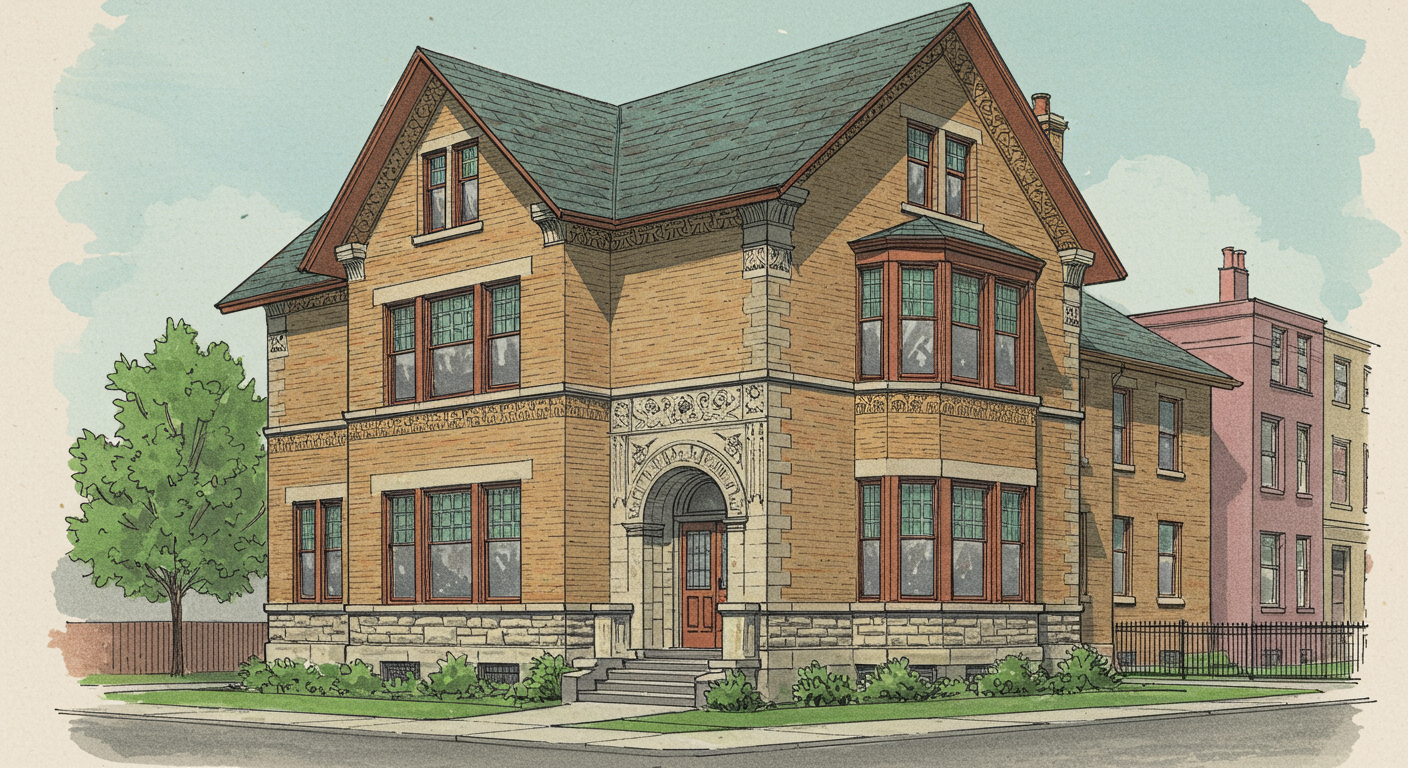
A residential design in the manner of Louis Sullivan’s mid-1890s work — long horizontal Roman-brick walls, a low hipped roof with deep overhanging eaves, casement windows in horizontal bands. Wright, who served as the head draftsman in Adler & Sullivan’s office for the residential commissions of the early 1890s, drew most of these designs himself. The horizontal sensibility and the Roman-brick palette descended directly from Sullivan’s practice into Wright’s own when he set up his Oak Park office in 1893; the Prairie style is, on close inspection, what Sullivan’s residential vocabulary became when one of his draftsmen left to pursue it on his own.
The trouble — and it is a trouble that becomes obvious the moment one looks at the actual sites on which the Prairie was built — is that the prairie itself appeared in very few of the actual commissions. The Willits House (1901) sits on a Highland Park lot indistinguishable from any other Highland Park lot. The Robie House (1909) sits on a Chicago corner in Hyde Park, on a Roman-brick streetfront with neighbouring houses crowding it on two sides. The Coonley House (1907) sits on a large but firmly suburban parcel in Riverside, Illinois — landscaped, lawned, conventionally graded. The Heurtley House sits on a small Oak Park lot in the architect’s own neighbourhood. The Martin House sits on a Buffalo corner lot, hundreds of miles from any prairie. Of the major early-period Prairie houses, the only ones that sit on anything resembling open prairie are the few Wright designed for clients in genuinely rural settings — and those are a small minority of the corpus. The overwhelming bulk of the Prairie was built on suburban lots in Oak Park, River Forest, Riverside, Highland Park, Hyde Park, and the corresponding suburbs of other Midwestern cities. The prairie of the name was a metaphor for the horizontal landscape, not a physical condition of the site.
This is, on inspection, the inverse of the Craftsman’s misnomer. The Craftsman bungalow performed handcraft on a house that was industrially produced; the Prairie performed prairie-integration on a house that was placed on a suburban lot. Both styles made an architectural argument that the actual conditions of the architecture’s production did not bear out, and both styles asked the inhabitant to live inside the argument’s performance rather than its literal premise. One occupied a bungalow on a fifty-foot city lot that argued one was living in the workshop of a craftsman; one occupied a Prairie house on a graded suburban parcel that argued one was living on the open American landscape. The architectural argument was real in both cases; the literal premise was, in both cases, a fiction that the architecture politely performed.
One is obliged to concede that this is also the most thoroughly American thing one could have done with a continental landscape: detach it from its geography, render it as a metaphor, and build the metaphor into the houses of the people who could afford to commission them.
The Specimen
If one is to identify a Prairie house — and there are not many of them, in absolute terms, but the surviving stock is concentrated heavily in the inner suburbs of Chicago, Buffalo, and a few other Midwestern cities, where one can walk a particular street and find three or four in a row — the simplest exercise, as before, is to walk around a specimen and assemble the evidence.
Begin at the silhouette. A Prairie house presents, almost without exception, a low-pitched hipped roof with very wide overhanging eaves — the roof running shallow at perhaps twenty to twenty-five degrees, hipped on all four sides (or, on the high-style Wright examples, hipped on the principal masses and gabled only over secondary masses), and the eaves projecting two to five feet beyond the wall on every side. The hipped roof is the first decisive identifier and the one that distinguishes the Prairie from the Craftsman with the highest reliability. Where the Craftsman bungalow drives a front-facing gable toward the street with exposed rafter tails beneath it, the Prairie house presents a flat eave line running parallel to the street, sweeping outward in a horizontal gesture that has no equivalent in the gabled idiom. The horizontal proportion is the design’s central commitment — more than for the Craftsman, more than for any other style in this series — and the roof is the principal instrument of that proportion.
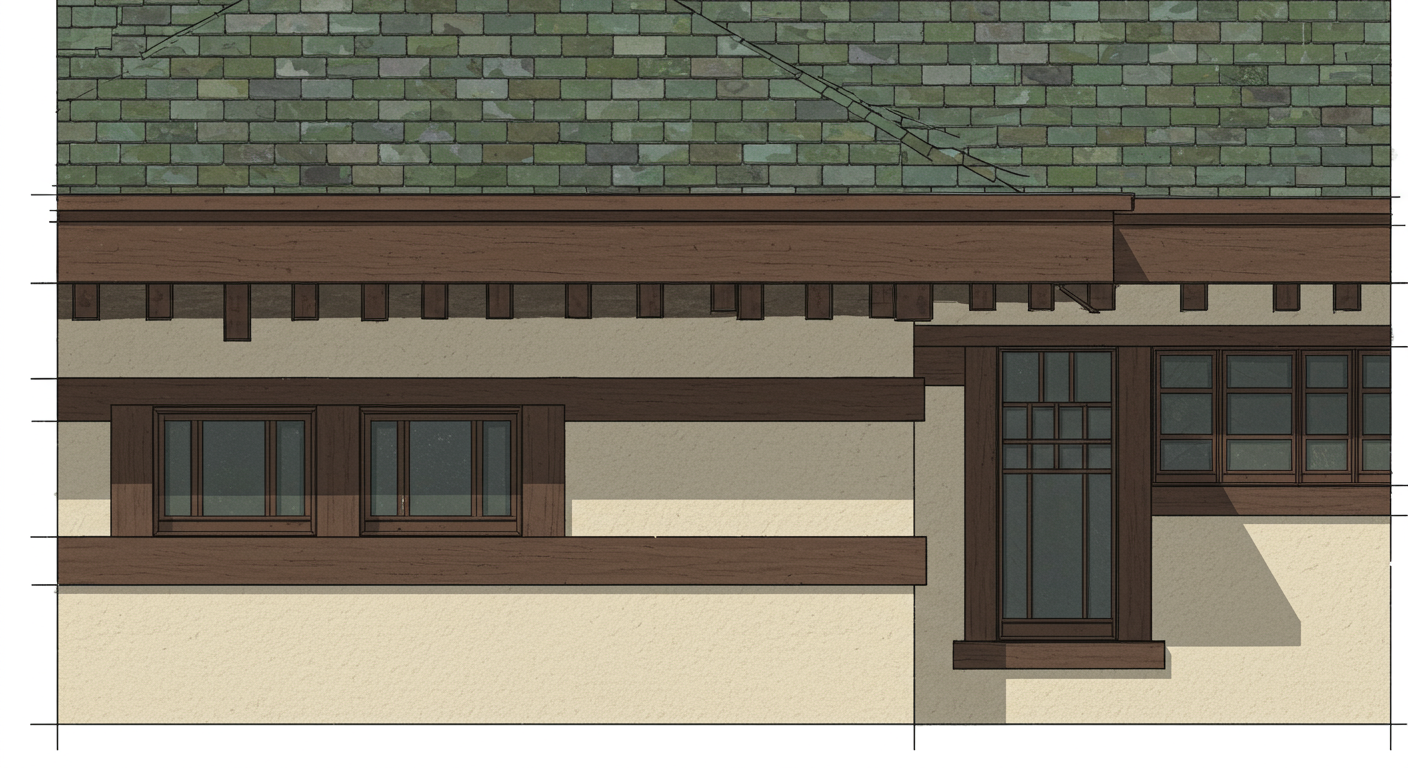
A wide overhanging eave on a low hipped roof — the projection running perhaps three feet beyond the wall, the eave line continuous and uninterrupted, finished with a horizontal trim band that emphasises the horizontal sweep of the building. The hipped roof is the Prairie’s first reliable identifier and the principal feature distinguishing it from the gabled Craftsman bungalow. The horizontal proportion of the design rests, more than on any other element, on the eave line.
Look at the wall surface beneath the roof. This is where the Prairie makes its most distinctive non-roof claim, and the claim is unique enough to the style that it has no good parallel in any other American idiom. Continuous horizontal trim bands run around the house at deliberate elevations — at the floor levels, at the window-sill level, at the lintel level, and immediately under the eave. These bands are not the incidental trim of conventional construction. They are the structural argument of the design: each band is a horizontal line drawn deliberately across the building’s elevations to emphasise the building’s horizontality and to break the wall surface into stacked horizontal panels. On a stucco-walled specimen the bands are picked out in dark-stained wood against the cream-coloured stucco; on a Roman-brick specimen the brick courses themselves are laid with deeply raked horizontal mortar joints (the vertical joints flush, the horizontal joints recessed) so that the brick surface reads as a continuous horizontal striation. The banding is, after the hipped roof, the second most reliable identifier of the style.
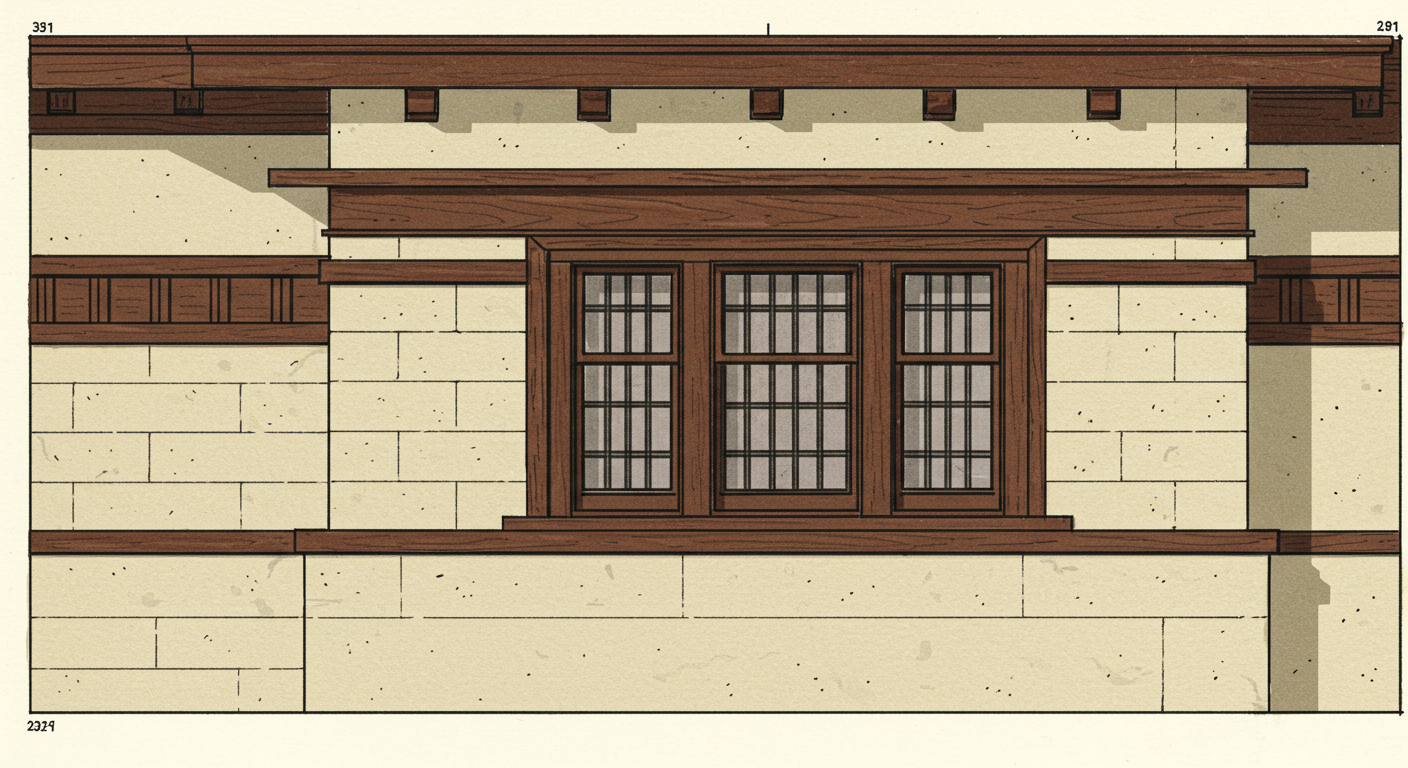
Continuous horizontal trim bands at the floor, sill, and lintel levels — picked out in dark-stained wood against cream-coloured stucco. The bands are the Prairie’s second signature: deliberate horizontal lines drawn around the building’s elevation to break the wall surface into stacked horizontal panels and emphasise the design’s horizontal commitment. On Roman-brick specimens the banding is performed by the masonry itself — deeply raked horizontal mortar joints, with the vertical joints flush, producing a continuous horizontal striation across the wall surface.
Examine the windows. Prairie windows are casements grouped in long horizontal ribbon bands, running across the wall surface in continuous sequences of three, five, seven, or more units, often the full length of a major wall. The casements open outward on hinges rather than sliding vertically as a double-hung sash, and the glass is frequently art-glass leading in geometric patterns — Wright’s famous abstract grids of small rectangles bordered by interlocking lines, often picked out in coloured glass or in transparent glass with a leaded geometric design. The ribbon arrangement contrasts sharply with the windows of every other style in this series. Where the Colonial Revival’s windows are discrete sashes set into a symmetric facade, where the Queen Anne’s windows are varied in shape and randomly placed, where the Craftsman’s windows are three-over-one sashes in grouped pairs and triples, the Prairie’s windows are a continuous horizontal band that treats the wall plane as something to be sliced laterally rather than punctured discretely.

A horizontal ribbon band of casement windows — five units in continuous sequence, opening outward on side hinges, glazed with art-glass leading in an abstract geometric pattern. The ribbon arrangement is the Prairie’s third signature: the wall plane treated as a surface to be sliced horizontally rather than punctured by discrete sashes. The geometric leading is a Wright invention, and the patterns are abstract — not the leaded foliate or figurative glass of the Queen Anne or the Tudor Revival, but a Wrightian grid of small rectangles in interlocking lines.
Examine the walls. Prairie walls are usually cream-coloured stucco on a wood frame, or Roman brick on a structural masonry wall, with the brick laid in long thin courses (Roman brick is typically 12 inches long by 2 inches high — substantially longer and thinner than standard American common brick) for maximum horizontal effect. The wall colour is consistently muted and earthy: cream stucco, tan Roman brick, occasionally weathered grey or pale ochre. Bright colour is alien to the style. White-painted clapboard is alien to the style. The walls are meant to read as continuous horizontal planes interrupted only by the horizontal banding and the horizontal window bands; any element that would break the horizontal — vertical siding, vertical pilasters, vertical shutters — is studiously avoided.
Now look for the central chimney. Every Prairie house worth the name carries a massive central masonry chimney — usually in the same Roman brick or rough stone as the walls, but treated as the deliberate vertical anchor against the horizontal sweep of the rest of the building. The chimney rises from the centre of the plan, often at the visual heart of the house, and its mass is exaggerated to a scale considerably larger than the actual flue would require. Wright’s argument about the chimney was an explicit one: the hearth was the spiritual centre of the home, and the chimney that rose from it should be the architectural anchor around which the rest of the house arranged itself. In practice the plan radiated outward from the chimney mass, with the major rooms — living, dining, library — opening from the central hearth space and flowing outward to the perimeter. The plan is the most distinctive Prairie feature one can read without actually entering the building, because the chimney mass that anchors it is visible above the roofline as the building’s vertical climax.
Two more details complete the specimen. Prairie houses very often display cantilevered horizontal elements extending outward from the main mass — porches, balconies, terraces, porte-cocheres — supported by piers near the body of the house and projecting horizontally into the landscape, often well beyond what conventional structural logic would suggest. The Robie House’s roof cantilevers, which extend twenty feet beyond their supporting piers, are the famous example; the move is repeated at a smaller scale on most Prairie houses, where some portion of the structure visibly reaches outward rather than rising upward. And the entrance is, almost without exception, concealed. Wright disliked the symmetric front-door-on-axis approach of the conventional American house, and the Prairie entrance is typically on the side, or set back from the front plane behind a cantilevered porch, or approached by a long horizontal sweep around the building. One identifies a Prairie house, in part, by being unable to find its front door from the street.
Assemble these — the low hipped roof with wide overhanging eaves, the continuous horizontal banding at floor and sill and lintel levels, the ribbon windows with abstract geometric art-glass leading, the cream stucco or Roman-brick walls, the massive central masonry chimney as vertical anchor, the cantilevered horizontal projections, the concealed entrance — and one has a Prairie. Wright’s high-style examples carry every feature in elaborated form; the Prairie School followers’ work carries them in slightly simplified form; the suburban-builder versions that appeared briefly in the 1910s carry them in further simplified form again. The vocabulary scales from Wright’s most expensive commission down to a pattern-book bungalow with Prairie trim — but, unlike the Craftsman, the scaling is shallow. There are not many simplified Prairies, and the further one gets from Wright’s own drawings, the more diluted the recognition.
The Chicago Office
The historical arc of the Prairie is the story of a single architect’s office, in a single Chicago suburb, producing the high-style examples of a residential idiom, and then dispersing — under personal and professional pressures — into the work of a few dozen followers who carried the idiom for another decade.
The roots are in Adler & Sullivan’s Chicago office. Frank Lloyd Wright joined the firm in 1888 as a young draftsman from rural Wisconsin; by 1890 he was Louis Sullivan’s chief draftsman for residential commissions, drawing — under Sullivan’s general direction but with substantial latitude — the Charnley House (1892), the Harlan House, and a handful of other small projects that the firm took on alongside its main commercial work. The horizontal-Roman-brick-and-deep-eave sensibility that became the Prairie’s central vocabulary appeared, in embryonic form, in those early 1890s residential designs. Wright drew most of them. In 1893 the firm discovered that Wright had been running an independent practice on the side, producing what would later be called his “bootlegged houses” for private Oak Park clients, and a breach followed that ended his employment. Wright opened his own office in Oak Park and began producing residential work under his own name.
The first decade of the independent practice — 1893 through 1900 — is sometimes called Wright’s early period. The houses of this period are recognisably Wright but not yet recognisably Prairie: the Winslow House (1893) is symmetric, Roman-brick, with a hipped roof but without the elongated horizontal banding that the mature style would adopt; the Heurtley House (1902) is the transitional specimen in which the horizontal banding first appears decisively. By 1900 Wright had settled the central elements of the style, and the public articulation followed at once.
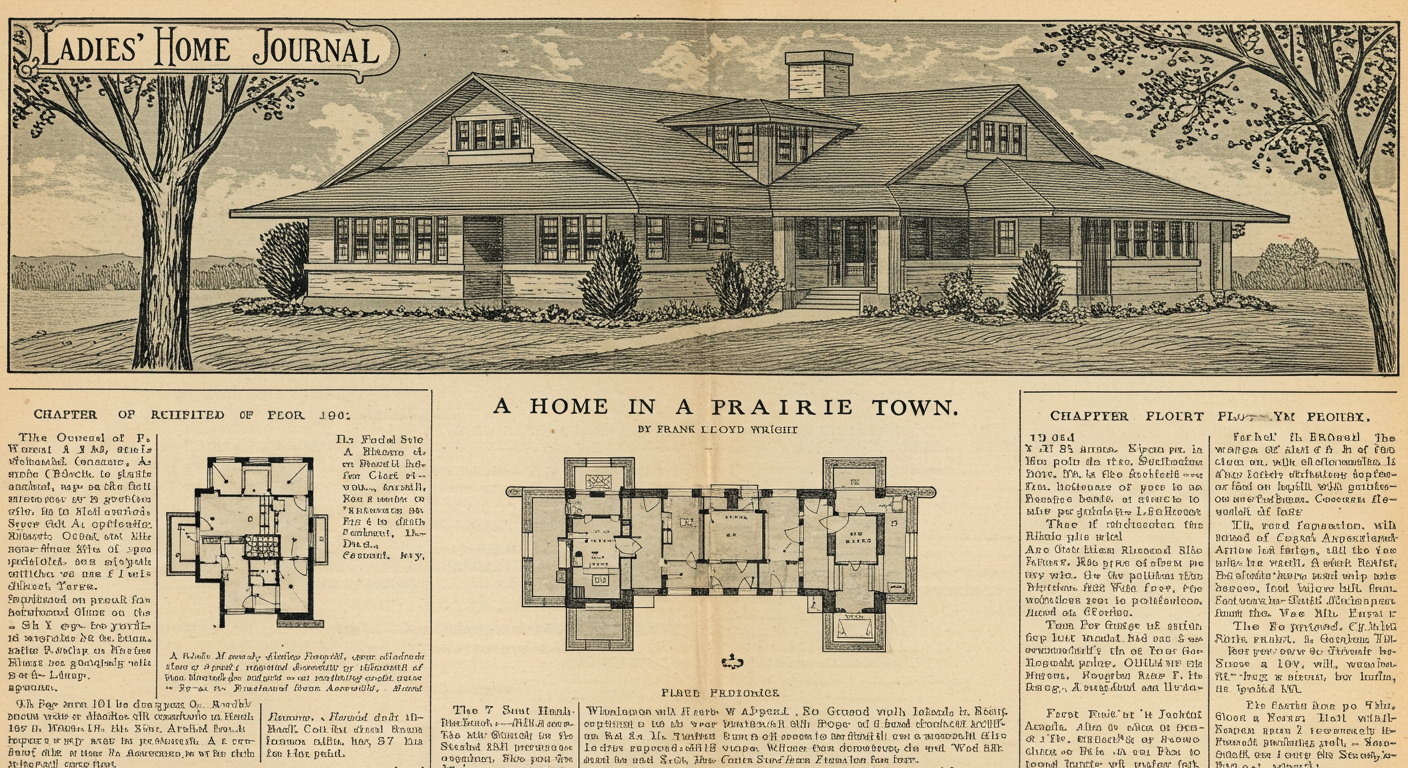
A page from Frank Lloyd Wright’s A Home in a Prairie Town, as published in Ladies’ Home Journal of February 1901 — elevation, plan, and descriptive text for a single-family residence in what Wright then called the prairie manner. The article was one of two Wright contributed to the magazine that year (the second, A Small House with ‘Lots of Room in It,’ appeared in July) as part of Edward Bok’s commissioned series of ideal American houses. The two articles were the Prairie’s public manifesto: the first time the horizontal vocabulary, the open plan, the ribbon casements, and the central chimney had been laid out together in a popular magazine, in an architectural argument framed as a description of what an American house ought to be.
The articulation was a magazine commission. Edward Bok, the editor of Ladies’ Home Journal, had begun commissioning prominent American architects to design “ideal” houses for which subscribers could send away for full architectural plans at modest cost — a kind of upmarket pattern-book operation directed at the magazine’s middle-class readership. Wright contributed two designs in 1901: A Home in a Prairie Town (February 1901) and A Small House with “Lots of Room in It” (July 1901). The two articles laid out the central elements of the style — horizontal massing, low hipped roof, wide eaves, ribbon casements, open plan organised around a central hearth — in plates and elevations accompanied by Wright’s prose. The articles are the closest thing the Prairie has to a manifesto, and they marked the moment the style passed from Wright’s office into general American architectural conversation.
The mature period followed: roughly 1901 to 1909. In that span Wright produced the work that has, ever since, been taken as the canonical Prairie corpus. The Willits House at Highland Park (1901), the Dana House at Springfield (1902-04), the Heurtley House at Oak Park (1902), the Martin House at Buffalo (1903-06), the Coonley House at Riverside (1907-08), the Robie House at Hyde Park (1909-10), and perhaps two dozen lesser commissions. Wright’s office in Oak Park employed a rotating set of draftsmen and apprentices through these years, several of whom would become the principal figures of what came to be called the Prairie School: Walter Burley Griffin (who would later win the international competition for the design of Canberra), Marion Mahony (the first licensed female architect in Illinois and the principal renderer of Wright’s drawings for publication), George W. Maher (who developed his own independent Prairie practice), William Drummond, Barry Byrne, John Van Bergen, and others. The firm of Tallmadge & Watson took up the idiom in the suburbs; Robert Spencer carried it into his own commissions. By 1908 the Prairie School was, in some real sense, the dominant architectural movement in Chicago residential design, with several offices producing Prairie work and the trade press treating it as a coherent stylistic moment.
The end came in two stages, neither of which had much to do with architecture as such. In late 1909 Wright abandoned his Oak Park practice and his family and left for Europe with Mamah Borthwick, the wife of a client. He returned in 1911 to build Taliesin — his own combined home, studio, and farm — in rural Wisconsin, and his Chicago practice never fully recovered. The murders at Taliesin in 1914, in which seven members of the household including Mamah Borthwick were killed by an arsonist-servant, marked the close of Wright’s first major creative period; the years that followed were dominated by the Imperial Hotel commission in Tokyo (1916-22), during which Wright spent long periods in Japan, and by the personal and financial difficulties of his Wisconsin years. The Prairie School continued through these years under Wright’s followers, but with the central figure absent the movement slowly lost its coherence. By the early 1920s the major Prairie practitioners had dispersed: Griffin to Australia, Mahony with him, Maher into a quieter Chicago practice, the younger draftsmen into their own offices doing other things.
The cultural moment closed around 1925. The horizontal-massing argument that had defined the style was overtaken, after the First World War, by competing residential idioms — Tudor Revival, Spanish Colonial, French Eclectic — that the catalogues and the building press now offered to the suburban market. Wright himself, returning to American practice in the 1920s, shifted to his textile-block houses in California (the Hollyhock House, the Ennis House, the Storer House) and abandoned the Prairie vocabulary; later, in the 1930s, he would launch the Usonian houses, which were Prairie ideas worked through in a deliberately modest small-house form. But the Prairie as a contemporary idiom was effectively dead by 1925, and by the time the European modernism of Mies and Gropius arrived in American practice after the 1932 MoMA exhibition, the Prairie was already being read as a historical chapter rather than a living movement.
The total Prairie corpus is small, by the standards of this series. The number of recognisably Prairie houses produced between roughly 1900 and 1920, including all the Prairie School followers as well as Wright himself, is somewhere between two and four thousand. The Craftsman, in roughly the same span, produced something close to a million. The two styles were sibling idioms in vocabulary but vastly different in scale: the Prairie was the architect-defined high-style version, never mass-produced, never quite reaching the pattern-book and kit-house economy that gave the Craftsman its enormous run; the Craftsman was the mass-market vernacular version, available everywhere, dominant in volume but lacking — by design — the single architect-author who could give the style a coherent intellectual centre. The Prairie’s small numbers are part of what has made its surviving examples so heavily studied and so jealously preserved: there are perhaps four hundred surviving Wright Prairie houses, and each one is, today, the architectural anchor of the neighbourhood that surrounds it.
What It Is Not
Four styles stand near enough to the Prairie that the beginner confuses them with it, and distinguishing them is most of the work of reading the early-twentieth-century American suburban house at the architect-defined end of the market.
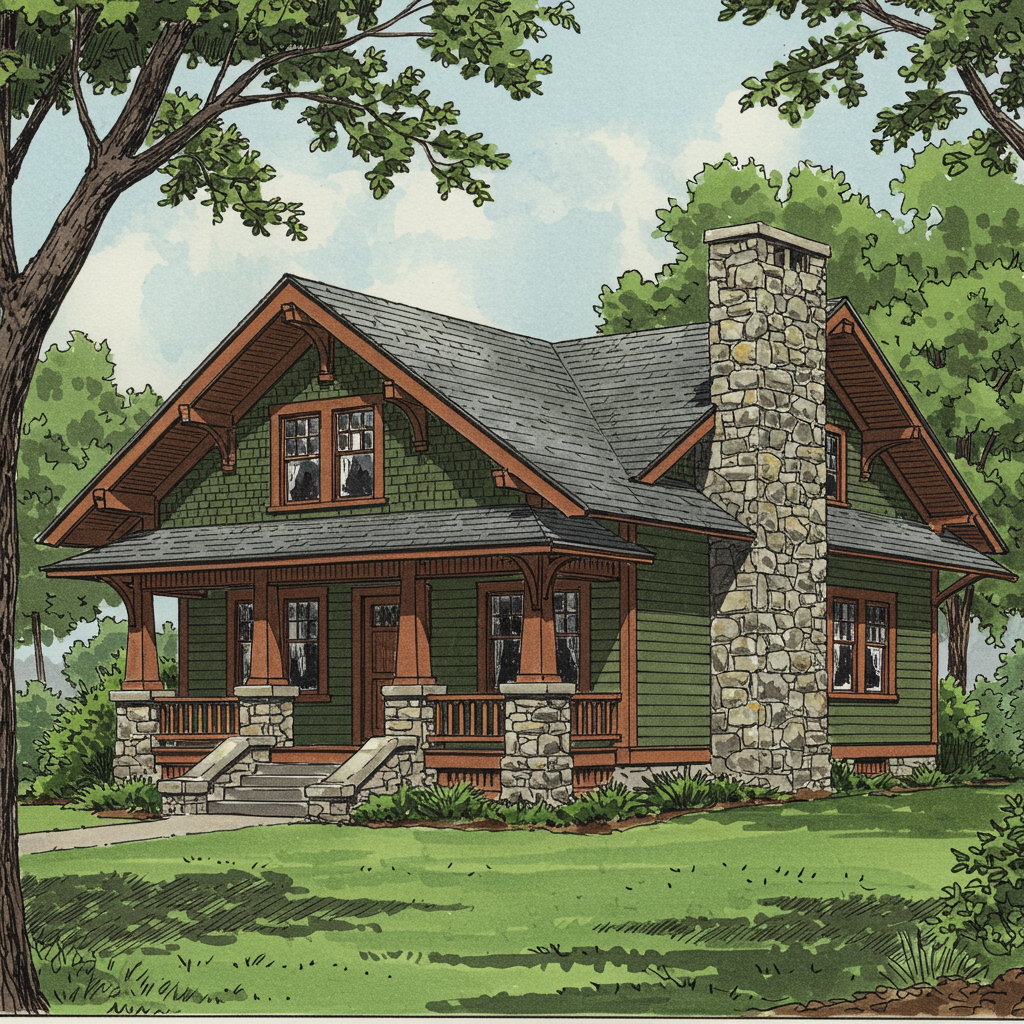
The Craftsman — the Prairie’s pattern-book contemporary, examined in the previous post — drew on the same Arts-and-Crafts-influenced moment but pursued the argument through a mass-market mail-order economy rather than through the work of an architect’s office. The two styles share a great deal of vocabulary: the wide overhanging eave, the muted earth-tone palette, the horizontal porch on heavy supports, the deep integration of indoor and outdoor spaces, the rejection of historical revival ornament. They differ at the roofline and in the level of geometric abstraction. A Craftsman bungalow carries a gabled roof with the gable end facing the street, exposed rafter tails beneath the eaves, and decorative triangular knee braces; a Prairie house carries a hipped roof with continuous flat eaves and no exposed structural ornament. A Craftsman’s windows are three-over-one double-hung sashes in pairs and threes; a Prairie’s are casements in long ribbon bands with art-glass leading. The rule of thumb: gabled with rafter tails is Craftsman; hipped with horizontal banding is Prairie.
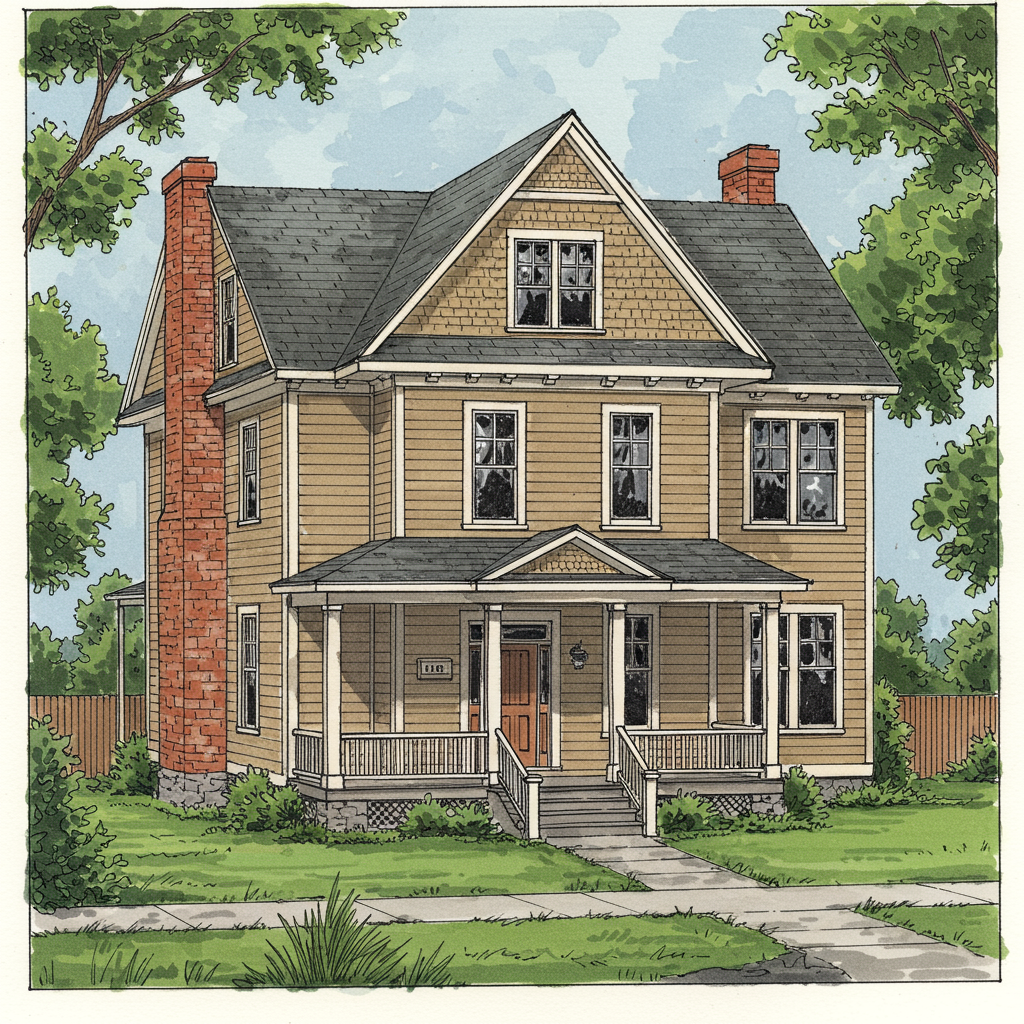
The American Foursquare — the Prairie’s vernacular cousin — is the style that the beginner most reliably confuses with the Prairie, because the two share the hipped roof, the central dormer, and the broad horizontal proportions that distinguish both from the gabled idioms. A Foursquare is, on inspection, a Prairie reduced to its bare structural shape and stripped of its argumentative apparatus: square two-storey plan, hipped roof, central front dormer, broad front porch on tapered posts and stone piers, and an interior that is conventionally divided into separate rooms rather than opened into a Wright-style flowing plan. The Foursquare is the contractor’s interpretation of what the Prairie looked like, sold through the same pattern-book and kit-house catalogues as the Craftsman. There are far more Foursquares than Prairies — perhaps a hundred Foursquares for each true Prairie — and most people who think they know a Prairie are actually looking at a Foursquare with Prairie-influenced trim. The rule of thumb: continuous horizontal banding at sill and lintel levels, ribbon casements with art glass, and a massive central chimney are Prairie; tapered posts on stone piers, a central front dormer, and three-over-one double-hung windows are Foursquare.
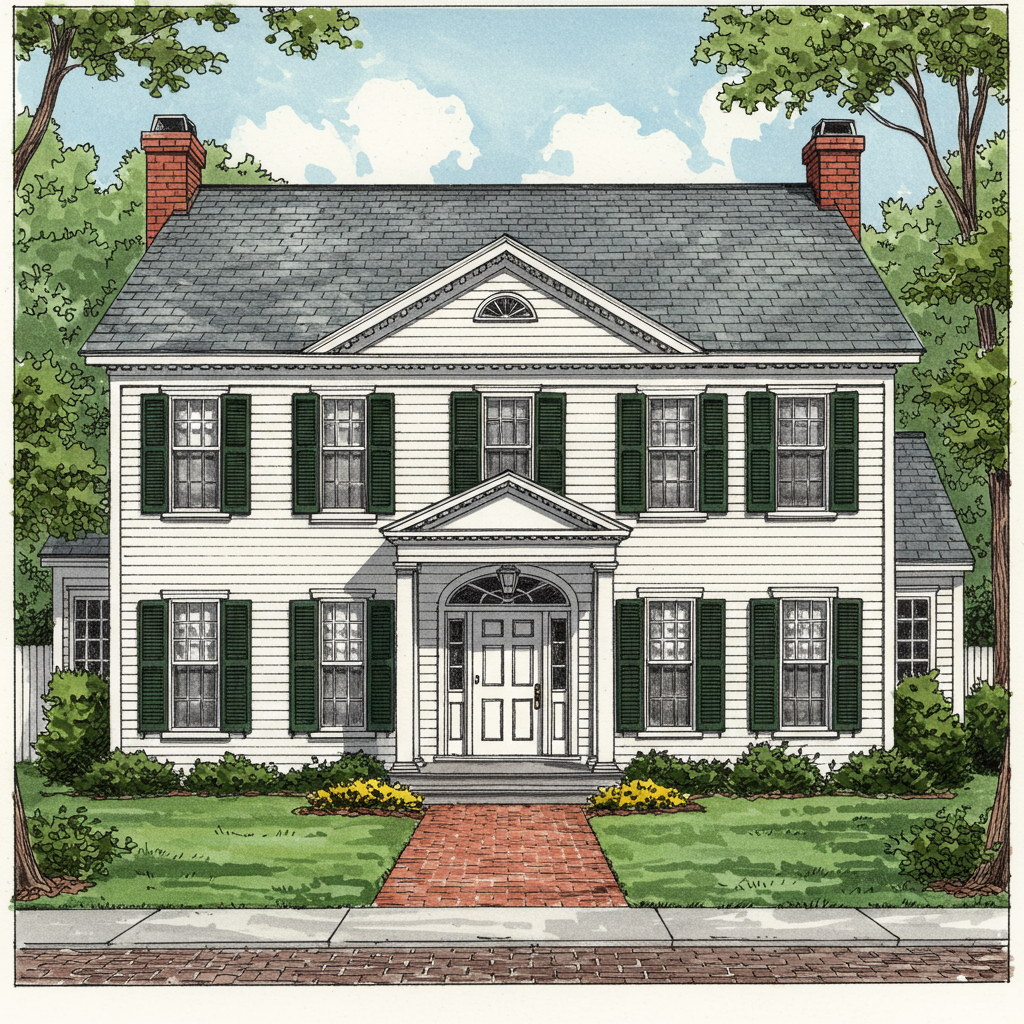
The Colonial Revival — the academic competitor for the same upper-middle commissions, examined two posts ago — argued for symmetry, classical ornament, white-painted clapboard, and historical reference to the country’s Anglo-Georgian past. The Prairie argued for asymmetry, abstract geometric ornament, earth-tone cladding, and rejection of any historical reference at all. The two styles competed directly for the early-twentieth-century professional-class commission, often in the same Chicago and Buffalo suburbs, and they represented opposing arguments about what the modern American house ought to declare. The visual distinction is overdetermined: white symmetric clapboard with shutters and pediment is Colonial Revival; cream stucco or Roman brick with horizontal banding and no shutters is Prairie.
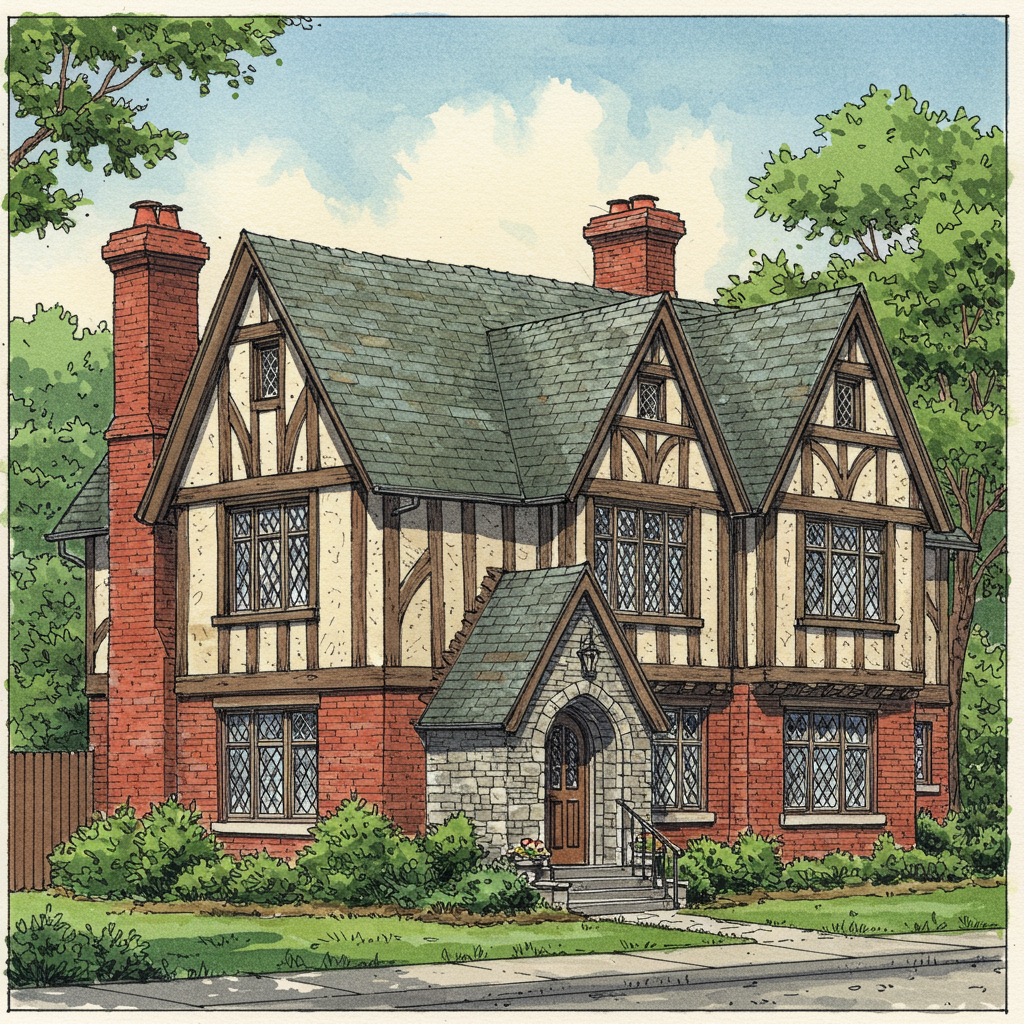
The Tudor Revival — the Prairie’s suburban contemporary, which would dominate the upper-middle commission of the 1920s after both the Prairie and the Craftsman had faded — drew on English Tudor-and-Jacobean sources and produced houses with half-timbered upper storeys, steep cross-gables, and mullioned casement windows. The two styles ran in parallel through the 1910s but represented entirely different architectural arguments: the Tudor argued for a quoted English past, the Prairie for an unquoted American present. The visual distinction is straightforward: half-timbered upper storey and steep cross-gables is Tudor Revival; long horizontal banding and a low hipped roof is Prairie.
What It Was Trying to Say
The Prairie flourished in America for a quite short interval — perhaps fifteen years, with its sharpest period running from about 1901 to 1915 — and produced, in that span, a smaller body of work than any other style in this series. The cultural temper that had supported it, like the temper that had supported the Craftsman, was steadily eroded after the First World War, and by 1925 the style was old-fashioned. Wright himself moved on to other vocabularies, and the Prairie School followers either dispersed into other practices or abandoned residential design altogether. What survives today is a few thousand houses concentrated in Chicago, Buffalo, and the inner suburbs of a handful of other Midwestern cities, of which perhaps a few hundred are Wright’s own work.
What the style was trying to say is best taken, again, as the sum of two arguments running in parallel.
The first is the geographical-American argument. Wright’s prose for Ladies’ Home Journal and for the architectural press of the 1900s argued that the American Middle West was a horizontal landscape and that its architecture ought to reflect this. The European house was vertical, hierarchical, oriented to a closed and stratified urban society; the American prairie house should be horizontal, low, broad, integrated with its landscape, evoking the openness of the continent. This was, in a sense, the first explicit attempt by an American architect to produce a residential style that justified itself geographically rather than historically. The Shingle had drawn on Colonial American vernacular; the Craftsman had drawn on English Arts and Crafts; the Prairie drew, by its own account, on the American land itself. That the actual sites were almost always suburban lots indistinguishable from any other suburban lot does not, on inspection, weaken the argument so much as relocate it. The Prairie was making a cultural claim about American geography — about what the continent metaphorically required of its architecture — rather than a literal claim about siting. The metaphor was the architecture’s point, and the actual landscape was almost beside the point.
The second is the architect-as-author argument. The Prairie is the first American residential style in this series whose intellectual content can be traced, in detail, to a single named architect’s published prose. The Greek Revival’s argument was widely shared but had no single author; the Colonial Revival was the product of a generation of academic architects and pattern-book publishers; the Craftsman had Stickley but Stickley was a publisher and furniture-maker more than he was a designing architect, and the bulk of the Craftsman corpus was produced by carpenters from catalogues rather than by an architect’s office. The Prairie is different. Frank Lloyd Wright’s Ladies’ Home Journal articles, his lectures, his prose for The Architectural Record, and the published photographs of his commissions established the style’s argument with a degree of authorial coherence that no previous American residential idiom had produced. The Prairie was Wright’s — even when it was being practised by Griffin or Maher or Drummond, even when it was being interpreted by a Foursquare carpenter from a builder’s plan, the central reference was an architect’s personal vision rather than a culture’s shared taste. This was a new kind of American architectural authority, and the architecture that followed in the twentieth century — from the European modernism that arrived after 1932 to Wright’s own Usonian houses of the 1930s — increasingly assumed it as the default. The named-author architect, with a coherent body of work and an articulable theoretical position, was a position the Prairie made imaginable for American residential design.
What I find most telling about the Prairie, taking these two arguments together, is its thinness on the ground. The other styles in this series — even the Greek Revival and the Stick, which produced fewer houses than the dominant late-Victorian idioms — produced enough buildings to constitute the architectural character of multiple American towns. The Prairie did not. A few thousand surviving Prairie houses are scattered through the inner suburbs of the upper Midwest, and most American towns of any size contain no Prairie houses at all. The style was always the architect-defined high-style version of an idiom whose mass-market form lived elsewhere — in the Craftsman bungalow and the Foursquare. To walk a residential street looking for the Prairie is, in nearly every American town, to fail. To find one, one has to know which streets in Oak Park and Riverside and Hyde Park and Buffalo to walk down. The style is concentrated in a handful of places, dense in those places, and absent everywhere else. This is part of what makes it the architectural anchor of the neighbourhoods that contain it: there are not enough Prairie houses for them to ever recede into the suburban background, and the surviving examples remain, in their neighbourhoods, the obvious centres of attention a century later.
The next specimens I should like to take up are the American Foursquare and the Tudor Revival, examined in a paired post — the two middle-class suburban shapes that succeeded the Craftsman and the Prairie in the years between roughly 1915 and 1940, and that filled out the architectural character of interwar American residential streets in ways neither of the two preceding styles ever managed to do.