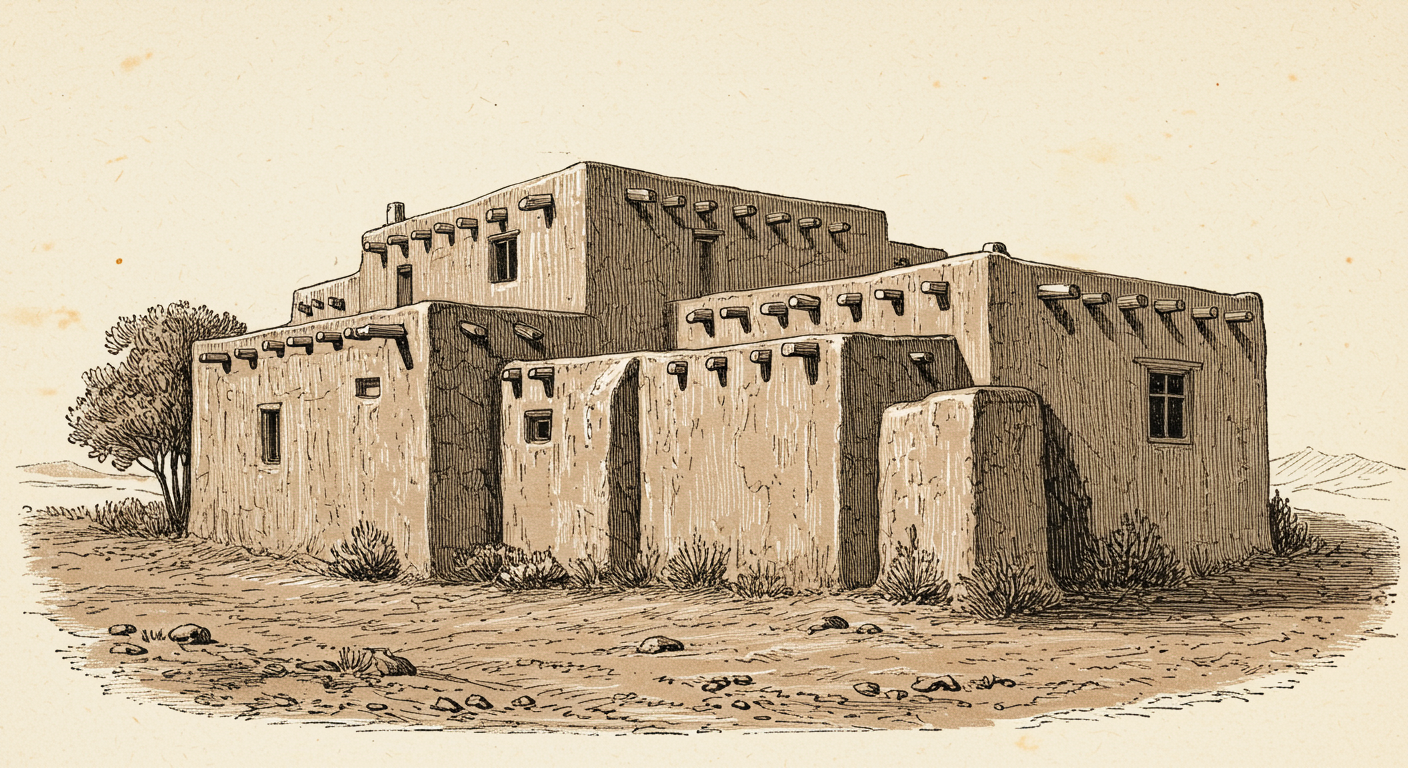
The Spanish Colonial Revival post, six entries back, named four styles standing near it and gave the fourth of them a single short paragraph and a place in the comparison plate — the Pueblo Revival, “the Southwestern variant,” flat-roofed and earth-walled where its red-tiled cousin was pitched and Mediterranean. The Federal of the previous post closed by promising one of two styles next: the Dutch Colonial of the Hudson, or the Pueblo Revival. This post pays the older of the two debts, taking up the style the Spanish Colonial Revival post could only point at and treating it on its own terms rather than as somebody else’s fourth sibling.
This is the twentieth post in Reading the American House. It takes up the Pueblo Revival — known also, after the city that adopted it as civic policy, as the Santa Fe style — the flat-roofed, earth-walled, soft-cornered house of the twentieth-century Southwest, built from roughly 1900 to the present day across New Mexico and Arizona and the drier margins of Colorado and west Texas. The Pueblo Revival is, in the plainest sense, a romantic image of older building rendered in modern materials: it takes the adobe architecture of the Ancestral Puebloan villages and the Hispano settlements — the genuine earthen architecture of the Southwest, a thousand years and more in the making — and reproduces its appearance, in stuccoed wood frame or concrete block, for an owner who wished his house to look as though it had stood for centuries. That gap — between the image of adobe and adobe itself — is the load-bearing distinction of this post, and a wider gap than any previous post in the series has had to carry.
The Specimen
If one is to identify a Pueblo Revival house — and one will find them in number, the style being the near-universal idiom of Santa Fe and Taos and much of Albuquerque — the exercise begins, as always, at the silhouette. Every house before this one has been read, in the first instance, by its roof; the Pueblo Revival has, to the eye from the street, no roof at all.
The principal feature of the Pueblo Revival house is its flat roof concealed behind an earthen parapet, the whole composition battered, rounded, and soft. The walls lean very slightly inward as they rise — the batter, the inward slope a thick earthen wall acquires when built to stand without a frame — and terminate not in an eave but in a parapet, the wall carried up past the roof and finished with a rounded top. The corners are not square but softened, as though weather and a hundred re-mudded summers had worn them. The wall surface is stucco, earth-toned — tan, buff, a pale pinkish brown, the colour of dried mud. There are no gables, no ridge line, no overhanging eaves: a set of cubic, soft-edged, earth-coloured masses, and the absence of a visible roof is the first and surest sign of the style.
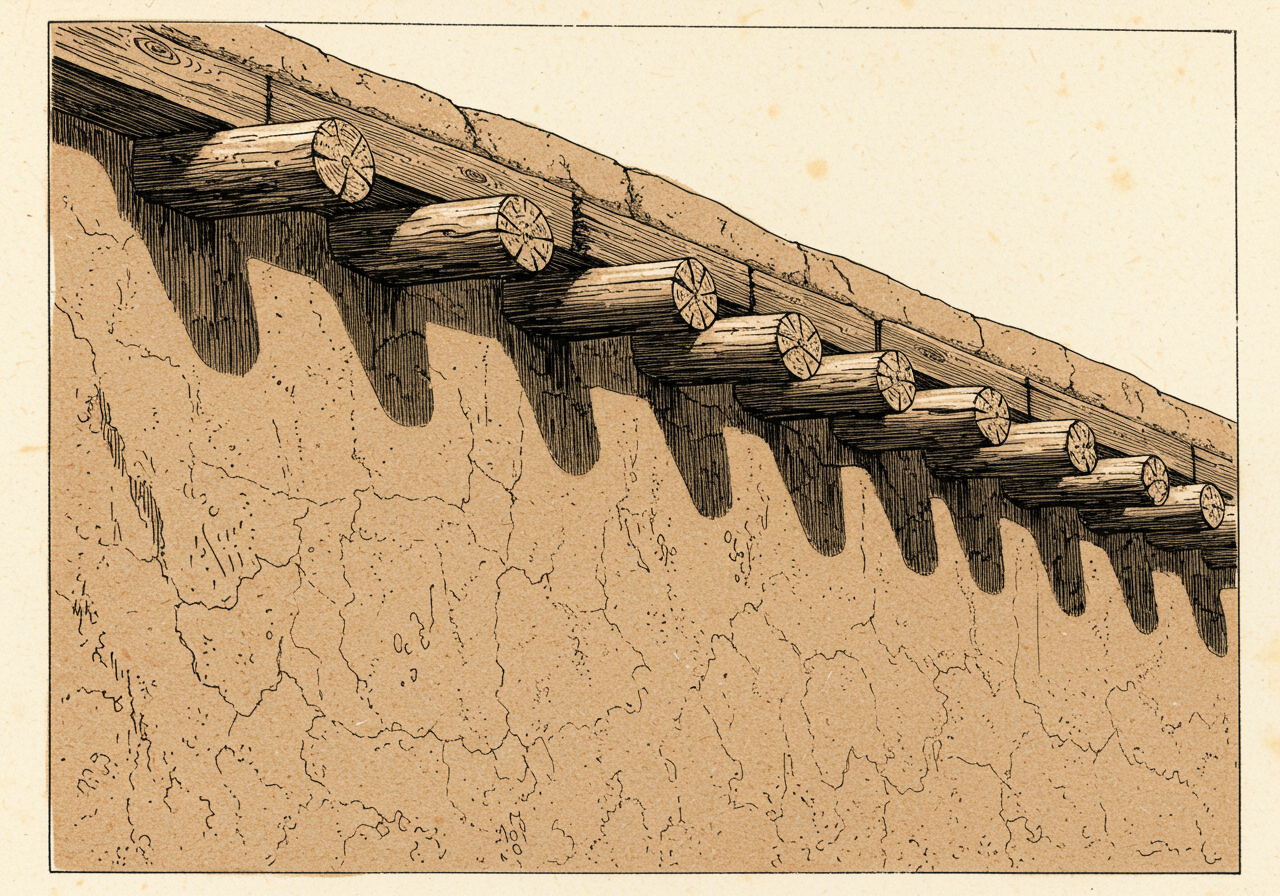
The signature Pueblo Revival element — the projecting vigas. A row of round wooden roof beams runs through the wall and emerges, cut ends exposed, in a regular rank just below the parapet; the wall itself is battered, leaning very slightly inward as it rises, and finished in a hand-troweled earth-toned stucco. In a true adobe building the viga is the roof structure itself, carrying the weight of the earthen roof above; in the great majority of Pueblo Revival houses it is a short length of timber set into a frame wall for the sake of its shadow alone. The viga is the fastest way to know the style from the street — and, as the rest of this post will argue, the place where the gap between the revival and the thing revived is most plainly on view.
The architectural event of the Pueblo Revival wall — the feature by which the style announces itself, and the one this whole post is built around — is the viga. A viga is a roof beam: a round, debarked timber, in genuine adobe construction the structural member that spans from wall to wall and carries the flat earthen roof. The Pueblo Revival makes a great display of it, a rank of vigas projecting horizontally through the wall, their cut ends emerging in a regular row just below the parapet. Above and between them, in the more careful examples, run the latillas — the smaller poles or split saplings laid close across the vigas, the secondary layer of a real adobe roof. The viga is the single fastest way to identify a Pueblo Revival house, and more than a convenience of recognition: of all the elements the revival borrowed, it is the one most often borrowed as image and not as structure, and the section below will return to it.
The third feature is the canale. Because the Pueblo Revival roof is flat, the water that falls on it cannot run off down a slope; it must be carried, deliberately, through the parapet and clear of the wall by a canale — a wooden or metal spout, often a simple carved trough, projecting from the parapet to throw rainwater past the face of the building. On a real adobe house it is a plain necessity, set where the wall is most vulnerable to the water that would dissolve it. The revival kept the canale, sometimes as a working drain and sometimes — like the viga — as a detail valued for the shadow it gives the parapet line.
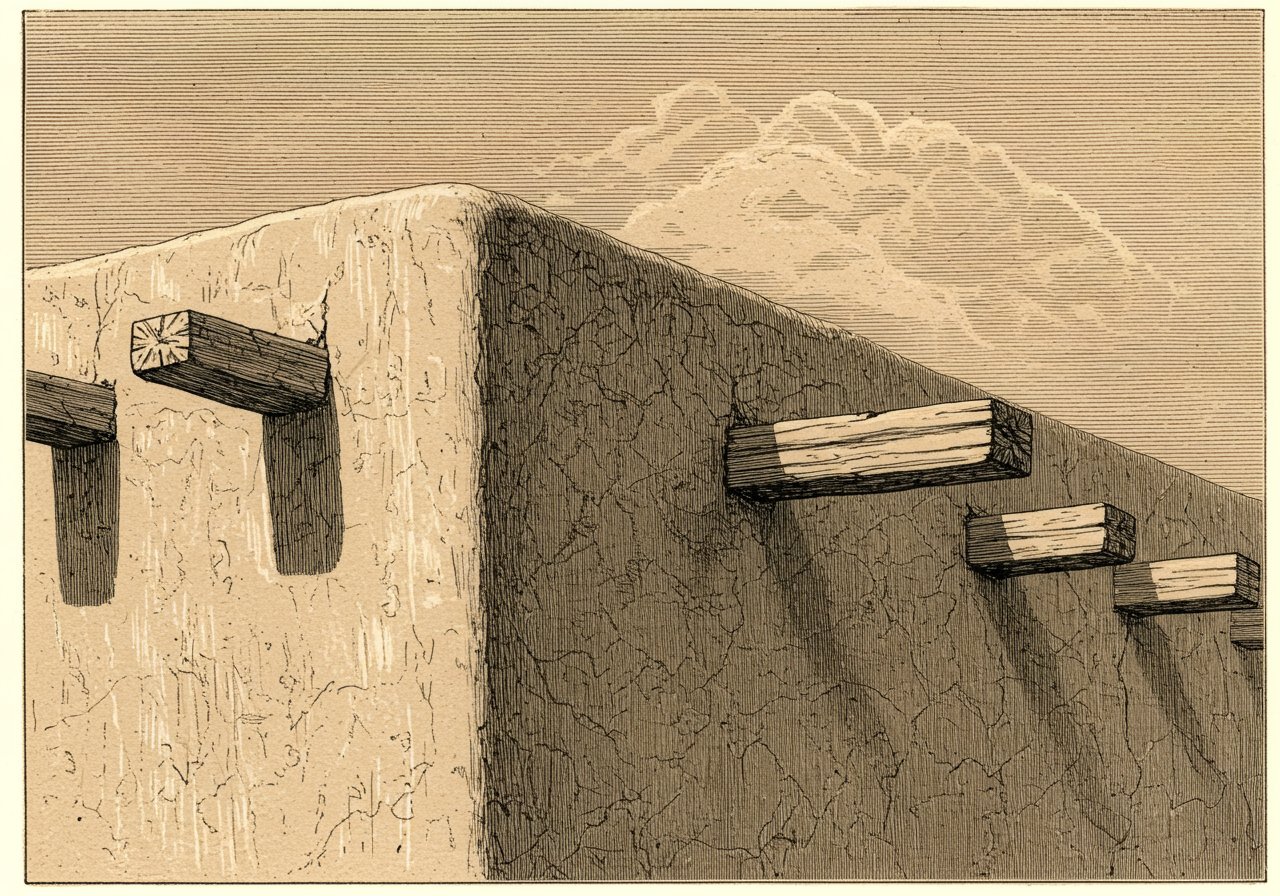
The Pueblo Revival roofline in close view — a rounded, softly modelled parapet, a corner worn round rather than cut square, and a canale, the carved wooden spout that carries rainwater off the flat roof and clear of the earthen wall. On a true adobe house the rounded parapet is the natural shape of a wall that is re-plastered with mud every few years by hand; the canale is the single most necessary drainage device the building has. The Pueblo Revival reproduces both — the roundedness in shaped stucco over frame, the canale sometimes working and sometimes ornamental. The softness is the whole effect: the style refuses the straight line and the sharp corner, because the material it is imitating could never hold them.
The fourth feature is the massing, on which the largest claims of the style depend. The genuine Pueblo — Taos chief among the surviving examples — is not a house but a village in one structure, a stepped, terraced block of rooms piled several storeys high. The Pueblo Revival borrows this terraced massing and reduces it to the scale of a single dwelling: a larger house presents itself as an assembly of cubic masses of differing heights, the taller blocks set back behind the lower, the whole climbing in irregular steps so that the silhouette recalls — at the scale of one family rather than a hundred — the multi-storey pueblo. The deep-set windows complete the effect: small openings punched into a wall that wishes to be read as a foot or more of earth, recessed well back from the face, often carrying a plain exposed wooden lintel. The thick-walled, small-windowed, stepped mass is the Pueblo Revival’s largest gesture.
The fifth feature belongs partly to the interior and partly to the threshold. The Pueblo Revival carries, into rooms otherwise modern, a set of borrowed earthen-architecture details: the corner fireplace with its rounded, sculpted, beehive-like adobe hood, sometimes called a kiva fireplace after the round ceremonial chambers of the Pueblo villages; the heavy, hand-adzed wooden door and the carved corbel; the portal, the long covered porch carried on round wooden posts with carved bracket capitals. None is structurally required by a frame-and-stucco house; all are present because the style is, before anything else, an argument that the house is older and earthier than it is.
The City That Legislated a Style
The documentary anchor of the Pueblo Revival is not a pattern book, as the Federal’s was, nor a single catalysing exposition, as the Spanish Colonial Revival’s was. It is a city, and a decision that city made about itself — but the place to begin is with the genuine architecture the city decided to imitate.
That architecture has two strands, braided together long before any revival took them up. The first is the building of the Ancestral Puebloan peoples and their descendants — the apartment-like adobe and stone villages of the northern Rio Grande, of which Taos Pueblo, continuously inhabited for close to a thousand years, is the great surviving instance: structures of coursed adobe, earth mixed with straw and water and laid up wet or formed into sun-dried bricks, the walls thick because earth has no tensile strength and must work in compression, the roofs flat because that is what earth and climate together permit. The second strand is the building the Spanish brought after 1598: the colonial mission churches of New Mexico — San Estevan at Acoma, the church at Isleta, the much-photographed church at Ranchos de Taos — which married the Pueblo adobe technique to the European church plan and produced the massive, battered, twin-towered earthen churches that are the most monumental adobe buildings the Southwest possesses. The Pueblo Revival drew on both — from the villages the stepped massing, the viga, the flat roof; from the mission churches the battered wall, the heavy buttress, the carved corbel — so that the genuine architecture it inherited was, by 1900, a thousand-year Puebloan tradition with three Spanish centuries laid over it.
What turned that genuine architecture into a revival was, in the first instance, a university and a railway. The early experiments belong to the University of New Mexico at Albuquerque: under the presidency of William Tight, the campus buildings were deliberately remodelled in the Pueblo manner — Hodgin Hall given vigas and a battered profile around 1908 — making the university one of the earliest institutions to adopt the style as policy. It was not, at the time, a popular policy: the regents forced Tight out in 1909, and his “primitivism,” the Pueblo-style campus chief among the charges, was part of why he was vilified — a reminder that the style was resisted before it was beloved. Running alongside the university was the commercial machinery of Southwestern tourism: the Atchison, Topeka and Santa Fe Railway and the Fred Harvey Company that ran its hotels had every reason to sell the Southwest to the eastern traveller as a place of romance and antiquity, and an architecture that looked a thousand years old was exactly the advertisement they wanted. Mary Colter, designing for the Harvey Company at the Grand Canyon, worked an adjacent vein — her Hopi House of 1905 a frank reconstruction of a Pueblo dwelling for the tourist to walk through. The style, in these first years, was the architecture of the institution and the advertisement.
Then the city of Santa Fe took it up, and did something no other American city has done with a regional style: it made the style compulsory. Santa Fe at the turn of the century was an old Hispano town that the railway had bypassed and that feared, with reason, for its commercial future. A circle of civic boosters, antiquarians, artists, and archaeologists — the figures around the Museum of New Mexico and the School of American Research — arrived at a deliberate strategy: Santa Fe would secure its future as a destination by looking like the old Southwest more thoroughly than any actual old town ever had. The remodelling of the buildings around the central Plaza in the Pueblo and Spanish manner began in earnest around 1912 to 1920, the New-Old Santa Fe Exhibition of 1912 setting out the program; and in time the policy was given the force of law, requiring new building in the central districts to conform to the “Old Santa Fe Style.” The result is the one American city with a regional architectural style enforced by ordinance — a city that is, in a sense, a very large Pueblo Revival building in its own right.
Behind the ordinance stood the architect who gave the style its finest expression — and who, when Santa Fe drew up its Historic Styles Ordinance in 1957, chaired the committee that drafted it, so that the law itself is in good part his work. John Gaw Meem came to New Mexico in 1920, as so many did, as a tuberculosis patient seeking the dry air; he stayed, learned the regional building, and became — across a practice running from the 1920s into the 1950s — the central architect of the mature Pueblo Revival. He built churches, libraries, the great bulk of the University of New Mexico’s mature campus, the La Fonda hotel additions on the Santa Fe Plaza, and a long series of houses; and what distinguishes his work from the boosters’ first remodellings is that he measured the old mission churches and brought to the revival a real understanding of the proportion of the thing he was reviving. He could not make a frame-and-stucco building into an adobe one — no architect could — but he could make the imitation intelligent. Meem is to the Pueblo Revival what Bulfinch and McIntire together were to the Federal: the figure whose buildings are visited. Santa Fe did not admire the Pueblo Revival. It mandated it.
What It Is Not
Four styles stand near enough to the Pueblo Revival that the beginner confuses them with it, and the last of the four is the confusion this whole post has been built to resolve.
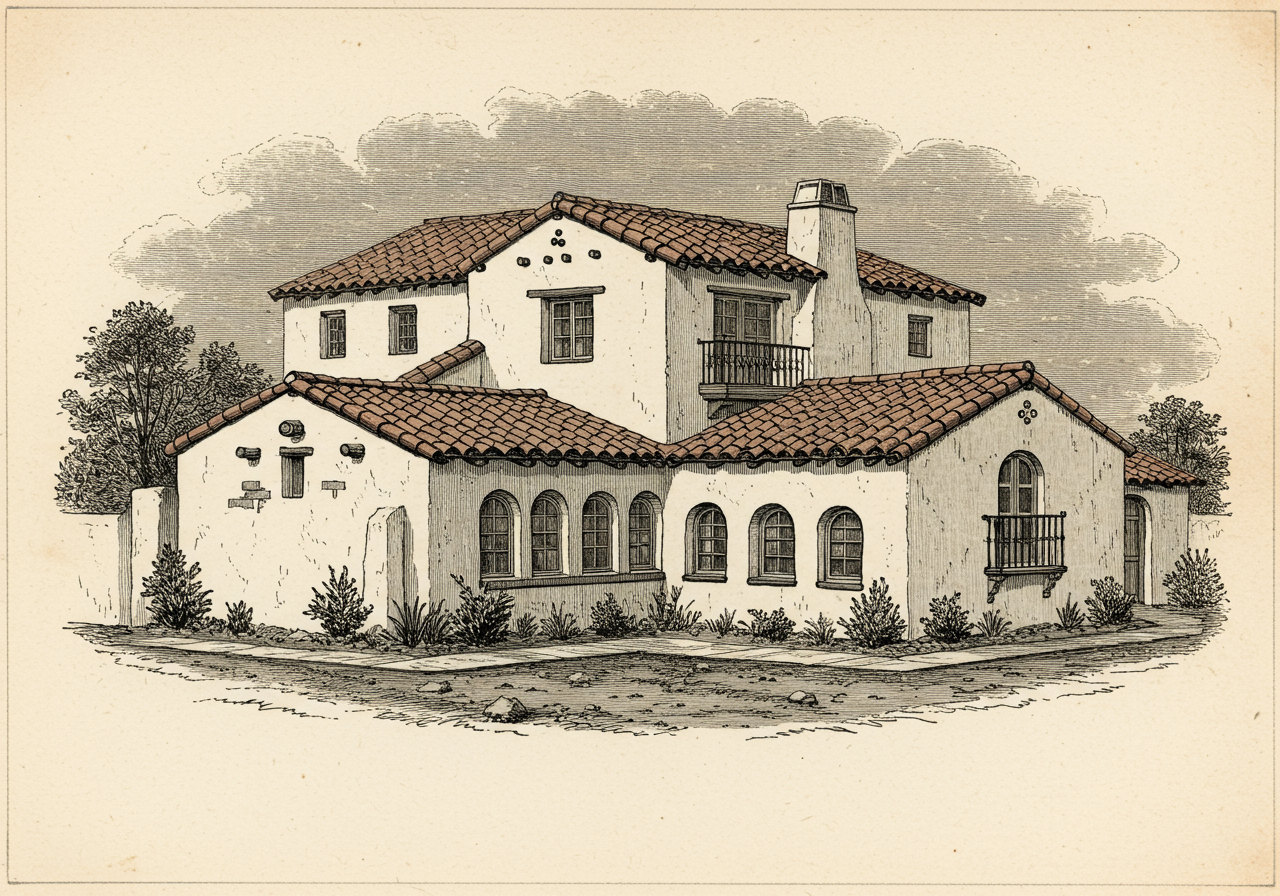
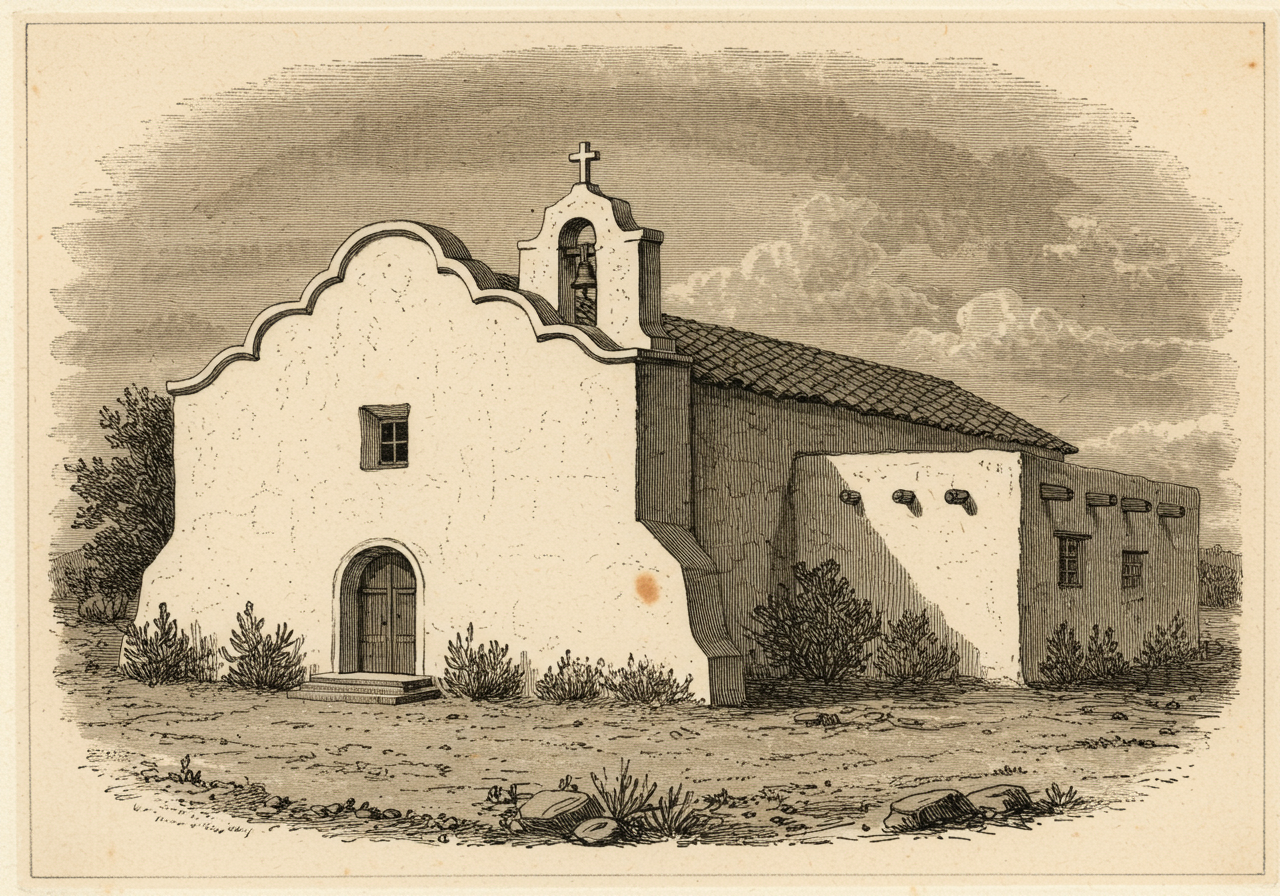
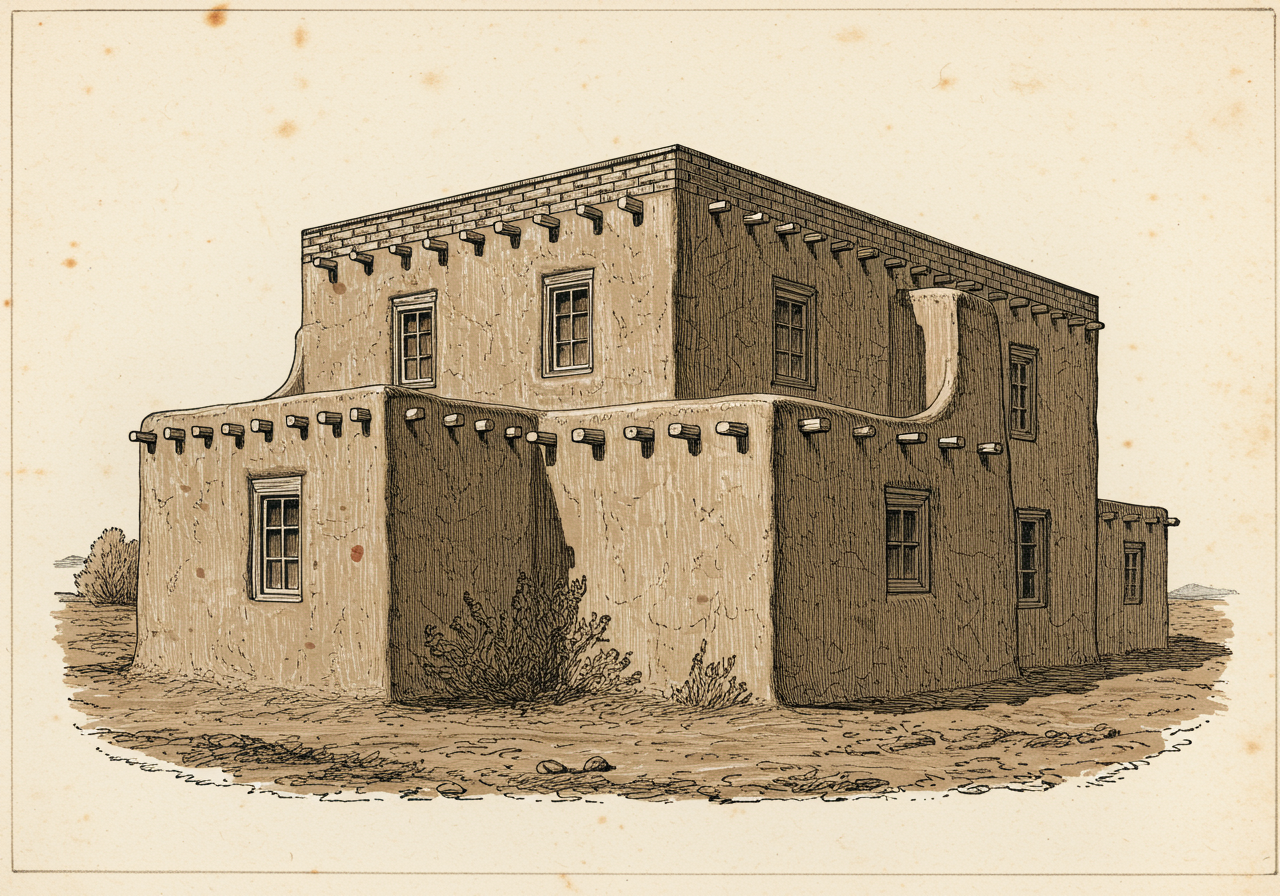
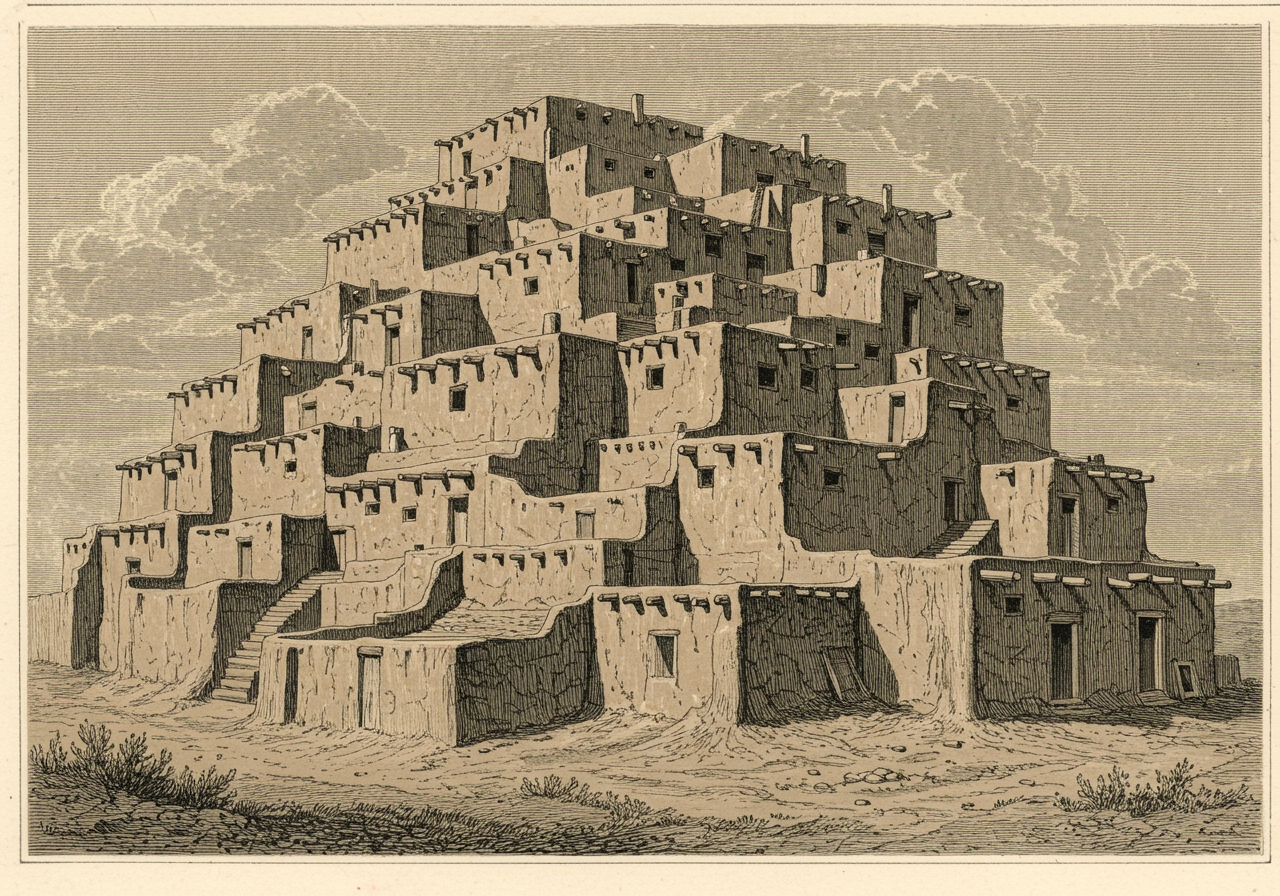
A Spanish Colonial Revival is the tiled cousin, examined six posts back. The two are genuinely close: both are stucco-walled, both are earth-related styles of the warmer American regions, both quote a Spanish colonial past, and the trade not infrequently files them together. The difference is the roof, and it is total. The Spanish Colonial Revival presents a visible, low-pitched roof of red clay barrel tile; the Pueblo Revival presents a flat roof entirely concealed behind an earthen parapet, and no tile anywhere. From there the rest follows: the Spanish Colonial Revival is smooth white stucco that makes its ornament at the entrance in carved cast stone and quotes the Mediterranean church and the Mexican hacienda; the Pueblo Revival is hand-textured earth-toned stucco, carries almost no carved ornament, makes its effect from massing, batter, and the rhythm of projecting vigas, and quotes the Native American village and the New Mexican adobe. The rule of thumb: red tile and white stucco is Spanish Colonial Revival; earthen parapet, projecting vigas, and earth-toned stucco is Pueblo Revival.
A Mission Revival is the California church style — the austere predecessor that the Spanish Colonial Revival post named as one of its siblings. Emerging in the 1890s, it takes its vocabulary from the chain of Spanish Franciscan missions of the California coast: smooth stucco, a low tile roof, and — its signature element — the curvilinear shaped parapet, the scrolled, curved gable-end that rises over the entrance of a mission church. Here the confusion with the Pueblo Revival is precise, because both styles use a parapet and both can carry a flat or near-flat roof behind it. The distinction is the parapet’s shape: the Mission Revival’s is a deliberate, curvilinear, scrolled silhouette, a quotation of a specific church gable; the Pueblo Revival’s is the opposite, a plain, rounded, softly irregular top, the natural profile of a hand-plastered earthen wall. The rule of thumb: a scrolled and curving parapet over the door, with red tile, is the Mission Revival; a plain, rounded, earth-toned parapet with projecting vigas is the Pueblo Revival.
A Territorial style house is the variant that lives nearest of all — the same flat-roofed, earthen-walled New Mexican house, but wearing Anglo clothes. It takes its name from New Mexico’s territorial period, between the American annexation of 1846 and statehood in 1912, when Anglo settlers and Anglo materials arrived in a region that had built in adobe for centuries. The Territorial house keeps the adobe form — the flat roof, the thick battered earthen wall, the low cubic massing — but applies to it Anglo-American classical details the genuine Pueblo and Hispano building never had: a parapet capped by a projecting course of fired brick, introduced when the railway made brick available, rather than finished in plain rounded mud; and window and door openings trimmed with painted wooden Greek Revival surrounds — pediments, pilasters, moulded architraves set into an earthen wall. The Territorial style is, in effect, the adobe house meeting the Greek Revival at the territorial frontier; the Pueblo Revival refuses every Anglo classical element and presents the wall plain, rounded, and untrimmed. The rule of thumb: a flat-roofed earthen house with a brick-coped parapet and white-painted classical wooden window trim is Territorial; the same house with a plain rounded mud parapet and unadorned deep-set windows is Pueblo Revival — the two ways the twentieth century chose to dress the same New Mexican adobe form, one in Anglo trim, one in deliberate primitiveness.
The original Pueblo is the genuine thing — the architecture the revival is named for and exists to imitate — and the comparison closes the circle the post opened, being the load-bearing distinction of the whole essay. The genuine Pueblo, Taos foremost among the inhabited survivors, is true coursed adobe: a structure of earth built up wet by hand, several storeys of dwellings stepped and terraced into a single communal block, its vigas carrying real roofs of packed earth, its walls re-plastered with mud every few years, its rounded and battered surfaces the inevitable consequence of the material. The Pueblo Revival reproduces every visible feature of this — the stepped massing, the projecting vigas, the flat roof, the rounded parapet, the deep-set windows, the earth-toned wall — and almost none of the substance. The revival house is, with very few exceptions, wood frame or concrete block, stuccoed to look like adobe: its battered wall a thin frame wall given a battered profile in stucco, its vigas (as the first figure observed) very often short lengths of timber set in for their shadow alone, its rounded corners shaped plaster rather than worn earth. The rule of thumb is therefore not a matter of the eye at all: a stepped, viga-pierced, flat-roofed building built of earth, re-mudded by hand, structural in every member, is a genuine pueblo; the same silhouette in frame and stucco is the Pueblo Revival — and one tells them apart not by looking but by knowing what the house is made of.
What It Was Trying to Say
What I find most telling about the Pueblo Revival is that it is, almost alone among the houses this series has treated, a style that imitates the appearance of a building without imitating the building — and that this is not, on inspection, a failing of the style so much as the entire point of it.
The first thing the Pueblo Revival was saying it said by its choice of antecedent. Every revival in this series has gone looking for a past to borrow: the Colonial Revival borrowed the Federal, the Tudor Revival borrowed the English manor, the Spanish Colonial Revival borrowed the mission and the hacienda. The Pueblo Revival borrowed the oldest and most local past available anywhere in the country — the thousand-year Puebloan village and the three-century Hispano adobe, an architecture indigenous to the exact ground the revival house stood on. In this it exceeds even the Spanish Colonial Revival’s regional honesty: that style quoted a past that had really happened in California, but the Pueblo Revival quoted a past that was, in the Pueblo villages, still happening — Taos was and is inhabited, its architecture a living practice and not a ruin. The revival built, in frame and stucco, a romantic portrait of its neighbours’ houses.
The second thing the Pueblo Revival was saying is bound up in the Santa Fe ordinance, and it is the strangest civic fact in this series. Santa Fe’s boosters understood, with a clarity that is faintly unsettling once one sees it plainly, that a city’s appearance was an economic asset — that a town which looked uniformly old would draw the traveller and the dollar in a way that a town which merely was old would not. So they legislated the appearance. The Pueblo Revival, in Santa Fe, is not the free choice of a thousand owners arriving independently at the same taste, as the Federal was; it is a municipal policy, applied to filling stations and bank branches and supermarkets alike. The style was saying, through the ordinance, that authenticity could be manufactured and then required — and the uncomfortable truth the visitor must sit with is that the manufactured thing is, by now, genuinely beloved, a century of enforcement having produced real coherence out of a frankly commercial decision. The Pueblo Revival is the proof that a romantic image, mandated long enough, becomes a real place.
The third thing the Pueblo Revival was saying is the one that returns the post to the distinction it was built to resolve. The Pueblo Revival house is a frame building wearing the costume of an earthen one — its vigas carrying nothing, its thick walls thin, its rounded corners shaped by a plasterer in an afternoon rather than by a hundred years of weather. One could call this dishonest, and the stricter sort of critic has. But the style never pretended, to anyone who knew how to look, to be the thing itself — it offered, openly, an image of the Southwest’s earthen architecture, romantic and consciously antique, to owners who wanted their houses to belong to a place and a deep past that their own arrival there did not give them. That is what a revival is. The Federal’s later imitators did the same with the fanlight, the Tudor’s with the half-timber; the Pueblo Revival simply did it with a more dramatic gap between image and substance, because the substance it imitated — earth, laid up wet, re-mudded by hand — was the one building material the twentieth century was least willing to actually live in. And so the series, having reached the Southwest, finds its clearest case of the thing every revival in it has quietly been: not a building, but a picture of a building, made convincing enough that the people inside it could believe, on a tan and sunlit afternoon, that they had always been there.
The next specimen I should like to take up returns the series from the Southwest to the older eastern argument the Federal post reopened — the Dutch Colonial, the gambrel-roofed farmhouse of the Hudson valley and the Jersey shore, the colonial form the Federal never displaced. It is the second of the two debts the Federal post left standing.