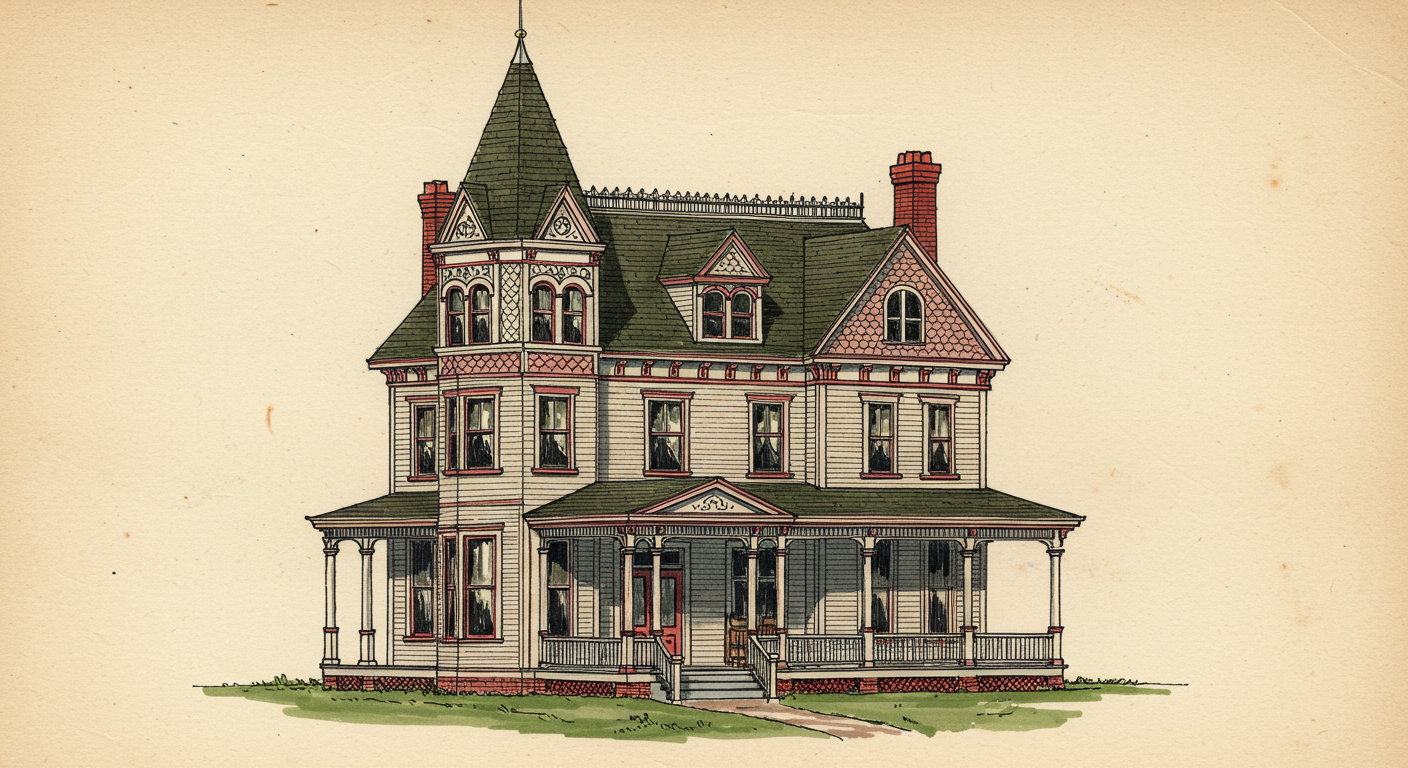
A few weeks ago I found myself walking a residential block in a town I was passing through — one of those New England riverside towns where the 1880s left the main street alone and then, a few blocks back from it, put up houses that are still there — and I stopped in front of one and admitted that I could not have told anyone, with any precision, what I was looking at.
It was plainly a Victorian. It had a corner tower. It had, on closer inspection, three different wall textures on a single elevation — clapboard on the lower storey, shingles in a fish-scale pattern above, and a panel of sawn woodwork at the gable peak — and it had a veranda that ran around two sides of the ground floor and terminated in a small open gazebo. The roof was steeply pitched and carried a dominant gable facing the street. The colour scheme was three colours, of which two were unflattering. That was all I could say. “Victorian” is a dodge of a word that spans sixty years and at least six distinct architectural styles, and I had been using it, I realised with some small shame, in exactly the way a New Englander uses “sugaring” — to mean whatever is near at hand.
This was a Queen Anne. I had stood in front of dozens of them in my life and had never once named one, and I thought it worth taking the time to learn. What follows is the first in a series that intends to do, for American houses, what I should have been doing the whole while: read them.
The Misnomer
The first thing worth noting about the Queen Anne is that almost nothing in its name is true.
Queen Anne — the historical Queen Anne, the last Stuart, who reigned from 1702 to 1714 — presided over an architecture of her own that is, to the modern eye, almost painfully restrained. Georgian in its symmetry, brick in its material, sash-windowed, pedimented, strongly indebted to Wren. One can still walk past Queen Anne houses in English market towns and recognise them: flat-fronted, sober, about as different from an American Queen Anne as two buildings that share a name can contrive to be.
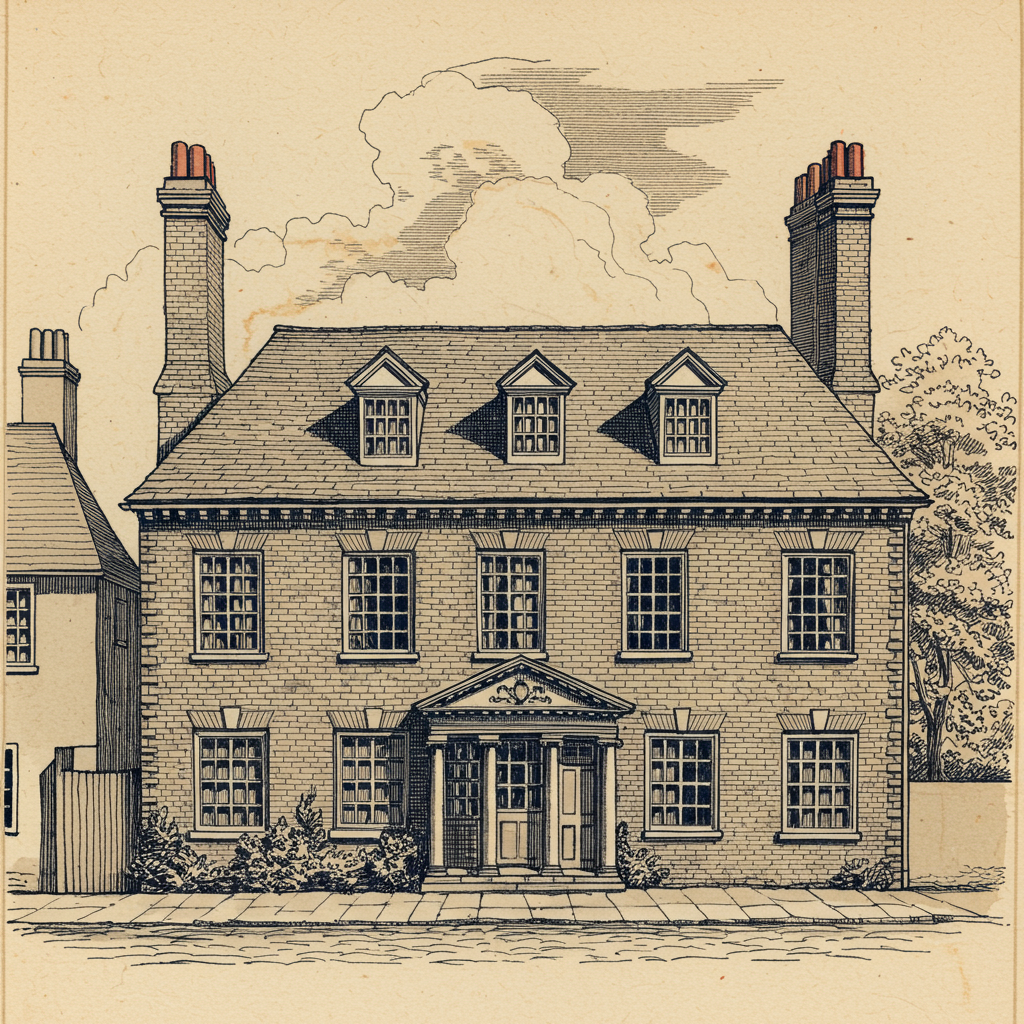
An English Queen Anne house, c. 1710 — flat-fronted, brick, restrained. Almost nothing in common with the American style of the same name.
The name as we use it is a gift of the English architect Richard Norman Shaw, who in the 1860s and 1870s revived the earlier — that is, the Elizabethan and Jacobean — tradition of half-timbering, irregular rooflines, and picturesque asymmetry, and had the poor publicity-sense to file it under the name of a monarch who had nothing to do with the work. His Bedford Park development in west London was the first real specimen of what he was doing, and by the time the catalogue had crossed the Atlantic, American carpenters had taken what they liked from it and put aside what they did not. The Americans kept the irregular rooflines, the ornamental woodwork, the mixing of wall textures, and the tower. They dropped the half-timbering in most cases — the climate and the labour supply preferred painted wood. The style was briefly called “Free Classic” or “Modern Gothic” in the trade journals of the 1880s; “Queen Anne” was the one that stuck, and it has been stuck ever since.
One is obliged to concede that this is the sort of thing that happens to architectural styles more often than not. They are named in a hurry, by the wrong people, after the wrong century.
The Specimen
If one is to identify a Queen Anne — and the great pleasure of beginning to read a style is that, very shortly, one can identify one at a glance — the best exercise is to walk around a specimen and assemble, out of its features, the evidence of its kind.
Begin at the roof. A Queen Anne roof is steeply pitched, complicated, and deliberately asymmetrical. A dominant front-facing gable lands over the façade — not centred, as a Georgian would have demanded, but offset — and crosses with other gables and dormers in a way that refuses any single reading of the silhouette. Somewhere on the corner, very often, sits a round or polygonal tower, capped by a conical or witch’s-hat roof. The tower is the giveaway, though it is not mandatory; roughly half the Queen Annes I have learned to recognise lack one altogether.
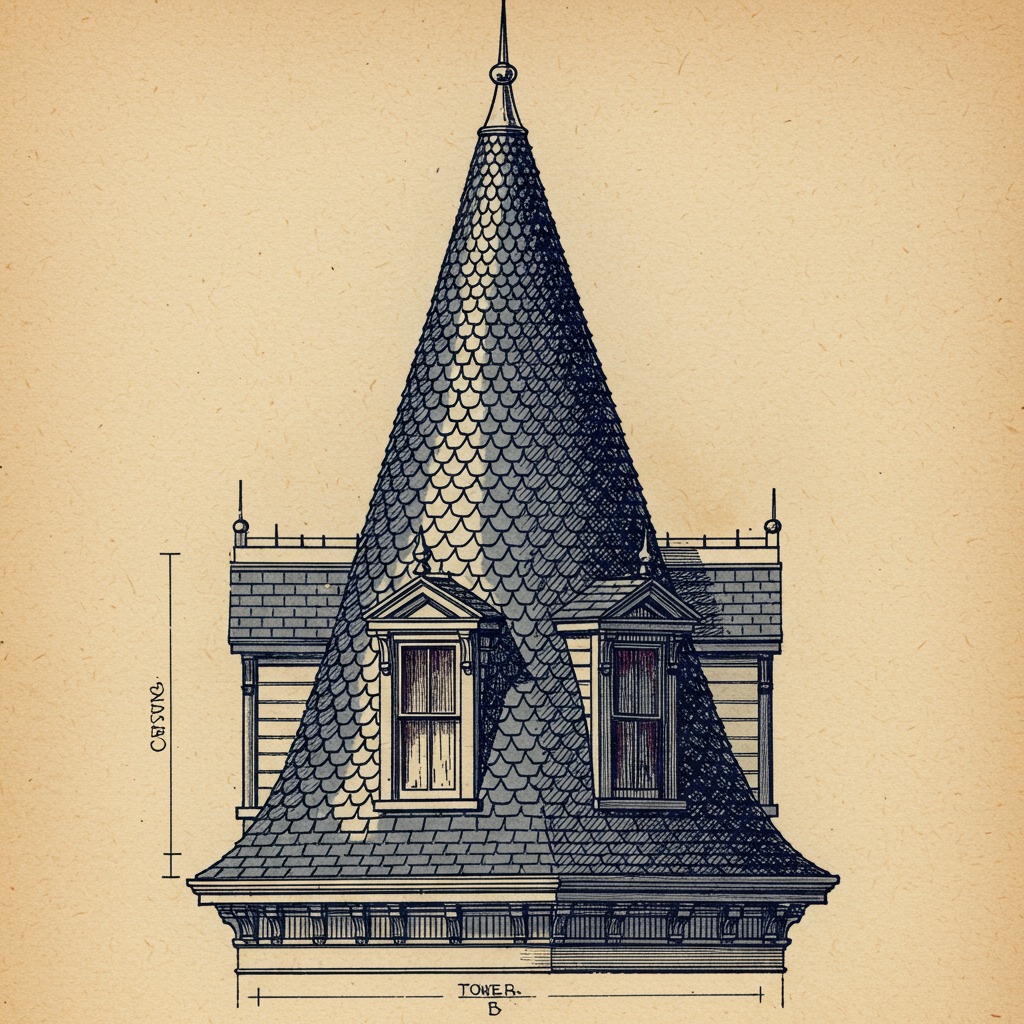
The tower — a corner volume crowned by a conical witch’s-hat roof. The most legible identifying feature, though not mandatory; perhaps half of Queen Annes lack one.
Come down to the walls. One will find more than one material. The canonical Queen Anne uses three wall textures on a single elevation: clapboard on the first storey, shingles — often in fish-scale or imbricated patterns — on the second, and a carved or sawn panel at the gable peak. The intent is a studied textural busyness, the building refusing the austerity of a single surface. Some examples swap brick for clapboard below, and the very grandest throw masonry, shingle, and half-timbering at the same elevation and trust the viewer to forgive them.
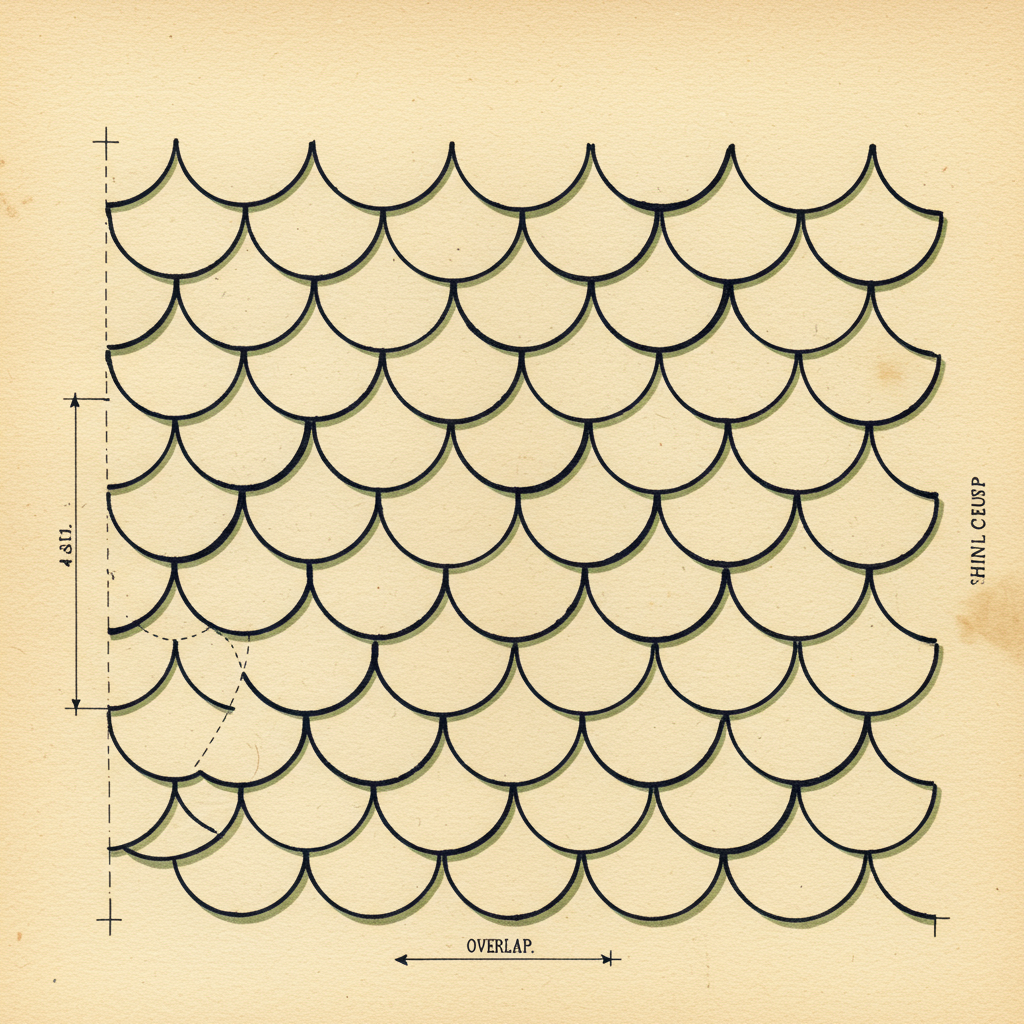
Patterned shingle on the upper storey. The wall material that does most of the work of identifying a Queen Anne — used on upper storeys and gable panels in patterned rows.
The porch is the other giveaway. A proper Queen Anne has a veranda — not a portico, not a stoop, but a veranda that runs along the front, wraps around at least one corner, and is supported by turned spindle columns linked by sawn balustrades and, above, by a frieze of pierced woodwork called spindlework. This last is the detail most responsible for the style’s reputation as fussy. It is fussy. The fussiness is the point.
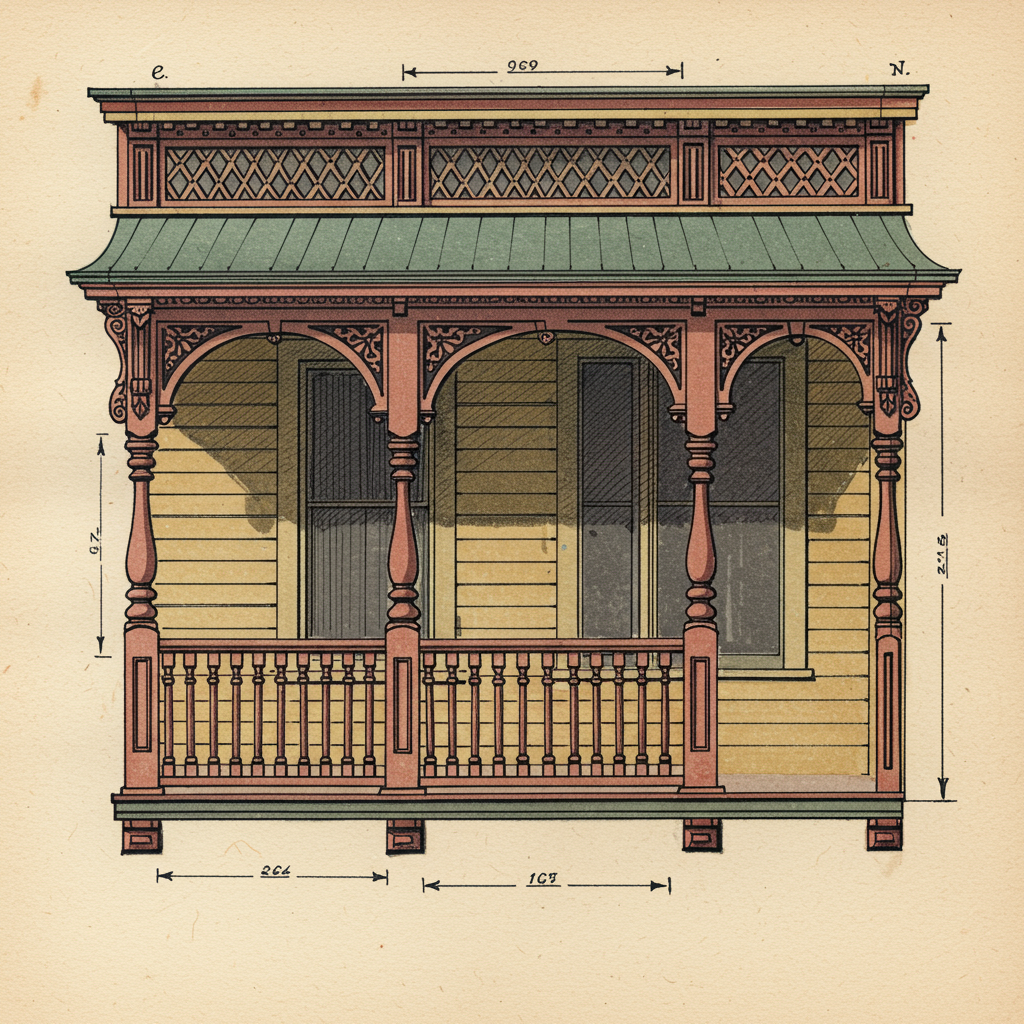
Spindlework — turned columns, sawn balustrade, and a frieze of pierced woodwork above. The detail responsible for the style’s reputation as fussy, the fussiness being the point.
Two details round out the specimen. The windows are generally sash, often tall and narrow, and very often one of them — most commonly the front parlour — is a bay that projects from the façade and carries a roof of its own. And the chimneys, if the house was built with any seriousness, are tall and corbelled, their brick stepped outward in decorative courses near the top. A Queen Anne chimney does not apologise for itself.
Assemble these — the complicated roof, the tower (perhaps), the textured walls, the wrapping veranda with its spindlework, the bay and the chimney — and one has a Queen Anne. One also has, one begins to suspect, a building that cost more than the next house over. This was not, on the whole, a cheap style.
The Machine Behind the Ornament
That the Queen Anne is a fussy, heavily decorated style looks at first like a personal extravagance on the part of its clients. It was not. It was, more honestly, what the American lumber industry of the 1880s could produce cheaply and what the railroads could distribute to any town with a siding.
The Queen Anne rose on the back of the scroll saw. Steam-powered scroll saws, perfected in the middle of the century, could cut wooden ornament in quantity and to a uniform standard that the jobbing carpenter with a hand plane could not. A small mill in a railroad town could produce turned porch spindles by the gross, sawn balustrade panels by the running foot, and fish-scale shingles by the bundle — and, the railroad being what it was, the lumberyard in a town in central Ohio carried the same catalogue as the one in Maine.
The pattern books followed at once. George Palliser, Robert Shoppell, the brothers Bicknell — the pattern-book architects of the 1870s and 1880s worked out designs that a small-town carpenter could build without an architect, specified in part numbers from the mill catalogues, and sold the plates for a few dollars a piece. One could build a Queen Anne, in the 1880s, out of a book and a lumber delivery. The ornament was not bespoke; it was stock. This is the honest answer to why Queen Annes in Michigan look uncannily like Queen Annes in Massachusetts — they are very often the same plate, built out of the same mill’s catalogue, in the same five years.
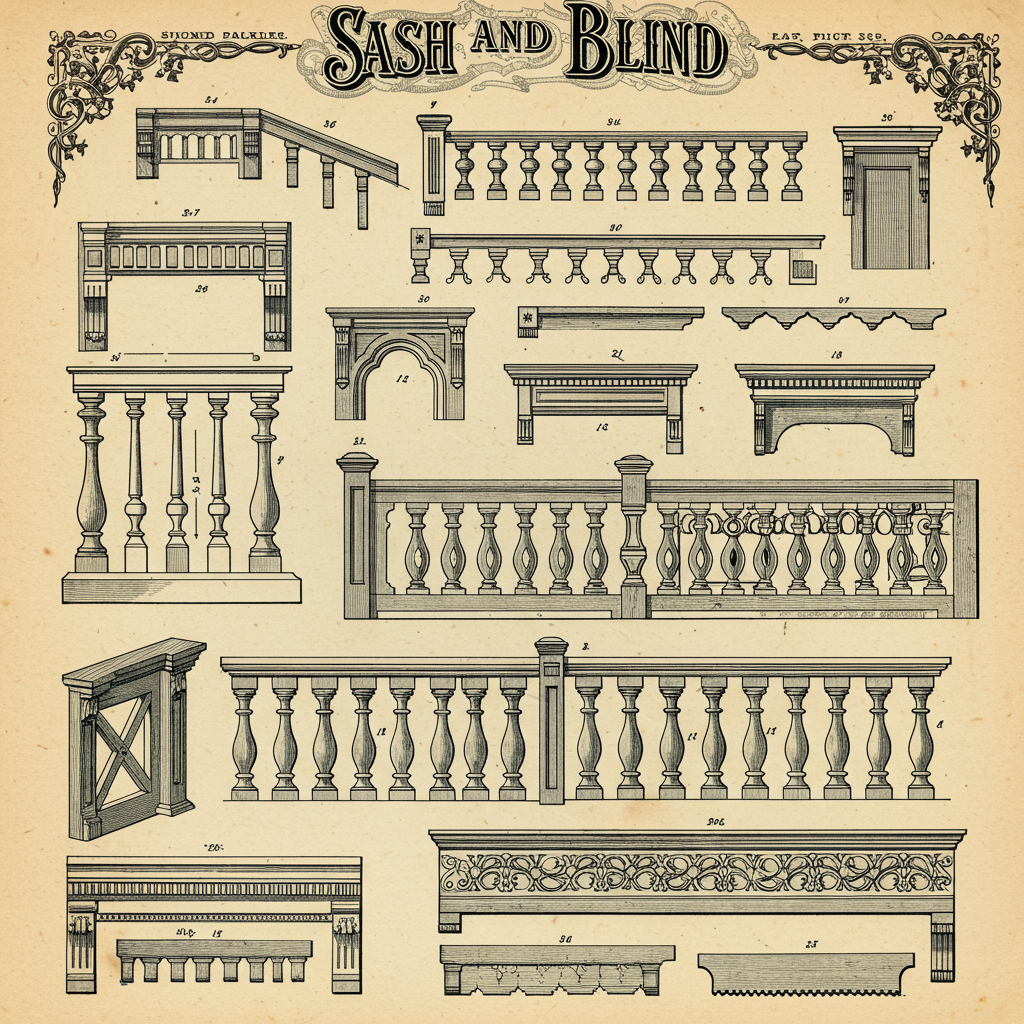
An imagined sash-and-blind catalogue page, c. 1885. The ornament was not bespoke; it was stock. The mill in central Ohio carried the same parts as the mill in Maine.
It was, in its way, the country’s first mass-produced middle-class house. The style it produced reads as picturesque, but its economics were squarely industrial. I find myself unable to hold this against it; an industrial house is still a house, and the country turned a great many of them out.
What It Is Not
Four styles stand near enough to the Queen Anne that the beginner confuses them with it, and distinguishing the four is most of the work of reading an American house.
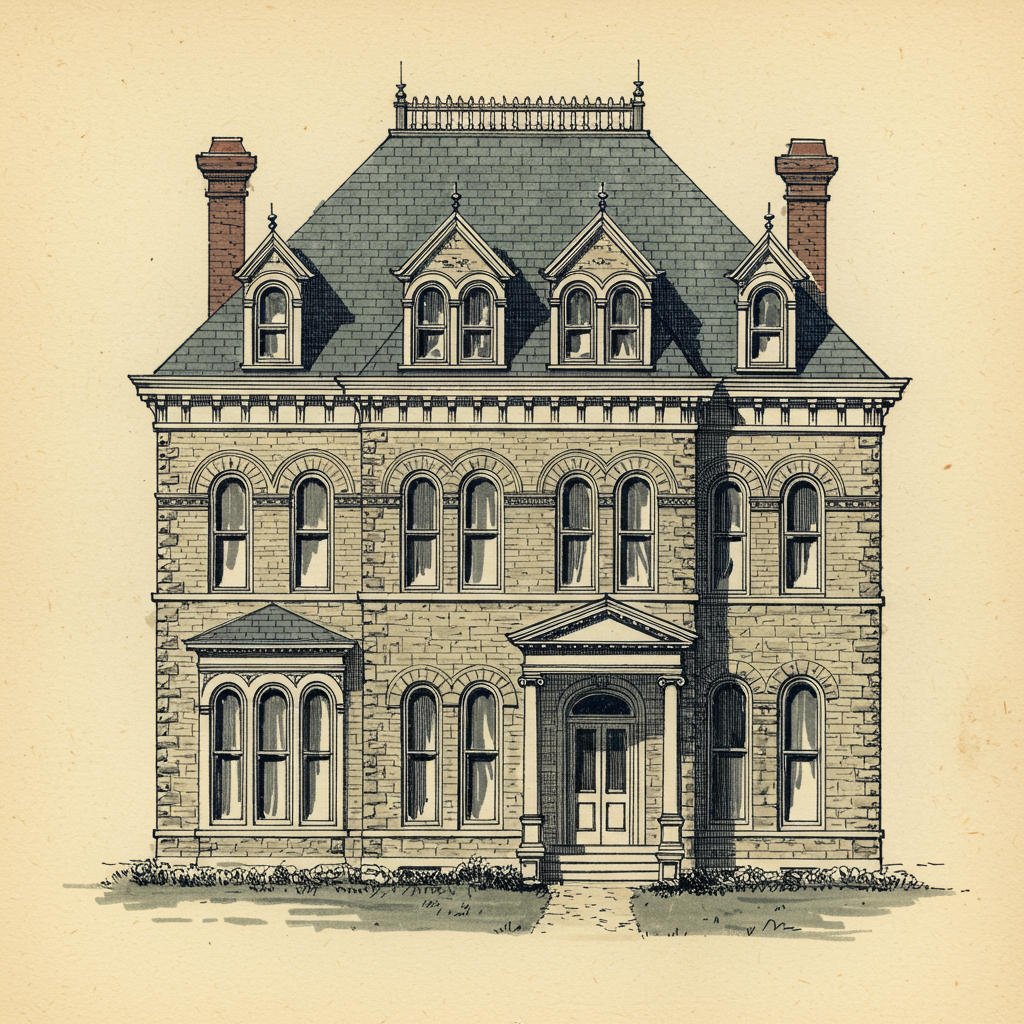
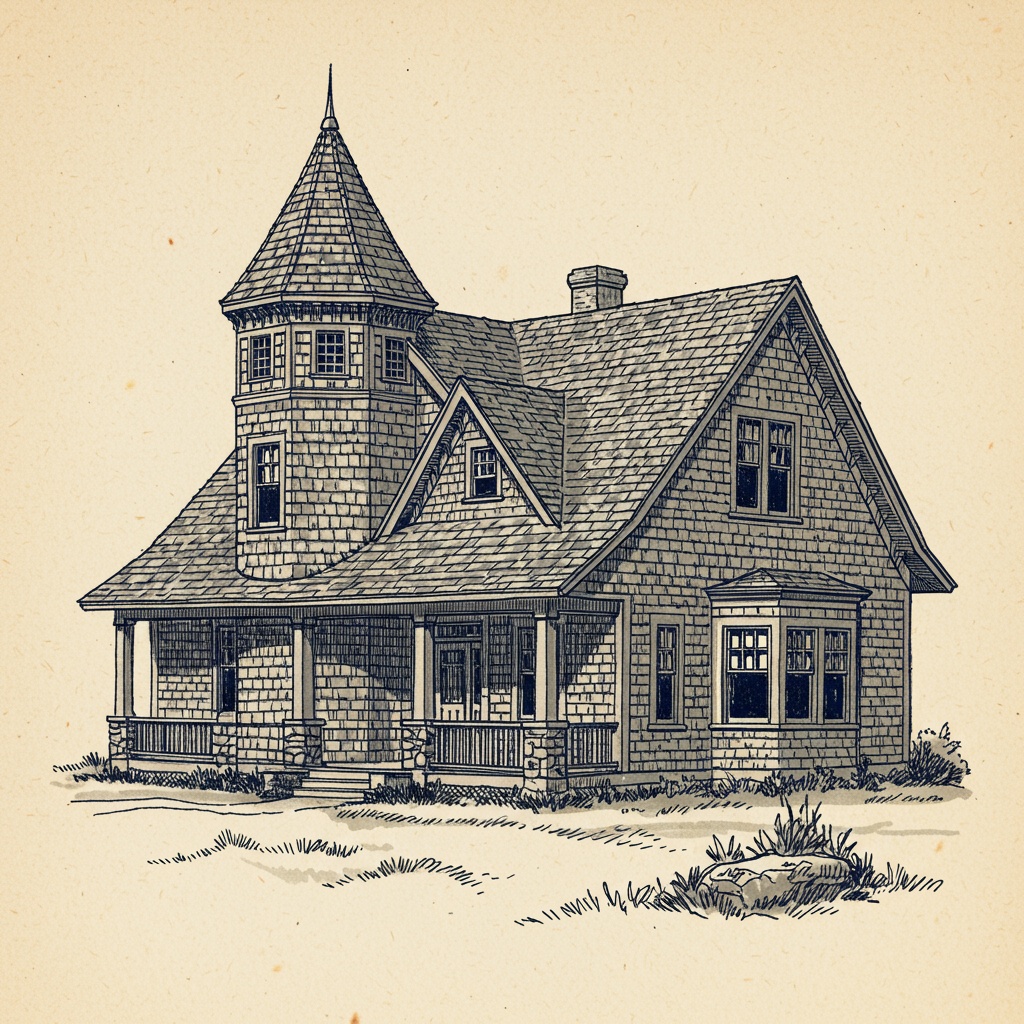
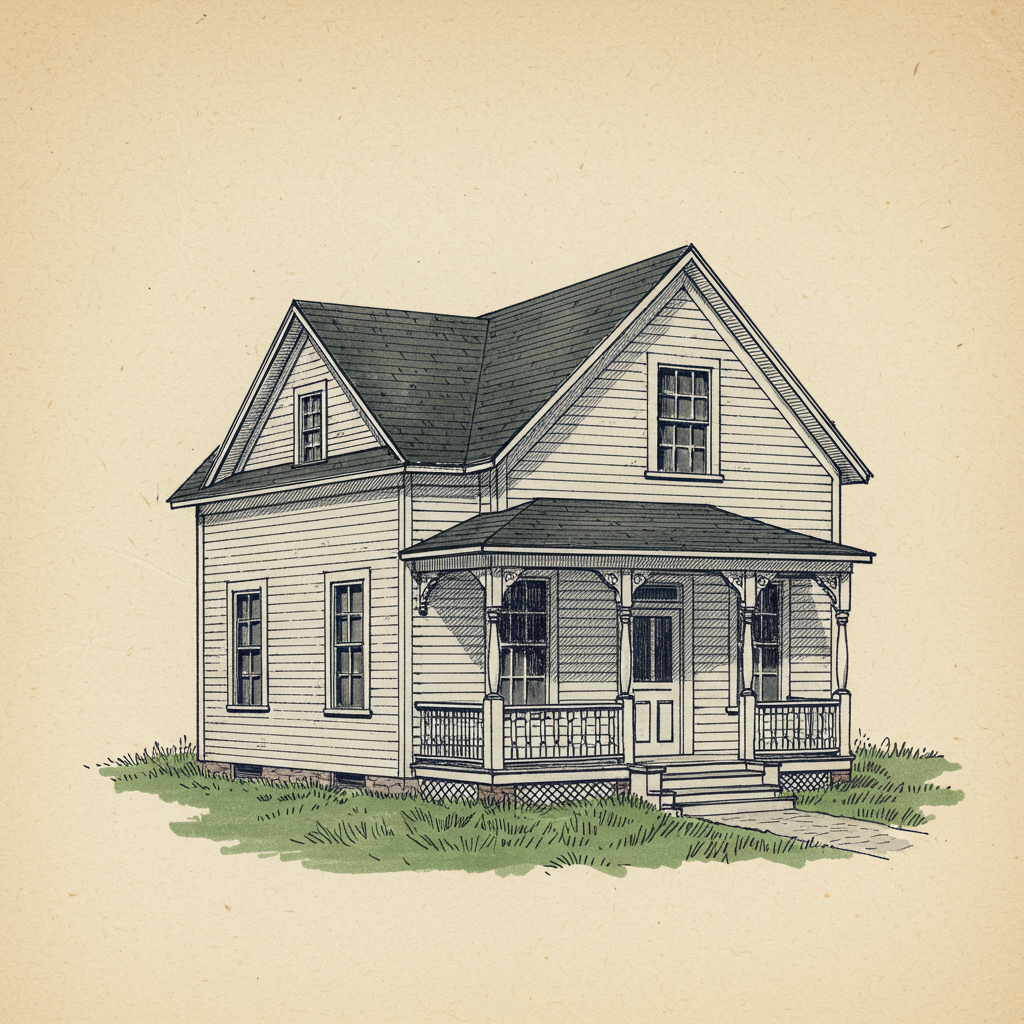
The Second Empire — earlier than the Queen Anne, roughly 1860 to 1880 — is the one with the mansard roof: that slope-shouldered double-pitched roof that originated in Paris and was pressed into service in America chiefly for the purpose of getting a usable attic storey under a tax code that counted storeys by roof slope. Mansard means Second Empire. A Queen Anne with a mansard roof is a Queen Anne with the wrong roof, and it does not exist.
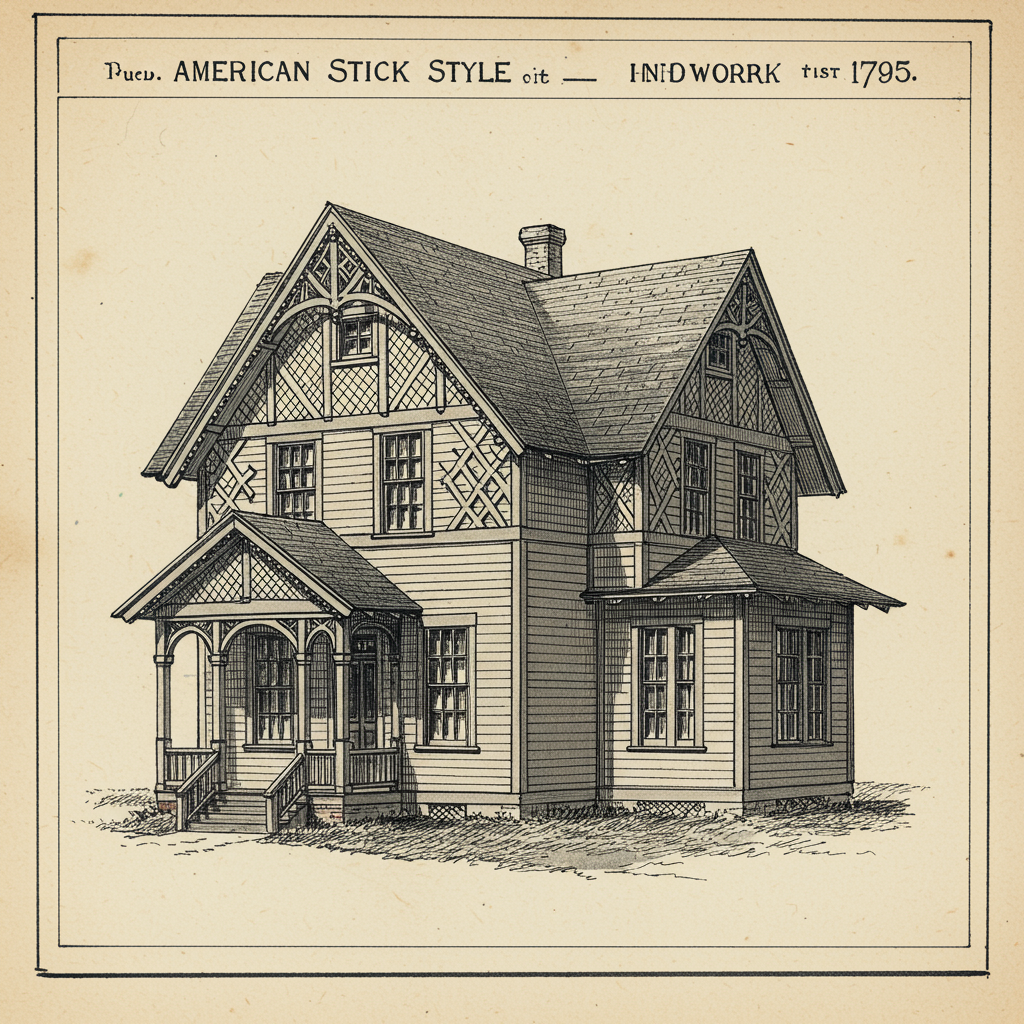
The Stick style — contemporaneous with the early Queen Anne, overlapping it — keeps the steep roof and the textured walls but expresses the frame of the house rather than its surface. Boards applied vertically, horizontally, and diagonally on the exterior mimic the wall’s internal framing. A Stick house looks like a Queen Anne that has forgotten its ornament and remembered its bones; it is usually plainer and usually earlier.
The Shingle style is the Queen Anne’s contemporary, and the one the taste-making architects of the 1880s preferred when a client would let them. It retains the irregular silhouette but abandons the textural mixing: the whole exterior, from foundation water-table to gable peak, is wrapped in a continuous skin of wooden shingles. No clapboard, no spindlework, no polychrome paint. A Shingle is what a Queen Anne aspires to become once it has been told, quietly, to settle down.
The Folk Victorian is the Queen Anne’s poorer cousin: a plain farmhouse or small-town house, not designed to any style in particular, to which the owner has attached porch spindles and perhaps some scrollwork bought out of the same mill catalogues as the real Queen Annes were built from. Strip the ornament and one has an I-house or a side-gabled vernacular. The difference between a Folk Victorian and a Queen Anne is, in the end, about three hundred board-feet of lumber and a second storey of fish-scale shingle.
What It Was Trying to Say
Every architectural style that becomes a fashion expresses something about the moment it flourished in, and the Queen Anne is not an exception.
The America of the 1880s had, for the first time in a generation, a solid and growing professional middle class. The industrial North had survived the Civil War and was growing rich on its machinery; the railroads were a decade out from having linked the continent; the country’s towns were expanding on the backs of their small factories and department stores and, crucially, were filling with families who wanted a house that would announce that the household had money without being quite rich enough for the architect-designed Italianate or the French mansion on the heights. The Queen Anne, with its book-plate designs and mill-produced ornament, was the house one built when one had succeeded modestly and wished this to be visible.
The asymmetry, in particular, reads to me as a period argument. The Federal and Greek Revival houses that preceded the Queen Anne had been exercises in classical symmetry: a centred door, a central gable, window-bays balanced to either side. The Queen Anne refused the whole geometry, and did so cheerfully. The tower is off-centre. The porch wraps one corner and not the other. The roof slope on one side is not the roof slope on the other. One reads, in this, a middle class that was willing to be itself — to put the tower where it wanted one, rather than where classical precedent permitted one — and was willing, for the first time in American domestic architecture, to make the outside of the house follow the preferences of the inside.
Whether one calls this vulgar or liberating is, one supposes, a question of temperament. I notice that I find it liberating.
The next specimen I should like to take up is the Greek Revival — the style the Queen Anne was, in its cheerful asymmetry, refusing.