There is in the connoisseur’s habit of mind a quiet expectation that any object of sufficient age, well-made, will on inspection prove to have a story attached to it — and that the story can, with patience, be read off the object itself. The wear pattern under a chair leg is evidence; the knot count on a square inch of rug is evidence; the joinery at the back of a drawer is evidence; the way a piece of inlay has shrunk over a century-and-a-half of household weather is evidence. None of this is hidden. It is merely waiting for someone willing to slow down sufficiently to look.
This is the opening note of a new series on the blog, in the spirit of the architecture series that has by now run to a dozen posts. The premise is precisely the same as that one and applied to a different class of object. Houses can be read; so can rugs; so can the cabinets and tables and chests of period furniture, of every national tradition and every century back as far as the documentary record reasonably stretches. The reading is a teachable skill. Most of it consists of knowing what categories of evidence to attend to and what categories one can safely ignore, and the great majority of an apparently mysterious piece — the unsigned chair, the unattributed rug — gives up the better part of its provenance to ten or fifteen minutes of careful looking, once one has the trained eye.
Two Arcs
The series has been laid out in two parallel arcs which will run, without any particular pretence to a single cadence, alongside one another for as long as the subject continues to repay attention.
The first is Reading the Antique Rug. The arc takes one regional weaving tradition per post — Heriz from the slope above Tabriz, Tabriz itself, Kashan, Bidjar, Hamadan, Kazak from the Caucasus highlands, the Tekke and Salor and Yomut weavings of the Turkmen, the Hereke court rugs of late Ottoman Turkey, the Oushak villages of western Anatolia, the Mughal-influenced workshops of Agra and Amritsar, and so on through the body of weaving traditions that the European and American collecting market has paid serious attention to over the past century and a half. Each post gives the regional context, the structural and material signatures by which the type is identified, the design vocabulary peculiar to it, and the trajectory of its market reception over the period in which it has been collected. A Heriz is not a Tabriz. A Tekke is not a Salor, though to an unfamiliar eye both will look like what one might lazily call “a Bukhara.” The arc is in part a corrective to that lazy looking.
The second is Reading the Period Cabinet. This arc takes one national furniture tradition at one well-defined period per post — French Louis XIV through Empire, the run of English styles from Jacobean through Chippendale and Sheraton and Hepplewhite into Regency, the Italian Renaissance and Baroque and the long slow Italian Rococo, German Biedermeier in its short and remarkable mid-century run, the Spanish baroque and the Mudejar before it, the Dutch marquetry tradition, the Scandinavian Gustavian and its quiet proto-modernism, the American colonial through Federal through Empire and on into Eastlake and Mission. Each post takes the tradition on its own terms — the construction methods, the wood and the hardware, the vocabulary of ornament, the social function of the principal forms, the changes that were quietly happening underneath the more visible stylistic changes. Furniture is, more than any other class of antique, an index of the society that produced it; one sees in any cabinet or commode of any period the kind of household it was built to live in, and a great deal else besides.
The Method
Each post in either arc will follow approximately the same shape, which is the shape that has worked for the architecture series and which one knows by now to trust.
It will begin with the specimen — a particular rug, a particular form of cabinet — and walk the reader through what one looks at first, what one looks at second, and what features are decisive between this type and the half-dozen other types it most resembles. It will set out the structural and material evidence: in rugs, the warp and weft and pile and dye; in furniture, the wood and the joinery and the hardware and the finish. It will give the regional or workshop context — where the type was made, who made it, who used it, who later collected it. It will show siblings — the nearest neighbour types, with which it is most often confused — and antecedents, the older traditions out of which it grew. And it will close with the kind of practical attention that is the principal reason one bothers learning any of this in the first place: how to know, when one is looking at a particular example, what one is looking at.
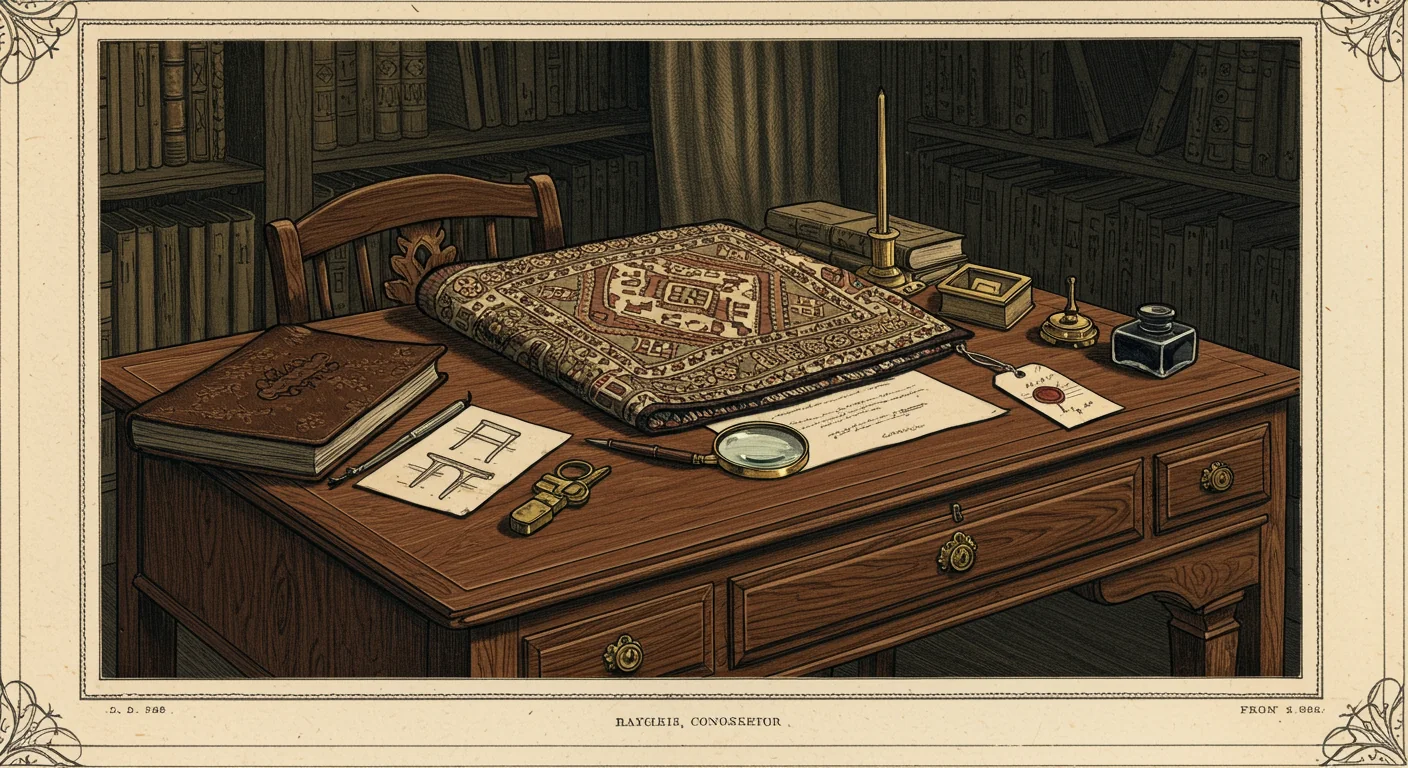
Each post will carry its own plate in the series visual idiom. The rug plates will be set out as if from a Victorian connoisseur’s portfolio of weaving studies; the furniture plates as if from a nineteenth-century cabinet-maker’s pattern book. The aesthetic stays as it has been — copperplate engraving on parchment, restrained Edwardian register, a single warm accent — and the cartouche on each plate will signal which arc the post belongs to. Each post will also, where the type repays it, carry the smaller secondary plates on which the architecture posts have settled: an antecedent, three details, a workshop or pattern-book page, four siblings — adapted in each case to what the subject actually demands.
What to Expect
The series will run on no particular cadence. Some weeks will produce a rug post; some will produce a furniture post; some will produce both; some will produce neither. The arcs are independent. There is no plan to interleave them by any rule, and no commitment to publish in any fixed order within either.
The first per-subject post of either arc will arrive shortly. It is likely to be a rug — Heriz, almost certainly, because Heriz is the type that most rewards an opening post and the type whose place in the wider weaving tradition makes it the cleanest first specimen for an arc that will eventually want to discuss the others by reference to it. But this is not a strict commitment.
A general note, for any reader who is accustomed to the architecture series and is wondering what the difference is. Houses are easy to write about because one can see the whole of them from across the street, and the great American house types of the past century and a half have been documented in a body of pattern books, magazines, and architectural surveys deep enough that the bibliography for any given style is available within a few hours’ library work. Rugs and period furniture are different. Each requires that one learn what to look at — the diagonal of a Heriz medallion, the carve of a Chippendale ball-and-claw foot, the camelback of a Hepplewhite shield-back chair, the silver-blue field of a Salor engsi. A great deal of the satisfaction of antiques is in the slow process of acquiring those specific looks. The series is, in a sense, an offered apprenticeship.
That, in any case, is the standing invitation. The first specimen post is in preparation, and will arrive when it is ready.