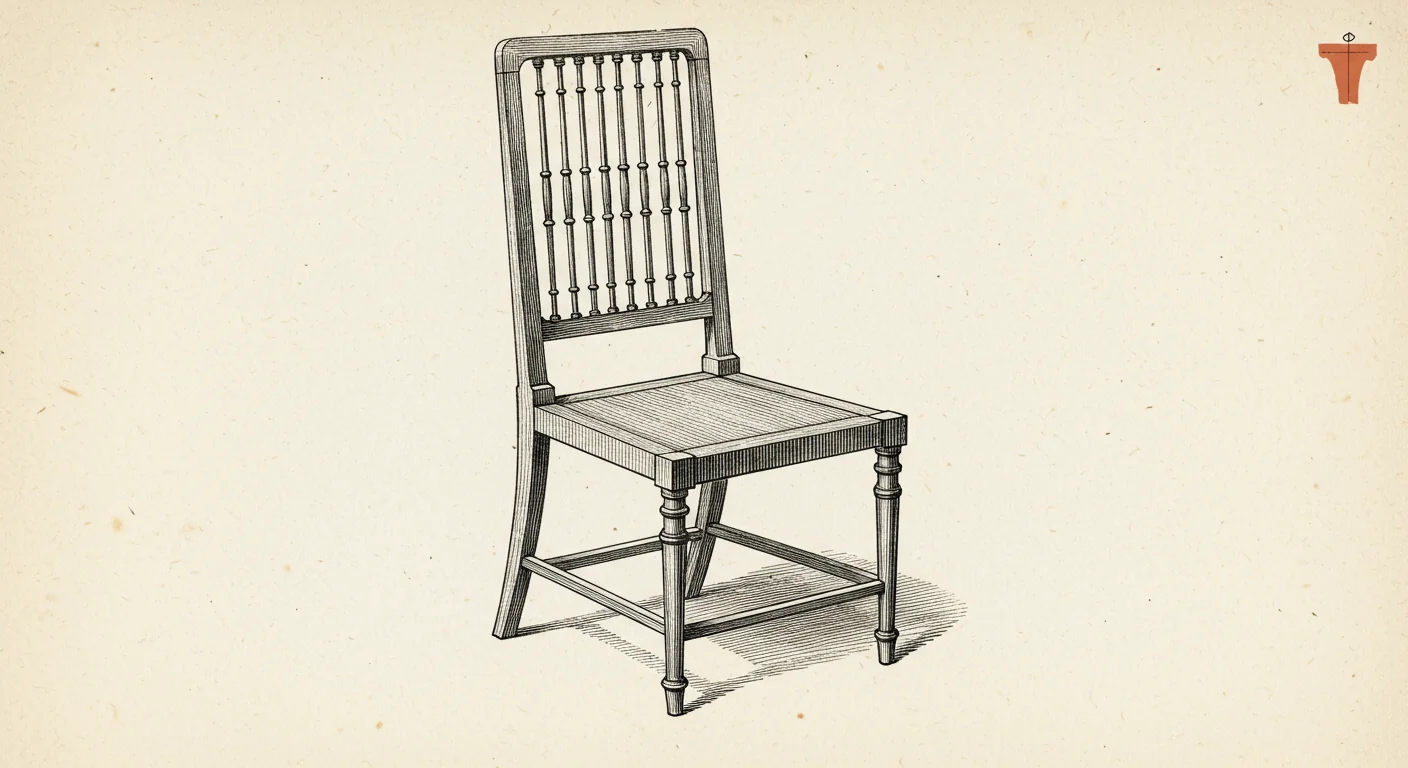
The eighth post in this arc treated George Hepplewhite, and closed by promising one of two continuations: a return to the English neoclassical line in its slightly later register, or an extension of the same vocabulary into the post-colonial American workshops. This is the first of those. It treats Thomas Sheraton as the immediate succession to Hepplewhite — the late-eighteenth-century English neoclassical refinement that pushed the cabinet tradition to its most slender and most rectilinear extreme before the heavier Regency took over after 1800. As with the two Italian posts and with Hepplewhite before it, this is a taxonomy post: a description of a type and the evidence by which one reads it, not a personal narrative. Sheraton’s Cabinet-Maker and Upholsterer’s Drawing-Book, issued in parts from 1791 and complete by 1794, is the documentary source.
There is a difficulty in the word Sheraton that this post will return to repeatedly, and it is the same difficulty the Hepplewhite post made its load-bearing fact — sharpened, if anything, to a finer point. The style is named for a man about whom a great deal more is known than was known of Hepplewhite, and yet it is defined no less completely by a book. Thomas Sheraton was a designer and a drawing master; whether he ever ran a cabinet-making workshop at all is doubtful, and — with a single, much-disputed exception, a glass-fronted bookcase stamped “T.S.” inside a drawer — not one piece of furniture has ever been securely traced to his hand. “Sheraton furniture” therefore does not mean, and cannot mean, furniture made by Sheraton. It means furniture worked in the manner of the Drawing-Book. One should hold that fact from the first page — and hold beside it the second fact this post exists to establish, which is the boundary between Sheraton and Hepplewhite: where Hepplewhite curves, Sheraton squares.
The Specimen
The canonical Sheraton piece, for the purpose of beginning to read the style, is the rectangular-back side chair — canonical because it concentrates the whole vocabulary into a single object the eye can take in at once, and because it states the one distinction from which every other distinction in this post descends. The Hepplewhite chair back is a closed curvilinear sweep: the shield, the oval, the heart, its outline a continuous curve. The Sheraton chair back is a rectangle — a square or oblong frame, top rail and stiles straight, the corners turning a clean architectural angle rather than a curve. Within that frame the workshop set ornament that is itself rectilinear: slender vertical splats rising from a cross-rail, a single carved or inlaid panel set in the top rail, a lattice or a row of colonnettes, the whole arrangement organised on uprights and horizontals rather than on a sweeping outline. The chair stands on straight legs of marked slenderness, frequently turned on the lathe and reeded — round in section, the surface cut with fine parallel flutes — and finishing in a small tapered or arrow foot. Where a Sheraton leg is square in section it is squarer and more attenuated than the Hepplewhite member, but it is the turned-and-reeded leg that the Drawing-Book prefers. The frame is pale, satinwood very often, light enough that the chair can be lifted with one hand.
This is the chair. But the Drawing-Book drew a great deal more, and the second thing the Sheraton manner is known for is mechanical ingenuity — furniture that does more than one thing, or does its one thing by some contrived and pleasing means. The Pembroke table with its hinged flaps; the dressing table whose top lifts to disclose a mirror and a fitted interior of small drawers; the cylinder-front secretary whose curved tambour rolls back to open the writing surface; the harlequin table, the converting bed, the library steps that fold into a stool — the Drawing-Book and the later Cabinet Dictionary are full of such “patent” and dual-purpose pieces, and a taste for them is as much a part of the Sheraton signature as the rectangular chair back. The rectangular-back chair and the ingenious mechanical case-piece between them set out the entire Sheraton manner; the rest of the Drawing-Book carries that manner across the remaining furniture of the house.
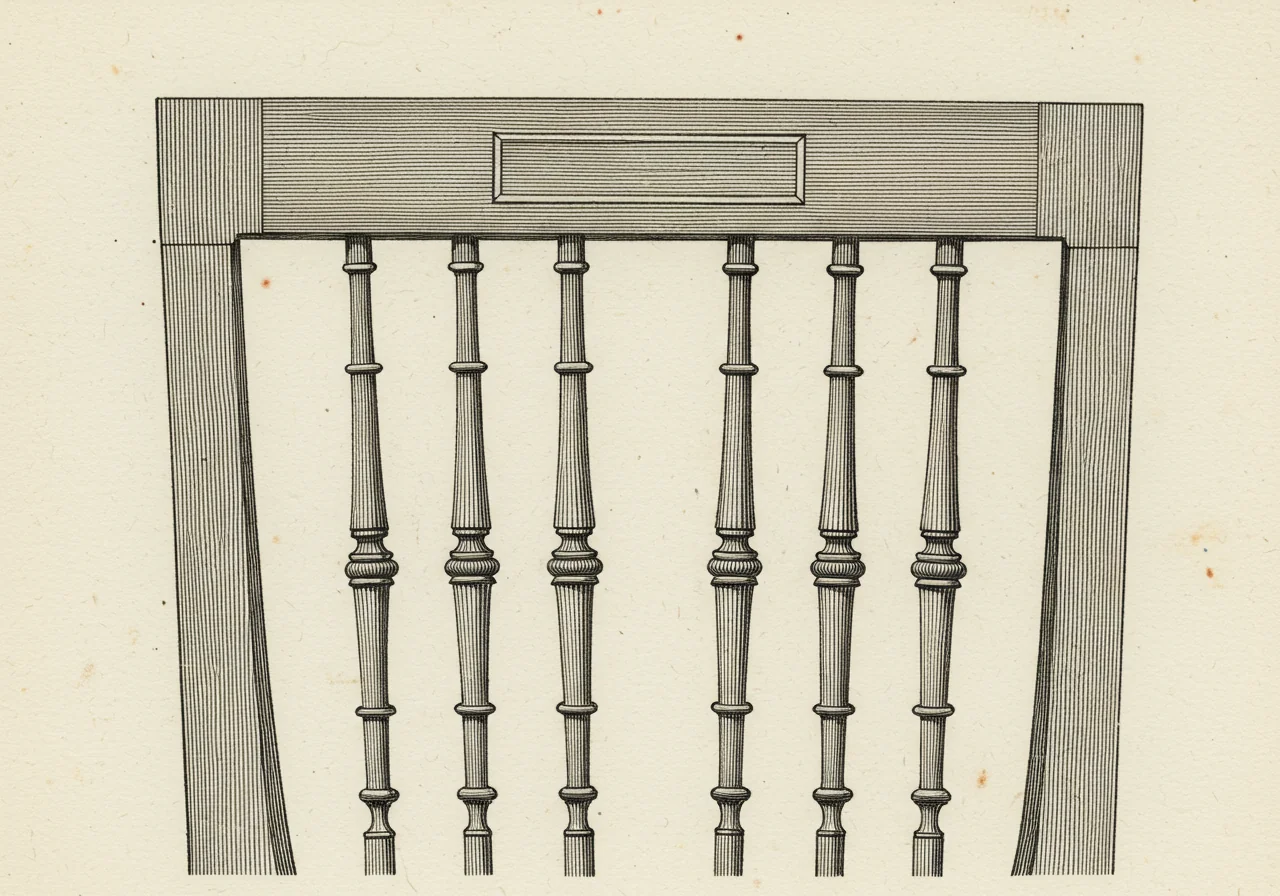
A close detail of a Sheraton rectangular-back chair — the slender vertical splats and the satinwood-and-ebony inlay top-rail. The rectangular form distinguishes Sheraton from the Hepplewhite shield-back at first glance.
The Evidence
The wood, first, because the wood is most of what one is reading for, and here the Sheraton tradition stands very close to the Hepplewhite one. Both worked in satinwood — the pale golden-yellow timber, hard and close-grained, capable of a high lustrous polish — and where a piece is not satinwood throughout it is very often a mahogany ground crossbanded and strung in satinwood and other pale woods. The change from Hepplewhite is not a change of timber but a change of degree. The Sheraton register is the finer of the two: the satinwood more often figured and chosen for its grain, the contrasting woods more various, the whole surface treated as a field for the most delicate inlay the English trade produced before the Regency coarsened it.
The ornament, second. The Sheraton cabinet-maker, like the Hepplewhite one, laid his ornament onto the surface rather than carving it into the wood, and two techniques carry the work: painted decoration — the satinwood ground painted with neoclassical motifs, figurative medallions, festoons and trophies — and inlay. But the inlay register is where the eye learns to part Sheraton from Hepplewhite. The Sheraton inlay runs to fine line and stringing: narrow bands of ebony, holly, or boxwood let into the pale ground along the edge of every panel, every drawer front, every leg, drawing the architecture of the piece in a thread of dark against light. Where the Hepplewhite marquetry tends to the broader pictorial motif — the inlaid urn, the shaded husk-chain, the figured paterae — the Sheraton tends to the linear: the contrast made by the line itself, the panel framed and subdivided by stringing. It is the difference between a drawing shaded in mass and a drawing built up in line.
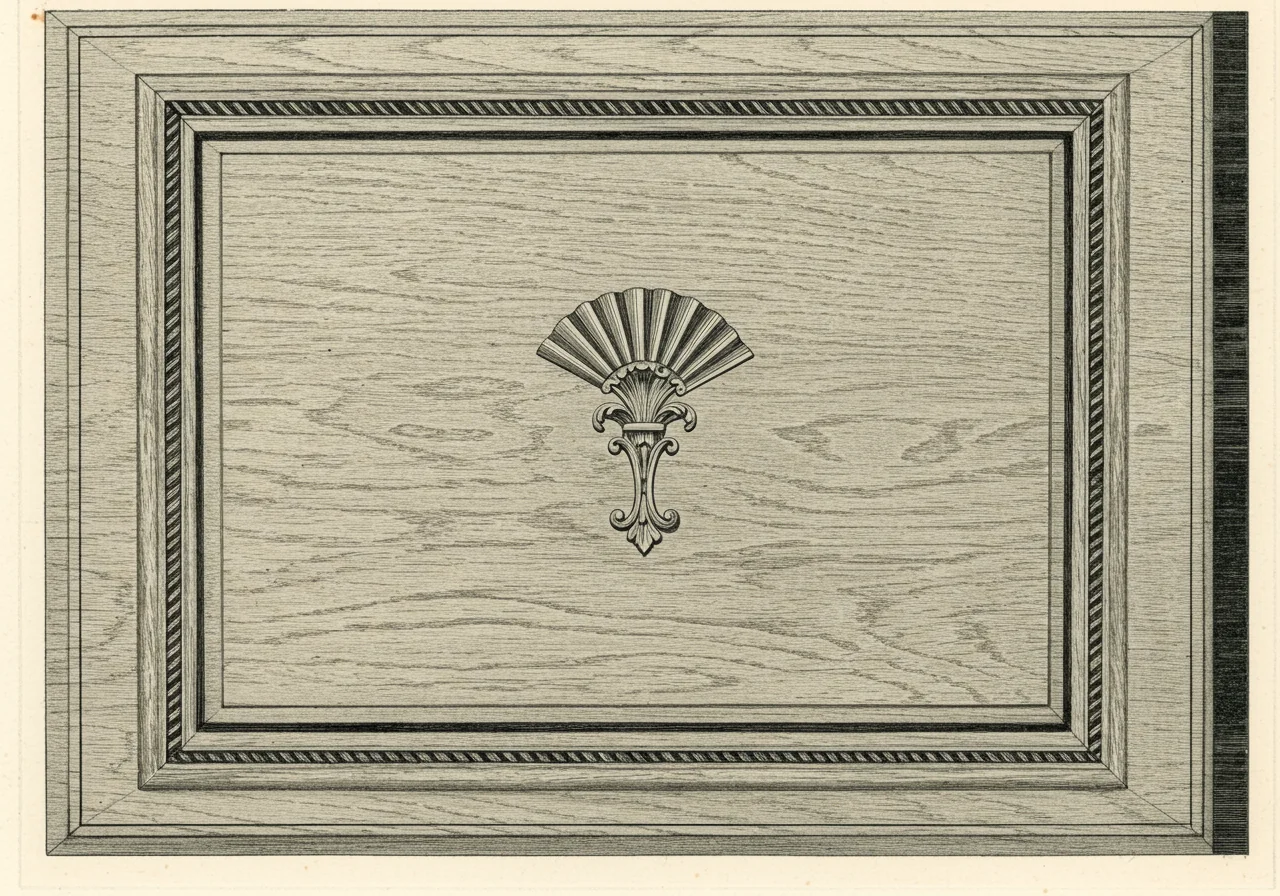
A close detail of Sheraton satinwood-and-ebony stringing — the fine line-inlay along panel edges that distinguishes the Sheraton register from the broader Hepplewhite inlay.
The leg, third, and the leg is the second great discriminator after the chair back. The Hepplewhite leg is straight, square in section, evenly tapered, and finished with a small spade foot — an architectural support drawn from the classical column. The Sheraton leg keeps the straightness and the slenderness and presses both further. It is frequently turned on the lathe rather than cut square — round in section, swelling slightly or running true, and characteristically reeded, its surface worked into fine parallel convex flutes that catch the light in a row of bright lines. It ends in a small turned foot, a tapered foot, or the slight arrow form. Where it is square in section it is squarer and more attenuated than the Hepplewhite leg, and altogether the Sheraton chair stands taller and thinner on the floor: the vertical emphasis that runs through the whole style is nowhere plainer than in the leg.
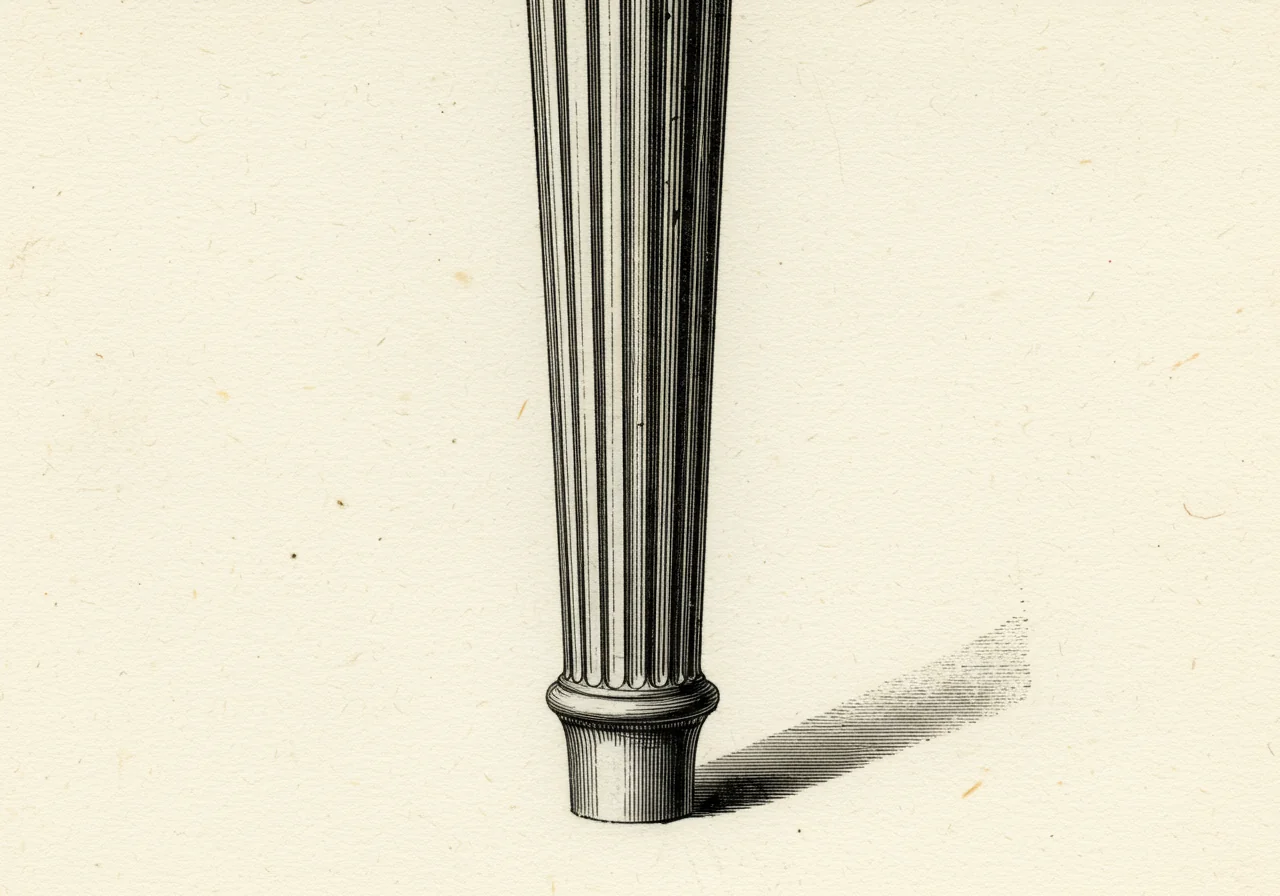
A close detail of the Sheraton leg — slender, turned on the lathe and round in section, characteristically reeded, distinct from the Hepplewhite square-tapered leg with its spade foot.
The construction, fourth. The Sheraton piece is light, and its lightness is the structural expression of the style — slender frame members, thin crossbanded veneers, a paring-away of timber carried a step beyond Hepplewhite. On a genuine period example this delicate workshop construction shows the period hand: hand-cut dovetails of irregular spacing, pit-sawn or hand-planed secondary timber, hand-laid veneer over a hide-glue ground, two centuries of shrinkage and oxidation on the backboards and undersides. And where the piece is one of the mechanical sorts — the rising mirror, the rolling tambour, the converting bed — the construction is to be read for the contrivance itself: the runners, hinges, counterweights, and small fitted interior, all of which the period workshop made by hand and a later imitation tends to simplify.
And the Drawing-Book, fifth — at once the evidence of last resort and of first resort, because for Sheraton, as for Hepplewhite, the pattern book is not a supplement to the furniture but the definition of it. The plates of the 1791–1794 Drawing-Book, and afterwards of the Cabinet Dictionary of 1803, are the document against which a piece is judged to be “in the Sheraton manner.” There is no maker’s stamp to find, no workshop label; there is only the question of whether the form, the ornament, and the proportion answer to the engraved plates. This is an unusual position for a style to occupy, and the next section sets out why.
The Period
The Sheraton period proper runs from about 1790 to 1805, a span as short and as sharply bounded as the Hepplewhite one — at its beginning by the Drawing-Book, at its close by the rise of the heavier Regency taste after 1800. The man whose name it carries is, unlike Hepplewhite, not a documentary blank; what is remarkable about him is something else. Thomas Sheraton was born at Stockton-on-Tees in 1751, and was by trade and by inclination a journeyman cabinet-maker, a drawing master, and — increasingly, as his life went on — a writer and a religious controversialist. He came to London about 1790, and there, rather than opening a workshop, set himself to teaching drawing and to publishing. The Cabinet-Maker and Upholsterer’s Drawing-Book appeared in parts from 1791, was complete in 1793, and was followed within a year by an Appendix and an Accompaniment; the Cabinet Dictionary came in 1803; and the unfinished Cabinet-Maker, Upholsterer and General Artist’s Encyclopaedia occupied his last years, 1804 to 1806. He died in 1806, in poverty — a contemporary who visited him recorded a man living in two mean rooms, in evident want, supporting a wife and children by his pen and his teaching. The style that bears his name made fortunes for the cabinet trade and none at all for Sheraton.
What the Drawing-Book translated into the trade was the same neoclassicism the architects had set going a generation earlier — the painted ceilings and slender plaster relief of Robert Adam, the urn and swag and paterae drawn from the antique. Hepplewhite had already taken that architect-led vocabulary down off the wall and into a trade pattern book. What Sheraton did was to take Hepplewhite’s pattern book and refine it: to square what Hepplewhite had curved, to attenuate what Hepplewhite had already made slender, to substitute the fine line for the broad inlaid motif, and to add the whole class of ingenious mechanical furniture the Drawing-Book delighted in. The relation is one of succession and correction, not of opposition. Sheraton’s book was published while the third edition of Hepplewhite’s Guide was still being revised, and through the 1790s the two designs were current together — a great deal of the furniture of the decade could be referred to either book with equal honesty.
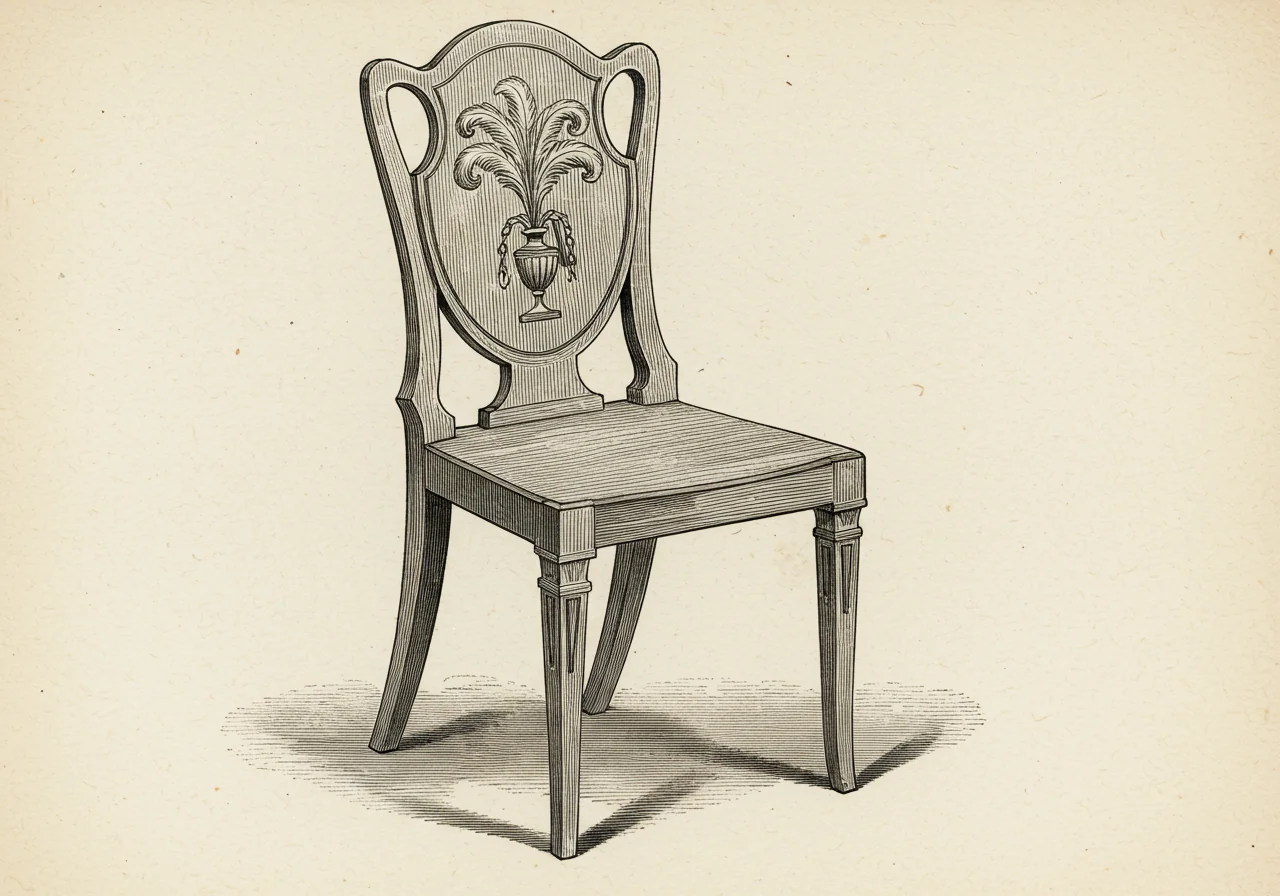
A Hepplewhite shield-back chair — the immediate predecessor in the English neoclassical succession. The Sheraton period kept the pale satinwood and the neoclassical vocabulary but moved from the shield to the rectangle and refined the inlay further.
The load-bearing distinction every Sheraton collector must master is therefore not, in the first place, a distinction between this style and a neighbouring one — that is the work of the next section — but a distinction internal to the word Sheraton itself, and it is the attribution problem in an even purer form than Hepplewhite presented it. With Hepplewhite one could at least say that a cabinet-making shop in Cripplegate had existed, and that a widow had run it, even if no furniture could be traced to it. With Sheraton the workshop itself is in doubt. There is no evidence that Thomas Sheraton ever employed a single journeyman or sold a single chair. He was a designer and a drawing master who published books; the books were worked from by hundreds of cabinet-making shops across Britain and beyond; and “Sheraton furniture” is the furniture those shops made. When a dealer, an auction catalogue, or a museum label says “Sheraton,” the word does not — cannot — mean “made by Sheraton.” It means “made in the manner of the Drawing-Book,” and the Drawing-Book was a public document any shop was free to consult and copy. The style is a book, and behind the book there is, more nearly than with any other style in this arc, no maker at all.
This inverts the ordinary logic of attribution in the same way Hepplewhite inverted it, and the grading of a piece runs along the same two axes that must be kept apart. The first is date — a piece of the 1790–1805 period, or a later piece worked in the same idiom, since the Drawing-Book stayed in use long after the period closed and the later-nineteenth-century “Sheraton revival” produced a great quantity of honest decorative furniture in the manner that is not period work. The second is quality — how fluently the published vocabulary has been realised, since a single plate could be executed by a London shop of the first rank in figured satinwood with painted medallions, or by a country shop in plain mahogany with a single line of inlay, and both are legitimately “Sheraton.” The collector keeps date and quality apart, and asks of the word Sheraton only what it can honestly bear: not who made the piece, which is unanswerable, but whether it is faithfully in the manner of the book.
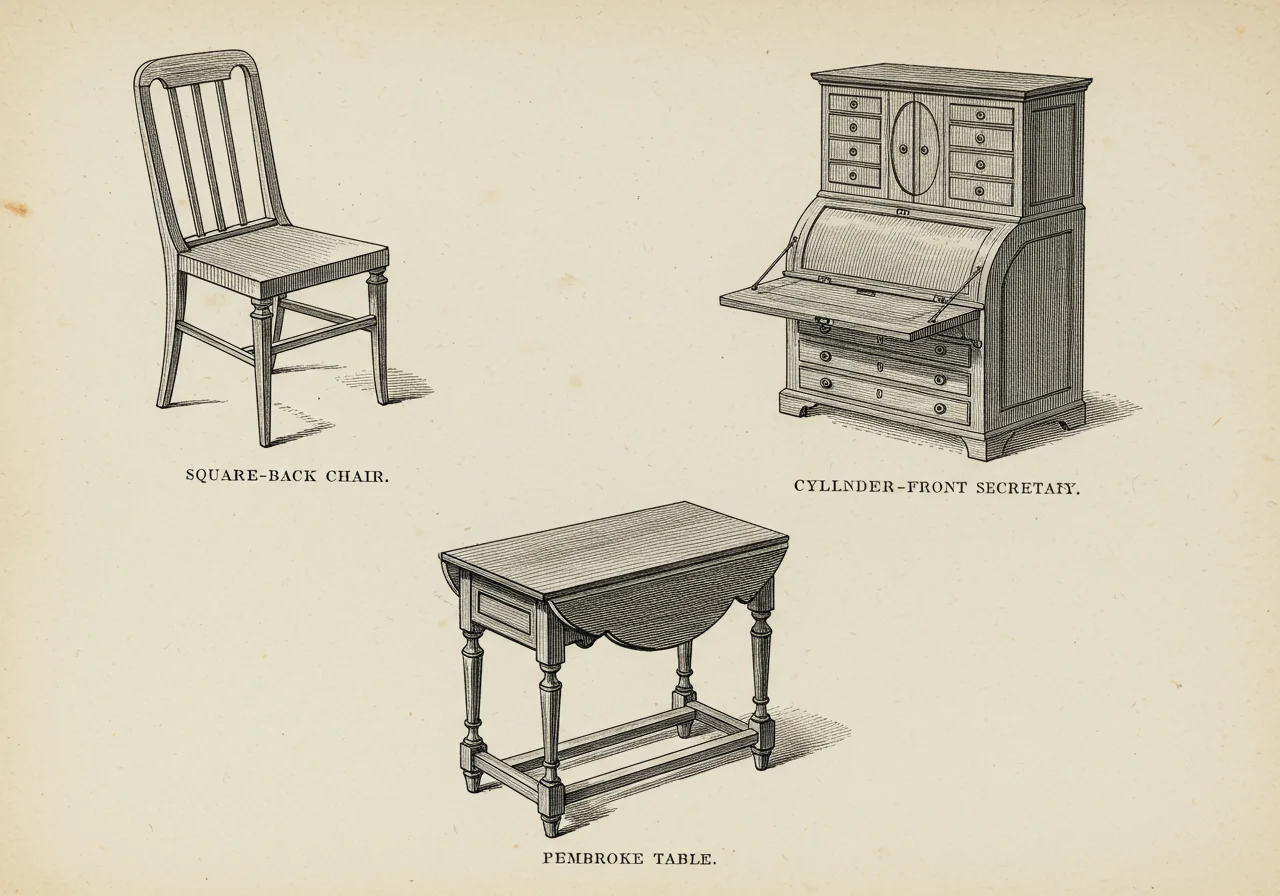
A page from Sheraton’s 1791–1794 Drawing-Book — engraved plates showing the canonical Sheraton forms: the rectangular-back side chair, the cylinder-front secretary, the library table with reeded legs, the dressing table with hinged mirror.
What It Is Not
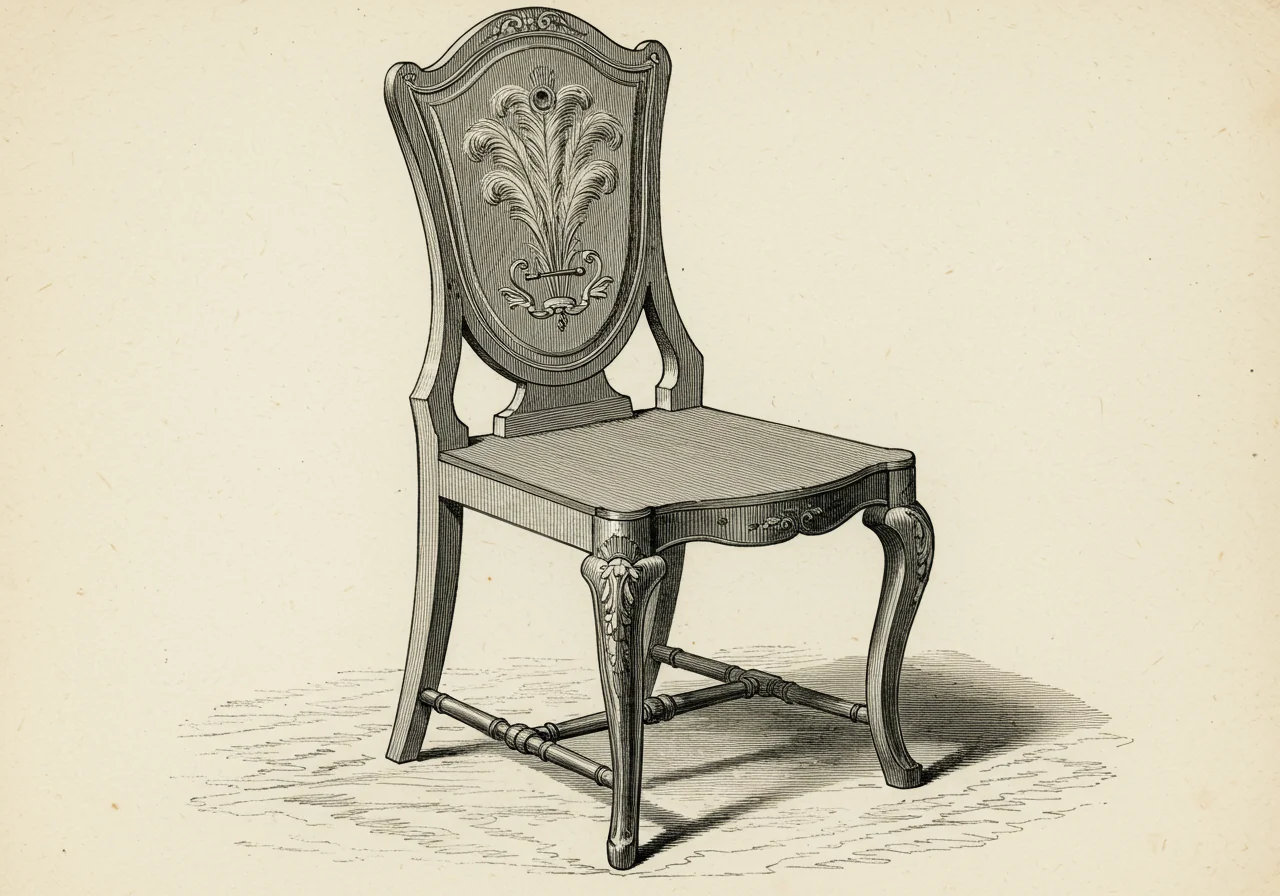
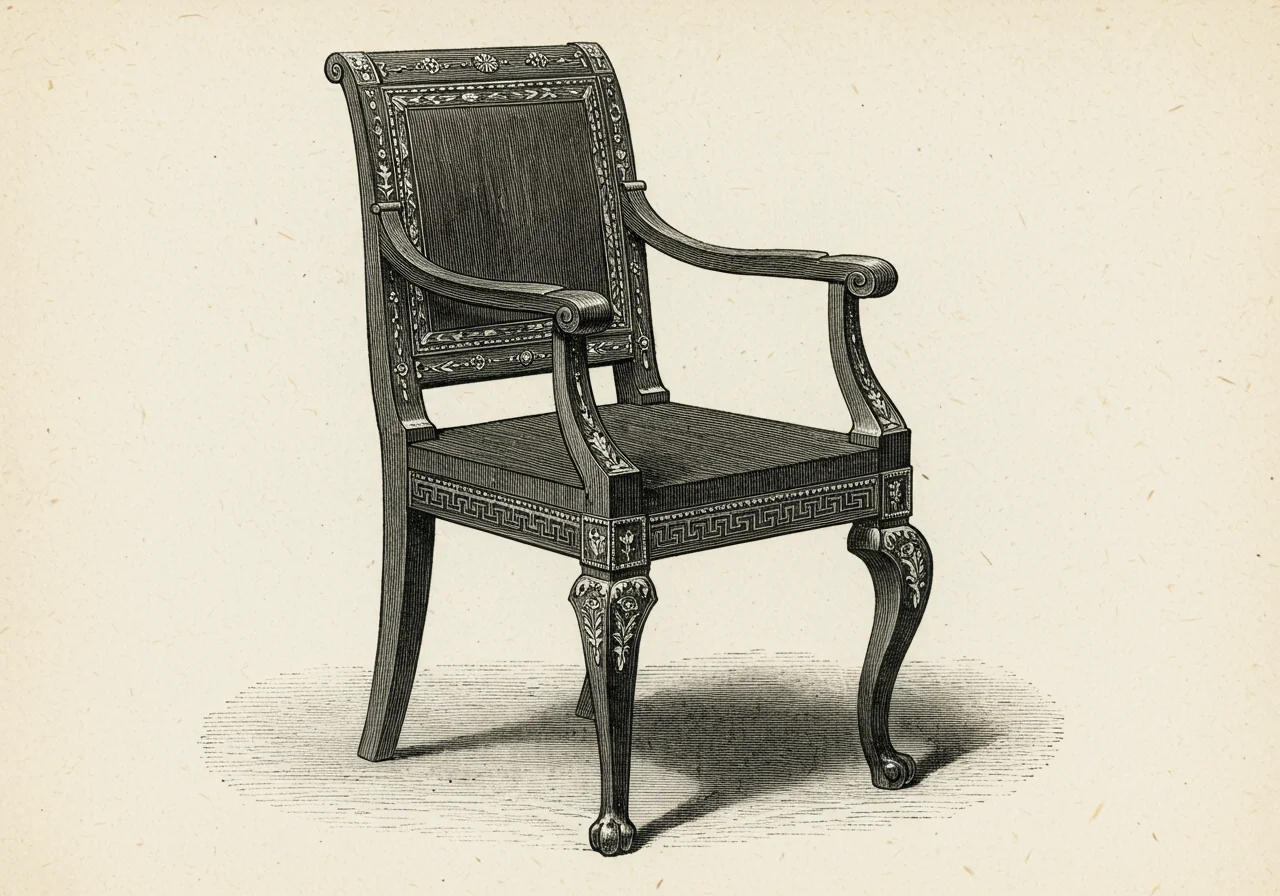
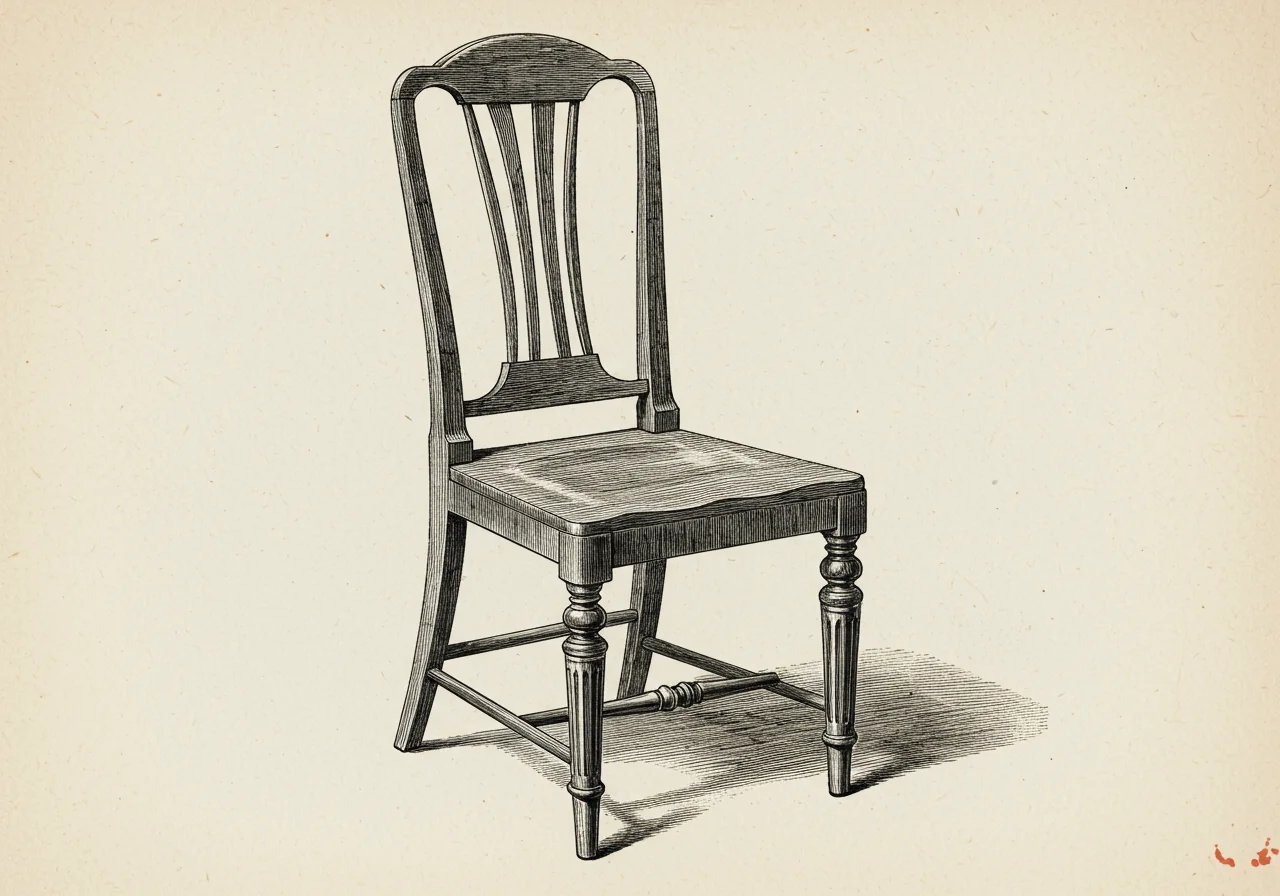
A Hepplewhite is the immediate predecessor — the post just before this one in the arc, the style Sheraton’s Drawing-Book answered and refined — and this is the hardest of the four distinctions to draw, because it is the closest, and so the one to give real care. The two pattern books overlap heavily. Both are English, both neoclassical, both work in pale satinwood with painted and inlaid ornament, both stand their chairs on slender tapered legs, and a great deal of 1790s furniture could be referred to either book without dishonesty. The distinction lies principally in the chair back, and after that in the leg and the inlay. The Hepplewhite back is curvilinear and closed — the shield, the oval, the heart, an outline that is a continuous sweeping curve. The Sheraton back is rectangular — a square or oblong frame, top rail and stiles straight, the ornament arranged on vertical splats and horizontal cross-rails within it. The Hepplewhite leg is square in section and often spade-footed; the Sheraton leg is frequently turned, round in section, reeded on the lathe, and more slender still. And the Hepplewhite inlay tends to the broad pictorial motif, the Sheraton to fine line and stringing. The rule of thumb: a curvilinear open back on a square tapered leg with spade foot is Hepplewhite; a rectangular back on a slender turned-and-reeded leg, the inlay run in fine dark line, is Sheraton. The rule is sound on the whole — but the honest collector concedes that the two books shade into one another, and that “Hepplewhite-Sheraton” is a defensible label for a great many pieces on the boundary.
An English Regency piece is the heavier successor — the style that displaced Sheraton after about 1805. Where Sheraton is the lightest and most slender phase of English neoclassicism, the Regency is its weighting and its archaeological hardening. The Regency turned from pale satinwood to dark woods — rosewood above all, and mahogany again — and from fine wood-stringing to brass: brass inlay let into the dark ground, brass galleries, brass paw feet and mounts. Its neoclassicism is more literal, drawing directly on Greek, Roman, and Egyptian models — the sabre leg, the klismos chair, the sphinx and the lion mask. The rule of thumb: pale satinwood, slender turned legs, and fine line-inlay is Sheraton; dark rosewood, sabre legs, brass inlay, and a heavier archaeological vocabulary is Regency. The move from one to the other is the move from refinement to weight.
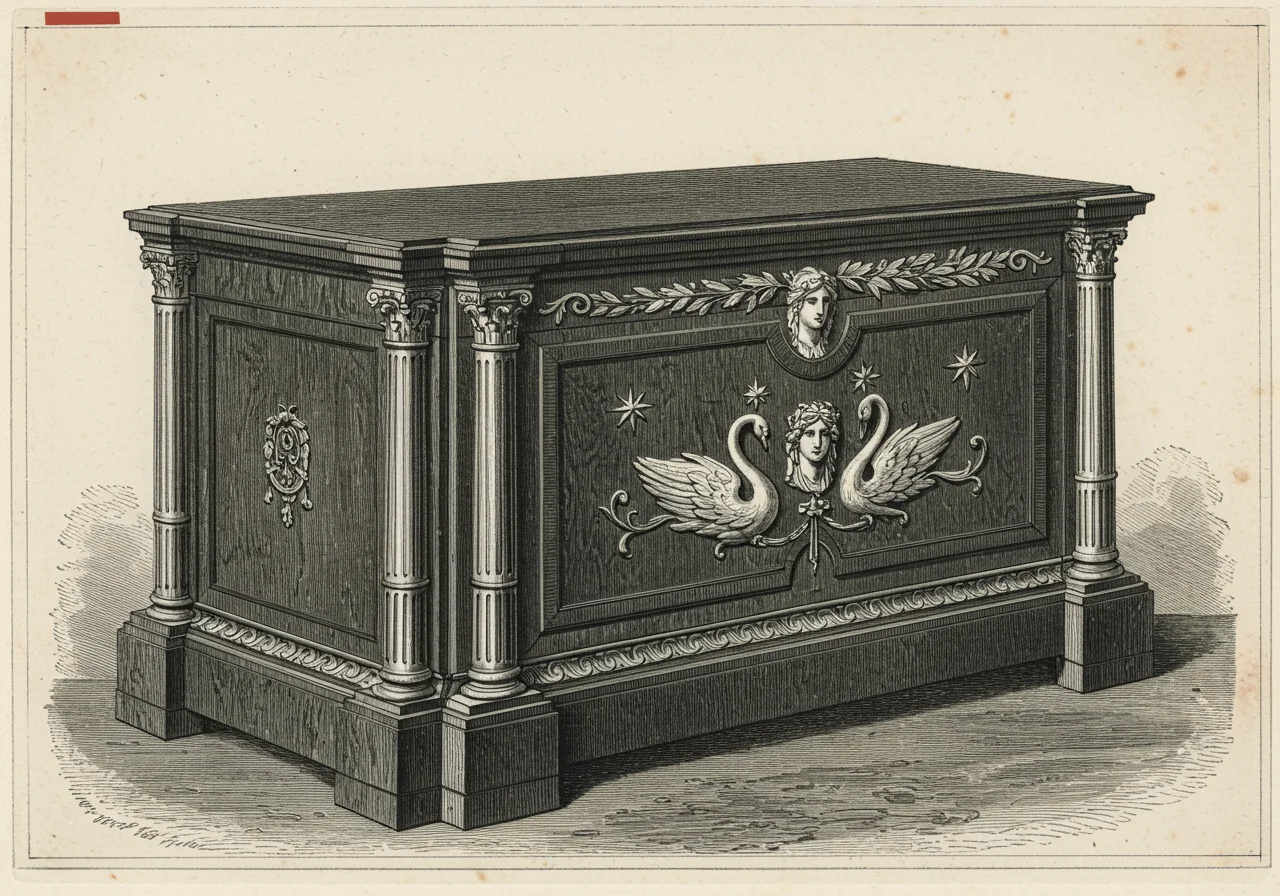
A French Empire piece is the Continental late-neoclassical contemporary — the imperial style of Napoleonic France, parallel in date to the close of Sheraton and the opening of the Regency. It shares the literal, archaeological neoclassicism, but the register is altogether different: Empire works in dark, richly figured mahogany, builds in broad architectural masses rather than slender frames, and carries its ornament in gilt-bronze mounts — ormolu sphinxes, swans, victories, classical heads — applied to plain veneered surfaces. The rule of thumb: light English satinwood with inlaid line-ornament is Sheraton; massive French mahogany with applied gilt-bronze mounts is Empire. The first is a drawing-master’s economy of line; the second is an imperial display of metal.
An American Federal piece is the colonial American descendant — furniture made in the American workshops of the Atlantic seaboard in the decades after Independence, working directly from both the Hepplewhite Guide and the Sheraton Drawing-Book, frequently from both at once. The distinction here is genuinely difficult, and at first glance often impossible, because the American cabinet-makers were working from the very same plates. The Federal piece tends to read in a slightly plainer register — often in mahogany with satinwood inlay rather than figured satinwood throughout, frequently combining a Sheraton rectangular back with Hepplewhite detailing or the reverse — and it shows the secondary woods of the American forest, tulip poplar and white pine, in its drawer linings and backboards rather than the oak and deal of the English shop. The rule of thumb: the English Sheraton piece works toward figured satinwood, fine line-inlay, and English secondary woods; the American Federal piece works more often in inlaid mahogany, mixes the two pattern books freely, and shows American secondary timber — and the secondary wood, examined on the underside, is frequently the most reliable tell of all.
What One Looks At
One looks first at the form of the chair back, because the back is the signature and the rectangular back is the type-specimen — and because it is the back that parts Sheraton from Hepplewhite at a glance. The canonical Sheraton back is a rectangle: a square or oblong frame, top rail and stiles straight, the corners turning a clean angle, the ornament within it arranged on slender vertical splats and horizontal cross-rails. A closed curvilinear back — the shield, the oval, the heart — points toward Hepplewhite; a heavier back with a sabre-curved stile and an archaeological vocabulary points forward to the Regency.
One looks next at the leg, the second great discriminator. The Sheraton leg is straight and markedly slender, and characteristically it is turned on the lathe — round in section, reeded with fine parallel flutes — finishing in a small turned, tapered, or arrow foot. A leg square in section, more substantial, ending in a spade foot leans toward Hepplewhite; a sabre leg, curved like a cavalry blade, belongs to the Regency. The slender turned-and-reeded leg, and the tall thin stance it gives the chair, is the Sheraton member.
One looks then at the wood and the inlay together. The piece should be pale — satinwood throughout, or a mahogany ground crossbanded and strung in pale woods — and the ornament should run to fine line: narrow bands of ebony, holly, or boxwood stringing let into the surface along every edge and panel. A broader pictorial inlay, the shaded urn and husk-chain, leans toward Hepplewhite; a dark rosewood ground inlaid with brass belongs to the Regency; applied gilt-bronze mounts on figured mahogany belong to the French Empire. And one keeps in mind the mechanical character of much of the Sheraton repertory — the rising mirror, the rolling tambour, the converting and dual-purpose piece — a taste for ingenuity that is itself part of the signature.
And one looks, finally, at the question of attribution itself — which is to say, one keeps in mind throughout that there is no maker to find, and that here there may not even have been a workshop. A genuine period Sheraton piece is a piece of the 1790–1805 English cabinet trade, worked from or closely after the plates of the Drawing-Book, and showing the period hand in its construction; what it is not, and what virtually no piece of Sheraton furniture has ever been shown to be, is the documented work of Thomas Sheraton himself, the drawing master and writer who died poor. The collector reads form, leg, wood, and inlay against the Drawing-Book; reads the construction for date; reads the quality for rank; and asks of the word Sheraton only what it can honestly bear — that the piece is in the manner of the book, made by one of the many shops that worked from it, in the short and well-defined period the book defined.
The next post in the furniture arc will be either English Regency — to set out the heavier Regency succession after 1800 — or American Federal, to extend the Sheraton-and-Hepplewhite vocabulary into the post-colonial American workshops. The choice will depend on what photographic material is available at the time of writing.