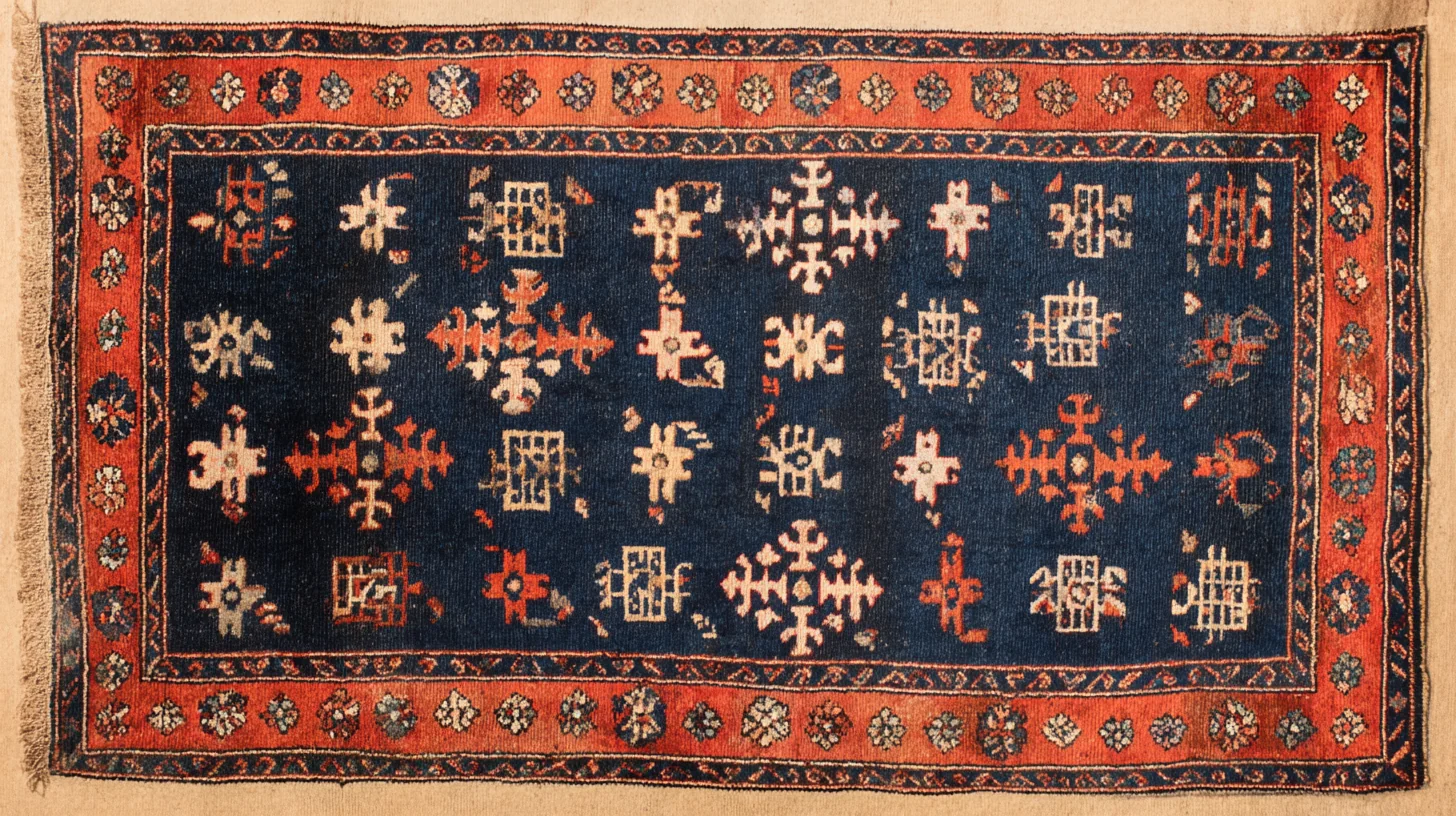
The twelfth post in this arc treated Karabagh, and it spent most of its account holding two things together: a tribal-geometric tradition and a borrowed French floral one, both unmistakably Caucasian beneath the pile. Its closing line named Shirvan and Kuba as the two rugs that might come next, and the choice has fallen on Shirvan — partly because the photographic material was to hand, and partly because the natural movement of the account is eastward, out of the southern mountains and along the western shore of the Caspian, where the loom narrows, the pile drops, and the great medallion gives way to a far quieter habit of drawing. This is the thirteenth post in Reading the Antique Rug. It treats Shirvan in the position the arc has reserved for it: the region along the western Caspian coast in what is now Azerbaijan, south of the Greater Caucasus range with Baku at its eastern edge, that produced the most-collected of the eastern Caucasian rugs and the principal foil to the burgundy-and-rose tradition the prior post described.
The Shirvan is, of all the Caucasian types, the one a collector is most likely to meet and the one most often misread on first meeting. It is misread because it does not announce itself the way the southern Caucasian rugs do. The Kazak shouts; the Karabagh sings; the Shirvan murmurs. It is a small rug, more often than not, and its design is correspondingly small — organised not around the single stepped medallion the southern rugs hang their composition on, but around a quiet field of repeats: small star medallions, S-form devices, scattered geometric motifs, set into a dark ground at a density the eye must close on before the pattern resolves. One has to step nearer. That habit of approach is the first thing this post is asking the eye to learn, and most of the rest follows from it.
The Specimen
A Shirvan one encounters on the open market is, in the great majority of cases, a nineteenth-century or early-twentieth-century village rug of moderate proportions — a scatter rug perhaps four by six feet, a prayer rug of similar reach, or a long narrow runner. Room-sized Shirvans exist, but they are not the type-defining specimen; the type is keyed to the small piece. The first thing to settle, before any motif is read, is the ground, because the Shirvan ground is the type’s signature in the way burgundy was Karabagh’s and brick-red was Heriz’s. It is, with great reliability, a dark navy — a deep indigo, nearly black at a distance and resolving into the saturated mid-blue of the dye only on close approach. The southern Caucasian rugs run red; the eastern Caucasian rugs run dark blue. The rule is not absolute (a Shirvan on ivory exists; a Shirvan on madder exists), but the canonical Shirvan is navy, and the navy field is the first thing to look at and the first thing to verify.
Against that dark ground the design is drawn in the eastern Caucasian register. Where the Kazak set a great stepped medallion on a saturated red and the Karabagh hung a French rose-bouquet on burgundy, the Shirvan does neither. The field is broken into a repeat of small motifs in regular ordering — small star medallions, eight-pointed or stepped; S-form devices, the running curl the trade has variously called the running dog; little geometricised flower-heads; the occasional botanical boteh; on the prayer rugs, a directional niche at one end and a lamp suspended within it. The drawing is finer than anything the southern Caucasus produced, for the same reason the pile is lower and the knot closer: the Shirvan weaver, working eastward toward the Persian world, drew at a register the southern loom did not attempt.
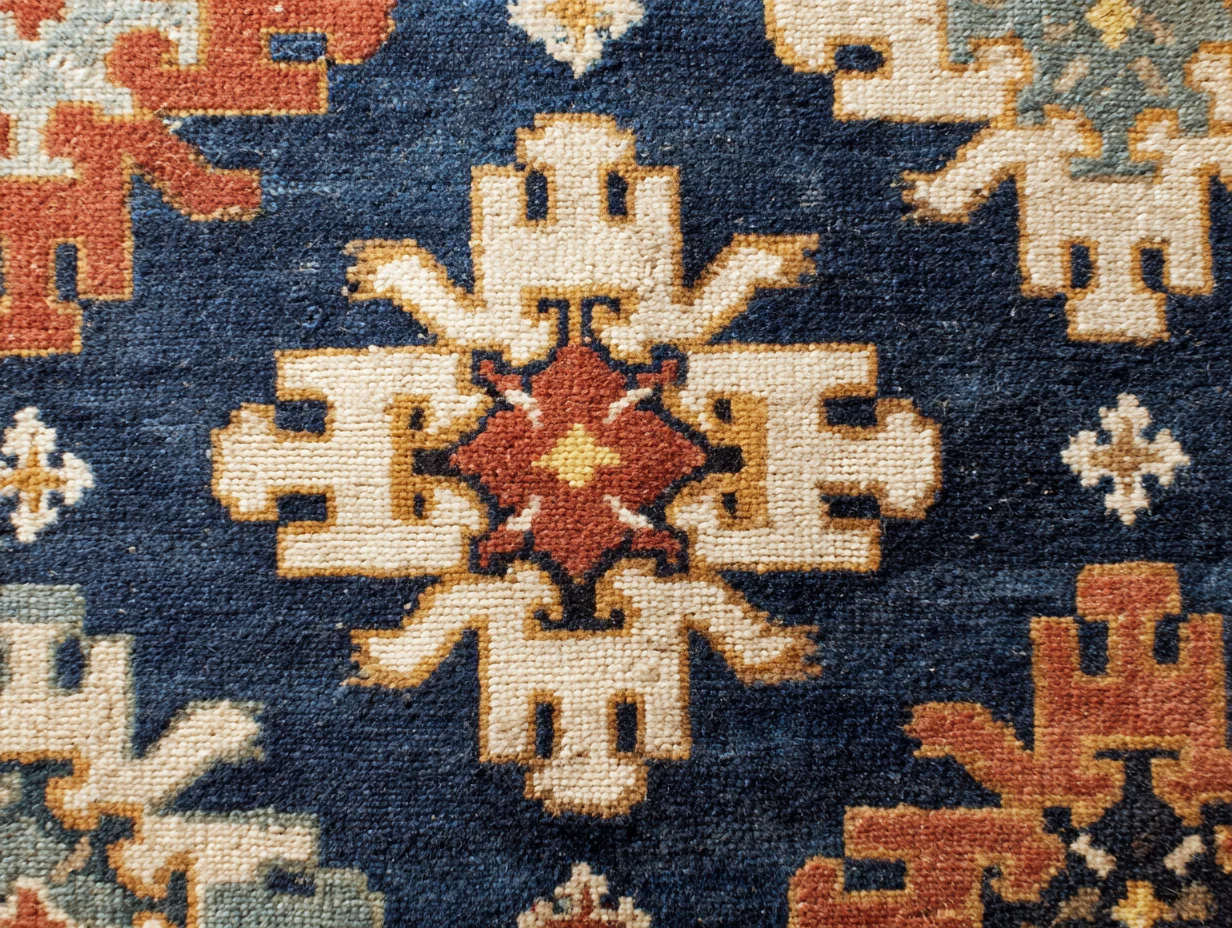
A close detail of a Shirvan field — small star medallions and S-form devices set into the dark navy ground, drawn at the fine register the eastern loom is keyed to.
The palette completes the specimen. Where the design picks up colour, it picks it in clear small touches — ivory, a clean madder-red, a soft orange-rust, a pale green, a single saffron note — set against the dark field in a contrast the eye reads at first as restraint and on longer attention as great variety held to small extent. The Shirvan is not polychrome the way an Anatolian village rug is; it is a quietly-coloured rug in which a half-dozen distinct hues each occupy a small part of the field. That distribution — many colours, each in small motifs, on a dominant dark ground — is the visual signature, and it is one to recognise across the sub-types the trade names by village (Marasali, Bidjov, Akstafa, Chajli, and several more), all of which sit beneath the Shirvan label and share the navy ground and the small-scale habit.
The Evidence
The foundation is the structural evidence, and for the Shirvan it confirms what the design has already suggested. The Shirvan is woven on a wool foundation, generally with a wool warp and a wool weft, though one encounters a cotton weft now and then on late-nineteenth-century export pieces. The warp is wool with great regularity. One turns the rug over, parts the pile at a worn place, or reads the warp at the fringe — and the threads are wool. A wool warp with a navy field is pointing to the eastern Caucasus; a cotton warp with a similarly dark field is pointing, very probably, to Bidjar or another similarly-dyed Persian district, and the foundation alone settles the question before any motif is read.
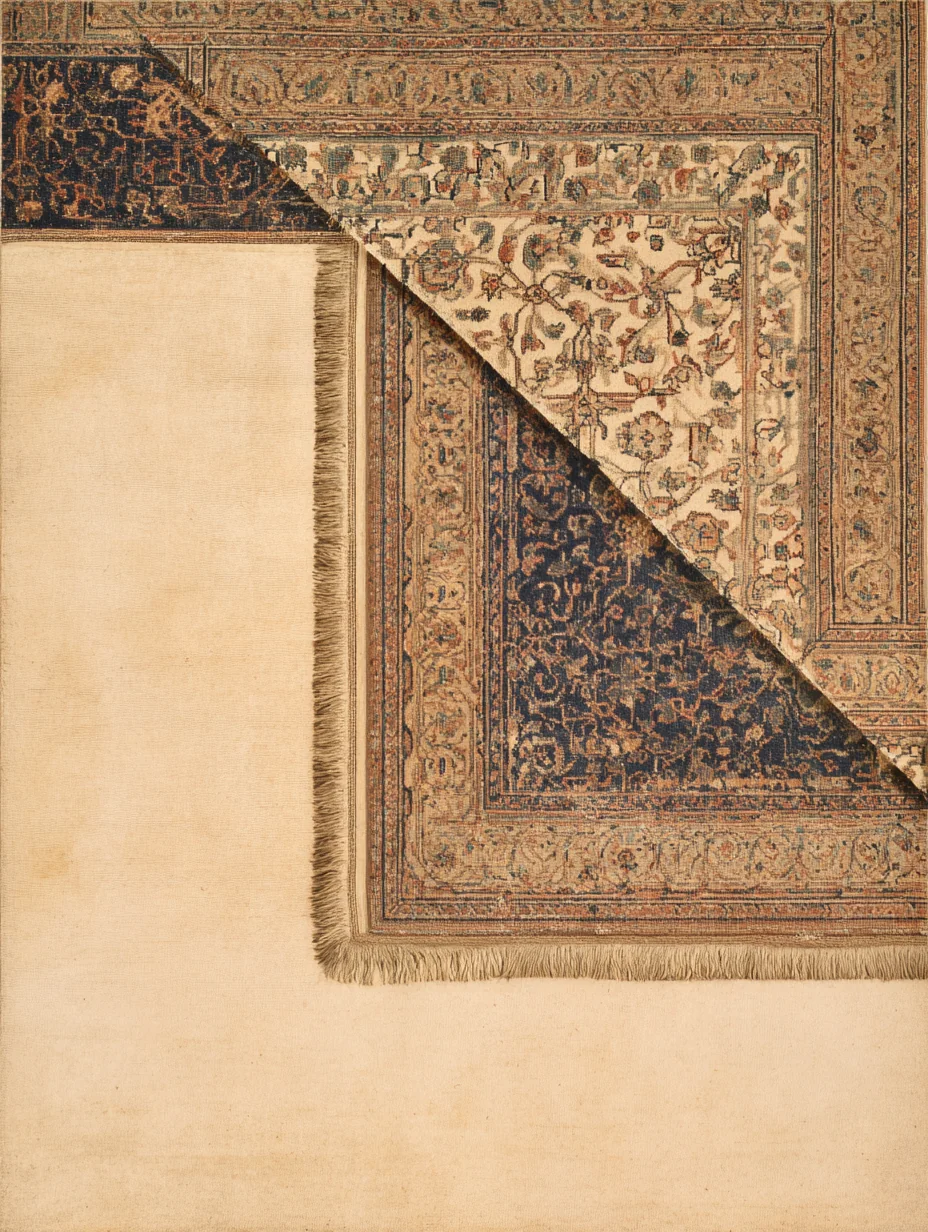
A close detail of the back of a Shirvan — the wool warp and wool weft, the symmetric knot at the fine eastern Caucasian density that separates Shirvan from the looser tying of the southern Caucasus.
The knot is the second piece of structural evidence, and it is where the Shirvan separates itself most cleanly from its southern neighbours. The knot is symmetric — the Turkish knot, used uniformly across the Caucasian and Anatolian world — and that the Shirvan shares with every other rug in the family. What is not shared is the density. The Kazak runs coarse; the Karabagh moderate; the Shirvan is finer than either, between 90 and 160 knots per square inch on a good piece. The consequence is the second feature the rug declares at once: the pile is low. One sets a hand on a Shirvan and feels not the shaggy long pile of the highland Kazak nor the medium clip of the Karabagh, but a short, close, almost flat pile a careless eye may at first mistake for wear. It is not worn. It is woven that way.
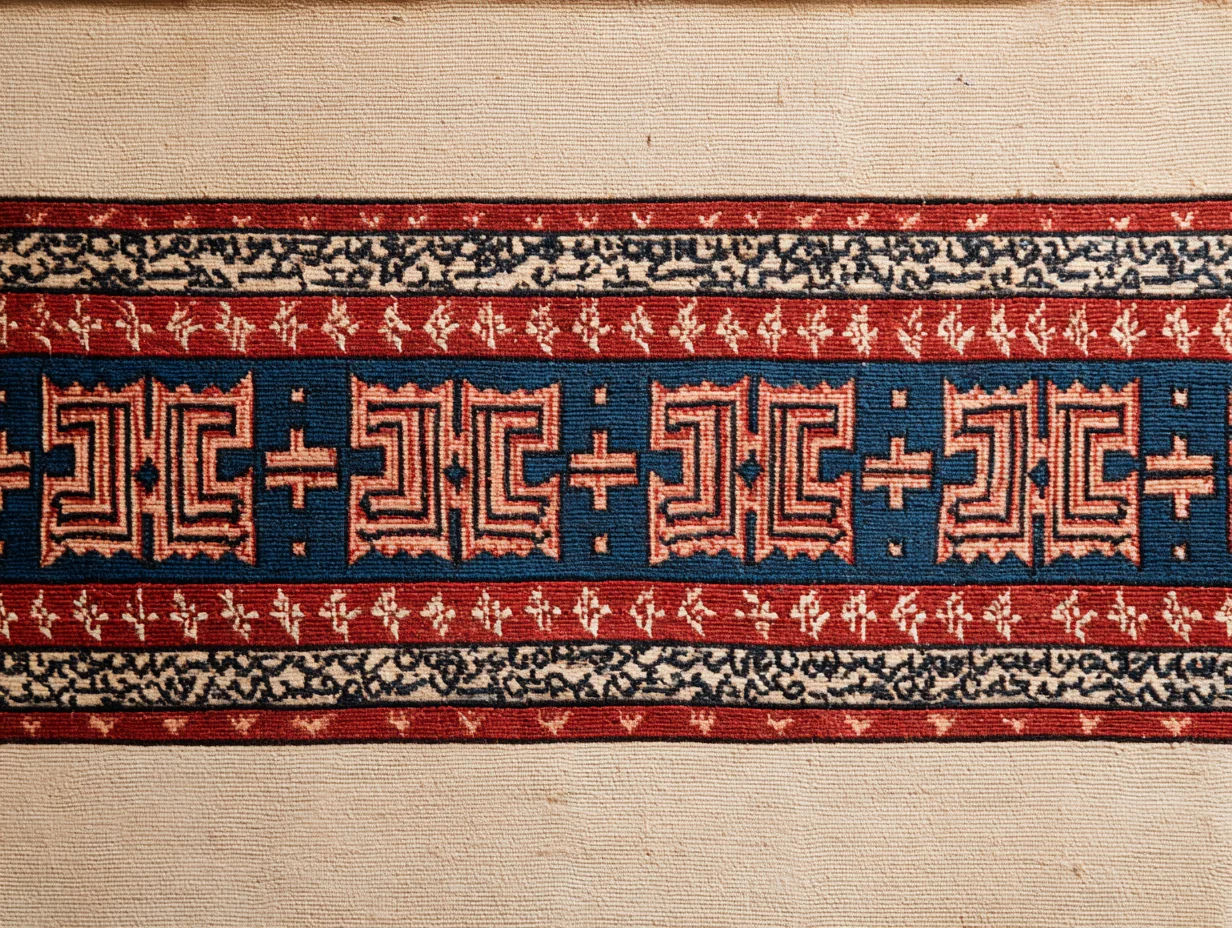
A close detail of a Shirvan main border — the kufic-script-derived repeat, the angular geometricised letterforms that distinguish the eastern Caucasian border vocabulary from the floral and stepped-polygon borders of the south.
The borders complete the structural evidence, and the principal one to learn on a Shirvan is the kufic border — a repeating angular device the trade called kufic because it resembles, at a sufficient remove, the angular Arabic letterforms of the early Islamic Kufic script. Whether the resemblance is historically traceable or merely coincidental is a question the literature has not entirely settled, but the device is unmistakable in the rug: a regular series of geometric stems and uprights set at right angles to each other and repeated along the border, reading at a little distance as a written line. Not every Shirvan carries one, but it is among the most diagnostic of the eastern Caucasian devices, and the southern Caucasian rugs simply do not produce it. A Caucasian rug with a kufic border is, with high probability, an eastern one — and most often a Shirvan or a Kuba.
The Period
Shirvan is a region, not a town. It lies along the western shore of the Caspian, south of the Greater Caucasus range proper and reaching down to the Kura, with Baku sitting at its eastern edge on the Apsheron peninsula — the coastal plain and low foothills of what is now central and eastern Azerbaijan, country crossed by every imperial power that has reached the Caspian and that has, for that reason, woven for a great variety of customers over a great length of time. The Shirvanshahs ruled here from the ninth century to the sixteenth; the Safavids absorbed the region; the Russians took it, with the rest of the eastern Caucasus, by the Treaties of Gulistan (1813) and Turkmenchay (1828) — the same annexation that pulled Karabagh out of Persian hands and into the Russian commercial orbit. The dating matters, because the Shirvan one collects today is, almost without exception, a post-1828 rug, woven for a market made up partly of the local trade, partly of the Russian one, and partly of the European export buyers who reached Baku in serious numbers in the second half of the nineteenth century.
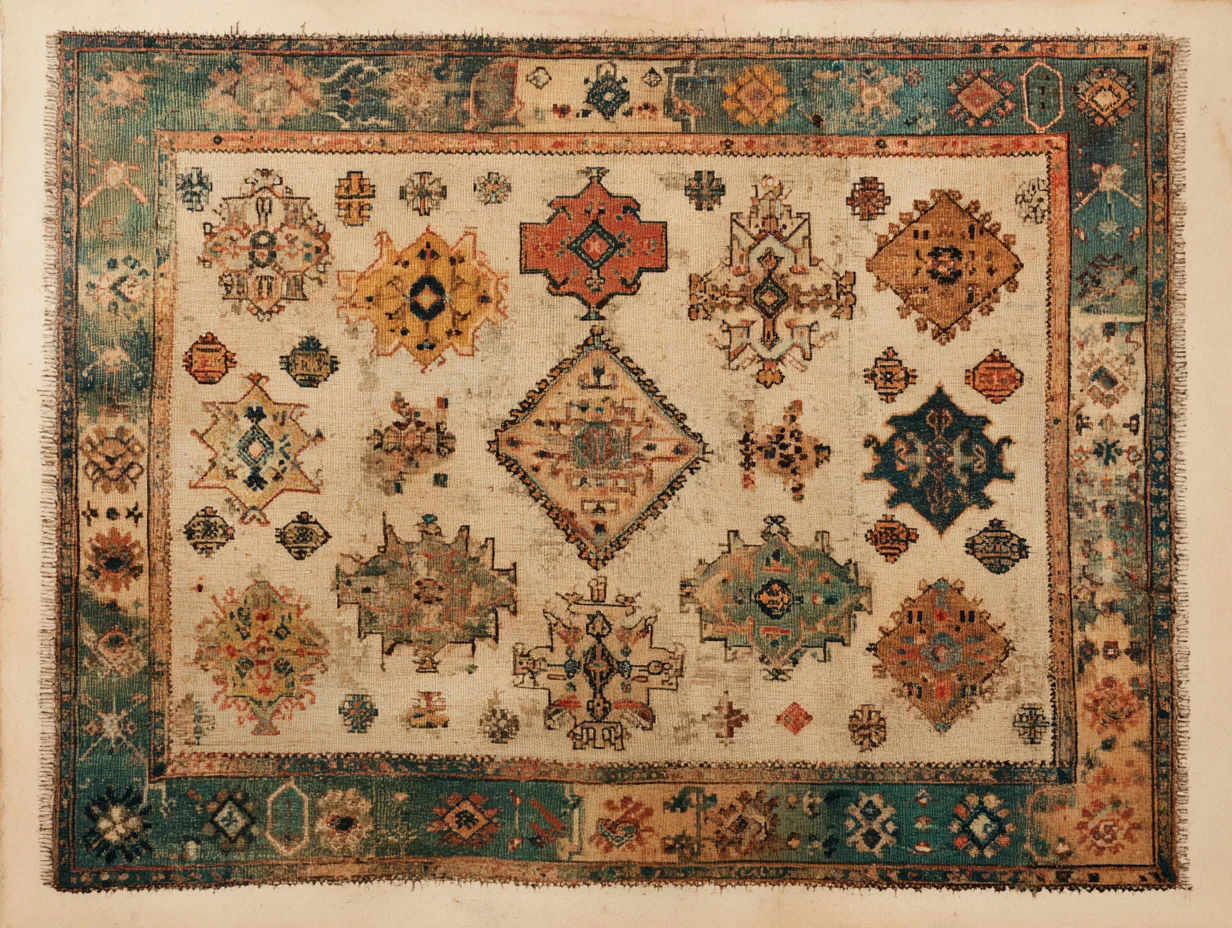
A pre-19th-c Shirvan village rug — the older eastern Caucasian tradition before the post-1828 Russian-mediated export market regularised village production. The drawing is looser, the palette more variable, the conventions less standardised than the canonical nineteenth-century Shirvan that grew out of it.
The export trade had two consequences, both visible in the rugs themselves. The first was a regularisation of design: the village conventions, individual before the trade, became more uniform under it, and the canonical Shirvan vocabulary one now describes is in part the vocabulary the market settled on. The second was the steady production of the prayer-rug format, which had always been woven in the eastern Caucasus but which the trade favoured particularly — for its smaller size and for the legibility of its directional design to buyers unfamiliar with the wider Caucasian repertoire. A great many of the prayer rugs the collector now meets under the Shirvan label were woven specifically for sale, and the conventions were honed accordingly.
The early twentieth century brought the decline that came to most of the regional weaving districts. The collapse of the Russian Empire, the establishment of Soviet Azerbaijan, and the Soviet reorganisation of the looms into managed production ran across the Shirvan tradition in succession, and the old village independence was, by mid-century, essentially over. Shirvan-design rugs continue to be made; some are made well. But the type as the collector knows it is a nineteenth-century type, woven under one specific commercial arrangement in one specific imperial frame, and the period of the great Shirvan is the period between roughly 1830 and 1910.
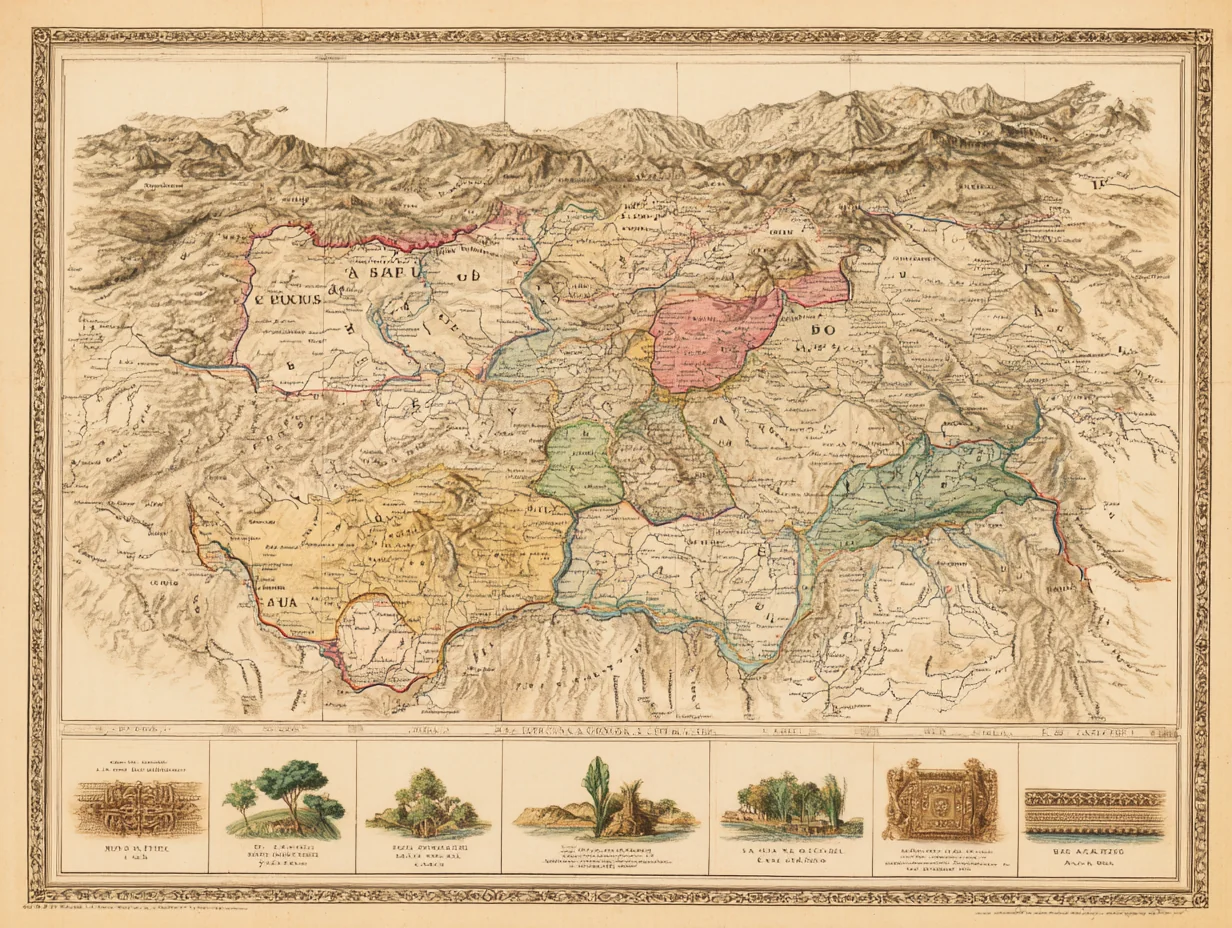
A page from a Victorian connoisseur’s portfolio on the eastern Caucasian region — a district map locating Shirvan, Kuba, Daghestan, and Baku along the western Caspian, with archetype drawings of the four sub-types arranged for comparison.
What It Is Not
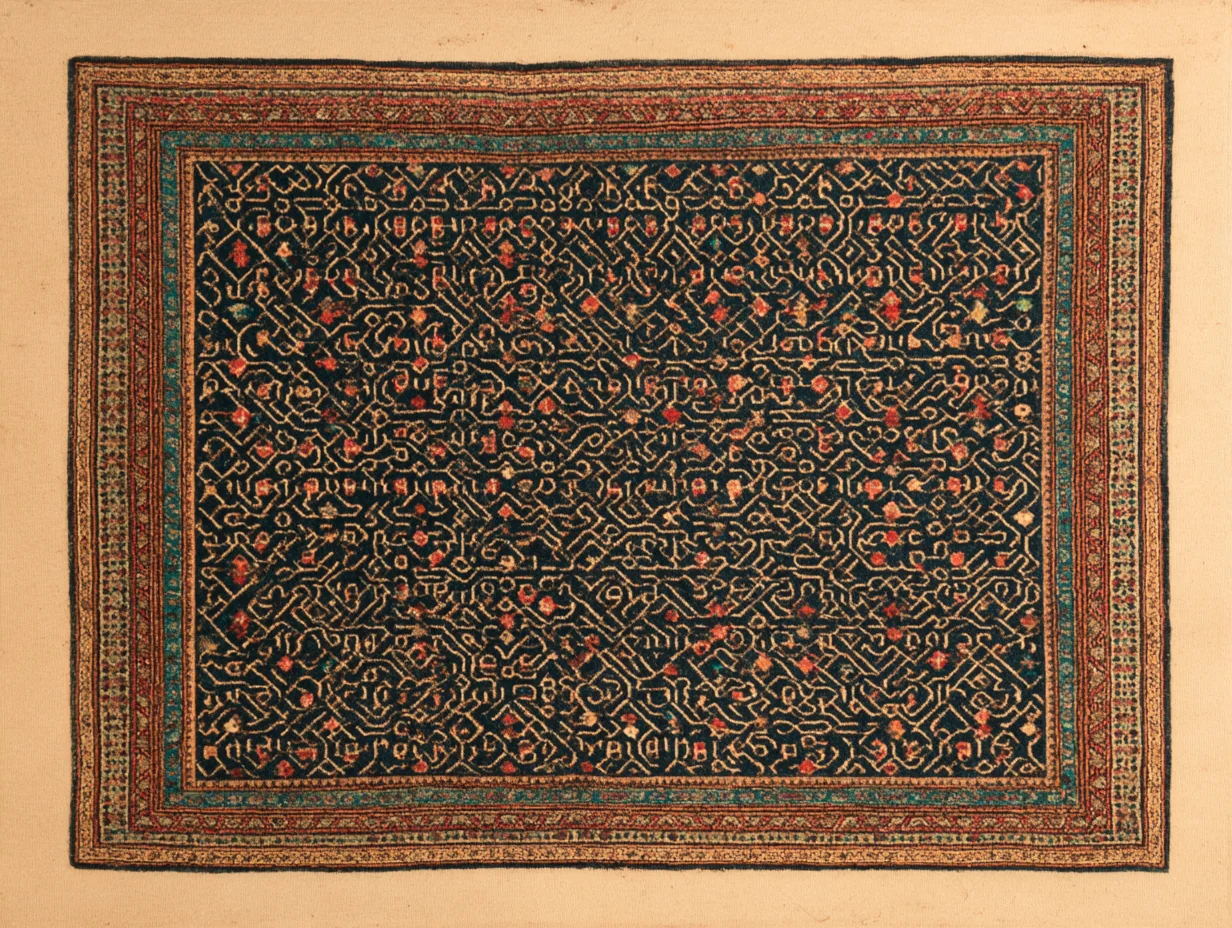
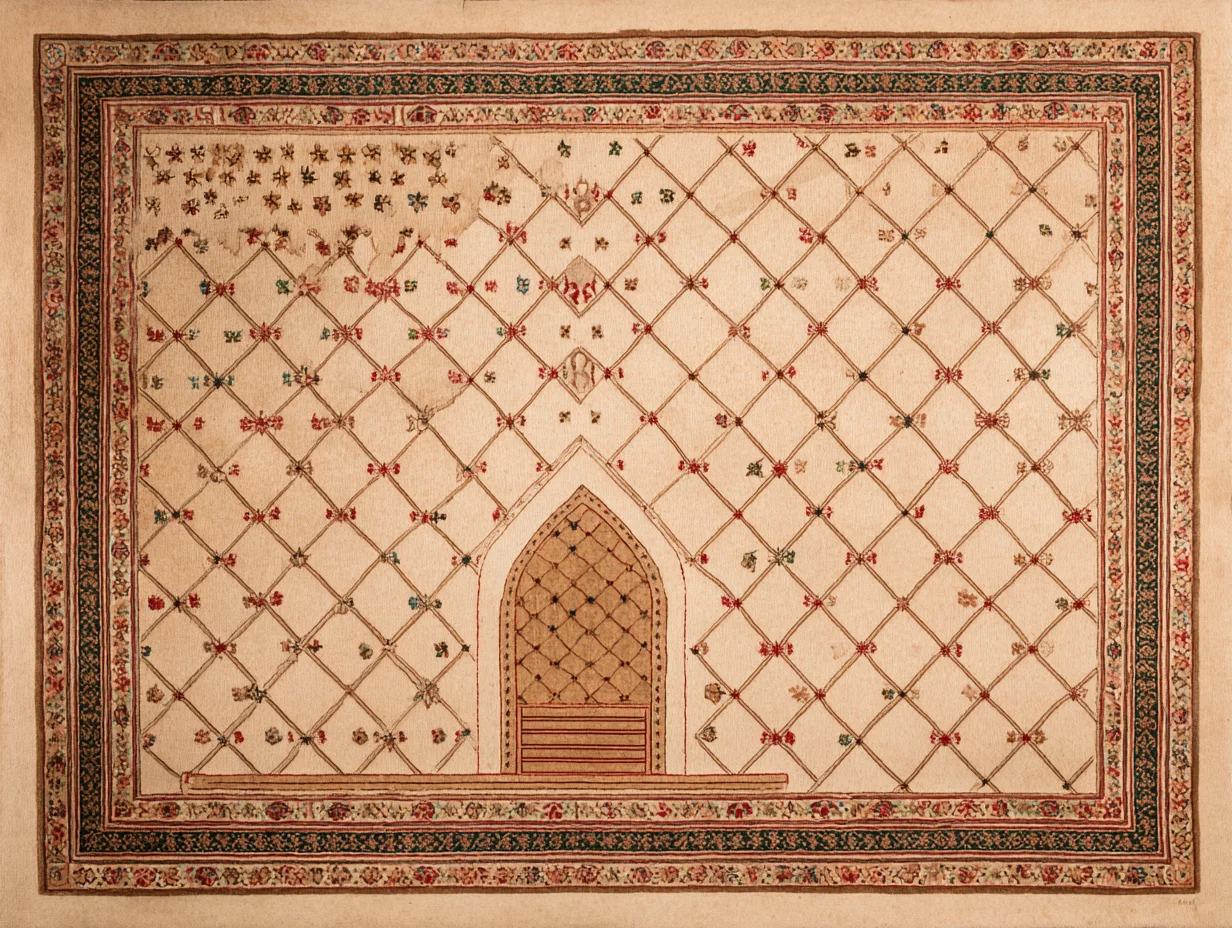
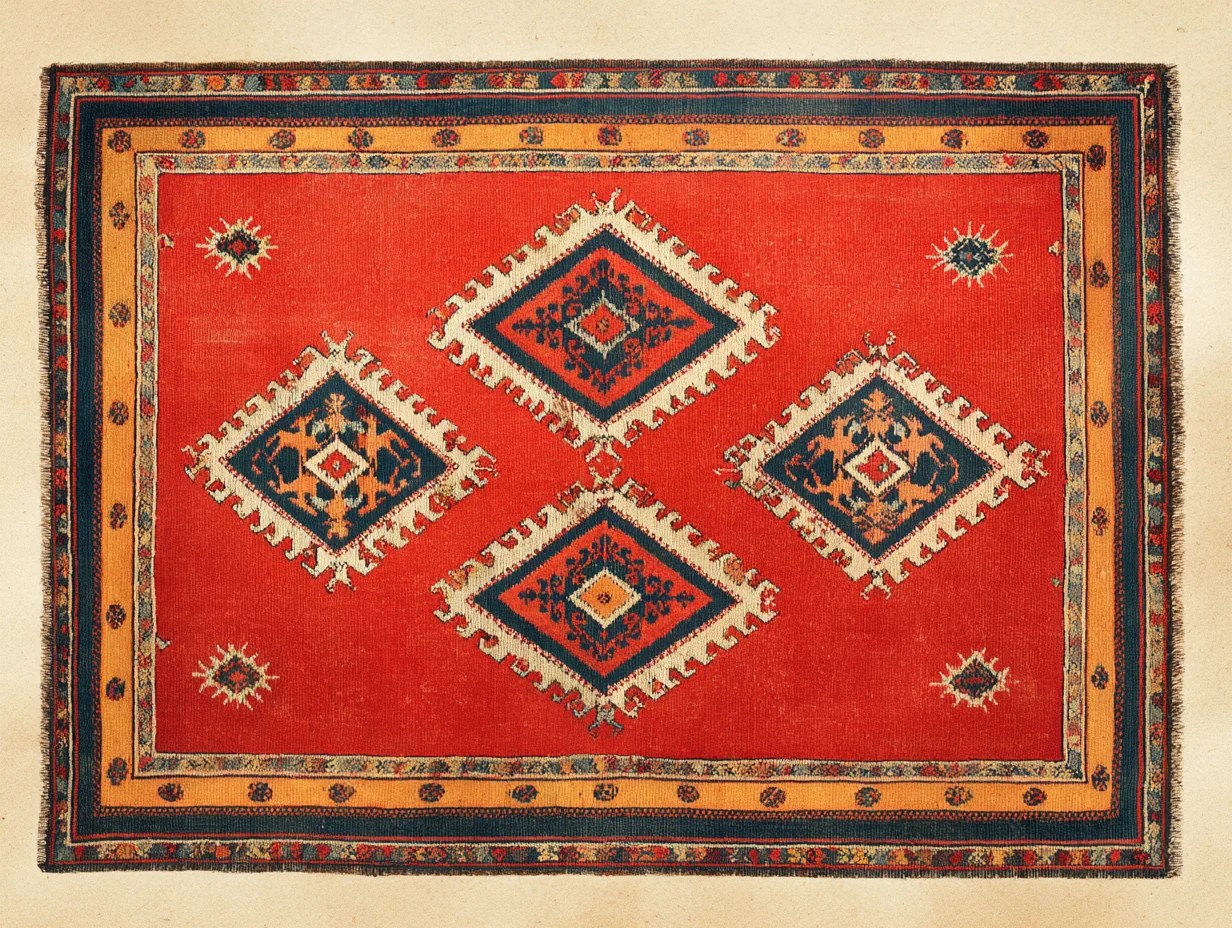
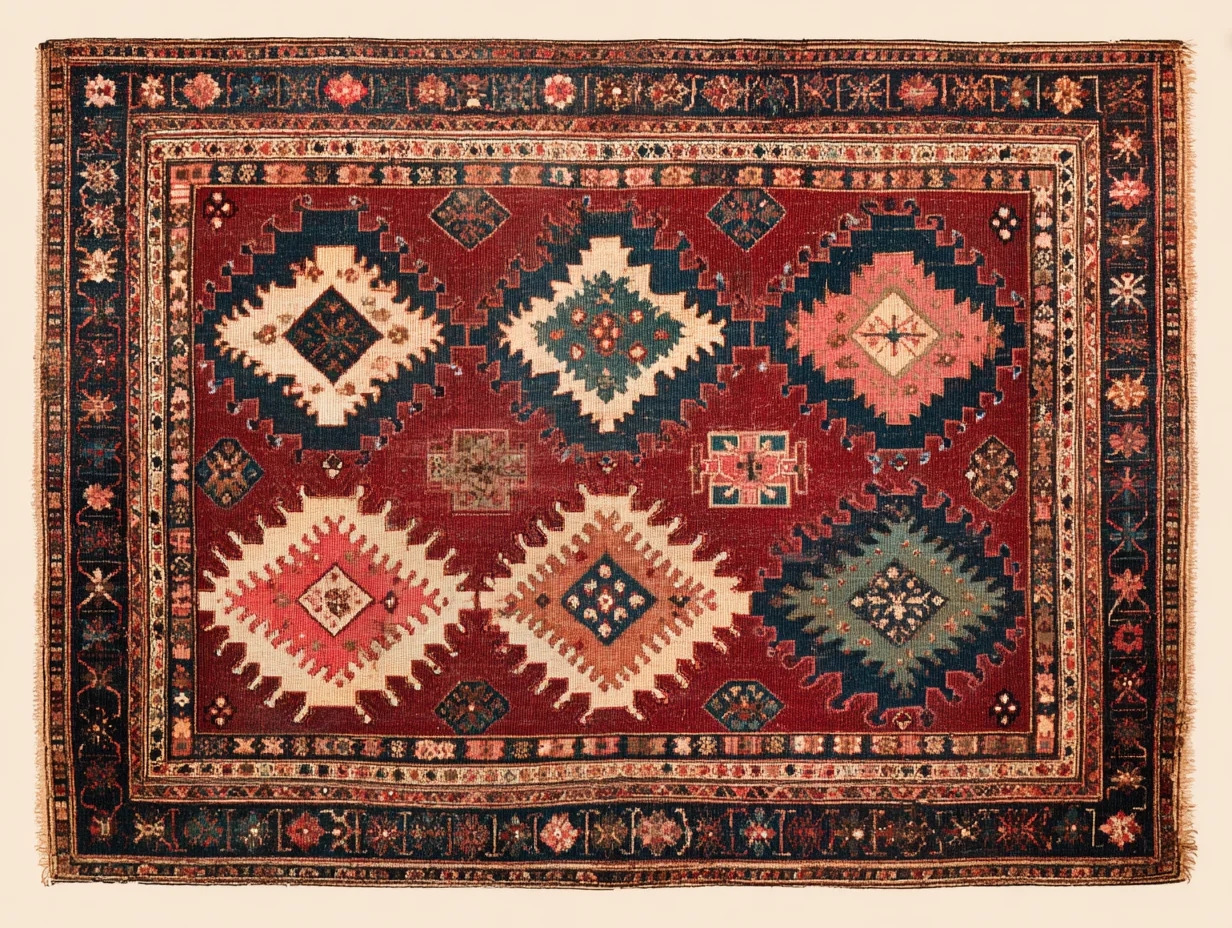
The four types set against the Shirvan in the plate are all Caucasian, all woven on the wool foundation at the symmetric knot — so neither the broad region nor the structural family will separate them. The practised eye separates them instead by reading the palette of the ground, the scale at which the field is drawn, and the density to which the knot is tied. The working rule for the eastern Caucasus is one the Karabagh post stated for the south and this post can now extend: the Shirvan is the eastern type in which a dark navy ground, a small-scale repeat, and a fine low pile are all to be found together.
A Kuba is the comparison that does the most work, because Kuba is the Caucasian rug nearest to Shirvan in everything that matters. Both are eastern Caucasian; both are woven on wool foundations; both run to a dark ground; both are tied at a fine knot count and clipped low. The separation is compositional. The Shirvan organises its field around a repeat of distinct motifs with breathing room between them, and the eye reads it as a series of legible figures. The Kuba goes one step further toward density: its field is the dense allover, a surface covered edge to edge with a tight repeating motif, read not as figures but as a continuous texture. A dark-ground eastern rug with breathing space between its motifs is Shirvan; one with no breathing space at all is Kuba.
A Daghestan moves the comparison farther north and changes the format. Daghestan is the northeastern Caucasian type most associated with the prayer-rug format, and the canonical Daghestan is a pale-ground prayer rug — an ivory or light field carrying a regular diamond lattice of small flower-heads, with the prayer-niche at one end. A pale-ground lattice prayer rug from the northeast is a Daghestan; a dark-ground prayer rug from the same region — and many Shirvans are prayer rugs — is much more probably a Shirvan. Both types weave prayer rugs; only one weaves them on navy.
A Kazak carries the comparison south into the highlands, and the separation here is the easiest of the four. The Kazak is a large-scale tribal rug — bold stepped medallions, saturated tomato-red ground, shaggy long pile, coarse symmetric knot — and the Shirvan is its opposite at every point. A bright red highland rug at coarse scale is Kazak; a dark navy coastal rug at fine scale is Shirvan. The two stand at opposite ends of the Caucasian register.
A Karabagh is the type the most recent post described, and it is included here because the Karabagh is the rug a collector is most likely to be looking at just before meeting a Shirvan — and the eye should not carry the prior reading into the new one. Burgundy with roses or large medallions is Karabagh; navy with small star-and-S repeats is Shirvan. The two share a region, an annexation date, and an export market; they share almost nothing else.
What One Looks At
The practical discipline of identifying a Shirvan comes down, as in the prior rug posts, to a short ordered checklist — and because the Shirvan is the quiet type, the checklist must respect a discipline of its own: one must approach the rug closely. A Shirvan does not read from across the room. The first move of the eye is therefore a move of the body. One steps in.
One looks first at the ground. A Shirvan field is dark navy, with great regularity, and the navy is the single fastest piece of attribution the rug offers. A Caucasian rug on a dark navy ground is already pointing eastward at one glance, and away from every southern and highland district. The navy is the rug’s first declaration, and one should not pass it by simply because dark grounds do not catch the eye the way red ones do.
One looks next at the scale of the drawing. The Shirvan field is built of small motifs in regular repeat, not a single great medallion. A dark-ground rug carrying a large stepped medallion is pointing somewhere else — perhaps to a Karabagh, perhaps to a darker-palette Kazak — and is almost certainly not Shirvan. A dark-ground rug whose field is a regular series of small star medallions, S-forms, geometricised flower-heads, or a directional prayer-niche of similarly small scale, is the Shirvan field.
One looks next at the foundation and the knot. One turns the rug over, reads the warp at the fringe, and confirms two things at once: that the foundation is wool (placing the rug in the Caucasian family and not the cotton-warp Persian one) and that the knot is tied finely (placing it in the eastern Caucasus and not the south). A wool foundation at 90 to 160 knots per square inch, with a low close pile, is the eastern register; a wool foundation at 30 to 60 knots with a shaggy pile is the highland one. The single difference of density does most of the remaining attributing work.
One looks, last, for the coherence of the whole. A navy ground carrying a small-scale repeat of geometric motifs, drawn at the fine eastern Caucasian register, on a wool foundation at fine knot count, with a low pile that announces the type before any wear is read for age — and a kufic main border, where present, settling the matter at a stroke. Where those observations land together, the rug is Shirvan. Where any one is in serious dispute — a bright red ground, a single great medallion, a cotton warp, a shaggy long pile — the attribution is wrong, and the rug belongs elsewhere in the family. The Shirvan is the eastern coastal type, the small fine rug, the quiet rug of the Caucasian tradition; once the eye learns to step in close to it, the rest follows.
The next post in the rug arc will be either Kuba — to extend the eastern Caucasian into the dense-allover composition that presses the small-repeat habit to its limit — or Daghestan, to continue the eastern Caucasian arc with the pale-ground prayer-rug variant. The choice will depend on what photographic material is available at the time of writing.