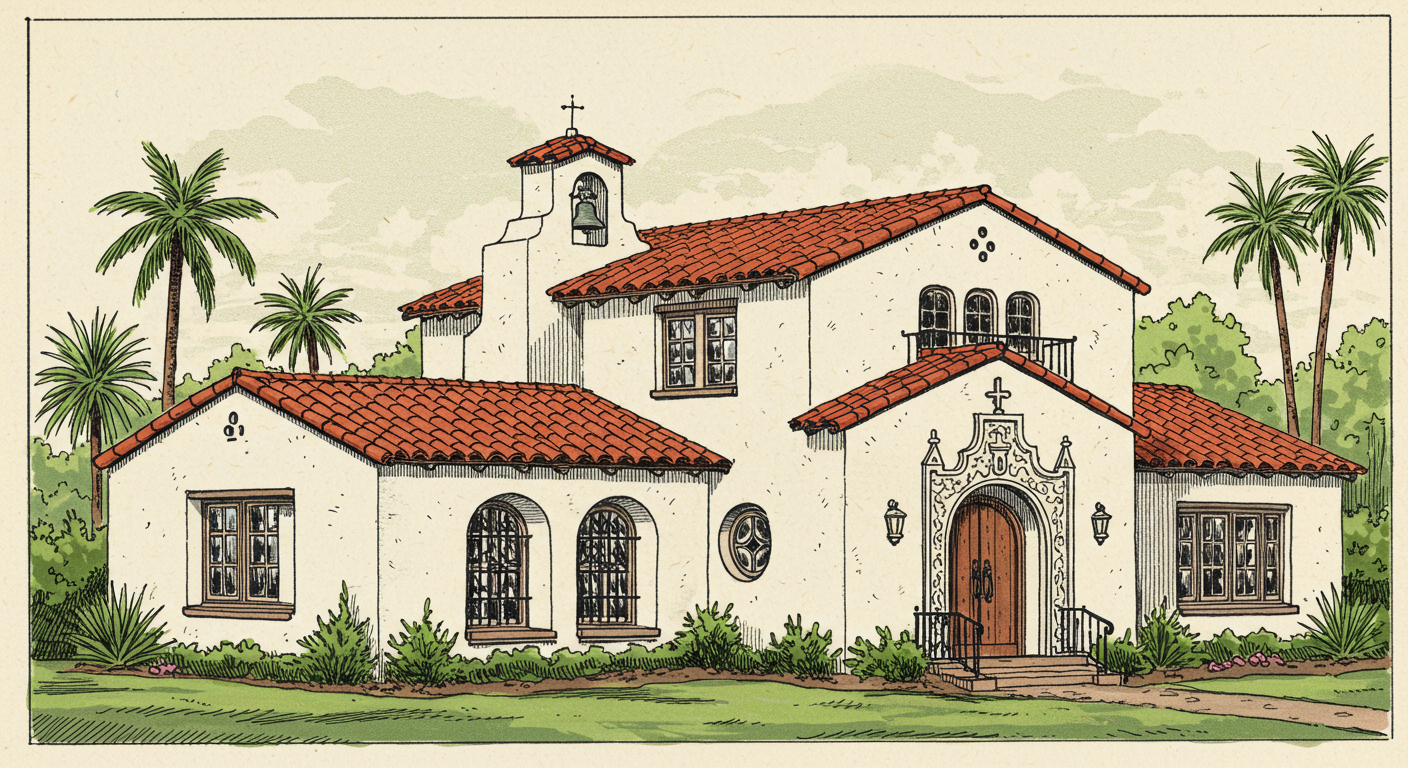
The Spanish Colonial Revival house of the inter-war American suburb — white stucco walls, a low-pitched roof of red clay tile, round-arched windows in rhythmic groups along the facade, a small wrought-iron balcony at the second storey, an interior courtyard glimpsed through a Moorish-arched garden gate, perhaps a small tower or campanario rising at one corner — is, on inspection, the precise Mediterranean inverse of the Tudor Revival the previous post described. Where the Tudor Revival quoted England, the Spanish Colonial Revival quoted Mexico and California’s own Spanish past, and through them the broader Mediterranean tradition of stucco-and-tile architecture that runs from the Andalusian villages back to the Roman colonial farmhouses they descended from.
This is the fourteenth post in Reading the American House. It treats the Spanish Colonial Revival because the Spanish Colonial Revival, taken together with the Tudor Revival of the previous post, constitutes the principal historicist argument of the inter-war American suburb. The same upwardly-mobile American professional class that bought a Tudor Revival in Bronxville or Shaker Heights bought a Spanish Colonial Revival in Beverly Hills or Coral Gables; the architectural choice was, in significant part, the regional one (a buyer in California or Florida or Texas would have found a Tudor Revival faintly ridiculous on a sunny suburban lot, just as a buyer in New York or Chicago would have found a Spanish Colonial Revival exotic and unsuitable); but the social and cultural meaning of the two styles was structurally the same. Reading them in succession illuminates the geography of the inter-war American suburb in a way reading either alone cannot manage.
The Specimen
If one is to identify a Spanish Colonial Revival — and one will find them in considerable numbers in the western and southern American suburbs built up between roughly 1915 and 1940, often constituting the dominant historical-style stock of those neighbourhoods — the exercise begins, like the Tudor Revival’s and the Foursquare’s, at the silhouette, but the silhouette one is reading is composed differently and is to be read for different things.
Begin at the roof. The Spanish Colonial Revival presents, almost without exception, a low-pitched roof of red clay barrel tiles — the so-called Spanish-S tile, set in courses that run with the slope of the roof and that catch and shed the southern California or southern Florida sun in the manner the Mediterranean farmhouses of two centuries earlier did. The pitch is moderate (ten to thirty degrees, considerably lower than the Tudor Revival’s steep gables), the colour is deep terracotta verging on rust, and the tiles are sometimes intentionally graduated in tone to suggest the mottled weathering of a much older roof. Some examples carry a flat or near-flat roof hidden behind a parapet (in the more Mission-influenced or more Pueblo-influenced sub-styles), but the more common form across the broader category is the low-pitched tile roof.
The wall surface is the second decisive feature. A Spanish Colonial Revival house presents smooth stucco walls in white, cream, or pale terracotta, uniformly applied over a wood-frame (or, in California especially, hollow clay tile or concrete block) wall, with the stucco often deliberately troweled in a slightly irregular hand-finish texture to suggest age. The smooth white stucco is the principal colour signature of the style and is what reads from across the block. There is no half-timbering, no brick coursing, no shingle work; the wall surface is unified and continuous. Where decorative articulation appears on the wall, it is typically cast-stone or carved limestone surrounds at the principal openings — a richly ornate entrance surround, a sculpted window head, the small balconette frame of an upper window — set as discrete events against the otherwise plain stucco field.
Examine the openings. Spanish Colonial Revival windows are typically small to medium in scale, often round-arched (sometimes Moorish-arched with the characteristic pointed apex), grouped in rhythmic arcades across particular bays of the facade, and often protected on the ground floor by wrought-iron grilles (the Spanish rejas) that read as the principal exterior decorative element of the lower storey. Multi-paned casement windows are the norm, sometimes with small leaded panes in the Mediterranean register, almost never the double-hung sash that dominates the Foursquare and the Colonial Revival. Where the second storey has windows, they are often deliberately smaller than the first storey, in a hierarchical arrangement that recalls the Spanish hacienda’s emphasis on the piano nobile (the principal floor) at ground level rather than at the first floor as in the European tradition.
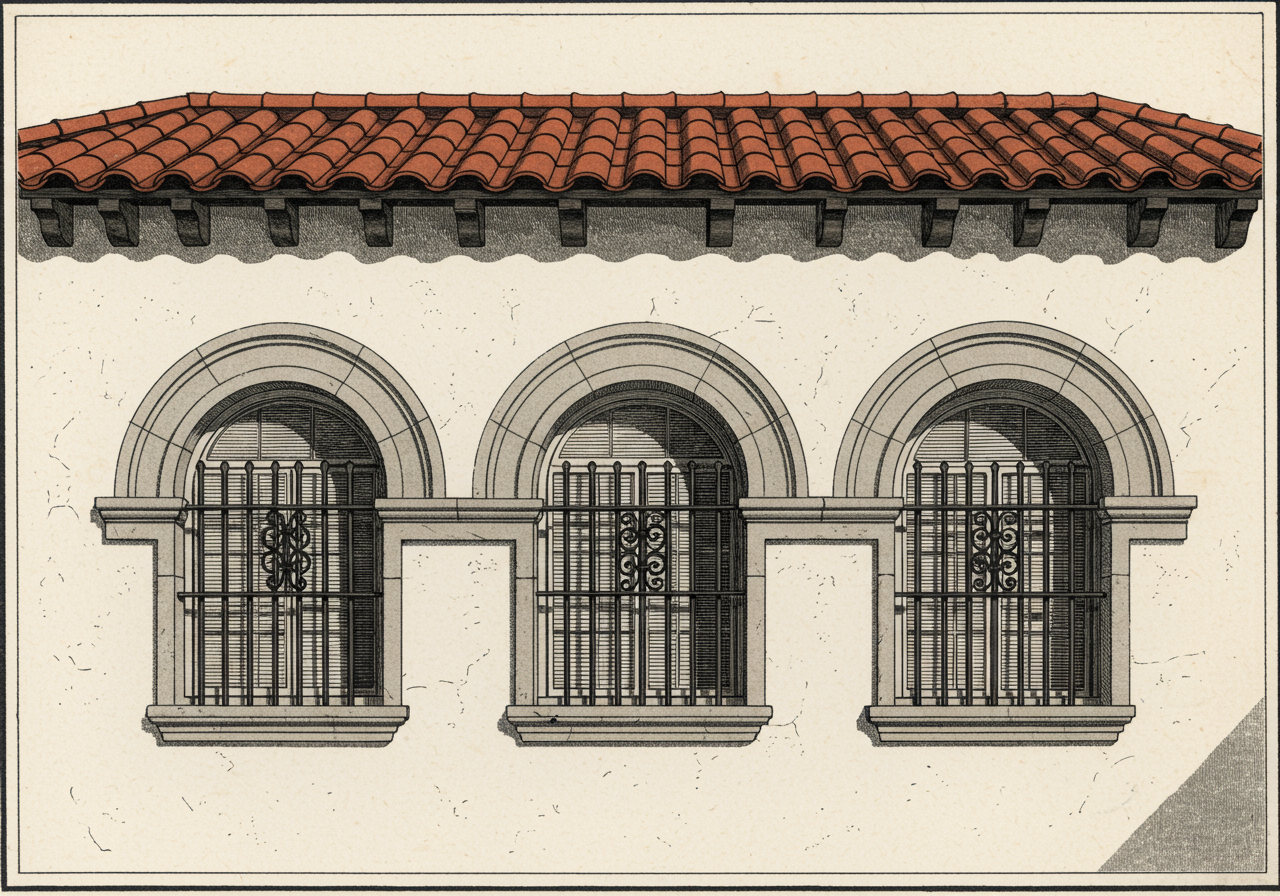
A close detail of a Spanish Colonial Revival arched arcade — three round-arched openings in smooth white stucco with cast-stone surrounds, the low-pitched terracotta tile roof visible above, wrought-iron grilles at the ground floor. The round arch is the principal opening shape of the style, in rhythmic alternation with the wall surface, and the arcade composition (three or five or seven openings in regular rhythm) is one of the principal facade-organising moves of the better Spanish Colonial Revival houses. The contrast between the smooth white stucco field and the cast-stone surround of the arch is what draws the eye to the openings as a major elevational feature.
Examine the entrance. The Spanish Colonial Revival presents its principal door under an elaborate cast-stone or carved-limestone surround in one of two principal vocabularies. The first is the Churrigueresque (named after the late Spanish baroque architects José Benito and Joaquín Churriguera) — densely-carved ornament of intertwined foliage, cartouches, scrollwork, broken pediments, and figurative sculpture, all in a high-relief composition that occupies the entire wall surface around the entrance. This is the most elaborate variant and is associated with the upper-class commissions of the period. The second is the Plateresque — flatter low-relief ornament of medallions, garlands, and classical detailing, somewhat more restrained than the Churrigueresque and more common on the mid-market suburban specimens. Some examples present a much simpler entrance — a plain wooden door under a small Mission-style projecting hood, in the more austere Mission Revival sub-vocabulary — but the elaborate carved surround is the more characteristic of the broader category and is the entrance treatment most readers will recognise as the “Spanish Colonial” signature.
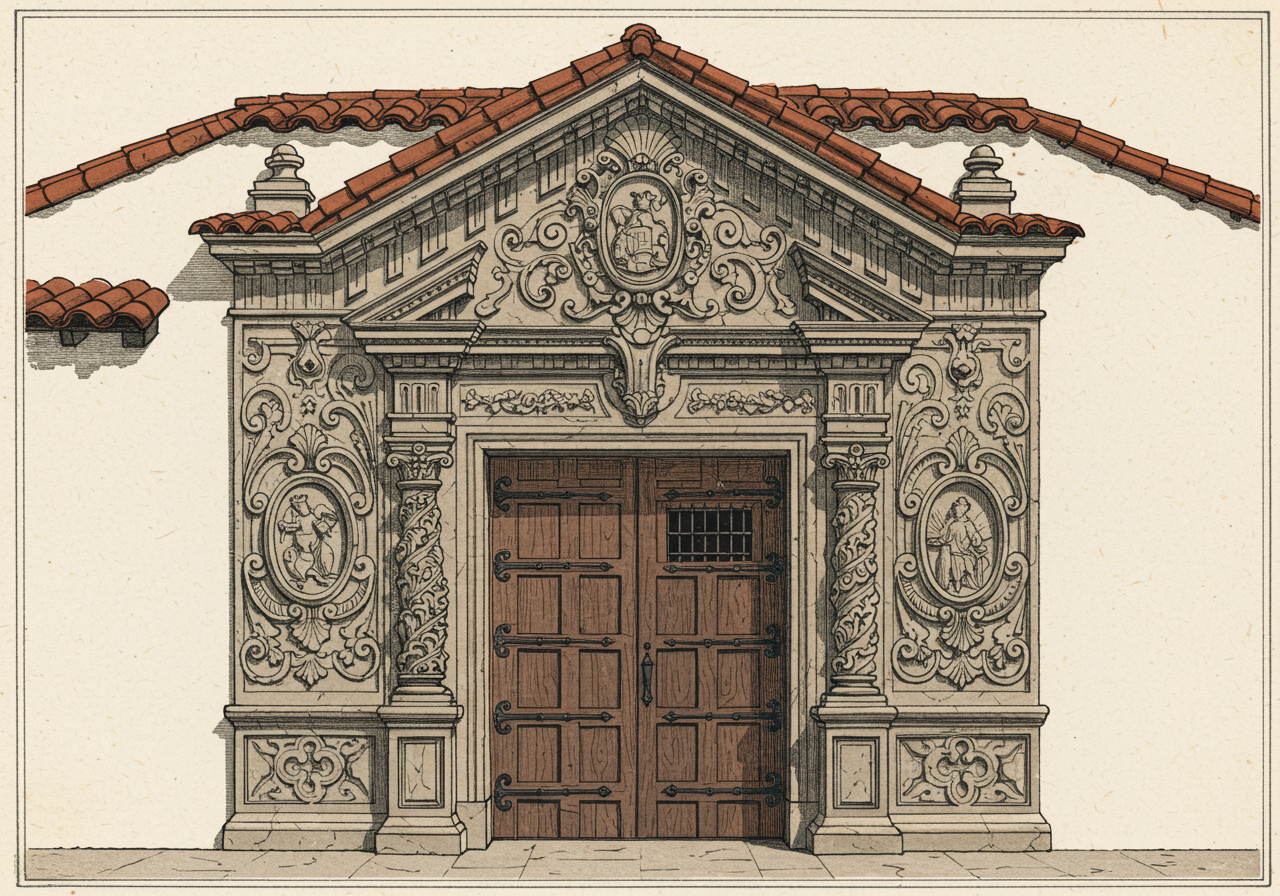
An ornate Churrigueresque-style cast-stone entrance surround on a Spanish Colonial Revival house — densely-carved foliage, cartouches, scrollwork, broken pediments, and figurative sculpture in high-relief framing a heavy panelled wooden door, set against the smooth white stucco of the surrounding wall. The Churrigueresque vocabulary descends from the late Spanish baroque of the seventeenth and eighteenth centuries and through the Mexican colonial churches that the American Revival was directly quoting. The composition makes the entrance the principal sculptural event of the facade — in pointed contrast to both the Tudor Revival’s quiet Tudor-arched stone entry and the Colonial Revival’s symmetric pedimented portico.
Examine the decorative tile work. The Spanish Colonial Revival house carries, at particular significant points, coloured tile in the Spanish-Mexican tradition — Talavera tile from Puebla, Sevillan azulejo tile, or American reproductions of both, in deep blue, yellow, red, and green geometric or floral patterns. The tile appears on stair risers (particularly the principal stair from the entrance to the upper floor), on fountain surrounds (in the courtyard or as a wall-mounted shell), on fireplace hearths and reveals (particularly in the principal living room), and as decorative accents under the eaves or around the base of the campanario. The tile is, in modest quantities, one of the most reliable identifiers of the style, and a courtyard fountain surrounded by Talavera tile is the canonical Spanish Colonial Revival image of the period.
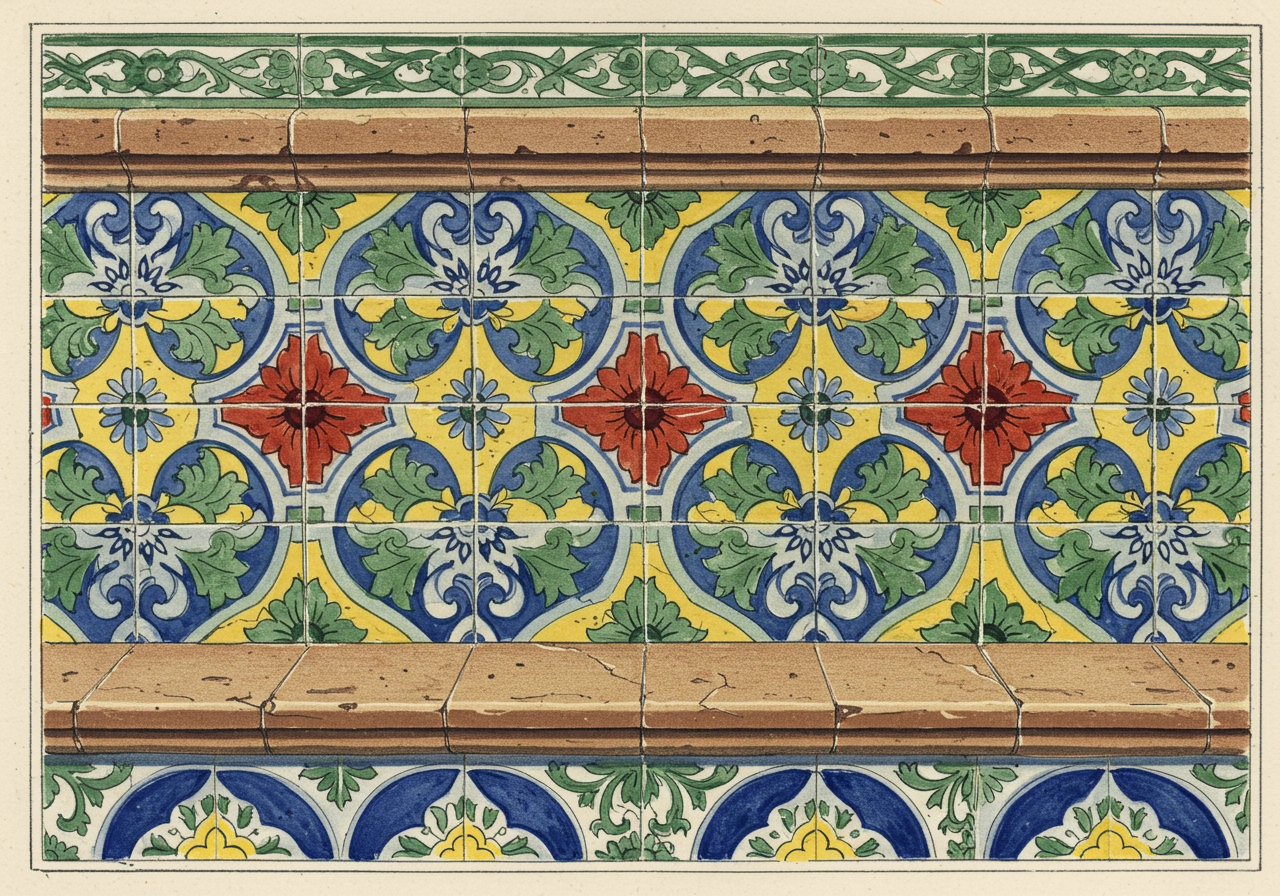
A close detail of Spanish Colonial Revival decorative tile work — Talavera-style tiles in deep blue, yellow, and red geometric and floral patterns, set into a fountain surround in an interior courtyard or onto the principal staircase risers. The tile tradition descends from the Spanish-Moorish azulejo work of Andalusia and through the Mexican colonial workshops that produced Talavera pottery at Puebla. The deep blue-and-yellow palette is the canonical Spanish Colonial Revival tile palette, and the geometric-and-floral repeat patterns are characteristic. A few square feet of tile, used at decisive points (the fountain, the stair, the fireplace), do as much work for the style’s visual identity as several thousand square feet of stucco.
Examine the composition of the facade as a whole. A Spanish Colonial Revival house is asymmetric and picturesque in composition, like the Tudor Revival but in a different vocabulary. The entry is usually off-centre, often set into a recessed bay or under a small projecting porch hood; the window groupings are clustered rhythmically across the facade rather than spaced symmetrically; the roof line is often broken by a single tower (the campanario or campanile, derived from the mission bell-tower tradition), or by a small recessed terrace, or by a stepped parapet. Each principal architectural event — the entry, the arcade, the campanario, the principal window group — occupies a particular bay of the elevation and is composed in relation to the others by the architect’s eye, in the same picturesque mode the Tudor Revival used in a different idiom.
A note on the interior. The defining interior feature of the Spanish Colonial Revival, where it is present at any scale, is the courtyard (the patio, in the Spanish usage that the style preserves). The courtyard is typically a partially-enclosed open-air space at the centre of the house plan, paved with terracotta floor tiles, often planted with citrus or palm or bougainvillea, frequently centred on a tiled fountain, and surrounded on at least one side by an arcaded gallery (the corredor) that connects the principal rooms. The courtyard descends directly from the Mexican-and-Spanish hacienda tradition, in which the courtyard was the social and climatic centre of the house — open to the sky for ventilation, shaded by the surrounding gallery, planted for visual interest. In the smaller Spanish Colonial Revival suburban houses the courtyard is reduced to a small patio at the side or rear; in the substantial Beverly Hills or Santa Barbara commissions it occupies the architectural centre of the plan, as it would in the original Mexican source.
Assemble these — the low-pitched terracotta-tile roof, the smooth white stucco walls, the round-arched windows in rhythmic arcades, the wrought-iron grilles at the ground floor, the ornate cast-stone entrance surround, the decorative tile accents at significant points, the asymmetric picturesque composition, often a campanario at one corner, often a courtyard at the plan’s centre — and one has a Spanish Colonial Revival. The variations within the type are considerable, ranging from the small five-room Los Angeles tract bungalow of perhaps fourteen hundred square feet to the substantial Santa Barbara estate of twelve thousand, but the principal moves do not vary.
The Mediterranean Suburb
The historical arc of the Spanish Colonial Revival in America is the story of a particular regional convergence of climate, history, immigration, and commercial circumstance that produced, in the western and southern United States across the four decades from 1890 to 1940, the dominant historical architecture of the upper-middle and upper-class suburb.
The roots of the style are several and ought to be sorted carefully, because the term Spanish Colonial Revival has been used by the trade to cover a range of buildings whose actual antecedents are different and whose differences are worth observing.
The first antecedent is the California Mission tradition — the chain of twenty-one Spanish missions established by the Franciscan order between 1769 (San Diego de Alcalá) and 1823 (San Francisco Solano de Sonoma) along the California coast at roughly one-day-on-horseback intervals. The missions are simple stucco-and-tile structures of considerable architectural restraint, with curved Mission-style parapets, austere bell towers, deep splayed window reveals, minimal ornament, and a heavy massing rooted in the practical considerations of frontier construction. The actual missions were, by the late nineteenth century, in considerable disrepair (many had been ruined during the Mexican secularisation of 1834 and the subsequent American period), and the late-nineteenth-century interest in their preservation — championed by Charles Fletcher Lummis and the Land of Sunshine magazine after 1894 — was both the impetus for the first Mission Revival buildings and the beginning of the broader Spanish Colonial Revival movement.
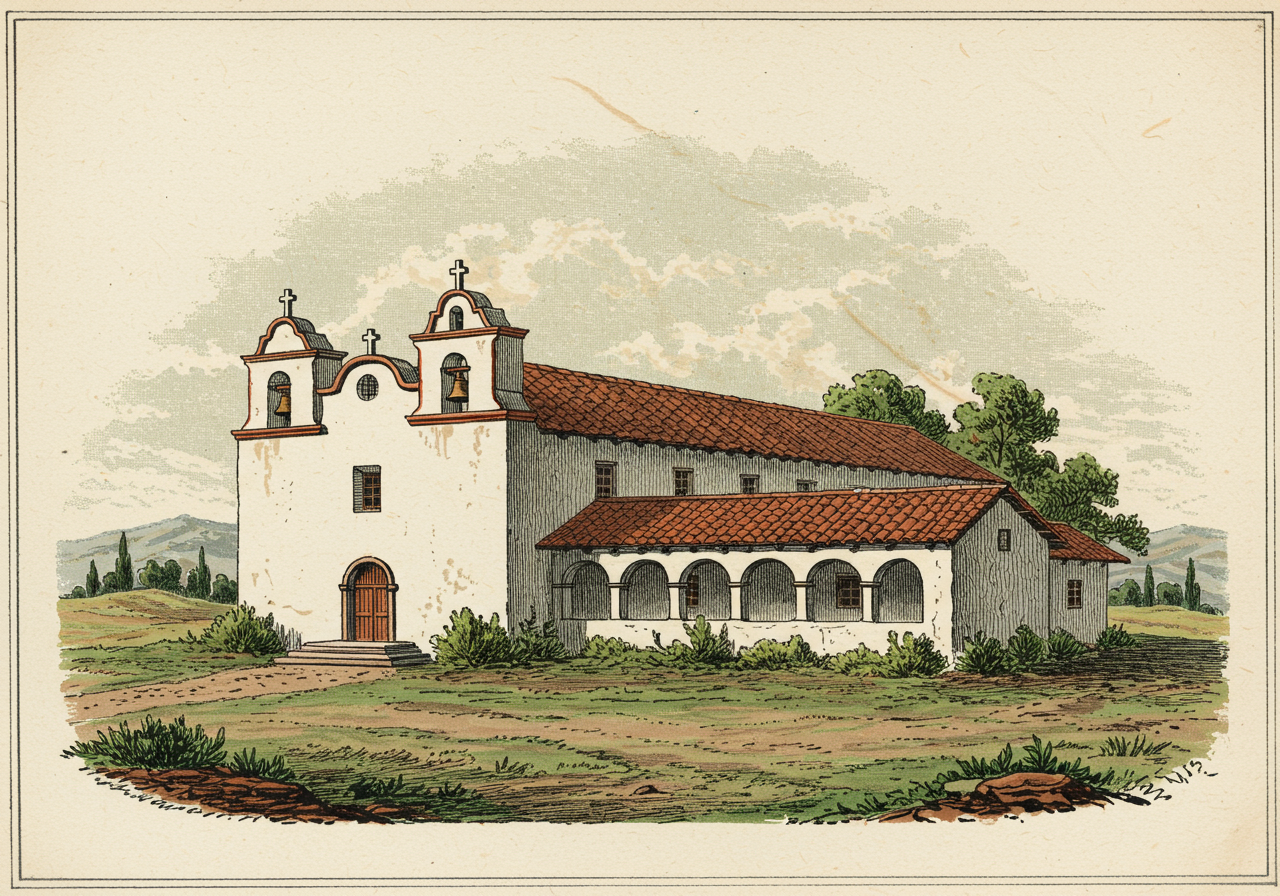
A California Spanish mission of the late eighteenth or early nineteenth century — smooth white stucco walls, low-pitched red tile roof, curved Mission-style parapet at the entrance, an arched arcade of the colonnaded gallery (the corredor), and a simple campanario bell tower. The missions were the principal architectural antecedent of the American Spanish Colonial Revival, and the late-nineteenth-century interest in their preservation (championed by Charles Fletcher Lummis after 1894) was the impetus for the first Mission Revival buildings of the 1890s. The actual missions were architecturally austere by the standards of what the Revival made of them, but the basic vocabulary — stucco, tile, arch, parapet, campanario — descended unaltered.
The second antecedent is the Mexican Spanish Colonial tradition more broadly — the churches, the haciendas, the public buildings produced across what is now Mexico from the sixteenth through the nineteenth centuries. This tradition is considerably more elaborate than the California missions, with the Churrigueresque ornament that characterises the late-baroque churches (the cathedral of Mexico City, the Sanctuary of Ocotlán, the parish church of Taxco), the Talavera tile tradition of Puebla, the azulejo tradition derived from Spanish Andalusia and applied to Mexican walls and floors, and the courtyard-and-arcade composition of the Mexican hacienda. The American Spanish Colonial Revival drew directly on this Mexican tradition for its ornament, its tile, and its plan, often more directly than on the simpler California missions.
The third antecedent is Spanish architecture itself — the Moorish-Andalusian synthesis of southern Spain (the Alhambra, the Mezquita of Córdoba, the white-washed villages of the Sierra Nevada and the Andalusian countryside), the Castilian-Renaissance tradition of central Spain, and the late-Spanish baroque that produced the Churrigueresque vocabulary that the Mexican colonial churches subsequently developed. American architects of the period — Goodhue, Smith, Neff, Mizner — travelled to Spain and to Mexico and brought back drawings, photographs, and direct architectural quotation. The buildings they produced were, by the testimony of their published works, conscious quotations of specific Spanish and Mexican antecedents, and one can in many cases identify the specific Spanish building a particular American Spanish Colonial Revival house is quoting.
The catalysing event for the Spanish Colonial Revival as a mass phenomenon was the Panama-California Exposition of 1915 in San Diego. Bertram Grosvenor Goodhue, the principal architect of the exposition, designed a set of fantasy Spanish Colonial buildings — the California Tower, the Casa del Prado, the buildings of the Plaza de Panama — that demonstrated the commercial potential of the style on a public stage. The exposition ran for two years, was visited by some thirty-eight million people, and produced a body of architectural drawings (published in Goodhue’s monograph The Architecture and the Gardens of the San Diego Exposition of 1916) that became the design vocabulary the subsequent decade of Spanish Colonial Revival residential architecture drew on. The exposition’s effects were immediate: by 1920 the Spanish Colonial Revival was the dominant new-construction style in the upper-class neighbourhoods of Los Angeles, Pasadena, Santa Barbara, San Diego, Beverly Hills, Coral Gables, Palm Beach, and the more substantial neighbourhoods of Houston, Dallas, Phoenix, and Tucson.
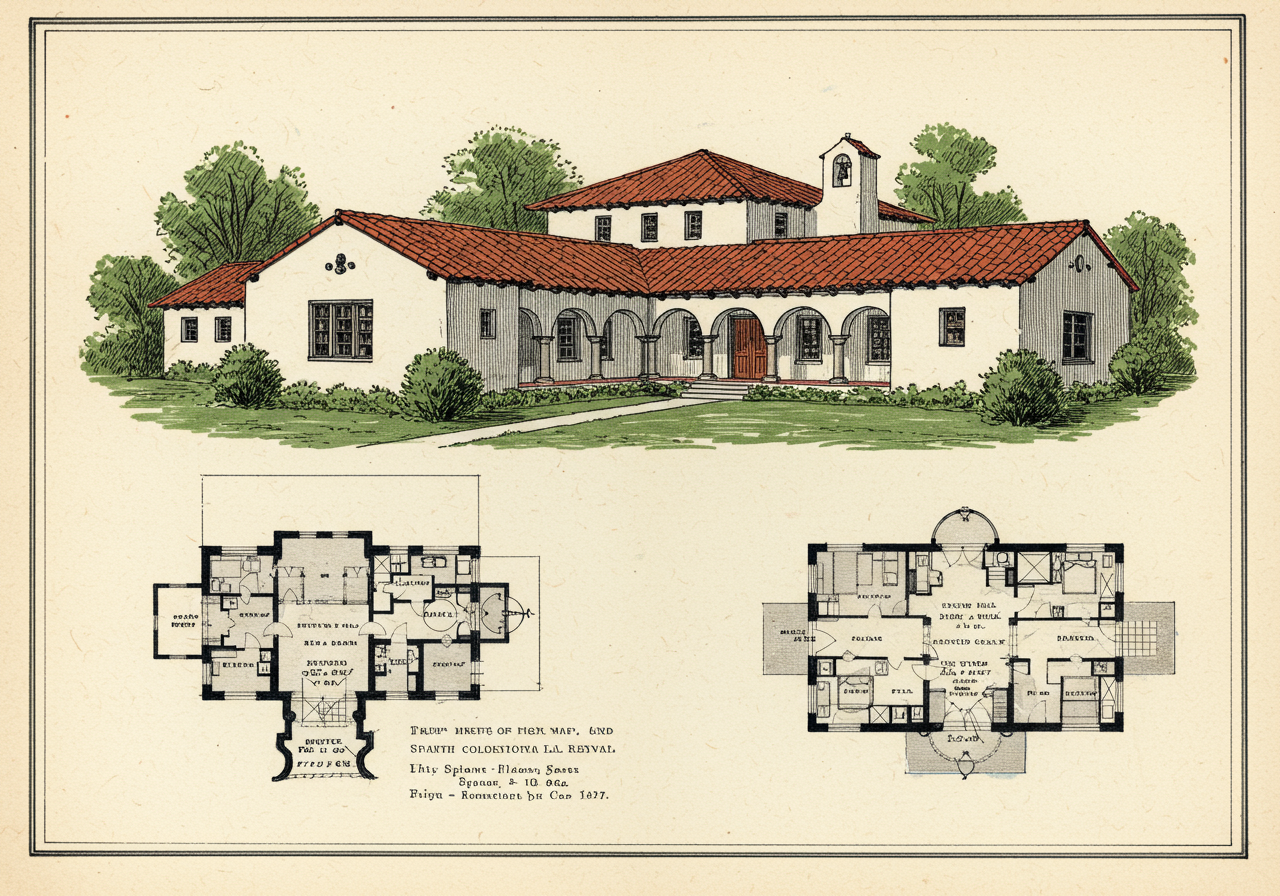
A page from a 1920s architects’ pattern book showing a Spanish Colonial Revival house — perspective rendering with the low terracotta-tile roof and white stucco walls, principal-floor plan showing the central courtyard with surrounding rooms accessible through an arcaded gallery, second-floor plan with bedrooms arranged around the open courtyard above. The pattern-book trade for the Spanish Colonial Revival was substantial in the 1920s — books such as Rexford Newcomb’s The Spanish House for America (1927) and the Mediterranean Architecture portfolios of the period provided the working vocabulary that the suburban architects of California, Florida, and the southwest drew on through the decade. The plan with central courtyard is the most distinctive Spanish Colonial Revival feature when present, and was the principal architectural argument for the style at the upper end of the market.
The mature period of the American Spanish Colonial Revival ran from roughly 1920 to 1935. In that span the style was the dominant new-construction shape across the western and southern American suburbs, in every metropolitan area in those regions of any consequence, with a particular concentration in California (Los Angeles, Pasadena, Santa Barbara, San Diego), Florida (Miami, Coral Gables, Palm Beach, Boca Raton), Texas (River Oaks in Houston, Highland Park in Dallas), and Arizona (the better neighbourhoods of Phoenix and Tucson). The style was sold through the same combination of architect-designed commissions at the upper end and pattern-book or kit-house production at the middle. By 1928 a typical block of new construction in such a suburb would have been seventy or eighty per cent Spanish Colonial Revival, with the remaining houses divided among Mediterranean Revival (a related and sometimes-interchangeable category), Tudor Revival (occasional and somewhat incongruous in the regional context), and Mission Revival (the earlier sub-style).
A note on the named architects, because the Spanish Colonial Revival is a style with substantially documented authorship. Bertram Grosvenor Goodhue (1869–1924) was the foundational figure, both for the 1915 Exposition and for his earlier work on the architecture of the American Catholic church. George Washington Smith (1876–1930) of Santa Barbara was the most refined of the residential masters, producing a body of Spanish Colonial Revival houses in Montecito and Santa Barbara of considerable austerity and beauty (the Heberton House, the Steedman estate, the Lobero Theatre); his work is sometimes called the Andalusian style for its references to the simpler Spanish vernacular. Wallace Neff (1895–1982) of Pasadena was the master of the Beverly Hills commission, designing the original Pickfair for Mary Pickford and Douglas Fairbanks, the Diane Keaton house, and several dozen substantial Beverly Hills mansions. Reginald Johnson, Roland Coate, Marston and Maybury were the second-tier of the California school. Addison Mizner (1872–1933) was the principal Florida architect, producing the extraordinary commissions of Palm Beach and Boca Raton in the 1920s in a particularly exuberant register. Carleton Winslow worked with Goodhue at the 1915 Exposition and continued in the style independently. The combined body of architect-designed Spanish Colonial Revival residential work runs into the thousands of substantial commissions, considerably more than the comparable Tudor Revival corpus, and the upper-end stock is among the most-prized residential architectural inventory of the period.
The end came, as with the Tudor Revival, in stages. The first stage was the Depression, which after 1929 reduced new construction in the western and southern suburbs by a substantial fraction and ended most of the upper-end commissions. The second was the war, which suspended all non-essential residential construction across 1941–1945. The third was the post-war shift in residential preference toward the smaller and less-decorated California Ranch (which emerged in the late 1930s under Cliff May and which itself descended in part from the Spanish Colonial Revival but in a stripped-down form), then toward the still-simpler minimum traditional and modernist housing of the post-war suburban boom. By 1955 a new Spanish Colonial Revival was a rare commission; by 1965 it had effectively disappeared as a current style, surviving only as the existing stock that the 1920s and 1930s suburbs had built.
The American Spanish Colonial Revival’s total production, summed across all the western and southern suburbs of all the affected metropolitan areas, is somewhere on the order of two hundred thousand to three hundred thousand houses across the period 1900–1940. This is more than the Tudor Revival’s hundred thousand or so, less than the Foursquare’s million and a half, and concentrated in particular kinds of neighbourhoods that have, in most cases, survived intact and are now among the most valuable residential real estate in the country. The Beverly Hills Spanish Colonial Revival house of 1926 and the Coral Gables Spanish Colonial Revival house of 1927 are still, in 2026, what their original buyers paid them to be: the architectural marker of a particular kind of upper-middle American arrival.
What It Is Not
Four styles stand near enough to the Spanish Colonial Revival that the beginner confuses them with it, and distinguishing them is most of the work of reading the western and southern American suburban street at the upper end of the market.
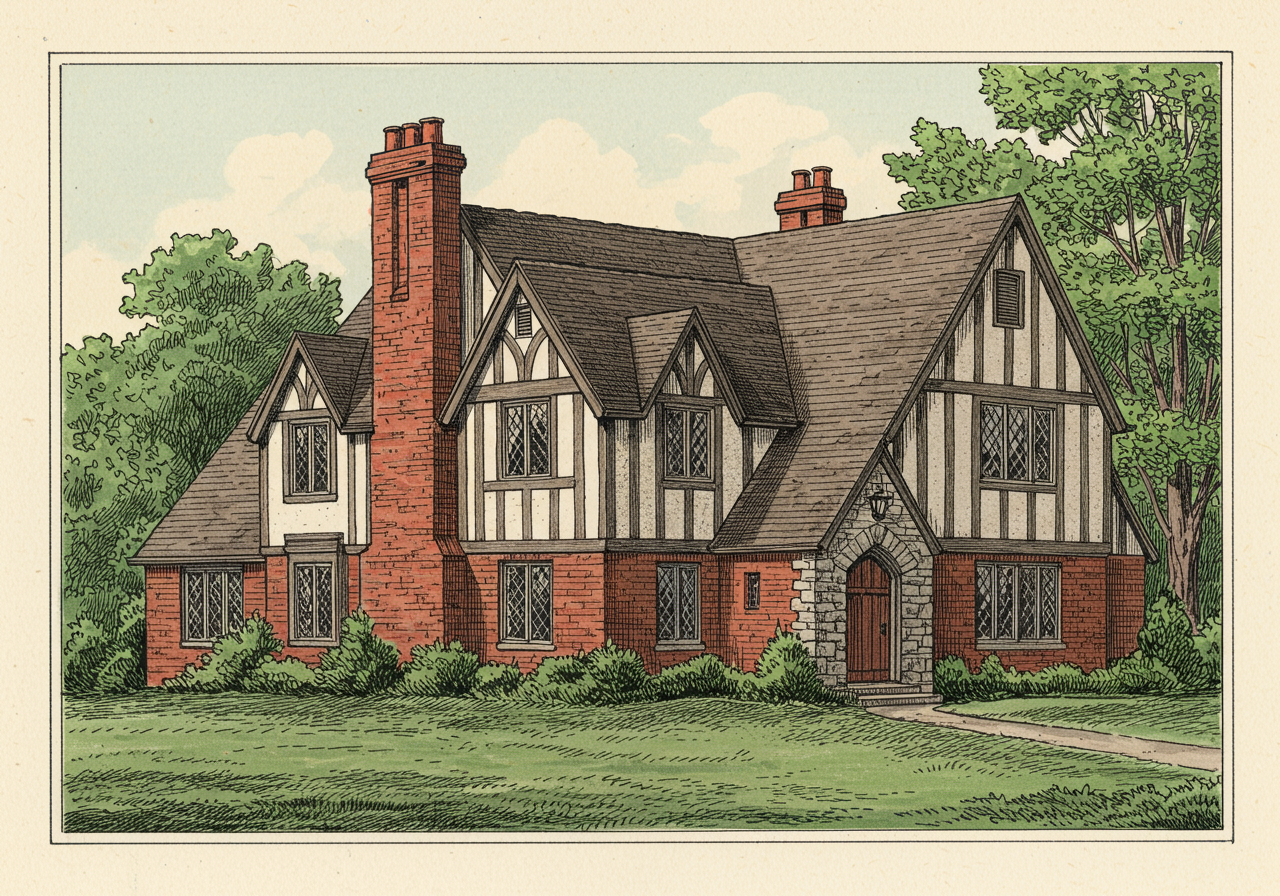
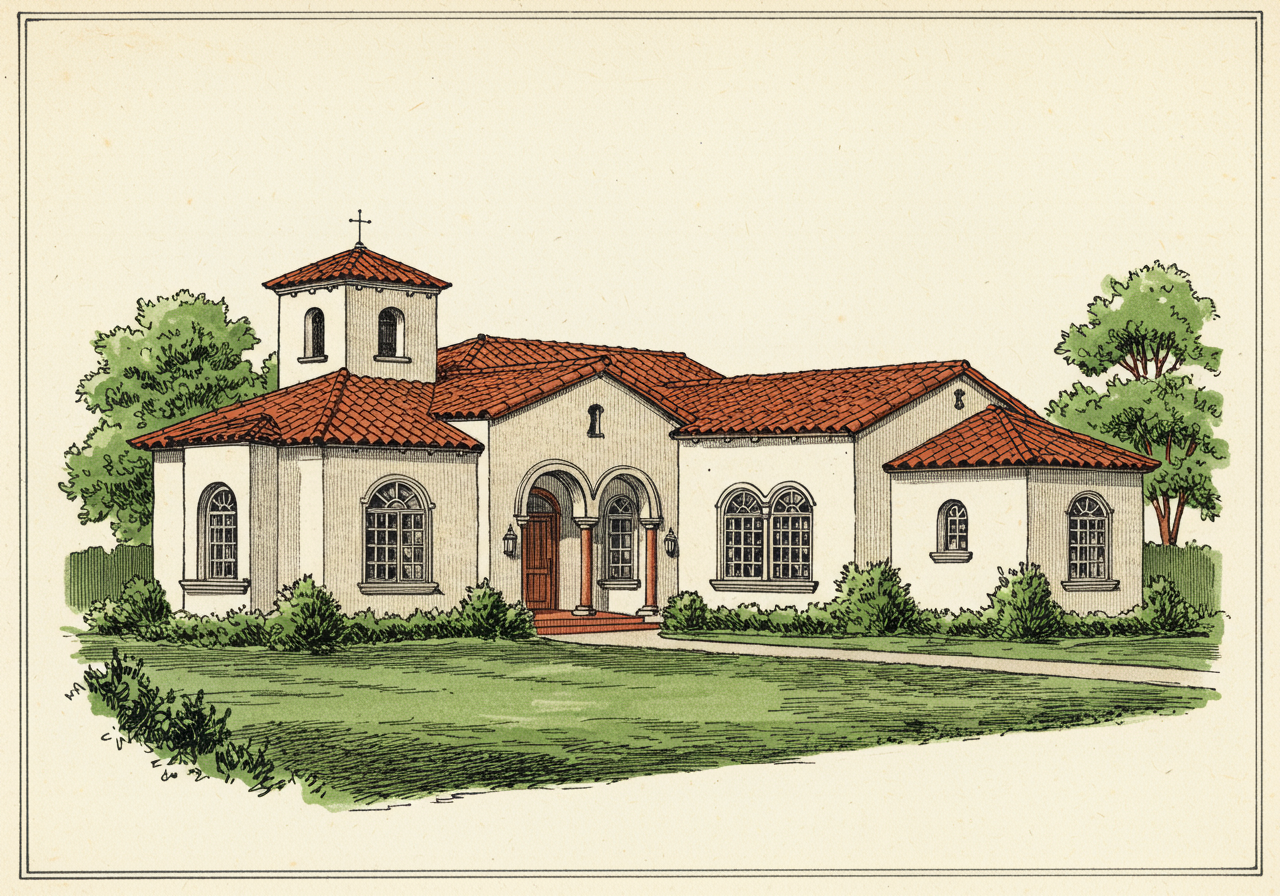
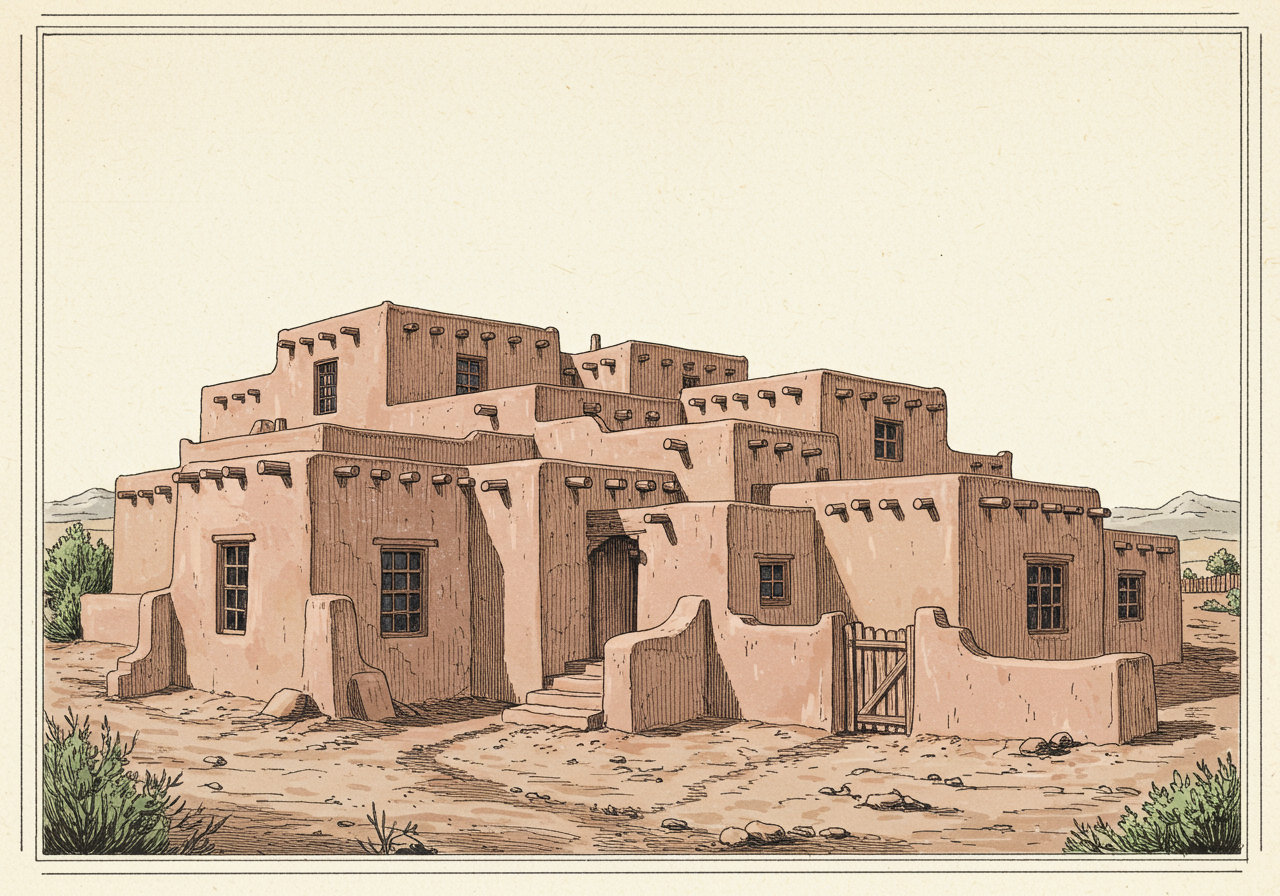
The first is the Tudor Revival — examined in the previous post and the Spanish Colonial Revival’s direct historicist counterpart at the same upper-middle suburban price point but in the opposite regional and cultural register. The Tudor Revival quoted the English manor house; the Spanish Colonial Revival quoted the Spanish hacienda. The Tudor Revival flourished in the Northeast and Midwest; the Spanish Colonial Revival flourished in the West and South. The two styles competed for the same buyer in the limited overlap zones (parts of upper-middle Beverly Hills carried both in the 1920s, as did parts of upper-middle Westchester County), but in their respective dominant regions each was the default historicist commission and the other was the exotic departure. The visual distinctions are immediate: half-timbered upper storey and slate roof and Tudor-arched entry is Tudor Revival; smooth stucco walls and red tile roof and Churrigueresque entry is Spanish Colonial Revival. The rule of thumb: gray-and-brown northern palette is Tudor; white-and-terracotta southern palette is Spanish Colonial.
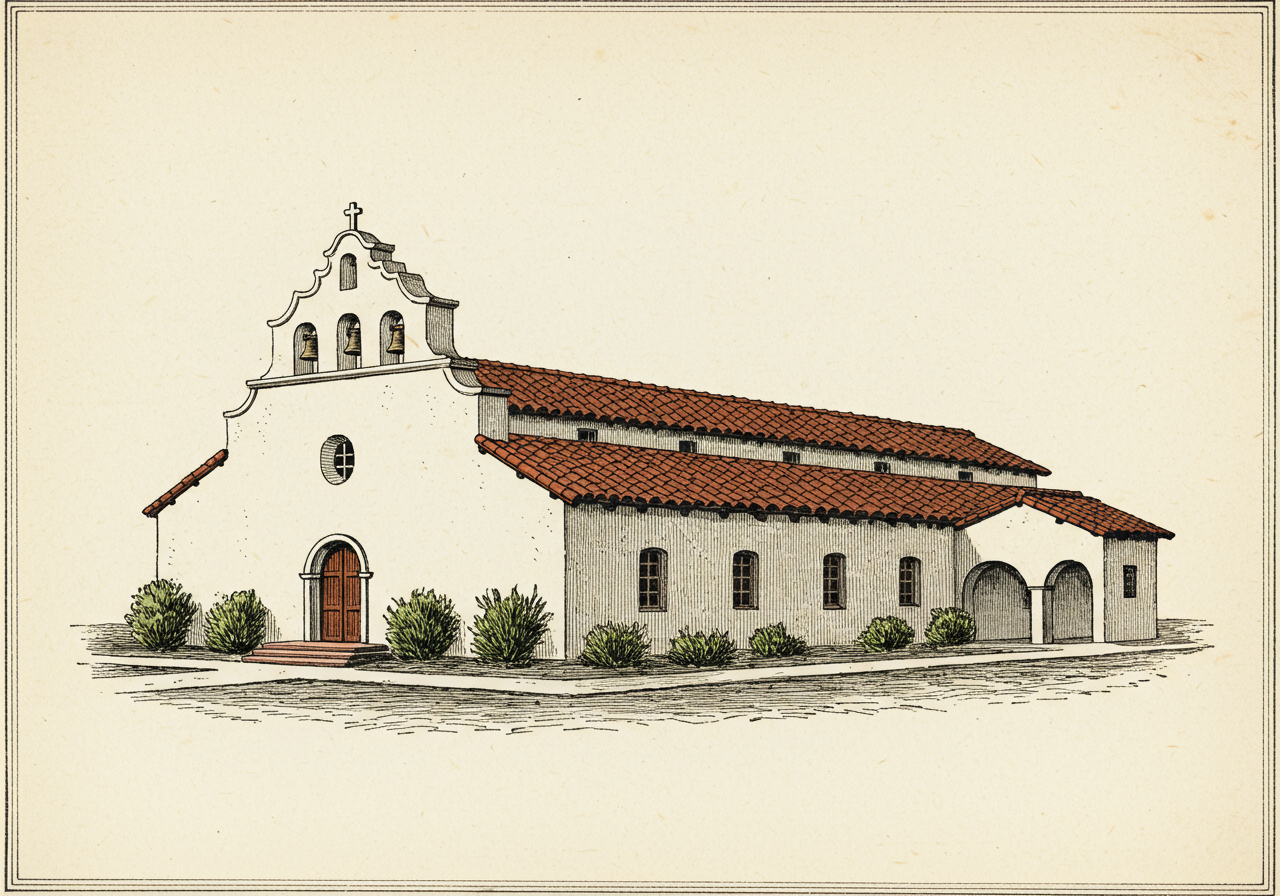
The second is the Mission Revival (1890–1915) — the earlier and more austere predecessor of the Spanish Colonial Revival proper. Mission Revival buildings carry the same fundamental vocabulary (stucco walls, tile roof, arched openings, asymmetric composition) but in a much more restrained register, with the curved Mission-style parapets at the entrance, the simpler campanario bell-tower elements, the absence of the elaborate Churrigueresque ornament that distinguishes the high Spanish Colonial Revival of the 1920s. The Mission Revival was the precursor that prepared the ground for the Spanish Colonial Revival’s mass adoption after 1915. A modest Mission Revival cottage of 1905 and an elaborate Beverly Hills Spanish Colonial Revival mansion of 1928 are the two ends of a single stylistic continuum; the post-1915 elaborated version is what the broader category most often means. The rule of thumb: austere with curved parapets and minimal ornament is Mission Revival; elaborated with Churrigueresque entries and decorative tile is Spanish Colonial Revival proper.
The third is the Mediterranean Revival — sometimes used interchangeably with the Spanish Colonial Revival in trade and dealer literature, but technically a broader category that includes Italian Renaissance Revival, French Provençal Revival, and other non-Spanish Mediterranean sources. A Mediterranean Revival house may carry the same stucco-and-tile vocabulary as a Spanish Colonial Revival but with Italian Renaissance details (classical columns, formal symmetric composition, Tuscan towers, terrazzo floors) or French Provençal details (provincial round-arched openings, ochre stucco, terracotta accents) rather than Spanish-Mexican details. In Florida especially the Mediterranean Revival was the dominant terminology, with Spanish-Mexican references mixed freely with Italian-French sources in the same building. The rule of thumb: if the ornament is specifically Spanish (Churrigueresque, azulejo tile, hacienda courtyard) it is Spanish Colonial Revival; if the ornament is broadly Mediterranean without specifically Spanish references, Mediterranean Revival is the more correct term.
The fourth is the Pueblo Revival (also called Santa Fe Style) — the Southwestern variant rooted in the actual Pueblo and Spanish-influenced adobe architecture of New Mexico, Arizona, and west Texas. Pueblo Revival buildings carry thick walls (suggesting adobe construction even when they are wood-frame stucco), flat roofs with projecting vigas (wooden roof beams extending through the wall), deliberately rounded corners and apertures, deep window reveals, an earth-tone palette of soft tans and pinks and browns, and explicit reference to the Native American Pueblo tradition alongside the Spanish-colonial influence. The Pueblo Revival is geographically distinct (concentrated in Santa Fe, Taos, Albuquerque, parts of Phoenix and Tucson) and stylistically distinct (the flat roof, the vigas, the earth-tone palette) from the Spanish Colonial Revival proper, though the two are sometimes lumped together by dealers unfamiliar with the regional distinctions. The rule of thumb: flat roof with projecting vigas and earth-tone palette is Pueblo; low-pitched tile roof with white stucco and ornate Spanish details is Spanish Colonial.
What It Was Trying to Say
The Spanish Colonial Revival flourished in the American suburb for forty years — its peak running from about 1920 to 1935 — and produced, in that span, the upper-middle and upper-class residential architecture of the inter-war western and southern American suburb. The cultural temper that supported it was a particular regional variant of the same Anglo-American suburban aspiration that produced the Tudor Revival in the Northeast and Midwest — a desire on the part of the upwardly-mobile American professional class to claim, through the architecture of their houses, a connection to a particular historical antecedent that the class itself had no actual lineage to.
What the style was trying to say is best taken, as with the Tudor Revival, as the sum of three arguments running in parallel.
The first argument is the regional historicism argument. Where the Tudor Revival quoted English history to claim Anglo-Saxon heritage at a moment of mass immigration from non-Anglo countries, the Spanish Colonial Revival quoted California’s own Spanish-Mexican history to claim a regional heritage that, in the western and southern American context, made considerably more sense than the imported English vocabulary. California, after all, had actually been a Spanish colony from 1769 to 1822 and a Mexican territory from 1822 to 1848; the Spanish missions and the few surviving Mexican hacienda buildings were the actual historical architecture of the region the buyer was now living in. The Spanish Colonial Revival house was, in this argument, a Mediterranean climate-and-history adaptation that the Tudor Revival could not match — the building referred to a real Spanish-Mexican past rather than to a fictitious English one, and the regional argument was, by the standards of the period’s debate, considerably stronger.
The second argument is the climate-and-place argument. The Spanish Colonial Revival was, more than any of the other historicist styles of the period, an explicitly climatic architecture. The stucco walls reflected the southern California or southern Florida sun rather than absorbing it as the dark wood of the Tudor Revival would have done. The low-pitched tile roof was suited to a region of mild winters and minimal snow load. The courtyard organisation provided cross-ventilation and shade in the manner the Mexican hacienda had been designed to provide. The wrought-iron grilles protected the ground-floor windows in regions where the climate permitted (and the residential security culture sometimes required) more open ground-floor openings than the cold-climate Eastern equivalent. The argument was that the style was appropriate to its climate and region in a way the borrowed Tudor or Colonial Revival was not — and a Beverly Hills or Coral Gables Tudor Revival, even when one encountered it (and one occasionally did), read as a transplant that the Spanish Colonial Revival did not.
The third argument is the Hollywood-and-aspiration argument, and it is the one that explains why the Spanish Colonial Revival flourished in California particularly and in Florida secondarily. The 1920s Hollywood film industry was, by the testimony of the trade press and the surviving production stills, deeply committed to the Spanish Colonial Revival as the aspirational residential architecture of its own milieu. Mary Pickford and Douglas Fairbanks’s Pickfair (designed by Wallace Neff in 1919, the first Beverly Hills mansion of the modern era and the architectural model that subsequent Beverly Hills commissions consciously emulated) was a Spanish Colonial Revival. The Cecil B. DeMille house, the Greta Garbo house, the John Barrymore house, the Charlie Chaplin house — all were Spanish Colonial Revival. The fan magazines of the period reproduced the houses of the stars in considerable detail, and the aspirational suburban buyer in Los Angeles in 1928 was buying not merely an architectural style but the architectural style of the period’s most-photographed celebrities. The Florida equivalent was the Palm Beach society of the Mizner houses — the same dynamic in a different region. The Hollywood-and-Palm-Beach aspirational dimension of the Spanish Colonial Revival is what most distinguishes it culturally from the more restrained Tudor Revival of the Eastern country-club suburb, and the architectural similarities of the two styles disguise a substantial difference in the social meaning of the buildings.
What I find most telling about the Spanish Colonial Revival, taking these three arguments together, is the fit between the architectural quotation and the actual regional history. The Spanish Colonial Revival quoted Spanish-Mexican antecedents in the region that had actually been Spanish-Mexican, in a climate that actually suited the Mediterranean vocabulary, and the resulting buildings made an architectural argument that the buyer’s actual surroundings could support. This is a different position from the Tudor Revival’s, which quoted English antecedents in regions that had never been English in any meaningful sense and in a climate considerably colder than the English Midlands the architecture was drawn from. The Spanish Colonial Revival’s historicist argument was, in the strict accounting, more honest — it referred to a real past in a place where that past had really happened, and the resulting architecture, even at its most exuberant Beverly Hills extremes, was on stronger intellectual ground than its Tudor Revival counterpart.
This is, on inspection, the cleanest possible case of regional historicism in American residential architecture. The buyer of a 1928 Pasadena Spanish Colonial Revival house lived in a region whose actual architectural history was Spanish-Mexican, in a climate that actually suited the architecture, in a cultural milieu (the Hollywood circle, or the broader Los Angeles professional class) that had explicitly chosen this architecture as its aspirational signature, in an aesthetic register (the smooth stucco and the red tile and the arched arcade) that was demonstrably appropriate to the southern California light and the southern California garden. The Spanish Colonial Revival’s silence in the post-war architectural conversation was not the silence of a forgotten style — it was the silence of a style whose social moment had passed but whose architectural assumptions remained legible to anyone who walked the older neighbourhoods of the affected regions. The houses still stand; the courtyards still hold their fountains; the campanarios still rise at the corners of the substantial Pasadena and Beverly Hills and Coral Gables houses; the architectural record of the moment when the American West and South decided that the appropriate historicist quotation was Mediterranean rather than English remains in plain sight.
The next specimen I should like to take up is the Spanish Colonial Revival’s post-Depression descendant, the California Ranch — Cliff May’s stripped-down Mediterranean-influenced one-storey suburban house that emerged in the late 1930s, dominated post-war Western residential construction, and would become, in its descendants, the dominant American suburban shape of the second half of the twentieth century. Where the Spanish Colonial Revival had been the upper-middle commission of the inter-war Western suburb, the California Ranch became the middle-class default of the post-war Western suburb, and reading the two in succession illuminates how the historicist suburban architecture of the 1920s was domesticated into the mass-market suburban architecture of the 1950s.