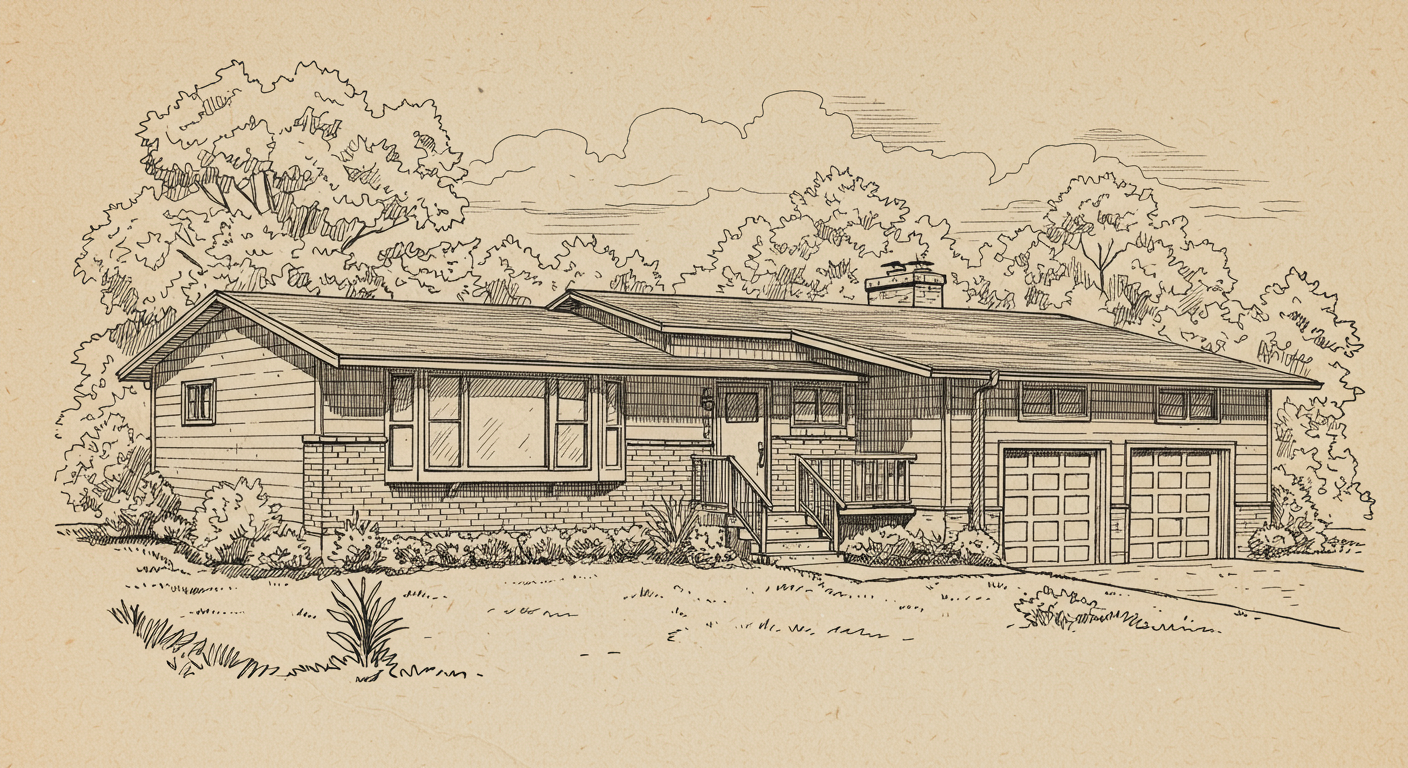
The California Ranch of two posts ago described the Western post-war suburb in its dominant residential form, and the Cape Cod of the previous post described its Eastern counterpart — the two-form architectural settlement on which the United States built something on the order of seventeen million single-family detached houses between 1945 and 1965. The Split-Level this post takes up is what happened to that settlement when the two parameters on which it had been designed — the flat or near-flat suburban lot, and the household of two or three children — both began to alter in the second half of the 1950s. The lot supplies in the established subdivisions of varied topography (the river-valley suburbs of the upper Midwest, the hill suburbs of the Pacific Northwest, the rolling lots of the Mid-Atlantic, the moraine country north of Chicago) began to push tract development onto sloping ground that the Ranch’s long horizontal footprint did not gracefully fit. The Baby-Boom household, in the same years, began to ask the same Ranch or Cape footprint to hold four or five children where it had been designed for two or three. The builder’s response was the Split-Level: a house that kept the Ranch’s broad horizontal silhouette and its low-pitched roof, but that reorganised the floor plan across three or four staggered half-storey levels under a single continuous roofline, so that the public rooms sat on one level, the bedrooms half a flight above, the family room and garage half a flight below, and the household was given the additional square footage and the additional bedroom count without the lot being asked to absorb a longer horizontal footprint than it could carry.
This is the seventeenth post in Reading the American House. It treats Split-Level in the position the Cape Cod post pointed toward — the late-1950s and 1960s descendant of the Ranch-and-Cape pair, named at the close of that post and reserved for treatment in this one. Read against its parents, the Split-Level is the post-war American suburban form’s first major morphological adjustment to its own success: the Ranch and the Cape had been designed for the flat lot and the smaller post-war family, and the Split-Level is what the same builders produced when the lot supplies and the family sizes both stopped looking like what those forms had assumed. It is also the form on which the post-war suburb’s load-bearing collector confusion sits, because what is loosely called a Split-Level is in fact not one form but at least two — a side-split in which the staggered levels are arranged across the width of the front facade, and a back-split in which they are arranged front-to-back along the depth of the lot — and the distinction is the one most American readers do not carry but most need.
The Specimen
If one is to identify a Split-Level — and one will find them in considerable numbers across the post-war suburbs of varied topography, often constituting the dominant residential stock of the 1958–1975 subdivisions in the regions where the form took hold — the exercise begins, as it did for the Ranch and the Cape before it, at the silhouette. But the Split-Level silhouette is doing something the two parent forms did not, and the something is the principal architectural fact about the style.
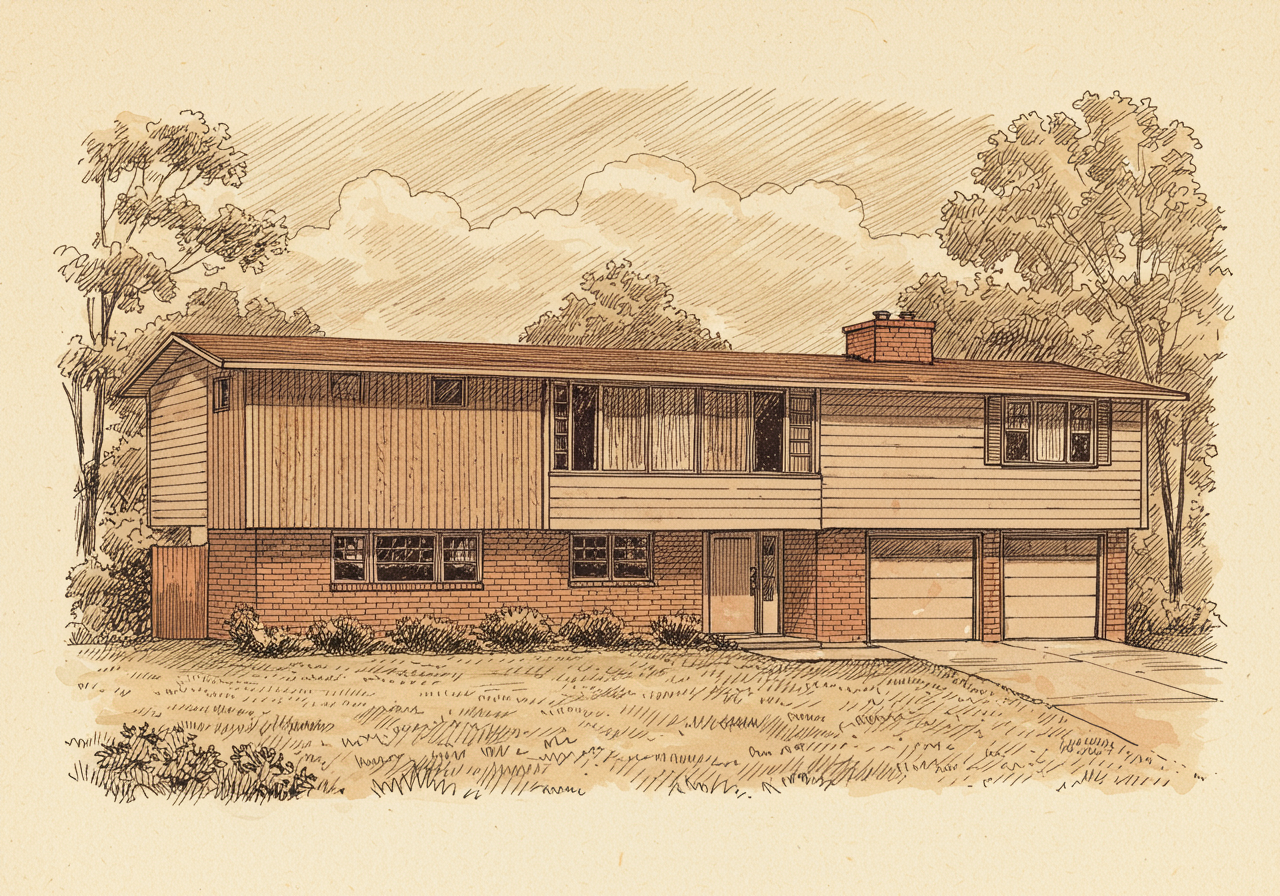
The principal feature is the broad horizontal silhouette under a single low-pitched roof, distributed across three or four staggered half-storey levels. A Split-Level presents a front-facade width comparable to the Ranch’s — typically forty to sixty feet across — with a roof in two or three planes pitched at roughly fifteen to twenty-five degrees, eaves projecting twelve to twenty-four inches (less broad than the Ranch’s eighteen-to-thirty-six but unmistakably horizontal), and a single continuous roofline running across the entire silhouette in pointed contrast to the Cape’s compact symmetric gable and the full-two-storey Colonial Revival’s tall vertical mass. What distinguishes the Split-Level immediately from the Ranch, however, is what sits under that roofline: a visible vertical step in the wall surface, typically of four to six feet (half a storey), where one part of the facade rises higher than the adjacent part because the floor levels behind it are at different elevations. The Ranch’s facade is rigorously horizontal; the Cape’s is rigorously symmetric; the Split-Level’s is stepped, and the step is the single fastest way to identify the style from the street.
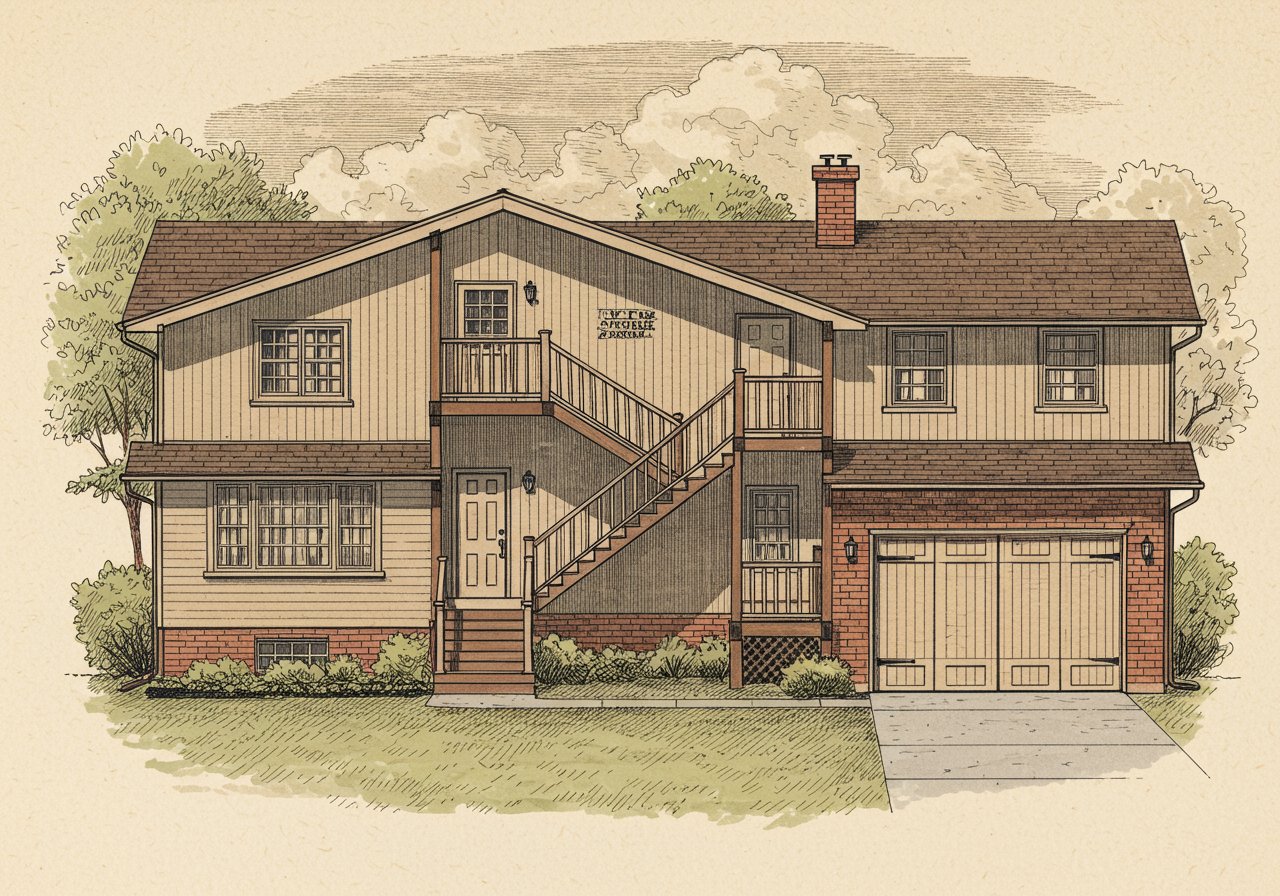
The canonical Split-Level staggered-levels arrangement — a lower level at or near grade housing the family room and the attached garage, a middle level half a flight above housing the kitchen and the living and dining rooms, and an upper level half a flight above that housing the bedrooms. The half-flight transitions of seven or eight risers each are the form’s defining interior move and the principal architectural reason for its existence. The image here shows a side-split, in which the levels are arranged across the width of the front facade — the side-split versus back-split distinction is the post’s load-bearing collector point.
The wall surface inherits directly from the Ranch. A Split-Level presents the same deliberately mixed materials the Ranch made canonical — a stretch of board-and-batten in stained earth tones, a stretch of common-brick veneer often used as a base course wrapping the lower level, a stretch of horizontal redwood siding or clapboard, and on the higher-priced builds a stretch of smooth stucco — combined across the staggered facade in calculated combinations that emphasise the vertical step rather than disguise it. The brick is typically used to ground the lower level (the family-room and garage portion), and the board-and-batten or clapboard rides above it on the middle and upper levels; the material change at the step underscores the level change behind it, so that the facade reads, from the street, as two or three different houses pressed together under one roof. Where the Cape’s wall is uniform and the Ranch’s wall is mixed-but-horizontal, the Split-Level’s wall is mixed-and-stepped, and the stepping is the variation the form adds to its inherited material vocabulary.
The roof, in pointed contrast, is continuous. A Split-Level’s defining trick is that the staggered floor levels are absorbed under what reads, from a sufficient distance, as a single roofline — usually a low-pitched gable with the ridge running along the long axis of the facade, occasionally a hip — in which the roof descends in two or three planes to follow the stepped floor levels behind. The lower level’s roof plane is at one elevation; the middle level’s is at a slightly higher one; the upper level’s, on a four-level back-split, is higher still. From across the street the effect is of a long low Ranch-style roof that has been creased once or twice horizontally, and that visual continuity is what allows the Split-Level to read as a Ranch-descendant rather than as a small two-storey house. The post-war builder’s choice to preserve the Ranch silhouette across the multi-level plan is the central architectural compromise the form made, and the choice is what holds the style together — without the continuous low-pitched roof the Split-Level would simply be an awkward small two-storey on a sloped lot.
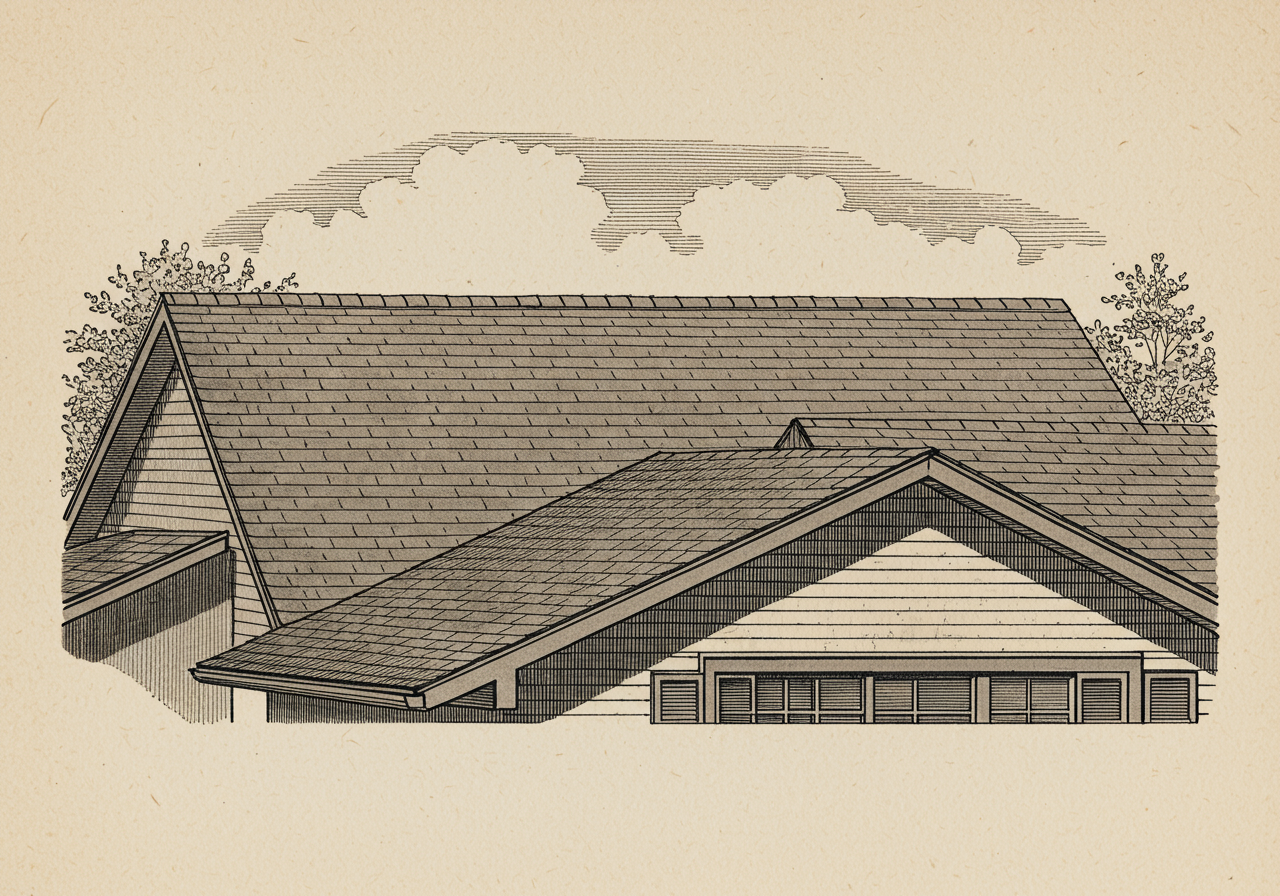
The canonical Split-Level continuous roofline — a single low-pitched gable at fifteen to twenty-five degrees of pitch, the ridge running along the long axis, the roof plane descending in two or three creases across the staggered floor levels behind, eaves projecting moderately less than the Ranch’s. The continuity of the roofline is what allows the form to read as a Ranch-descendant rather than as a small two-storey on a sloped lot — without the continuous low-pitched roof the silhouette would fall apart.
Three further features complete the front facade. The first is the picture window, inherited directly from the Ranch and placed at the principal living-room facade on the middle (entry) level — a single large fixed plate-glass pane flanked by smaller operable casements, running ten to fifteen feet across, the canonical Ranch facade event preserved on the Ranch’s descendant. The second is the attached garage, projecting at one end of the front facade in the Ranch manner but here set on the lowest level rather than continuous with the principal floor, with the garage door at or near grade and the family room beside or behind it sharing the lower-level slab; the lowest-level garage is the Split-Level’s principal innovation, and it allows the upper levels to sit free of the automobile and the heating plant. The third is the entry, which sits at the middle level — between the lower level (family room and garage) and the upper level (bedrooms) — and is reached by a short flight of four or five exterior steps from the front walk, with a small landing inside the front door from which one ascends seven or eight risers to the middle living-room level, or descends seven or eight to the lower family-room level. The entry-at-the-middle is the form’s defining circulation move and the one feature most reliably present across both side-split and back-split variations.
The Topographical Suburb
The documentary anchor of the Split-Level is not a single named builder-developer in the way Levitt and Sons anchored the Cape Cod or Cliff May anchored the Ranch — the Split-Level was a common-property form produced by the regional builder-developers of the late 1950s and early 1960s across the suburbs of varied topography, with no single firm responsible for its codification at the scale Levittown represented for the Cape. What can be said with more confidence is the topographical and demographic shift that produced it, and that shift is the principal account the post is owed.
The post-war suburb’s first decade (roughly 1946 through 1955) had been built on the flattest available land — the potato fields of Long Island for Levittown, the bean fields north of Long Beach for Lakewood, the orange groves of the San Fernando Valley for the Los Angeles tracts, the cornfields west of Chicago for the early Cook County subdivisions. These lots accommodated the Ranch’s long horizontal footprint and the Cape’s compact symmetric one without difficulty, and the FHA mortgage specifications of the period — which set minimum lot sizes, setbacks, and street widths, and which favoured rectangular footprints on level grade — were calibrated to flat-lot development. By about 1957 the flat lot supplies in the established commuter suburbs of the Northeast and the upper Midwest had begun to thin, and the next ring of subdivision land available to the regional builder-developers was, in many of those metropolitan areas, sloping land. The Schuylkill and Delaware valleys outside Philadelphia, the Hudson Valley north of New York, the Connecticut River Valley north of Hartford, the Cuyahoga Valley around Cleveland, the moraine country north of Chicago, the river-valley land along the Allegheny outside Pittsburgh, the rolling country outside Detroit, the Pacific Northwest hills outside Seattle and Portland — all carried lot supplies that the Ranch’s long horizontal footprint would not gracefully fit. A long one-storey house on a fifteen-percent grade requires either substantial cut-and-fill earthwork (expensive) or a stepped foundation with portions of the slab at different elevations (also expensive, and producing the same level changes the Split-Level absorbed under its roof in any case). The regional builders’ response — and the response appears in the trade literature of the late 1950s with no single point of origin — was to embrace the level changes the lot was already producing, and to absorb them into the plan as designed features rather than as constructional inconveniences.
The demographic shift ran in parallel. The Baby Boom — the post-war fertility surge that began in 1946 and ran through 1964 — produced household sizes that the original Ranch and Cape plans had not been designed to hold. A 1947 Levittown Cape’s two upstairs bedrooms, or a 1952 Lakewood Ranch’s three on one floor, could be made to serve a family of four; a 1960 family of six or seven, with four or five children of school age, asked for four bedrooms and a dedicated family or rec room separate from the formal living room, and the Ranch and Cape footprints did not comfortably provide both without growing longer (on the Ranch) or taller (on the Cape, via the dormered conversion that produced the so-called expanded Cape). The Split-Level’s staggered-levels arrangement gave the builder more habitable square footage per linear foot of front facade than either parent form, with the lower-level family room as a dedicated children’s space separate from the middle-level living and dining rooms, and with three or four bedrooms on the upper level rather than two on the Ranch’s principal floor or two-plus-finished-attic on the Cape’s. The form was, in this sense, a builder’s solution to two convergent problems — a topographical one and a demographic one — that the Ranch and the Cape could solve separately but not together. The Split-Level solved both at once, and the regions in which it dominated through the 1960s were precisely the regions where both problems coincided: the river-valley suburbs of the Mid-Atlantic and the upper Midwest where the topography was sloping, the demographics were Baby-Boom suburban, and the lot supplies after about 1957 were what they were.
What It Is Not
Four styles stand near enough to Split-Level that the beginner confuses them with it, and distinguishing them is most of the work of reading the late post-war American suburb.
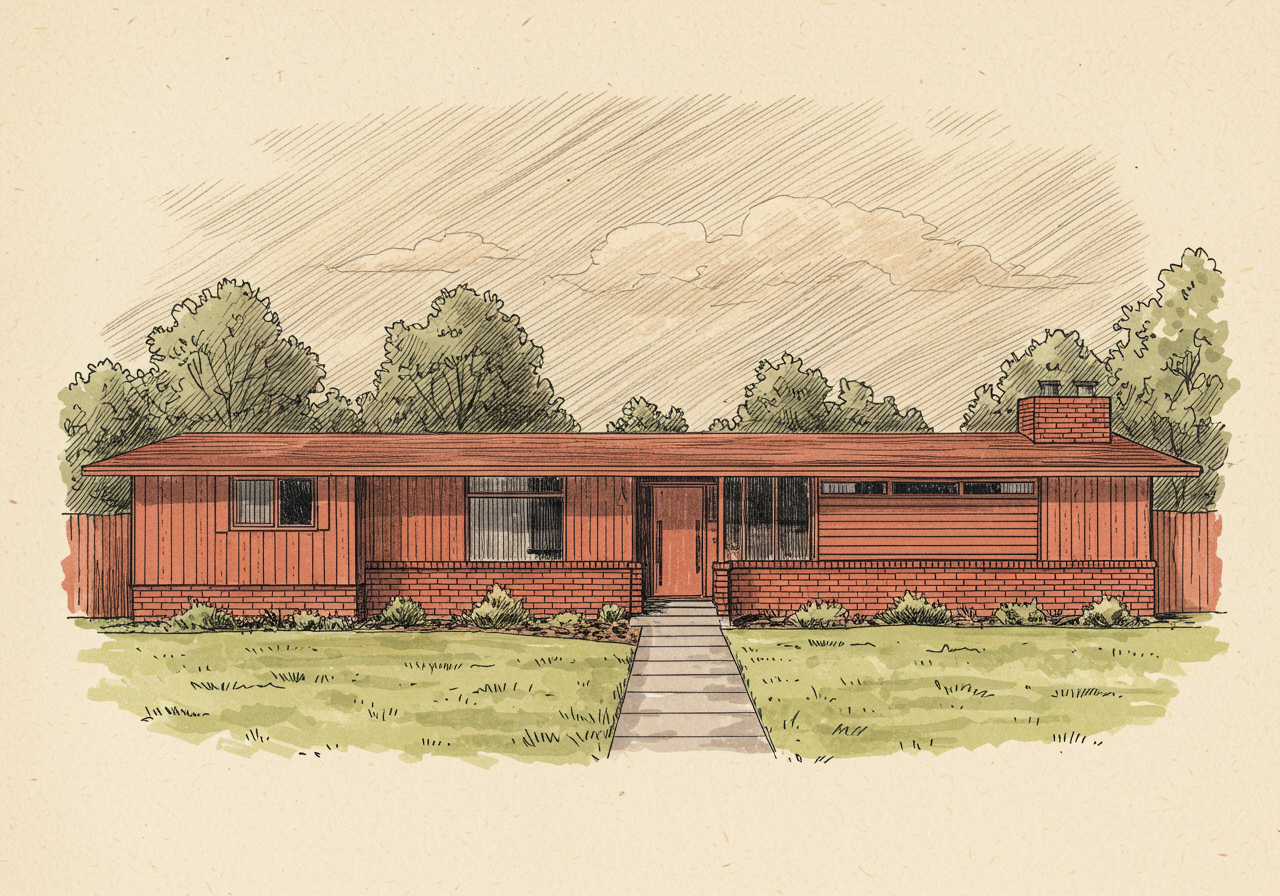
A California Ranch is the one-level parent and was treated two posts ago. The Ranch presents all primary rooms on a single floor (no staggered levels, no half-flight transitions), runs to a long horizontal footprint of thirty to sixty feet on a flat lot, and houses garage, living rooms, and bedrooms all at the same elevation. The Split-Level descended from the Ranch’s silhouette but redistributed its plan vertically across half-storey levels for sloping lots and larger families. The rule of thumb: one continuous floor under one roof is Ranch; staggered half-storey levels under one continuous roof is Split-Level.
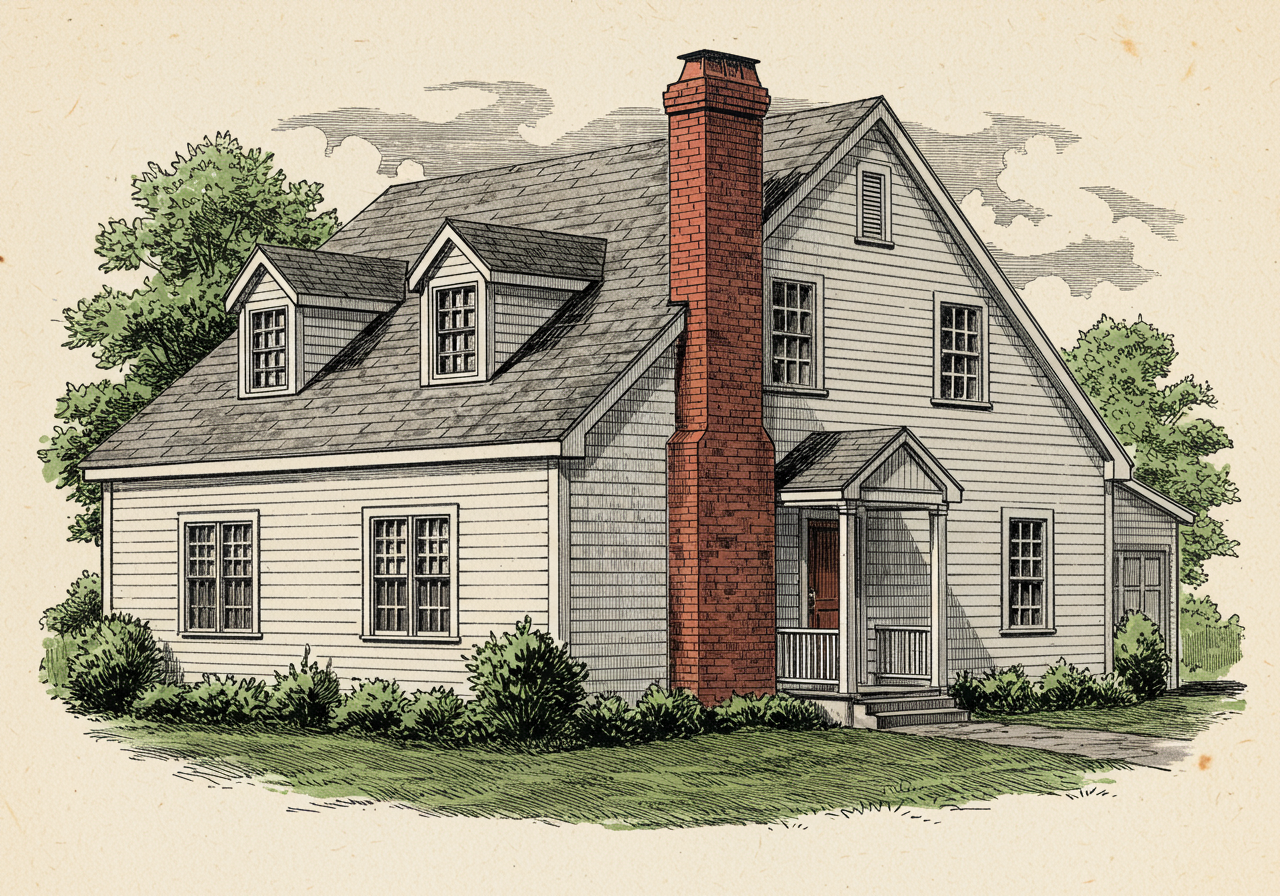
A Cape Cod is the East Coast post-war counterpart and was treated in the previous post. The Cape is one-and-a-half storeys under a steep symmetric gable at forty to forty-five degrees, with a central chimney at the ridge, a symmetric front door under a pedimented hood, and six-over-six sash in symmetric pairs — a rigorously vertical, symmetric, colonial-revival quotation. The Split-Level keeps the Ranch’s casual modernity (mixed materials, low-pitched roof, picture window, attached garage on the lowest level) and adds vertical level changes rather than the Cape’s compact upright symmetric box. The rule of thumb: one-and-a-half storeys with central chimney and symmetric gable is Cape Cod; multi-level with continuous low-pitched roof and stepped facade is Split-Level.
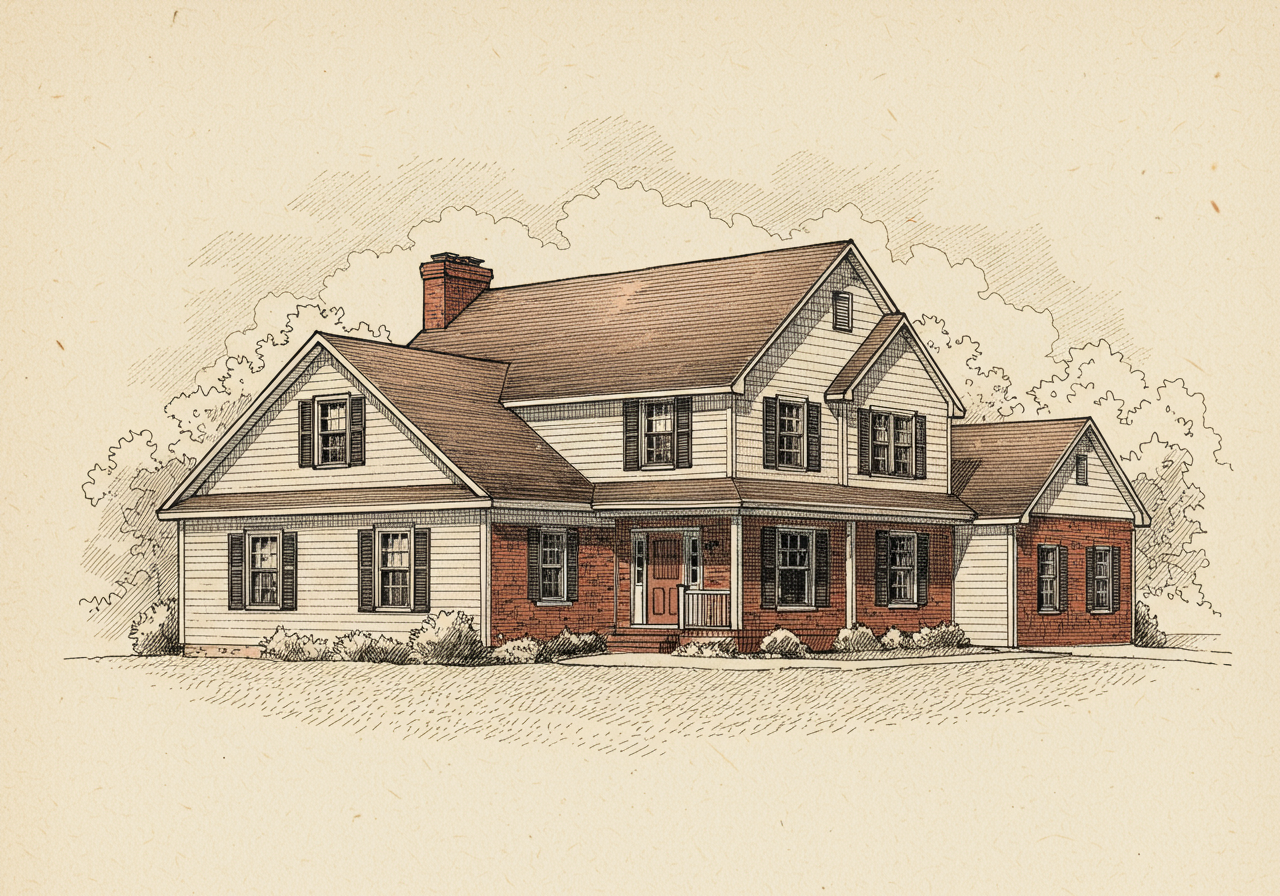
A Colonial Revival — in its late-twentieth-century mass-market form, which is the variant most relevant to the Split-Level comparison — is the form that succeeded the Split-Level as the dominant suburban builder’s house through the late 1970s and 1980s. The 1980s Colonial Revival is fully two storeys on one elevation throughout (no staggered levels, no half-flight transitions), presents a symmetric facade with a centred front door under a portico, uses six-over-six or eight-over-eight sash in symmetric pairs, and reads as a deliberate historicist quotation in pointed contrast to the Split-Level’s casual modernity. By roughly 1980 the suburban builder’s market had shifted toward this fully-two-storey symmetric Colonial register, and Split-Level production declined accordingly. The rule of thumb: full two storeys at a single elevation throughout, symmetric and historicist, is Colonial Revival; multi-level with stepped facade and casual modernity is Split-Level.
A Raised Ranch is structurally the most-confused sibling, because the Raised Ranch and the Split-Level are sometimes used interchangeably in the casual real-estate vocabulary, and they should not be. A Raised Ranch is a Ranch on a half-storey above-grade basement: the principal floor of the house is a single level (in the Ranch manner), but the entire principal floor sits four to six feet above grade on a finished or finishable basement level that has windows above grade and is used as family room and garage. The entry sits between the two levels — typically at the principal floor with an exterior flight of stairs from the walk, or at a small middle landing with stairs going up to the principal floor and down to the lower — but unlike the Split-Level the principal floor itself is one continuous level, not staggered. There is no half-flight between bedrooms and living rooms in a Raised Ranch; the bedrooms are on the same level as the kitchen and living and dining rooms, and the only level change is between the principal floor and the basement-level family room and garage below it. The Split-Level by contrast staggers the principal-floor rooms themselves across two or three different elevations. The rule of thumb: a one-level house lifted on a finished basement is Raised Ranch; a multi-level house with bedrooms and living rooms at different elevations is Split-Level.
What It Was Trying to Say
What I find most telling about the Split-Level, taking the Specimen and the topographical account together, is that the form represented something specific about the post-war suburb’s relation to its own built record: the Split-Level was the suburb’s first morphological adjustment to its own success, and the adjustment was a practical one rather than an aesthetic one. The Ranch and the Cape had been argumentative architectures — the Ranch arguing casual modernity and the rear-yard orientation, the Cape arguing colonial-revival restraint and the historicist quotation — and reading them on the same street one read two contending versions of what the post-war suburb should look like. The Split-Level argued comparatively little. It took the Ranch’s argument as already won, accepted the silhouette and the casual modernity and the mixed materials and the picture window and the attached garage as given, and modified the plan only where the plan needed to be modified to fit the lots and the households the Ranch had not been designed for. This is the principal social and architectural fact about the form, and the form’s three arguments follow from it.
The first argument is the topographical-accommodation argument, and it is the principal practical fact about the Split-Level. The Ranch’s long horizontal footprint had been designed for the flat lot, and the flat-lot supplies in the established commuter suburbs of the late 1950s — particularly in the river-valley regions of the upper Midwest and the Mid-Atlantic, the moraine country north of Chicago, the Pacific Northwest hills outside Seattle and Portland — had begun to thin. The next ring of subdivision land was sloping, and the regional builder-developers who served those metropolitan markets were asked to produce houses that fit grades of five to fifteen percent without either expensive cut-and-fill or constructional contortions. The Split-Level’s stepped foundation absorbed the level change as a designed feature rather than a constructional one, and produced — in the bargain — additional habitable square footage per linear foot of front facade by stacking the family-room-and-garage level under the bedroom level on the same footprint. The form was, in this sense, the post-war suburb’s first response to the geometry of its own remaining land supplies, and it is no accident that the geographies of Split-Level dominance correspond closely to the geographies of sloping post-war subdivision land.
The second argument is the family-growth argument, and it is the principal demographic fact about the Split-Level. The 1947 Levittown Cape and the 1952 Lakewood Ranch had been designed for households of four — two parents and two children — at the median of post-war American family size. By 1958 the median household with school-age children was running closer to four or five children, and the builder’s plan was being asked to provide four bedrooms and a family room separate from the living room and a finished play space distinct from the formal entertaining area, all on the same suburban lot and at the same FHA-eligible price point. The Ranch and the Cape could be extended to provide some of these, but neither could provide all of them within the same footprint and price. The Split-Level’s three-or-four-level plan gave the builder a separate children’s level (the lower family room), a separate adult level (the middle living and dining rooms), and a separate sleeping level (the upper bedrooms), and gave the household a separation of zones the parent forms could not produce. The architectural critics of the period who dismissed the form as awkward — and there were many — misread what the builder was solving. The builder was solving a circulation problem and a square-footage problem the Ranch and the Cape had begun to fail at, and the Split-Level’s staggered levels were the geometrical answer to both.
The third argument is the class-position argument, and it is the principal social fact about the Split-Level. The form was, through the late 1950s and the 1960s, modestly upmarket of the Ranch and the Cape — the additional square footage, the additional bedroom, the larger lot it usually sat on (the sloping suburban lots of varied topography ran somewhat larger on average than the flat-lot subdivisions of the immediate post-war years), and the additional construction complexity all pushed the Split-Level’s price ten to twenty-five percent above the comparable Ranch or Cape of the same period. The buyer was, characteristically, a household that had begun in a smaller Ranch or Cape and was moving up — the second-purchase suburban household of the early-to-mid-1960s, where the first-purchase suburban household of the late 1940s had bought the Ranch or the Cape new. This is the architectural translation of the post-war American household’s first generational upgrade, and the Split-Level is what that upgrade in many cases looked like. By the late 1970s and 1980s, however, the household that would have bought a Split-Level in 1965 was buying instead a fully-two-storey Colonial Revival — the same square footage at a single elevation throughout, with the historicist quotation the Split-Level had refused — and the form declined accordingly. The Split-Level’s window of dominance was narrower than either parent’s, and what looks in retrospect like a short reign is, more accurately, the form’s particular suburban moment: the years between the Ranch-and-Cape settlement of 1945–1958 and the Colonial-Revival re-historicization of 1978–1990, during which the suburb had grown larger and steeper than its first forms could accommodate but had not yet decided to dress its larger houses in the colonial-revival vocabulary the 1980s would settle on. Reading the Split-Level in that interval is reading the post-war suburb at the moment of its first morphological adjustment to its own scale.
The next specimen I should like to take up is the Mid-Century Modern — the architect-designed parallel to the post-war builder’s Ranch-and-Cape-and-Split settlement, the form in which the designed-and-named-architect tradition continued through the same years the tract developers were producing the mass-market suburb at scale, and the principal counterpart to the Ranch’s Cliff May customs at the more substantial end of the residential market. Reading the builder’s Split-Level and the architect’s Mid-Century Modern in succession illuminates the two parallel tracks of post-war American residential design — the mass-market production form and the named-architectural custom form — that ran side by side through the same suburban decades and that the architectural histories of the period have, more often than not, read as if only one of them existed.