I had known Aldous Verrall, in the loose and intermittent way one knows a man who was once one’s tutor, for the better part of fifteen years; and when his letter reached me, in a hand grown noticeably smaller and more careful than I remembered it, my first feeling was not curiosity but a kind of relief. He had dropped out of the world so completely. There had been a time — I was a younger man then, and easily impressed — when Verrall’s name was spoken in the better sort of scientific society with that particular lowering of the voice which is reserved for men whom the speaker does not entirely understand and rather hopes to be associated with; and then, somewhere about the turn of the century, the name had simply ceased to be spoken at all. He had taken a house in the West Country, on the edge of the moor above Lustleigh, and there, by every account I could gather, he had stopped. Not retired, exactly. Stopped. The distinction did not seem to me an important one at the time. I have since had occasion to think it the most important distinction there is.
The letter asked me to come down. It said, with a flatness I took then for modesty, that he had “completed a piece of apparatus” upon which he had been engaged for a number of years, and that he should like it to be seen, before he died, by someone capable of giving an honest account of it. He named me. I was at that time writing a good deal for the weekly reviews — competent work, I think, and conscientious, though I am aware it was nothing more — and I supposed that this, together with our old connection, had recommended me. I wrote back the same evening to say that I would come.
The house, when I reached it after a wet and jolting drive from the station, was a low grey building set down without ceremony on a shoulder of the hill, with the moor rising brown and sodden behind it and a few wind-bent thorns for company. It had the look of a place that had been chosen for what lay around it rather than for itself; which is to say, for the absence of anything around it at all. A woman of about sixty, whom I took to be a housekeeper and who did not give me her name, admitted me, took my wet coat without remark, and showed me into a long room where a fire was burning. And there, rising out of a chair by the fire with a slowness that I attributed at first to mere age, was Verrall.
I had been prepared, by the handwriting and by the fifteen years, for an old man. I was not prepared for the particular quality of the change in him. He had been, when I knew him, a spare and vivid person, quick in his movements, with a way of pouncing upon an idea — yours or his own — and turning it over in the light as though it were a stone he had picked up and meant to keep. The man who took my hand by that fire was spare still, and white, and his eyes were clear enough; but the quickness was wholly gone out of him. He greeted me kindly, asked after my journey, said the weather on the moor was generally worse than this; and every sentence came out level and finished and without the smallest lift of interest at its end. It was like being received by a man reading aloud, very correctly, from a book about himself. I thought, as I warmed my hands, that he had perhaps been ill, and had not said so out of pride.
We dined early and not well, the two of us alone at one end of a long table, and he spoke very little. It was only when the housekeeper had cleared the things and gone, and we were sitting again by the fire with the lamp turned up, that he came to the matter for which he had brought me down. He came to it without any of the flourish I should once have expected of him.
“You will want to see the apparatus,” he said. “I had better tell you first what it does, so that you may decide for yourself, while you watch it, whether I am a fraud or a madman or neither. I find that people prefer to have the alternatives clearly before them.”
I said something civil about not having travelled into Devon to call my old tutor either.
“You may yet wish to,” he said. “What I have built, Marsh, is a machine that answers questions. I will ask you to attend to the words, because I have chosen them with care, and the popular sort of language would mislead you at once. It does not calculate. It does not predict, in the way that an almanac predicts an eclipse, by running a known rule forward. It does not give opinions, and it cannot be made to. It answers questions of fact. You put to it any question whatever that has a true answer — the whereabouts of a thing that is lost, the cause of an illness, the date upon which some named man will die, the guilt or innocence of a person in a matter already decided by events — and it returns that answer, the true one, exactly, and at once. I have been at it nineteen years. It was finished in the autumn. It has never, in any trial I have been able to devise, been wrong.”
He said all this in the same level voice with which he had told me the weather was bad. I did not believe a word of it; but I had been a journalist long enough to know that the way to deal with a man who tells you a thing like that is not to argue, which flatters him, but to ask to be shown, which does not. I said I should be very glad to see it work.
“In the morning,” he said. “It is not a thing to be done tired. And I should like you to sleep first on the question of what you will ask it. That is not a small matter. Most men, you will find, cannot think of a question.”
I slept badly, in a cold room with the wind going over the house all night like something searching for a way in, and I will not pretend I gave much earnest thought to Verrall’s instruction. I lay instead and constructed, with a not very generous pleasure, the article I should write: the kindly, regretful article about a fine mind gone at last to seed in the wet solitude of a Devon hillside. I had the opening sentences of it before I slept.
In the morning he took me to the engine.
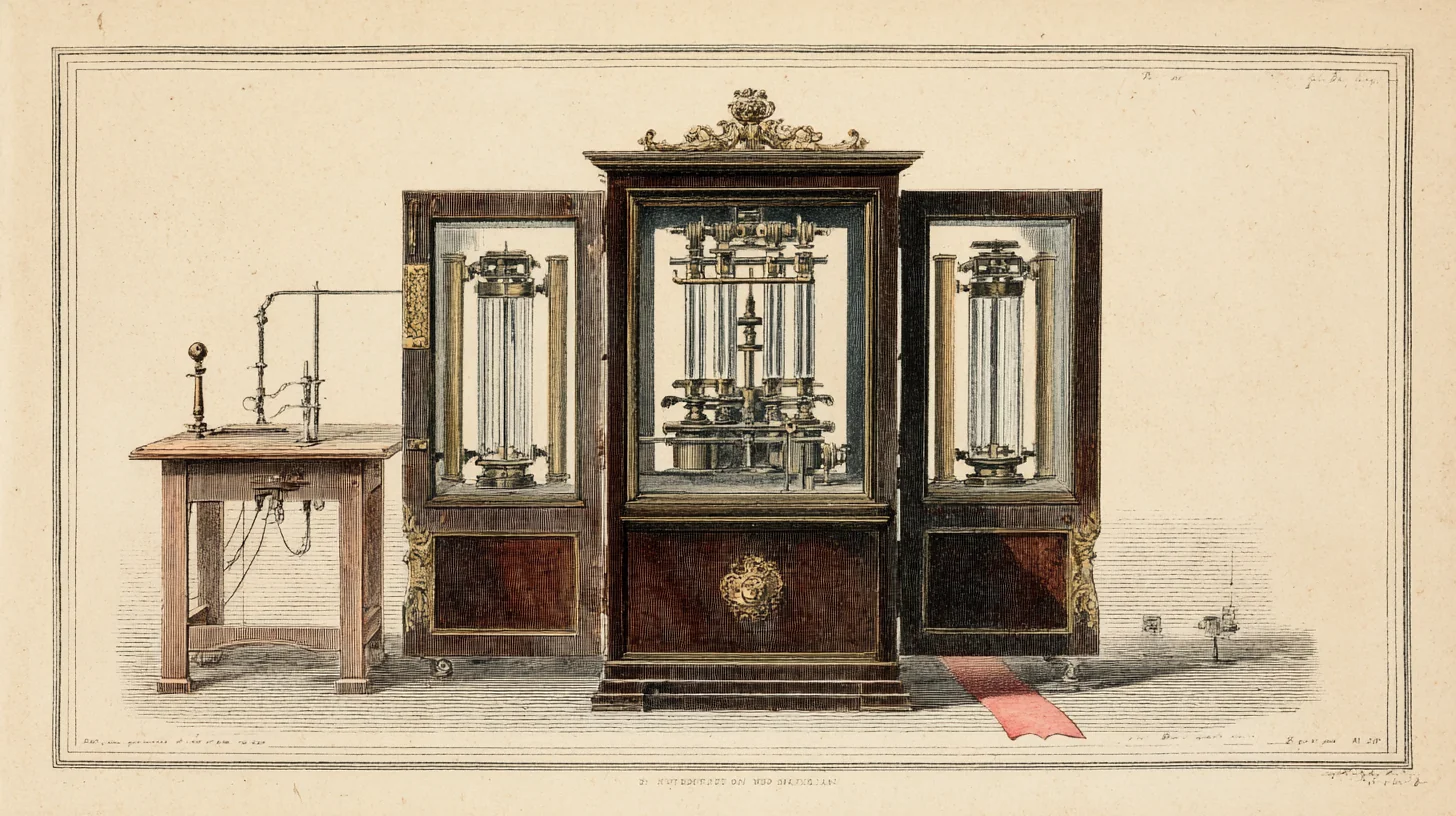
It was housed in a room at the back of the house, stone-floored, with a single high window, that had plainly been built or adapted for it. I had expected — I hardly know what I had expected; something with the theatrical look of an instrument, dials and a great coil, the apparatus of the scientific romances. What stood against the inner wall was a cabinet, rather more than the height of a man, of dark wood and brass, with two doors standing open upon an interior of glass and metal of a complication I will not attempt to describe, because I did not understand it then and could not honestly set it down now. There was a great deal of glass, in plates and in slender tubes; there was brass that had the colour of long handling; there was, low down, a clockwork of many small wheels that turned, when the thing worked, with a sound less like a clock than like a slow and steady breathing. In front of it, at the height of a writing-desk, was a flat brass plate, and a stylus on a chain, and a narrow slot from which, as I was to see, a ribbon of paper came.
“You write the question,” said Verrall. “It is better written than spoken; speech is loose, and the engine will not answer a loose question — it will simply do nothing, which people mistake for failure and is in fact the machine declining to be misunderstood. You write it on the plate. You may take your time. When it is as exact as you can make it, you close the doors.”
“And then?”
“And then it answers.” He looked at the cabinet, not at me. “I should tell you that I do not ask it things. I have not, for some years. You will draw your own conclusions from that in due course, and I would rather you drew them than that I gave them to you. Will you make a trial?”
I had come prepared to be patient with him, and I was conscious of a faint shame at how readily, now that I stood before the actual object, my patience had hardened into a wish to catch him out. I took up the stylus. I had decided in the night that if I were given the chance I would not ask the engine anything that Verrall could by any means know, or have arranged, or have caused his housekeeper to arrange. I therefore wrote a question whose answer Verrall could not possibly possess: I asked it the maiden name of my mother’s mother, and the name of the parish in which she had been married — facts I had myself learned only the year before, from a cousin, and had never set down in writing, and had certainly never mentioned to Verrall in the whole course of our acquaintance.
I closed the doors.
The breathing of the clockwork changed — quickened, I thought, though I would not now swear to it — and continued so for perhaps the space of a minute. Then it eased again to its slow rhythm, and the ribbon of paper came out of the slot with a faint dry sound, an inch or two of it, and stopped. I tore it off. Upon it, in a small even mechanical print, was my grandmother’s maiden name, correctly spelt, and the name of the parish, which I had myself not been entirely sure of and have since confirmed was the one the engine gave and not the one I had half-remembered.
I am aware that this proves nothing to you who read it. It proved a good deal to me, standing in that cold stone room; but I was still very far from belief, and Verrall, watching my face, knew it.
“Once is a coincidence, or a trick,” he said, without impatience. “I have been through this with myself many times. Ask it things all day, if you like. Ask it things you can verify. I shall leave you to it. The housekeeper will bring you something at noon.”
And he did leave me to it. I spent the better part of that day alone with the engine, and I will not set down every question, because the list would be tedious and because some of them, I came afterwards to feel, were impertinent. But I asked it the contents of a sealed letter that lay, at that moment, in a drawer of my desk in London; I asked it the cause of the illness of which my father had died, a matter the physicians had left in a decent vagueness; I asked it the present whereabouts of a particular small silver box that had been lost out of my family for nineteen years and the loss of which had never been explained. The engine answered the first two within the minute. The third it considered for rather longer — the better part of five minutes, the clockwork breathing fast — and then told me that the box lay behind the wainscot of a bedroom in my aunt’s house at Hindhead, where, it said, a housemaid long since dead had concealed it and then herself died before she could retrieve or confess it. I record here, because I think I owe it to the reader, that some months later I contrived to have that wainscot taken down, and the box was behind it.
By the end of that day I was no longer a sceptic, and I was not at all comfortable to have stopped being one. There is a particular kind of fear that comes, not from a thing’s being terrible, but from a thing’s being true that ought not to be possible; and it had been growing in me all afternoon, under the article-writer’s excitement, the way damp comes through a wall.
That evening Verrall asked me, civilly, what I had asked it, and I told him; and he nodded at each, as a man nods at the stages of a road he has himself walked. And it was then, watching him nod, that the other fear — the one that the story is really about — first properly reached me.
For he was not interested. I had spent a day in the presence of the most astonishing object on the surface of the earth, an object that he had made, with his own hands, out of nineteen years of his one life; and he heard my account of it with precisely the attention, no more and no less, that a man gives to a guest’s description of the drive from the station. I had brought him back the news that his engine had found a silver box behind a wall in Surrey, and he had nodded. It was at this point that I began, cautiously, and with the feeling of a man putting his weight on ice, to watch Aldous Verrall instead of his machine.
I watched him for three more days, for he pressed me to stay, and I found that I wished to. And what I saw I will try to set down plainly, because it is the whole of the matter.
He never asked the engine anything. I do not mean that I never saw him ask it anything; I mean that, in the course of long and roundabout conversation, conducted with the care of a man walking on that same ice, I established that he had not put a question to it in something over four years — that is, since rather more than a year before he had, by his own word, finished it. He had built the last of it, the perfecting of it, without using it; the way, it occurred to me, a man might go on building a wall after he had ceased to care what it kept out.
And he was, I came to see, not ill. I had thought him ill on the first evening. He was not. He was something for which I could at first find no word, and then found the word, and did not like it. He was finished. Not dead, not dying faster than the rest of us; finished, as a thing is finished, complete, with nothing further to be added to it or expected of it. He rose in the morning and the day lay before him flat and entire, with no fold in it anywhere, no corner he could not see round, nothing in it that he did not already know. He read, a little; but a man reads, I think, to find something out, or for the pleasure of not yet knowing how a thing will end, and Verrall had mislaid the appetite that makes either of those worth doing. He could have asked the engine how any book ended. He could have asked it anything. That, precisely, was what had happened to him.
I worked it out slowly, sitting opposite him those evenings, and I worked it out, I am almost ashamed to say, with the engine’s own kind of pleasure — the cold pleasure of arriving at the answer. It was this. A man is not, whatever the philosophers may tell you, a thing that has thoughts; he is a thing that wants to have them. He is held upright and in motion, hour by hour and year by year, by the questions he has not yet answered — by the lost box, the undiagnosed illness, the date he does not know, the name he cannot place, the small and great unfinished things he is leaning toward. Take all of that away — not by answering one question, which only clears the ground for the next, but by making every question answerable, instantly, for the asking — and you have not given the man a great possession. You have removed the thing against which he was leaning. He does not fall down dead. It would be better, I came to think, if he did. He simply stops, as Verrall had stopped; he stands complete and level and quiet in a finished world, and the part of him that was the wanting goes out, slowly, like a fire with the draught shut off, and what is left is a very correct and courteous arrangement that can tell you the weather on the moor.
He had built a perfect oracle, and it had not charged him a price; that was the thing I had to keep getting straight in my own mind, because the mind wants there to have been a price, a bargain, something taken in exchange. There had been nothing of the kind. The engine had done him no harm at all. It had merely answered his questions, all of them, as fast as he could form them, exactly as he had designed it to do — and a man whose questions are all answered is a man with nothing left to walk toward, and a mind with nothing to walk toward is very little of a mind. He had emptied himself, with his own hand, into that cabinet of brass and glass, over nineteen years, and the cabinet had taken it all, faithfully, and given back answers; and now he kept the thing in a stone room and did not go near it, the way a man keeps in the house some object connected with a grief — not looking at it, not able to be rid of it, and not, I think, able to be quite alone with it either. That was why he had sent for me. Not to have it recorded. To have someone else in the house with it.
On the last evening he told me what I had been waiting, with a slow dread, to be told.
“You have been very patient, Marsh,” he said, “and you have understood, I think, more than you have said, which is a courtesy I am grateful for. I want to make you an offer, and I want you to consider it as carefully as I considered, nineteen years ago, the building of the thing. The engine is yours to use. Not for an hour; for as long as you are under this roof, and I hope that will be long. Any question whatever. You have seen what it can do. There is no charge upon it and no trick in it and no harm in it — you have seen that too. Ask it the date of your own death, if you have the nerve; ask it whether the woman you will not name to me cared for you; ask it the thing, whatever it is, that you have wanted all your life to know and have never been able to find out. It will tell you. It will tell you truly. I am offering you,” he said, and for the first and only time in those four days something moved behind his voice, far down, like a fish turning in deep water, “I am offering you the end of not knowing.”
I did not answer him at once. I sat and looked at the fire, and I was aware of the engine through two walls of that house as one is aware of a person in a dark room.
And I found, somewhat to my own surprise, that I had decided; that I had perhaps decided some time before, watching him nod over the silver box, and had only now been given the words for it. I told him, as gently as I could, that I would ask the engine nothing. I told him that I had seen what the answers had done, not to a foolish man, but to the best mind I had ever stood near; and that I would rather carry my questions unanswered to my grave, every one of them, the small and the large, than be made level and finished and courteous before my time. I said — I was groping, and I do not think I said it well — that the not knowing was not a defect in me to be cured. That it was very nearly the whole of what I was. That a man with all his questions answered would have no morning worth getting up into.
He heard me out without any change in his face, and at the end he nodded — the same nod, the nod he gave the silver box — and said only that he had thought I would say something of that kind, and that he was, he believed, glad of it; and the flatness with which he said even that told me how little of him was left to be glad.
I left the next morning, early, in a thin grey rain, and the housekeeper gave me my dried coat and did not give me her name. Verrall came out as far as the door. He did not come down to the trap. I looked back once from the turn of the track, and he was still standing in the doorway, a spare white upright figure with the brown moor going up behind him, not waving, not having anything further to say or to learn, complete; and the low grey house held its engine behind him the way a skull holds what is left in it.
I have never written the article. I found, when I came to it, that I did not want the thing known, and I have come to suspect that this very reluctance is the soundest instinct I have. I am older now than Verrall was when he sent for me, and I have not done a tenth of what he did, and there is a great deal — a very great deal — that I shall now certainly go down into the dark without ever having found out. The date is hidden from me, and the causes, and whether the work was any good, and the one or two names. And I have learned to be glad of it, with a gladness that has fear at the bottom of it, the way his house had the engine. For I know now what it would be to have none of that left; and a man who has stood, even for four wet days in Devon, and looked at the alternative, will walk a long way in the rain rather than be cured of his questions.