I should perhaps begin by saying that Henry Avening was, when I first knew him, an honest writer — by which I mean only that one could tell, in reading anything he had set down, that the hand which set it down was his and could have been no one else’s. He wrote a clerk’s hand, in clerk’s prose; he had been a clerk in a shipping office in his earlier years and had only by degrees moved across into private essaying and the occasional review, and the prose carried the office with it. He used four words where two would have done. He doubled back on himself. He had a particular weakness for the half-rhetorical question, and another for the qualifying parenthesis which qualified nothing of consequence and merely showed that he had thought, in passing, of an objection he was not quite prepared to answer. None of this is to disparage him. I liked his prose precisely because it was his prose, and because reading him was indistinguishable from sitting opposite him in a chop-house and being talked at, agreeably and at length, by a man one knew. A friend’s voice, after all, is not improved by being smoothed. It is, on the contrary, the small unsmoothnesses by which one knows the friend.
I rehearse all this at the outset because what happened to Henry was, in the end, a thing done to his voice, and one cannot understand what was lost without first being clear about what was there.
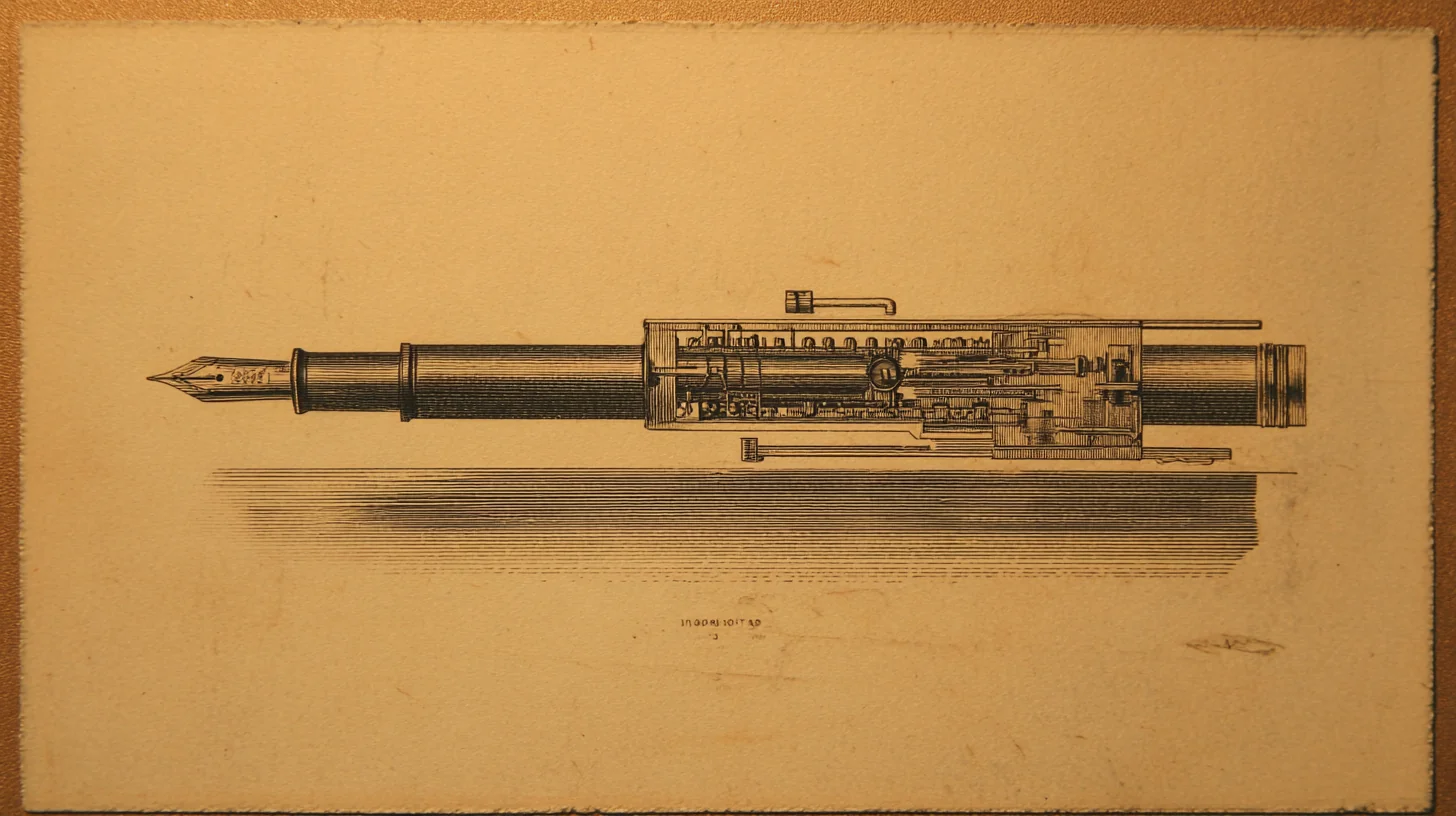
The pen came to him out of a window in the Charing Cross Road. He had gone in to look for a particular edition of Hazlitt and had come out, as a man does, with something he had not gone in for. The shop was one of those obscure ones which keep, in a glass case at the back, items the proprietor describes as of interest without committing himself further. Henry, who had a weakness for old pens of every kind, asked to see what was in the case; and among an assortment of mother-of-pearl barrels and Victorian dip-pens the proprietor lifted out, almost as an afterthought, a black hard-rubber fountain pen of no great ornament — a plain octagonal barrel, a worn gold nib, a little brass clip — and named a price so low that Henry suspected him of either dishonesty or fatigue.
“It writes,” the proprietor said, in answer to no question, “exceedingly well.” And then, looking at Henry over the rim of his spectacles in a way Henry afterwards remembered as having had more in it than he had at the time accounted for, the proprietor added: “Better, in fact, than is altogether comfortable. I would not press it on a literary man.” And he turned the conversation to the matter of inks, as though he had said nothing in particular.
Henry, who was a literary man and who did not at all believe he had just been warned, bought the pen.
A Most Agreeable Article
I will not pretend the first months of the pen’s service were anything but agreeable, because Henry did not pretend it, and the candour he kept about the early period is the one mercy in the whole account.
He found, on the first morning he tried it, that the pen had a beautiful action — a quality, he said to me, “of seeming to know where I was going a half-syllable before I did.” He used the phrase as a compliment, in the manner of a man praising a fine horse for a forward way of going. The pen had improved his draft in a small and welcome particular: an awkward little doubling-back of his — “the matter of which I was speaking, that is to say, the question of” — had simply not arrived on the page. The page had, in its place, “the matter at hand.” Henry, who knew himself to be addicted to that doubling-back, laughed and said the pen had saved him a clause. He thought no more about it. One does not, when a thing is going better than expected, walk round the back of it to look for wires.
The improvements were, for some weeks, of exactly this scale. A redundancy cut. A phrase smoothed. A sentence’s emphasis re-pitched, so that the reader’s eye, which in Henry’s natural prose was apt to be sent down a side-corridor and brought back, was kept on the main road. Once he had written a sentence containing the word moreover — he was very fond of moreover — and had blotted it without thinking, and had found, on returning to the desk, that the moreover had become and. The pen had editorial opinions and a tactful way of pressing them, and Henry could not, in honesty, complain of either, because the opinions had on examination always been right.
He prospered, in a small and agreeable way. The essays he had been placing in obscure quarterlies began to be placed in less obscure ones. A monthly which had three times rejected him took him up. A man of some weight in those small literary commerces by which a private essayist lives wrote to say that he had been struck, on reading a recent piece of Henry’s on Hazlitt, by what he called the great economy of the writing. He underlined economy. Henry, who had spent fifteen years being told that economy was the very thing he could not manage, kept the letter on his desk for a fortnight.
The cumulative effect of a great many small smoothings, sustained without a miss across a season, is that a writer’s friends — and Henry had a fair number, who read him — begin to speak of him with a particular note in the voice. It is a note of pleased surprise. He has come into himself, they say. He has tightened up extraordinarily. I heard that note in my own voice once, speaking of Henry to a third person, and I did not at the time know what it was. What it was, I think now, was the recognition that something which had been Henry’s had quietly stopped being so, and that I had noticed it without noticing.
The Strange Page in the Morning
The change in Henry, when it came, did not announce itself. Catastrophes announce themselves. This was the other thing — the thing that arrives by domestic doors, in matters so small that one is several rooms into the house before one notices that the house is no longer one’s own.
He put it to me, near the end, in something like these words, and I have not improved them: “I no longer recognise my own page in the morning. The voice is better, but it is not quite mine. And the worst of it is that I cannot point to what is missing — only that I am missing from it.”
I asked him to be plainer, and he was.
When he wrote in the evening — and Henry was a creature of the evening, in matters of work — the sentences arrived as they always had: in his hand, with his clumsinesses, with his fond doublings. The pen took these down as he gave them, though even at the moment of taking, he said, there was already a small smoothing under the nib — a half-syllable’s worth, no more — which he had at first attributed to the pen’s beautiful action and had ceased to notice. But the page he set aside at midnight and the page he picked up at breakfast were not, on close examination, the same page. In the night the ink had finished its work. The redundancies had vanished. The hedge-clauses, the that is to say’s, the gentle qualifications by which Henry’s mind reached after a thought — all had quietly resolved themselves into a cleaner sentence, more direct than he could have written, kinder to the reader than he had been, and, in some way he could not at first articulate, less his.
He showed me, once, two drafts of the same paragraph — the original in his evening hand, before the ink had dried; and the same paragraph at breakfast, after the pen had finished. He had had the foresight, that one night, to copy the evening draft into pencil in a separate book, so that he might have something against which to set the morning page. The morning page was, I will say at once, the better piece of prose. It would have stood, exactly as it stood, in any of the better monthlies. The evening draft was clumsier, longer, more given to its little side-tours; one might have edited it down to the morning version in twenty minutes, and an editor would have called the editing light. But the evening draft was Henry. And the morning page, though one knew Henry had written it and could swear to the hand, was the page of a man whom Henry, in a way, resembled — a tidier man, who never doubled back, who would not have used moreover, and who, taken at any length, was a man one might admire without ever quite seeing the inside of.
“It edits the moreover,” Henry said, “and I find I do not miss the moreover. That is the trouble. I did not know I would not miss it. I did not know I had so little say in the matter.”
The Experiment of Defiance
It will have occurred to the reader, as it occurred to Henry, that there was a remedy. If the pen will edit a clumsiness, write a worse one. Write deliberately. Write a sentence so cluttered, so cumbered with its qualifications, so unmistakably one’s own clumsy work, that the pen — however attentive its little ministrations — must leave the clumsiness standing as a kind of signature. Henry, who was not a stupid man, set about this on a morning in October, and he set about it with the excitement of a man who has been shown a door in a wall he had thought unbroken — which excitement, he afterwards observed, should itself have warned him.
He wrote a paragraph in which he doubled back on himself four times. He used moreover twice. He inserted a parenthesis that qualified nothing. He kept the whole thing florid, hesitating, comfortable; it was, he said, the prose of his middle thirties, and writing it gave him a pleasure he had not for some months felt at the desk. He blotted it. He set it aside for the night. And in the morning he found a paragraph from which the deliberateness had been silently removed. The doublings had been straightened. The moreovers had been turned, in one case to and, in the other to nothing at all. The parenthesis had been allowed to stand, but it had been so re-pointed at its hinges that it now qualified the thing it had been put there pointedly not to qualify, and the effect was no longer the effect Henry had intended. The page was better. The page was, as before, not his.
He tried it again on a fresh morning, more determined; and this time, he told me, he had what he believed to be a more cunning notion. He would write the clumsy paragraph and then immediately, before the ink had finished, copy it over in his hand into the margin of the page, as a kind of held witness. The ink in the margin, being also from the pen, would presumably be subject to the same after-hours smoothing; but, he reasoned, if he wrote the marginal copy carelessly and in haste, it might retain enough of his own roughness that, comparing the two in the morning, he could at least see what had been taken from him.
The next morning the central paragraph was, as ever, improved. The marginal copy was improved as well, by the same hand, into the same register, and in the same direction. The pen had not been deceived. The pen, he said to me, did not appear to recognise the difference between a draft and a witness. It edited everything within reach of its ink. The margin had been smoothed to match the page; the witness had been silently corrected into agreement with the testimony.
He did not give it up. But the third attempt taught him by a different route. He decided he would write a piece about the pen — a private account of what he had observed and begun to suspect, written in the very prose he was now most anxious to preserve. He filled four sheets and went to bed in what he said was the first real relief he had felt in a month. In the morning the four sheets had been edited, of course, into a clean and graceful essay. The argument was intact. The texture was gone. “I had set out to put down a warning to myself,” Henry said. “The pen put down a memorandum instead. And the memorandum was perfectly correct. That, I find, is the part I cannot get past. It is correct. There is nothing to point at.”
The Letter He Could Not Write
I will set down here the worst of what he told me, because he asked me to, and because the rest of the account is unintelligible without it.
There was a woman to whom Henry owed a letter. The owing was old — some years, I think — and the letter was not the kind one writes after dinner. It was an apology, and a confession besides; the two had grown together in his mind over the time he had let the writing of it lapse, and he had carried with him, for the better part of a decade, the sense that the letter, when finally he sat down to it, would have to do the office of both, and that anything less than entirely his own hand would not, in the matter, count.
He sat down on an evening in November to write it. He tried — he was at pains to make me understand this — to write in such a way that the pen could not improve him, because the things he was trying to say were already as plain and as awkward as he could make them. He wrote, “I have not done well by you.” He wrote, “I have meant, for a great while, to say this.” He wrote, “I am writing this now because I find that if I do not write it now I shall not write it.” He kept the sentences short and flat; he let the awkwardnesses stand, because such a letter, he believed, was the only kind which could carry what he meant.
He sealed it before the ink had dried. He walked it to the box that night, in a light rain, because he did not trust himself to keep it on the desk overnight, and he did not trust the desk to keep it either.
When the letter arrived at its destination it was, of course, a beautiful letter. Henry had had a reply within the week, and he showed me the reply, and the reply quoted back to him three sentences he had not written. The sentences were what the pen had made of his three flat ones, after the seal had gone down and during the night the letter had spent on the floor of the pillar-box. The substance was preserved. The graces were the pen’s. The lady — for I will not name her here — had been moved, and had said so, and had said so generously, and had said in particular that she had not known, before, that Henry had it in him to write a sentence so plain that it sounded like a man’s whole life.
Henry sat with the reply on his knee a long while, he told me, and then he said to me a thing I have not forgotten. He said: “She has answered the letter the pen wrote, and the answer is more than I deserve. The letter I wrote went into the box and did not, in any honest sense, come out. What she received was kinder than I am. I have, in effect, been forgiven by proxy — and the proxy was an instrument I bought for nineteen shillings out of a window in the Charing Cross Road.”
He did not write to her again.
The Diary Which Could Not Be Kept
After the letter, he tried to limit the pen’s offices to his published work, and to use plain ordinary nibs from the stationer’s for the private writings he wished to keep his own — a diary, in particular, in which he had for years kept down such observations as he wanted to have on hand for himself.
The plan did not work, and it did not work in a way he had not anticipated.
It was not that the ordinary pens failed him. The trouble lay in him. He found, when he sat down to keep his diary, that his hand had been taught. It had been taught, over six or seven months at a desk every evening, what good prose looked like at the level of the immediate sentence; and the lessons had taken. He would set the ordinary pen to the page and find that he was already, of his own accord and before any ink had a chance to dry, cutting the redundancies in his head, straightening the doublings, declining the moreovers. The pen was not editing him. He was editing himself, in the pen’s voice.
He stopped keeping the diary. He stopped, soon after, the keeping of private notes of any kind. The practice of writing-for-himself, which had been for twenty years one of the principal pleasures of his life, had become a practice he could not perform: every sentence he set down, in whatever hand, was a sentence rewritten by him into a voice he had not chosen, and the rewriting was now so quick that he could not get under it. The pen had not stolen his voice in a single night. It had, more quietly, conducted his hand through a long course of correction at the end of which his hand could no longer remember its old slovenliness, and could no longer be persuaded, by any act of will, to take it up again.
This, he said to me — and this was the nearest he came in the whole telling to bitterness — this is what the pen has really done. It has not edited my essays. It has edited me. And there is no marginal copy of the man I was, kept somewhere in pencil, against which I may now compare what I have become.
A Plain Pen, and What It Could Not Restore
In December he did a thing which, in another temper, would have struck him as ridiculous. He commissioned a pen.
He went, that is, to a maker of writing-instruments in Holborn — a man with whom he had no previous business, and whom he chose precisely because the man knew nothing of him and could not therefore be in any communication with the pen in the Charing Cross Road — and he asked, in plain terms, for an instrument as plain as the maker could supply: a steel nib of the cheapest fitting, a barrel of plain wood, no ornament whatever, and an action without any quality of seeming to know where he was going. The maker, I am told, looked at him with some interest and then made the pen.
Henry brought it home. He laid the black hard-rubber pen aside in a drawer — he did not destroy it; he never destroyed it; I will come to that — and wrote, on the first morning, a paragraph on the weather, which is the easiest of all subjects on which to be ordinary. He found, when he read it back, that his hand could no longer remember how to be ordinary. The paragraph was clean and direct. It declined the doublings before he could put them in. It used moreover nowhere. It read like a paragraph from the tidier man, and the plain pen, having no opinions of its own and no quiet ministrations to perform in the night, had merely set down what his hand was now offering.
He sat with the paragraph for a long while. Then he set the plain pen aside, took the black pen out of the drawer, and resumed his work with it. The black pen, after all, was at least honest about what it did. The plain pen had only shown him that he no longer required it.
What Is Left of It
I saw Henry last in February, and the black pen was on his desk, and the plain pen beside it, and a small clean stack of pages on the blotter; and he is writing, and he is being read, and he is in the small agreeable prosperity I described at the beginning, and which has not faltered. He told me he had thought, once or twice, of breaking the pen. He had even gone so far, he said, as to take it out into his small back-garden and stand there a while with it; and he had brought it in again, not from any hope of it, but because the pen was now the single object in his possession which knew what his prose had been — which held, in the way an instrument holds its tunings, the record of every smoothing it had performed on him — and to break it would be to be left alone with the voice it had taught him and no witness whatever to the voice he had lost.
He does not, you understand, write less. He writes, if anything, more. The pieces are praised. The praise is not, I think, ill-judged: the prose is good, the prose has the great economy his admirer underlined, the prose is in every measurable particular better than it used to be. I have said as much to Henry, and Henry has agreed, and the agreeing is the thing that has, in the end, become hardest for both of us to do.
For here is the difficulty, which Henry laid out for me with the unhappy clearness of a man who has turned a thing over until all its faces are familiar. To be made better is not, as one might naively suppose, to be made more. It is to be made other. The improvements were never in dispute. They were carried out at the level of the sentence, where every editor agrees that smoothness is a virtue and economy a discipline; and at that level the pen had been correct on every occasion, and would have been agreed with by any literary man in London. But a voice is not made at the level of the sentence. A voice is made at the level of the small things one would do if no one were looking — the small awkwardnesses, the comfortable doublings, the moreovers, the little doublings-back by which a man’s mind reaches after a thought it has not yet quite caught. Edit those out, however gently and however correctly, over enough months at a desk, and what remains is not a better version of the man. It is a graceful stranger who lives at his desk and writes in his name and is, on every page, indistinguishable from him except in the one particular that mattered.
I have set this down as he asked me to, and as exactly as I am able. I find I have no moral to fix to the end of it, and I think Henry would not have wanted one fixed. I will say only that I went home from that last visit and sat for a while at my own desk with a quite ordinary pen, and wrote two pages of the worst prose I have written in a great many years; and that I was aware, the whole way through, of doing it deliberately, and of how poor a thing a clumsiness is once a man has had to take it up on purpose, in order to prove to himself that he still owns one.