I have known Edmund Carraway the better part of thirty years, and in all that time I never knew him to be late, to be startled, or to be wrong about a small thing. It was a quality I once admired in him without reservation, and it is only now, with the whole of his case laid out before me, that I understand admiration to have been a poor and incurious response. A man so composed is not a man who has mastered his circumstances. He is a man to whom circumstances no longer happen. The distinction took me the greater part of those thirty years to arrive at, and I arrived at it too late to be of any use to him; but I set it down here, in the order in which I came to it, because Carraway asked me to, and because a thing of this kind ought not to go unrecorded merely on the grounds that no one will believe it.
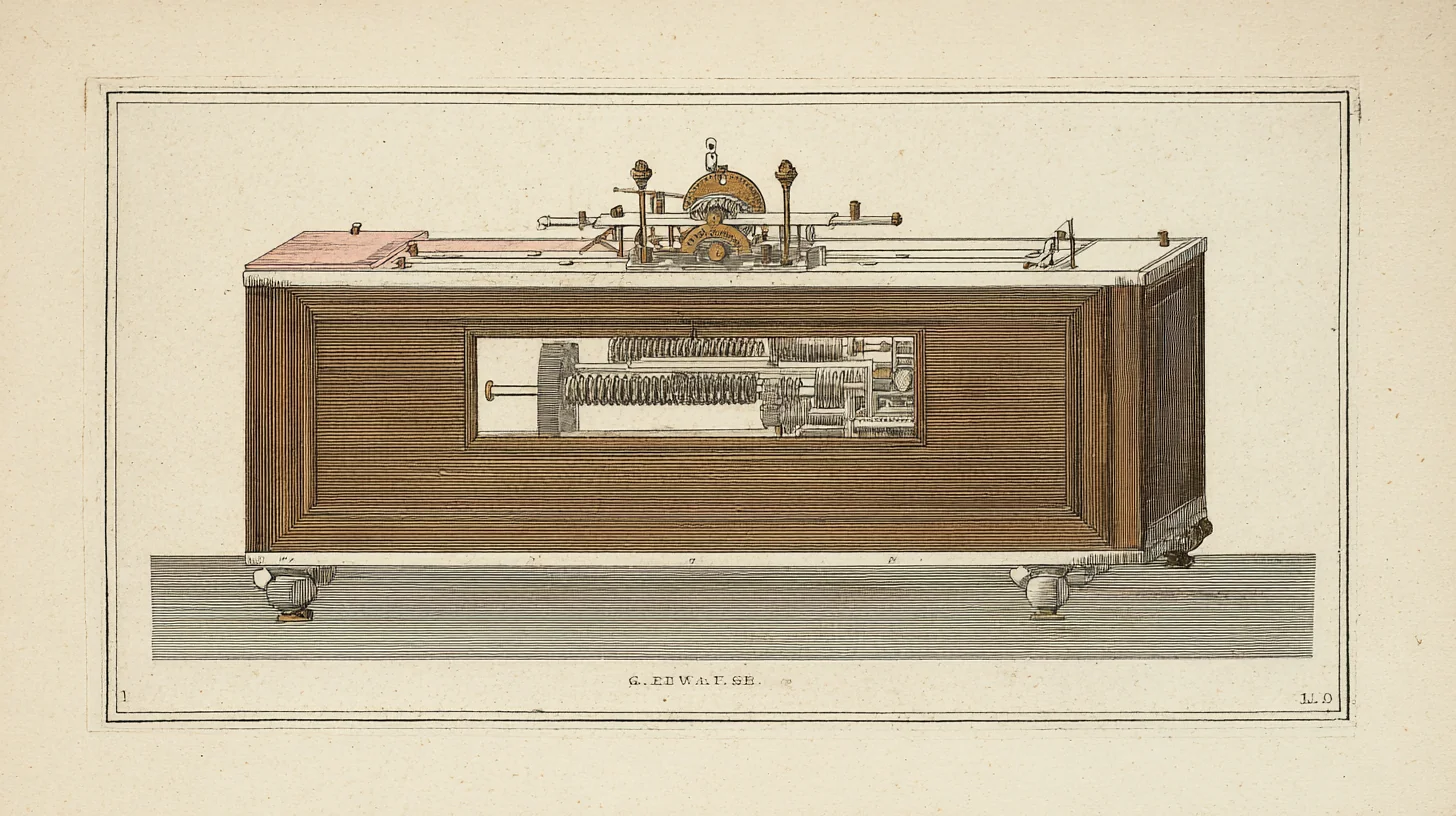
He came into the instrument, as he came into most of what he owned, by way of an inheritance. His uncle on the maternal side—a Mr. Aldous Penge, of whom the family spoke seldom and never warmly—had been a maker of barometers and chronometers in a small way of business off the Tottenham Court Road, a man of exact habits and no friends, who died without a will and without, so far as anyone could discover, a single regret. The contents of his rooms were divided among such relatives as could be found, and Carraway, being the only one who would trouble himself to go and look, was permitted to take what he liked. He took a quantity of books, a good clock, and a thing he could not at first identify: a mahogany case, about the size of a writing-desk’s drawer, fitted with a glass face, a brass aperture along its lower edge, and an arrangement of springs and escapements within that suggested clockwork put to some purpose other than the telling of time.
There was a card gummed to the underside of the lid, in Penge’s small upright hand. It said only: Wind at night. Read in the morning. Do not come to depend upon it.
Carraway, who told me all of this himself, and told it slowly, said that he had read the third sentence as the kind of thing a solitary old man writes to give his possessions an air of consequence. He wound the instrument that night, in the manner the mechanism plainly invited, and thought no more about it. In the morning he found, projecting an inch from the brass aperture, a slip of paper perhaps two inches wide, covered on both faces in a fine printed hand—not Penge’s hand, nor any hand, but a regular mechanical type, faint and grey, as though the machine had a press of its own somewhere in its inwards.
The slip described his day. It described it from the hour of his waking to the hour the instrument expected him to sleep, and it described it not in the loose and hedging language of an almanac but in particulars. It said that the second post would bring a letter from his sister, that the letter would mention a Dr. Havering and ask after Carraway’s chest, and that Carraway would mislay the letter before answering it. It said that at a quarter past eleven a man delivering coal would knock at the area door and be sent away because the coal was not wanted until Thursday. It said that it would rain between four and half-past, briefly, and that Carraway would be indoors and not mind. It gave him the better part of a remark his housekeeper would make about the price of fish.
He kept the slip in his waistcoat pocket through the day, he told me, in the spirit of a man humouring a coincidence. The letter came with the second post. It mentioned Dr. Havering. The coal-man knocked at a quarter past eleven. The rain came at four. And the housekeeper, setting down the dish, said the thing about the fish almost word for word—Carraway said almost, and I noticed that he was at pains to say it, as though the small inexactness were a thing he wished, even then, to hold on to.
A Most Convenient Article
I will not pretend the early part of the business was anything but agreeable, because Carraway did not pretend it, and his honesty in the matter is the one mercy in the whole account. For something better than a year the instrument was, in his own phrase, the most convenient article a man could own.
Consider what it is to be told your day in advance and to find the telling exact. One is never ambushed. Carraway met every caller already knowing the caller’s errand, and was thought wonderfully quick. He carried an umbrella on the days it was wanted and left it at home on the days it was not, and was thought wonderfully lucky, which is a reputation a man may enjoy a long while before he examines it. He declined an invitation to dine with the Massinghams on a Tuesday because the slip, read that morning, had set down that a Mr. Croft would be of the party and would contrive to quarrel with him over a matter of politics; Carraway sent his regrets, and the quarrel, having no Carraway to fasten upon, did not occur, and the Massinghams thought him a man of delicate tact.
He began, in a small way, to lay wagers. Nothing extravagant—Carraway had no taste for extravagance, and besides, the instrument’s particulars did not run to the names of horses, which it seemed not to know or not to care for. But it would tell him that a parcel he was expecting would come broken, and he would arrange to be elsewhere when it was opened; it would tell him that a clerk at his bank would make an error of two shillings against him, and he would have the figure ready. Small sure things. The cumulative effect of a great many small sure things, sustained without a single miss across a year, is that a man’s friends begin to speak of him with a particular note in the voice—a note of affection laid over something that is not quite envy and not quite unease. I heard that note in my own voice once, speaking of Carraway to a third person, and did not at the time know what it was.
What it was, I think, was the recognition that he had stopped being surprised, and that the rest of us had not, and that this had quietly become the most important fact about him.
The Cost, Which Arrives Domestically
I have called the early part agreeable, and so it was; but I should be misleading the reader if I let him suppose the change, when it came, announced itself. It did not. Catastrophes announce themselves. This was the other thing—the thing that arrives so gradually, and by such ordinary doors, that a man has lived a good way into it before he thinks to give it a name.
Carraway put it to me, near the end, in these words, and I have not improved them: “A day that you have read at breakfast,” he said, “is not a day you can afterwards live. You can only verify it.”
I asked him to be plainer, and he was.
A surprise, he said, is not merely a pleasant or unpleasant jolt; it is the proof that the day is still ahead of you, still unspent, still in some real sense yours. Dread is the same proof wearing a darker coat. And hope—hope above all—hope is the whole forward lean of a life, the thing by which a man leans into his afternoon. Take the three of them away together, as the slip took them away every morning at a stroke, and what is left is a day one walks through the way an actor walks through the four hundredth night of a play he has long ceased to hear. The lines arrive on their cues. One says them. They are correct. One has said them before, at breakfast, reading the grey type by the window, and the saying of them again at noon adds nothing whatever—confirms, merely; files the day, as a clerk files a paper already written, into the drawer of days that have been found to be in order.
His conversations were the worst of it, he said. To sit at one’s own table and hear a friend deliver, with every appearance of spontaneity, a remark one has had in one’s waistcoat pocket since nine that morning—to watch the friend arrive at his little joke and be pleased with it, and to know the joke, and the pleasure, and the exact small laugh that will follow—this, Carraway said, is a particular kind of loneliness for which he had never until then required a word. The friend is in the day. Carraway was not in the day. He was outside it, holding the script, and the friend’s company, which ought to have been the warm unrepeatable thing it is for the rest of us, had become a performance got up nightly for an audience of one man who had read the notices.
He stopped, about this time, doing a number of things he had used to enjoy, not from any decision but because enjoyment had quietly gone out of them. There is no savour in opening a letter whose contents you have been told. There is no point in turning to the window to see what kind of day it is. He found, he said, that he had given up wondering—not as one gives up a vice, with effort and relapse, but as one gives up a language one no longer has anyone to speak it to. The faculty simply fell into disuse, and then into disrepair, and the loss of it was the loss of the particular muscle by which a man holds his face toward tomorrow.
The Experiment of Defiance
It will have occurred to the reader, as it occurred to Carraway, that there was an obvious remedy, and that he was a fool not to have tried it sooner. If the slip is a tyranny, defy the slip. Read it, learn what it commands, and then with deliberate purpose do the opposite. Let the day printed at breakfast and the day actually lived diverge, and the divergence itself will be the unread, unspent, genuinely future thing—a small territory of real tomorrow reconquered each day by an act of will.
He set about it, he told me, with more excitement than he had felt in many months, which excitement should itself have warned him, for it was the excitement of a man who has been shown a door in a wall he had thought unbroken.
The first morning the slip said that he would lunch at his club at one o’clock and have the cold beef. Carraway resolved that he would not. He would lunch at half-past twelve, at a chop-house he never used, and have whatever was furthest from cold beef on the bill. He went out in good time, walked the unfamiliar direction, and found the chop-house closed for the painting of its front. The next establishment he came to did not please him. By the time he had satisfied himself, in a third place, that the painting and his own hesitancy had carried the hour past one, he had eaten, of the things on offer, the only one he could bring himself to face, which was cold beef; and it was, by then, well past one o’clock, and he was nearer his club than the chop-house, and had in plain fact lunched at one, on cold beef, a quarter-mile from where the slip had set it down—the slip having been wrong only in the address, and the address being the one thing Carraway found he could not afterward feel had ever greatly mattered.
He did not give it up. He is not a man who gives a thing up because it has gone badly once. But the experiment, repeated, taught him a lesson by two routes, and I am not sure which of the two he found the colder.
The first route was the lunch’s route. He found, again and again, that the slip’s account had a way of being fulfilled around his defiances—that the day was a larger and more loosely woven thing than the single thread he had picked at, and that pulling the thread puckered the cloth without unmaking the pattern. He would refuse to call on a man, and the man would call on him. He would resolve to be out of temper with his housekeeper, by way of contradicting a slip that had foretold a pleasant morning, and would find the resolve curdle, the moment he tried to act on it, into the recognition that he had no genuine quarrel and that manufactured ill-temper is a thing the face declines to counterfeit. The day closed over his defiances the way water closes over a thrown stone.
The second route was worse, and I will give it to the reader exactly as Carraway gave it to me, because he gave it to me very quietly and then looked at his hands.
There came a morning when, thoroughly resolved upon revolt, he read the slip through with particular care, looking for the firmest of its statements to break. And he found, set down in the grey type among the rest of the day’s small businesses, in the same even and unemphatic voice that allotted the post and the weather, the following: that at about a quarter to ten Mr. Carraway would read his slip, and would form the intention of defying it, and would attempt to do so in the matter of his morning’s walk, and would, in the event, walk as the slip described.
The instrument had foreseen his defiance. It had foreseen it, and printed it, and filed it among the weather. His revolt was not outside the forecast. It was an item in the forecast—a small recurring feature of his days, like the second post.
The Slips He Did Not Read
After that, Carraway told me, he stopped reading the slips. I want to set down plainly what he hoped from this, because the hope was reasonable, and a reasonable hope defeated is a sadder thing than a foolish one.
He hoped, simply, to have his days back. If the ruin lay in the reading—if it was the breakfast knowledge that hollowed the noon—then let the knowledge go unclaimed. Let the instrument print into the morning air, if it must; he would not look. He would take his post unforewarned, and be rained on, and be surprised, and walk once more with his face turned properly toward an afternoon he did not own in advance. He did not destroy the instrument. He told himself, and told me, that he kept it only from a natural unwillingness to break a thing of his uncle’s; but I have wondered since whether even then some part of him knew that he was keeping it for the reason a man keeps anything he cannot use and cannot part with.
He let it stand on the side-table in his morning-room, and each day it produced its slip, and each day Carraway did not read it. He went so far, for a time, as to gather the slips unread into a drawer, and then, finding the drawer’s slow filling a thing he disliked to think of, he left them simply where the instrument delivered them, in a small white drift along the side-table, accumulating.
And he discovered the last and quietest of the instrument’s properties, which is this: that a known and unread account of the day is very nearly as fatal to the day as a read one.
He could not, he found, forget that the slip existed. It lay on the side-table, complete, exact, already true—the whole of his Tuesday set down in grey type six feet from where he ate his breakfast, wanting only to be looked at. And the knowledge that it lay there, finished, did to his Tuesday very much what reading it would have done. The surprise of the second post was no surprise; it was an envelope whose contents were at that moment described, in full, on a slip in the next room, and Carraway’s not having walked over to read the description did not make the contents one particle less settled. He had not spent the day’s secrets. But he no longer possessed them either. They had been written down, and the writing-down was the theft, and his refusal to read what had been written was a refusal that changed nothing, the way a man’s shutting his eyes does not unmake the room.
The future, he said to me—and this was the nearest he came, in the whole telling, to bitterness—the future is not made unknown again by my declining to know it. It is only made unknown to me. The instrument knows it. The slip on the table holds it. I have not got my mornings back. I have merely arranged to be the one person in the house kept in the dark, and a man cannot live forward on a future that has been promised in writing to a drawer.
The Last of It
I saw Carraway last in the autumn, at his house, and the instrument was still on the side-table, and there was still the white drift of slips beside it, though the drift was older now and a little yellowed at the edges, and no new slip lay on the top of it. He had let it run down. He had stopped winding it at night some weeks before, he said, and it had printed its last forecast and fallen silent, and the silence, he admitted, had been at first a great relief and then something he could not name and did not like.
For here is the difficulty, and Carraway laid it before me with the unhappy clearness of a man who has turned a thing over until all its faces are familiar. To wind the instrument again is to resume the forecast, and the forecast he knows; he has had a year and more of what it makes of a life. But to leave it unwound is not, as he had once supposed, to step back into the ordinary blessed ignorance in which the rest of us conduct our affairs. Because he knows the instrument works. He has lived inside its accuracy. And a man who has once been certain that the day to come is a fixed and printable thing does not, by the act of declining to read it, become a man who feels the day to be open. He becomes only a man who knows the day is fixed and has chosen not to be told the fixing. The wonder did not come back when the printing stopped. Carraway had thought it was the slips that had killed his mornings. He understands now that it was the knowledge, and that the knowledge cannot be unwound.
I asked him—it seemed the only thing left to ask—why, then, he did not simply destroy the thing: take it out to the yard, he said himself it was hardly more than mahogany and clockwork, and have done. And he was quiet a while, and then he said that he had carried it out to the yard twice, and stood with it, and brought it in again. Not, he said, from any hope of it; he was past hoping anything of it. But the instrument was now the single object in his possession that knew—that held, in its springs and escapements, the propositions about his days that he could no longer feel but could no longer disbelieve—and to break it would be to be alone with a settled future and no longer any witness to it; and he had found, standing in the yard with the case in his two hands, that this was somehow worse than the side-table, and worse than the drift of slips, and that he could not do it.
So it stands there yet. He does not wind it and he does not break it. He goes down each morning and it is the first thing his eye finds, silent, full, declining to be either used or got rid of; and he eats his breakfast within sight of it, and reads no slip, and is surprised by nothing, and the second post comes.
I have set this down as he asked me to, and as exactly as I am able. I find I have no moral to fix to the end of it, and I think Carraway would not have wanted one fixed. I will say only that I went home from that last visit by a road I did not know, in order to find out what was along it; and that I was aware, the whole way, of doing it on purpose, and of how poor a thing a wondering is once a man has had to take it up deliberately, like a tool, in order to prove to himself that he still owns one.