I have set down what follows because Hollis Vane asked me to, and because I do not entirely trust myself to remember it correctly if I do not write it now. He told me the thing over several conversations in the last winter of his tenancy of the Wimpole Street house — told it without pressing it, as a man states a fact about his own affairs and leaves the question of belief to the listener. I believed him then and I believe him still, though I will admit I do not always wish to. There is a class of stories of which the chief discomfort is not that they are incredible, but that they are credible at every point, and arrange themselves at last into a thing one would rather have remained ignorant of. This is such a story.
Vane was a bachelor solicitor of fifty when he came into the house. He had taken the Wimpole Street lease, and the contents of the rooms with the lease, on the death of an aunt who had not been a near relation. He moved in chiefly because the rooms were better than his chambers, and because — he was honest with me about this — the rent of his chambers had been raised in a manner he had felt to be personal.
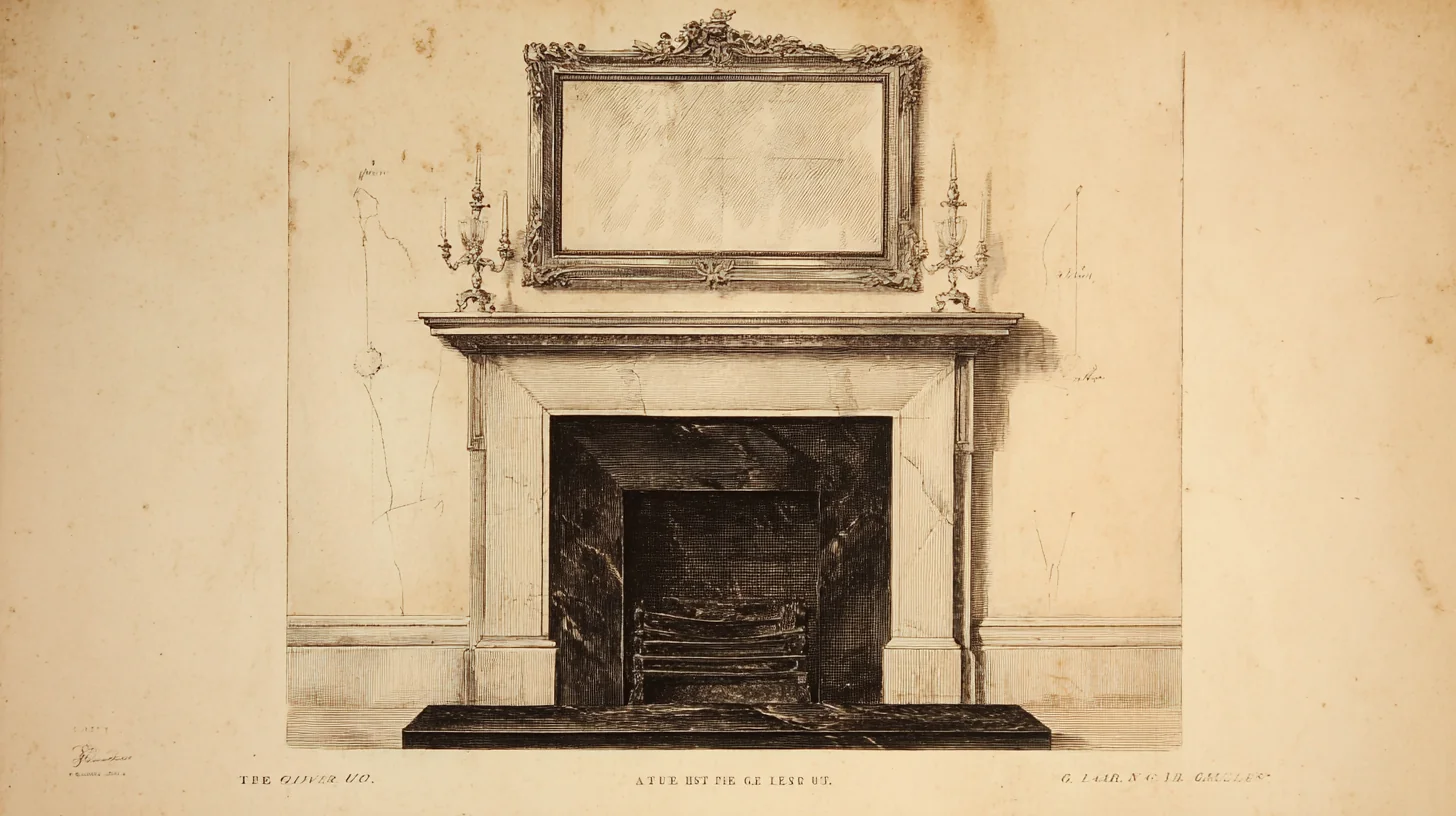
The drawing-room was the best of the rooms: a long room on the first floor, with two windows giving onto the street and a heavy black mantel of marble at the far end. Above the mantel hung the looking-glass.
It was, as such things go, a perfectly ordinary mirror — a plate somewhat over four feet in height and a little over three across, with the faint silver-bloom of glass long silvered and never resilvered, set in a sober Regency frame of polished mahogany. There was nothing whatever to mark it out. Vane noticed it as one notices a piece of furniture in a room one means to live in: he formed the small private intention of having it cleaned, and did not have it cleaned, and forgot the intention, and the mirror hung as it had hung, presumably, for most of his aunt’s tenancy and possibly for the tenancy before hers as well.
He went on living in the house, in his quiet and orderly way, for some months before anything occurred. He wrote letters and read in the drawing-room of an evening; his sister called on Thursdays and they took tea there; once a month a man of his acquaintance from the Inn would come up and they would sit and talk about a case or about nothing. A good deal was said in the room, in the way a good deal is always said in rooms, and Vane thought no more of any of it than one thinks of breath.
The First Voice
The first replay came on a Tuesday evening in the November of his first year. He had spent the day in chambers and had come home tired and settled into the chair he kept by the fire in the drawing-room, with a book and a glass. He was reading, he said, with the half-attention of a man whose principal pleasure is in the sitting still, when he heard, perfectly distinctly, his own voice say a sentence in the room.
The sentence was: “Well, I don’t pretend to know what Aunt Maud would have wanted; but I think she would have wanted the desk to go to Phoebe.”
He sat up in the chair. The voice had come, plainly, from the direction of the mantel. It was altogether his own voice, in the unmistakable way one’s own voice is unmistakable — in a manner one cannot afterwards confuse with any other thing.
Vane was not a man given to fancies. His first thought was perfectly rational: he had heard something from the street, refracted by the chimney or by some peculiarity of the room’s acoustics, and his mind had supplied the resemblance. He set the book down and listened. The street was quiet. The fire ticked. A cab went by, far off. Nothing else came. His second thought was that he had spoken the sentence himself, aloud, in the absence of mind that overtakes a tired man with a book, and had only thought he had heard it. He found this less plausible than the first, but he entertained it, because the alternative — that the sentence had come, fully formed and in his own voice, out of an empty room — was not a thing he was prepared to entertain at all.
It was when he went, an hour later, to bed, that the third thought arrived, and the third thought was the bad one. He had spoken the sentence before. He had spoken it, in fact, in that very room, three weeks earlier, to his sister Phoebe, on a Thursday over tea. They had been discussing the disposal of certain pieces from the estate. He remembered now, with the sharp small remembering one does in bed at such moments, that Phoebe had laughed at the formality of his manner and said, “Hollis, you are not a probate clerk, you are her nephew.” He remembered the laugh. He had heard, an hour before in the drawing-room, the sentence and not the laugh.
He went to sleep telling himself that he was tired, and that the brain, which is an instrument he had never quite trusted, had supplied an echo of a real conversation in place of an unreal one. He woke in the morning believing this. He believed it through breakfast. By evening he had given up believing it, because he could not, in honesty, believe a thing the only support of which was that he wished to.
For some days he did not sit in the drawing-room. He took his book to the dining-room, where he had never sat in the evenings, and read there, and was uncomfortable, and felt foolish for being uncomfortable. By the end of the week he had decided that the only respectable course was to go back. He went in. He sat. He read. Nothing came. He went in the next evening. Nothing came. He went in the third evening, and Phoebe’s voice, from the direction of the mantel, said, “Hollis, you are not a probate clerk, you are her nephew.” And then, after a pause perhaps of a second, the small contained laugh he remembered her giving. And then nothing more.
The Pattern, So Far as I Could Make It Out
It would be tidy to report that Vane settled at once into careful observation; he did not. The first weeks were a watchfulness one could not tell from dread, in which he heard nothing for several evenings together and then a fragment at the unlikeliest possible hour, and was made to start. It was nearer four months before he had anything like a pattern to lay before himself.
The mirror gave back things that had been said in front of it. He satisfied himself of this by a series of small tests: he would say a particular harmless sentence aloud in the room of an evening, with no one to hear; and within a few days to a few weeks, that sentence, in his own voice and at his own pitch, would come back from the mantel at some moment he could not predict. The replay was perfectly faithful in voice and in word. It was not faithful in selection. The mirror did not give back everything. It gave back, by some preference of its own, only certain things.
The preference he learned slowly, and never with confidence; but as nearly as he could state it: the mirror favoured what had been said with feeling. It did not concern itself with the housekeeper’s good-morning, nor with the small mechanical phrases by which men open and close their evenings. It returned, by preference, confidences — the things one says when one has dropped one’s voice a little; the half-completed thought one had not pursued because the friend changed the subject and one had been a little relieved. It returned, especially, the sentences a man says once and once only — a kindness expressed, an admission made, an opinion offered with more candour than was strictly safe — and then does not repeat, because to repeat such a thing is to underline it, and one does not always wish to be quite so underlined.
It returned, in short, the things one said meaning them.
The First Conversation Staged for It Deliberately
There came a stage at which Vane attempted to use the mirror. He had been carrying for some weeks a piece of unfinished business in his own mind: a sentence he had not said to his father before his father died, twelve years before. He did not tell me what the sentence was. I gathered only that not having said it had been, in his own private accounting, one of the few real failures of his ordinary decency.
He resolved, one evening in February, to say the sentence aloud to the mirror — in his father’s hearing, so to speak, in the closest approximation the world any longer allowed — and to let it be there. He did not expect his father to answer; he had not lost his sense of proportion. He expected only that the mirror, having heard the sentence in the register of feeling in which he meant to say it, would in due course return it, and that he would hear it then in his own voice, as a man hears a thing he has at last said, and the unfinished business would by this means be at any rate retired.
He cleared the room. He put the lamp where he wished it. He sat in the chair by the mantel and said the sentence aloud, in the voice he had meant to use, and got up afterwards a little foolish and a little relieved.
Three days later, going into the drawing-room with the post, he heard from the mantel a sentence in his own voice — and it was not the sentence he had said. It was an instruction he had given some months earlier to his clerk, in passing, about a misfiled affidavit. He stood with the post in his hand and listened to himself deliver it; and there was nothing else.
He waited, after that, for weeks. He gave the mirror, as he put it, every opportunity to amend the choice. It did not amend the choice. It returned, in those weeks, a number of other things — a remark of Phoebe’s, a fragment of a conversation with a client whom he no longer liked, a sentence of his own about the price of asparagus — and it did not return the sentence he had prepared. It did not return it that winter, and it did not return it in the spring, and at some point in the summer he understood that it would not return it at all.
The mirror was not to be commanded. One could speak in front of it; one could not address it. His attempt to feed it the sentence had been an attempt to instruct an instrument of which he was, evidently, not the operator but the subject.
The Voices He Did Not Know
I should have mentioned earlier — except that Vane himself did not mention it to me until quite far into the telling — that he had by this time begun to hear voices in the drawing-room that he did not know.
They had been there from the start; he had simply taken them, in the first months, for further tricks of his mind. There would be the small distinct sound of a woman saying, “I have asked him twice, and he will not say.” A man’s voice, with a north-country edge in it, saying only, “Then it is settled, and we shall not speak of it again.” Once — and this was the one that had stayed with him longest — a child, perhaps eight or nine, said quite calmly, “I do not want to live with her, Father,” and then nothing.
These had at first frightened him more than the others, because the others were at least his. He began, by way of getting them in order, to keep a small notebook of the sentences he had heard; and in the second half of the first year he took the notebook to the small office in the basement that had been his aunt’s, and went through the papers there with a patience he had not previously brought to them. He found a quantity of correspondence going back many decades, in three or four different hands, and a small leather-bound household book in which his aunt had kept, all her widowed life, a record of her dinners — who had dined, what had been served, what had been spoken of. The aunt had been a methodical woman.
By cross-reference, Vane was able to put names to a number of the voices. Some were friends of his aunt, long since dead. Some were earlier — his aunt’s husband, who had died before Vane was born, and whose voice Vane had now heard several times in his own drawing-room; his aunt’s husband’s first wife, of whom Vane had never heard, and whose existence he had learned of only by tracing her name through a letter. And some were older than the household book itself. They belonged to a tenancy before the aunt’s, and Vane could not, by any document he could find, attach a name to them at all.
He came to understand, then, that the mirror had not begun with him. It had not begun with his aunt either. It had been hanging on some mantel or other, in some drawing-room or other, for as long as it had been a mirror; and it had kept what was said in front of it, the whole time, and given back whatever portion the mirror chose to give back, to whoever happened to be sitting in the room when the giving back occurred. None of it had gone. The mirror evidently kept everything.
The Closing of the House
The period that followed is difficult to give in the proper proportion, because nothing very dramatic took place, and yet the shape of Vane’s life altered considerably, by stages that were each in themselves quite small.
He stopped sitting in the drawing-room in the evenings unless he was alone. He found, after a few attempts at company there, that he could no longer hear a friend say something across the hearth without thinking, and now that, too, has been kept; and this thought, once arrived, put a small constraint on his side of the conversation which the friend felt without identifying, and which spoiled the evening. He gave up the drawing-room for company, and used the small parlour at the back of the house instead, and matters were better there, for a time.
He understood, after some months, that he could no longer be sure the mirror’s effect was confined to the drawing-room. He had no evidence that any other room held the same property; but he had no evidence that none did, either, and the second absence weighed on him more heavily than the first. He moved his company to the dining-room; gave up the dining-room after a winter; and then, by a step that arrived without quite being decided on, gave up the house for company altogether. He met his friends at his club, or at theirs, or at restaurants in which he had never previously taken any pleasure, and he did not have them in.
Phoebe, who was the only person who would have insisted, did insist; and Vane, who could not bring himself to tell her the reason, told her instead that he had become difficult and solitary in his old age. She accepted this, because she had always half expected it of him, and because the alternative was a thing she could not have done very much with. She came less often, and then on alternate Thursdays, and then for tea at her own house instead of his. The drawing-room sat empty most evenings, and the mirror hung in it.
The Realisation
He had begun, after the first months, to think of the mirror as a recording device. That was the natural figure, in the age in which we live; it was the figure I myself reached for when he first described it, and he saw me reach for it, and was patient with the reach. But he had come, by stages, to think it was not a recording device at all. A recording device sets out to capture what passes before it and stores a copy of the capture; the original passage of speech has gone, and the copy, which is a kind of artefact, is what remains.
The mirror was not of this kind. It did not so much record what was said before it as retain it. It did not produce a copy and store the copy. It kept the thing itself. What had been spoken in front of the mirror had not, in any sense the mirror cared about, gone; it had merely ceased, for a while, to be audible. The replays were not playbacks of stored copies. They were the original speech, becoming audible again, in the same voice and on the same breath, as if no time had passed at all.
I do not know whether Vane was right about this. It is, on the face of it, a metaphysical claim, and he was not by trade a metaphysical man. But I have not found a way of describing the mirror’s behaviour that fits the behaviour as well as his does. A recording is a copy. The mirror did not give copies. It gave the thing.
The consequence was this. Vane had spent the first fifty years of his life, as the rest of us spend ours, on the working assumption that speech is a perishable substance. One says a thing aloud; the air receives it; the thing is gone, and only such part as the listeners chose to retain in their own memory survives. This assumption underwrites the whole texture of ordinary conversation. One ventures a confidence because the confidence will soon be only what the friend chooses to remember of it; one drops one’s guard because the air will close, in a moment, over whatever one has let through. Speech is provisional. This is the unwritten contract under which men have been talking to one another, in drawing-rooms and elsewhere, for the whole of recorded time.
The mirror voided the contract. Not by recording. By witnessing. What had been said in its presence had not gone; it had been held; and Vane had been talking, for the better part of two years before he understood this, on the assumption that it was going.
What he most regretted, he said, was not anything in particular he had said. His life had not been the kind to furnish shameful sentences in any quantity. What he regretted was the manner of his having said the ordinary things: said them in the confidence that the air would presently close over them. He had spoken with feeling because the feeling would not be kept; and the feeling had been kept, and was now in the room, complete, available to be reissued on the mirror’s own schedule and on no schedule of his.
It was, he said, like discovering at sixty that one had been overheard since five.
The Last Evening
He gave up the lease the following spring. I was there on his last evening. Most of the furniture had gone. The drawing-room held only the chairs, and the small table, and the mantel with the mirror over it.
He had, by then, covered the mirror. He had done it weeks before, with an old grey cloth he had had from somewhere — not, he was at pains to say, in any expectation that it would silence the thing, but as a small private courtesy to himself, so that he should not be obliged to see the room reflected in it whenever he went in. The cover did not silence it. A sentence had come out from under the cloth, on a Wednesday in the previous month, in a voice he did not know — a woman’s voice, perhaps a hundred years dead, saying, “It is not the money, James, you know it is not the money.” It had come out as clearly as it would have come from in front of the glass. The cover was, as he had expected, only a courtesy.
I asked him whether he meant to take the mirror with him. He shook his head. The mirror was a piece of the house and not of his furniture, he said. He had considered breaking it; but he could not destroy a thing which contained the only surviving record — if record was the word — of speech that had belonged to people he had never known, and he was not at liberty to silence the dead a second time on his own authority.
We sat there a while, in the chairs, in the nearly empty room. The fire was low. He was, I think, a little reluctant to leave. He had not been happy in the house, in the latter part; but he had been, in some way I could not quite name, attended in it, and was not yet sure what it would be like not to be.
He got up, after a long pause, and walked over to the mantel, and took the cloth down from the mirror, and folded it, and laid it on the empty mantelshelf. The plate, with the small bloom on it, gave back the room and the two of us in it and the low fire behind us. We did not say anything for some little while.
Then, from the direction of the mantel, in his own voice, came a sentence I had not heard him say and that he was not, in that moment, saying. It was not long. He had spoken it, he told me later, in the autumn of his second year in the house, in this room, alone, on an evening he had quite forgotten until he heard it now. He gave me, when I asked, the words of it; but I think on consideration that I will not set them down. It was the sort of sentence a man says once, to no one, because he had not until that moment known he meant it; and the mirror had taken it and kept it for him; and it now stood — if it stood — as the only proof that he had ever meant it at all.
He listened to it through. He did not speak. When it was done, he stood another moment by the mantel, and then put the cloth back over the glass, and we left the room, and he locked the door.
I walked with him as far as Cavendish Square. At the corner he stopped and shook my hand and thanked me, in his ordinary undemonstrative way, for having listened to him over the winter; and he said, almost as an afterthought, that he supposed the mirror would be heard by someone else now, and that this was probably as it should be, since a thing of that kind ought not, on reflection, to belong to any one tenant.
I have not been back to the house. I do not know who lives there now. I do not know whether the mirror still hangs above the mantel, or whether it has been moved, in the way mahogany frames eventually are, into another drawing-room in another house, on another street, where someone is at this moment sitting by the fire and reading and is about to hear, very distinctly, a sentence in a voice he knows.
I have set this down as Vane asked me to, and as exactly as I am able. I have no moral to attach, and I think Vane would not have wanted one attached. I will say only that I have, since that winter, found myself a little more careful about what I say in rooms — not from any belief that the rooms I sit in are listening, for I have no such belief, but from a small new awareness that the air’s closing over a sentence is a thing I had been counting on without ever having examined the count; and that a man who has once been told the air does not always close cannot quite, afterwards, return to the easy speech of those who have not been told.