I have set down what follows exactly as Mr. Aldous Renn told it to me, on three evenings in the autumn of his retirement, in the small house he kept above the harbour at Penllech. He was by then an old man, careful and unexcitable, with the dry, exact manner that the long practice of his profession leaves upon those who have given their lives to it; and he told the thing without ornament, as a man states a fact he has examined from every side and cannot make to come out otherwise. I record it because I have not been able, in the years since, to make it come out otherwise either; and because Renn asked me, with a particular and quiet insistence, to write it down only after he was gone. He has been gone now some while. What I owe him is accuracy, and I have tried to give him that.
Renn was a surveyor — a good one, by the testimony of every man I have spoken to who knew his work. He had been trained in the old discipline of the chain and the theodolite, in the days before the aeroplane and the photographic plate took so much of the labour and so much of the judgement out of the business; and he held, all his life, that a map made by a man who had walked the ground was a different kind of object from a map made by a man who had not. The distinction mattered to him. He returned to it more than once in the telling, as though it were the hinge of everything else.
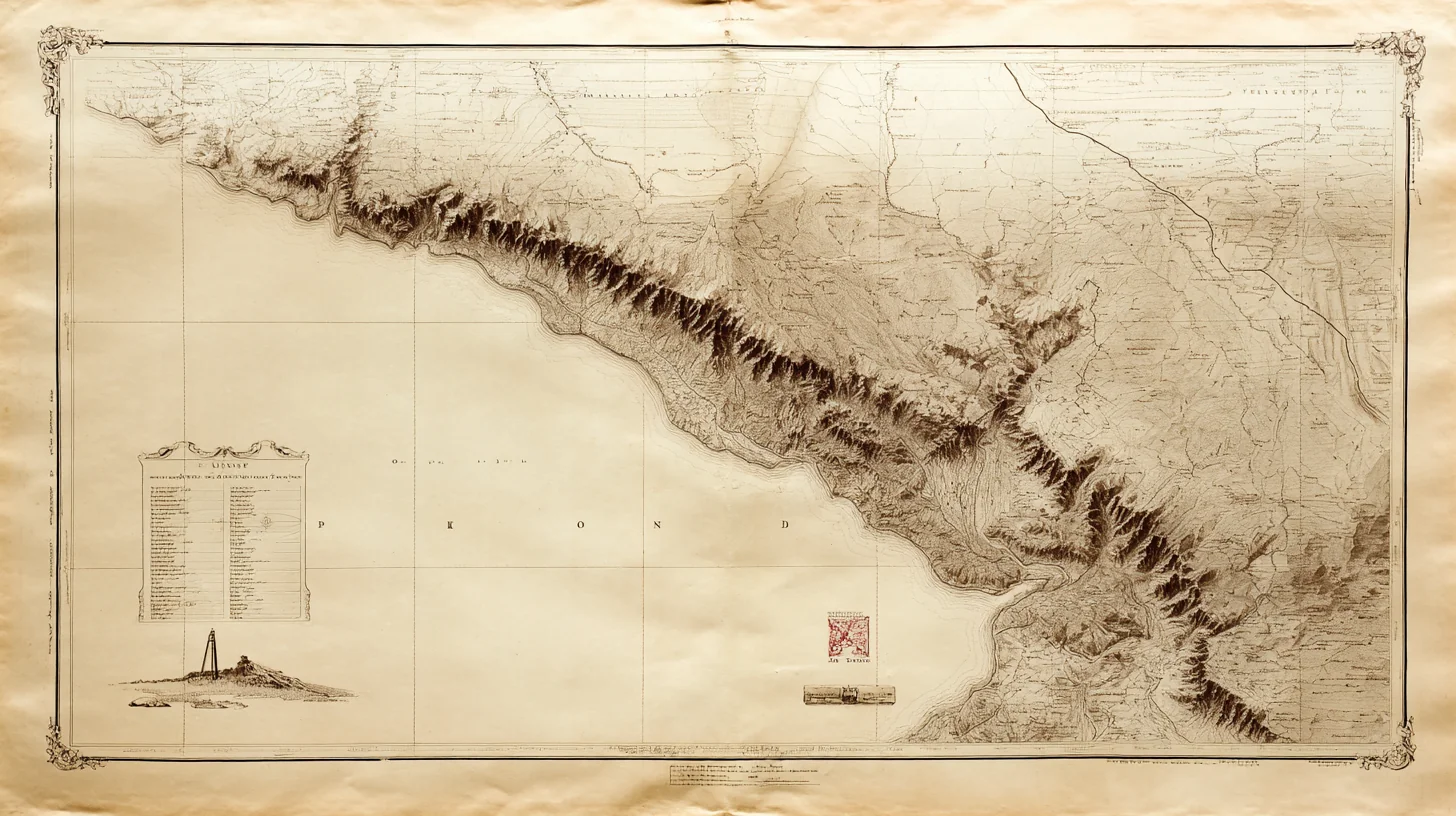
In the spring of his thirty-fourth year he was commissioned to survey a district in the west that had never been properly charted. I shall not name it precisely; Renn did not, and I think his reticence was deliberate, and I have come to share it. It was a stretch of perhaps forty square miles — moor and rough upland to the north and east, a broken and difficult coast to the west, and between them a country of small valleys, peat, standing water, and a few scattered farms whose people kept to themselves and had kept to themselves, by every sign, for a very long time. It had been mapped before, after a fashion. There existed an estate plan of part of it, and a coastal chart that concerned itself only with what a vessel must avoid, and a county map on which the whole district was rendered with the frank and cheerful vagueness of a thing copied from another thing that had itself been guessed. Renn’s commission was to replace all of this with a single accurate survey, at a scale of six inches to the mile, fit to be engraved.
He took two seasons over it, and a chainman and a boy, and he did the work, as he insisted to me, honestly. I want to be exact about his meaning here, because the whole of the rest depends upon it. He did not mean that he had measured every yard of forty square miles, for no surveyor does that or could. He meant that wherever the ground would yield to measurement he had measured it, and wherever it would not he had done what every competent surveyor does, which is to infer — to carry the line across the doubtful place by reason and by eye, and to set it down with the same firm stroke as the part that was certain, because a map may not stammer. A map that confessed every uncertainty would be unreadable, and useless, and no map at all.
So there were, in Renn’s finished survey, a number of strokes that were inference and not measurement, and he knew precisely which they were, and he named them over to me one by one, that first evening, the way a man tells over a debt.
There was the coastline below the northern headland, where the cliffs fell sheer into broken water and no man could stand to take a reading; he had drawn that coast from a boat, in a swell, at two hundred yards, and he had smoothed it — had given it a clean, plausible, gently curving line where the truth was very likely a thing more jagged and more ugly than any instrument of his could have caught.
There was the river. It ran down off the moor and went, for the better part of a mile, into a gorge so deep and so overgrown that he could not follow it and could not see into it; he had stood at the place where it entered and the place where it came out, and between those two certainties he had drawn the course he judged most probable — a single confident curve through country he had never set eyes on.
There was a hill in the southeast quarter. He had never climbed it and never properly seen it; but the light, on two separate evenings, had fallen across that quarter in a way that declared high ground, and the streams ran from it as streams run from a summit, and so he had placed a hill there, of a height he inferred, and drawn the contour rings about it with a steady hand.
There was a boundary, an old parish line, that the documents disputed and the local people remembered three different ways; and a boundary a map cannot leave ambiguous, so he had chosen, and drawn it, and made it certain by drawing it.
And there was — this he told me last, and more slowly — a valley in the empty west of the sheet, a small green valley running down toward the sea, that had no name. He had asked, and no one had a name for it; it was simply the valley, or down there, or it was nothing at all. A surveyor dislikes a blank where a name should be; it makes the sheet look unfinished, and it troubles the eye. And so, idly, at his table one evening with the lamp drawn close, to fill that empty quarter and for no better reason than that the sheet asked for it, he had written across the little valley a name of his own invention. He told me the name. I will not give it here. It was a soft name, plausible, of the kind the country itself might have produced; he had built it, he said, out of two ordinary words of the old local speech, fitted together the way such names are fitted, so that it would not look false beside the true ones. And then he had inked it in, in the proper lettering, and thought no more about it, and delivered the map.
That was the whole of it. There is nothing in any of that which a hundred honest surveyors have not done a hundred times. Renn was at pains that I should understand this. He had done nothing that the profession does not silently sanction; he had done only what the work itself requires; and if there is a horror in this account — and I believe there is — it begins precisely there, in the fact that he had done nothing wrong at all.
He returned to the district fourteen months later.
There was an ordinary reason for it. A question had been raised about one of the engraved sheets — some small discrepancy of levels, the sort of thing that is settled in a morning — and Renn, being the man who had done the original work, was the natural man to send. He thought nothing of the journey. He went down in the early autumn, alone this time, with a single copy of his own published map folded in his coat, and he meant to be home within the week.
He was not home within the week.
He came up onto the moor by the eastern road, the way he had first come into the district two years before, and the first thing — he was insistent that it was the very first thing, before he had any thought in his head of anything being wrong — the first thing he noticed was the hill.
It stood in the southeast quarter. It stood exactly where he had placed it. He had placed it, you will remember, by inference, from the fall of the light and the running of the streams, having never seen it; and now he saw it, and it was the hill he had drawn. He stood in the road a long time looking at it. A man may, of course, infer a hill correctly; that is what the skill is for; and Renn told me that for perhaps a quarter of an hour he stood there assuring himself, quite reasonably, that he had simply done his work well, and that the unease he felt was the foolish unease of a man meeting, in the flesh, a thing he had previously known only as a line. He walked on. But he had taken the map out of his coat, and he did not put it back.
He went down to the coast next, because the coast was on his way, and because — though he did not say so to himself in those words — he wished to be reassured by the coast. He was not reassured by the coast.
The cliffs below the northern headland, which he had drawn smooth from a boat at two hundred yards in a swell, knowing as he drew them that the truth was certainly rougher and uglier than his line — those cliffs now ran smooth. They ran in a clean and gentle and plausible curve. They ran, foot for foot and bay for bay, as he had drawn them. He stood above them for a long while, Renn said, and he was a careful man and not a fanciful one, and he searched that coast for the jaggedness he knew ought to be there, the jaggedness that any true coast has; and the coast declined to be jagged. It had the smoothness of a drawn thing. It had been, he said — and here he stopped, the first evening, and was silent for a little — it had been generalised. That was the surveyor’s word he reached for, and could not better. The coast had been generalised, in the way a draughtsman generalises a coast he cannot see in full; and the generalisation was his.
I will not give every test in the order he gave it to me, for he gave it to me very slowly, and circled back, and the three evenings ran together. But the substance of the next days, as he reconstructed them for me, was this.
He went up the river, and the river had moved. Where it came out of the gorge — that mile of gorge he had never been able to enter or see into — it came out now along the course he had guessed for it. He knew it had moved, because he had stood at that lower mouth two years before and watched the water come out, and it had come out then bearing to the left of a particular split rock, and now it came out bearing to the right of that rock, which was the side his drawn line required; and the old channel, the true channel, was a dry and grassy scar that the eye could still follow if the eye knew to look. The river had been corrected. It had been brought into agreement with the map.
He went, last, to the valley.
He went to it, he admitted to me, with dread, and he went to it knowing already, I think, what he would find, because by then the pattern of the thing had laid itself out before him with the cold and orderly logic of a proof. There was a valley in the empty west of the sheet. It ran down toward the sea, small and green, as he had drawn it. He came over the shoulder of the land above it in the late afternoon and stood looking down, and there was a farm in the valley, and a man mending a wall, and Renn went down to him and gave him good evening and asked him, as a traveller asks, the name of the place.
The man told him the name.
It was the name Renn had invented at his table by lamplight, out of two old words, to fill an empty quarter of a sheet of paper. The man gave it readily, with the small flat certainty of a thing entirely beyond question; and when Renn — keeping his voice, he said, very level — asked how long the valley had been called by that name, the man looked at him without comprehension and said that it had always been called that. That his father had called it that. That it was the name of the place. There was no other name, had never been any other name, and the question itself was a foolishness, the sort of question a stranger asks.
Renn thanked him and went back up onto the high ground in the last of the light and sat down, because his legs, he told me without any embarrassment at all, would not at that moment carry him further.
I have wondered since how a man of Renn’s particular temper met a thing like that, and the answer he gave me — the answer his whole conduct over the following days was — is the part of the story I find I most want to set down faithfully, because it is the part most unlike what a man imagines of himself.
He did not flee, and he did not pray, and he did not persuade himself he was ill. He was a surveyor. He had spent his life establishing the truth of doubtful ground by subjecting it to test, and so, sitting on the hill in the dark, he resolved quite steadily that he would subject this to test; that he would treat the appalling proposition before him exactly as he would treat any other hypothesis about the country — that is, he would put a mark on the map where the ground did not yet warrant it, and then he would go and see.
He chose something small. He told me he chose it small on purpose, partly from a scientist’s instinct for the modest experiment and partly — he was honest about this — from fear; he did not want to author anything large. There was a particular field he knew, a high bare field on the moor’s edge with nothing in it, and he took his pen that night at the inn and he drew, in the corner of that field nearest the road, the small circular symbol that the survey used for a single standing stone. There was no standing stone in that field. He had walked the field himself two years before; he had walked every yard of it; it was empty. He inked the symbol in and let it dry and folded the map and, he said, did not sleep.
In the morning he walked out to the field. The walk was four miles. He has described that walk to me and I will not attempt to improve on the plainness of his description: he said it was the longest distance he ever covered, and that he did it without once raising his eyes from the road immediately before his feet, because he found he could not bear to look up and see the field while there was still any distance left in which the field might be empty.
The stone was there.
It stood in the corner nearest the road, where his pen had put it — a single rough pillar of the grey country rock, lichened, bedded deep, leaning a little with the unmistakable look of having leaned so for a thousand years. The grass grew up against its base undisturbed. There was no rawness anywhere about it, no mark of the ground having been opened. It had the complete and seamless pastness of a thing that has always been there; and Renn stood with his hand flat against it — he wanted, he said, the fact of it against his palm — and understood that the map was no longer a description of that country.
The map was the authority. The country was the copy. Where the two differed the country would, quietly and without haste and without any witness to the moment of change, give way and become what the map already said. He had spent his career, and his whole faith, on the principle that the map must answer to the ground. He stood in the field and understood that for this district, and perhaps — the thought came to him there and he did not afterward find any way to refuse it — for every district, the ground answered to the map.
A man might have stopped there. Renn did not stop there, and I have come to believe that the reason he did not stop is the reason the story is worth the telling, and worth the long care he took that it should reach me whole.
He did not stop, because a question had opened under the first horror, and it was a question only a mapmaker would think to ask, and once asked it could not be put down. The question was this. If the ground of that district had been made to agree with his map — if his survey of two seasons had become the true thing and the country the obedient copy — then his survey was not a description. It was an instrument. It had made. And a thing with that power was either the first such thing that had ever existed, which Renn, sitting in the field, found he did not for a moment believe; or else it was not the first, and his map stood in a line.
He wanted, therefore, an older map. He wanted to know what had charted that country before he came to it.
He spent, he told me, the better part of three weeks at it, and he was a methodical man and knew where such things are kept — the muniment rooms of the old houses, the county archive, the chests in the vestries of remote churches where the parish records lie under dust and damp. He found the estate plan he already knew of, and the coastal chart, and two or three others, none older than a hundred and fifty years and none of them anything but ordinary. And then, in the last place he looked — it was the strong-room of a private library, the collection of a family long settled in that country, and he had got himself admitted to it by a chain of small civilities I need not detail — in the last place he looked, folded in a parchment cover and catalogued under no useful heading, he found the old map.
He knew it was old before he could have said how he knew. It was drawn on skin, and the skin was very dark, and the hand that had drawn it was not any draughtsman’s hand he had been trained to recognise; but it was, unmistakably and beyond any possibility of his mistaking it, a map of his district. There were the forty square miles. There was the moor, and the broken coast, and the small valleys between. And it was drawn — Renn made me sit with this, the third evening, for a long time before he would go on — it was drawn with features upon it that he believed he had invented.
The coast ran smooth, in his curve. The river ran in his guessed channel. The hill stood in the southeast quarter. The valley in the western quarter bore a name, lettered small in the old brown ink, and though the characters were strange to him he had spent his life reading the lettering of maps and he worked it out, and it was his name — the soft name he had built one evening out of two old words to fill an empty space. It was on the old map. It had been on the old map, by every evidence of the skin and the ink, for longer than his country had kept records at all.
He stood in the strong-room, he said, and he was past horror now and into something colder and more level, a kind of attention; and being a surveyor, being to the last a man who reads a sheet methodically and to its edges and does not stop at the part that interests him, he read the rest of the old map. He read it across, and down, and into its corners.
And in the eastern quarter, on the moor’s edge, above the line of an old road, he found a small mark.
It was not a symbol of the survey he knew. It was a little figure, drawn fine, of a kind he could not name; and beside it, lettered very small in the old brown hand, was a word. The word was a name. He read it. He stood, he told me — and this was the last thing he told me, on the last of the three evenings, and he told it quite quietly, with his hands still on the arms of his chair — he stood and read, set down on that map centuries before his birth, in a country he had believed himself the first man ever truly to chart, the name of the house in which he had been born, and beside it, in the same small ancient certain hand, his own.
He understood then, he said, what he was. He had gone into that district as the man who held the pen. He came out of the strong-room knowing that he had never held it; that he, and his two careful seasons, and his six inches to the mile, and his whole exact and honest life, were a line on someone’s earlier sheet — drawn, inferred perhaps across some doubtful place, named to fill a space — and that he had been walking, all the while he believed himself the author, the obedient and finished country of an older map.
He did not tell me, and I did not ask, whether he ever went back to the strong-room to look at the old map again. I think he did not. There would have been no use in it. A man cannot revise the sheet he is drawn upon; he can only, at the last, and carefully, and to one other person, set down what he has read there — and hope that the setting-down is itself not already inked, small and certain, in some hand he will never see.