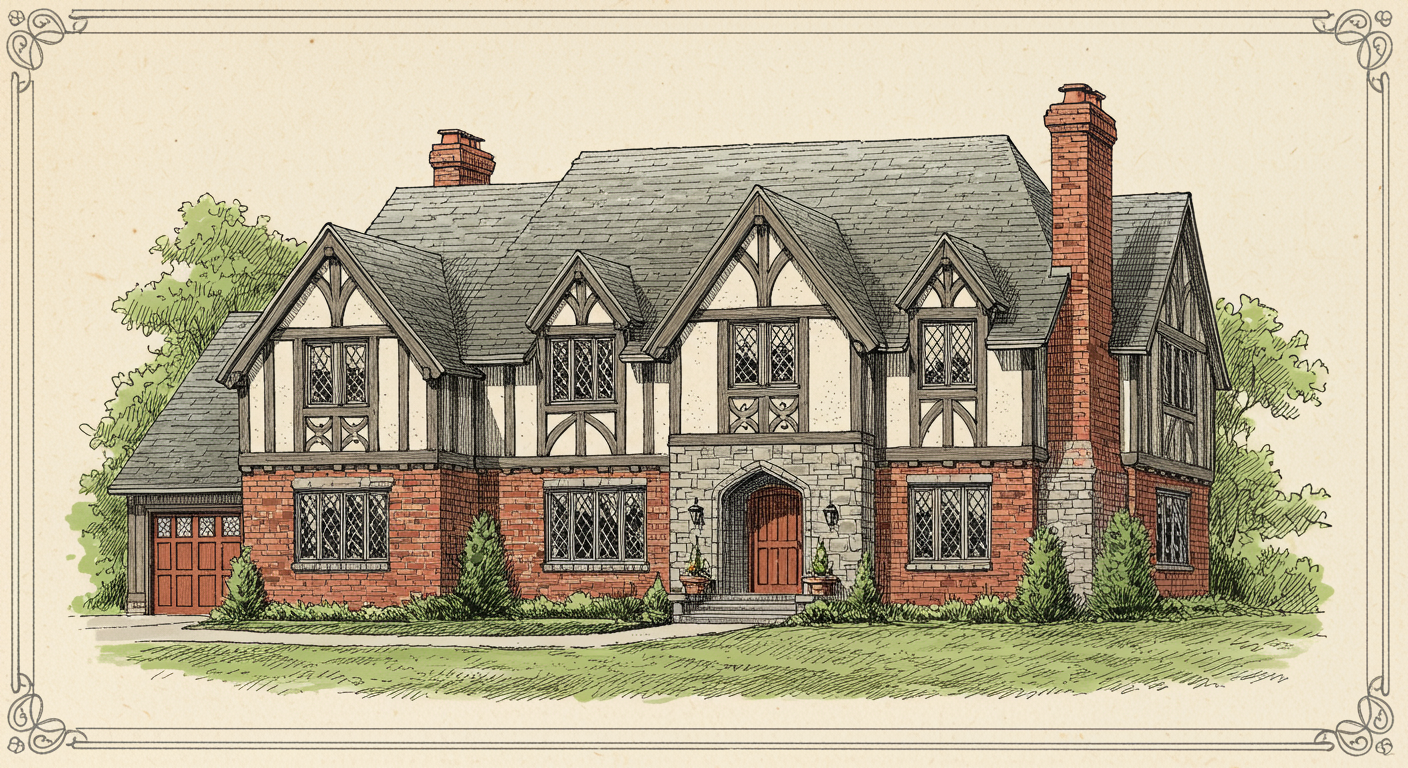
The Tudor Revival house of the inter-war American suburb — black-and-white timbered upper storey above a brick or stone first storey, multiple steeply-pitched gables intersecting at picturesque angles, a massive front-facing chimney standing as the principal vertical anchor of the facade, mullioned casement windows in tall narrow groups, an entry under a round-arched stone surround with no porch — is, on inspection, the most thoroughly historicist house in the American residential tradition since the Greek Revival of a century earlier. It quotes an architecture that was old when Shakespeare was young, applies it to the suburban lot of the 1920s American businessman, and trusts the resulting picturesque composition to speak for the kind of household-and-lineage gravity that the businessman’s actual lineage, three generations off the boat from somewhere east of the Channel, was not in a position to claim on its own.
This is the thirteenth post in Reading the American House. It treats the Tudor Revival because the Tudor Revival, more than any other inter-war suburban style, illuminates what the upwardly-mobile Anglophone American middle class was, in the 1920s and 1930s, attempting to purchase when it bought a house. The previous post on the Foursquare treated the catalogue-economy default of the same period; this post treats its architect-defined upper-middle counterpart, with which it often shared a single suburban block. The two arguments — the Foursquare’s plain functional efficiency and the Tudor Revival’s picturesque historicist quotation — were the two principal moves available to the inter-war suburban builder, and the choice between them was, for the buyer, often less an architectural decision than a social one.
The Specimen
If one is to identify a Tudor Revival — and one will find them in considerable numbers in the country-club neighbourhoods of nearly every American town that supported one between roughly 1915 and 1940, the upper-middle and upper-class residential streets of the period — the exercise begins, like the Foursquare’s, at the silhouette, but the silhouette one is reading is composed differently and is to be read for different things.
Begin at the roof. The Tudor Revival presents, almost without exception, a steeply-pitched roof of multiple intersecting cross-gables, asymmetrically arranged across the principal facade, with the dominant front gable typically taller and steeper than the others and the lesser gables stepping down beside it. The pitch is steep — sixty degrees and not infrequently steeper — and the eaves are minimal, often closed and tightly bracketed against the wall surface. The roofing material on the better houses is slate; on the more modest, clay tile or asphalt shingle in a colour intended to suggest slate. There is no central dormer of the Foursquare type, no wide sweeping eaves of the Prairie type. The roof is the dominant feature of the elevation and asserts itself first.
The chimney is the second decisive feature. A Tudor Revival house carries one or more massive masonry chimneys — brick most often, stone on the more substantial commissions, sometimes patterned brickwork or with terracotta chimney pots in the manner of Hampton Court — and these chimneys are, frequently, positioned on the principal facade as a major architectural element rather than concealed at the side or rear. The chimney announces the hearth as the social heart of the house, and the chimney’s prominence is the architect’s quotation of an English country-house tradition in which the great fireplace was the room around which the house was organised.
Examine the wall surface. The Tudor Revival’s principal decorative move is the combination of materials, and the typical specimen presents a brick or stone first storey surmounted by a half-timbered upper storey in which decorative dark wood timbers are applied against a stucco or pebble-dash infill. The half-timbering is, in the great majority of American Tudor Revival houses, false — the timbers are nailed to a conventional balloon-frame stucco wall, performing no structural function — but it is laid out with attention to the patterns the original sixteenth-century English work would have used, with vertical posts at regular intervals, horizontal rails at the floor levels, and decorative diagonals across particular bays. On the more careful examples, the carpenter has cut the timbers to suggest the slight irregularity of hand-hewn work; on the less careful, machine-milled boards are nailed in straight runs and the effect is correspondingly mechanical.
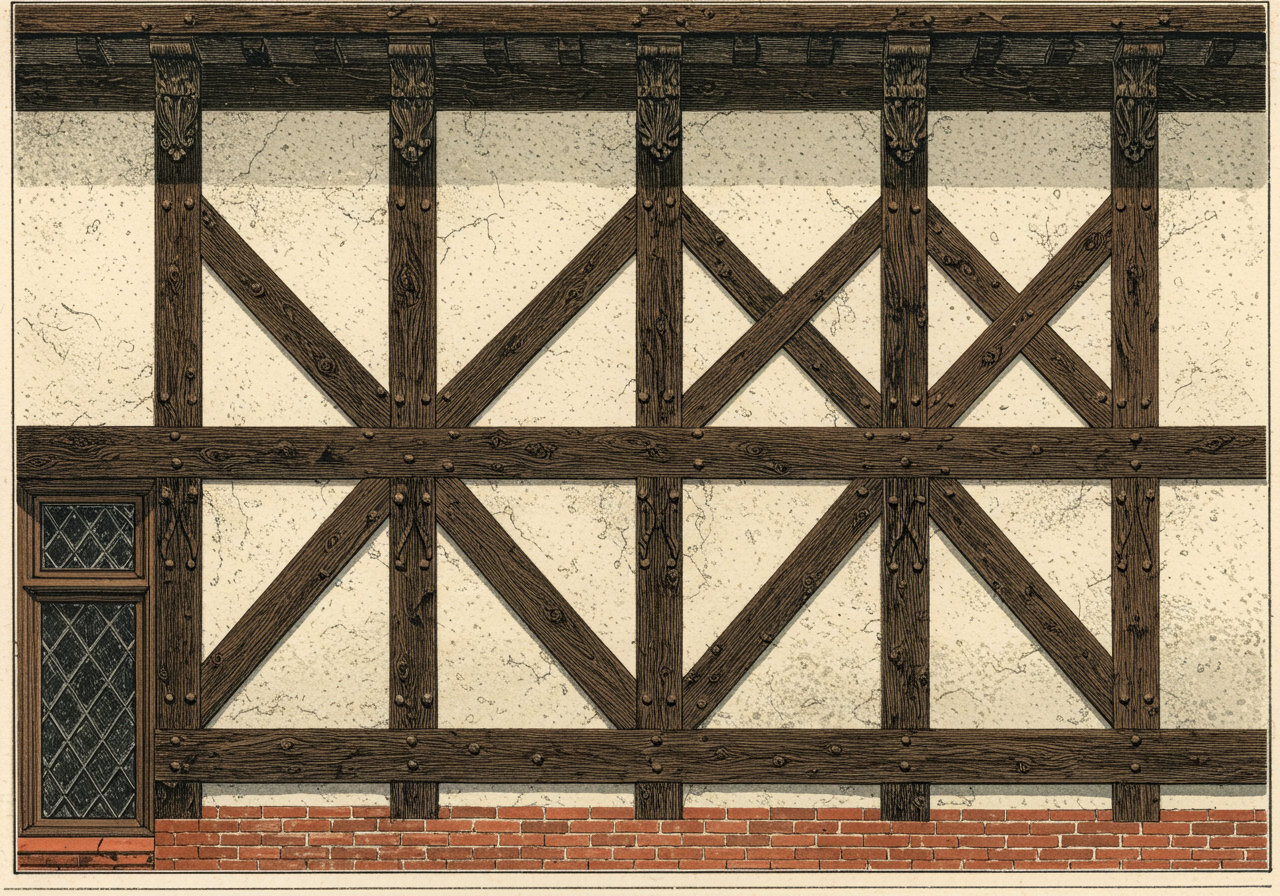
A close detail of decorative half-timbering on the upper storey of a Tudor Revival house — dark wood timbers against light stucco infill, vertical posts at regular intervals, horizontal rails at the floor levels, and decorative diagonals across particular bays. The half-timbering is, in nearly all American Tudor Revival houses, false: the timbers are nailed to a conventional balloon-frame stucco wall and perform no structural function. The original sixteenth-century English half-timber work used real timber frames with infill of wattle-and-daub or brick; the American Revival used the visual vocabulary without the structural substance. A trained eye reads the difference at close range — the American timbers are typically thinner, more uniformly machine-milled, and more regularly spaced than the irregular hand-hewn work of an authentic English specimen.
Examine the windows. Tudor Revival windows are mullioned casements, often grouped in tall narrow bands of three to six, with the panes divided by leaded muntins into small diamond-shaped or rectangular lights. The casement (a window hinged at the side and swinging outward) is geographically appropriate to the English antecedent — the double-hung sash of the Foursquare and the Colonial Revival is an American innovation; the casement is the European norm. On the better houses, the windows incorporate stained glass or armorial leading at particular points: a heraldic shield at the stair landing, a small medallion of coloured glass in an upper transom. The windows are tall and narrow rather than wide and square, and the proportions tilt the elevation upward, emphasising the verticality of the gables and chimneys.
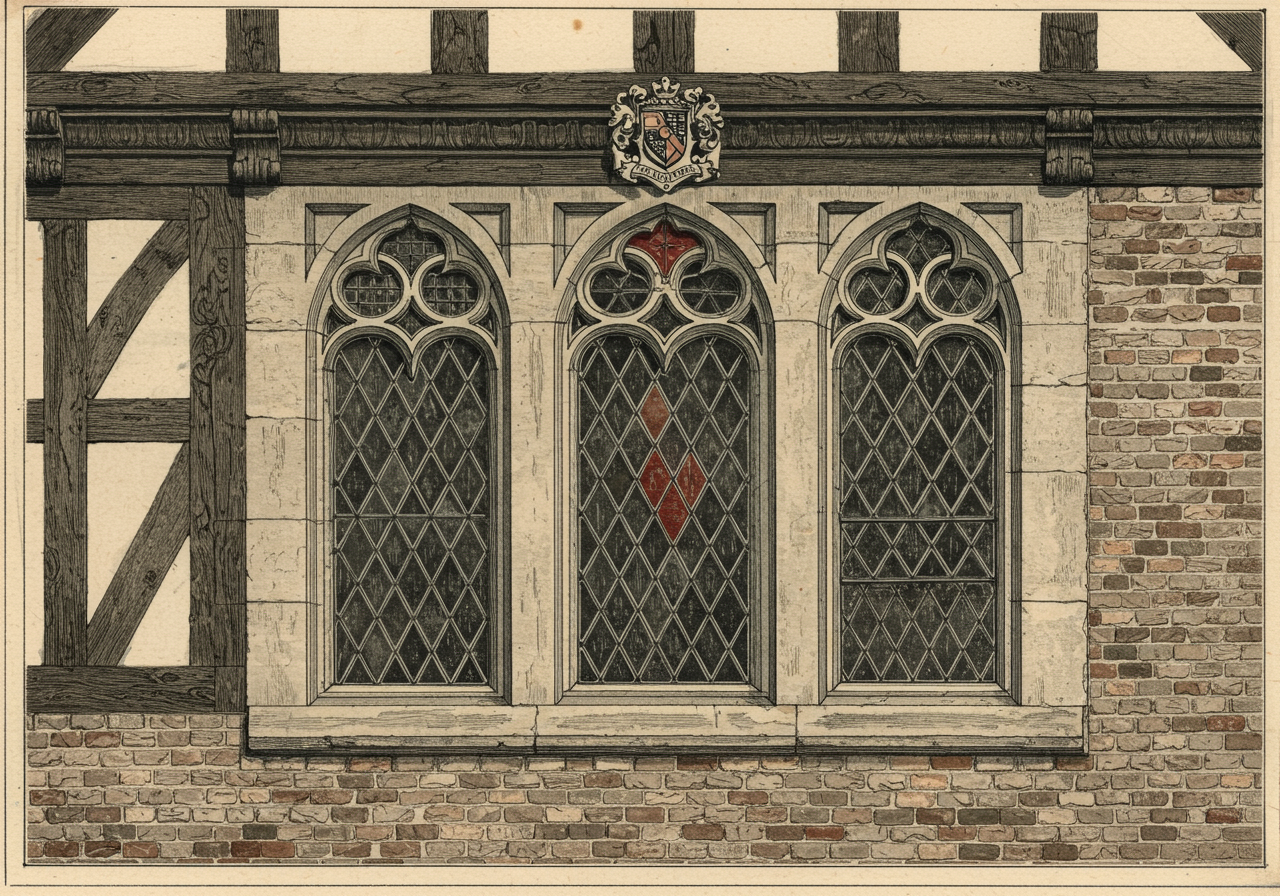
A bay of mullioned casement windows on a Tudor Revival house — three tall narrow casement sashes grouped together, with leaded muntins dividing the glass into small diamond-shaped lights and a small armorial medallion of coloured glass in the upper transom. The casement is the European norm and the historically appropriate window for the period the Revival is quoting; the double-hung sash that dominates the Foursquare and the Colonial Revival is an American innovation that the Tudor Revival deliberately declines. The proportions are tall and narrow, tilting the elevation upward and emphasising the verticality of the gables and chimneys.
Examine the entrance. The Tudor Revival presents its front door under a Tudor-arched or round-arched stone surround, typically without a porch or with only a small projecting hood. The door itself is heavy panelled wood, often oak, sometimes studded with iron nails or fitted with iron strap-hinges to suggest a medieval English original. The arch above is either Tudor (a flattened pointed arch with a low rise) or half-round Norman, and is built up of cut stone voussoirs — sometimes contrasting in colour with the surrounding wall to draw the eye to the entrance as a major elevational feature. There is no transom and sidelights of the Colonial Revival type; there is no full-width porch of the Foursquare type. The door is treated as a single dramatic element set into the wall surface.
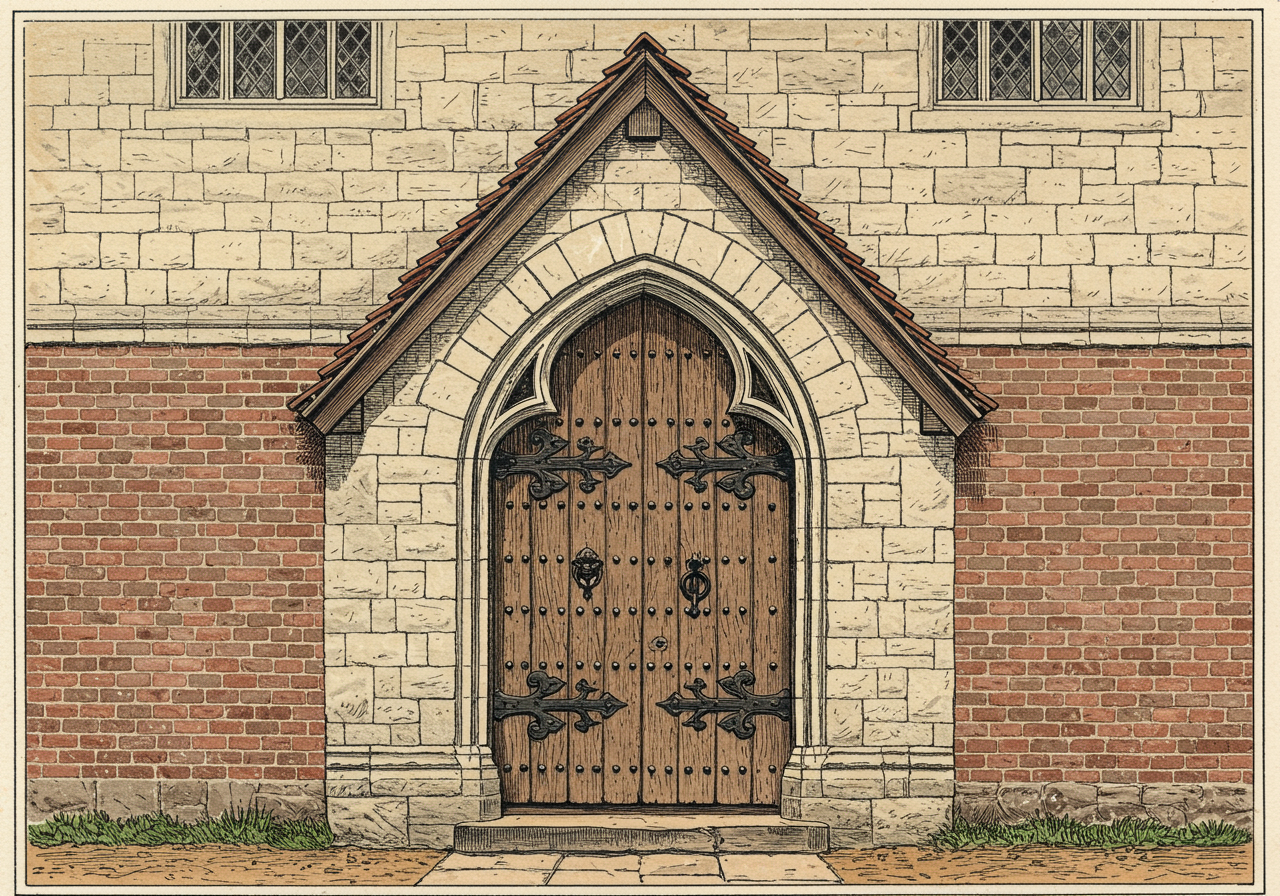
The principal entrance of a Tudor Revival house — a heavy panelled oak door studded with iron nails and fitted with iron strap-hinges, set under a Tudor-arched stone surround of cut voussoirs, with no porch or only a small projecting hood above. The Tudor arch (a flattened pointed arch with a low rise) is the medieval English signature; the alternative is the half-round Norman arch on the more conservative specimens. The contrast between the cut-stone surround and the surrounding brick or stucco wall draws the eye to the entrance as a major elevational feature, in pointed contrast to the Foursquare’s quiet symmetric entrance and the Colonial Revival’s pedimented portico.
Examine the wall composition as a whole. A Tudor Revival house is asymmetric. The entry is off-centre. The gables are at different sizes and positions. The chimney rises from one side or one front corner rather than from the centre. The window groupings are clustered for picturesque effect rather than spaced symmetrically. Each of the principal architectural events — the entry, the dominant gable, the chimney, the principal window group — occupies a particular bay of the elevation and is composed in relation to the others by the architect’s eye rather than by any modular symmetric rule. This is the picturesque mode, in pointed and deliberate contrast to both the Foursquare’s residual symmetry and the Colonial Revival’s deliberate symmetry.
Look at the wall materials in combination. The typical Tudor Revival mixes at least two and often three or four wall materials across the principal facade — brick on the lower storey, half-timbered stucco on the upper, stone surrounds at the entry and at significant windows, perhaps a small section of decorative patterned brickwork at a chimney or a cornice. The materials are mixed deliberately and signal the picturesque composition that the elevation as a whole is making. A Foursquare carries one wall material across the whole facade; a Colonial Revival similarly. A Tudor Revival deliberately combines.
Assemble these — the steep multiple cross-gables, the massive masonry chimney on the principal facade, the brick lower with half-timbered upper, the mullioned casement windows in tall narrow bands, the Tudor-arched stone entry, the asymmetric picturesque composition, and the mixed wall materials — and one has a Tudor Revival. The variations within the type are considerable, ranging from the modest suburban cottage of perhaps fifteen hundred square feet on a small lot to the substantial country-club mansion of eight thousand square feet on three acres, but the principal moves do not vary.
The Country-Club Suburb
The historical arc of the Tudor Revival in America is the story of a particular kind of suburb that existed for roughly forty years between 1900 and 1940 and that produced, in those forty years, the upper-middle and upper residential architecture of the inter-war American city.
The roots of the style are English. The English Tudor and Jacobean architecture of the late fifteenth, sixteenth, and early seventeenth centuries — the half-timbered manor houses, the great country houses of the Elizabethan court, the smaller manor houses of the gentry — was the source the American Revival was quoting, and the body of surviving English work (Hampton Court, Hatfield House, Hardwick Hall, Knole, the smaller manor houses of the Cotswolds and the Welsh Marches and Cheshire and Kent) was the visual library from which the American architects were drawing. None of these buildings was in any meaningful sense a model for an American suburban house; the English originals were vastly larger, of genuine antiquity, and built into landscapes and social systems no American suburb could reproduce. But the visual vocabulary — the half-timbering, the steep gables, the great chimneys, the mullioned windows, the Tudor arches — could be detached from its original context and reassembled in a new register, and that detachment-and-reassembly was precisely the architectural project the Revival undertook.
The American intermediary was the late-nineteenth-century English domestic revival, which in turn drew on the same Tudor and Jacobean sources. The work of Richard Norman Shaw, Philip Webb, William Morris’s Red House, the smaller country houses of the English Arts and Crafts movement of the 1870s and 1880s — these buildings reinterpreted the Tudor and Jacobean vocabulary in a more domestic, more middle-class register that was both more imitable and more obviously suited to the suburban lot. American architects of the 1880s and 1890s — Henry Hobson Richardson, Stanford White, Charles Platt, McKim Mead and White in their less formal commissions — adopted the Norman Shaw vocabulary first for upper-class country houses (Newport, the Hudson Valley, the North Shore of Long Island) and from that base it descended into the suburban Tudor Revival of the early twentieth century.
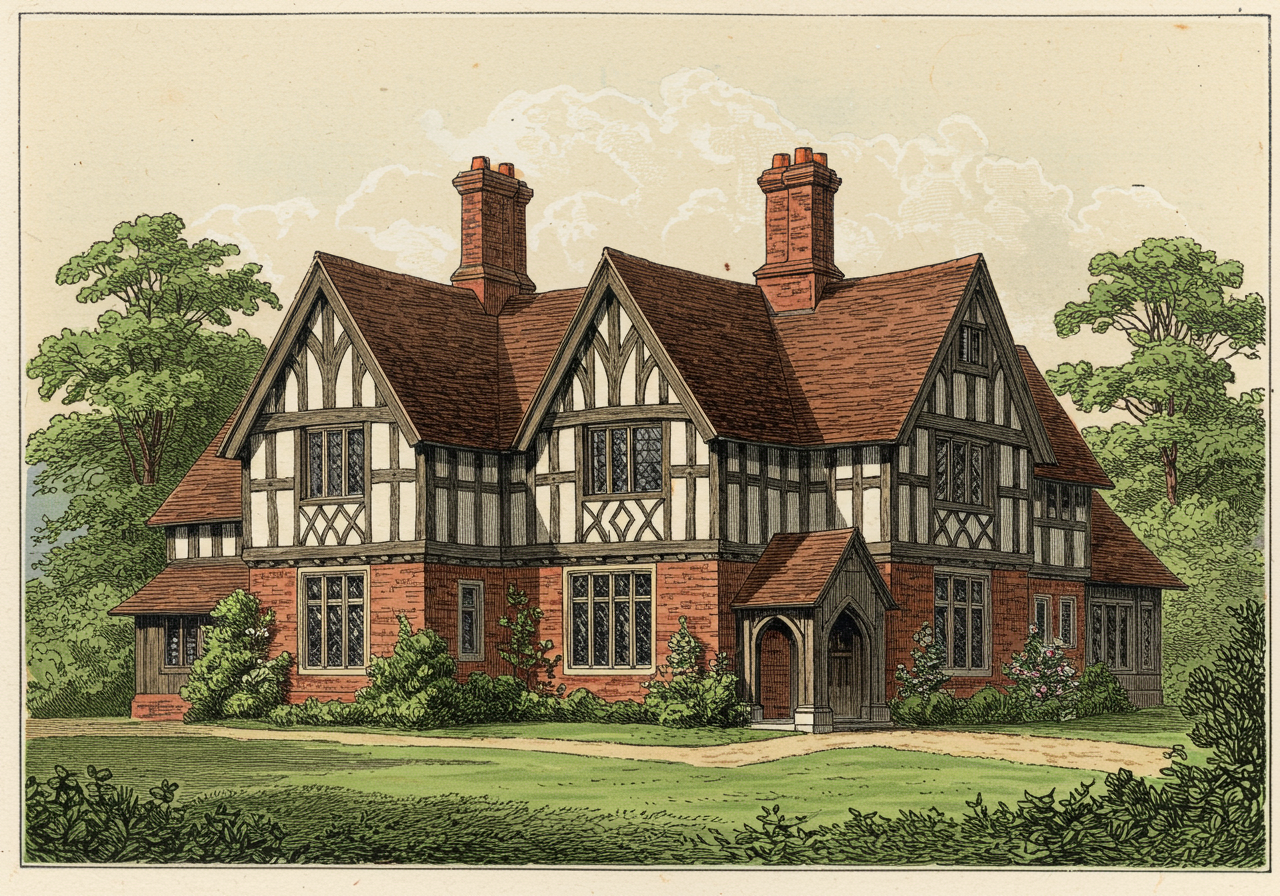
A late-nineteenth-century English country house in the Norman Shaw manner — half-timbered upper storey above a brick lower, steep cross-gables, massive chimneys, mullioned casement windows. The English domestic revival of the 1870s and 1880s was the American Tudor Revival’s immediate antecedent; the buildings of Norman Shaw and his contemporaries reinterpreted the sixteenth-century Tudor vocabulary in a more domestic register that was suited to suburban lots and middle-class budgets. American architects of the 1880s and 1890s — Henry Hobson Richardson, Stanford White, Charles Platt — adopted the Norman Shaw vocabulary first for upper-class country houses on the Hudson, in Newport, on the North Shore; from that base it descended into the suburban Tudor Revival of the inter-war period.
The suburban Tudor Revival as a mass phenomenon is the product of the period 1915–1935, and it is a product of a particular kind of suburb. The country-club neighbourhood — a large planned residential development organised around (or near) a private country club, with curving streets, generous lots, mature trees, and architectural review boards — emerged across the American metropolitan periphery in the first two decades of the twentieth century. Examples include Shaker Heights and the Van Sweringen brothers’ developments outside Cleveland, Roland Park and Guilford in Baltimore, the Country Club District in Kansas City (J.C. Nichols’s pioneering planned suburb), Bronxville and Scarsdale in Westchester, Lake Forest and Kenilworth on Chicago’s North Shore, Beverly Hills in early Los Angeles, the older parts of Bronxville and the Tuxedo Park development in New York. These developments were marketed to a particular class of buyer — the lawyer, the doctor, the senior banker, the partner in a brokerage, the executive of a manufacturing concern — and they sold on an explicit promise of social distinction and architectural quality.
The Tudor Revival was, by the testimony of the architectural press of the period and the surviving stock of the developments themselves, the dominant style of these neighbourhoods through the 1920s. The reasons are bound up with the social aspirations the country-club suburb was designed to serve. The Anglo-American identification — the desire of the upwardly-mobile American professional class to claim Anglo-Saxon heritage at a moment of mass immigration from southern and eastern Europe — found its architectural expression in a house that quoted English antiquity, and the half-timbered Tudor Revival was a more obvious quotation than the comparatively quiet Colonial Revival. The country-house ideal — the suburban house as a miniature country estate, with its own grounds, its own chimney smoke, its own gabled silhouette across the lawn — was more obviously available in the picturesque massing of a Tudor Revival than in the regular box of a Colonial Revival or the plain cube of a Foursquare. And the architect’s commission, paid for by a buyer who had the resources to pay an architect rather than to order from a catalogue, was the means of production: a Tudor Revival was almost always architect-designed, even when the architect was the local-firm partner working from a generic vocabulary, where a Foursquare was almost always catalogue-or-builder-designed.
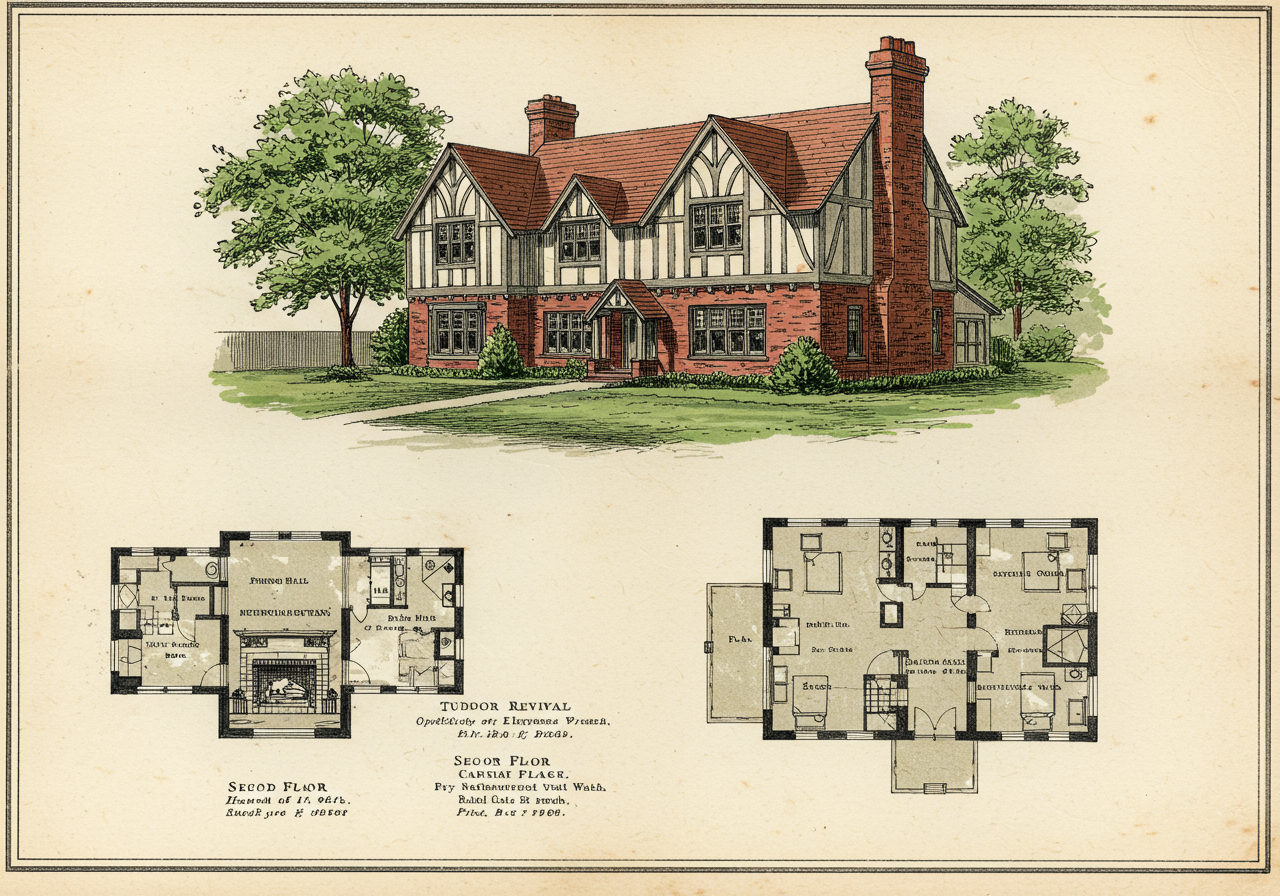
A page from a 1920s suburban architects’ pattern book showing a Tudor Revival house — perspective rendering, principal-floor plan, second-floor plan, and brief specifications for a substantial suburban commission. The pattern book was the working tool of the local architect’s firm: it provided the architect with a stock vocabulary of plans and elevations from which to compose a particular commission, and it provided the buyer with a visual catalogue of the firm’s competence. Books such as Charles M. Hart’s House Plans for Everybody and H. Vandervoort Walsh’s The Construction of the Small House circulated widely among the country-club-suburb architects of the 1920s; the Tudor Revival vocabulary they codified is what built the great majority of the suburban Tudor stock that survives today.
The mature period of the American Tudor Revival ran from roughly 1920 to 1935. In that span the style was the dominant new-construction shape on every country-club suburb of any consequence, in every American metropolitan area large enough to support one. By 1928 a typical block of new construction in such a suburb would have been seventy or eighty per cent Tudor Revival, with the remaining houses divided among Colonial Revival, Spanish Colonial Revival (in the West and South), Mediterranean (similarly), and the occasional Cotswold cottage or Jacobean variant. The form’s dominance was complete in its market segment, even as the broader American residential market continued to be dominated, by sheer volume, by the catalogue Foursquare and the Craftsman bungalow. The Tudor Revival was the upper-middle commission; the Foursquare and the bungalow were the middle and working class.
The end came in two stages. The first was the Depression, which after 1929 reduced the volume of upper-middle suburban commissions by something on the order of three-quarters and removed from the market the buyer class on which the Tudor Revival had depended. New construction in the country-club suburbs declined sharply through the 1930s, and what new construction did proceed shifted partly toward smaller and less-elaborate houses (the Tudor cottage rather than the Tudor mansion) and partly toward the more economical Colonial Revival, which used a single wall material and a regular framing scheme and was correspondingly cheaper to build. The second was the war, which ended new residential construction across virtually all of the American market for four years, and the post-war period that followed, in which the Levittown ranch and its descendants displaced the architect-designed historicist house from the suburban market entirely. By 1948 a new Tudor Revival was a rare commission; by 1955 it was almost extinct as a current style, surviving only as the existing stock that the country-club suburbs of the 1920s had built.
The American Tudor Revival’s total production, summed across all the country-club suburbs of all the American metropolitan areas, is somewhere on the order of a hundred thousand houses across the period 1900 to 1940 — far fewer than the Foursquare’s million-and-a-half, but produced at a much higher per-unit value and concentrated in particular kinds of neighbourhoods that survived (in most cases) intact through the post-war suburbanisation. The Tudor Revival housing stock is therefore disproportionately visible to anyone who walks the older suburbs of any American city, and disproportionately treasured by the second-and-third-generation owners who maintain the houses today.
What It Is Not
Four styles stand near enough to the Tudor Revival that the beginner confuses them with it, and distinguishing them is most of the work of reading the inter-war American suburban street at the upper end of the market.
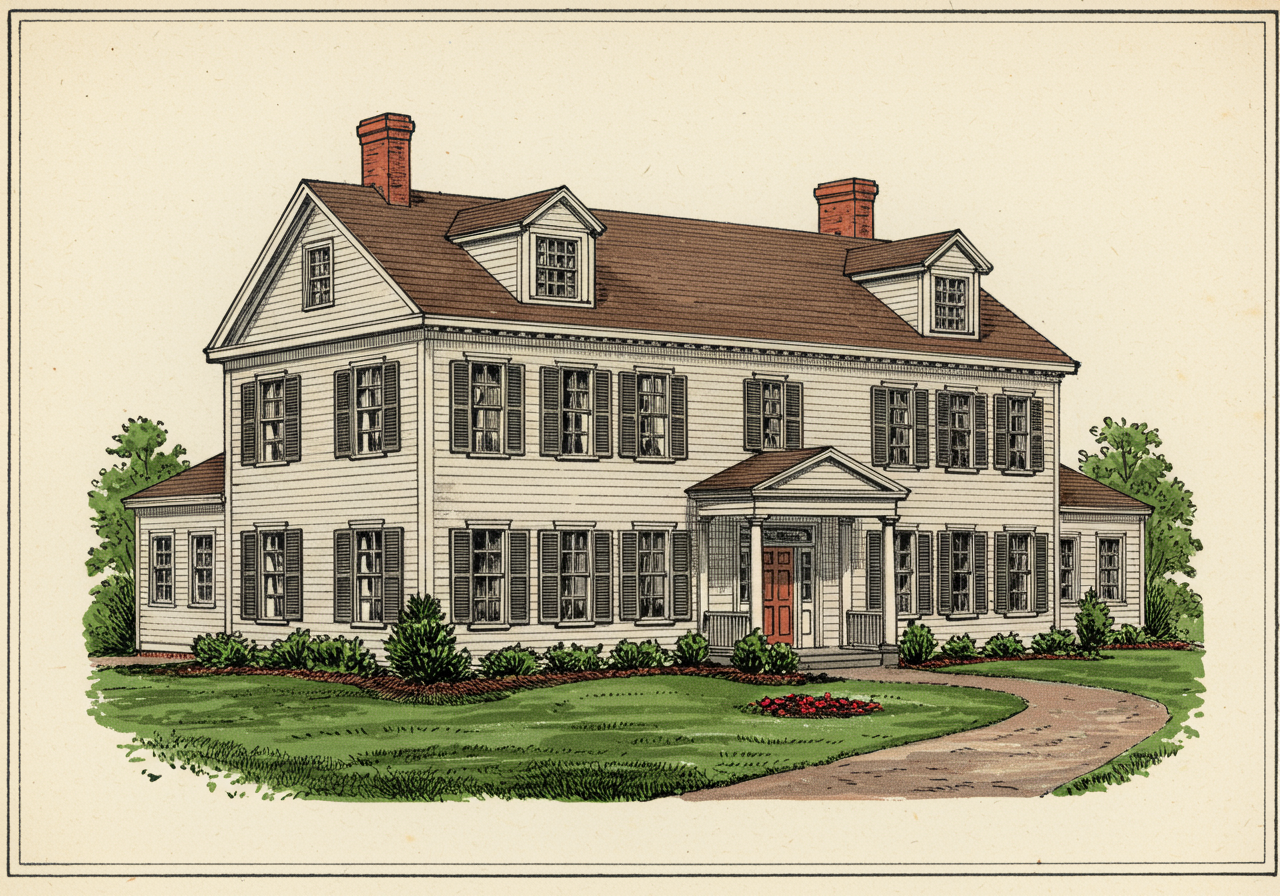
The Colonial Revival — examined three posts ago and the Tudor Revival’s principal competitor on the upper-middle suburban lot — argued for the American historicism of an Anglo-Georgian colonial past, where the Tudor Revival argued for the English historicism of a Tudor and Jacobean past one further removed. The two styles competed directly for the same buyer and often appeared on the same block in the same year — a developer’s tract of new construction in 1925 would commonly carry Colonial Revivals and Tudor Revivals on adjacent lots, with the buyer’s choice between them being as much a matter of personal aesthetic temperament as of any decisive architectural argument. The visual distinctions are clean: a Colonial Revival is symmetric, regular, white-painted clapboard or red brick with white trim, with a pedimented portico over the central entrance and double-hung sashes in regular bays; a Tudor Revival is asymmetric, picturesque, half-timbered or brick-and-stucco, with an arched stone entrance and mullioned casements in tall narrow groups. The rule of thumb: symmetry and white paint is Colonial Revival; asymmetry and half-timbering is Tudor Revival.
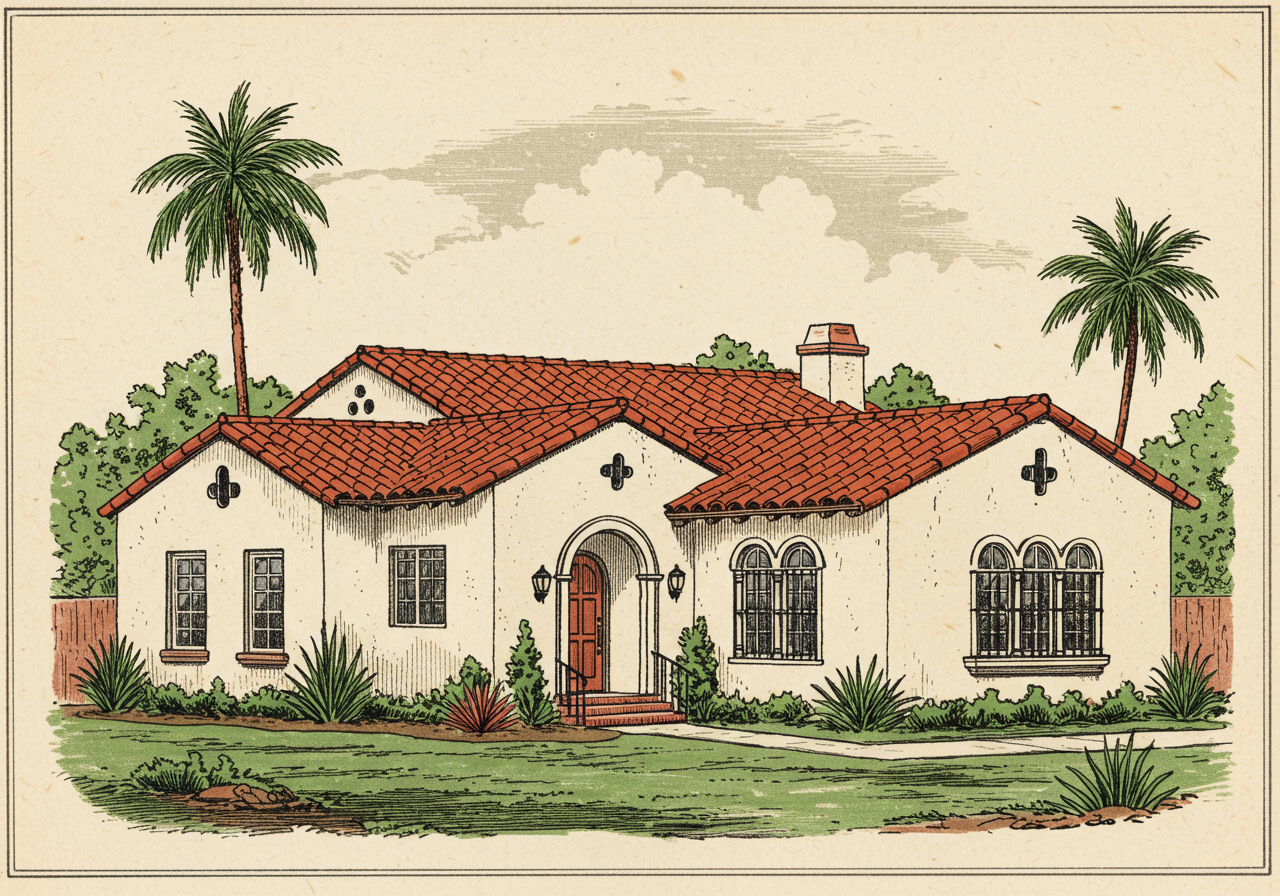
The Spanish Colonial Revival — the Mediterranean alternative that flourished in the same inter-war suburban market in California, Florida, the Southwest, and (less commonly) in the warmer parts of the East — argued for a Mediterranean historicism of Spanish and Italian and southern French sources, where the Tudor Revival argued for a Northern European historicism. The two styles were geographically partly complementary — the Spanish Colonial dominant in the West and South, the Tudor Revival dominant in the Northeast and Midwest — but they overlapped in particular markets (Beverly Hills, Coral Gables, the better neighbourhoods of Houston and Phoenix and Atlanta) where the buyer chose between an English aspiration and a Mediterranean one. The visual distinctions are immediate: a Spanish Colonial Revival has stucco walls, a low-pitched red-tile roof, round-arched arcades and openings, an open courtyard, and minimal eaves; a Tudor Revival has half-timbered walls, steep slate roofs, Tudor-arched openings, and no courtyard. Both are picturesque and asymmetric; the difference is the climate they quote.
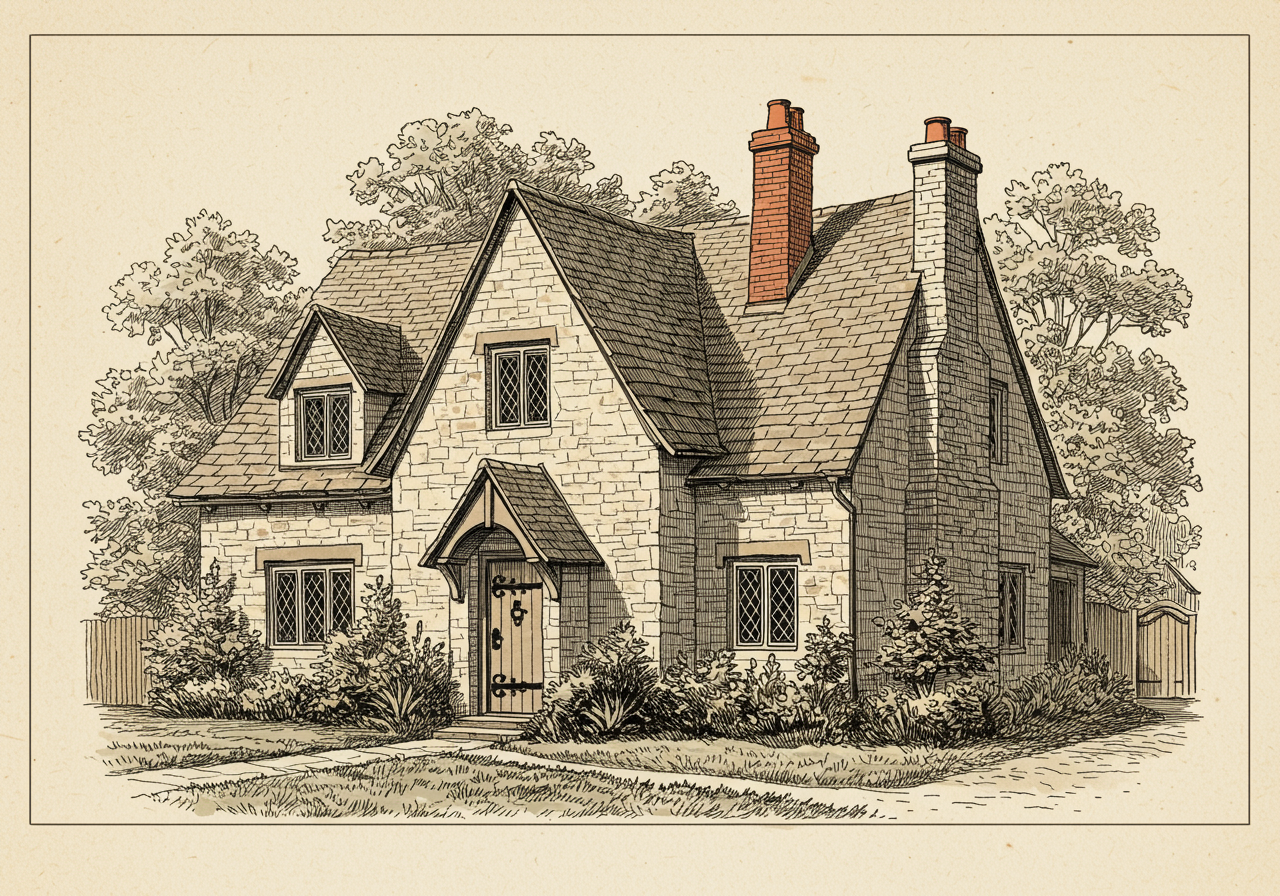
The Cotswold cottage — also called the Storybook style — is a smaller, more whimsical variant of the Tudor Revival that flourished in the same period (1920s and 1930s) and the same suburbs but at a smaller scale and a more romantic register. The Cotswold cottage is single-storey or storey-and-a-half, with a rolled-eave roof that simulates the thatch of an English cottage, asymmetric massing in deliberately picturesque composition, low doors under steep gables, stone walls (often with the deliberately irregular coursing called Cotswold stone), and decorative details (false clipped-eave gables, deliberately wavy eaves, inset stained-glass windows) that push the picturesque toward the storybook. A substantial Tudor Revival is an architect-designed quotation of an Elizabethan manor house; a Cotswold cottage is an architect-designed quotation of a Cotswold village rural cottage. The two share much vocabulary but differ at the silhouette and the scale. The rule of thumb: rolled-eave thatch-simulating roof and single-storey scale is Cotswold; multi-storey gabled with slate or tile is Tudor Revival proper.
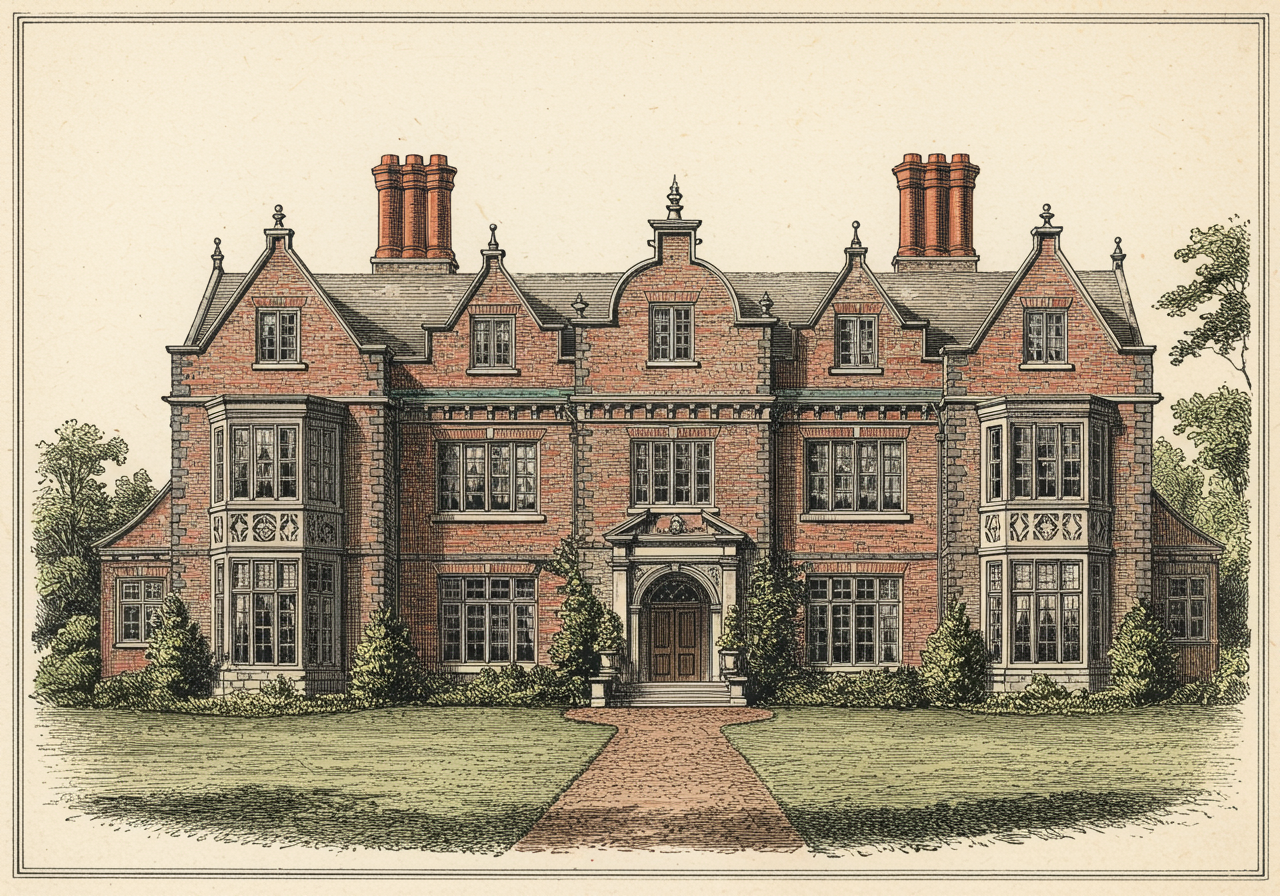
The Jacobean Revival is a more formal variant of the Tudor Revival drawing specifically on the early-seventeenth-century English Jacobean architecture (the period roughly 1603–1625, between the Tudor proper and the Restoration). Jacobean Revival is symmetric rather than asymmetric, uses flat shaped gables (often of a Dutch-influenced ogee or stepped profile rather than the steep triangular Tudor gable), and frequently incorporates mullioned bay windows projecting from the principal facade. The brick-and-stone vocabulary is similar to the Tudor Revival, but the composition is regular and formal — the Jacobean Revival reads as the upper-class formal cousin of the more picturesque Tudor Revival proper. It was used most often for institutional buildings (university dormitories, country-club clubhouses, prep-school halls) and for the very largest country-club-suburb commissions, and is comparatively rare in the more typical upper-middle suburban stock. The rule of thumb: symmetric facade with flat shaped gables is Jacobean Revival; asymmetric facade with steep triangular gables is Tudor Revival proper.
These are the four most-confused-with styles. There are others — the French Norman (which uses a conical-roofed tower and is more rural-French in feel), the Châteauesque (which is bigger, more castle-like, and quotes the Loire valley rather than rural England), the various English Arts and Crafts variants — but the four above account for the great majority of misattributions one will encounter in the wild.
What It Was Trying to Say
The Tudor Revival flourished in the American suburb for forty years — its peak running from about 1920 to 1935 — and produced, in that span, the upper-middle and upper-class residential architecture of the inter-war American metropolitan periphery. The cultural temper that supported it was the particular Anglo-American aspiration of the period — a desire on the part of the upwardly-mobile professional class to claim, through the architecture of their houses, a connection to an English antiquity to which they had no actual lineage and a country-house tradition in which they had no actual stake.
What the style was trying to say is best taken as the sum of three arguments running in parallel. The arguments are explicit in a way that the Foursquare’s were not, because the Tudor Revival had architects writing about it in the period (in the Architectural Record, in House Beautiful, in Country Life in America, in the various pattern-book introductions of the 1920s) and the explicit arguments were available for inspection.
The first argument is the historicist quotation argument. The Tudor Revival explicitly quoted an English architectural past, and made of that quotation the principal aesthetic move of the house. The half-timbering quoted Elizabethan manor houses; the great chimneys quoted Hampton Court; the Tudor arches quoted the medieval English entrance; the casement windows quoted the European pre-double-hung-sash window. None of this was hidden or unspoken; the architects were explicit that they were quoting, and the buyers understood themselves to be purchasing a quotation. The argument was that the modern American house should look back to a particular pre-modern moment of Anglo-Saxon residential architecture — not to the modern Anglo-American Colonial Revival, but further back, to the pre-Colonial period when English architecture was, by the Tudor Revival’s account, at its most authentic and most rooted. This was the explicit argument, made repeatedly in the period press, and it served the buyer’s identification with an English-rooted Anglo-Saxon civilisation that the period was, by the period’s own self-understanding, anxious to assert.
The second argument is the picturesque composition argument. The Tudor Revival deliberately rejected the symmetric and regular composition that had dominated American residential architecture from the Colonial Revival onward, and substituted in its place the asymmetric and picturesque composition characteristic of English Arts and Crafts and earlier English vernacular work. The argument was that a house should be composed by an architect’s eye, with each elevational element placed in pictorial relation to the others, rather than by a modular geometric rule. The result was a composition that read as inhabited and historically grown rather than as designed-to-a-formula, and it gave the Tudor Revival a particular kind of visual character — looking at a Tudor Revival house, one had the sense of looking at something that had accumulated over centuries rather than at something that had been built in a season. This was, of course, an illusion; the houses were built in months from architects’ drawings on cleared suburban lots, and their picturesque composition was a stylistic move rather than a record of accumulation. But the picturesque effect was the move, and the move was what the buyer was paying for.
The third argument is the country-house aspiration argument, and it is the one that explains why the Tudor Revival flourished in the country-club suburb particularly and not elsewhere. The Tudor Revival presented its house as a miniature English country house — a manor at a domestic scale, with its own grounds (the suburban lawn standing in for the country estate’s fields), its own chimney smoke (the great masonry chimney standing in for the Elizabethan kitchen hearth), its own gabled silhouette across the lawn (the suburban house standing in for the English manor across its park), and its own architect-designed character (the architect’s commission standing in for the centuries of accretion that had produced the original English manor). The buyer of a Tudor Revival house was, in the social register the country-club suburb was designed to serve, performing a particular kind of arrival: he was claiming, through his house, a connection to a tradition of English landed gentry to which he had no actual lineage, and he was doing so through an architectural quotation that the architects of the period had made available specifically for that purpose. The country-club suburb, with its private golf course, its tennis courts, its riding stable, its restricted social membership, and its architecturally-controlled streets of half-timbered houses with cut-stone Tudor entrances, was the social and physical infrastructure that made this aspiration available. The Tudor Revival was its principal architectural expression.
What I find most telling about the Tudor Revival, taking these three arguments together, is the precise explicitness of the historicist quotation. The architects of the period made no pretence that their houses were anything other than quotations; the buyers understood the houses as quotations; the architectural press treated the houses as quotations; the entire transaction was conducted in full awareness that what was being purchased was a quotation of an English past for application to an American present. This is, in some sense, the cleanest possible historicist position — far more honest than the later post-war suburban builder houses that quoted the same Tudor vocabulary without acknowledging the quotation, and arguably more honest than the contemporary Colonial Revival that presented its quotation of the colonial past as a continuity rather than a quotation. The Tudor Revival knew what it was doing and said so. The buyer knew what he was buying and bought it for that reason. The architectural transaction was, in that limited sense, fully transparent, and the resulting architectural stock — which still constitutes the dominant residential character of the surviving country-club suburbs of the 1920s — is a record of a particular American aspiration of a particular American moment, made architecturally explicit and built in brick and stone and decorative timber across the metropolitan periphery of every American city large enough to support one.
This is, on inspection, a very particular American thing to have done with the suburban architecture of the inter-war period: to have built, in tens of thousands of substantial houses, the architectural quotation of an English past one did not have, on a country-club suburb infrastructure that was itself a quotation of an English country-life one had never lived, and to have done so in a register that was self-aware enough to acknowledge the quotation and self-confident enough not to apologise for it. The Tudor Revival’s silence in the post-war architectural conversation was not the silence of a forgotten style — it was the silence of a style whose social moment had passed and whose architectural assumptions (that historicist quotation was a legitimate architectural project) had been displaced by a modernist consensus that thought such quotation embarrassing. The houses themselves remain, and the country-club suburbs remain, and they constitute the surviving record of the moment when the upwardly-mobile American professional class, between the wars, decided that the house it most wanted to live in was an English manor in miniature on a suburban lot.
The next specimen I should like to take up is the Spanish Colonial Revival — the Mediterranean alternative that flourished in the same inter-war suburban market on the West Coast and in the South, and which made a parallel historicist argument for a different national past. Where the Tudor Revival quoted England, the Spanish Colonial Revival quoted Mexico, California’s own Spanish past, and through it the broader Mediterranean tradition of stucco-and-tile architecture; the two styles together constitute the principal historicist arguments of the inter-war American suburb, and reading them in succession illuminates the cultural geography of that suburb in a way neither alone can manage.